Primatology - life history + reproducing
Study these flashcardsFree · spaced repetition · iPhone, Android, Mac & web
All cards
1
Why is there a large period of time after reproduction ability in humans?
Menopause
Short reproduction intervals
Grandmothers can help raise grandchildren
Short reproduction intervals
Grandmothers can help raise grandchildren
2
Describe the characteristics of primate life history
Late maturation ----> long juvenile period ----> long maternal investment
Slow reproduction (average interbirth interval 2.3 years)
Limits no. of offspring (normally just one at a time - max. 2 in Callitrichids)
Low adult mortality, long reproductive career
Long life span
Females live longer than males (more equal in cooperative species)
Slow reproduction (average interbirth interval 2.3 years)
Limits no. of offspring (normally just one at a time - max. 2 in Callitrichids)
Low adult mortality, long reproductive career
Long life span
Females live longer than males (more equal in cooperative species)
3
Define sexual selection
Selective process acting on behaviour and traits that maximise reproduction
Trade-off between natural selection and sexual selection adaptive value of traits
Trade-off between natural selection and sexual selection adaptive value of traits
4
2 types of sexual selection
Intrasexual selection
Intersexual selection
Intersexual selection
5
Describe intrasexual selection
Intimidating, deterring or defeating same sex rivals
6
Describe intersexual selection
Making themselves attractive to the opposite sex (mate choice)
Opposite sex reproductive strategies differ and compete (creates sexual conflict)
Opposite sex reproductive strategies differ and compete (creates sexual conflict)
7
Advantages to using any reproductive strategy
Maximises lifetime reproductive success
8
Why is there lots of competition in sexual selection?
Males ready to mate most of the time
Females constrained by physiology (limited no. of receptive females)
Females constrained by physiology (limited no. of receptive females)
9
Types of competition in sexual selection
Male-male competition
Mate choice - females choose among potential mates
Mate choice - females choose among potential mates
10
What is sexual dimorphism?
Variation in the size of physical traits between males and females
11
Male characteristics as a result of male-male competition
Sexual dimorphism:
- Larger body size
- Physical weaponry
- Vocal apparatus
- Secondary sexual characters (male orangutans have flanges - developed during maturation)
- Larger body size
- Physical weaponry
- Vocal apparatus
- Secondary sexual characters (male orangutans have flanges - developed during maturation)
12
Describe the kind of mating system where sexual dimorphism is more common
Higher sexual dimorphism in mating systems with one single reproductive male
Harem
Plavcan 2012
Harem
Plavcan 2012
13
Example of male-male sexual competition
Sperm competition - reflected in size of testes
Chimpanzees in multi male groups - above allomatric scale
Gorillas below
High sperm competition in multi-male societies
Harcourt et al 1995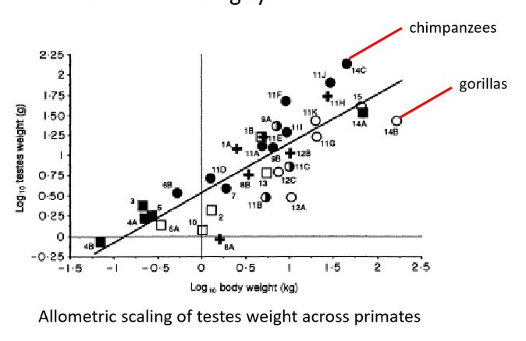
Chimpanzees in multi male groups - above allomatric scale
Gorillas below
High sperm competition in multi-male societies
Harcourt et al 1995
14
What does mate choice depend on?
Attractiveness of certain traits (resource holding potention (RHP) = capacity to provide protection, parental care, resources, provide good genes (refelcted by good health))
RHP often given by honest signals by males
RHP often given by honest signals by males
15
What are honest signals?
Characteristics in males that display their good genes, good health/condition, therefore high potential for resource holding
16
How are honest signals displayed?
Colourful ornaments
17
Evidence for honest signals in primates
Brightly coloured Mandrill males get more copulations - increased chances to sire
Females approach more brightly coloured males
Females present more to brightly coloured males
Setchell 2006
Females approach more brightly coloured males
Females present more to brightly coloured males
Setchell 2006
18
Define sexual conflicts
Males and females prefer different reproductive strategies to reach optimal fitness
Conflicting optimal fitness strategies concerning reproduction
Evolutionary arm race between males and females
Conflicting optimal fitness strategies concerning reproduction
Evolutionary arm race between males and females
19
Examples of reproductive strategies to maximise energy costs
Male reproduction is cheap (invest in numerous gamete with no energetic reserves - ready to mate most of the time)
Females reproduction is costly: invest in few gametes with high energetic reserves, invest
in costly maternal investment (gestation, lactation, maternal care - constrained by energetic needs to store reserves)
Females reproduction is costly: invest in few gametes with high energetic reserves, invest
in costly maternal investment (gestation, lactation, maternal care - constrained by energetic needs to store reserves)
20
Why is female reproduction costly?
eggs, gestation, lactation, maternal care
-> reproductive mistakes are costly
-> females are choosy – mate choice
-> males are limited by access to females
-> reproductive mistakes are costly
-> females are choosy – mate choice
-> males are limited by access to females
21
What factors limit the number of offspring that male and female primates can produce?
Reproductive strategies implicate on space use
Females: high investment in offpsring (gestation, lactation, maternal care)
Limited by the access to resources (food)
Males: low investment in offpsring
Limited by the access to females
Search for more matings
Females: high investment in offpsring (gestation, lactation, maternal care)
Limited by the access to resources (food)
Males: low investment in offpsring
Limited by the access to females
Search for more matings
22
Outline the female reproductive strategies involved in intersexual selection
Dominance hierarchies
Intrasexual competition for resources
Intrasexual competition for resources
23
Define reproductive success
Number of offspring they can produce
24
How do females maximise reproductive success despite limited access to resources?
-> compete among females for better resources (shorter inter-birth interval, higher survival, better offspring survival, better health)
-> monopolize resources (keep/take greatest share of)
-> dominance hierarchies
-> matrilines
-> monopolize resources (keep/take greatest share of)
-> dominance hierarchies
-> matrilines
25
Advantages of high female rank in dominance hierarchies
Indirect fitness advantage: access to food resources
Direct fitness advantages: survival (higher rank = survive longer)
Faster reproduction (shorter inter-birth intervals) with higher rank
Reproductive success: high variance in reproductive success
Direct fitness advantages: survival (higher rank = survive longer)
Faster reproduction (shorter inter-birth intervals) with higher rank
Reproductive success: high variance in reproductive success
26
Outline the 5 male reproductive strategies involved in intersexual selection
Dominance hierarchies
Coercion
Infanticide
Female defence
Resource defence
Coercion
Infanticide
Female defence
Resource defence
27
Advantages of high male rank in dominance hierarchies
Variance in reproductive success is high
High ranking > low ranking
High reproductive skew in males (high ranking males have most reproductive opportunities)
Top sire each year produced 24% offspring, 71% troop = NO offspring at all
Widdig et al 2004
High ranking > low ranking
High reproductive skew in males (high ranking males have most reproductive opportunities)
Top sire each year produced 24% offspring, 71% troop = NO offspring at all
Widdig et al 2004
28
Define coercion
A form of sexual conflict
Males attempt to bias mating in their favour by:
- harassment
- intimidation (aggression)
- forced matings
Males attempt to bias mating in their favour by:
- harassment
- intimidation (aggression)
- forced matings
29
Affects of coercion
leads to:
-> a higher rate of potentially fertile matings
-> a lower rate for other potential mates
-> costs for the female
Female counterstrategies - Costlier investment from females to counteract coercion
-> a higher rate of potentially fertile matings
-> a lower rate for other potential mates
-> costs for the female
Female counterstrategies - Costlier investment from females to counteract coercion
30
Which primates show the most coercive behaviours?
Old World Males > New World Males in coercive strategies
Clarke, Pradham and van Schaik 2009
Clarke, Pradham and van Schaik 2009
31
Example of female counterstrategies against male coercion
Female coalition in Bonobos against male coercion
Female dominance
"When females formed coalitions, 100% won against target male"
Tokuyama and Furuuichi 2016
Female dominance
"When females formed coalitions, 100% won against target male"
Tokuyama and Furuuichi 2016
32
Potential advantages for infanticidal males
Increased male reproductive success
Hrdy 1977, 1979
Faster reproduction (Species with lactational amenorrhea, short male tenure, resumes female cycle so sexually receptive)
Infants of other males targeted (done by new males, and not with females who they have mated with prior)
High chance of siring new infants in dominant males in one-male groups
Hirawai-Hasegawa 1988
Hrdy 1977, 1979
Faster reproduction (Species with lactational amenorrhea, short male tenure, resumes female cycle so sexually receptive)
Infants of other males targeted (done by new males, and not with females who they have mated with prior)
High chance of siring new infants in dominant males in one-male groups
Hirawai-Hasegawa 1988
33
Example of female counterstrategies to infanticide
Paternity confusion:
-> Promiscuous mating (in multi-male, multi-female social systems)
-> Synchrony of reproductive cycles of all females
-> Zinner et al 1994 found more females synced = reduced probability of males siring offspring
-> Post partum oestrus (time after birth, no post partum oestrus = more lactation)
-> van Schaik and Kappeler 1997 found specied with no oestrus after birth had high infanticide rates
Male-female association (females spend more time with males after birth of infant, and less time after death of infant)
Palombit et al 1997
-> Promiscuous mating (in multi-male, multi-female social systems)
-> Synchrony of reproductive cycles of all females
-> Zinner et al 1994 found more females synced = reduced probability of males siring offspring
-> Post partum oestrus (time after birth, no post partum oestrus = more lactation)
-> van Schaik and Kappeler 1997 found specied with no oestrus after birth had high infanticide rates
Male-female association (females spend more time with males after birth of infant, and less time after death of infant)
Palombit et al 1997
34
Outline female defence
Males directly defend access to one or more females via:
Long term association (monogamous bonds, harems)
Dominance hierarchy (in mixed sex groups, dominant males have priority access, form short-term courtship bonds)
Coercion
Long term association (monogamous bonds, harems)
Dominance hierarchy (in mixed sex groups, dominant males have priority access, form short-term courtship bonds)
Coercion
35
7 types of social systems in primates
Solitary dispersed
Pair bonded
One female multi-male groups
One male groups ("harem")
Multi-male multi-female groups
Fission-fusion communities
Multi-level societies / modular societies
Pair bonded
One female multi-male groups
One male groups ("harem")
Multi-male multi-female groups
Fission-fusion communities
Multi-level societies / modular societies
36
Describe solitary dispersed social system
Forage alone
Social contact via vocal and olfaction (scent marking)
Often nocturnal
Polygynous
Eg. Orang-utans
Social contact via vocal and olfaction (scent marking)
Often nocturnal
Polygynous
Eg. Orang-utans
37
Describe pair-bonded social system
One male, one female
Territorial defence
Monogamous
Extra pair copulations
Parental offspring care
Eg. Hylobatids (gibbons etc.)
Territorial defence
Monogamous
Extra pair copulations
Parental offspring care
Eg. Hylobatids (gibbons etc.)
38
Describe one female multi-male social system
Cooperative breeding
Reproduction of subordinate females suppressed by aggression/pheromonal signals
Polyandrous
Cooperative polyandry
Eg. Multi Male - MarMosets
Reproduction of subordinate females suppressed by aggression/pheromonal signals
Polyandrous
Cooperative polyandry
Eg. Multi Male - MarMosets
39
Describe one-male/harem social systems
Single reproductive adult male defends territory with several females and subordinate males
Exclusive mating access
Polygynous
Bachelor groups
High infanticide risk
Sexual dimorphism
Eg. gorillas
Exclusive mating access
Polygynous
Bachelor groups
High infanticide risk
Sexual dimorphism
Eg. gorillas
40
Describe multi-male multi-female social system
Polygyandrous
Males and females mate with several members
Female philopatry
Matrilines
Exaggerated sexual swellings
Eg. macaques
Males and females mate with several members
Female philopatry
Matrilines
Exaggerated sexual swellings
Eg. macaques
41
Describe fission-fusion community social system
Temporary sub-groupings depending on food conditions
Male philopatry
Female dispersal
Eg. chimpanzees
Male philopatry
Female dispersal
Eg. chimpanzees
42
Describe multi-level society social system
3 levels of social structure:
-> one male units (reproductive unit)
-> bands (ecological unit)
-> troop (temporary aggregations)
Polygynous
Infanticide
Eg. geladas
-> one male units (reproductive unit)
-> bands (ecological unit)
-> troop (temporary aggregations)
Polygynous
Infanticide
Eg. geladas
43
4 different mating systems
Monogamous = 1M, 1F
Polygynous = 1M, 2+F
Polyandrous = 2+M, 1F
Polygynandrous = 2+M, 2+M
Polygynous = 1M, 2+F
Polyandrous = 2+M, 1F
Polygynandrous = 2+M, 2+M
44
What did Soltis et al find and when?
2001
Studied multi-male, multi-female group of Japanese macaques
Found socially dominant males monopolised most female matings
Lower ranking males avoided competition by engagning in secret copulations with females away from other males
Sexual conflict:
Males = mate guarding by high ranking males
Females = mate with several males of varying dominance rank
Studied multi-male, multi-female group of Japanese macaques
Found socially dominant males monopolised most female matings
Lower ranking males avoided competition by engagning in secret copulations with females away from other males
Sexual conflict:
Males = mate guarding by high ranking males
Females = mate with several males of varying dominance rank