HE - evolution of modern humans
Study these flashcardsFree · spaced repetition · iPhone, Android, Mac & web
All cards
1
State the 3 models of human origins
Regional evolution
Replacement
Admixture
(or potentially all happened at the same time)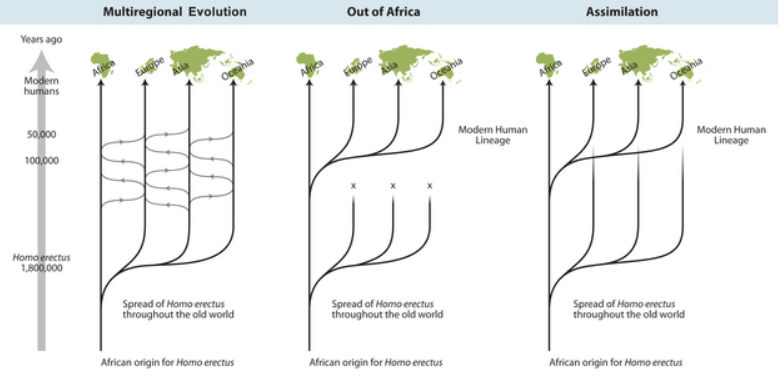
Replacement
Admixture
(or potentially all happened at the same time)
2
What does lithic mean?
Stone
3
What did Thorne and Wolpoff suggest and when?
1992
Continuous anatomic sequence in Asian and Australian hominin fossils might suggest linear evolution of Homo erectus to Homo sapiens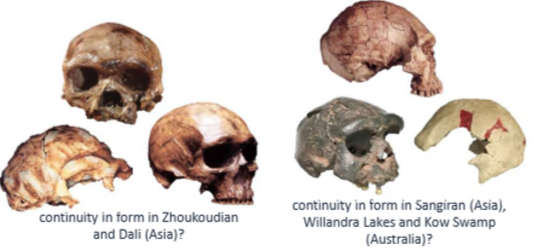
Continuous anatomic sequence in Asian and Australian hominin fossils might suggest linear evolution of Homo erectus to Homo sapiens
4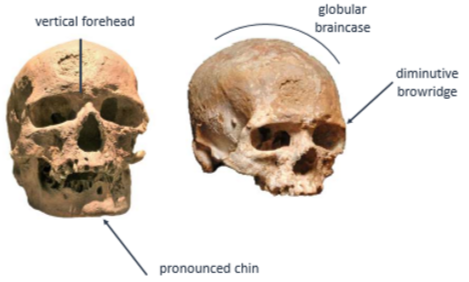
How to identify modern humans (Homo sapiens) according to Lieberman 1998
5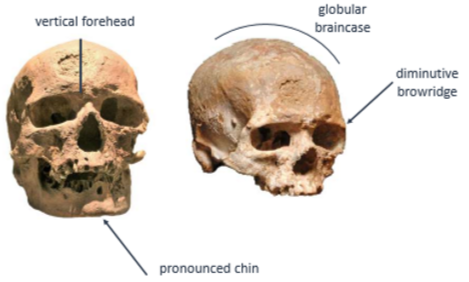
Image occlusion: name the hidden labels
6
3 types of evidence used to interpret modern human origins
Structure of living human variation - allelic diversity decreases with distance from Africa (founder effect), suggests replacement process
Gene flow - modern humans and non-modern humans interbreeding
Geographical pattern - was first appearance of modern humans in Africa?
Gene flow - modern humans and non-modern humans interbreeding
Geographical pattern - was first appearance of modern humans in Africa?
7
What does diversity and gene flow suggest about human origins?
Allelic diversity higher in Africa - suggests location of human origin
Gene flow between different human populations - suggests interbreeding
Gene flow between different human populations - suggests interbreeding
8
Outline where and when the earliest modern human specimens were found
Middle east
East Africa and South Africa
Morocco
Ranging from 300 - 82 kyr
Supports earliest Homo sapien being in Africa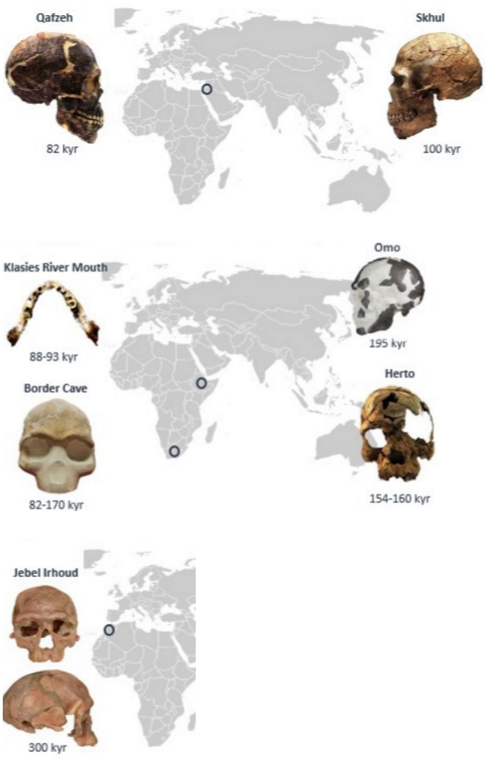
East Africa and South Africa
Morocco
Ranging from 300 - 82 kyr
Supports earliest Homo sapien being in Africa
9
Evidence for coexistence of modern humans and archaic human groups
Different populations potentially existing at same time
Coexistence of Nesher Ramla Homo (archaic hominin) and Homo longi (modern human)
Homo longi might be a sister group of Homo sapiens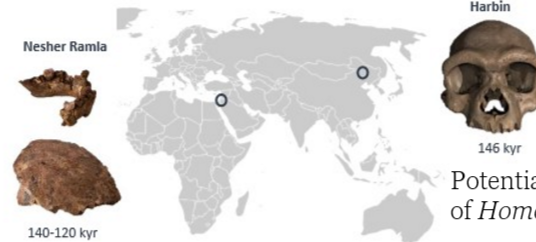
Coexistence of Nesher Ramla Homo (archaic hominin) and Homo longi (modern human)
Homo longi might be a sister group of Homo sapiens
10
Homo sapiens brain shape
Late emergence of globular brain with prolonged maturation
Potential behavioural implications
No globular maturation in early Homo sapiens
Slowly became more globular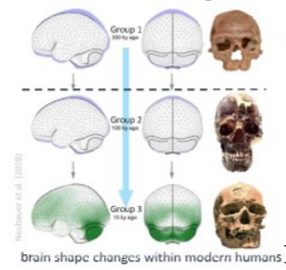
Potential behavioural implications
No globular maturation in early Homo sapiens
Slowly became more globular
11
Potential explanations for Homo sapiens emergence of globular brain
Increased no. of neural connections in brain
Helped to create new behavioural innovations
Helped to create new behavioural innovations
12
Homo sapiens running capabilities
Body proportions and effective dissipation of heat produced to allow for continuous running
Allowed for persistent hunting? - wait until prey is overexhausted
Allowed for persistent hunting? - wait until prey is overexhausted
13
Evidence of Homo sapiens culture in Middle Stone Age/Middle Paleolithic
Cumulative culture
Stone tool technology - flakes, mini handaxes, hafting techniques (artefact attached to handle), elongated picks
Non-lithic material culture - personal ornaments, abstract drawings, engravings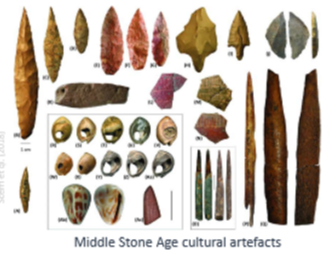
Stone tool technology - flakes, mini handaxes, hafting techniques (artefact attached to handle), elongated picks
Non-lithic material culture - personal ornaments, abstract drawings, engravings
14
Evidence of Homo sapiens culture in Later Stone Age/Upper Paleolithic
Sophisticated technology
Stone tool technology - prismatic blades, geometric microliths (small stone tool)
Non-lithic material culture - bone flutes, cave paintings, carved figurines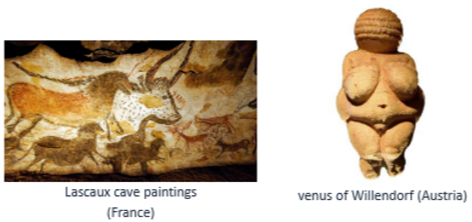
Stone tool technology - prismatic blades, geometric microliths (small stone tool)
Non-lithic material culture - bone flutes, cave paintings, carved figurines
15
What might have occurred at the same time as the emergence of cultural and technical innovation?
Co-occurrence of brain changes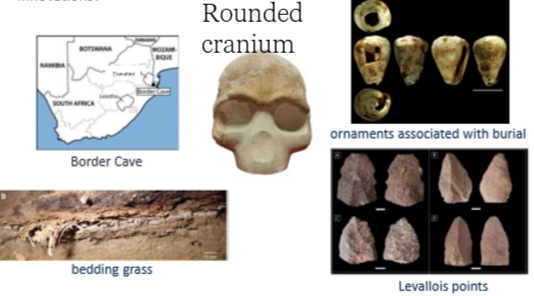
16
State the 5 transitions in modern human evolutionary history
Origins
Expansion 130 - 100 kyr
Dispersals 70 - 50 kyr
Structuring 45 - 25 kyr
Holocene filter 15 - 0 kyr
Expansion 130 - 100 kyr
Dispersals 70 - 50 kyr
Structuring 45 - 25 kyr
Holocene filter 15 - 0 kyr
17
Outline origins (transition in modern human evolutionary history)
o Complex archaeological and fossil record 300-130ka in Africa suggests prolonged phase of repeated expansions and contractions
o Origin of modern human lineage around 200ka
o Evolution of distinct, universal morphological traits of H. sapiens
o Change from archaic to modern morphology in one African lineage
o Don’t know the date of the last African ‘archaic’ or the spatial framework of the disappearance of this population
o Origin of modern human lineage around 200ka
o Evolution of distinct, universal morphological traits of H. sapiens
o Change from archaic to modern morphology in one African lineage
o Don’t know the date of the last African ‘archaic’ or the spatial framework of the disappearance of this population
18
Outline expansion (transition in modern human evolutionary history)
Africa, Western Asia
Environment:
Shift from hyper-glacial to warm conditions allowed for dispersal
Expansion of forests
Period of important behavioural innovations:
First evidence of personal ornaments
Non functional-use of pigments
Carefully chosen plants for bedding
Burials with objects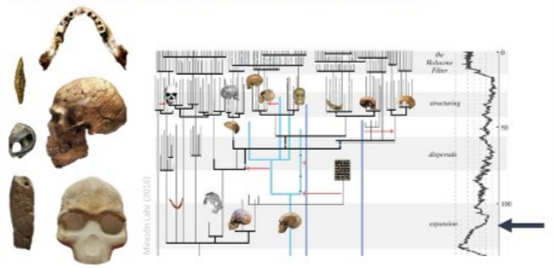
Environment:
Shift from hyper-glacial to warm conditions allowed for dispersal
Expansion of forests
Period of important behavioural innovations:
First evidence of personal ornaments
Non functional-use of pigments
Carefully chosen plants for bedding
Burials with objects
19
Outline dispersals (transition in modern human evolutionary history)
Africa, Eurasia
End of mega-draught
Multiple groups in Africa (regional differentiation) as a consequence of deteriorating climatic conditions
From this population: ancestors of African populations and of modern humans out of Africa in contact with Neanderthals and other hominins like Denisovans
Eurasian dispersal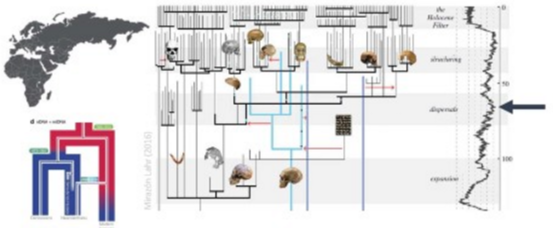
End of mega-draught
Multiple groups in Africa (regional differentiation) as a consequence of deteriorating climatic conditions
From this population: ancestors of African populations and of modern humans out of Africa in contact with Neanderthals and other hominins like Denisovans
Eurasian dispersal
20
Limitation of knowledge about the dispersal period of modern human evolutionary history
- Very poorly represented fossil record of H. sapiens during this period
21
Outline structuring (transition in modern human evolutionary history)
Eurasia, Australia
Last Glacial Maximum (global): refugia (move to refuges - icy/cold so move to better habitats), major tech innovations (oldest pot in China)
First lithic industry accepted as reflecting modern humans
Northern latitudes covered by glaciers and become depopulated
Tropical deserts become hyper arid - reduces land availability and shifts animal distributions
Extremes of cold and aridity led to refugia
Intergroup diversity increases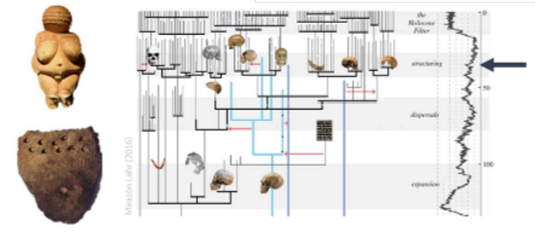
Last Glacial Maximum (global): refugia (move to refuges - icy/cold so move to better habitats), major tech innovations (oldest pot in China)
First lithic industry accepted as reflecting modern humans
Northern latitudes covered by glaciers and become depopulated
Tropical deserts become hyper arid - reduces land availability and shifts animal distributions
Extremes of cold and aridity led to refugia
Intergroup diversity increases
22
Outline Holocene filter (transition in modern human evolutionary history)
Worldwide
Last deglaciation (rising sea level as a result of melting glaciers in Northern Hemisphere): expansion of hunter-gatherers out of refugia across vast spaces created by abrupt climate change, peopling of Americas, agriculture removed unpredictability of hunter-gatherer lifestyles
Forests expanded in Africa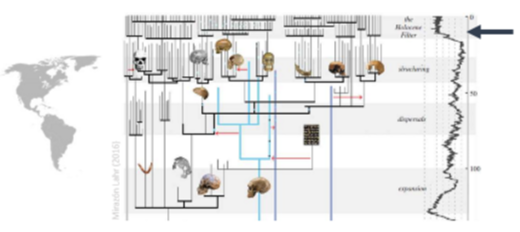
Last deglaciation (rising sea level as a result of melting glaciers in Northern Hemisphere): expansion of hunter-gatherers out of refugia across vast spaces created by abrupt climate change, peopling of Americas, agriculture removed unpredictability of hunter-gatherer lifestyles
Forests expanded in Africa
23
Outline some of the hunter-gatherer strategies employed during the Holocene Filter
Forest animal produce (eg. bee keeping)
Fishing and shell-fishing
Key plant produce
Levels of storage
Fishing and shell-fishing
Key plant produce
Levels of storage
24
State the 3 possible dispersals seen in Homo sapiens
Ealy dispersal at 130 kyr?
Main out-of-Africa event 70 - 60 kyr
Early human dispersal within Americas
Main out-of-Africa event 70 - 60 kyr
Early human dispersal within Americas
25
Outline possible early dispersal before main dispersal event (dispersal pattern of Homo sapiens)
Hominin remains in China (teeth), Sumatra, Australia - 80 - 65 kyr
Unsuccessful dispersal with replacement by Neanderthals in the Levant (eastern Mediterranean shores) and Europe - modern humans travelled through and couldn't survive OR replace by Neanderthals?
Don't know why this expansion wasn't successful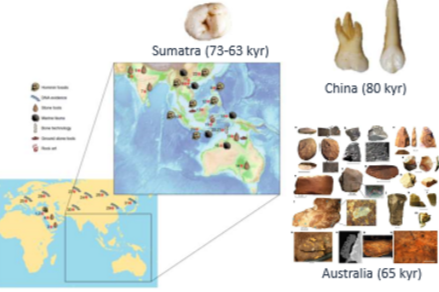
Unsuccessful dispersal with replacement by Neanderthals in the Levant (eastern Mediterranean shores) and Europe - modern humans travelled through and couldn't survive OR replace by Neanderthals?
Don't know why this expansion wasn't successful
26
Outline main out-of-Africa event (dispersal pattern of Homo sapiens)
First wave: into Southeast Asia and Australia via a southern route
Second wave: into Eurasia via a northern route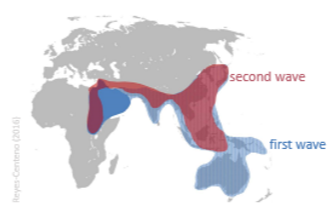
Second wave: into Eurasia via a northern route
27
Outline early human dispersal within Americas (dispersal pattern of Homo sapiens)
Ancestral native Americans diverged from Siberians and East asians ~23 kyr
Mass extinction of North America's megafauna (very large mammals)- more likely climate change than overkill by humans
Modern humans arrived from Africa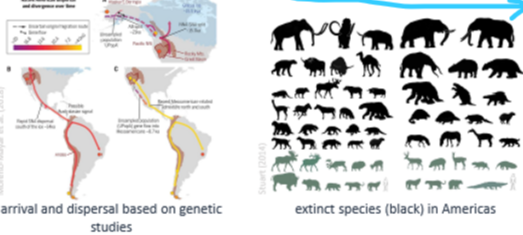
Mass extinction of North America's megafauna (very large mammals)- more likely climate change than overkill by humans
Modern humans arrived from Africa
28
Which human population is the most diverse?
African populations
29
Where are the earlist modern human fossils found?
Ethiopia
30
Evidence for sub-Saharan Africa as place of origin of modern humans
Allelic diversity highest in African populations
Earliest modern human fossil found in Ethiopia
Earliest modern human fossil found in Ethiopia
31
Changes in human diversity were universal
- True
- False
32
Limitation of understanding of modern human dispersals
Limited number of African fossils before and after out-of-Africa dispersals
Ergo, difficult to contrast behaviour of first Eurasian humans and African ancestors / relatives
Ergo, difficult to contrast behaviour of first Eurasian humans and African ancestors / relatives
33
Define human diversity
Sum of unique biological and cultural variation within our species
34
What is a trigger of environmental expansion and contraction?
Climate change
35
What leads to population contraction?
Adverse periods
Resource depletion
Nutritional deficits
Increased habitat fragmentation
Resource depletion
Nutritional deficits
Increased habitat fragmentation