HE - neanderthals
Study these flashcardsFree · spaced repetition · iPhone, Android, Mac & web
All cards
1
Factfile: Neanderthal 1 (first specimen attributed to Neanderthal)
Date: 0.25 - 0.04 Ma
Site: Eurasia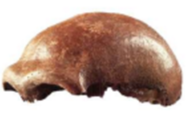
Site: Eurasia
2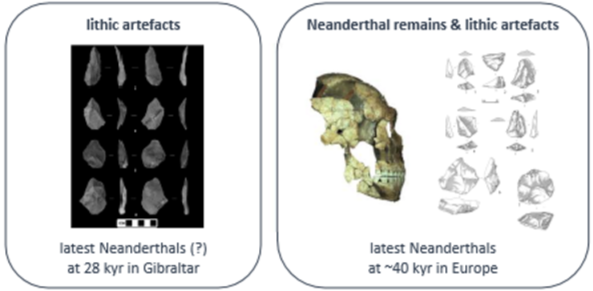
Image occlusion: name the hidden labels
3
Neanderthal craniodental features
Large posterior teeth
Supraorbital torus (brow ridge)
Large nose
No chin
Midfacial prognathism
Taurodontism (below gumline: small, stubby roots with large tooth. Point where roots of teeth fuse together much lower than other species)
Suprainiac fossa (depression)
Occipital bun (bulge)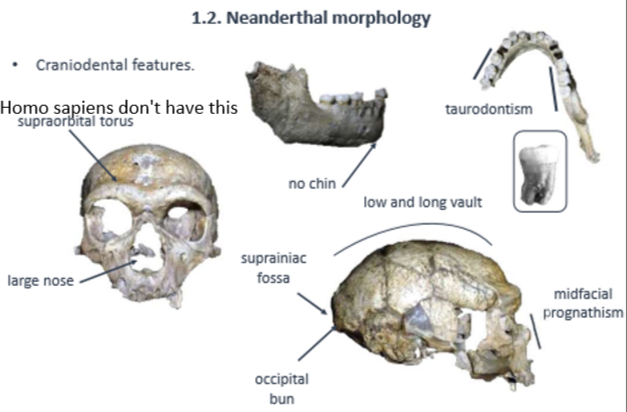
Supraorbital torus (brow ridge)
Large nose
No chin
Midfacial prognathism
Taurodontism (below gumline: small, stubby roots with large tooth. Point where roots of teeth fuse together much lower than other species)
Suprainiac fossa (depression)
Occipital bun (bulge)
4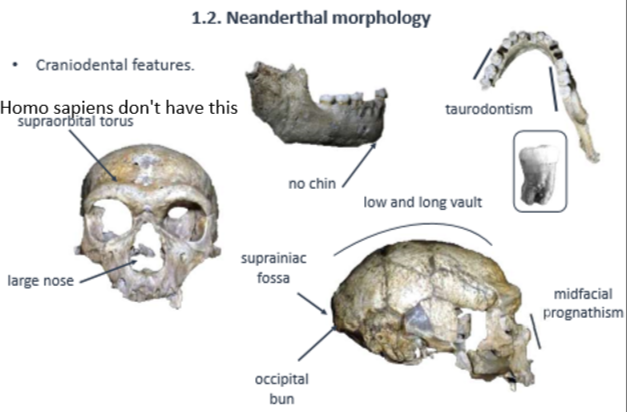
Image occlusion: name the hidden labels
5
Neanderthal postcranial features
Conical ribcage
Short trunk
Robust hand bones
Thick cortical bone
Wide pelvis
Large articular facet (type of joint)
Short distal limbs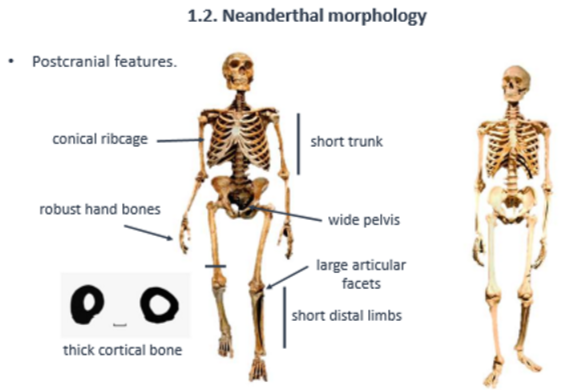
Short trunk
Robust hand bones
Thick cortical bone
Wide pelvis
Large articular facet (type of joint)
Short distal limbs
6
Image occlusion: name the hidden labels
7
Outline Homo heidelbergensis
Potential Neanderthal ancesstor
Fossils:
Primitive - no chin, robust mandible
Derived - modern human-like dental proportions
New species or already discovered species?
Fossils:
Primitive - no chin, robust mandible
Derived - modern human-like dental proportions
New species or already discovered species?
8
Outline the accretion model
Suggests Neanderthals evolved in partial/complete genetic isolation from the rest of humanity through the gradual accumulation of distinctive morphological traits in European populations
Used to explain potential relationship between Homo heidelbergensis and Neanderthals
Used to explain potential relationship between Homo heidelbergensis and Neanderthals
9
Outline 2 possible scenarios for the origins of Neanderthal and their split from modern humans
Scenario 1:
Homo heidelbergensis ancestor to Neanderthals and Denisovans, but not modern humans
Accretion model
Scenario 2:
Homo heidelbergensis ancestor to Neanderthal, Denisovans and modern humans
Homo heidelbergensis not more closely related to Neanderthals than to modern humans as seen in scenario 1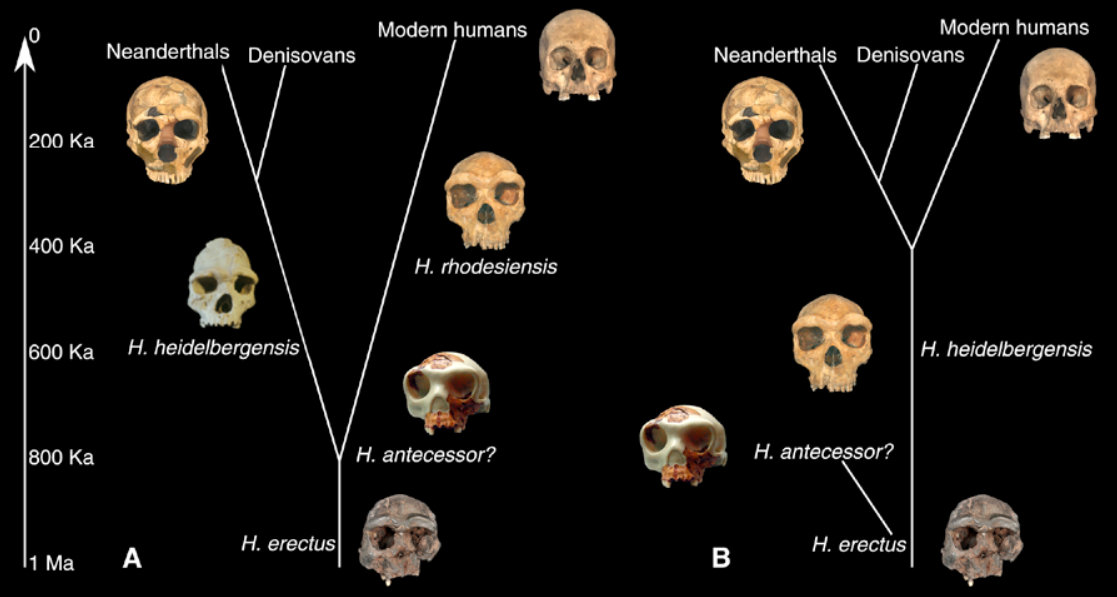
Homo heidelbergensis ancestor to Neanderthals and Denisovans, but not modern humans
Accretion model
Scenario 2:
Homo heidelbergensis ancestor to Neanderthal, Denisovans and modern humans
Homo heidelbergensis not more closely related to Neanderthals than to modern humans as seen in scenario 1
10
Outline a potential hybrid
Site: Portugal
Mix of Neanderthal and modern human features - suggests closely related
Later confirmed that Neanderthals and modern humans are closely related using molecular analysis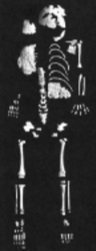
Mix of Neanderthal and modern human features - suggests closely related
Later confirmed that Neanderthals and modern humans are closely related using molecular analysis
11
Outline the evolutionary history hypothesis created from molecular analysis
Phylogeny created by combining nuclear and mitochondrial DNA
Neanderthals more closely related to Denisovans than modern humans
Evidence of introgression - some exchanges between Neanderthals and modern humans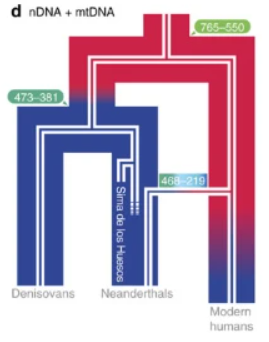
Neanderthals more closely related to Denisovans than modern humans
Evidence of introgression - some exchanges between Neanderthals and modern humans
12
Neanderthal behaviour during last glacial maximum
Major glaciation during Middle Pleistocene
Led to population expansion and isolation
Found in south Europe (north = too cold) to survive and find food
Groups potentially more isolated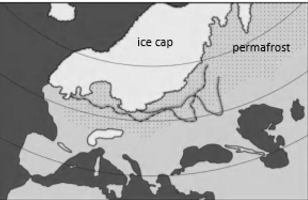
Led to population expansion and isolation
Found in south Europe (north = too cold) to survive and find food
Groups potentially more isolated
13
Evidence for Neanderthals being adapted to cold environments
Large nasal aperture - warms and humidifies inspired air
Body poportions adapted to cold conditions following Bergmann's and Allen's rules
Short limbs
Short stature
Body poportions adapted to cold conditions following Bergmann's and Allen's rules
Short limbs
Short stature
14
Describe Bergmann's and Allen's rules
Bergmann's rule - organisms at higher latitudes should be larger and thicker than those closer to the equator to better conserve heat so smaller SA:V
Allen's rule - shorter and thicker limbs at higher latitudes
Allen's rule - shorter and thicker limbs at higher latitudes
15
Biological adaptations of Neanderthal brain
Large and elongated brain
Expanded visual cortex - potentially helped with hunting
Distinct evolutionary trajectory (different from modern humans)
No globular phase of development (modern humans = rounded brain)
High brain growth rate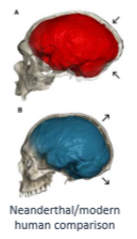
Expanded visual cortex - potentially helped with hunting
Distinct evolutionary trajectory (different from modern humans)
No globular phase of development (modern humans = rounded brain)
High brain growth rate
16
Dental and postcranial characteristics of Neanderthals
Faster dental maturation
Presence of adolescent growth spurt
Presence of adolescent growth spurt
17
Complex tool behaviour found in Neanderthals
Lithic industries (groups of stone tools)
Mousterian (type of tool found during Middle Paleolithic) - Levallois reduction method and retouched flakes (start with core and then retouch)
Chatelperronian (Upper Paleolithic) - produced by Neanderthal, modern humans or mixing of archaeological artefacts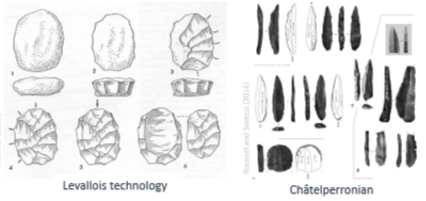
Mousterian (type of tool found during Middle Paleolithic) - Levallois reduction method and retouched flakes (start with core and then retouch)
Chatelperronian (Upper Paleolithic) - produced by Neanderthal, modern humans or mixing of archaeological artefacts
18
Dietary behaviour of Neanderthals
Herbivore meat - woolly rhinos, mammoths
Good hunters, used tools, strategies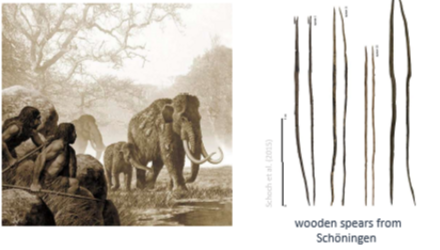
Good hunters, used tools, strategies
19
Evidence for Neanderthal art
Ornaments
Music
Symbols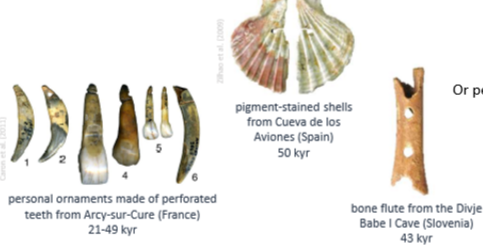
Music
Symbols
20
Evidence for symbolic behaviour
Paintings
Constructions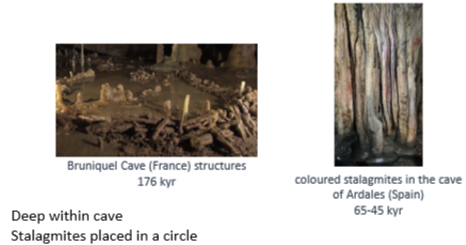
Constructions
21
Evidence for social behaviour
Burial
Cannibalism
Healthcare
Genetics suggest female migration between communities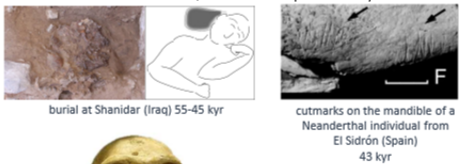
Cannibalism
Healthcare
Genetics suggest female migration between communities
22
4 potential reasons why Neanderthals went extinct
Climate - highly variable, fragmentation of habitats
Competition with modern humans - indirect (limited resources during critical time intervals, disease), direct (interpersonal violence)
Demographics - small groups, lower birth rates, higher mortality rates, lower fertility rates, longer interbirth spacing, less complex social networks
Assimilation - Neanderthals assimilated into populations of modern humans
Competition with modern humans - indirect (limited resources during critical time intervals, disease), direct (interpersonal violence)
Demographics - small groups, lower birth rates, higher mortality rates, lower fertility rates, longer interbirth spacing, less complex social networks
Assimilation - Neanderthals assimilated into populations of modern humans