B6 - Nerves
Study these flashcardsFree · spaced repetition · iPhone, Android, Mac & web
All cards
1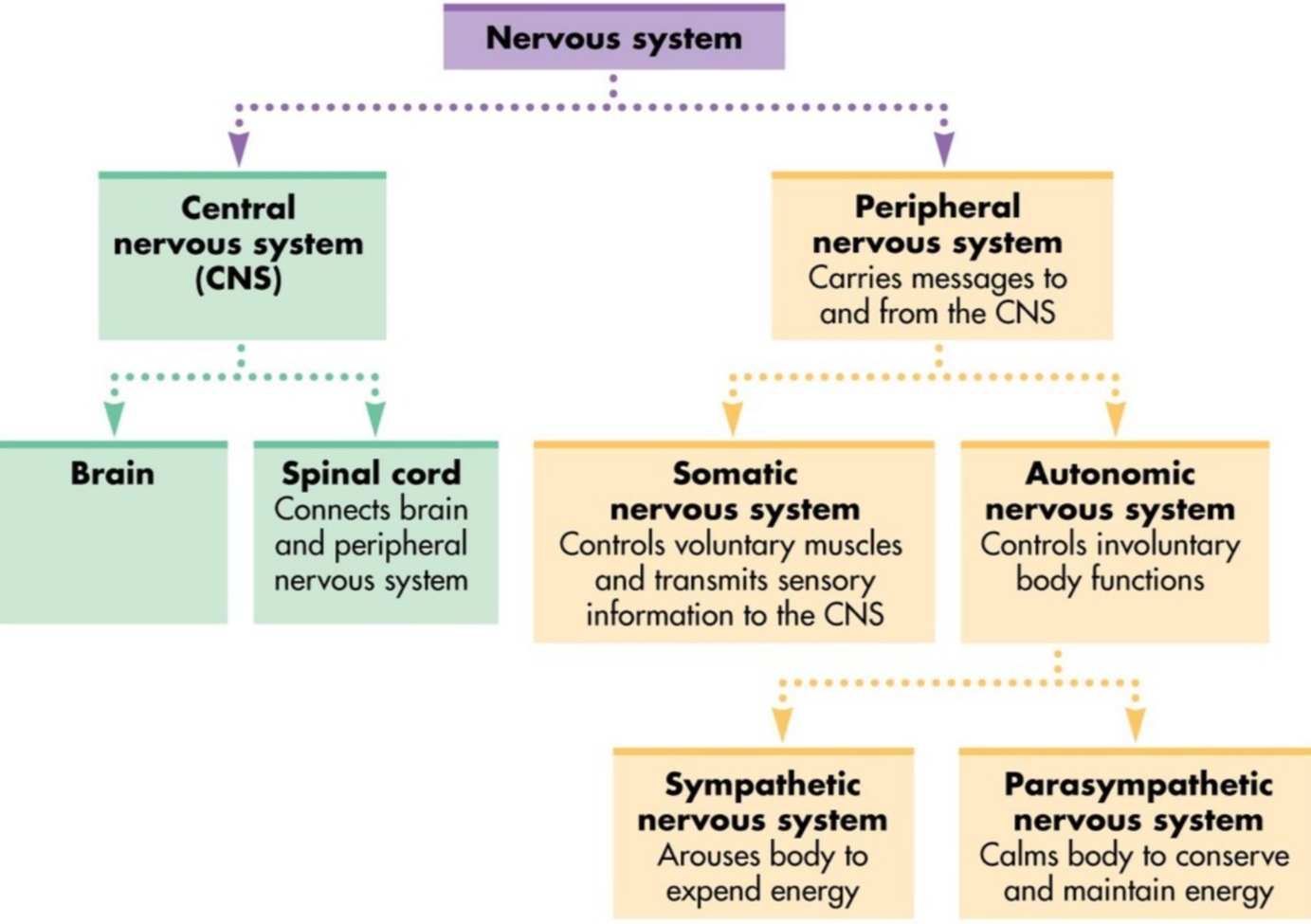
Outline the nervous system
2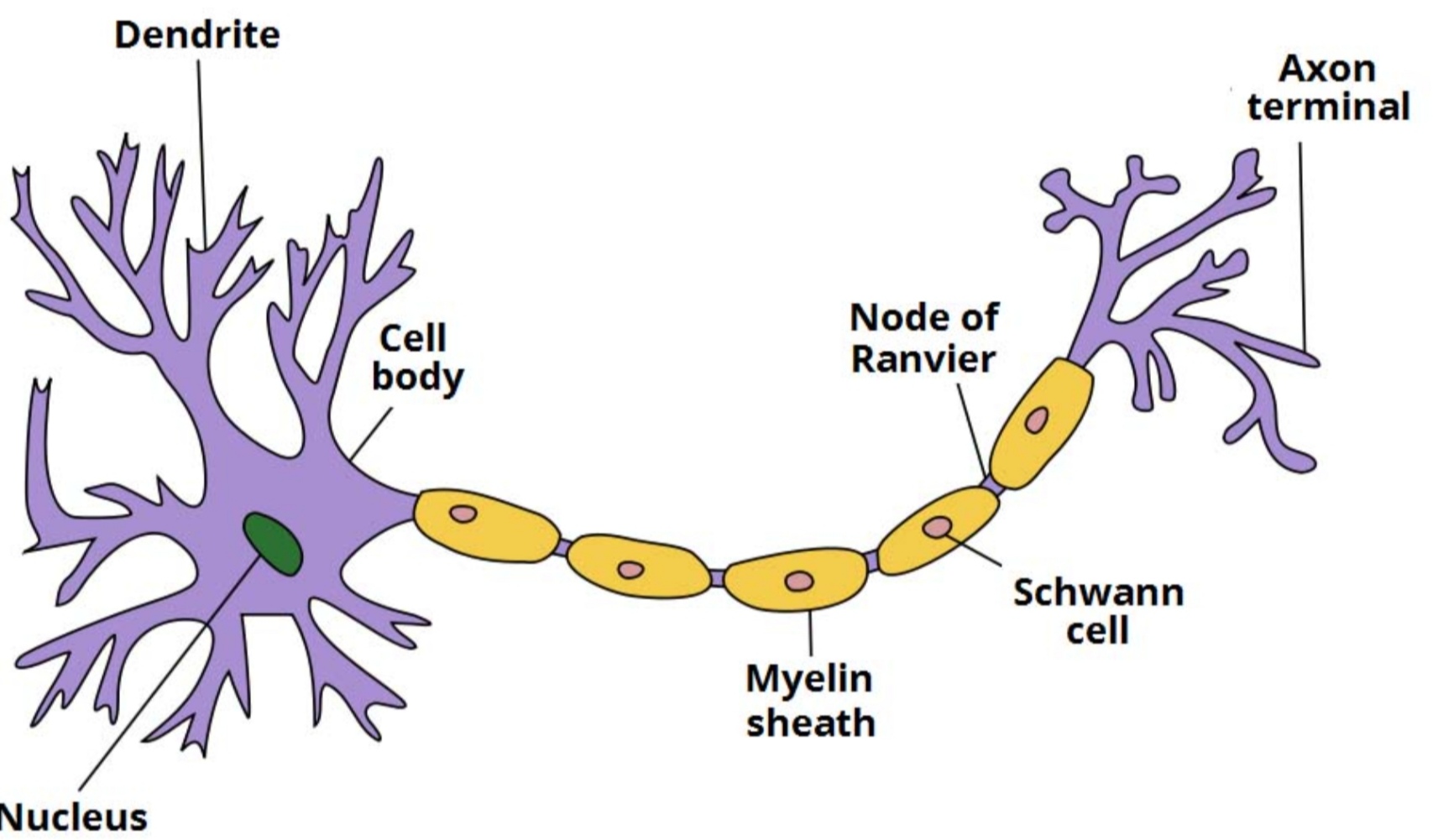
Image occlusion: name the hidden labels
3
Image occlusion: name the hidden labels
4
Image occlusion: name the hidden labels
5
Image occlusion: name the hidden labels
6
Image occlusion: name the hidden labels
7
Image occlusion: name the hidden labels
8
Image occlusion: name the hidden labels
9
Outline a reflex response
Stimulus
Receptor
Sensory
CNS
Relay
Motor
Effector
Respons
Receptor
Sensory
CNS
Relay
Motor
Effector
Respons
10
What are the 2 types of Effector?
Muscles
Glands
Glands
11
What neurotransmitter is released when the sympathetic division is stimulated?
Noradrenaline
12
What neurotransmitter is released when the parasympathetic division is stimulated?
Acetylcholine
13
What is an action potential?
Temporary reversal of p.d. across axon membrane
Not an electrical current
Not an electrical current
14
What 2 states can the axon be in?
Resting potential
Action potential
Action potential
15
What is the p.d. at resting potential ?
-70mV
More negative inside axon than outside
More negative inside axon than outside
16
How is the resting potential maintained?
Na+/K+ pump
3Na+ removed from axon
2K+ inside axon
Na+ channels shut
K+ channels leaky so some K+ leaves axon
3Na+ removed from axon
2K+ inside axon
Na+ channels shut
K+ channels leaky so some K+ leaves axon
17
What is it called when an action potential occurs?
Depolarisation
18
Describe depolarisation
Stimulus causes voltage gated Na+ channels to open
Na+ rapidly diffuses into cell down electrochemical gradient
Inside becomes more positive
-70mV to +40mV
Na+ rapidly diffuses into cell down electrochemical gradient
Inside becomes more positive
-70mV to +40mV
19
Describe repolarisation
Na+ channels shut
K+ channels open
K+ diffuses out of axon down electrochemical gradient
K+ channels open
K+ diffuses out of axon down electrochemical gradient
20
What happens if an axon is myelinated?
Depolarisation only at nodes of ranvier
Saltatory conduction
Faster
Saltatory conduction
Faster
21
What happens if an axon is unmyelinated?
Depolarisation across entire axon
Slower
Eg. Relay neurons
Slower
Eg. Relay neurons
22
Define threshold
Minimum intensity of stimulus required to open voltage gated Na+ channels (-55mV) and trigger an action potential
23
What is the all or nothing law?
Above the threshold, a full action potential is produced regardless of stimulus intensity
24
Define refractory period
Time delay after an AP before another AP can be generated
25
How does a refractory period prevent another AP occurring?
Na+ channels shut so no more Na+ enters axon
26
Why is a refractory period important?
Ensures AP only travel in one direction
Produces discrete impulses
Limites number of AP
Produces discrete impulses
Limites number of AP
27
What is hyperpolarisation and what happens?
Axon becomes too negative after repolarisation
Too much K+ is removed (reaches - 90mV)
Na+/K+ pump restores resting potential
Too much K+ is removed (reaches - 90mV)
Na+/K+ pump restores resting potential
28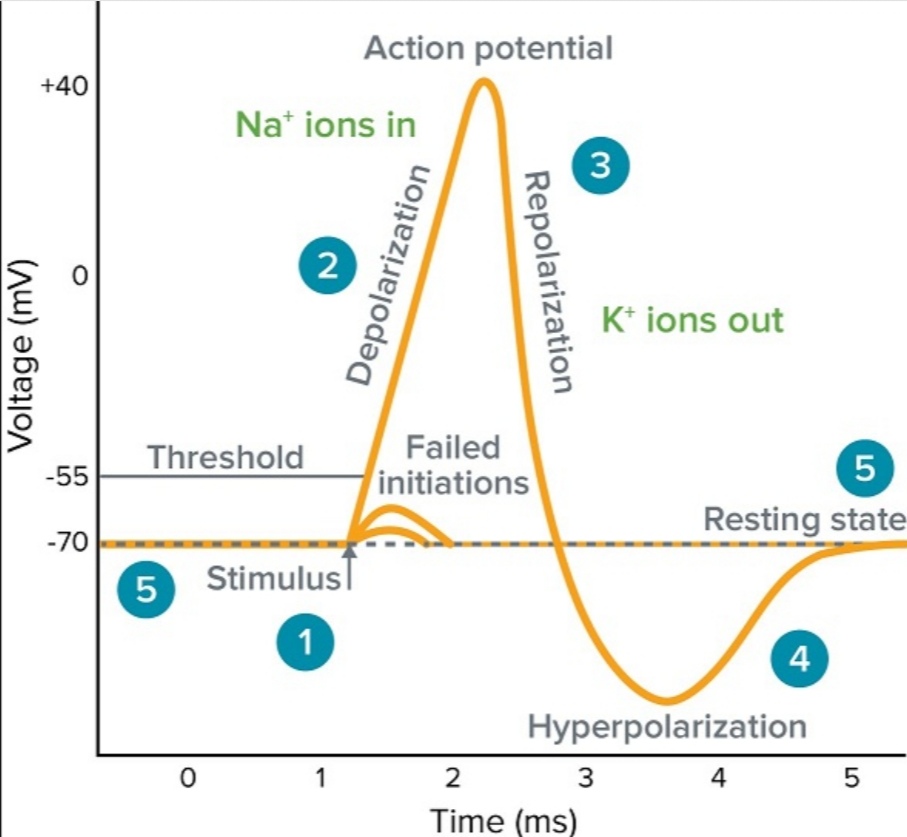
Image occlusion: name the hidden labels
29
Image occlusion: name the hidden labels
30
What are the 2 types of neurotransmitters and give an example
Excitatory = acetylcholine (Ach)
Inhibitory = GABA
Inhibitory = GABA
31
What is found on the post synaptic membrane?
Na+ channels with receptors attached
32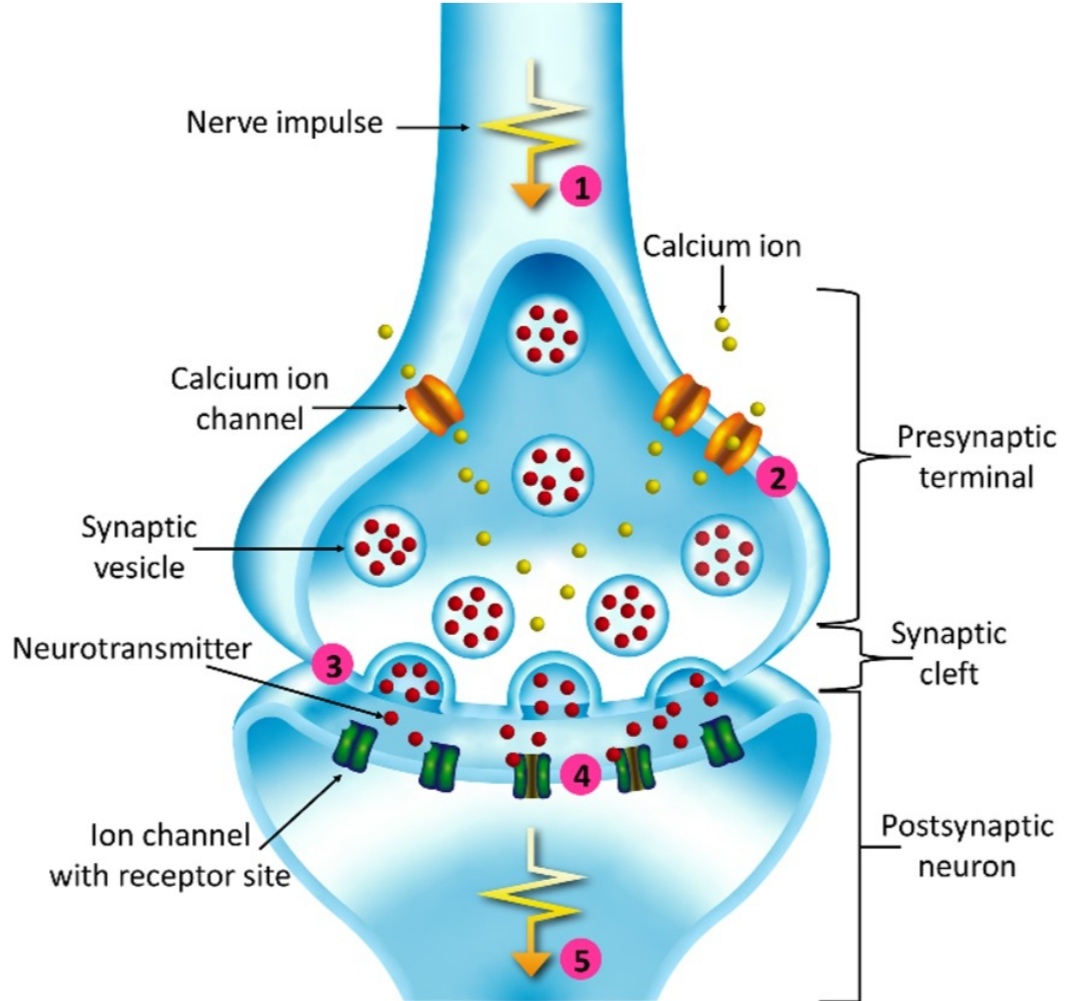
Image occlusion: name the hidden labels
33
Image occlusion: name the hidden labels
34
Image occlusion: name the hidden labels
35
Describe the process of the synaptic transmission of Ach
Pre-synaptic membrane is depolarised
Voltage gated Ca2+ channels open
Ca2+ enters by facilitated diffusion
Vesicles fuse with Pre-synaptic membrane and release Ach by exocytosis
Na+ channels on post-synaptic membrane have receptors for Ach
Ach binds to receptors and opens Na+ channels
Influx of Na+ causes depolarisation of post-synaptic membrane
Voltage gated Ca2+ channels open
Ca2+ enters by facilitated diffusion
Vesicles fuse with Pre-synaptic membrane and release Ach by exocytosis
Na+ channels on post-synaptic membrane have receptors for Ach
Ach binds to receptors and opens Na+ channels
Influx of Na+ causes depolarisation of post-synaptic membrane
36
Describe what happens to Ach after it binds to Na+ channels
Acetylcholinesterase breaks down Ach into acetate and choline
Diffuses back into Pre-synaptic knob
Diffuses back into Pre-synaptic knob
37
Why do nerve impulses only travel one way at a synapse?
Neurotransmitters and Vesicles at pre synaptic membrane
Receptors on post synaptic membrane
Receptors on post synaptic membrane
38
What is summation
For depolarisation to occur, lots of NETS needed
Just one synapse releasing NETS isn't always enough
Just one synapse releasing NETS isn't always enough
39
What are the 2 types of summation?
Temporal
Spatial
Spatial
40
Describe spatial summation
No. of different pre-synaptic neurones together release enough NETS to exceed threshold value and generate AP of 1 post-synaptic neurone
41
Describe temporal summation
2 or more AP arrive in rapid succession along a single presynaptic neurone
Enough NETS to generate AP
Enough NETS to generate AP
42
How does an inhibitory neurotransmitter work?
GABA
Binds to receptors on Cl- channels on post-synaptic membrane
Cl- facilitated diffusion into post-synaptic membrane
Also opens K+ channels so K+ moves out of post-synaptic membrane
Post-synaptic membrane very - ive (hyperpolarisation)
Threshd can't be reached so no AP
Binds to receptors on Cl- channels on post-synaptic membrane
Cl- facilitated diffusion into post-synaptic membrane
Also opens K+ channels so K+ moves out of post-synaptic membrane
Post-synaptic membrane very - ive (hyperpolarisation)
Threshd can't be reached so no AP