Primatology - feeding + surviving
Study these flashcardsFree · spaced repetition · iPhone, Android, Mac & web
All cards
1
6 requirements of feeding strategies
Carbs - fruit
aa - leaves
Fat and oil - seeds
Vitamins and minerals - fruit
Water - food, tree/water holes
Avoid toxins
aa - leaves
Fat and oil - seeds
Vitamins and minerals - fruit
Water - food, tree/water holes
Avoid toxins
2
How is water collected?
Fluid dipping into holes in trees
Use wooden sticks / leaf sponges
Use wooden sticks / leaf sponges
3
How is food collected?
Honey extraction
Termite fishing
Tool use - nut cracking, termite pounding, tortoise pounding, oyster cracking
Termite fishing
Tool use - nut cracking, termite pounding, tortoise pounding, oyster cracking
4
2 visual adaptations for searching for food
Colour vision (ripeness)
Stereotypic vision
Stereotypic vision
5
Describe frugivory
Source of carbs
BUT patchy distribution and quality (seasonal and due to competition)
Contest competition
BUT patchy distribution and quality (seasonal and due to competition)
Contest competition
6
Describe contest competition and state who outlined this and when
Clumped resources
Resources scarce and valuable
Worth fighting over
Compete to gain access to these particular resources
Resources are monopolisable
Direct competition
van Schaik 1989
Resources scarce and valuable
Worth fighting over
Compete to gain access to these particular resources
Resources are monopolisable
Direct competition
van Schaik 1989
7
Describe folivory
Source of proteins and fibre
Even distribution
Some components hard to digest
Hard to monopolise
Scramble competition
Even distribution
Some components hard to digest
Hard to monopolise
Scramble competition
8
Describe scramble competition
Dispersed (insects) and evenly (leaves) distributed resources
Scramble to get enough
Resources are not monopolisable
Resources not worth fighting over
No direct competition (it's indirect)
van Schaik 1989
Scramble to get enough
Resources are not monopolisable
Resources not worth fighting over
No direct competition (it's indirect)
van Schaik 1989
9
How does food availability and distribution affect defence of food resources?
Defence of either core area (high feeding intensity), food patches (high feeding intensity) or boundary (high food abundance)
10
5 adaptation for finding food
Spatial memory
Euclidean maps show primates know position of food source and can approach it from different locations (almost acts as a reference point)
Niche partitioning - different strata and diet
Interspecific associations - sympatric situations (occupy same strata)
Anticipation - knowing when to leave to eat a certain food at a certain time (eg. figs in the early morning)
Euclidean maps show primates know position of food source and can approach it from different locations (almost acts as a reference point)
Niche partitioning - different strata and diet
Interspecific associations - sympatric situations (occupy same strata)
Anticipation - knowing when to leave to eat a certain food at a certain time (eg. figs in the early morning)
11
Name 4 anti-predation strategies
Grouping (dilution and confusion effect)
Sleeping sites (nest building, cliff sleeping)
Number of adult males (more males when higher risk of predation)
Alarm call systems (leads to different behavioural responses, referential calls to climb/come down from trees depending on predator)
Sleeping sites (nest building, cliff sleeping)
Number of adult males (more males when higher risk of predation)
Alarm call systems (leads to different behavioural responses, referential calls to climb/come down from trees depending on predator)
12
Define the co-evolution princinple
Reciprocal evolutionary changes between pairs of species / groups as they interact with one another
Eg. shapes of flowers and shape of beaks of hummingbirds
Eg. shapes of flowers and shape of beaks of hummingbirds
13
2 examples of co evolution principle
Angiosperm co-evolution hypothesis
Visual predation hypothesis
Visual predation hypothesis
14
What is the angiosperm co-evolution hypothesis?
our primate ancestors evolved key adaptations like forward-facing eyes, excellent colour vision, rounded, blunt teeth and fingers without claws, all for the purpose of eating and living from fruits
Sussman et al., 2012, Am. J. Primatol.
Sussman et al., 2012, Am. J. Primatol.
15
What is the visual predation hypothesis?
forward-facing eyes and grasping hands evolved in primates to allow them to eat insects in trees
Carmill, 1974, Science
Carmill, 1974, Science
16
Difference between angiosperm co-evolution hypothesis and visual predation hypothesis
ACOH = evolved to eat fruit
VPH = evolved to eat insects
VPH = evolved to eat insects
17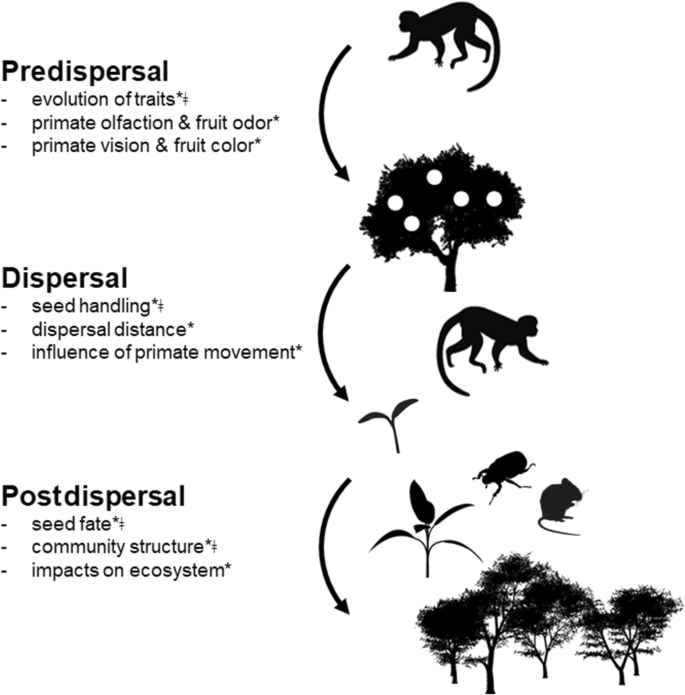
Image occlusion: name the hidden labels
18
What do all primates do with seeds
Spit or swallow seeds - leading to dispersal
19
What do New and Old World Moneys both specialise in
Eat colourful fruit with flesh and easy to swallow seeds
Lambert & Garber, 2006
Lambert & Garber, 2006
20
High or low no. of seeds dispersed over long distances?
High
Poulsen et al 2001
Poulsen et al 2001
21
What did Mitani find and when?
1991
Studied polyspecific associations between 6 primate species
Found the polyspecific groups were formed frequently for foraging
May help to optimise their foraging biomass
Foraging groups likely have an optimal size to maximise their foraging biomass and per capita food acquisition
Studied polyspecific associations between 6 primate species
Found the polyspecific groups were formed frequently for foraging
May help to optimise their foraging biomass
Foraging groups likely have an optimal size to maximise their foraging biomass and per capita food acquisition
22
Outline research into mixed species groups
Red colobus and diana monkeys form most associations during the height of chimp hunting season (predator)
Grouping and dilution effect
More vigilant and alarm calls
Also form more association during dry season - thinner foliage (increased crowned eagle predation risk)
Grouping and dilution effect
More vigilant and alarm calls
Also form more association during dry season - thinner foliage (increased crowned eagle predation risk)
23
3 possible explanations for forest-living primates forming polyspecific associations
Chance encounters of mutually tolerant species
Improved foraging efficiency
Reduced predation
Improved foraging efficiency
Reduced predation
24
2 advantages of mixed-species groups
Complementary antipredation skills
Predators may prefer one species
Predators may prefer one species