HE - evolution + diversity in genus Homo
Study these flashcardsFree · spaced repetition · iPhone, Android, Mac & web
All cards
1
Outline the defining cranial characteristics of Homo erectus
Sagittal keel (bump on skull)
Large face
Supraorbital torus (lump) - brow ridge
Occipital torus
Flat forehead
Large face
Supraorbital torus (lump) - brow ridge
Occipital torus
Flat forehead
2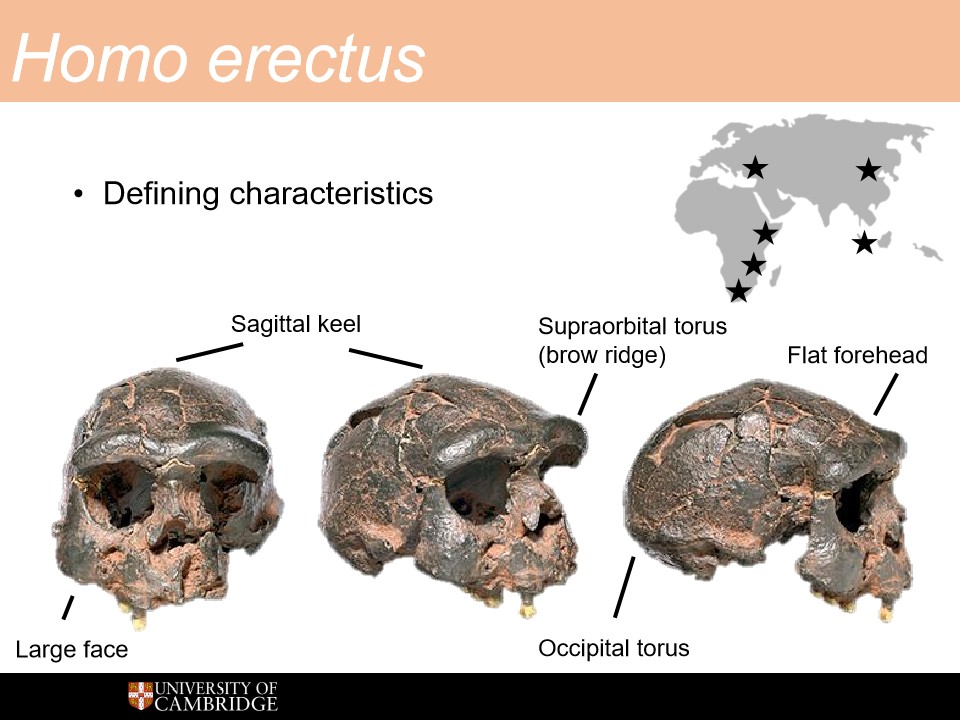
Image occlusion: name the hidden labels
3
Image occlusion: name the hidden labels
4
Image occlusion: name the hidden labels
5
Image occlusion: name the hidden labels
6
What did Anton suggest and when?
2003
Homo erectus may be one single, widely dispersed, long lived, polytypic taxon
Lots of variation within a single species (Homo erectus)
Homo erectus may be one single, widely dispersed, long lived, polytypic taxon
Lots of variation within a single species (Homo erectus)
7
State the 2 taxonomic methods for categorising the Homo erectus fossils
Lumping
Splitting
Splitting
8
Outline lumping
Method of categorising taxonomic groups
Lumps all samples into a single, highly variable taxon
Accept larger range of intraspecific variation within hominins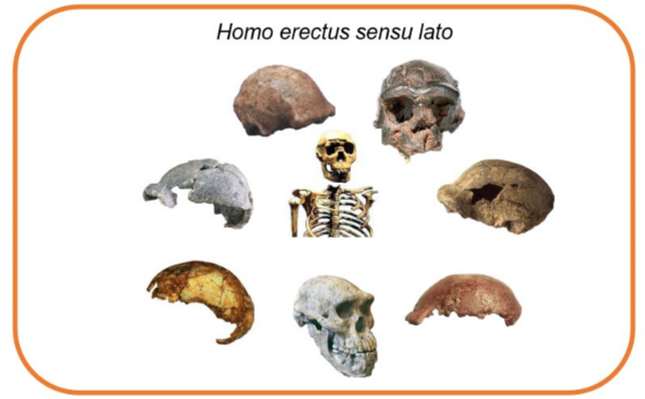
Lumps all samples into a single, highly variable taxon
Accept larger range of intraspecific variation within hominins
9
Outline splitting
Method of categorising taxonomic groups
Splitting large, varriable groups into smaller chunks
Expect less variation and larger degree of morphological overlap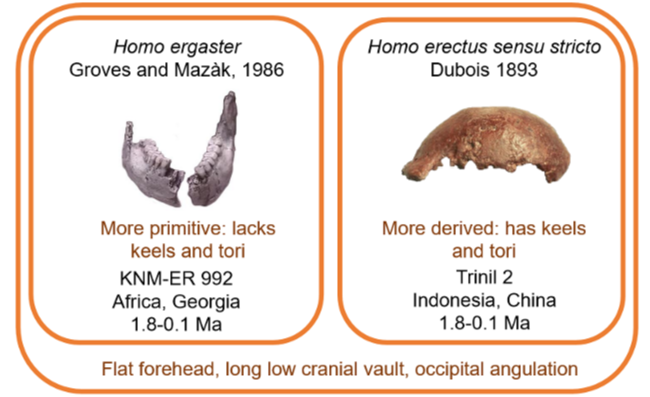
Splitting large, varriable groups into smaller chunks
Expect less variation and larger degree of morphological overlap
10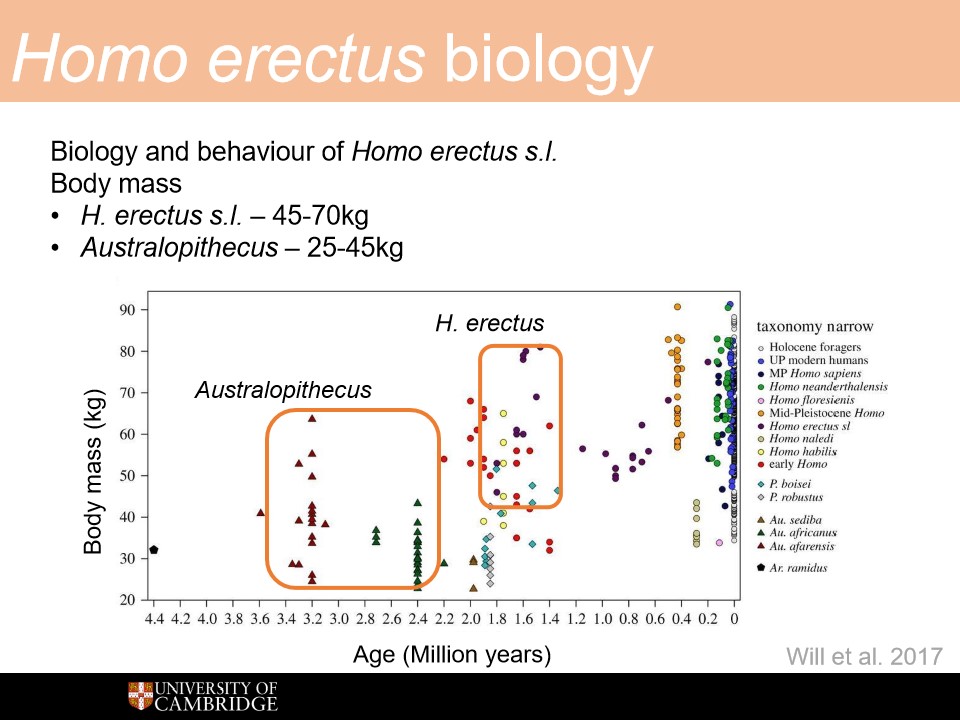
Image occlusion: name the hidden labels
11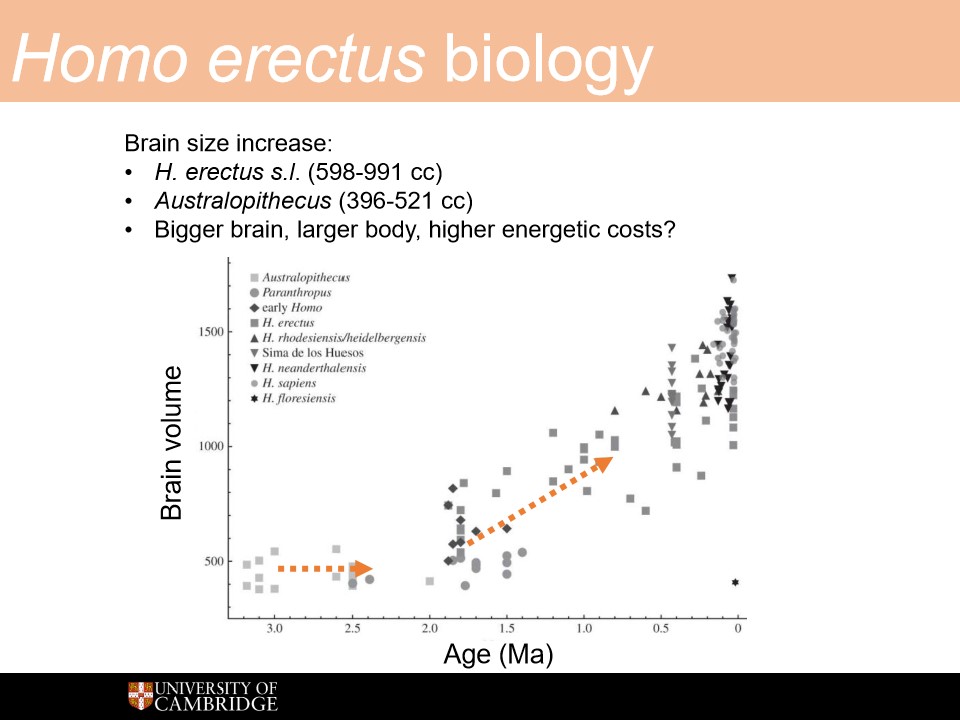
Image occlusion: name the hidden labels
12
Homo erectus diet and biology
High quality diet:
- Meat consumption (increased carnivory)
- Potential aquatic resources
Evidence of butchery:
- Defleshing
- Disarticulation
- Marrow extraction
Smaller jaws and teeth
Cut marks more common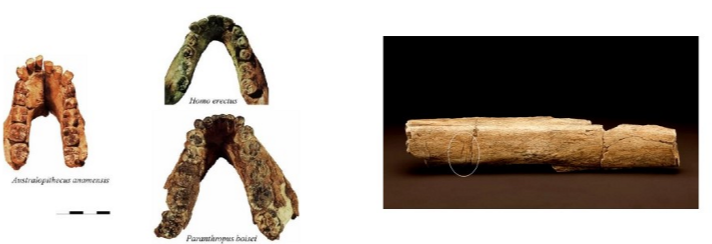
- Meat consumption (increased carnivory)
- Potential aquatic resources
Evidence of butchery:
- Defleshing
- Disarticulation
- Marrow extraction
Smaller jaws and teeth
Cut marks more common
13
What does Homo erectus sensu lato mean?
Name given according to the lumping method to all potential Homo erectus
14
Outline Homo erectus sensu stricto
Name given to potential Homo erectus specimens in East Asia
More derived - has keels (ridge) and tori (bony ridge)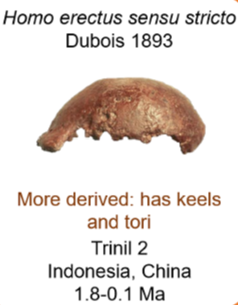
More derived - has keels (ridge) and tori (bony ridge)
15
Outline Homo ergaster
Name given to the potential Homo erectus specimens in Africa and Georgia
More primitve - lacks keels and tori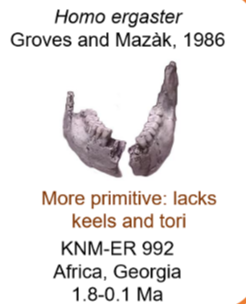
More primitve - lacks keels and tori
16
State the 2 types of tools
Oldowan
Acheulian
Acheulian
17
Outline Oldowan tools
Older than Acheulian tools
Chopping tools, flakes
Quartz, quartzite, basalt
Chipped in 2 direction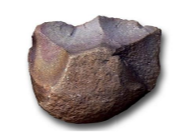
Chopping tools, flakes
Quartz, quartzite, basalt
Chipped in 2 direction
18
Outline Acheulian tools
Newer than Oldowan tools
More sophisticated
Hand axes
Flint, basalt
Use of hammers, symmetry of both sides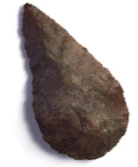
More sophisticated
Hand axes
Flint, basalt
Use of hammers, symmetry of both sides
19
Consequence of Homo erectus postcranium biology
Increased locomotor efficiency
Can travel further for food
Allowed expansion out of Africa
Can travel further for food
Allowed expansion out of Africa
20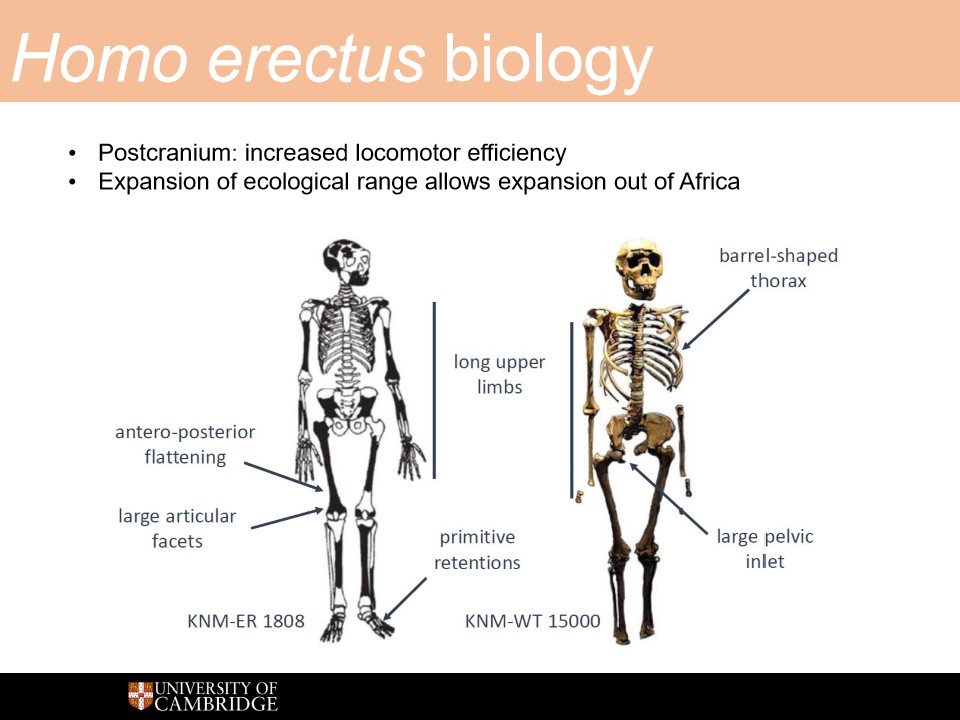
Image occlusion: name the hidden labels
21
Homo erectus postnatal development
Fast growth
Absence of human-like growth spurt
Absence of human-like growth spurt
22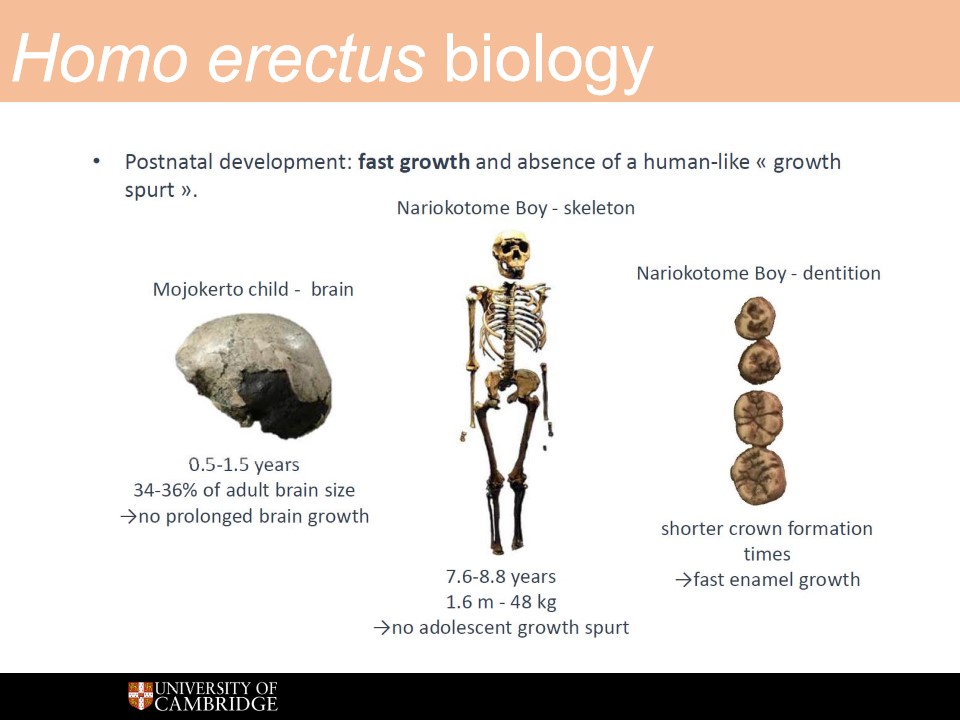
Image occlusion: name the hidden labels
23
Image occlusion: name the hidden labels
24
Species of Homo during the Middle Pleistocene
Rightmire 2015
Found in UK, South Africa, Southeast Asia
Globally dispersed
Homo antecessor
Homo heidelbergensis
Homo longi
Homo bodensis
Found in UK, South Africa, Southeast Asia
Globally dispersed
Homo antecessor
Homo heidelbergensis
Homo longi
Homo bodensis
25
3 different theories of how H. erectus spread throughout old world during the Middle Pleistocene
Multiregional evolution
Out of Africa
Assimilation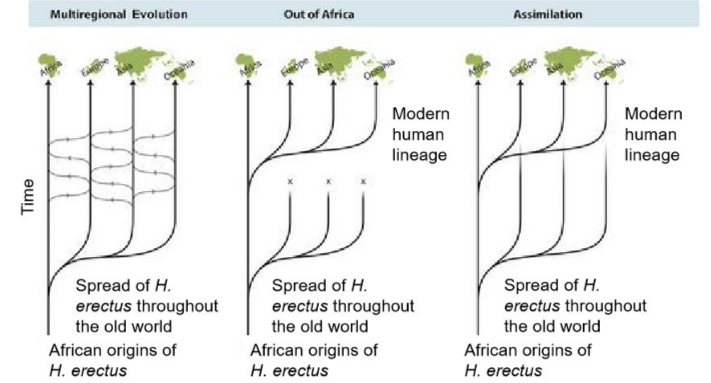
Out of Africa
Assimilation
26
Outline the charactersitics of multiregional evolution
Regional adaptations
Gene flow
Continuity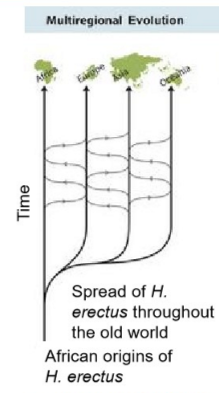
Gene flow
Continuity
27
Outline the charactersitics of out of Africa
Replacement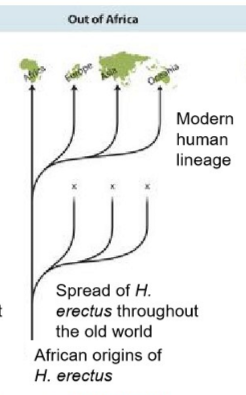
28
Outline the charactersitics of assimilation
Combination of continuity and replacement
Interbreeding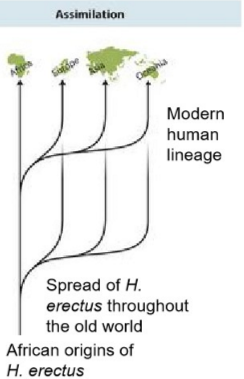
Interbreeding
29
Where are small bodied Homo found?
Small islands and caves
Eg. Indonesia
Eg. Indonesia
30
What species did small bodied Homo evolve from?
Homo erectus after it dispersed to small islands - led to insular dwarfism
31
Species of small bodied Homo
Homo naledi
Homo florensiensis
Homo luzonensis
Homo florensiensis
Homo luzonensis
32
Factfile: Homo florensiensis
Height: 1m
Brain: 380 - 430cc
Made tools (cut marks in animal bones)
Insular dwarfism
Dward descendent of H. erectus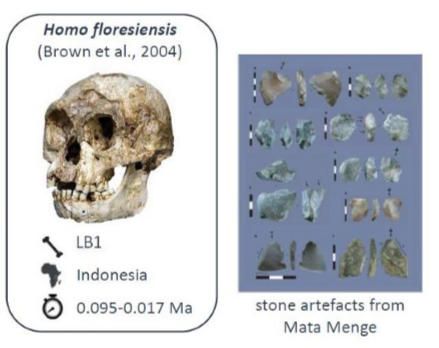
Brain: 380 - 430cc
Made tools (cut marks in animal bones)
Insular dwarfism
Dward descendent of H. erectus
33
Outline insular dwarfism
When large animals are stuck on small islands, they evolve to have a naturally smaller size
Not enough food available to sustain large-bodied organisms
Seen in elephants, hippos etc.
Not enough food available to sustain large-bodied organisms
Seen in elephants, hippos etc.
34
Factfile: Homo luzonensis
Mix of Homo sapiens-like and primitive features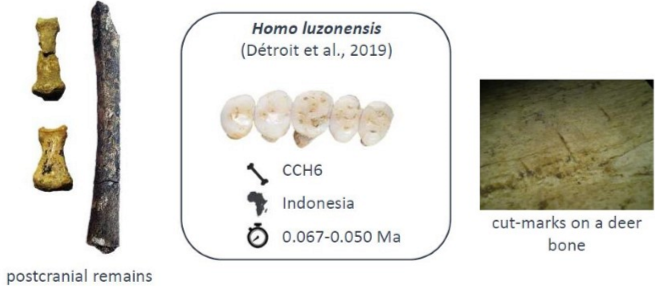
35
Factfile: Homo naledi
Derived craniodental morphology with primitive Australopithecus-like postcranium
- Long arms
- Strong curved fingers associated with climbing
- Human-like legs and feet
- Homo-like cranium
- Small brain
- Evidence of tool making (countered thinking about larger brain being required for toolmaking)
Ritual behaviour - bodies found deep within cave systems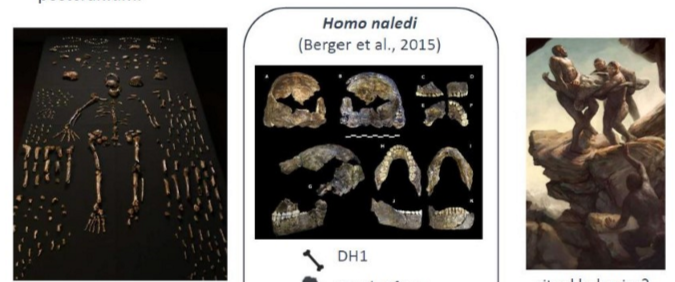
- Long arms
- Strong curved fingers associated with climbing
- Human-like legs and feet
- Homo-like cranium
- Small brain
- Evidence of tool making (countered thinking about larger brain being required for toolmaking)
Ritual behaviour - bodies found deep within cave systems
36
Where was H. naledi found?
Cave in SA
37
Where was H. florensiensis found?
Island in Indonesia
38
Outline the process-based approach to hominin taxonomy
Degree of overlap in populations' trait distributions expected to grow smaller over time as they go through speciation
39
Which 2 key assumptions is the process-based approach to hominin taxonomy based on?
Same morphological criteria employed across hominin fossil record
Morphology and progression of speciation are correlated (BUT speciation not always marked by morphological differentiation between daughter species)
Morphology and progression of speciation are correlated (BUT speciation not always marked by morphological differentiation between daughter species)
40
What is the original view of how the genus Homo dispersed?
Onset of African aridity
Expansion of open grasslands
Led to evolution of:
- Increased carnivory
- Brain enlargement
- Long-distnace mobility
- Prolonged life history
Expansion of open grasslands
Led to evolution of:
- Increased carnivory
- Brain enlargement
- Long-distnace mobility
- Prolonged life history
41
State the Homo erectus features believed to have evolved together as a result of more open habitats and arid climates, allowing for dispersal beyond Africa
Large, linear bodies
Elongated legs
Large brain
Reduced sexual dimorphism
Increased carnivory
Unique life history traits
Tool making
Increased social cooperation
Elongated legs
Large brain
Reduced sexual dimorphism
Increased carnivory
Unique life history traits
Tool making
Increased social cooperation
42
What do new Homo fossils suggest about adaptations in response to increased aridity and open grasslands in Africa?
Not all of the adaptations evolved at the same time
Some evolved substantially earlier/later than previously understood
Some evolved substantially earlier/later than previously understood
43
Which feature, originally believed to be unique to Homo has also been found in Australopiths?
Long hind limbs
44
What do fossil and archaeological records of early Homo suggest are key factors in the success and expansion of the genus?
Dietary flexibility in unpredictable environments
Cooperative breeding
Flexibility in development allowed range expansion and reduced mortality risks
Cooperative breeding
Flexibility in development allowed range expansion and reduced mortality risks
45
What is the problem with suggesting that long legs and efficient bipedalism is unique to Homo?
Existed well before origin of this genus
So cannot necessarily be used to distinguish between genera/species
So cannot necessarily be used to distinguish between genera/species
46
How do early Homo differ from Australopiths?
Larger average body and brain sizes
47
What do fossils in Georgia show?
Variation found in early African H. erectus and other early African Homo
- Derived H. erectus characters
- Some primitive characteristics
- Small brain size
Suggests early dispersal of the species
- Derived H. erectus characters
- Some primitive characteristics
- Small brain size
Suggests early dispersal of the species
48
What does new data suggest about the origins of the genus Homo?
Homo evolved during fluctuating moisture and aridity, shifting resource regimes and spatial heterogeneity dominant features of East Africa
Climate and landscape variability highlights different sets of adaptive problems
More likely to survive if able to easily adapt to constantly changing and shifting environments
Climate and landscape variability highlights different sets of adaptive problems
More likely to survive if able to easily adapt to constantly changing and shifting environments
49
What adaptations enabled Homo to successfully survive in the changing and unpredictable environments?
- Increase in average body and brain size
- Changing dental size
- Increased toolmaking and stone transport
Suggests dietary expansion, developmental plasticity, cognitive evolution and social investments
- Changing dental size
- Increased toolmaking and stone transport
Suggests dietary expansion, developmental plasticity, cognitive evolution and social investments
50
What does early Homo dental morphology suggest?
Shift towards incisal preparation and molar shearing
- Tough plant products
- Animal tissues
- Tough plant products
- Animal tissues
51
How are tools useful in interpreting hominin expansion in and out of Africa?
Oldowan tools provide technological basis for expansion into southern and northern Africa and western Asia
52
What does larger body size in Homo compared to Australopiths reflect?
Increased nutritional sufficiency resulting from:
- Tool use
- Social cooperation
- Higher quality diet
- Tool use
- Social cooperation
- Higher quality diet
53
Larger body size = ?
Greater range of phenotypic adaptive flexibility in response to environmental change
In mammals: larger body size = larger home ranges
In mammals: larger body size = larger home ranges
54
What provides a faster responser to environmental challenges?
- Genetic change
- Intraspecific phenotypic plasticity
55
Outline the reasons for H. erectus being better able to survive than other hominins
Larger brain size
Potential for diverse body sizes
Inferred dietary flexibility
Cooperation
Enabled H. erectus to attain level of niche construction and adaptive versatility that allowed it to outcompete others
Potential for diverse body sizes
Inferred dietary flexibility
Cooperation
Enabled H. erectus to attain level of niche construction and adaptive versatility that allowed it to outcompete others
56
What does fossil evidence suggest was the first species to leave Africa and where did it go?
H. erectus
Georgia and Java, Indonesia
Georgia and Java, Indonesia
57
What is a limitation of fossil records documenting dispersal out of Africa?
Sparse records
H. erectus may not have been first or only hominin to disperse from Africa
H. erectus may not have been first or only hominin to disperse from Africa
58
Outline the factors that allowed the dispersal and range expansion of H. erectus
Increased body and brain size
Reduced mortality risk
Increased nutritional sufficiency
Enhanced niche construction and ranging
Reduced mortality risk
Increased nutritional sufficiency
Enhanced niche construction and ranging
59
Outline the likely form of expansion from Africa
Episodic
Likely to have involved many populations and back migrations
Likely to have involved many populations and back migrations
60
What is the evolution of early Homo associated with?
Periods of intensified moist-dry variability
61
Define cooperative breeding
Reproductive strategy in which most of the females of a social group do not breed regularly
Provide alloparental care to the offspring of breeding females instead
Provide alloparental care to the offspring of breeding females instead