HE - methods to study human evolution
Study these flashcardsFree · spaced repetition · iPhone, Android, Mac & web
All cards
1
Define phylogeny
Evolutionary history of a taxon including hypotheses about ancestors and descendants
2
Define cladistics
Method by which branching patterns of a phylogeny are generated
Based on shared character states of different taxa
Based on shared character states of different taxa
3
What are operational taxonomic units (OTUs)?
Taxa, genes, fossils etc.
4
Define matrix of characters
Molecular/morphological characters
5
Define cladogram
Graphic representation of evolutionary relationships between different taxa
6
Define clades
Different taxa
7
Outline the method for constructing a cladogram
Choose OTUs
Choose relevant characteristics and record presence/absence
Create matrix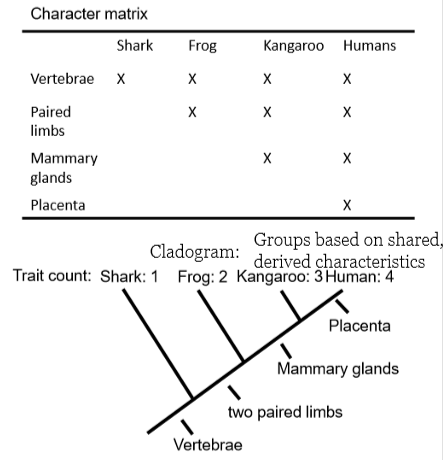
Choose relevant characteristics and record presence/absence
Create matrix
8
Limitation of parsimony
Doesn't account for homoplasy
Some characteristics evolved separately and independently in different species
Some characteristics evolved separately and independently in different species
9
Define monophyly
Group of organisms that comprises of the most recent common ancestor and all its descendants
10
Define paraphyly
Group of organisms that comprises the most recent common ancestor but NOT all of its descendants (only 1)
11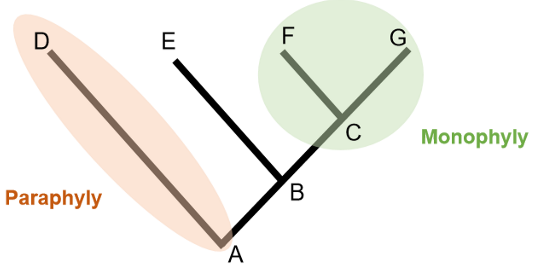
Image occlusion: name the hidden labels
12
Define apomorphy
Derived trait caused by evolutionary change
13
Define autopomorphy
Derived trait confined to a single taxon
Type of apomorphy
Type of apomorphy
14
Define plesiomorphy
Trait retained from an ancestor
15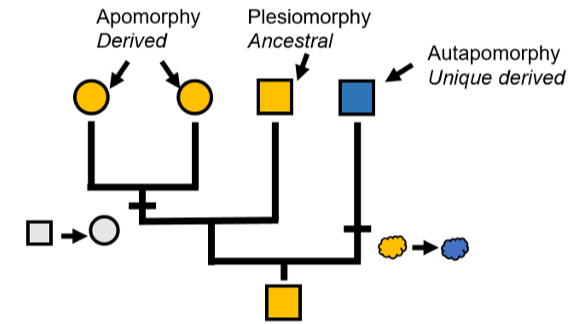
Image occlusion: name the hidden labels
16
Define homoplasy
Character shared by different taxa but not inherited from a common ancestor
Evolved independently in each species
Evolved independently in each species
17
Outline the differences between cladograms and phylogenies
Cladograms:
Represent hypothesis about evolutionary relationships between groups of taxa as a series of branching events
Phylogenies:
Represent hypothesis of true evolutionary history by incorporating the concept of time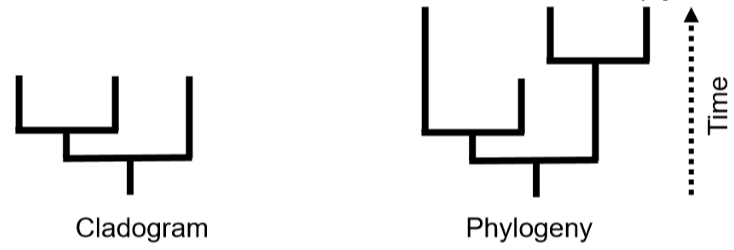
Represent hypothesis about evolutionary relationships between groups of taxa as a series of branching events
Phylogenies:
Represent hypothesis of true evolutionary history by incorporating the concept of time
18
Describe the <1990s (pre-genomics) understanding of primate phylogeny
Believed non-human apes more closely related to each other than modern humans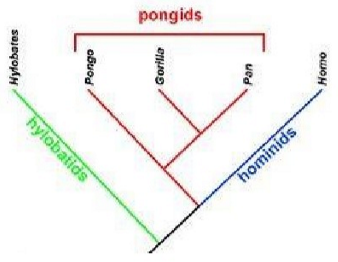
19
Describe the current understanding of primate phylogeny
Chimps and humans more closely related to each other than to gorillas etc.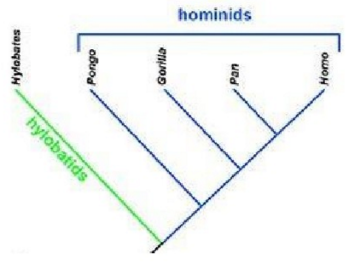
20
What did Kivell and Schmitt find and when?
2009
Independent evolution of knuckle walking in African apes shows that humans did not evolve from a knucle walking ancestor
Independent evolution of knuckle walking in African apes shows that humans did not evolve from a knucle walking ancestor
21
Define fossil
Remains of an organism
22
Define taphonomy
Study of factors involved in fossilisation
23
Define karst
Underground cave system formed by dissolution of soluble rocks
24
Define sinkholes
Collapse of surface layer
25
3 reasons why fossils might be found in caves
Carnivore den
Accidental falls
Deliberate disposal
Accidental falls
Deliberate disposal
26
Why are fossils rarely uncovered in rainforests?
Rapid decomposition
Decay too quick to be buried
Acidic soils
Decay too quick to be buried
Acidic soils
27
Define geochronology
Science of dating
28
Outline the 2 types of geochronology
Absolute dating (exact)
Relative dating (approximate)
Relative dating (approximate)
29
5 methods of absolute dating
Radiometric dating methods - 14C, uranium series, potassium/argon
Electron Spin Resonance (ESR)
Luminescence
Cosmogenic
Molecular clock
Electron Spin Resonance (ESR)
Luminescence
Cosmogenic
Molecular clock
30
2 methods of relative dating
Biostratigraphy
Palaeomagnetism
Palaeomagnetism
31
What do radiometric dating methods measure
Decay of radioactive isotopes
32
Define isotope
Same number of protons and electrons, but different number of neutrons
33
Define half life
Time required for one half of the atomic nuclei of a radioactive sample to decay
34
When might decay occur?
Isotopes that are unstable decay into more stable isotopes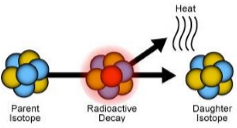
35
What is the benefit of using radiometric dating methods
Decay is highly predictable
36
Define speleothems
Stalagmites/stalactites
37
State the 4 types of radiometric dating
14C
Uranium to thorium
Uranium to lead
Potassium to argon
Uranium to thorium
Uranium to lead
Potassium to argon
38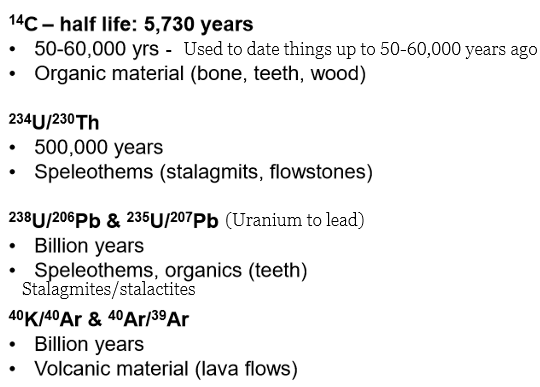
Image occlusion: name the hidden labels
39
Image occlusion: name the hidden labels
40
Image occlusion: name the hidden labels
41
Image occlusion: name the hidden labels
42
Outline electron spin resonance (ESR)
Accumulation of e- in certain minerals that are received from radioactive decay in the materials that surround it
43
What does ESR require?
Estimating dose a sample has received
Measuring dose rate generated by surroundings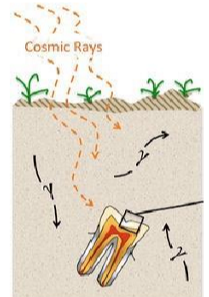
Measuring dose rate generated by surroundings
44
What is ESR used for?
Dating things up to 2 mill years ago
Dating speleothems and organic materials
Dating speleothems and organic materials
45
Outline luminescence
Estimates how long ago mineral grains were last exposed to sunlight or sufficient heating
Buried sediments receive radiation from surrounding isotopes, building up radiation dose
Short daylight exposure causes the dose to be emitted
Exposure to sunlight/heat resets optically stimulated luminescence (OSL) dating clock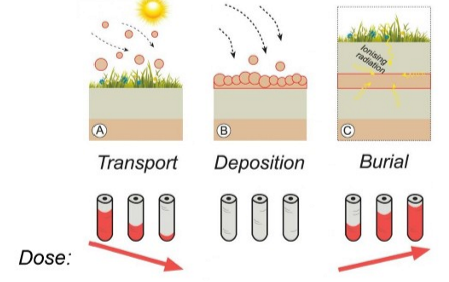
Buried sediments receive radiation from surrounding isotopes, building up radiation dose
Short daylight exposure causes the dose to be emitted
Exposure to sunlight/heat resets optically stimulated luminescence (OSL) dating clock
46
When might luminescence be used?
When looking at a key event in history (eg. heating)
47
Outline molecular clock
Uses mutation rate of biomolecules to deduce when 2 taxa diverged
Looks at DNA/RNA/aa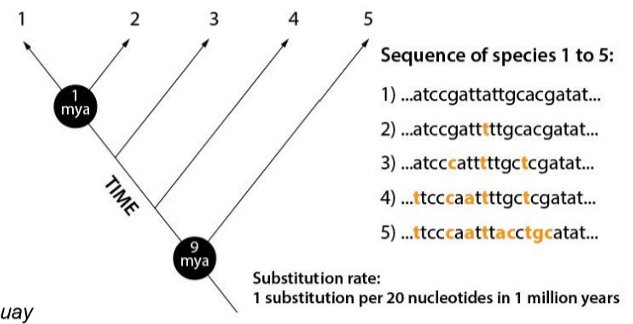
Looks at DNA/RNA/aa
48
Limitations of the molecular clock
- Mutation rate is per generation, generation time evolves
- Species differ in mutation rate
- One site may mutate several times, only 1 can be detected
- Species differ in mutation rate
- One site may mutate several times, only 1 can be detected
49
Outline biostratigraphy
Correlation of stratigraphic units using fossils
Comparing type of animal that exists in a particular site to other site where the same animal has been found
Comparing type of animal that exists in a particular site to other site where the same animal has been found
50
What is geomagnetic reversal
Statistically random change in Earth's magneitc field
51
Outline magnetostratigraphy
Dating based on polarity of Earth's magnetic field at time layer was deposited
Polarity of magnetic field recorded upon deposition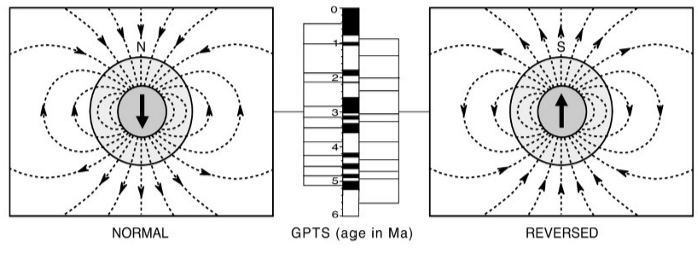
Polarity of magnetic field recorded upon deposition
52
When is magnetostratigraphy used?
To date volcanic deposits
53
Define chron
Long periods of consistent polarity