All cards
1
A gas mixture consists of 2 kg of $H_2$ and 32 kg of $O_2$. What are mole fractions of $H_2$ and $O_2$, respectively?
- 2/34, 32/34
- 0.2, 0.8
- 0.4, 0.6
- 0.5, 0.5
- 0.1, 0.9
2
A gas mixture consists of 16 kmol of $H_2$ and 2 kmol of $O_2$. What are the mass and mole fractions of $H_2$, respectively?
- 1/3, 2/3
- 2/18, 16/18
- 2/3, 2/18
- 1/3, 16/18
- 16/18, 2/18
3
0.5 $m^3$ of oxygen gas at 100 kPa and 300 K is mixed with 0.5 $m^3$ of nitrogen gas at 100 kPa and 300 k. If the mixture volume and temperature are 1 $m^3$ and 300 K, what is the pressure of the mixture?
- 10 kPa
- 25 kPa
- 50 kPa
- 100 kPa
- 200 kPa
4
A 2 $m^3 $ tank contains a gas mixture that consists of 1 kmol of $O_2$ and 3 kmol of $N_2$ at 100 kPa and 500 K. What would be the pressure of $O_2$ if it existed alone in this tank at 500K?
- 25 kPa
- 50 kPa
- 75 kPa
- 100 kPa
- 200 kPa
5
Is this statement correct? The temperature of an ideal gas mixture is equal to the sum of the temperatures of each individual gas in the mixture. If not, how would you correct it?
No, the temperature of a gas mixture is equal to the temperature of the individual gas components
6
Is this statement correct? The volume of an ideal gas mixture is equal to the sum of the volumes of each individual gas in the mixture. If not, how would you correct it?
The volume of a gas mixture is equal to the sum of the volumes each gas would occupy if existed alone ast the mixture temperature and pressure
7
What is the difference between the component pressure and partial pressure? When are these two equivalent?
Component pressure is the pressure a component would exert if existed alone at the mixture tempature and volume. Partial pressure is the quantity $y_i$$P_m$ where $y_i$ is the mole fraction of component i. These two are identical for ideal gases
8
What is the difference between the component volume and partial volume? When are these two equivalent?
Component volume is the volume a component would occupy if existed alone at the mixture temperature and pressure. Partial volume is the quantity $y_i$$V_m$ where $y_i$ is the mole fraction of component i. These two are identical for ideal gases
9
Select the incorrect statement regarding specific humidity and relative humidity
- The relative humidity of dry air is zero
- The relative humidity of saturated air is one
- The specific humidity of air increases when it is cooled
- The relative humidity of air decreases when it is heated
- The air that contains the highest possible amount of water vapor is called saturated air
10
Select the incorrect statement regarding the dew-point temperature of air.
- The dew-point temperature is defined as the temperature at which condensation begins when the air is cooled at constant pressure
- The dew-point temperature is the saturation temperature of water corresponding to the vapor pressure
- The dry-bulb temperature and the dew-point temperature of saturated air are identical
- The dry-bulb temperature cannot be above the dew-point temperature
11
What happens during a simple heating process?
- Both temperature and relative humidity increase
- Both temperature and specific humidity increase.
- Temperature increases and relative humidity decreases
- Both specific humidity and relative humidity increase
- Relative humidity decreases and specific humidity increases
12
What happens during a simple cooling process?
- Both temperature and relative humidity decrease
- Relative humidity remains constant and specific humidity decreases
- Specific humidity decreases and relative humidity increases
- Relative humidity increases and specific humidity remains constant
- Relative humidity decreases and specific humidity increases
13
Which two parameters remain nearly constant during an evaportive cooling process?
- Enthalpy and wet-bulb temperature
- Enthalpy and dry-bulb temperature
- Specfic humidity and wet-bulb temperature
- Wet-bulb temperature and relative humidity
- Specific humidity and dry-bulb temperature
14
Is it possible to obtain saturated air from unsaturated air without adding any moisture? Explain.
Yes by cooling the air at constant pressure.
15
What are the processes involved in an ideal Otto cycle?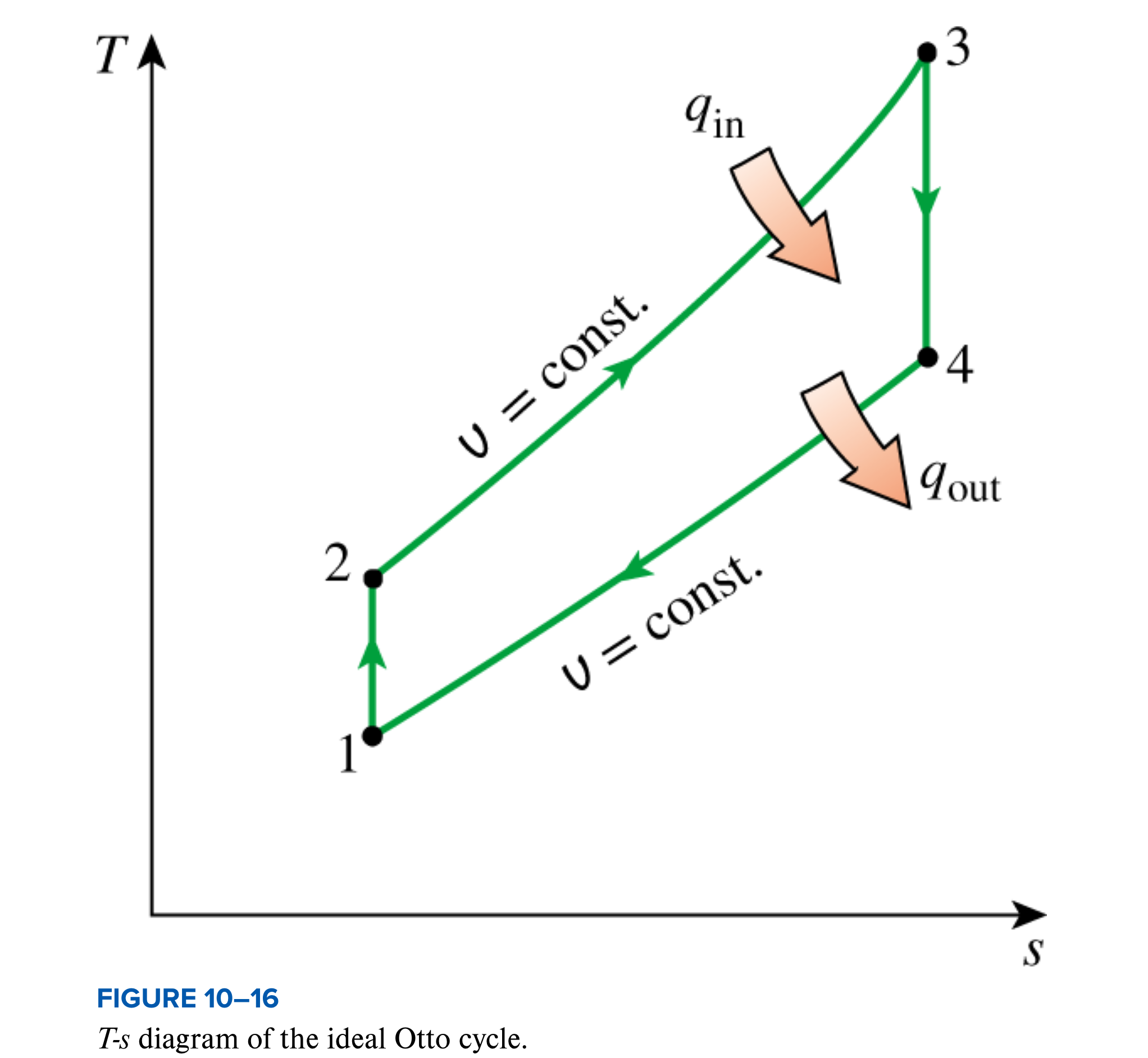
1 -> 2 Isentropic compression
2 -> 3 Constant volume heat addition
3 -> 4 Isentropic expansion
4 -> 1 Constant volume heat rejection
2 -> 3 Constant volume heat addition
3 -> 4 Isentropic expansion
4 -> 1 Constant volume heat rejection
16
What are the processes involved in an ideal Diesel cycle?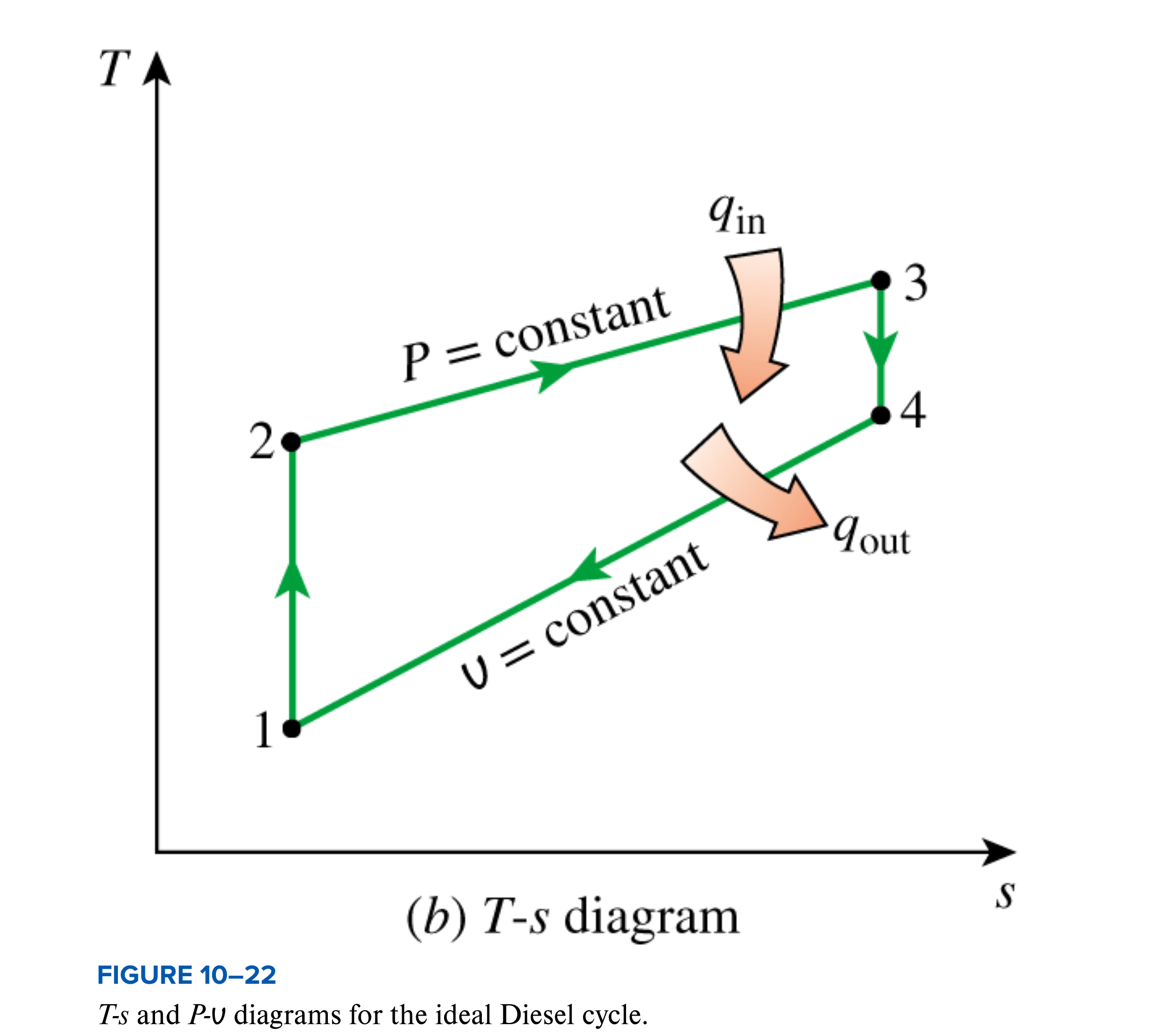
1 -> 2 Isentropic compression
2 -> 3 Constant pressure heat addition
3 -> 4 Isentropic expansion
4 -> 1 Constant volume heat rejection
2 -> 3 Constant pressure heat addition
3 -> 4 Isentropic expansion
4 -> 1 Constant volume heat rejection
17
What are the processes involved in an ideal Brayton cycle?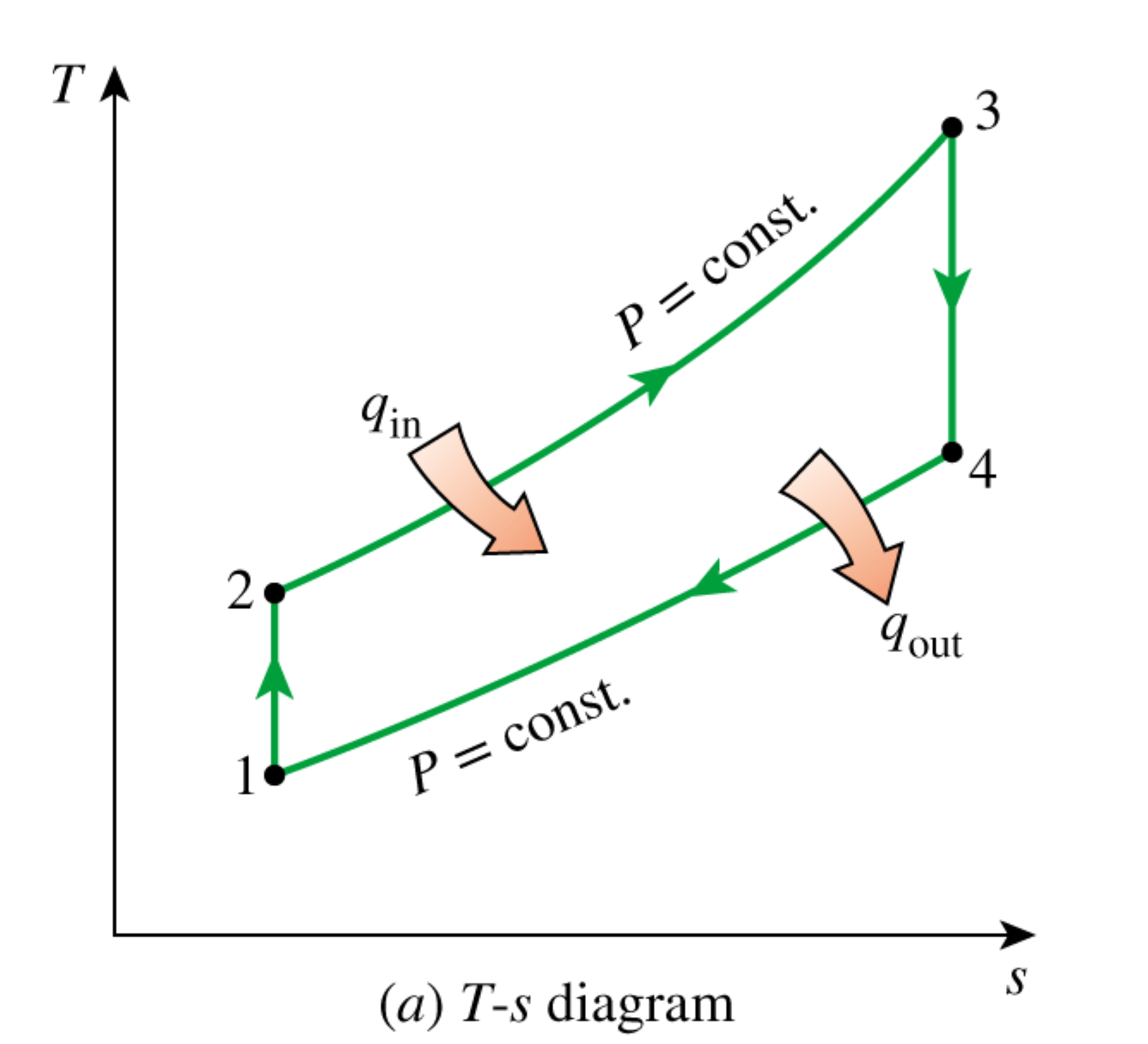
1 -> 2 Isentropic compression in compressor
2 -> 3 Constant pressure heat addition
3 -> 4 Isentropic expansion in d turbine
4 -> 1 Constant pressure heat rejection
2 -> 3 Constant pressure heat addition
3 -> 4 Isentropic expansion in d turbine
4 -> 1 Constant pressure heat rejection
18
What are the processes involved in an ideal Rankine cycle?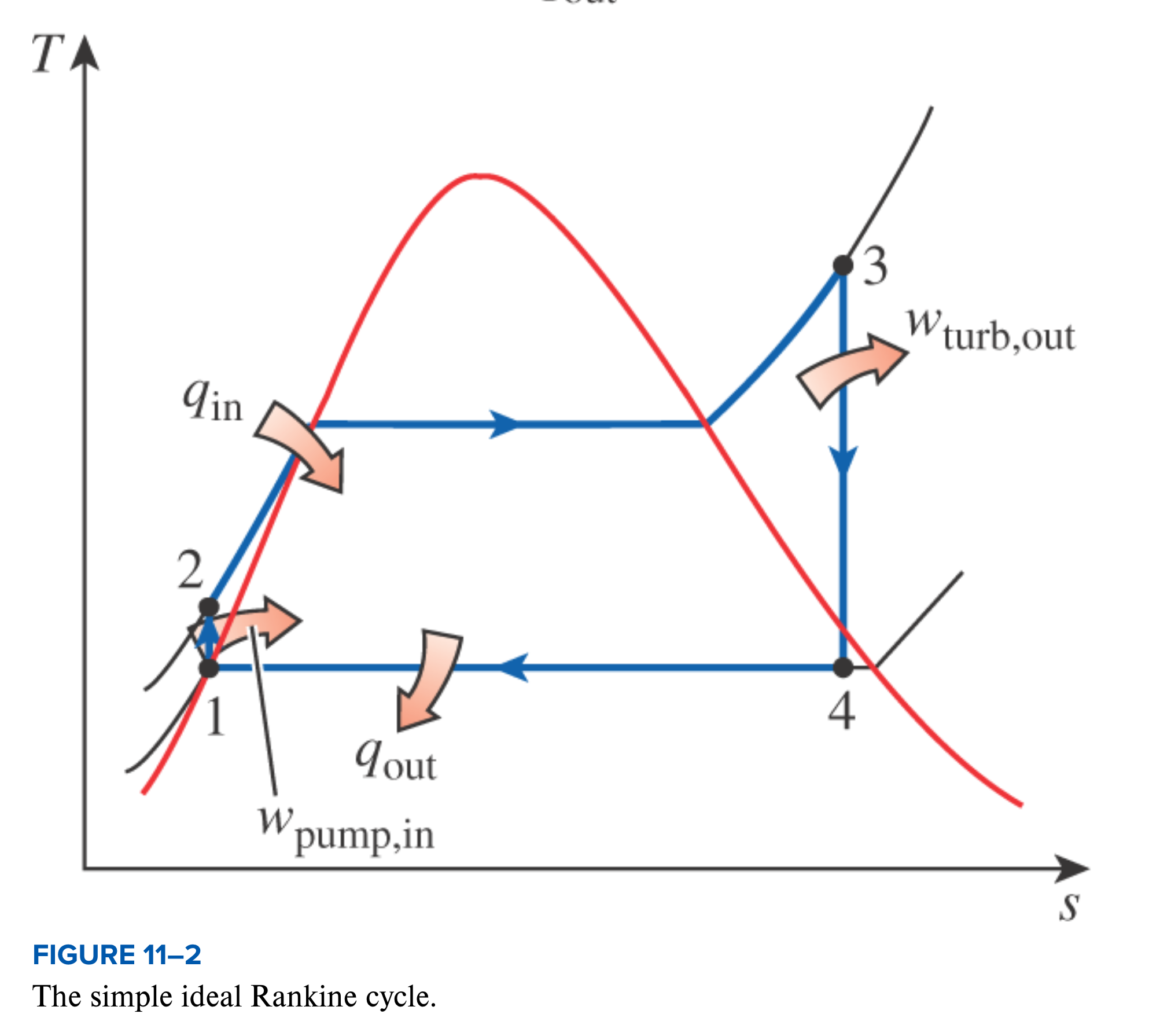
1 -> 2 Isentropic compression in pump
2 -> 3 Constant pressure heat addition in a boiler
3 -> 4 Isentropic expansion in d turbine
4 -> 1 Constant pressure heat rejection in d condeser
2 -> 3 Constant pressure heat addition in a boiler
3 -> 4 Isentropic expansion in d turbine
4 -> 1 Constant pressure heat rejection in d condeser