Chapter 3- Genetics
Study these flashcardsFree · spaced repetition · iPhone, Android, Mac & web
All cards
1
What type of cell is this?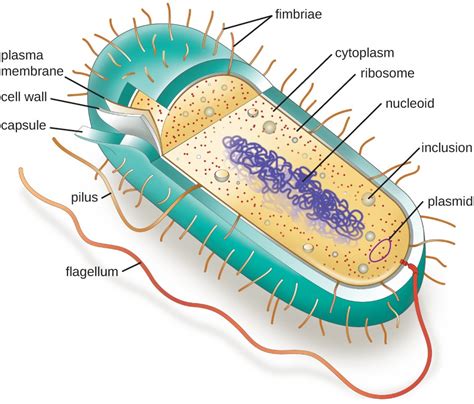
Prokaryote
2
Cell
Basic unit of life
3
Prokaryote
Single celled bacteria with no nucleus or organelles
4
Organelle
Structure within a cell
5
Example of a prokaryote
E. Coli
6
Eukaryote
Multicellular organisms with DNA in the nucleus and membrane-bound organelles
7
What are the two types of eukaryotic cells
Somatic Cells and Gametes
8
Somatic Cells
Body cells
9
How many chromosomes are in somatic cells?
46 chromosomes
10
How do somatic cells replicate?
through mitosis
11
Where are somatic cells found?
Brain, blood, skin, and bone
12
Gametes
sex cells
13
What type of cells are eggs and sperm?
Gametes
14
How many chromsomes are in a gamete cell?
23 chromosomes
15
How do chomosomes replicate?
Meiosis
16
Why do gametes only have 23 chromosomes?
Because when a sperm and egg meet during conception, their chromosomes mix to gain the full set of 46 chromosomes
17
Chromosomes
The packaging of DNA
18
How many chromosomes do humans have?
46 chromosomes
19
In terms of chromosomes, what determines how similar species are to one another?
the DNA inside the chromosomes
20
Genes
Sections of DNA that code for different traits
21
Genome
The entirety of our gene pool made up of our genes and chromosomes
22
Homoplasmic
The DNA located in every cell is more or less the same
23
Mitochondrial DNA (mtDNA)
Heteroplasmic DNA we inherit from our mothers
24
How many chromosomes does mtDNA contain?
37 chromosomes
25
Heteroplasmic
Differs from cell to cell
26
Matriline
maternal lineage
27
What are the three parts to DNA?
Sugar, phosophate, and a nucleotide base
28
What are the nucleotide bases?
Adenine, Thymine, Guanine, and Cytosine
29
What bases compliment each other
Adenine goes with Thymine, and Cytosine goes with Guanine
30
How is DNA structured?
Think of it as a ladder, with sugar and phosphate at the side, and two bases in the middle forming a rung
31
what happens to DNA when a cell divides?
The DNA copies its entire genome
32
What is the result of DNA being unstrung?
Two template strands
33
How do template strands become full dna strands?
Free standing nucleotides bond to these strands in accordance to the base pairing rule, and two strands are then made that were identical to the original strand
34
What can cause genetic variation during DNA duplication?
Copying mistakes
35
Homologous Pairs
Chromosomes that match length
36
How many chromosome pairs are in autosomes?
22 pairs
37
What are the sex chromosomes?
X and Y
38
Karyotype
a way to visualize chromosomes
39
How are chromosomes numbered on karyotypes?
They're numbered by size
40
What chromosome comes last on a karyotype?
The sex chromosome
41
Diploid cells
regular cells with 46 chromosomes
42
Haploid cells
egg and sperm cells with 23 chromosomes
43
Embryological Development
The developing of organs and tissues post-zygote stage
44
Mitosis
Cell division; the splitting of cells for the sake of duplication
45
What is the process shown above??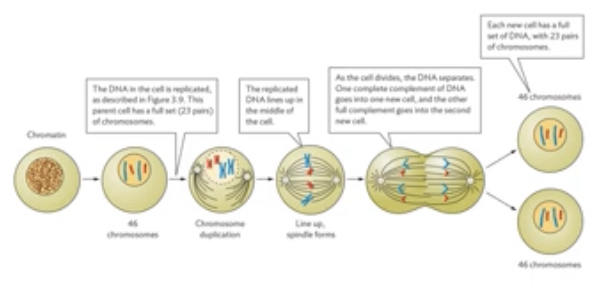
Mitosis
46
What are the steps of mitosis?
1) Cell starts off as a single diploid cells with 46 chromosomes
2)Chromosomes unwind, and DNA attaches itself to three nucleotide bases
3)Chromosomes line up in the middle
4)Cells pull apart into two daughter cells with matching DNA
2)Chromosomes unwind, and DNA attaches itself to three nucleotide bases
3)Chromosomes line up in the middle
4)Cells pull apart into two daughter cells with matching DNA
47
Do haploids have chromosome pairs?
no
48
Recombination
a chunk of chromosome from one parent intertwining with another chromosome from the other parent
49
Haplotypes
clusters of genes that are close to each other on chromosomes
50
Translocations
non-homologous chromosomes
51
What are the steps to Meiosis?
1) DNA replicates
2) homologous chromosomes pair up
3)cells divide into two identical daughter cells
4) cells divide again resulting in 4 daughter cells with 23 chromosomes each
2) homologous chromosomes pair up
3)cells divide into two identical daughter cells
4) cells divide again resulting in 4 daughter cells with 23 chromosomes each
52
What is the ratio of phenotypes between two heterozygous dominant parents?
9:3:3:1
53
What does DNA code for?
proteins
54
Proteins
What bodies are made of
55
Enzymes
catalyze chemical reactions
56
example of an enzyme
lactase-breaks down lactose in milk products
57
strucutral proteins
give structure to support to tissues
58
example of a structural protein
keratin-hair; collagen-bone
59
Gas transport proteins
Carry vital gases to tissues
60
example of a gas transport protein
hemoglobin-oxygen
61
Antibodies
part of the immune system
62
example of an antibody
anti-a and anti-b in ABO Blood system
63
Hormones
regulate metabolism
64
example of a hormone
insulin- regulates metabolism of carbs and fats
65
Mechanical Proteins
carry out specific functions or work
66
example of mechanical proteins
actin and myosin- helps muscles contract
67
Nutrients
Provide vital nutrients to tissues
68
How many amino acids can humans manufacture?
12
69
How many amino acids have to be consumed by humans?
8
70
What is the product of amino acids combining?
amino acid chains that carry different properties
71
What do amino acid chains become?
proteins
72
Codones
groups of three nucelotide base pairs that code for proteins
73
protein synthesis
The process in which DNA code is turned into a chain of amino acids
74
transcription
the process of turning DNA into mRNA
75
What part of the DNA is unwound during Transcription?
The gene
76
What amino acids are in the process of transcription?
Adenine, Cytosine, Guanine, and Uracil
77
What happens when a gene is transcribed
What happens when a gene is transcribed
mRNA leaves the nucelus and finds ribosomes in the cytoplasm
78
Translation
the process of turning transcribed mRNA into amino acid chains
79
Process of Translation
1)three nucleotides (a codon) are read by the ribosome and paired with an anticodon
2)anticodons are attached to a specific amino acid in a structure called a transfer RNA (tRNA)
3) groups of three continue until the stop sequence, amino acid chain is released in cytoplasm and form with other three-dimensional proteins
2)anticodons are attached to a specific amino acid in a structure called a transfer RNA (tRNA)
3) groups of three continue until the stop sequence, amino acid chain is released in cytoplasm and form with other three-dimensional proteins
80
What makes up 5% of the genome? what about the other 95%
Structural genes; regulatory genes
81
Regulatory Genes
turns genes on and off; regulate the amount of protein produced
82
homeotic (hox) genes
determines the general form of a creature's body
83
what are the three blood types?
A, B, and O
84
How can a blood type A and blood type B have a child with type O
If both parents are dominant recessive blood types AO and BO, they can have an O baby
85
Can a man with blood type AB be the father of a baby with blood type O?
No, because that man does not have the possibility of having an O gene
86
Law of Segregation
the mother and the father contribute equally to the offspring’s genetic makeup
87
Codominant
when two dominant alleles are equally expressed
88
Polygenic
multiple genes are responsible for one phenotype
89
What are examples of polygenic features?
skin color and height
90
Pleiotropic
influences many different phenotypes
91
Epigenetics
chemical changes in the genome affecting how the DNA is sued in production of proteins, without altering DNA sequences; environment affects genes
92
Methylation
the attachment of a methyl group to DNA; affects gene expression
93
How can a gene go through methylation?
Through extreme temperatures, chemicals, disease, or poor nutrition