Companion Animal Science: Unit 2
Study these flashcardsFree · spaced repetition · iPhone, Android, Mac & web
All cards
1
Carries nutrients and fresh O2 throughout body
Remove wastes (eg CO2) from cells of the body
Remove wastes (eg CO2) from cells of the body
circulatory system
2
responsible for propulsion and movement of blood through body
heart
3
carry blood away from the heart
arteries, arterioles
4
site of gas exchange
capillaries
5
return blood back to the heart
veins, venules
6
blood that passes through 2 capillary beds before returning to the heart (Gastrointestinal tract and liver)
portal circulation
7
Subset of the circulatory system and immune system
Drainage system that removes excess fluid from body tissue and returns to the bloodstream
one directional
Drainage system that removes excess fluid from body tissue and returns to the bloodstream
one directional
lymphatic system
8
recovery fluid in lymphatic system
lymph
9
part of the lymphatic system that serve as filters that “clean” the fluid before reaching the bloodstream
store immune system cells that attack and destroy harmful substances like bacteria
store immune system cells that attack and destroy harmful substances like bacteria
lymph nodes
10
Primary lymphoid organs - lymphocyte production
thymus, bone marrow
11
Secondary lymphoid organs - white blood cell production, stores and filters blood
spleen, lymph nodes, tonsils and adenoids
12
Help diagnose any change in heart size
Measured by counting number of vertebrae, no actual units
Sum of long + short axis (length + width of heart respectively, lined up with spine)
measured on radiographs
Measured by counting number of vertebrae, no actual units
Sum of long + short axis (length + width of heart respectively, lined up with spine)
measured on radiographs
vertebral heart score (VHS)
13
normal VHS score range for dogs
8.5 - 10.9 V
14
normal VHS score range for cats
6.8 - 8.1 V
15
Left ventricle, chamber that pumps oxygenated blood to the body, is enlarged
Heart does not have the same ability to pump enough oxygen-rich blood to the body
Can lead to congestive heart failure (Fluid in the heart backs up into the lungs)
Heart does not have the same ability to pump enough oxygen-rich blood to the body
Can lead to congestive heart failure (Fluid in the heart backs up into the lungs)
dilated cardiomyopathy (DCM)
16
disease that can be caused by a taurine deficiency in diet of cats
dilated cardiomyopathy
17
Long-term condition
Heart cannot handle the amount of blood it should, blood builds up in other parts of the body (fluid accumulation)
Fluid leaks out of veins and capillaries
Leaks due to higher pressure from too much fluid
Dogs and cats show difficulty in breathing and a higher respiratory rate
Heart cannot handle the amount of blood it should, blood builds up in other parts of the body (fluid accumulation)
Fluid leaks out of veins and capillaries
Leaks due to higher pressure from too much fluid
Dogs and cats show difficulty in breathing and a higher respiratory rate
congestive heart failure
18
Caused by parasitic worm
Transmitted by mosquito bite
Worms live inside host heart, lungs, and surrounding blood vessels
Cough, lethargy, decreased appetite, vomiting
100% preventable
Transmitted by mosquito bite
Worms live inside host heart, lungs, and surrounding blood vessels
Cough, lethargy, decreased appetite, vomiting
100% preventable
heartworm
19
parasitic worm responsible for heartworm
Dirofilaria immitis
20
Cancer of the white blood cells (lymphocytes)
Most common cancer in dogs and cats
General cause is unknown
15-20% of cancer in dogs and 33% in cats
Most common cancer in dogs and cats
General cause is unknown
15-20% of cancer in dogs and 33% in cats
lymphoma
21
Cancer of the endothelial cells that line blood vessels - very aggressive
Canine disease (5-7% of tumors seen in dogs)
Typically affects spleen and heart
Highly vascularized tumors
Tumors filled with blood, rupture easily causing internal bleeding
Canine disease (5-7% of tumors seen in dogs)
Typically affects spleen and heart
Highly vascularized tumors
Tumors filled with blood, rupture easily causing internal bleeding
hemangiosarcoma
22
Most common skin cancer in dogs
Skin tumor that starts with immune system mast cells
Can be on skin or subcutaneous but will ultimately metastasize to other organs including spleen, liver, intestine, and bone marrow
Most tumors diagnosed via fine needle aspiration, involves removing cells directly from the tumor
Skin tumor that starts with immune system mast cells
Can be on skin or subcutaneous but will ultimately metastasize to other organs including spleen, liver, intestine, and bone marrow
Most tumors diagnosed via fine needle aspiration, involves removing cells directly from the tumor
mast cell tumor
23
Provides supply of O2 for the body and removes CO2 produced by cells
Warms, humidifies, and filters inspired air, cools
Warms, humidifies, and filters inspired air, cools
respiratory system
24
Opening of the trachea
Series of cartilage plates that protect the lower respiratory tract (lungs) from aspirating food into the trachea
Series of cartilage plates that protect the lower respiratory tract (lungs) from aspirating food into the trachea
larynx (voicebox)
25
Transport air to the lungs
Contains cartilaginous rings to keep airway from collapsing
Contains cartilaginous rings to keep airway from collapsing
trachea
26
House alveoli where gas exchange occurs
lungs
27
vaccine for kennel cough, parainfluenza
bordetella
28
Long term airway inflammation
Cough that is present most days for a minimum duration of two months, without other diseases
Can be caused by long term exposure to smoke, air pollution, allergens, etc
Treatments are for quality of life, can’t be cured
Cough that is present most days for a minimum duration of two months, without other diseases
Can be caused by long term exposure to smoke, air pollution, allergens, etc
Treatments are for quality of life, can’t be cured
COPD/chronic bronchitis
29
cartilage rings weaken/flatten, narrowing the airway
more common in toy breeds
sudden dry cough --> progresses to more consistent cough when pressure around neck (leash)
no cure - medical management
more common in toy breeds
sudden dry cough --> progresses to more consistent cough when pressure around neck (leash)
no cure - medical management
tracheal collapse
30
location of sweat glands in dogs and cats
paw pads
31
which has more sweat glands: cats or dogs?
cats
32
used by dogs to dissipate heat via panting
evaporative cooling
33
cooling via contact with cold surfaces
conduction
34
transfer heat through the skin
convection
35
normal temperature for a dog
102
36
temperature of heat stroke for a dog
107
37
sign of heat stress
gums/tongue bright red
38
filters waste material from blood, stores and expels urine
regulates blood volume and body pH
male and female reproduction
regulates blood volume and body pH
male and female reproduction
urogenital system
39
filters blood with waste products
kidney
40
where blood enters the kidney
renal artery
41
where clean blood leaves the kidney
renal vein
42
waste product from protein
urea
43
waste product produced by muscles
creatinine
44
% of urine that is water
95
45
% of urine that is urea
2
46
% of urine that is creatinine, ammonia, uric acid
0.2
47
% of urine that is chloride, sodium, potassium, sulfur, magnesium, sulphate, clacium, phosphate...
2.8
48
analyzes the physical/chemical/microscopic characteristics of urine sample
urinalysis
49
physical characteristics of urinalysis
volume, color, odor, turbidity and cloudiness, specific gravity
50
measurement that reflects solute concentration in urinalysis
specific gravity
51
normal dog specific gravity
1.025
52
normal cat specific gravity
1.030
53
transparent urine
overhydration
54
pale yellow urine
ideal
55
dark yellow urine
dehydrated
56
pink or red urine
possible UTI, kidney infection
57
green urine
possible kidney problems
58
brown urine
possible internal bleeding (immediate medical attention)
59
ideal urine pH range in cats
6.3-6.6
60
ideal urine pH for dogs
7.0-7.5
61
urine chemical analysis: presence indicates diabetes or kidney disease
glucose
62
urine chemical analysis: fat breakdown, indicates fasting/starvation, cancer, diabetic ketoacidosis
ketones
63
urine chemical analysis: presence indicates infection or stones
blood
64
urine chemical analysis: presence indicates kidney disease or tumor
protein
65
urine chemical analysis: presence indicates liver disease
bilirubin
66
what is looked for in a microscopic urine examination
red blood cells, white blood cells, epithelial cells, crystals (bad)
67
cells that line the surface of organs and tissues
epithelial cells
68
typically develope in the bladder or urethra
crystals or stones
69
stone caused from diet (pH of urine needs to be more acidic)
struvite
70
stone caused by genetic abnormality in protein metabolism
need a low protein diet, particularly low in sulfur amino acids
need a low protein diet, particularly low in sulfur amino acids
cystine
71
stone caused by genetics, lack of oxalobacter microbe in the gut
difficult to manage, need a low calcium diet
difficult to manage, need a low calcium diet
oxalate
72
stones are most common in ____ _____ (have a narrower urethra)
male cats
73
obtains food, digests and abosrbs food, supplies body with needed nutrients
digestive system
74
type of digestion, physically decreasing particle size (chewing, peristalsis & contractions)
mechanical
75
type of digestion, use of acids to break down particles (HCl in stomach)
chemical
76
type of digestion, used to break down protein (proteases), fats (lipases), and carbohydrates (disaccharidases)
enzymatic
77
start of enzymatic digestion in cats/dogs
stomach
78
major site of enzymatic digestion
small intestine
79
type of digestion where microbes process fiber that mammalian enzymes cannot break down
fermentative
80
location of fermentative digestion
large intestine
81
dogs and cats have a shorter _____ _____
gastrointestinal tract (GIT)
82
microbes do not _____ as fast in a shorter GIT
colonize
83
components of the gastrointestinal tract
mouth, esophagus, stomach, small intestine, large intestine
84
responsible for prehension, mastication, saliva
mouth
85
dogs and cats lack alpha-amylase enzyme in their saliva and are therefore unable to digest ___ in the mouth
carbohydrates
86
transports food from the mouth to the stomach
esophagus
87
short term storage, enzymatic digestion initiated, grinds and mixes foodstuffs with gastric secretions, highly acidic (pH 1-3)
stomach
88
enzymatic digestion and absorption of nutrients
longest part of the digestive tract
mucosal folds, villi, and microvilli increase surface area
longest part of the digestive tract
mucosal folds, villi, and microvilli increase surface area
small intestine
89
3 sections of the small intestine
duodenum, jejunum, ileum
90
when the bolus of food arrives in the small intestine, the pacreas releases pacreatic secretion like _______ ________ (proteases, lipases, amylases) and _________ (normalizes the pH)
digestive enzymes, bicarbonate
91
when the bolus of food arrives in the small intestine, the liver releases ______ from the ________
bile, gallbladder
92
act as a detergent, emulsify fat into droplets (essential for fat digestion)
bile acids
93
responsible for water and electrolyte absorption
formation and storage of feces
microbia fermentation (minor in dogs and cats)
formation and storage of feces
microbia fermentation (minor in dogs and cats)
large intestine
94
3 sections of the large intestine
cecum, colon, rectum
95
Chronic inflammation of the GI tract caused by abnormal “local” immune response
Causes chronic vomiting and diarrhea
Exact cause not well understood - likely combination of many factors
Causes chronic vomiting and diarrhea
Exact cause not well understood - likely combination of many factors
inflammatory bowel disease
96
Acute or chronic
Can be caused by infection, toxins, genetics, age
Xylitol - sugar alternative that may cause acute liver failure in some dogs
Lethargy, decreased appetite, weight loss, diarrhea, increased thirst
Jaundice - yellowing of skiing and mucous membranes
Can be caused by infection, toxins, genetics, age
Xylitol - sugar alternative that may cause acute liver failure in some dogs
Lethargy, decreased appetite, weight loss, diarrhea, increased thirst
Jaundice - yellowing of skiing and mucous membranes
liver disease (general)
97
blood work done to diagnose liver disease: increased in blood when liver cells are damaged
alanine aminotransferase (ALT)
98
blood work done to diagnose liver disease: also increased in blood when liver cells are damaged but not liver specific
aspartate transaminase (AST)
99
blood work done to diagnose liver disease: increased in blood when obstruction of bile flow occurs
alkaline phosphatase (ALP)
100
produces and secretes hormones to control and regulate the body
powerful system, but relatively small
powerful system, but relatively small
endocrine system
101
chemical messangers with many different functions
travel throughout the body
travel throughout the body
hormones
102
"brain" of the endocrine system
secretes hormones that stimulate or suppress the release of hormones in the pituitary gland
secretes hormones that stimulate or suppress the release of hormones in the pituitary gland
hypothalamus
103
"master switch"
produces hormones regulating growth, metabolism, reproduction, lactation, and water balance
produces hormones regulating growth, metabolism, reproduction, lactation, and water balance
anterior pituitary (attached to hypothalamus)
104
growth hormone produced by anterior pituitary, stimulates the thyroid
ACTH
105
underproduction of growth hormone, also causes hair loss
dwarfism
106
overproduction of growth hormone, causes constant stress response = increased cortisol
Cushing's disease
107
produces digestive enzymes for digestion (exocrine)
produces insulin and glucagon to regulate blood glucose concentration (endocrine)
produces insulin and glucagon to regulate blood glucose concentration (endocrine)
pancreas
108
released when blood glucose is high
insulin
109
released when blood glucose is low
glucagon
110
produces hormones responsible for maintaining a healthy metabolism
thyroxine (T4) and triiodothyronine (T3)
thyroxine (T4) and triiodothyronine (T3)
thyroid
111
part of the thyroid, regulates Ca, P, and vitamin D levels
always consider with bone disorders
always consider with bone disorders
parathyroid
112
part of the thyroid, produce steroid hormones, maintains water balance and androgens, maintains carb, fat, and stress metabolism
adrenal glands
113
sex hormones
androgens
114
overproduction of hormones (causes Cushing's disease, common in middle-age, older dogs)
hyperadrenocorticism
115
thyroid dysfunction: decreased production of thyroid hormones
low T4
sluggish, gain weight
poor hair coat, lethargy, poor cold tolerance
common in older dogs
low T4
sluggish, gain weight
poor hair coat, lethargy, poor cold tolerance
common in older dogs
hypothyroidism
116
thyroid dysfunction: increased production of thyroid hormones
excessive T4
weight loss, increased appetite, vomiting, diarrhea
hyperactivity, high blood pressure
common in older cats (rare in dogs)
excessive T4
weight loss, increased appetite, vomiting, diarrhea
hyperactivity, high blood pressure
common in older cats (rare in dogs)
hyperthyroidism
117
underproduction of insulin by pancreas
more common in dogs
more common in dogs
type 1 diabetes
118
insulin insensitivity, body does not respond properly to insulin
more common in cats
more common in cats
type 2 diabetes
119
Symptoms for _____ include:
Weight loss
Decreased appetite
Increased thirst
Cloudy eyes (dogs)
Increased urination
Weight loss
Decreased appetite
Increased thirst
Cloudy eyes (dogs)
Increased urination
diabetes
120
treatment for diabetes
exercise and diet change (high protein + low carb + insulin injections, exercise makes body more sensitive to insulin)
121
too much glucose in blood as a result from diabetes overflows into urine, causing ______ which is very damaging to cells
dehydration
122
major components of the circulatory system
heart, arteries, veins, venules, capillaries, lymphatic system, portal circulation
123
major components of the respiratory system
nose, larynx, trachea, lungs, breathing muscles (diaphram and intercostal)
124
major components of the urogenital system
kidney, ureter, bladder, urethra, male/female reproductive structures
125
major components of the digestive system
mouth, esophagus, stomach, small intestine, large intestine, liver, gallbladder, pancreas
126
major components of the endocrine system
pituitary gland, thyroid gland, parathyroid glands, pancreas, adrenal glands, testes, ovaries
127
the pros of preventative medicine are that it helps prevent serious _____, prevents ______ of disease to other animals, and increases overall _____
disease, spread, health
128
the cons of preventative treatment are that it can have negative _____ ______, it can be ______, and it can be hard to ______ for some
side effects, expensive, access
129
vaccination, deworming, and flea and tick protection are types of _____ _______
preventative medicine
130
natural includes maternal antibodies, artificial includes monoclonal antibodies
passive immunity
131
natural inludes infection, artificial includes vaccination
active immunity
132
a toxin of foreign body that triggers an immune response
antigen
133
produced when the body interacts with a specific antigen or foreign body (eg immunoglobulin)
tags foreign disease for destruction when it enters the body again
tags foreign disease for destruction when it enters the body again
antibody
134
injection of a weakened version of a virus or bacteria
allows the body to create antibodies against virus/ bacteria
allows the body to create antibodies against virus/ bacteria
vaccine
135
the active ingredient of all vaccines is an ______
antigen
136
vaccine type:
weakened form of the agent, does not cause disease
results in strong immunity
used for canine distemper, adenovirus, parvo
weakened form of the agent, does not cause disease
results in strong immunity
used for canine distemper, adenovirus, parvo
live attenuated
137
vaccine type:
killed form (agent cannot cause disease)
immunity not as strong as live attenuated
used for rabies, coronavirus, lepto
killed form (agent cannot cause disease)
immunity not as strong as live attenuated
used for rabies, coronavirus, lepto
inactivated
138
compound added to strengthen the immune response for an inactivated vaccine
adjuvant
139
true/false: immunity typically develops immediately after vaccination
false (can take weeks to develop)
140
vaccines that are recommended for all pets
core
141
lifestyle vaccines (recommended by vets based on pet's medical history/lifestyle)
non-core
142
"the distemper vaccine" for dogs, core
DHPP
143
DHPP
Transmission: aerosol/direct
Respiratory, digestive, nervous
Fever, cough, diarrhea, seizures
Highly contagious
Found in many species outside of dogs
Transmission: aerosol/direct
Respiratory, digestive, nervous
Fever, cough, diarrhea, seizures
Highly contagious
Found in many species outside of dogs
canine distemper
144
DHPP
Transmission: direct
Liver, kidney, nervous
Fever, liver failure, rapidly fatal in puppies
Transmission: direct
Liver, kidney, nervous
Fever, liver failure, rapidly fatal in puppies
infectious canine hepatitus
145
DHPP
Transmission: direct contact (virus lives in soil, very hardy)
Digestive, lymph, bone marrow, heart
Fever, severe bloody diarrhea, dehydration
Transmission: direct contact (virus lives in soil, very hardy)
Digestive, lymph, bone marrow, heart
Fever, severe bloody diarrhea, dehydration
parvovirus
146
DHPP
Transmission: aerosol/direct
Respiratory
Cough (part of kennel cough complex)
Transmission: aerosol/direct
Respiratory
Cough (part of kennel cough complex)
parainfluenza
147
five-way vaccine that includes viral diseases in DHPP and leptospirosis
DHLPP
148
DHLPP
Transmission: water sources where wildlife frequent
Kidneys, liver, joint, stiffness/pain
Fever, cough, diarrhea, seizures
Higher potential for vaccine reactions when given in a combination vaccine
Many vets think it should be given separately
Not necessarily needed in areas where the disease is extremely rare or if dog has a sheltered lifestyle
Vaccine gives a short duration of immunity (<1 year)
Transmission: water sources where wildlife frequent
Kidneys, liver, joint, stiffness/pain
Fever, cough, diarrhea, seizures
Higher potential for vaccine reactions when given in a combination vaccine
Many vets think it should be given separately
Not necessarily needed in areas where the disease is extremely rare or if dog has a sheltered lifestyle
Vaccine gives a short duration of immunity (<1 year)
leptospirosis (lepto, non-core)
149
Transmission: bite from infected animal (saliva)
Nervous, digestive
Abnormal behavior, aggression, excessive salivation, paralysis, death
Infects central nervous system of mammals, ultimately causing disease in brain and death
Most common Iowa vectors = bats, skunks, coyotes, foxes, raccoons
2020 - 12 positive cases, all bats
Nervous, digestive
Abnormal behavior, aggression, excessive salivation, paralysis, death
Infects central nervous system of mammals, ultimately causing disease in brain and death
Most common Iowa vectors = bats, skunks, coyotes, foxes, raccoons
2020 - 12 positive cases, all bats
rabies (core)
150
(huge family of viruses)
Transmission: direct
Digestive, upper respiratory
Lethargy, diarrhea
Transmission: direct
Digestive, upper respiratory
Lethargy, diarrhea
canine coronavirus
151
primary DHPP shot is given to dogs in first ______ weeks
6-8 (boosters every 2 weeks after)
152
the rabies vaccine must be given before __ months by Iowa law
6
153
3 in 1 core vaccine for cats
FVRCP
154
FVRCP
Transmission: aerosol/direct
Respiratory, eye
Eye infection, coughing, sneezing, nasal discharge
Transmission: aerosol/direct
Respiratory, eye
Eye infection, coughing, sneezing, nasal discharge
feline rhinotracheitis/herpes virus 1
155
FVRCP
Transmission: aerosol/direct
Respiratory, eye
Gum/dental issues, respiratory infection, eye infection, hair loss around the nose and hepatitis with some strains
Transmission: aerosol/direct
Respiratory, eye
Gum/dental issues, respiratory infection, eye infection, hair loss around the nose and hepatitis with some strains
calicivirus (FVC)
156
FVRCP
Transmission: direct contact (virus lives in soil)
Digestive, lymph, bone marrow, heart
Severe abdominal pain, diarrhea, dull haircoat, fatal
Transmission: direct contact (virus lives in soil)
Digestive, lymph, bone marrow, heart
Severe abdominal pain, diarrhea, dull haircoat, fatal
feline panleukopenia (FPV)
157
caused by mother (queen) being infected by feline panleukopenia (FPV)
kittens are infected in womb during late stages of pregnacy
Cerebellum → equilibrium
Wobbly
Adapt very well
Live long/kind of normal lives
kittens are infected in womb during late stages of pregnacy
Cerebellum → equilibrium
Wobbly
Adapt very well
Live long/kind of normal lives
cerebellar hypoplasia
158
Contagious virus, causing terminal diseases
Cancer (lymphoma), blood disorders, weak immune system
Anemia = common symptom
Transmitted through saliva (bite wound, mutual grooming, etc)
Core vaccine for all cats <1 year of age
Non-core vaccine for cats >1 year of age that have no potential for exposure to infected cats
Cancer (lymphoma), blood disorders, weak immune system
Anemia = common symptom
Transmitted through saliva (bite wound, mutual grooming, etc)
Core vaccine for all cats <1 year of age
Non-core vaccine for cats >1 year of age that have no potential for exposure to infected cats
feline leukemia virus (FeLV)
159
Develop a compromised immune system
Outwardly healthy for 2-3 years
Bone marrow becomes infected
New blood cells will contain more virus
“Persistent viremia” = constant presence of virus in bloodstream
Lymphoma = final stage of disease
More common in kittens
Outwardly healthy for 2-3 years
Bone marrow becomes infected
New blood cells will contain more virus
“Persistent viremia” = constant presence of virus in bloodstream
Lymphoma = final stage of disease
More common in kittens
progressive FeLV infection (bad outcome, 30-40% of cases)
160
May test positive at first, then negative 3-4 weeks later
Virus inserts into cellular DNA
Doesn’t kill cells
Body eventually rejects abnormal cells or cat becomes sick
May result in immunity or develop into active infection
Pregnant cats produce positive kittens
Virus inserts into cellular DNA
Doesn’t kill cells
Body eventually rejects abnormal cells or cat becomes sick
May result in immunity or develop into active infection
Pregnant cats produce positive kittens
regressive FeLV infection (30-40% of cases)
161
No viraemia detectable
Antibody development
Antibody development
abortive FeLV infection (20-30% of cases)
162
presence of virus in the bloodstream
viremia
163
Affects up to 5% of cat population
Targets white blood cells
Causes immunosuppression
Slow acting, infected for life
Bouts of fever, diarrhea, eye / bladder / respiratory infections
Poor coat
Typically transmitted directly though cat to cat bites
Vaccine not effective - high risk of sarcoma, led to false positives
No longer available
Prevention is key, keep cats inside, isolated
Targets white blood cells
Causes immunosuppression
Slow acting, infected for life
Bouts of fever, diarrhea, eye / bladder / respiratory infections
Poor coat
Typically transmitted directly though cat to cat bites
Vaccine not effective - high risk of sarcoma, led to false positives
No longer available
Prevention is key, keep cats inside, isolated
feline immunodeficiency virus (FIV)
164
Caused by a mutation in strains of feline coronavirus
Most cats (> 50%) will have a coronavirus but won’t necessarily develop this disease
Not common but fatal - typically in cats < 2 years old
Higher risk breeds: Abyssinian, Bengal, Birman, Himalayan, Ragdoll, Devon Rex
Transmitted fecal-oral
Initial symptoms - lethargy, decreased appetite, weight loss, fever
Neurological - seizures, ataxia
Fluid in body cavities
Histology is only true diagnosis (difficult)
Effectiveness of vaccine is questionable
Most cats (> 50%) will have a coronavirus but won’t necessarily develop this disease
Not common but fatal - typically in cats < 2 years old
Higher risk breeds: Abyssinian, Bengal, Birman, Himalayan, Ragdoll, Devon Rex
Transmitted fecal-oral
Initial symptoms - lethargy, decreased appetite, weight loss, fever
Neurological - seizures, ataxia
Fluid in body cavities
Histology is only true diagnosis (difficult)
Effectiveness of vaccine is questionable
feline infectious peritonitis (FIP)
165
the primary FVRCP vaccine is give to kittens within _____ weeks
6-8 (2 boosters, booster every 2 weeks following)
166
vaccine given in right rear of dog
rabies
167
vaccies given in right shoulder of dog
distemper, lepto
168
vaccine given intranasally in dogs
bordetella
169
vaccine given intraorally in dogs
bordetella
170
vaccines given in left shoulder of dogs
bordetella, influenza
171
vaccines given in left rear of dog
lepto, lyme, coronavirus, rattlesnake
172
true/false: feline vaccinations are commonly given in the shoulders/ rear for cats
false (given on limbs/tail, able to amputate if sarcoma develops)
173
Rare, but important to consider
Cancerous tumors that arise following injections
Cause not established
Surgery, radiation therapy, and chemotherapy
Cancerous tumors that arise following injections
Cause not established
Surgery, radiation therapy, and chemotherapy
sarcomas
174
normal reaction after a vaccine includes _____, _____ ______, and _____ ______
lethargy, slight fever, decreased appetite
175
assume all puppies/kittens have _____
worms
176
__% of dogs estimated to be stool eaters (coprophagia)
24
177
35% of most cases
Most common GI parasite
Transplacental (dogs), transmammary (cats), ingestion of eggs from environment, predation of infected animals
Infections are usually subclinical but many notice diarrhea or weight loss
Most common GI parasite
Transplacental (dogs), transmammary (cats), ingestion of eggs from environment, predation of infected animals
Infections are usually subclinical but many notice diarrhea or weight loss
roundworm (ascarid)
178
Dogs are far more affected than cats (not common in cats in US)
34% of dog cases
Infects large intestine
Ingested from the environment (easy to acquire)
Symptoms:
Diarrhea, blood can be seen
May lead to inflammation, weight loss, anemia
Milbemycin oxime (heartworm med) is effective
34% of dog cases
Infects large intestine
Ingested from the environment (easy to acquire)
Symptoms:
Diarrhea, blood can be seen
May lead to inflammation, weight loss, anemia
Milbemycin oxime (heartworm med) is effective
whipworm (nematode)
179
Typically not seen in stools (owner will see bloody stools)
Blood sucking in the small intestine - causes significant blood loss, can be fatal
Infected by ingesting eggs or penetration via skin, transmammary (dogs only)
Adult cats and dogs develop some immunity
Blood sucking in the small intestine - causes significant blood loss, can be fatal
Infected by ingesting eggs or penetration via skin, transmammary (dogs only)
Adult cats and dogs develop some immunity
hookworm (multiple species)
180
10 different species affect cats, 14 affect dogs
Affects the small intestine
Infected by ingestion of intermediate host: fleas, lice, rodents, rabbits
Typically does not cause major symptoms in cats
Most effective treatment - praziquantel
Affects the small intestine
Infected by ingestion of intermediate host: fleas, lice, rodents, rabbits
Typically does not cause major symptoms in cats
Most effective treatment - praziquantel
tapeworm (cestodes)
181
(more common in dogs)
Caused by a protozoa, treated by sulfadimethoxine (Albon)
Caused by a protozoa, treated by sulfadimethoxine (Albon)
coccidiosis
182
(more common in dogs)
Caused by a protozoa, treated with fenbendazole
Vaccine but efficacy is limited
diarrhea with strong odor common clinical sign
Caused by a protozoa, treated with fenbendazole
Vaccine but efficacy is limited
diarrhea with strong odor common clinical sign
giardia
183
roundworms, hookworms, whipworms, and tapewoms are all sensitive to ______
fenbendazole (panacur)
184
treatment used on tapeworms
praziquantel
185
treatments used on hook and roundworms
ivermectin, pyrantel
186
treatment used for giardia
metronidazole (flagyl, typical for bacterial infection of the gut)
187
treatments used for heartworm
ivermectin, milbemycin oxime, moxidectin (heartgard, sentinel and interceptor, simparcia trio and proheart 6/12)
188
puppies are typically given _______ to prevent endoparasites
fenbendazole (panacur)
189
adults over 6 months are given panacur ____ times annually
1-2
190
lyme disease is treated with the antibiotic _______
doxycycline
191
tick-transmitted disease that causes fever, nose bleeds, and anemia
canine ehrlichiosis
192
tick-transmitted disease that causes similar symptoms to lyme
anaplasma
193
tick-transmitted disease that causes joint pain, swollen lymph nodes, clotting disorders, and neurologic issues
rocky mountain spotted fever
194
tick-transmitted disease that causes animal to be sluggish, feverish and lame, lymph node enlargement, joint pain and stiffness (blacklegged and deer tick)
lyme disease
195
tick-transmitted disease that breaks down blood cells, causes jaundice
babesiosis
196
flea disease transmitted via cat scratches from feral, flea-infested cats
typically cause more generalized skin infections
typically cause more generalized skin infections
bartonella
197
symptoms include excessive scratching, head shaking, ear irritation, “coffee-ground” discharge, strong odor, hair loss and scabs, behavioral changes
ear mites (in cats)
198
external parasite treatment - frontline plus
fipronil, s-methoprene
199
external parasite treatment - bravecto (prescription)
fluralaner
200
external parasite treatment - advantix
imidacloprid/permethrin
201
external parasite treatment - seresto
flumethrin/imidacloprid
202
Parastic infection:
Cats are the only definitive hosts - can but rarely affects cats
Intermediate host - parasite reproduces and makes clones of itself, clusters in cysts
Cats consume prey or meat with cysts
Definitive host - parasite reproduces and forms eggs
Cats then excrete eggs in feces
Pregnant and immunodeficient
2 populations that need to be cautious
⅓ - ½ of infants born to mothers who acquired this parasite during pregnancy are infected
Cats are the only definitive hosts - can but rarely affects cats
Intermediate host - parasite reproduces and makes clones of itself, clusters in cysts
Cats consume prey or meat with cysts
Definitive host - parasite reproduces and forms eggs
Cats then excrete eggs in feces
Pregnant and immunodeficient
2 populations that need to be cautious
⅓ - ½ of infants born to mothers who acquired this parasite during pregnancy are infected
toxoplasma (mothers do not typically experience symptoms)
203
which dog has the ideal length of humerus? (Border Collie or Pharaoh Hound)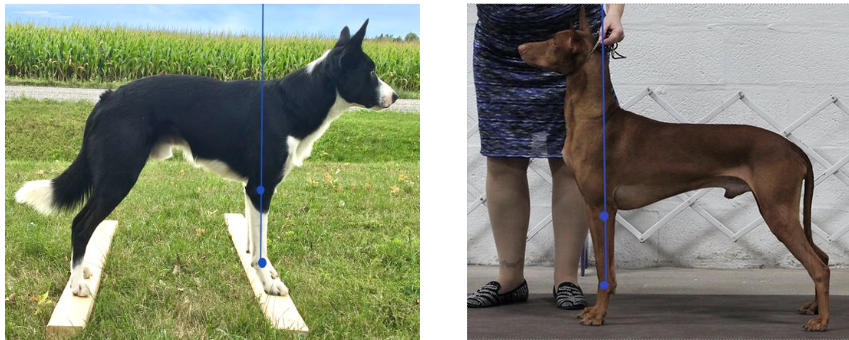
Border Collie (perpendicular line intersects with shoulder area, not neck/ears)
204
which dog has greater hind angulation? (Border Collie or Doberman)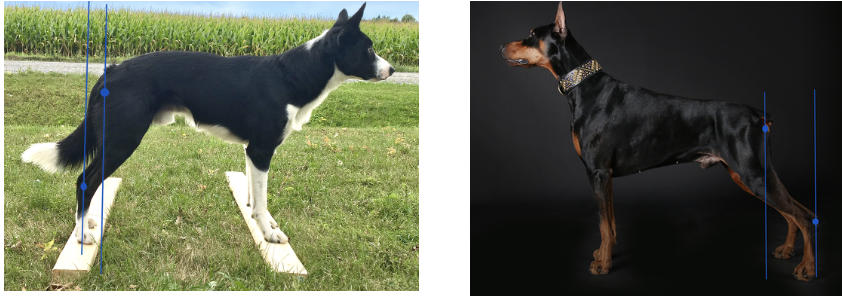
Doberman (ideal angulation dependon the breed)
205
increased rear angulation in dogs means they will have ______ ground speed
faster
206
increased rear angulation in dogs will cause ____ stability overall
less
207
true/false: a straight shoulder in dogs is better than a lay back shoulder
false (causes less stability, less reach and stride length)
208
cardiopulmonary arrest means the animal is _______ and ___ ________
unconscious, not breathing
209
CPR: this dog type should be laid on side and compressions given at highest point of the chest (labs, mid/large breed dogs)
round-chested
210
CPR: this dog type should be laid on side and compressions given right over the point of the heart (boxers, dobies)
keel-chested (and small dogs/cats)
211
CPR: this type of dog should be laid on back and given compressions directly over the sternum (frenchies)
flat-chested
212
dogs should be given __ breaths for every __ compressions
2, 30
213
CPR compressions should be between _______ BPM
100-120
214
3 types of routes for injections
intramuscular, subcutaneous, intravenous (IM, SQ, IV)
215
intramuscular injections should be given at a ___ degree angle
90
216
for large volume collection venipuncture, the ____ should be used
jugular vein
217
the needle should be inserted with the ____ facing upwards
bevel
218
pulling too hard back on the plunger will cause the negative pressure to ______ ___ ______
collapse the vein
219
this vein is located on the hind legs of dogs (typically used for injections/ blood draws)
lateral saphenous
220
vein located on front legs of dogs
cephalic vein
221
survival rate in dogs of pulmonary arrest (%)
4.1
222
the cephalic vein should be rolled _____ so that it is put on top of the leg
laterally
223
true/false: when drawing blood from the jugular, the restrainer is the one who holds off the vein
false (the one drawing blood holds off the vein)
224
proper route for cat vaccinations
subcutaneous
225
subcutaneous shots are given at a ___ degree angle
45
226
true/false: cat require a lot of restrain for vaccinations
false (typically respond well to gentle holding)
227
true/false: female cats are easy to catheterize
false (not typicaly done)
228
for small volume venipuncture in cats, the _____ and _____ veins are used
cephalic, femoral (rear leg)