Companion Animal Science: Unit 1
Study these flashcardsFree · spaced repetition · iPhone, Android, Mac & web
All cards
1
Dogs that are:
Trained for an individual with a disability
Perform 3+ tasks
Public access rights
Housing rights
Trained for an individual with a disability
Perform 3+ tasks
Public access rights
Housing rights
assistance dogs
2
the 3 types of assistance dogs
hearing, guide, and service
3
health assessments for all assistance dogs
eye CERF, OFA hip and elbow X-rays
4
health assessments done on breeding assistance dog candidates
genetic disease testing, PennHip X-rays, cardiac ECHO
5
behavior assessment conducted on assistance dogs, involves 50 items and ranks reaction based from severe (1) to absent (5)
behavior checklist (BCL)
6
Hormone released during sex, birth, and lactation
Associated with bonding, reduced fear and anxiety
Associated with bonding, reduced fear and anxiety
oxytocin
7
selection of juvenile characteristics
neoteny
8
appreciation of the natural world
biophilia
9
Pleasure associated with the interaction
Physiological connectedness
Security during times of stress
Biological connection - oxytocin release
Physiological connectedness
Security during times of stress
Biological connection - oxytocin release
attachment theory
10
extinct group of carnivores that gave rise to all felids and canids
miacids
11
first species to be domesticated
dogs
12
species that dogs descended from (~15,000 years ago)
gray wolves
13
progenitor of wolves and dogs
tomarctus
14
first true cat 30 million years ago
proailurus
15
between behavioral and morphological changes from domestication, which occur faster?
behavioral (full affinity in dogs within 6 generations)
16
number of bones in dog skeletal system
319 (approximately)
17
term for the legs/feet skeletal section of dogs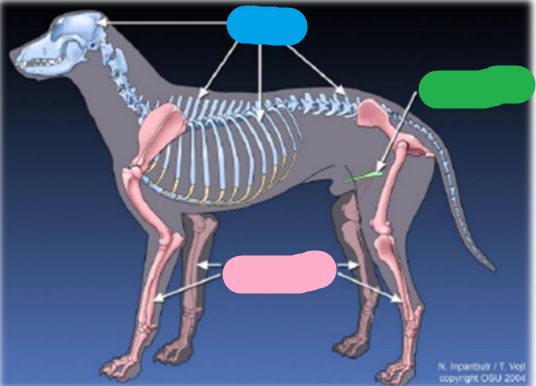
appendicular
18
term for the skull/neck/spine section of dog skeleton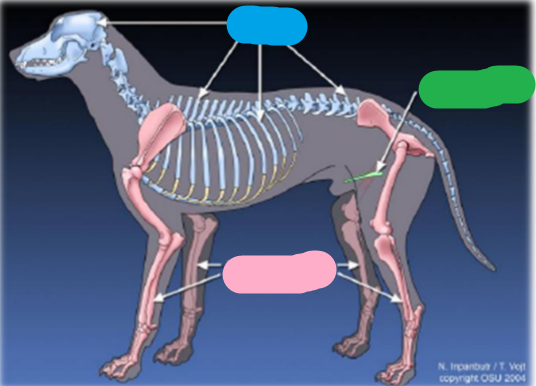
axial
19
term for the os penis of dog skeleton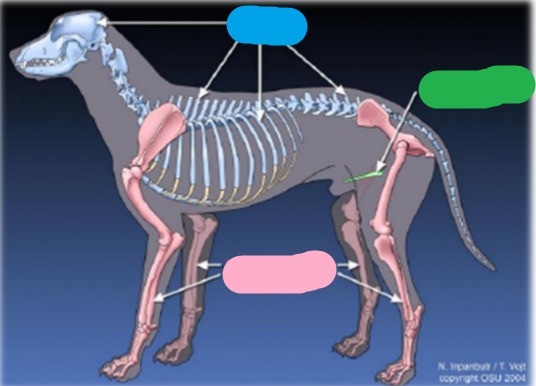
visceral/splanchnic
20
range of caudal vertebrae in dog tail
6-23
21
used by dogs to turn while running, can act as an "ice pick" when climbing out of icy water
dewclaw
22
number of bones in cat skeletal system
240-245
23
cat ____ are not tightly connected, which allows for better flexibility
vertebrae
24
cat ___ ___ are only connected with muscles
shoulder blades
25
hereditary malformation of the hip joint that causes it to be looser than normal, common in large dog breeds & Maine Coon
hip dysplasia
26
multiple developmental abnormalities of the elbow, seen in larger dog breeds, leads to progressive arthritis
elbow dysplasia
27
caused by twisting injury of the knee joint, often from changing direction too fast
ruptured cruciate
28
surgery required to treat ruptured cruciate
TPLO (tibial plateau leveling osteotomy)
29
when femoral trochlear groove is flattened so patella slides medially or laterally, common in small dog breeds, causes the dog to "skip"
patellar luxation