ANS 2140: Unit 1
Study these flashcardsFree · spaced repetition · iPhone, Android, Mac & web
All cards
1
this is composed of 2 or more organs
organ system
2
this is composed of 2 or more tissues
organ
3
this is a group of cells similar in structure, perform a common or related task
tissue
4
individual cells - myocytes
function - contracting
function - contracting
muscle tissue
5
individual cells - neurons
functions - signaling
functions - signaling
nervous tissue
6
functions - form membranes, protect surfaces, form glands
includes simple squamous, simple cuboidal, and simple columnar
includes simple squamous, simple cuboidal, and simple columnar
epithelial tissue
7
cells widely spaced within a matrix
types include under epithelium, adipose, tendon, bone, and blood
functions - bind, partition, protect, support
types include under epithelium, adipose, tendon, bone, and blood
functions - bind, partition, protect, support
connective tissue
8
state of relative consistency in the body
homeostasis
9
homeostasis is maintained via ___________ _________
feedback loops
10
feedback loop that consists of:
set point
receptors/sensors
control center
effector
set point
receptors/sensors
control center
effector
negative feedback loop
11
feedback loop that consists of:
sensor
control center
effector
amplification
sensor
control center
effector
amplification
positive feedback loop
12
the 4 types of tissue
connective, muscle, epithelial, nervous (c-men?)
13
type of epithelial tissue
thin in nature (found in lungs, used in gas exchange)
thin in nature (found in lungs, used in gas exchange)
simple squamous
14
type of epithelial tissue
square shape (found in kidneys)
square shape (found in kidneys)
simple cuboidal
15
type of epithelial tissue
rectangular shape, polarized
rectangular shape, polarized
simple columnar
16
the cardiovascular system __________ oxygen, hormones, nutrients, and waste
transports
17
the cardiovascular system __________ body temperature, blood pH, and blood volume
regulates
18
the cardiovascular system __________ using leukocytes (immune system) and clotting (platlet formation)
protects
19
main functions of the cardiovascular system
transport, regulation, protection
20
the 2 circuits of the cardiovascular system
pulmonary circuit, systemic circuit
21
pumps oxygen-poor blood from the right side of the heart to the lungs to become oxygenated
pumps blood from the lungs to the left side of the heart
pumps blood from the lungs to the left side of the heart
pulmonary circuit
22
pumps oxygen-rich blood from the left side of the heart to organs throughout the body
delivers gases and nutrients
delivers gases and nutrients
systemic circuit
23
pump that moves blood throughout the body
heart
24
veins, arteries, and capillaries - carry blood throughout the body
blood vessels
25
medium that carries gases, nutrients, waste, etc
blood
26
blood is composed of _______ / ______, _____ ______ ______, and ___ _______ ______
plasma, serum, white blood cells, red blood cells
27
component of blood, primarily water-based, constitutes 90% of solutes
plasma, serum
28
anti-coagulants are present only in the _______ of blood
plasma (not serum)
29
component of blood, responsible for immune response
white blood cells (leukocytes)
30
component of blood, responsible for transport of gases
red blood cells (erthythrocytes)
31
erythrocytes (red blood cells) in _________ have no nucleus
mammals
32
basophil, neutrophil, lymphocytes, monocytes, and eosinphils are all examples of _______________
leukocytes
33
carry blood away from the heart
arteries
34
carry blood to the heart
veins
35
transition areas, where gas exchange occurs
capillaries
36
2 capillary beds next to each other
portal systems
37
the 3 types of capillaries
continuous, fenestrated, sinusoid
38
type of capillary
most common - found in all types of tissue
least permeable
small molecules can pass through (water, hormones, gases)
most common - found in all types of tissue
least permeable
small molecules can pass through (water, hormones, gases)
continuous
39
type of capillary
moderate amount of permeability
lots of small holes
rapid movement of small molecules
found in digestive system, kidneys - rapid movement of nutrients/metabolic waste
moderate amount of permeability
lots of small holes
rapid movement of small molecules
found in digestive system, kidneys - rapid movement of nutrients/metabolic waste
fenestrated
40
type of capillary
most permeable
incomplete basement membrane, intercellular gaps
found in liver, spleen, and bone marrow - cell production/storage
most permeable
incomplete basement membrane, intercellular gaps
found in liver, spleen, and bone marrow - cell production/storage
sinusoid
41
________ capillaries are the least permeable
continuous
42
________ capillaries are the most permeable
sinusoid
43
the right atrioventricular valve is ___________
tricuspid (3 points of attachment in ventricle)
44
the left atrioventricular valve is ___________
bicuspid (2 points of attachment in ventricle)
45
prevent blood from flowing back into the atria from the ventricles
atrioventricular valves
46
prevent blood from flowing back into the heart from the arteries
semilunar valves (pulmonary and aortic)
47
heart muscle cells
cardiomyocytes
48
the 2 types of cardiomyoctes
contractile cardiac myocytes, autorhythmic cells
49
99% of the cells in the heart
responsible for pumping activity
extended absolute refractory period
responsible for pumping activity
extended absolute refractory period
contractile cardiac myocytes
50
self starting, aka pacemaker cells
1% of the cell population in the heart
1% of the cell population in the heart
autorhythmic cells
51
prevents contractions from occuring in the heart at a rate that would cause tetanic contractions (when heart stays contracted for a period of time - not good)
extended absolute refractory period
52
normal blood pH range
7.35-7.45
53
condition where blood pH is lower than normal range
acidosis
54
condition where blood pH is higher than normal range
alkalosis
55
commonly used buffer for maintaining pH
bicarbonate
56
sense: chemicals, dust, cold air
effect: coughing, bronchconstriction
effect: coughing, bronchconstriction
irritant receptors
57
sense: lung inflation
effect: inflation terminates
effect: inflation terminates
stretch receptors
58
sense: chest wall position, muscle tension
effect: breathing
effect: breathing
muscle, joint receptors
59
sense: chemicals, stretch, pulmonary edema
effect: shallow breathing, mucous secretion, bronchocontriction
effect: shallow breathing, mucous secretion, bronchocontriction
J receptors
60
major functions of the respiratory system
vocalization, supply oxygen, olfaction, acid-base homeostasis, remove carbon dioxide (VSOAR)
61
includes pulmonary ventilation, external respiration, transportation of respiratory gases, and internal respirtation
respiratory cycle
62
bringing air into/out of the lungs (inspiration and expiration)
pulmonary ventilation
63
gas exchange between the lungs and blood
external respiration
64
gases are moved throughout the body via blood
transportation of respiratory gases
65
blood deposits oxygen to tissue and picks up carbon dioxide
internal respiration
66
heats, humidifies, and filters incoming air
upper respiratory system ("shoulders up")
67
parts of the respiratory system that move air
conducting zones
68
the upper respiratory system is soley a ___________ ______
conducting zone
69
parts of the respiratory system that exchange gases
respiratory zones
70
the lower respiratory system is a conducting zone and a _____________ _______
respiratory zone
71
the functional unit of the lungs, where gas exchange occurs
alveoli
72
the 3 types of cells in alveoli
thin cells, macrophages, type II alveolar cells
73
alveoli cell - function in gas exchange
thin cell (type I)
74
alveoli cell - immune system functions
macrophage
75
alveoli cell - produces surfactant
type II alveolar cell
76
3 properties of mammalian respiratory system
compliance, elasticity, surface tension
77
ability of lung to stretch
compliance
78
ability of lung to return to original size
elasticity
79
detergent-like lipid and protein complex, reduces surface tension in the alveoli
surface tension from water in the alveoli pulls alveolar walls together and reduces amount of space for gas exchange
surface tension from water in the alveoli pulls alveolar walls together and reduces amount of space for gas exchange
surfactant
80
law that describes inverse relationship between gas pressure and volume
Boyle's law
81
intrapleural pressure is always __ mmHg less than Patm and Ppul
4
82
during inspiration, the diaphragm __________
contracts
83
when the diaphragm contracts, this ________ thoracic volume, which _________ intrapulmonary pressure (draws in air)
increases, decreases
84
during expiration, the diaphragm ___________
relaxes
85
when the diaphragm relaxes, thoracic volume _______, which _________ intrapulmonary pressure (expels air)
decreases, increases
86
amount of air that enters and exits the lungs during normal pulmonary ventilation
tidal volume
87
amount of air that can be inhaled past tidal volume
inspiratory reserve volume
88
amount of air that can be exhaled past tidal volume
expiratory reserve volume
89
amount of air that can be forcibly inhaled and exhaled
vital capacity
90
amount of air that stays in the lung (always some air left in the lung)
residual volume
91
total volume of air the lungs can hold
total lung capacity
92
places where air might be trapped and not used in gas exchange
dead space (anatomical and alveolar)
93
permanent features that do not exchange gas (eg trachea)
anatomical dead space
94
_________ dead space can be permanent or temporary
alveolar
95
law that describes how the total pressure of a mixture of gases is equal to the sum of partial pressures of all gases
Dalton's law
96
gas will flow into areas with ______ pressure
lower
97
law that describes how the amout of gas dissolved in a liquid depends on different factors
Henry's law
98
3 factors that influence the amount of gas as described by Henry's law
solubility of the gas, temperature of the liquid, partial pressure of the gas (STP, in blood solubility and temp are constant)
99
___% of oxygen in the blood is dissolved in plasma
1.5
100
___% of oxygen in the blood is loosely bound to each iron of hemoglobin in erythrocytes
98.5
101
each hemoglobin carries __ oxygen molecules
4
102
blood in the veins still has ___% of the oxygen bound
75 (3/4 O2 still bound)
103
true/false: blood in the veins is deoxygenated
false (oxygen poor, not oxygen free)
104
O2 and hemoglobin affinity decreases with ___ pH levels
low (acidic)
105
O2 and hemoglobin affinity decreases with ____ temperature
high
106
O2 and hemoglobin affinity decreases with ____ concentrations of 2, 3-diphosphoglyceric acid
high
107
__% of CO2 is transported in plasma
10
108
true/false: CO2 is more soluble than O2
true
109
__% of CO2 is bound in carbamino hemoglobin
20
110
__% of CO2 is transported as bicarbonate
70 (HCO3-)
111
when bicarbonate leaves the erythrocyte and a chloride ion (Cl-) enters to maintain ionic balance
chloride shift
112
CO2 moves from the ________ to the __________ where ________ __________ creates _______ _______ (H2CO3) from CO2 and H2O, which then dissociates to form H+ and _________ (HCO3-)
tissue, erythrocyte, carbonic anhydrase, carbonic acid, bicarbonate
113
birds do not have a __________
diaphragm
114
in birds, inspiration and expiration are both ______ processes
active
115
true/false: avian lungs are compliant and elastic
false
116
in the avian respiratory system, gas is transported in a ______ __________
single direction
117
avian - on the first inhale, air moves through the lungs to the _________ ___ _____
posterior air sacs
118
avian - on the second inhale, waste air moves to the _________ _____ ______
anterior air sacs
119
avian - on the first exhale, air moves to the ______
lungs
120
avian - on the second exhale, waste air moves from the anterior air sac to the ________ (leaves the body)
trachea
121
the endocrine system relies on ________ to send signals, influences ________ activity, responses occur relatively ________, and a ___ concentration is needed to induce a response
hormones, metabolic, slowly, low
122
the nervous system relies on ________ __________ to conduct signals, influences _________ and ________, and responses occur relatively ________
electrochemical gradients, muscles, glands, quickly
123
endocrine glands are _________, meaning they secrete products directly into the blood
ductless
124
exocrine glands contain ______ so products are not directly secreted into the blood
ducts
125
cell secretes products/factors that bind to its own receptors
autocrine signaling
126
cell secretes products/factors that bind to a neighboring cell (typically within same tissue)
paracrine signaling
127
cell secretes hormones that travel through the blood vessels to reach another cell (long distance)
endocrine signaling
128
chemicals that are carried through the blood or lymph to target distant tissues and recognized by high-affinity receptors
hormones
129
gland with the primary function of producing hormones
purely endocrine gland
130
the three types of hormone backbones
peptide/protein, amino acid, steroid (peptide/protein and amino acid are hyrdophilic)
131
steroid hormones typically bind to __________ receptors
intracellular (hydrophobic, able to pass through cell membrane)
132
target cell activation depends on the relative number of _________ on target cell, the ________ of binding between hormone and receptor, and the ______ __________ of the hormone
receptors, affinity, blood concentration
133
the three types of stimuli hormones are synthesized and released to
humoral, neural, hormonal
134
blood change in the level of ions or nutrients that directly cause the release of hormones (regulation of blood calcium levels)
humoral stimuli
135
neuron causes the release of the hormone (epinephrine and norepinephrine)
neural stimuli
136
hormones stimulate the release of other hormones (hypothalamus releases releasing hormones that enter anterior pituitary)
hormonal stimuli
137
thyroid stimulating hormone pathway
hypothalamus, thyrotropin releasing hormone, anterior pituitary, thyroid stimulating hormone, thyroid, thyroid hormones (inhibit hypothalamus and pituitary)
138
2 related compounds of thyroid hormones
thyroxine, 3-iodothyronine
139
which of the two thyroid compounds is 10x more effective than the other
3-iodothyronine
140
in the thyroid, follicle cells surround the ________
colloid
141
follicle cells produce __________
thyroglobulin
142
in the thyroid, iodines are added to thyroglobulin to create ___________ and ____________
thyroxine, 3-iodothyronine
143
lutenizing hormone/follicle stimulating hormone pathway
hypothalamus, gonadotropin releasing hormone, anterior pituitary, lutenizing hormone and follicle stimulating hormone, ovary (increase estrogen, positive feedback, stimulates GnRH)
144
adrenocorticotropin hormone pathway (ACTH)
hypothalamus, corticotropin releasing hormone, anterior pituitary, adrenocorticotropin hormone, adrenal gland, cortisol and corticosterone and aldosterone (alters metabolic functions, increase blood glucose from muscle and fat, negative feedback loop, inhibits hypothalamus and anterior pituitary)
145
cortisol and corticosterone are __________
glucocorticoids
146
aldosterone is a _____________
mineralcorticoid (increases Na and H2O retention, increasing blood pressure)
147
prolactin hormone pathway (PRL)
hypothalamus, thyrotropin releasing hormone, anterior pituitary, prolactin, mammaries (stimulates milk production, negative feedback)
148
prolactin also inhibits __________ ________ ________
gonadotropin releasing hormone (lacational anestrus)
149
growth hormone pathway
hypothalamus, growth hormone releasing hormone, anterior pituitary, growth hormone (increases blood glucose levels, increases lipolysis)
150
TSH
thyroid stimulating hormone
151
TRH
thyrotropin releasing hormone
152
LH
lutenizing hormone
153
FSH
follicle stimulating hormone
154
GnRH
gonadotropin releasing hormone
155
ACTH
adrenocorticotropin hormone
156
CRH
corticotropin releasing hormone
157
PRL
prolactin
158
GH
growth hormone
159
growth hormone indirectly affects the ______
liver (produces IGF2, muscle and bone growth, increased protein synthesis and cell proliferation)
160
GHRH
growth hormone releasing hormone, somatotropin
161
GHIH
growth hormone inhibiting hormone, somatostatin
162
true/false: oxytocin triggers milk production
false (triggers milk release/letdown)
163
ADH
antidiuretic hormone
164
triggers milk letdown/ release
stimulates uterine contractions during parturition
stimulates uterine contractions during parturition
oxytocin
165
stimulates water reabsorption in the kidneys
decrease in urine formationn
vasoconstriction of blood vessels
decrease in urine formationn
vasoconstriction of blood vessels
antidiuretic hormone
166
responsible for the production and sectretion of digestive enzymes
exocrine pancreas
167
irregularly shaped clusters of endocrine tissue in the pancreas
islets of langerhans
168
contains islets of langerhans, responsible for production of insulin and glucagon
endocrine pancreas
169
pancreas - produce glucagon
alpha cells
170
pancreas - produce insulin
beta cells
171
pancreas - produce somatostatin (GHIH)
delta cells
172
targets all tissues - especially fat and muscle to increase glucose uptake
participates in neural development, learning, and memorization
function - decrease blood glucose (inhibits glycogenolysis and gluconeogenesis)
participates in neural development, learning, and memorization
function - decrease blood glucose (inhibits glycogenolysis and gluconeogenesis)
insulin
173
breakdown of glycogen
glycogenolysis
174
released with low blood glucose
major target - the liver
promotes glycogenolysis and gluconeogenesis
major target - the liver
promotes glycogenolysis and gluconeogenesis
glucagon
175
cardiac output = ______ ____ x ______ _______
heart rate, stroke volume
176
initiates and distrubutes impulses so heart depolarizes and contracts in orderly manner from atria to ventricles
intrinsic conduction system
177
intrinsic conduction system - where signal originates
causes atria to contract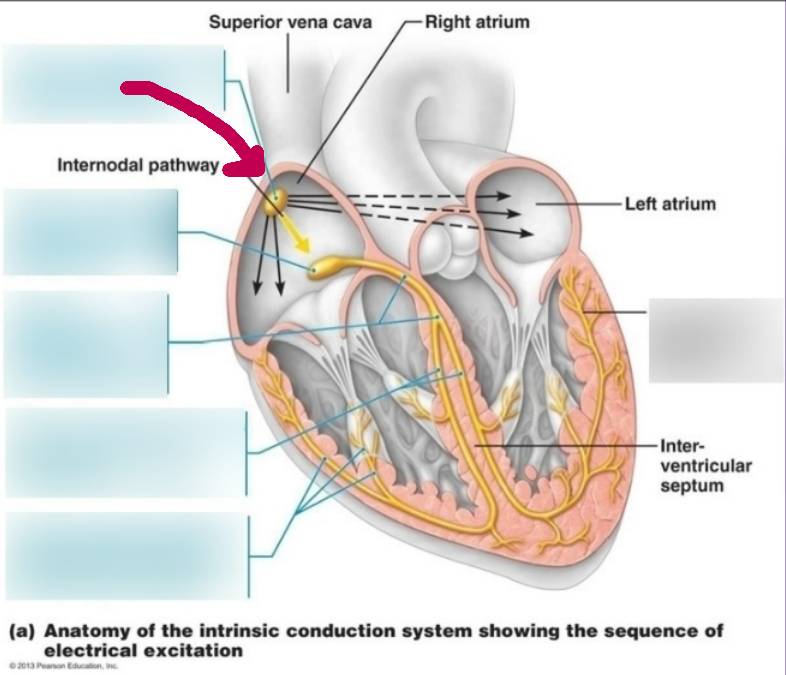
causes atria to contract
sino-atrial node (SA node)
178
intrinsic conduction system part, recieves signal from SA node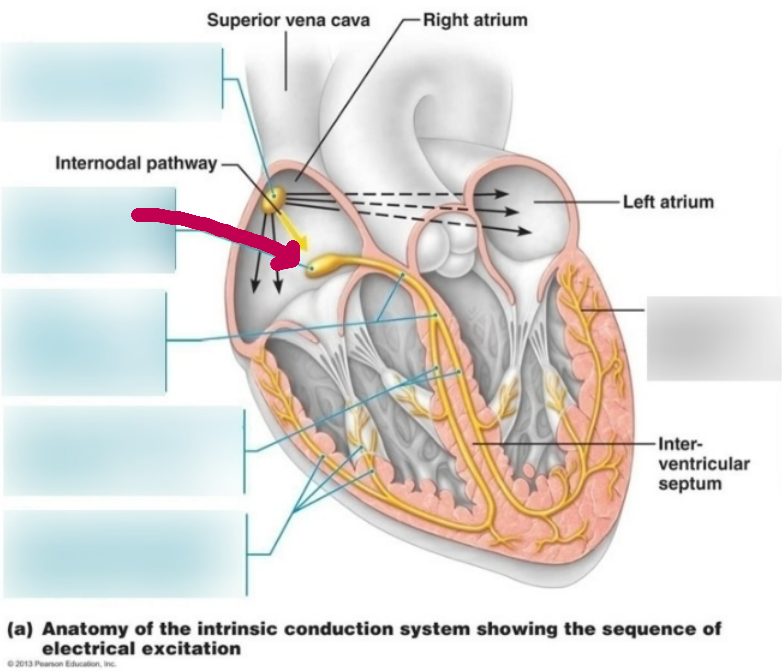
atrioventricular node
179
part of intrinsic conduction system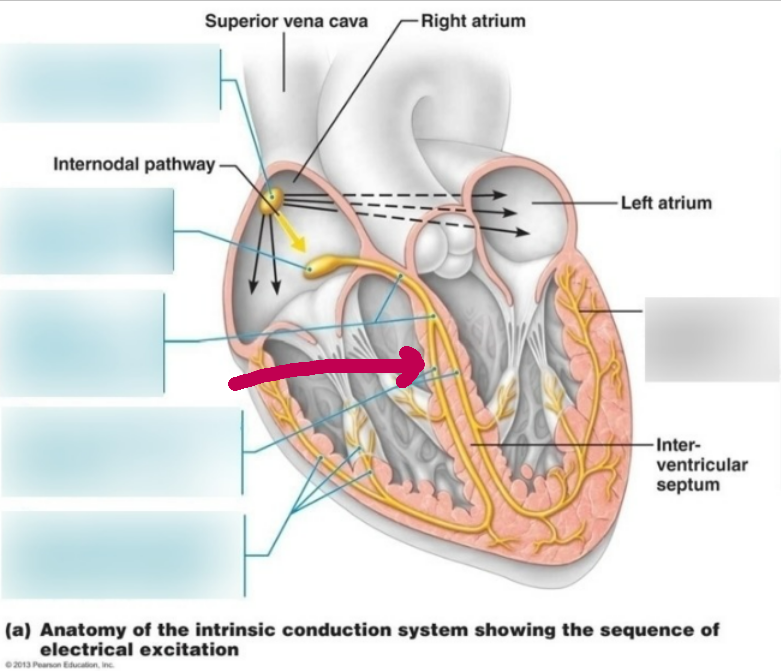
bundle of his
180
intrinsic conducting system part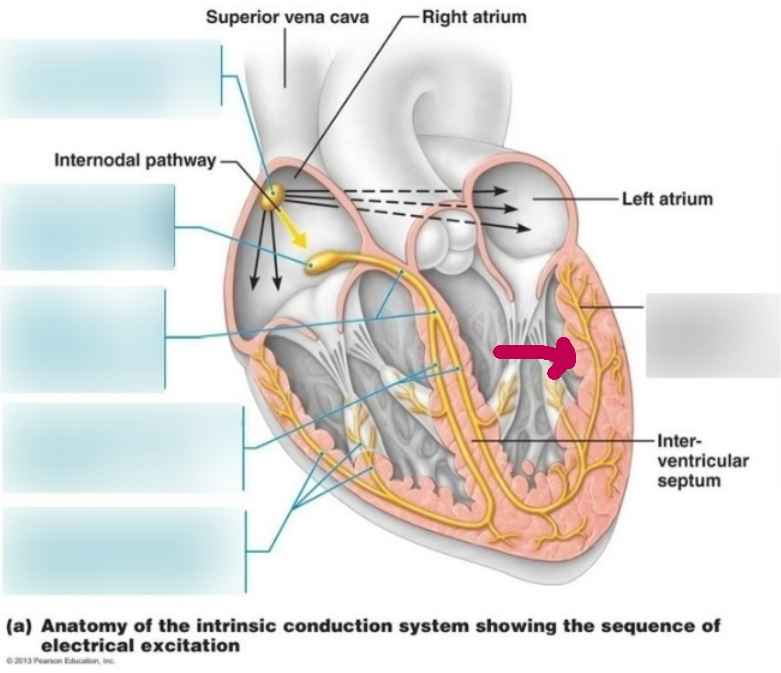
purkinje fibers
181
PTH
parathyroid hormone (calcium regulation)
182
IGF
insulin-like growth factor
183
ACTH targets the ______ _______, stimulates _______, and is inhibited by ________
adrenal glands, cortisol, cortisol
184
FSH and LH target the _______, stimulate _______ _________, and are inhibited by _______ _________
gonads, gamete production, gonadal hormones
185
PRL targets the _______, stimulates _____ __________, and is inhibited by _________
mammary, milk production, dopamine
186
GH targets ______, ________, and the ______, stimulates ____ _________ and ___, and is inhibited by ___________
muscle, adipose, liver, fat breakdown, IGF, somatostatin
187
TSH targets the ________, stimulates ______ ________, and is inhibited by ________ __________
thyroid, thyroid hormones, thyroid hormones
188
body temperature regulation:
set point is _____ degrees F (37 degrees C)
sensor is the ______________
the control center is the ________
the effector is __________
set point is _____ degrees F (37 degrees C)
sensor is the ______________
the control center is the ________
the effector is __________
98.6, hypothalamus, brain, sweating