Unit 2: Meat
Study these flashcardsFree · spaced repetition · iPhone, Android, Mac & web
All cards
1
indicate palatability, juciness, flavor, color, etc
USDA quality grades
2
indicate cutability, percent lean to fat and bone fat trim, size of cut, weight
USDA yield grades
3
also referred to as the rib eye, area exposed from cross section in which the surface area is measured to estimate fat depth
longissimus dorsi
4
USDA grading scale for beef and lamb cutability/yield (lower value = better)
1-5
5
USDA grading scale for pork (lower value = better)
1-4
6
young: prime, choice, select, standard
old: commercial, utility, cutter/canner
old: commercial, utility, cutter/canner
USDA beef quality grades
7
acceptable or unacceptable
USDA pork quality grades
8
prime, choice, good, utility, cull
USDA lamb quality grades
9
physical observation used to determine carcass maturity in lambs
break joint (spool joint in mutton)
10
measure of intramuscular fat in meat
marbling
11
jumbo, extra large, large, medium, small, peewee
USDA egg size grades (classifications)
12
AA, A, B, dirty/inedible
USDA egg quality grades
13
usually homgenized and fortified with vitamin D, must contain a minimum of 3.25% milkfat and 8.25% milk solids not fat (MSNF)
whole milk
14
milk which has between 2% and 3.25% milkfat
2% milk
15
milk that has between 0.5-2% milkfat, 8.25% milk solids not fat, fortified with vitamin A (D optional)
low fat milk
16
nonfat milk, must have less than 0.5% milkfat, 8.25% MSNF, and fortified with vitamin A (D optional)
skim milk
17
commercially sold product is cultured, lactic acid starter culture is added to freshly pasteurized skim milk or low fat milk to produce this
buttermilk
18
grade for milk that includes all fluid milk sold to consumers
grade A milk
19
grade for milk that has been produced under less sanitary conditions, still safe for human consumption, processed into other forms such as cheese
grade B milk
20
the pressing of milk through a screen with tiny holes, breaks down fats to prevent them from coalescing; results in whiter color, greater viscosity, and less stability in heat
homogenization
21
heat treatment under pressure to kill pathogenic microorganisms without changing physical/chemical properties of the product (does not prevent re-contamination, safe handling procedures necessary)
pasteurization
22
cut from the shoulder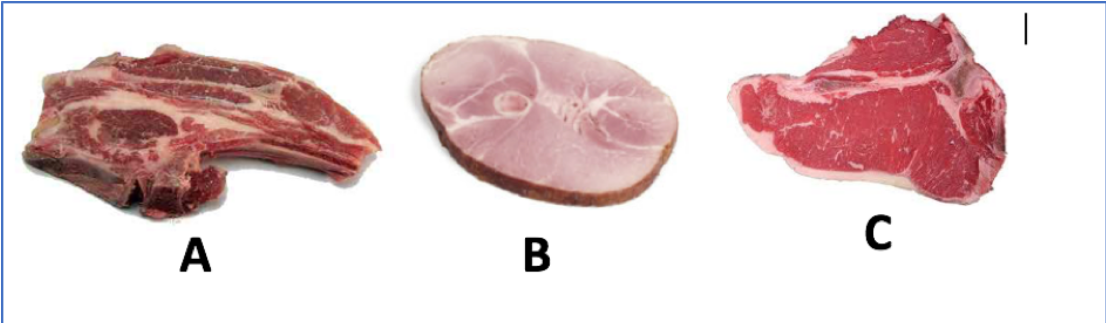
A
23
cut from the leg/ham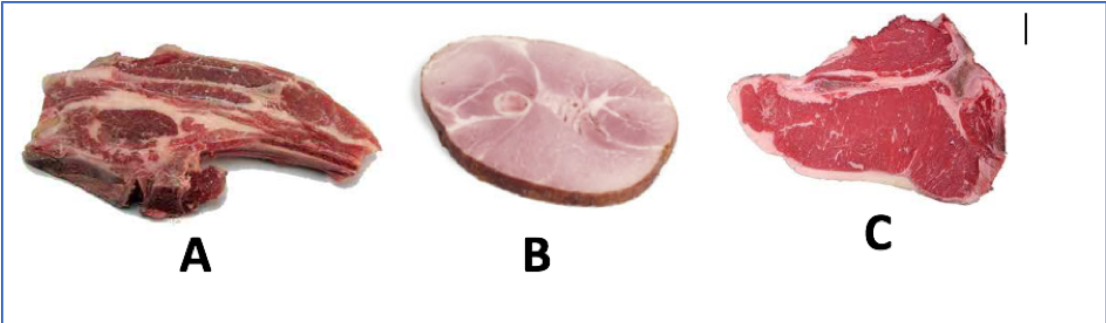
B
24
cut from the middle/loin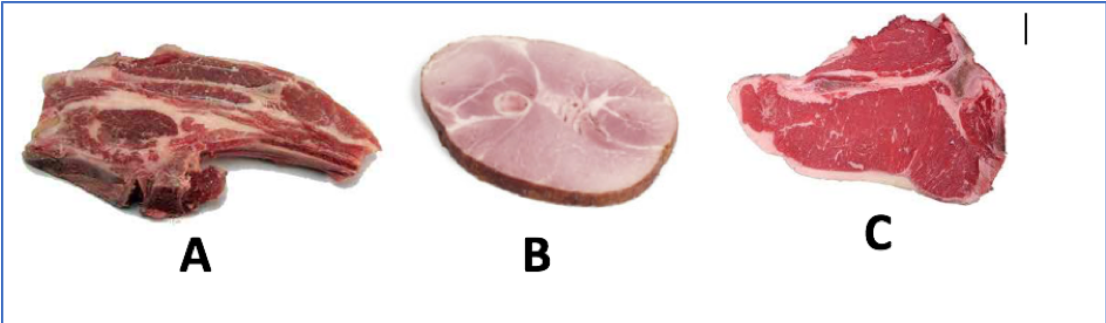
C