ANS 2140: Unit 2
Study these flashcardsFree · spaced repetition · iPhone, Android, Mac & web
All cards
1
2 main parts of the nervous system
central nervous system, peripheral nervous system
2
the central nervous system consists of the ______ and _____ ______
brain, spinal cord
3
the control center of the nervous system, recieves signals, makes decisions, sends signals out
central nervous system
4
part of the nervous system that functions to gather information and carry out instructions
peripheral nervous system
5
2 parts of the peripheral nervous system
sensory division, motor division (afferent and efferent division)
6
peripheral nervous system - gathers information, eg detecting temperature
sensory division (afferent)
7
the sensory division of the peripheral nervous system sends signals straight to the _________ _________ _________
central nervous system
8
peripheral nervous system - performs actions directed by CNS
motor division (efferent)
9
2 parts of the motor division of the peripheral nervous system
somatic nervous system, autonomic nervous system
10
part of the motor division of the peripheral nervous system that controls voluntary actions
somatic nervous system
11
part of the motor division of the peripheral nervous system that controls involuntary actions
autonomic nervous system
12
2 parts of the autonomic system
sympathetic system, parasympathetic system
13
part of the autonomic nervous system responsible for fight or flight response
sympathetic system
14
part of the autonomic nervous system responsible for conserving energy (rest and digest)
parasympathetic system
15
2 types of nerve cells
neurons, neuroglia (glial cells)
16
________ are the cells responsible for carrying signals
neurons
17
___________ are the cells that provide nutrients and structure to nerve cells
neuroglia
18
most common neuroglia - takes up neurotransmitters, provides nutrients, found in central nervous system
astrocyte
19
type of neuroglia - wraps around axon to provide insulation, found in central nervous system
oligodendrocyte
20
oligodendrocytes are found in the _______ _______ ________
central nervous system
21
type of neuroglia - serves as insulation for axon, found in peripheral nervous system
schwann cell
22
schwann cells are found in the __________ ________ ___________
peripheral nervous system
23
biosynthetic region of neuron, receptive region for signals
soma
24
branches that extend from the cell body of the neuron
interact with other neurons and recieve signals
interact with other neurons and recieve signals
dendrites
25
part of the neuron that propogates signal to the next cell
axon
26
junction between the soma and the axon - where signal accumulates
axon hillock
27
part of axon that contains secretory vessels and signaling molecules
axon terminal
28
the spaces between schwann cells/oligodendrocytes are called _______ ________ _____
myelin sheath gaps
29
3 properties of neurons
secretion, excitability, conductivity (SEC)
30
property of neuron - ability to recieve a signal and respond to change
excitability
31
property of neuron - ability to produce electrochemical gradient to conduct signal
conductivity
32
property of neuron - ability to send signal to the next cell
secretion
33
neurons send signals using _______ _________
action potentials
34
neurotransmitter binds to channel, causing it to open
ligand-gated channel
35
changes in pressure cause channel to open
mechanically-gated channel
36
membrane around channel changes voltage, changes in membrane potential cause channel to open
voltage-gated channel
37
resting membrane potential is ___mV
-70
38
sodium and chloride are found ________ of the plasma membrane
outside
39
potassium ions are found ________ of the plasma membrane
inside
40
proteins inside of the axon have a _________ charge, which exceeds the charge of the ____________ ions in the axon
negative, potassium (creates negative membrane potential)
41
1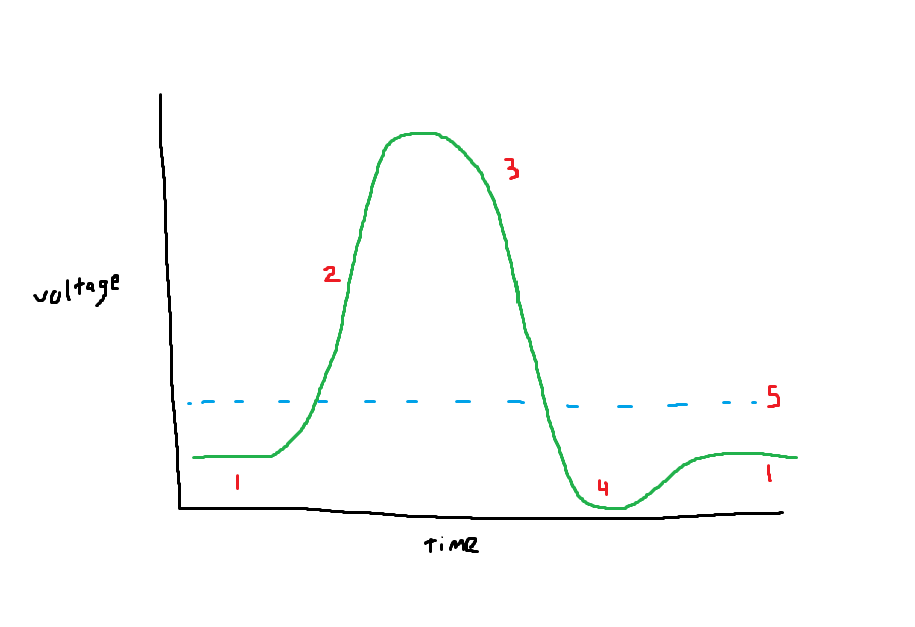
resting membrane potential
42
2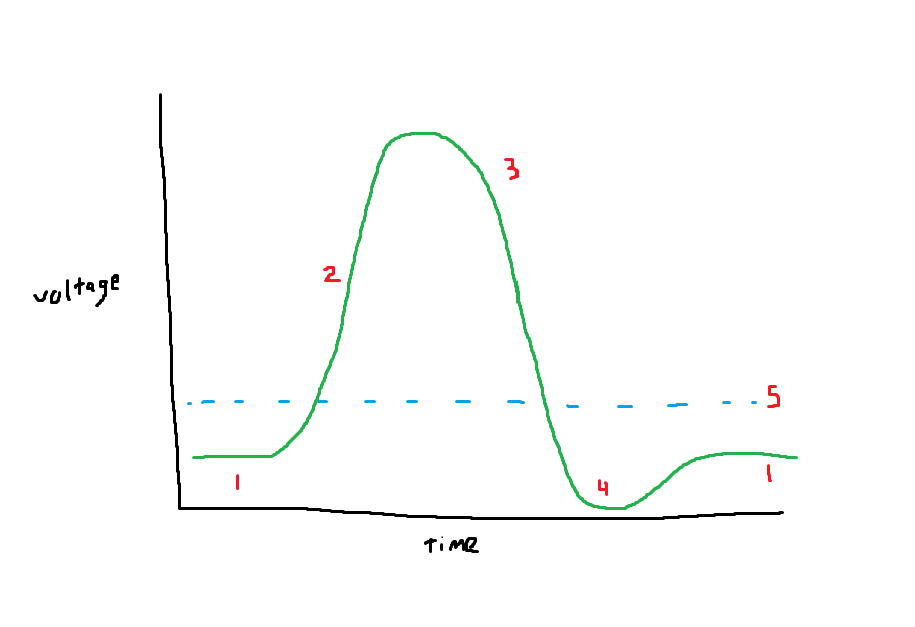
depolarization
43
3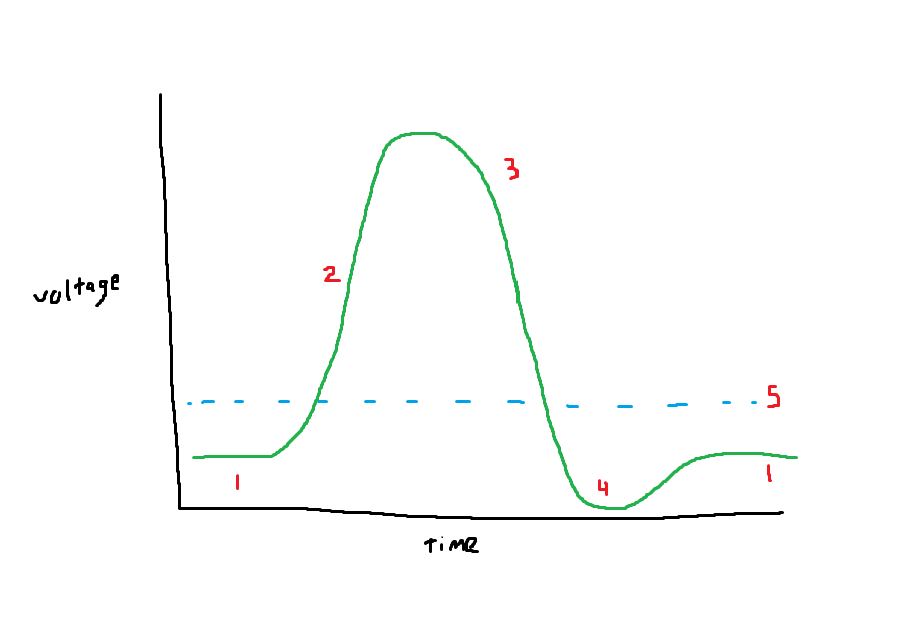
repolarization
44
4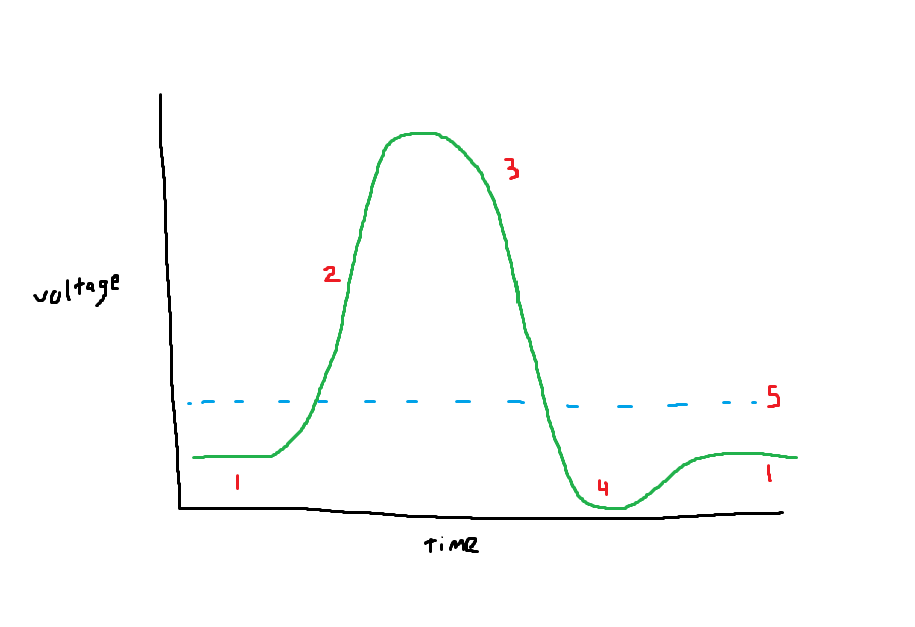
hyperpolarization
45
5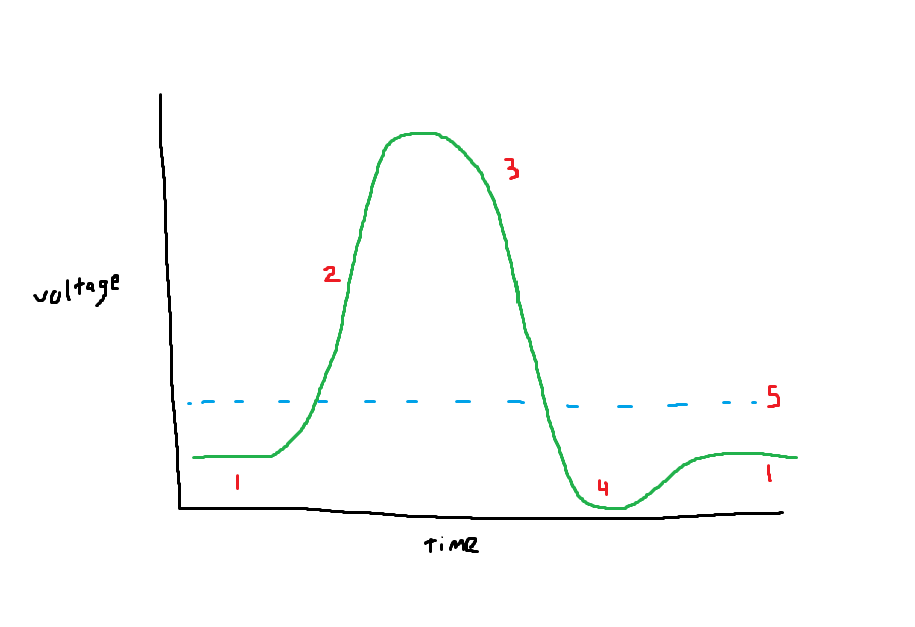
threshold
46
magnitude or intensity that must be exceeded for a certain reaction, phenomenon, result, or condition to occur or be manifested
threshold
47
membrane potential becomes less negative
fast voltage-gated Na+ channels open, allowing Na+ to enter axon
fast voltage-gated Na+ channels open, allowing Na+ to enter axon
depolarization
48
decline in membrane potential
slow voltage-gated K+ channels open, allowing K+ to leave axon
fast voltage-gated Na+ channels inactivated
slow voltage-gated K+ channels open, allowing K+ to leave axon
fast voltage-gated Na+ channels inactivated
repolarization
49
more negative membrane potential
Na+/K+ ATPase pumps allow K+ to reenter cell and Na+ to leave
reactivation of fast voltage-gated Na+ channels
Na+/K+ ATPase pumps allow K+ to reenter cell and Na+ to leave
reactivation of fast voltage-gated Na+ channels
hyperpolarization
50
brief period of time after action potential where cell cannot stimulate another action potential
absolute refractory period
51
where a second action potential can occur but stimulus has a larger threshold due to being in hyperpolarization stage
relative refractory period
52
the propogation of an action potential starts at the _____ __________
axon hillock
53
true/false: an action potential signal does not decay over time
false (signal decays the further it travels)
54
myelinated axons have a faster speed of __________
conduction
55
in myelinated axons, the strength of the action potential is restored at the _________ __ __________
nodes of ravnier (where ion channels are activated)
56
oligodendrocytes connect to/myelinate ______ ______
many cells (oligodendrocyte = many branching cells)
57
schwann cells connect to/myelinate _____ _____
one cell
58
functional connection between a neuron and another cell
synapse
59
these use a chemical (neurotransmitter) to send signals
chemical synapses
60
these use an electrochemical gradient to send signals
electrical synapses
61
the neuron that sends the signal
pre-synaptic neuron
62
the neuron that recieves the signal
post-synaptic neuron
63
axon terminals of the pre-synaptic neuron signals to the dendrites of the post-synaptic neuron
axodendritic synapse
64
axon terminals of the pre-synaptic neuron signals to the soma of the post-synaptic neuron
axosomatic synapse
65
axon terminals of the pre-synaptic neuron signals to the axon or axon terminal of the post-synaptic neuron
axoaxonic synapse
66
signaling pathway:
_______ _______ travels down ___________ _________ to the ______ _________
voltage-gated _______ channels open, allowing _______ to enter the axon terminal
________ binds to ___________ _________, causing ____________ filled vessels to move to and fuse with the ______ _________
vessels release ____________ into ________ ______ via _____________
_______ _______ travels down ___________ _________ to the ______ _________
voltage-gated _______ channels open, allowing _______ to enter the axon terminal
________ binds to ___________ _________, causing ____________ filled vessels to move to and fuse with the ______ _________
vessels release ____________ into ________ ______ via _____________
action potential, pre-synaptic neuron, axon terminal, calcium, calcium, calcium, cytoskeletal proteins, neurotransmitter, plasma membrane, neurotransmitters, synaptic cleft, exocytosis
67
________ _________ can have varying strength of responses (weak to strong, not all or nothing)
graded potentials
68
method of removal of neurotransmitters from synaptic cleft - ________ of neurotransmitters by the ___________ neuron
reuptake, pre-synaptic
69
method of removal of neurotransmitters from synaptic cleft - _________ of neurotransmitters by ________ in the synaptic cleft
degradation, enzymes
70
method of removal of neurotransmitters from synaptic cleft - ___________ of neurotransmitters away from the ___________
diffusion, synapse (eventually broken down by other cells)
71
skeletal muscle is ________, under _________ control, and _______________
striated, voluntary, multi-nucleated
72
skeletal muscle ________ rapidly and ________ easily
contracts, tires
73
cardiac muscle is _________, found in the _______ ______, is under __________ control, and is _________________
striated, heart walls, involuntary, multi-nucleated (1-3 nuclei per cell)
74
smooth muscle is ___ _________, is under ___________ control, is found in ________ _______, and is _________________
not striated, involuntary, hollow organs, mono-nucleated
75
functions of muscle
produce movement, generate heat, stabilize joints, maintain posture (PGSM)
76
characteristic of muscle - able to respond to electrical signal
responsiveness
77
characteristic of muscle - ablility to share signal with the rest of muscle fibers
conductivity
78
characteristics of muscle - ability to move and return to resting state
contractility, extensibility, elasticity
79
cells growing in number (cell division)
typically occurs before birth/hatch
typically occurs before birth/hatch
hyperplasia
80
increase in cell size
formation of myotubules and muscle fibers
formation of myotubules and muscle fibers
hypertrophy
81
myotubule matures into _________ _______ ______
skeletal muscle fiber
82
membrane that surrounds the whole muscle
epimysium
83
the grain of the meat is the _______
fasicle
84
the membrane that surrounds the fasicle is the ___________
perimysium
85
membrane between individual muscle fibers
endomysium
86
muscle fibers are surrounded by the __________
sarcolemma
87
the sarcolemma is similar to a plasma membrane, but it also has the ability to ___________ ___________ _____________
conduct electrochemical gradients
88
this holds calcium ions in muscle fibers along with performing ER tasks
sarcoplasmic reticulum
89
a triad is composed of 2 _______ _________ and 1 _________ ____________
terminal cisterns, transverse tubule
90
the terminal cistern is responsible for __________ _________ ____
holding calcium ions
91
the transverse tubule connects the ____________ with the ___________ _____________, also helps with communication
sarcolemma, sarcoplasmic reticulum
92
organelles that store glycogen
glycosides
93
make up 80% of the muscle fiber, make up myofilaments
myofibrils
94
the 2 types of myofilaments are _____ and ________
actin, myosin
95
actin is _____ and myosin is ______
thin, thick
96
functional unit of the muscle fiber - regions that contract and relax
sarcomere
97
response of a muscle to a single, brief threshold stimulus
muscle twitch
98
a muscle twitch is a _______ __________
graded response
99
the three phases of a muscle twitch
latent period, period of contraction, period of relaxation
100
brief delay of approximately 1-2 milliseconds between the stimulus and the onset of muscle contraction, during which the muscle prepares for contraction
latent period
101
1 neuron can engage with multiple different _______ _______
muscle fibers
102
when another stimulus is applied before the muscle relaxes completely, resulting in more tension
temporal summation (wave summation)
103
temporal summation results in __________ __________
unfused tetanus
104
occurs at high stimulus frequencies, no relaxation at all between stimulus
fused tetanus (complete tetanus)
105
the strength of a muscle contraction can be increased by recruiting more _______ _________
muscle fibers
106
graded muscle responses are influenced by the _________ and ________ of the stimulus
frequency, strength
107
neurotransmitter that crosses synaptic cleft to bind to ligand-gated ion channels
creates action potential down the sarcolemma
creates action potential down the sarcolemma
acetylcholine
108
actetylcholine binds to ________-gated ion channels and causes an ______ of ______ ions, creating a wave of ______________
ligand, influx, sodium, depolarization
109
the action potential generated by acteylcholine travels to the _________ and is funneled down, causing _______ ________ to open, releasing _______ into the __________
this is known as ______________________ ________
this is known as ______________________ ________
T-tubules, calcium channels, calcium, sarcoplasm, excitation-contraction coupling
110
______ has club-head structures that allow interactions with _____
myosin, actin
111
the two types of regulatory proteins found on actin
troponin, tropomyosin
112
________ is the calcium binding site on actin
troponin
113
____________ is long and thread-like, covers active sites on actin
tropomyosin
114
myosin uses club-head structures to pull actin, causing them to ______ past each other
slide
115
true/false: myosin moves when interacting with actin
false (remains stationary)
116
calcium that has flooded the sarcoplasm will bind to ________, which causes _________ to shift away and uncover the active sites on _____, allowing ______ to engage
troponin, tropomyosin, actin, myosin
117
first step of the coss bridge cycle: actin and myosin are engaged with each other
cross bridge formation
118
second step of cross bridge cycle: mysoin head moves actin
power stroke
119
third step of cross bridge cycle: ATP binds to myosin in order to separate from actin
cross bridge detachment
120
fourth step of the cross bridge cycle: myosin head reset and ready to engage with actin again, uses ATP hydrolysis
cocking of the myosin head
121
during muscle _________, nerve stimulus ceases and neurotransmitters are removed
relaxation
122
during muscle relaxation, ______ _________ is used to move _______ ions back into terminal cisterns of sarcplasmic reticulum
active transport, calcium
123
during muslce relaxation, the removal of calcium ions on ________ causes __________ to cover the binding site on actin
troponin, tropomyosin
124
the stiffening of the body after death
rigor mortis
125
rigor mortis occurs when the ___________ _________ deteriorates, causing the release of _______ ions
sarcoplasmic reticulum, calcium
126
during rigor morits, the body remains stiff because there is no ___ present for ___________ to occur
ATP, detachment (myosin binds to actin, causing power stroke, but is not released)
127
during rigor mortis, other _______ eventually break down actin and myosin, which it what causes meat to become ______
enzymes, tender
128
method of ATP generation where phosphocreatine donates a phosphate group to ADP
1:1 ratio of ATP production - produces creatine and ATP, short burst of energy (~15 seconds)
1:1 ratio of ATP production - produces creatine and ATP, short burst of energy (~15 seconds)
direct phosphorylation of ADP by creatine phosphate
129
method of ATP generation that uses glucose to produce pyruvate and ATP, occurs in the absence of oxygen
pyruvate is converted into lactic acid - fuel for liver, kindeys, and heart
1:2 ratio of ATP production, lasts 30-40 seconds
pyruvate is converted into lactic acid - fuel for liver, kindeys, and heart
1:2 ratio of ATP production, lasts 30-40 seconds
glycolysis and lactic acid formation
130
method of ATP generation that occurs in the presence of oxygen
pyruvate goes through krebs cycle and oxidative phosphorylation
1:36-38 ratio of ATP production - most efficient and lasts the longest
uses glucose, amino acids, and fatty acids
pyruvate goes through krebs cycle and oxidative phosphorylation
1:36-38 ratio of ATP production - most efficient and lasts the longest
uses glucose, amino acids, and fatty acids
cellular respiration (aerobic respiration)
131
during a muscle contration, ATP is used during the __________ step of the cross-bridge cycle, when pumping ________ ions into the SR via ______ _________, and when pumping ________ ions out and _________ ions into the sarcolemma
detachment, calcium, active transport, sodium, potassium
132
skeletal functions
support, hormone production, protection, anchorage, mineral and growth factor storage, blood cell formation, fat storage (SHPAMBF?)
133
true/false: the skeletal system is responsible for movement
false (skeletal muscle contracts against bone to move)
134
the two main minerals of the skeletal system
calcium, phosphate
135
this process occurs in red bone marrow, forms blood cells
hematopoiesis
136
yellow bone marrow contains __________ cells
totipotent
137
in the skeletal system, fat is stored in ______ ____ ______
yellow bone marrow
138
in the skeletal system, ___________ regulates insulin and energy homeostasis
osteocalcin
139
this includes the cranium, vertebral column, and ribcage
axial skeleton
140
this includes upper and lower limbs, shoulders, hips, wings, etc
bones that are associated with movement
bones that are associated with movement
appendicular skeleton
141
most abundant type of cartilage
found in joints, sternum, larynx, nose
provides structure but not overly rigid
found in joints, sternum, larynx, nose
provides structure but not overly rigid
hyaline cartilage
142
cells that excrete collagen, found in cartilage
chondrocytes
143
similar to hyaline but more stretchy
found in external ear and epiglottis
areas with lots of repeating binding occcuring
found in external ear and epiglottis
areas with lots of repeating binding occcuring
elastic cartilage
144
similar to hyaline but more stretchy
found in external ear and epiglottis
areas with lots of repeating binding occcuring
found in external ear and epiglottis
areas with lots of repeating binding occcuring
elastic cartilage
145
alternating rows of cells and thick cartilage
absorb shock/impact
found in knees, hock, vertebral column
absorb shock/impact
found in knees, hock, vertebral column
fibrous cartilage
146
the inorganic parts of bone provide _______ and are composed of ______________
strength, hydroxyapatite (calcium phosphate)
147
the organic component of bone include ____________ and _____________, providing _______ _________
glycoproteins, proteoglycans, tensile strength (flexibility)
148
either end of the bone - on top of the growth
epiphysis
149
middle portion of the bone - through the growth
diaphysis
150
where the epiphysis meets the diaphysis - forms after growth has finished
epiphyseal line
151
portion of the bone where growth is actively occurring
epiphyseal plate
152
bird bones are _________, meaning air sacs are found within them
pneumatic
153
ture/false: bird bones are hollow
false (pneumatic, not hollow)
154
type of bone that has a thick area where calcium is stored
medullary bone (found in birds - used for synthesizing egg shell)
155
functional unit of the skeletal system
osteon
156
the ________ ______ of the osteon contains neurons and blood vessels
central canal (Haversian canal)
157
part of the osteon that contains cells that monitor bone health (appear as small dark dots)
lacuna
158
type of cell found in bone - mitotically active stem cell
osteogenic cell
159
the __________ cell can differentiate into osteoblasts, osteocytes, and bone lining cells
osteogenic
160
type of cell found in bone - bone-building/matrix-synthesizing cell
osteoblast
161
osteoblasts secrete _______, which includes glycoproteins, proteoglycans, and collagen
these make up the bone matrix that gives structure to the bone
these make up the bone matrix that gives structure to the bone
osteoid
162
after the bone matrix is established, _____________ can occur
mineralization
163
type of cell found in bone - found in the lacunae and monitors bone health, maintains bone matrix
osteocyte
164
the osteocyte monitors ________ and _________ __________
pressure, hormonal regulations
165
type of cell found in bone - similar to the osteocyte but found in non-active areas (outer parts of the bone)
bone lining cell
166
type of cell found in bone - bone cutting cell
reduces bone mass by secreting calcium from the bone
reduces bone mass by secreting calcium from the bone
osteoclast
167
bone growth is _________
continual (occurs throughout life)
168
2 types of bone formation
endochondral ossification, intramembranous ossification
169
development and formation of bones using hyaline cartilage
applies to most bones except flat bones
applies to most bones except flat bones
endochondral ossification
170
bone formation that uses fibranous proteins as backbone for flat bones (clavicle and cranium)
intramembranous ossification
171
2 types of bone remodeling
bone resorption, bone deposition
172
parathyroid hormone recruits osteoclast to bone, releasing calcium from the bone (cutting)
bone resorption
173
bone remodeling that uses osteoblasts to build new bone
bone deposition
174
two types of directional growth in bones
lengthening, appositional
175
bone growth that occurs until max length is reached and epiphyseal plate becomes epiphyseal line
lengthening
176
bone growth that changes the width/density of the bone - can still occur after puberty
appositional
177
lengthening of the bone - where growth occurs
epiphyseal plate
178
lengthening of the bone - area closest to epiphysis, where non-active cells are found
resting zone
179
lengthening of the bone - where cartilage cells/chondrocytes undergo mitosis
proliferation zone
180
lengthening of the bone - where older chondrocytes increase cell size
hypertrophic zone
181
lengthening of the bone - where chondrocytes die and leave behind calcified areas (matrix calcifiers)
osteoclasts and osteoblasts recruited
osteoclasts and osteoblasts recruited
calcification zone
182
lengthening of the bone - area where new bone forms
ossification zone
183
________ ____ states that bones adapt their structure and strength in response to the mechanical loads placed upon them (use it or lose it concept)
wolff's law
184
parathyroid hormone, calcitonin, GH, IGF1, and reproductive hormones are all ____________ ___________ of the skeletal system
regulatory mechanisms