Unit 2: Horses
Study these flashcardsFree · spaced repetition · iPhone, Android, Mac & web
All cards
1
Body and Use Type: Known for its muscular, compact body, ideal for sprinting short distances, particularly a quarter mile. Extensively bred for ranch work in Western USA.
Color(s): Various colors, including sorrel, bay, black, brown, buckskin, palomino, and gray.
Place and Reason of Origin: Original to the US, developed from East Coast Chickasaw (short, stocky) and English Thoroughbreds to improve speed at short (¼ mile) distance races. Association formed in 1940. Largest numbers in the US.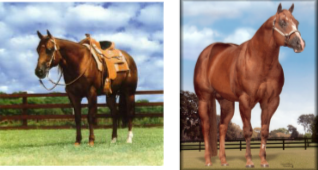
Color(s): Various colors, including sorrel, bay, black, brown, buckskin, palomino, and gray.
Place and Reason of Origin: Original to the US, developed from East Coast Chickasaw (short, stocky) and English Thoroughbreds to improve speed at short (¼ mile) distance races. Association formed in 1940. Largest numbers in the US.
American Quarter Horse
2
Body and Use Type: Known for endurance, spirit, and elegance. Used in endurance riding, show jumping, and as a general riding horse.
Color(s): Bay, gray, chestnut, black, and roan.
Place and Reason of Origin: Oldest breed, original to Arabian desert lands. Ancestral to many breeds. Extensively bred for ranch work in Western USA. Association formed in 1908.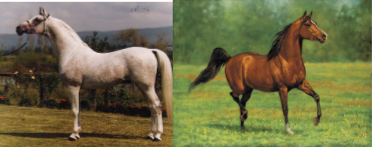
Color(s): Bay, gray, chestnut, black, and roan.
Place and Reason of Origin: Oldest breed, original to Arabian desert lands. Ancestral to many breeds. Extensively bred for ranch work in Western USA. Association formed in 1908.
Arabian
3
Body and Use Type: Large draft breed known for strength and gentle temperament. Used primarily for heavy draft work.
Color(s): Bay, chestnut, sorrel, or roan with a blonde mane and tail.
Place and Reason of Origin: Original to Belgium from medieval Flemish breeding. Brought to the US for farm work, with the last imports by an Iowan in 1940. Association formed in 1940. Largest numbers of draft registrations in the US.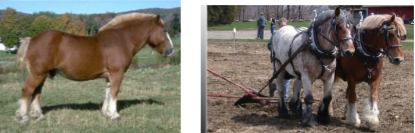
Color(s): Bay, chestnut, sorrel, or roan with a blonde mane and tail.
Place and Reason of Origin: Original to Belgium from medieval Flemish breeding. Brought to the US for farm work, with the last imports by an Iowan in 1940. Association formed in 1940. Largest numbers of draft registrations in the US.
Belgian
4
Body and Use Type: Muscular build, resembling a small horse. Used for Western riding, driving, and various equestrian disciplines.
Color(s): Known for its Appaloosa coloring, including patterns like leopard spots, blankets, and snowflakes.
Place and Reason of Origin: Original to Iowa in 1954 from a Shetland X Appaloosa cross, now with other breed influences. Bred for larger pony riders not yet ready for a full-size horse. 2nd largest numbers in the US for ponies.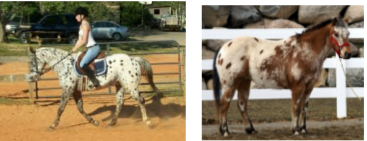
Color(s): Known for its Appaloosa coloring, including patterns like leopard spots, blankets, and snowflakes.
Place and Reason of Origin: Original to Iowa in 1954 from a Shetland X Appaloosa cross, now with other breed influences. Bred for larger pony riders not yet ready for a full-size horse. 2nd largest numbers in the US for ponies.
Pony of the Americas
5
Body and Use Type: Versatile breed known for its muscular build and agility. Used in various disciplines, including Western pleasure, reining, and trail riding.
Color(s): Distinctive coat patterns, including tobiano, overo, and tovero.
Place and Reason of Origin: Original to the US but from Spanish explorers with “two-toned” horses. Bred for ranch work in Western USA. 2nd largest numbers in the USA today.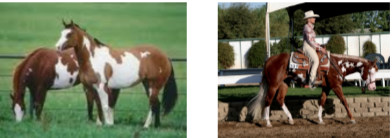
Color(s): Distinctive coat patterns, including tobiano, overo, and tovero.
Place and Reason of Origin: Original to the US but from Spanish explorers with “two-toned” horses. Bred for ranch work in Western USA. 2nd largest numbers in the USA today.
American Paint Horse
6
Body and Use Type: Large draft horse known for strength and gentle temperament. Used for heavy draft work, parades, and as a carriage horse.
Color(s): Bay, brown, or roan with white markings on the face and legs.
Place and Reason of Origin: Original to Great Britain, specifically Scotland. Bred for a faster gait pulling wagons. Brought to the US in the early 1800s. Not as popular for farm work because of feathers and size. Association formed in 1879.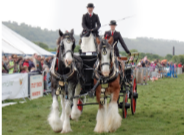
Color(s): Bay, brown, or roan with white markings on the face and legs.
Place and Reason of Origin: Original to Great Britain, specifically Scotland. Bred for a faster gait pulling wagons. Brought to the US in the early 1800s. Not as popular for farm work because of feathers and size. Association formed in 1879.
Clydesdale
7
Body and Use Type: Small, sturdy breed known for strength and hardiness. Used for riding by children, driving, and as a companion animal.
Color(s): Almost every color, including black, bay, chestnut, gray, and pinto.
Place and Reason of Origin: Original to the Shetland Islands in England, bred for coal mine draft work. Modern lines are less shaggy, more refined, and often used in English style equitation events, most notably harness/carriage events and halter shows.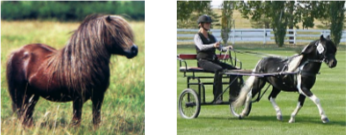
Color(s): Almost every color, including black, bay, chestnut, gray, and pinto.
Place and Reason of Origin: Original to the Shetland Islands in England, bred for coal mine draft work. Modern lines are less shaggy, more refined, and often used in English style equitation events, most notably harness/carriage events and halter shows.
Shetland Pony
8
Body and Use Type: Known for its distinctive spotted coat and versatility. Used in various disciplines, including Western riding, trail riding, and endurance.
Color(s): Various coat patterns, including leopard, blanket, and snowflake.
Place and Reason of Origin: Original to the US from Spanish horses developed by the Nez Perce Indians of NW USA in the 1700s. Same colors noted in European cave paintings of 15,000 BC. Endurance and color are key traits. Association formed in 1938.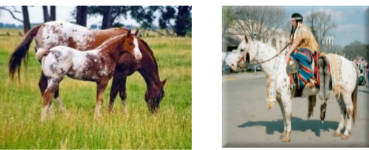
Color(s): Various coat patterns, including leopard, blanket, and snowflake.
Place and Reason of Origin: Original to the US from Spanish horses developed by the Nez Perce Indians of NW USA in the 1700s. Same colors noted in European cave paintings of 15,000 BC. Endurance and color are key traits. Association formed in 1938.
Appaloosa
9
Body and Use Type: Large draft horse known for strength and willingness to work. Used for heavy draft work, carriage driving, and riding.
Color(s): Typically gray or black.
Place and Reason of Origin:: Ancient origins from France with some Arab horse ancestry. Brought to the US in 1839, later than other drafts. However, 3X as many as others combined by WWII. Bred for farm and city labor. ISU famous for breeding program in the early 1900s.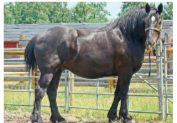
Color(s): Typically gray or black.
Place and Reason of Origin:: Ancient origins from France with some Arab horse ancestry. Brought to the US in 1839, later than other drafts. However, 3X as many as others combined by WWII. Bred for farm and city labor. ISU famous for breeding program in the early 1900s.
Percheron
10
Body and Use Type:: Known for speed and agility. Used primarily for racing, but also excels in other equestrian sports like show jumping and dressage.
Color(s):: Bay, chestnut, black, and gray.
Place and Reason of Origin:: Brought to the US in the 1700s from old English influence breeding of Arabians. Popular in eastern states for longer distance and endurance racing. Some lines and crosses popular in stadium jumping and field events. Association formed in 1894, later taken over by the US Jockey Club.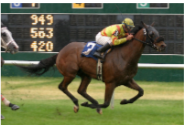
Color(s):: Bay, chestnut, black, and gray.
Place and Reason of Origin:: Brought to the US in the 1700s from old English influence breeding of Arabians. Popular in eastern states for longer distance and endurance racing. Some lines and crosses popular in stadium jumping and field events. Association formed in 1894, later taken over by the US Jockey Club.
Thoroughbred
11
Body and Use Type:: Versatile breed known for hardiness and good temperament. Used for riding by children and adults, driving, and various equestrian disciplines.
Color(s):: Various colors, including bay, chestnut, gray, and black.
Place and Reason of Origin:: Original to the harsh mountains of Wales. Bred and used in multiple ways over the years (mines, chariots, racing). Today, used for society and children’s pleasure. Brought to the US in 1889 and associated in 1907.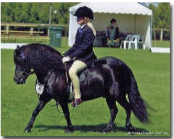
Color(s):: Various colors, including bay, chestnut, gray, and black.
Place and Reason of Origin:: Original to the harsh mountains of Wales. Bred and used in multiple ways over the years (mines, chariots, racing). Today, used for society and children’s pleasure. Brought to the US in 1889 and associated in 1907.
Welsh Pony
12
Body and Use Type: Known for harness racing, either at a trot or pace. Well-muscled build, also used for riding and driving.
Color(s): Bay, black, brown, and chestnut.
Place and Reason of Origin:: Original to the US in the early 1800s. Bred from Thoroughbred ancestry in the early 1800s to beat Morgan horses in harness races. Noted origins to “Hamletonian 10” foaled in 1849: ~ 90% of modern breed trace to him. Bred to race 1 mile standard time – hence the name.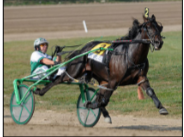
Color(s): Bay, black, brown, and chestnut.
Place and Reason of Origin:: Original to the US in the early 1800s. Bred from Thoroughbred ancestry in the early 1800s to beat Morgan horses in harness races. Noted origins to “Hamletonian 10” foaled in 1849: ~ 90% of modern breed trace to him. Bred to race 1 mile standard time – hence the name.
Standardbred
13
Body and Use Type: Known for athleticism and elegance. Used in disciplines like dressage, show jumping, and eventing.
Color(s): Bay, gray, chestnut, and black.
Place and Reason of Origin: Developed in Prussia in the 18th century from Thoroughbred and Arabian lines, but most lines today are from German origins. Brought to the US in the 1950s. Large (16 to 17 hands), athletic, and graceful, they are most valued in Olympic competitive events such as dressage and jumping.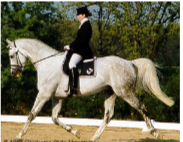
Color(s): Bay, gray, chestnut, and black.
Place and Reason of Origin: Developed in Prussia in the 18th century from Thoroughbred and Arabian lines, but most lines today are from German origins. Brought to the US in the 1950s. Large (16 to 17 hands), athletic, and graceful, they are most valued in Olympic competitive events such as dressage and jumping.
Trakehner
14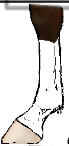
stocking
15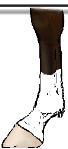
sock (boot)
16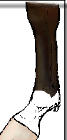
fetlock
17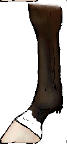
pastern
18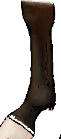
coronet
19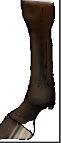
partial pastern
20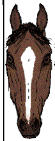
blaze
21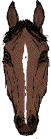
stripe
22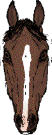
stripe (or thin blaze) and nose
23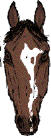
irregular blaze
24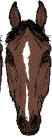
interrupted stripe
25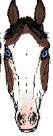
bald face
26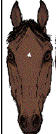
faint star
27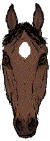
star
28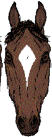
star and stripe
29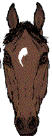
irregular star
30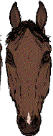
snip
31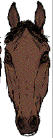
lip masking
32
A. eludes to body capacity of the horse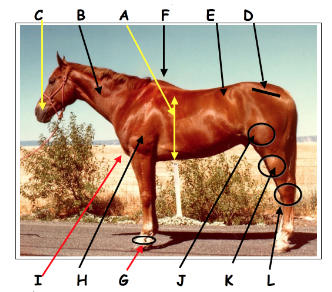
barrel (girth)
33
B. important in balance and control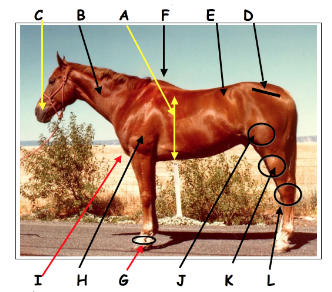
neck
34
C. front of the horse's face near the nostrils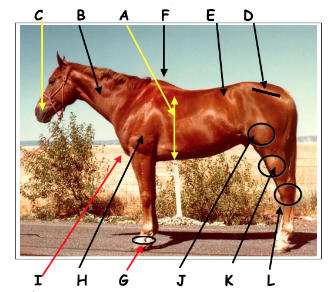
muzzle
35
D. distance between the point of the hip and the pin bones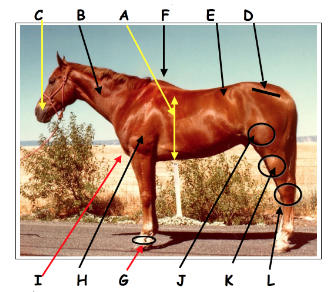
croup
36
E. located between the rib and point of the hip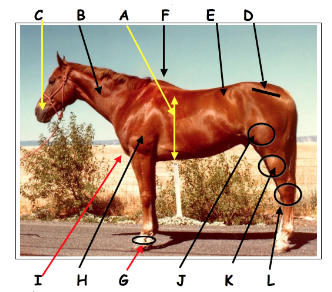
loin/coupling
37
F. top of the shoulder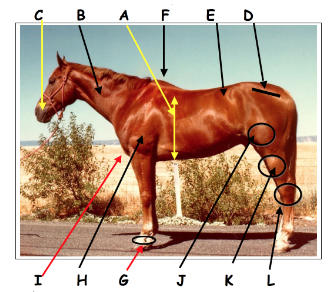
withers
38
G. important for soundness and performance in athletic horses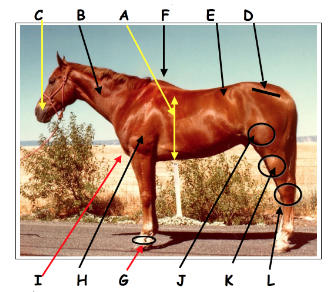
pastern
39
H. carries most of the weight of the rider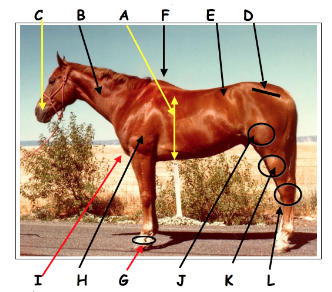
shoulder
40
I. formed by union of pectoral muscles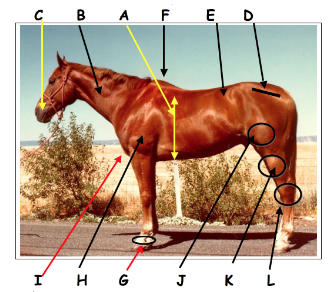
"vee" shape
41
J. area connecting humerus to pelvis 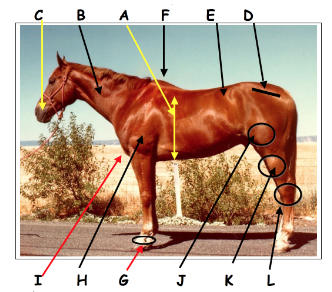
stifle
42
K. a muscle expression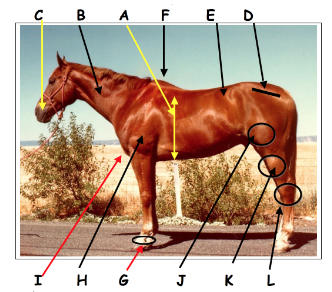
gaskin
43
L. consistent term across all species we've worked with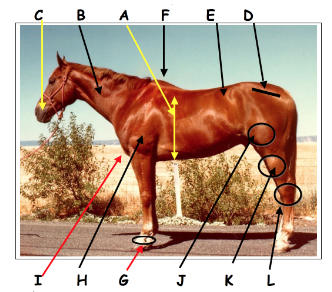
hock
44
reddish tan to brown with black mane, tail, lower legs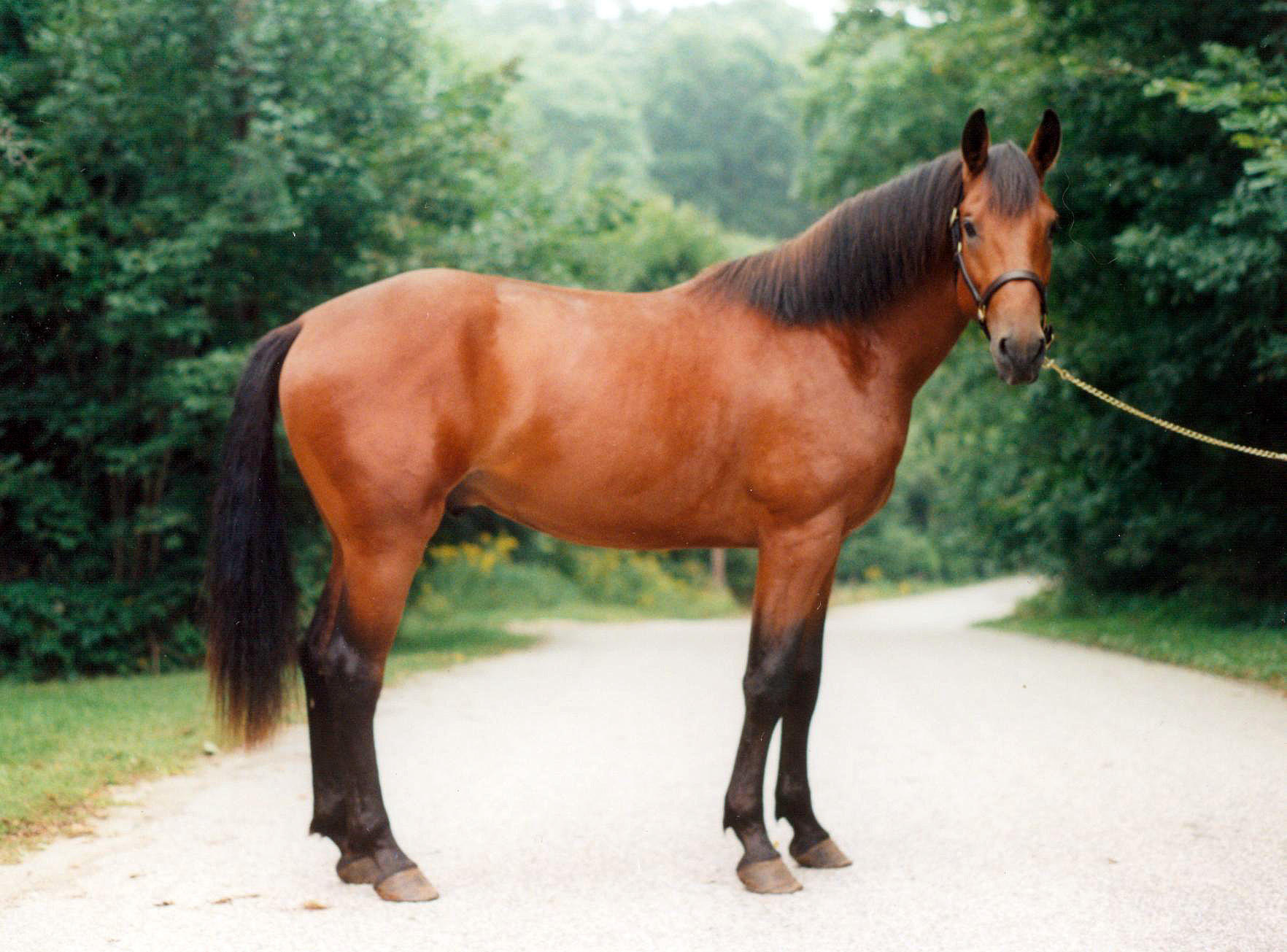
bay
45
true black with no light areas around muzzle or flank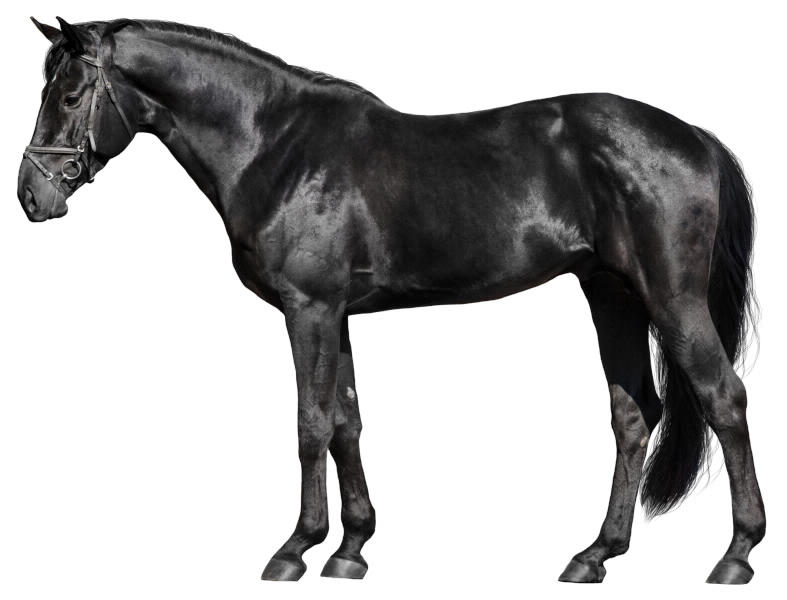
black
46
almost black, but brown or tan hair is found on muzzle or flank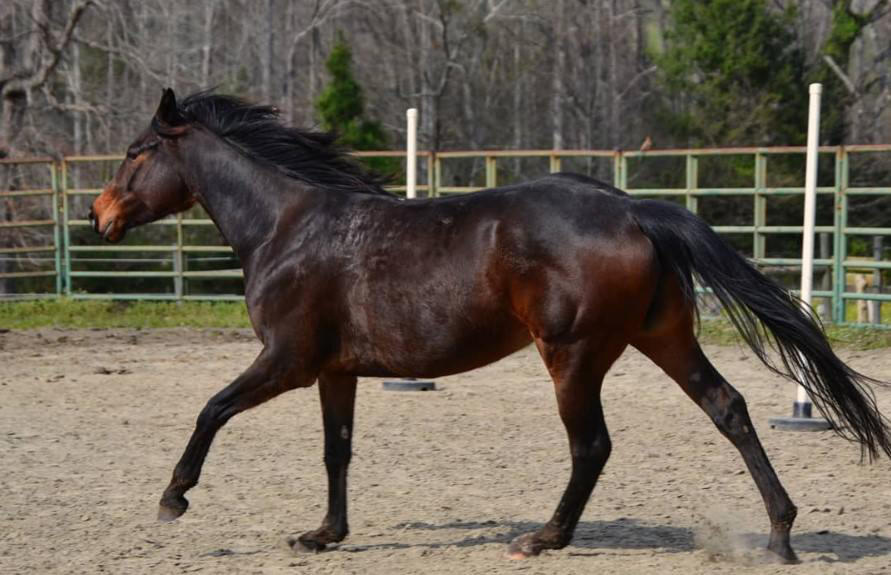
brown
47
copper bright reddish with main and tail the same color as the body, or flaxen ("blonde")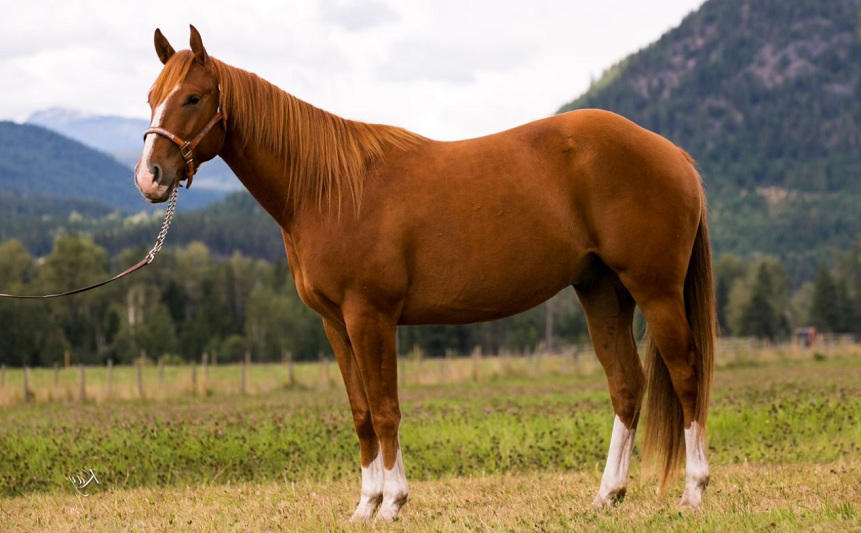
sorrel
48
dark red or reddish brown with mane and tail the same color as body, or flaxen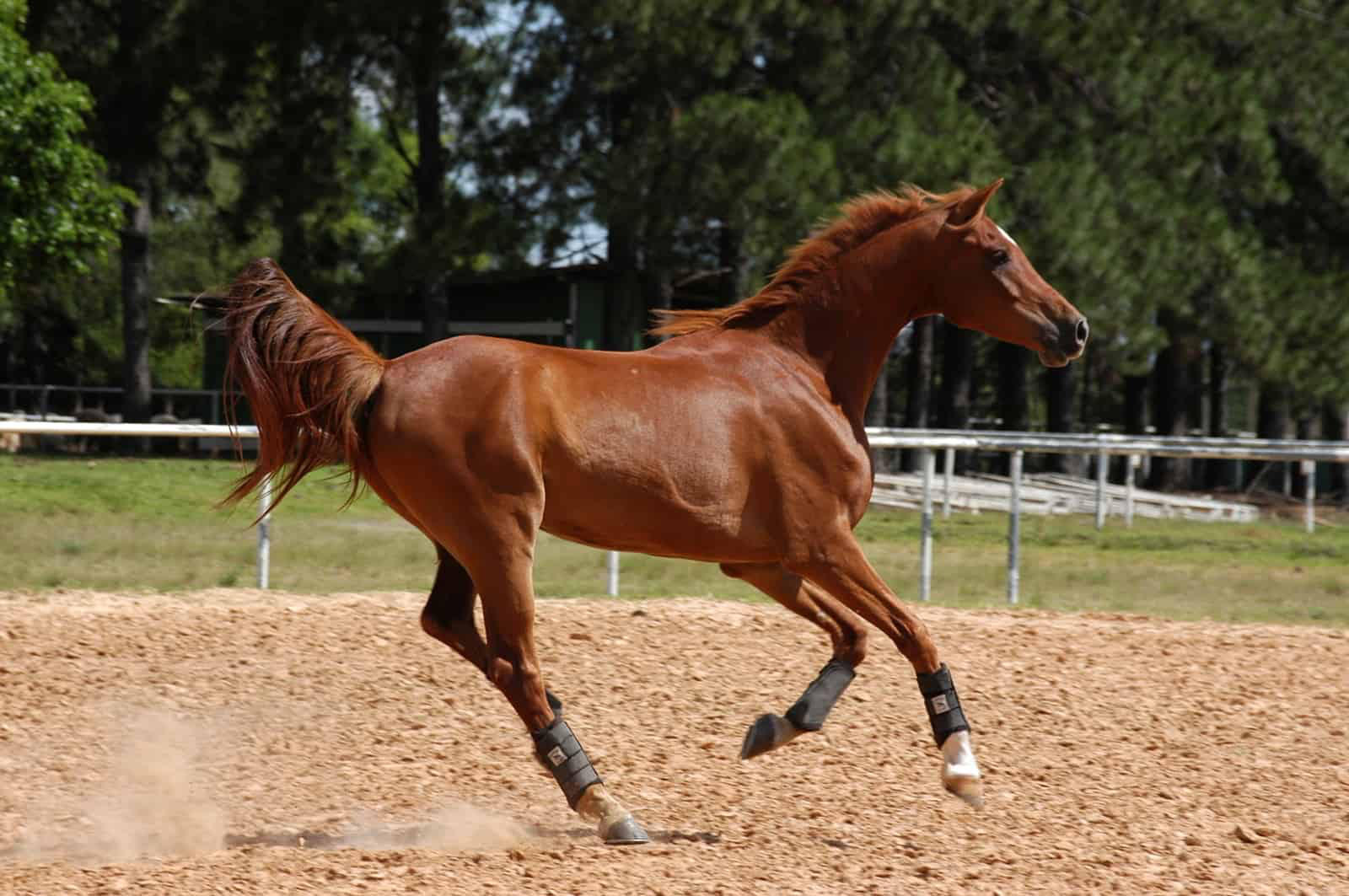
chestnut
49
mixture of white and black hair, often born non-gray and color lightens with age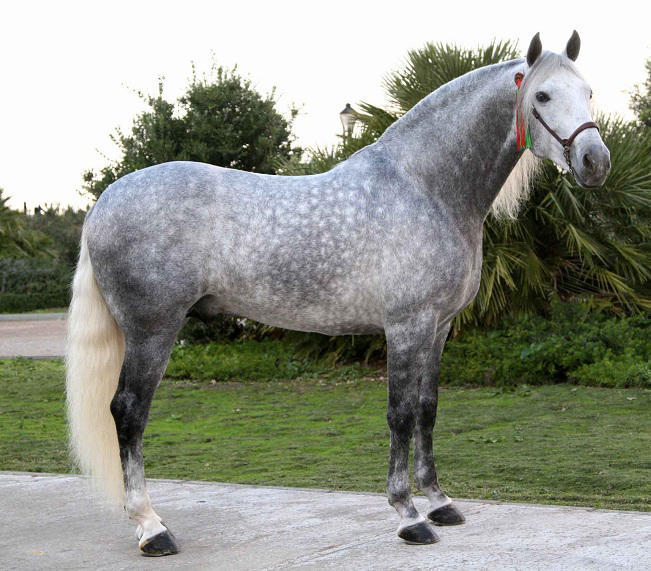
gray
50
Golden yellow with flaxen mane and tail. Note that this is also a breed registry name as well, eluding to the color requirement of the breed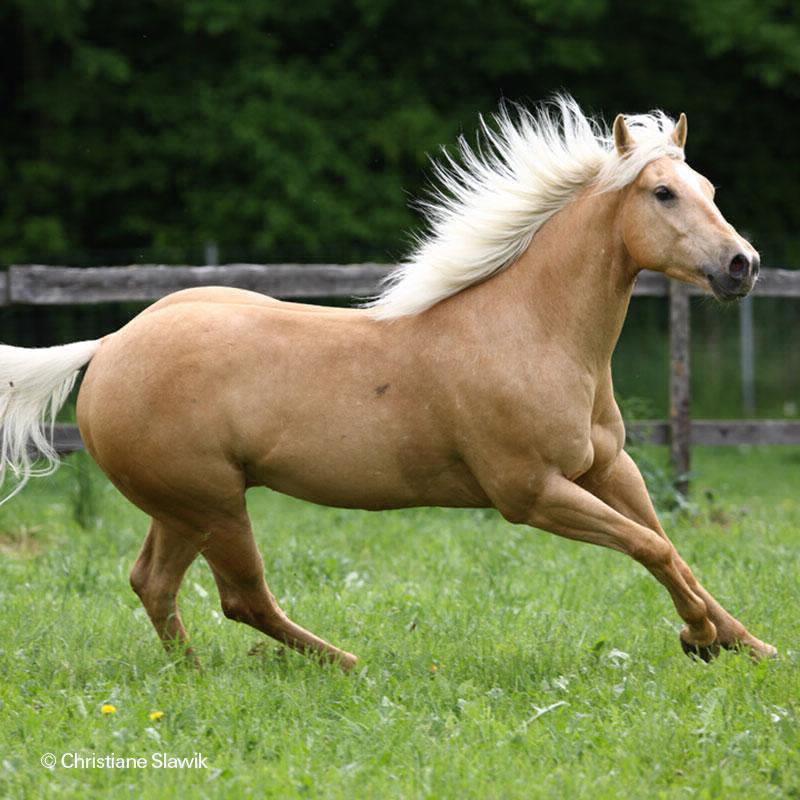
palomino
51
Mixture of white and either red (red roan), chestnut (strawberry roan) or black (blue roan) hair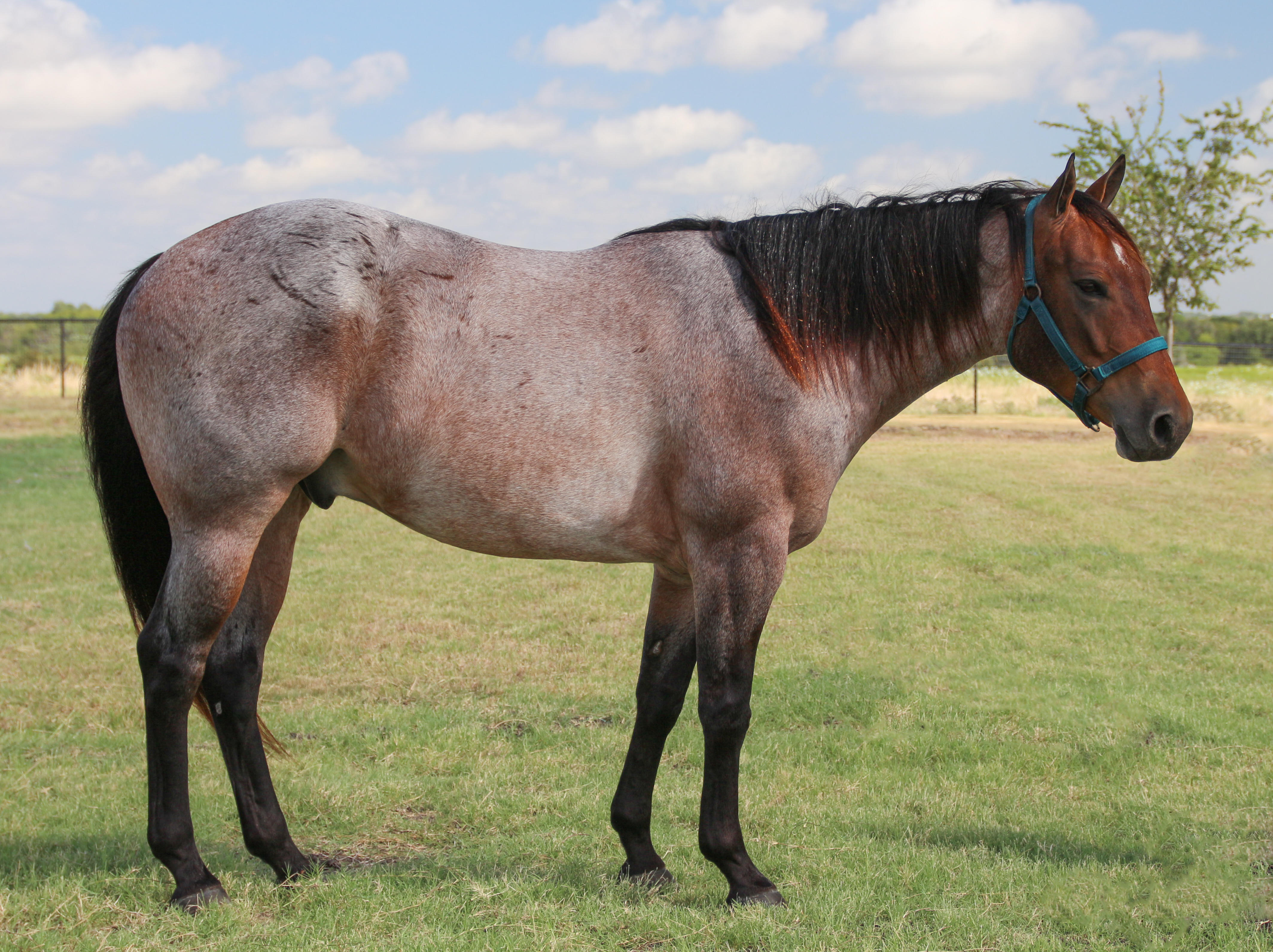
roan
52
Can be a number of colors, but diluted in color and with a dorsal stripe (down center of back) (spirit but whiter)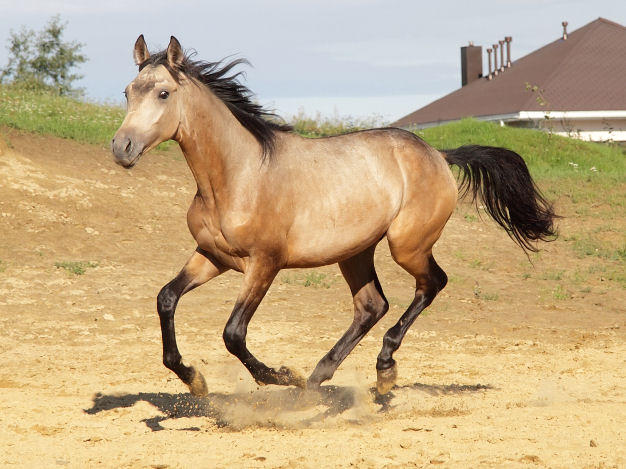
dun
53
True colored should be the color of tanned deer hide with black points. Shades may vary from yellow to dark gold. Points (mane, tail, legs) can be dark brown or black (looks like spirit)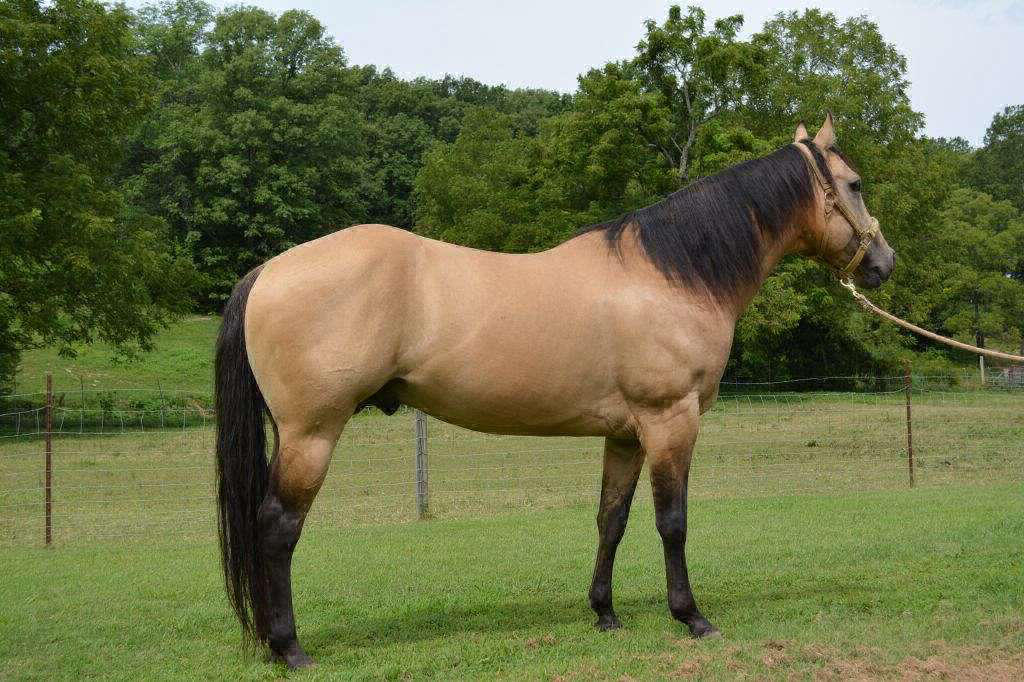
buckskin
54
Not really a color but a color pattern. Variable pattern often consisting of white over loin and hips with dark spots. Note that this is also a breed registry name as well, eluding to the color requirement of the breed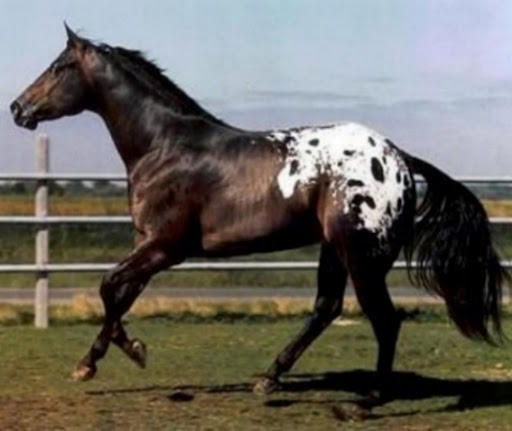
appaloosa
55
Note also this a breed registry name as well, eluding to the color requirement of the breed. Paints are any background color of a horse, with large white spotting patterns on the body of the horse (There are several subtypes of paint horse colors. The two most common are called Overo and Tobiano)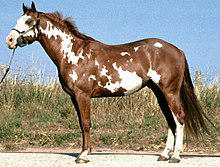
paint
56
True white, without pigment, though not albino. Does not turn grey with age. Is associated with a lethal gene, so not true breeding because homozygosity for the white gene is lethal in utero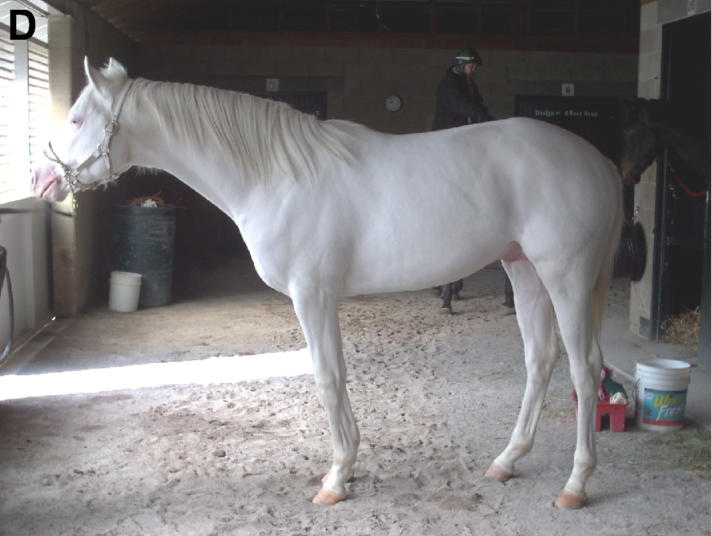
white
57
type of horse used for nearly every form of riding, also called "hot blooded"
light horse
58
type of horse bred to carry and pull heavy loads, also known as "cool blooded" (calm temperament)
draft horse
59
type of horse that is a cross between draft and light horse, intermediate temperament
warm blood horse
60
type of horse, also a light horse but bred and used for riding in order to provide smooth and comfortable ride
gaited horse
61
type of horse, less than 14.2 hands, bred for many different uses
pony
62
describes natural tendency seen in horses to be caregivers
epimelectic
63
horse characteristic that causes them to spook easily, have long memories, and high intelligence/trainability
highly developed nervous system
64
male donkey
jack
65
female donkey
jenny/jennet
66
jack x mare
mule
67
stallion x jenny
hinny (less preferred)
68
describes this style of working with horses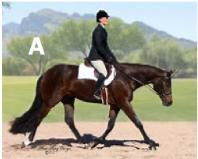
English
69
term that describes this style of working with horses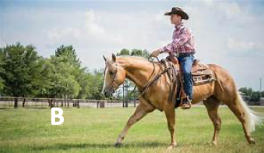
Western
70
horse gestation length
11 months
71
horse estrous cycle length
21 days
72
mare brought into proximity of a stallion to create arousal and detect estrous
tease
73
an elegant trained movement of a horse to perform in complex dance-like patterns in a small area
dressage
74
the filing of the continual growth of the "wolf" teeth of a horse to prevent mouth disease.
float
75
adjective to describe a horse that performs a trained 4 beated gait that is not entirely innate to the horse.
gaited
76
equipment used to work with the control of the horse
tack
77
person who shoes a horse
farrier
78
to work a horse on the end of a long lead rope, usually in an "round pen" to exercise and train the horse
lunge
79
to use the most extended inside hoof as the horse runs in a circle
take a lead
80
collective name for digestive illnesses in horses due to sensitive digestive system
colic
81
intact male horse
stallion
82
young female horse
filly
83
mature female horse
mare
84
horse offspring
foal
85
castrated male horse
gelding