GA Exam 1
Study these flashcardsFree · spaced repetition · iPhone, Android, Mac & web
All cards
1
Prone position
Lying face DOWN
2
Supine
Lying face UP
3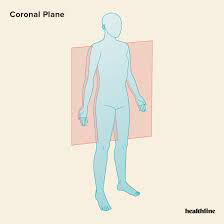
Frontal/coronal
4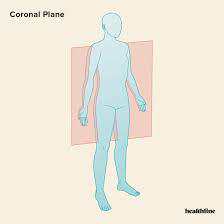
Median/Midsagittal/Sagittal
5
Transverse/Horizontal plane
6
Anterior
In front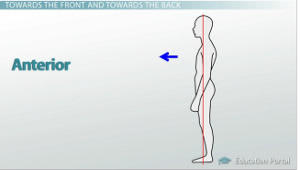
7
Posterior
Behind you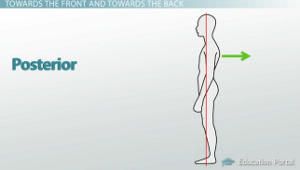
8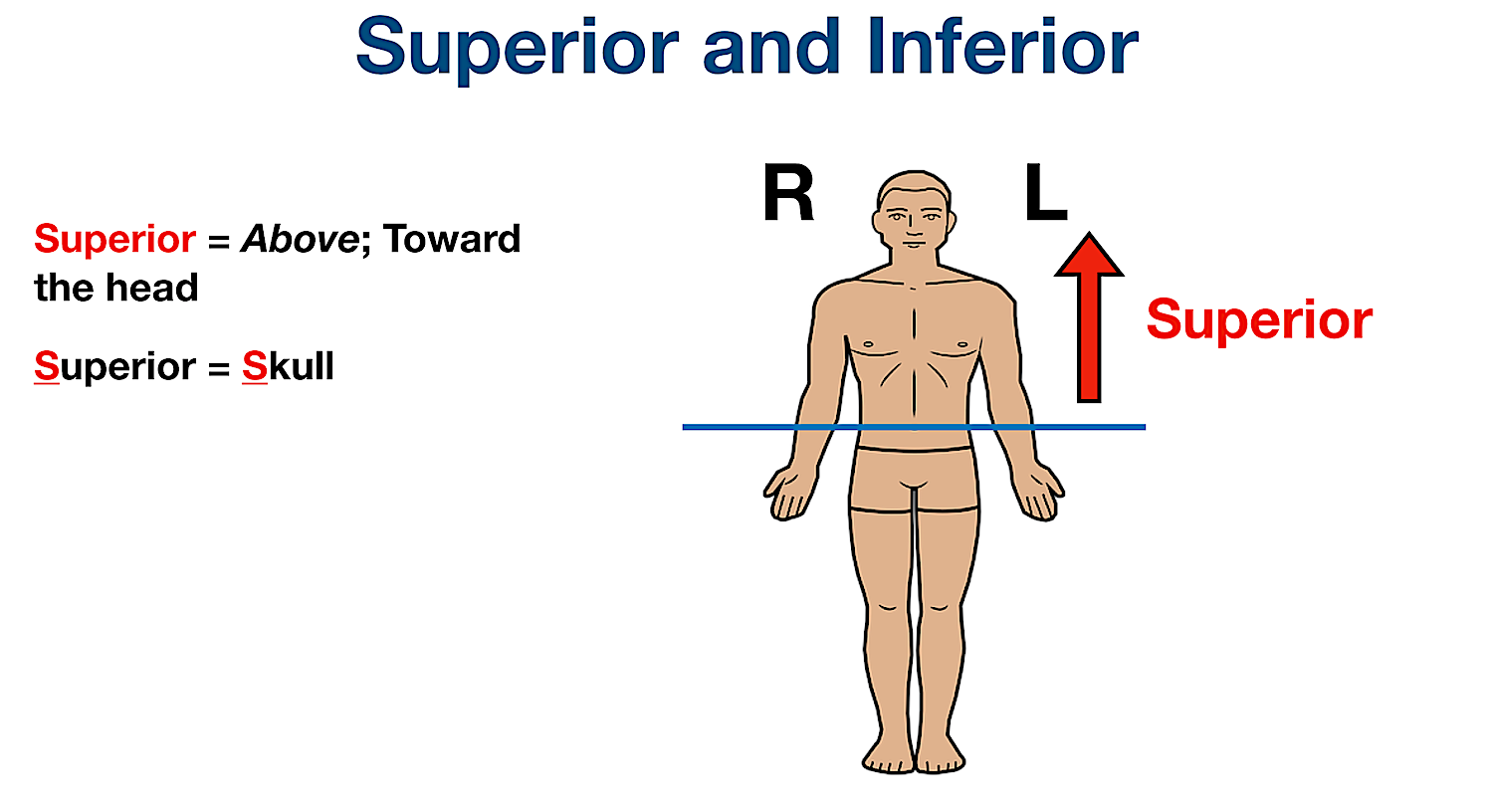
Superior
9
Inferior
10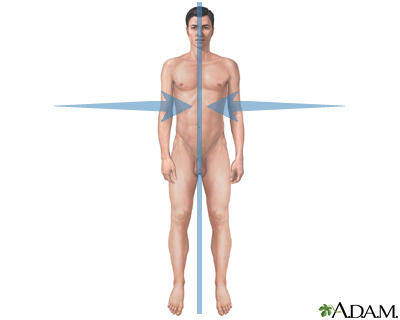
Medial
11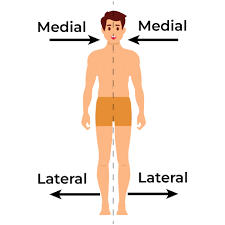
Lateral
12
Proximal/Distal
*Only used when comparing the structures on the limbs, not be used w/ structures on the trunk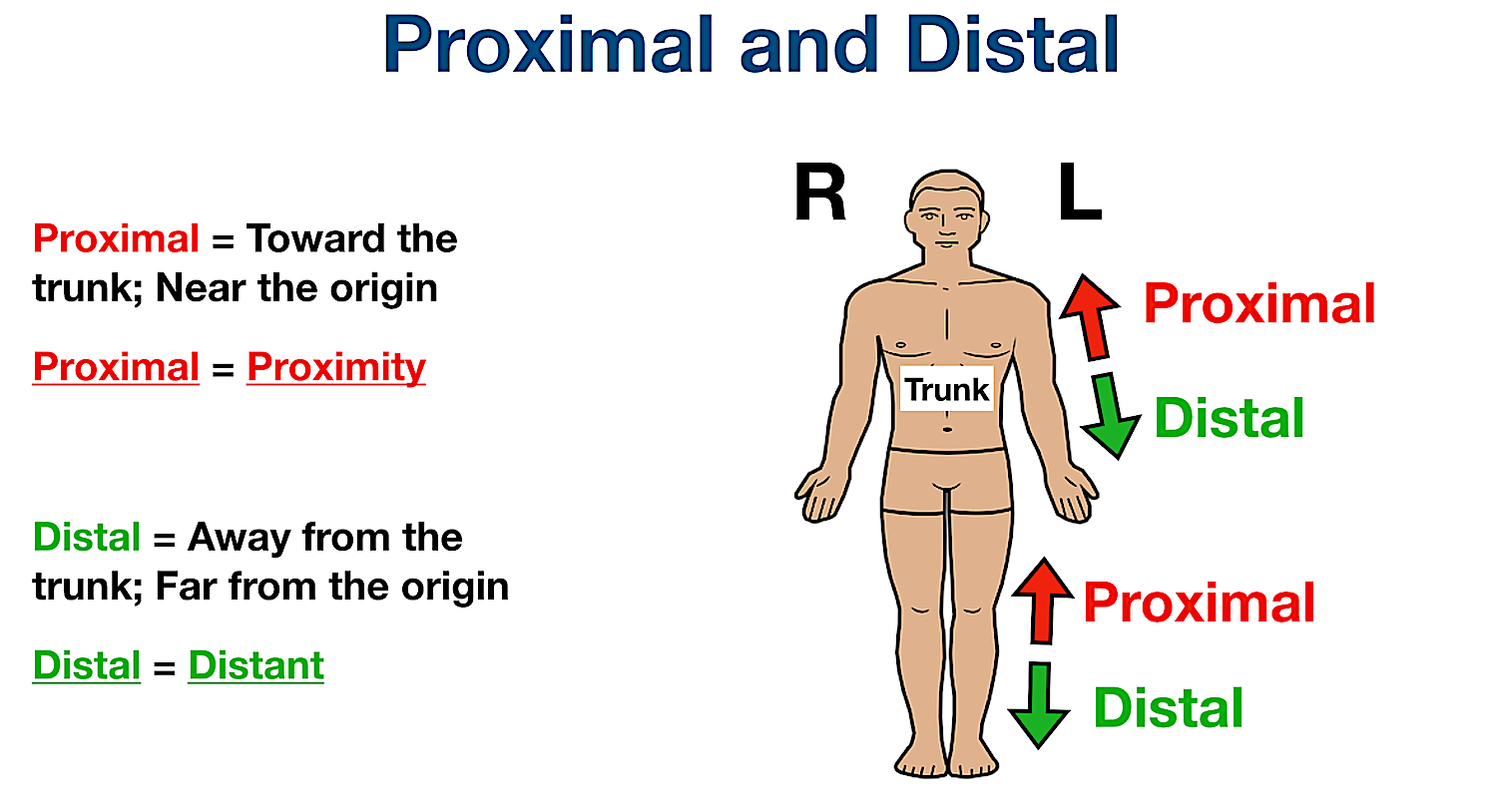
13
Contralateral
Something that is located on the opposite side of the body or structure (left arm, right leg)
14
Ipsilateral
Same side of the body/sturcture (left arm, left leg)
15
Epithelial tissues (Characteristics, made up of?)
-Superficial skin and inner lining of organs, cavities, blood vessels
-Avascular (Few or no blood vessels)
-Made up almost entirely by cells
-Avascular (Few or no blood vessels)
-Made up almost entirely by cells
16
Epithelial tissues (General functions)
Covers surfaces, inside and out (skin, blocks entrance for bacteria to enter)
17
Simple vs Stratified layer
Single layer vs Stacked layer
18
Pseudostratified layer
apperas to be multiple layers, but is actually a single layer of epithelium
19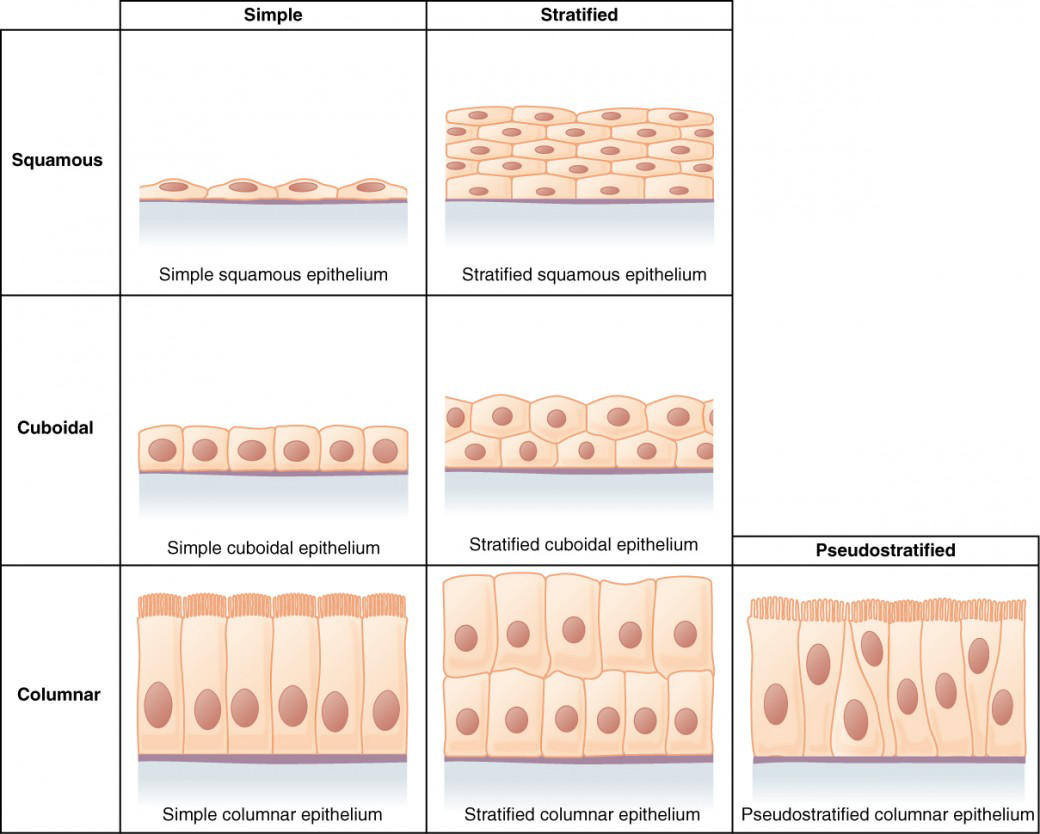
Squamous, cuboidal, and columnar epithelium
20
What are connective tissues?
Diverse group of tissues that connect body parts together
21
the 3 basic components of connective tissues
Cells
-fibroblasts (fiber-creators), fat cells and resident and wandering immune cells
Protein fibers
-majority collagen, but also elastic and reticular
Ground Substance
-Thin gel in proper connective tissue
-fibroblasts (fiber-creators), fat cells and resident and wandering immune cells
Protein fibers
-majority collagen, but also elastic and reticular
Ground Substance
-Thin gel in proper connective tissue
22
Collagen fibers (made of..., characteristics, appearance?)
-made of the protein collagen
-Tough, flexible and resists stretching
-Collagen has a glistening, pearly, white appearance
-Tough, flexible and resists stretching
-Collagen has a glistening, pearly, white appearance
23
Elastin fibers (characteristics)
Stretchy like rubber bands
has the ability to stretch and recoil back to original shape (how we can pinch skin and it recoils back)
has the ability to stretch and recoil back to original shape (how we can pinch skin and it recoils back)
24
Reticular fibers (made of.., characteristics, where its found in)
Made of type 3 collagen
Forms a net-like structure
Found in endocrine glands, liver, lymph organs
Forms a net-like structure
Found in endocrine glands, liver, lymph organs
25
4 types of connective tissue
Fibrous (Fibers)
Adipose (fat)
Supportive (Bone, cartilage)
Fluid (blood)
Adipose (fat)
Supportive (Bone, cartilage)
Fluid (blood)
26
Tendons (what they connect from and to)
Connect muscle to bone
- tendons are connective tissue
- tendons are connective tissue
27
Ligaments (what they connect from and to)
connect bones to other bones
- ligaments are connective tissue
- ligaments are connective tissue
28
Fascia (how they're formed, function)
Forms when connective tissue are arranged in enveloping sheets that surround structures
Function:
-Connects and organizes body tissues
-Stores water and fat
-Liquid btwn fascial sheets provide lubrication for movement
-mechanical protection against blows
-pathway for nerves and blood vessels to enter and exit muscles
Function:
-Connects and organizes body tissues
-Stores water and fat
-Liquid btwn fascial sheets provide lubrication for movement
-mechanical protection against blows
-pathway for nerves and blood vessels to enter and exit muscles
29
Superficial fascia (what is it, where it's found)
Loose connective tissue/ loose in organization
-Found deep to the skin universally in the body, rich in adipose tissue
-Found deep to the skin universally in the body, rich in adipose tissue
30
Deep fascia (compared to superficial, characteristics)
Tougher/thicker than superficial (ex. thin sheet enclosing muscle)
Blends w/ periosteum (fibrous sheath that covers bones) to connect to bone
lacks in adipose (fat) and extends inward to subdivide muscles and wrap around neurovascular bundles
Blends w/ periosteum (fibrous sheath that covers bones) to connect to bone
lacks in adipose (fat) and extends inward to subdivide muscles and wrap around neurovascular bundles
31
Internal fascia (what does it connect)
Connects pleura and peritoneum (Thorax and abdomen) to body wall
32
Cartilage (what it is, characteristics)
Cartilage connective tissue
-Weaker than bone, but more flexible and resilient
-Contains water, collagen and cells
-Weaker than bone, but more flexible and resilient
-Contains water, collagen and cells
33
Chondroblasts
Produce the matrix of cartilage
34
Chondrocytes
Mature cartilage cells that maintain the matrix
35
Cartilage matrix (characteristics)
Avascular, few or no blood vessels
Mostly made of water
-** Resistant to compression (like a basketball/ beach ball, notice the difference in resistance)
-Vulnerable to twisting and bending (tears easily)
Mostly made of water
-** Resistant to compression (like a basketball/ beach ball, notice the difference in resistance)
-Vulnerable to twisting and bending (tears easily)
36
Functions of cartilage
Provides...
-a gliding surface for joints
-a model for bone formation/ growth
Can be used in skeletal structure where flexibility or resistance to breaking is useful
ex. Costal (rib) cartilages, allows rib to move when breathing in, bc ribs are connected to cartilage
-a gliding surface for joints
-a model for bone formation/ growth
Can be used in skeletal structure where flexibility or resistance to breaking is useful
ex. Costal (rib) cartilages, allows rib to move when breathing in, bc ribs are connected to cartilage
37
Hyaline cartilage
Most abundant type of cartilage
found in areas such as trachea, larynx, joints, ends of bones
found in areas such as trachea, larynx, joints, ends of bones
38
Fibrocartilage
Shock absorbing cartilage
- resists stretch and compaction
found in intervertebral discs, knee joints, pelvis
- resists stretch and compaction
found in intervertebral discs, knee joints, pelvis
39
Five functions of bones
1. protection of vital structures/form rigid walls of cavities
2. support for body
3. Mechanical basis for movement, provide atachments for muscles and provide levers for other bones
4. Development of blood cells, such as red bone marrow in ends of long bones, in sternum and ribs, vertebrae and skull
5. Mineral storage, calcium, phosphorus, magnesium
2. support for body
3. Mechanical basis for movement, provide atachments for muscles and provide levers for other bones
4. Development of blood cells, such as red bone marrow in ends of long bones, in sternum and ribs, vertebrae and skull
5. Mineral storage, calcium, phosphorus, magnesium
40
Diaphysis
Growth btwn 2 parts (Shaft of bone)
41
Epiphysis
Growth at ends
42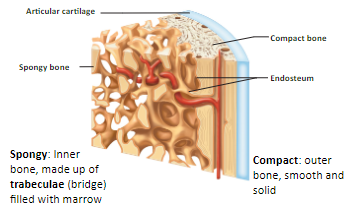
Bone anatomy
43
Tension on ___ side, compression on ___ side
lateral, medial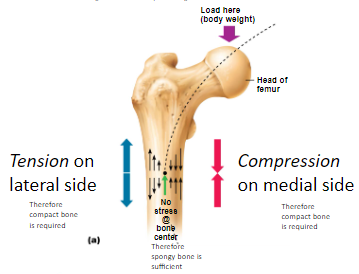
44
Two types of classifying bones
Axial/appendicular, shape
45
Axial skeleton (what's included?)
Skull
Vertebral column
Sternum & ribs
Vertebral column
Sternum & ribs
46
Appendicular skeleton
Pectoral girdle (clavicle and scapula)
Pelvic girdle (pubis, ilium & ischium)
Upper limbs (Humerus, radius and ulna)
lower limbs (femur, tibia and fibula)
Pelvic girdle (pubis, ilium & ischium)
Upper limbs (Humerus, radius and ulna)
lower limbs (femur, tibia and fibula)
47
the 5 shapes of bones
Long (Tubular)
Short (cuboidal, only wrist and ankle)
Flat/squamous (found in axial, protective functions)
irregular (any shape other than long, flat, or short)
sesamoid (knee cap/patella, develops in tendons)
Short (cuboidal, only wrist and ankle)
Flat/squamous (found in axial, protective functions)
irregular (any shape other than long, flat, or short)
sesamoid (knee cap/patella, develops in tendons)
48
Skeletal muscle cells (Where they're attached, characteristics)
Attached to bones, cells are long and multinucleated
49
Smooth muscle cells (Where they're attached, characteristics)
Sheets within organs and blood vessels
cells are shorter, contract together as a unit
cells are shorter, contract together as a unit
50
Cardiac muscle cells (Where they're attached, characteristics)
Found only within the heart
Contact together as a unit
Contact together as a unit
51
origin vs insertion, which is more mobile
Origin: where the muscle connects from, Insertion: where the muscle attaches too
Origin has a less mobile end, insertion has a more mobile end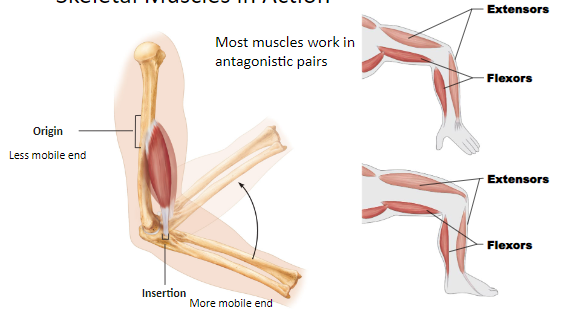
Origin has a less mobile end, insertion has a more mobile end
52
Motor neuron
A neuron that innervates a muscle
53
Motor unit
One motor neuron innervates many muscle fibers
54
Large motor units in locations w/ ___ motor control
gross
55
Small motor units in locations w/ ___ motor control
Fine
56
skeletal muscle cells develop from...
stem cells
57
Individual cells fuse to form...
long, multinucleated adult cells
58
Bc skeletal muscles have multiple nuclei...
adult muscle cells cannot divide to produce new adult muscle cells
59
increases in strength are due to...
expansion of existing adult muscle cells and increases in contractile protein mass within
60
Repair from injury requires what?
stem cell division to produce new adult muscle cells
61
Intrinsic muscles
Muscles found within the region where their action occurs
62
Extrinsic muscles
Muscles found outside the area where their action occurs
63
each muscle cell is also called...
muscle fiber
64
Muscle fibers can be arranged in ____ wrapped in ____
Fascicles, fascia
65
fascial ends weave together to form...
tendons
66
Belly
whole muscle btwn tendons reffered to as the belly
67
Aponeuroses
tendons of some muscles form flat sheets, connecting to other muscles
68
Unipennate
one whole, central tendon, fascicles on one side of the tendon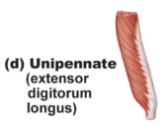
69
Bipennate
one whole, central tendon. Fascicles on both side of the tendon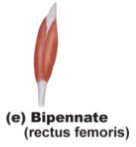
70
Multipennate
multiple fascicles/muscle fibers onto one tendon (like multiple feathers) 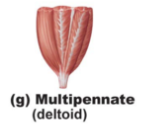
71
Fusiform/parallel
Two tendons and a muscle belly
For parallel: width of tendon~~width of belly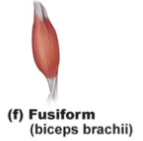
For parallel: width of tendon~~width of belly
72
Convergent
Broad to a narrow site
Usually an area w/ a large amount of force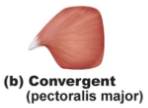
Usually an area w/ a large amount of force
73
Fusiform vs pennate
Parallel: More shortening possible
Pennate: more force produced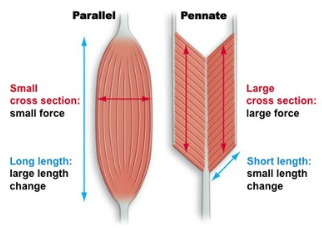
Pennate: more force produced
74
types of movements
Flexion, Extension/ hyperextension
abduction, adduction
circumduction
medial/internal rotation
laterla/external rotation
elevation or depression
abduction, adduction
circumduction
medial/internal rotation
laterla/external rotation
elevation or depression
75
another name for joints
arthroses, articulations
76
every joint is a balance of…
stability and mobility
77
joints can be divided into two categories…
synarthroses and diarthroses
78
characteristics of synarthroses, compared to diarthroses
highly stable, but low to no mobility (diarthroses have more mobility, but less stable/more prone to injury)
79
what material is in btwn the two bones of synarthroses?
connective tissues (broadly speaking)
80
Sutures
fibrous synarthrose
fibrous connective tissue that joins two bones
found in the skull
fibrous connective tissue that joins two bones
found in the skull
81
syndesmoses
fibrous synarthroses
two bones joined by a wide sheet or membrane
two bones joined by a wide sheet or membrane
82
gomphoses
fibrous synarthroses
like a pet and socket , surfaces of the bones are adapted to each other
tooth in jaw
like a pet and socket , surfaces of the bones are adapted to each other
tooth in jaw
83
synchondrosis
cartilaginous synarthroses
hyaline cartilage directly connects two bones (ex. epiphyseal planes/ growth planes)
hyaline cartilage directly connects two bones (ex. epiphyseal planes/ growth planes)
84
symphyses
cartilagenous synarthroses
pad of tilage connects two bones
common in weight-bearing locations (ex. pubic)
pad of tilage connects two bones
common in weight-bearing locations (ex. pubic)
85
synovial joints
another name for diarthroses
86
components of synovial joints
joint capsule of fibrous tissue
joint cavity enclosed by capsule
synovial membrane lining capsule
synovial fluid covering joint surfaces
hyaline (articular) cartilage covering joint surfaces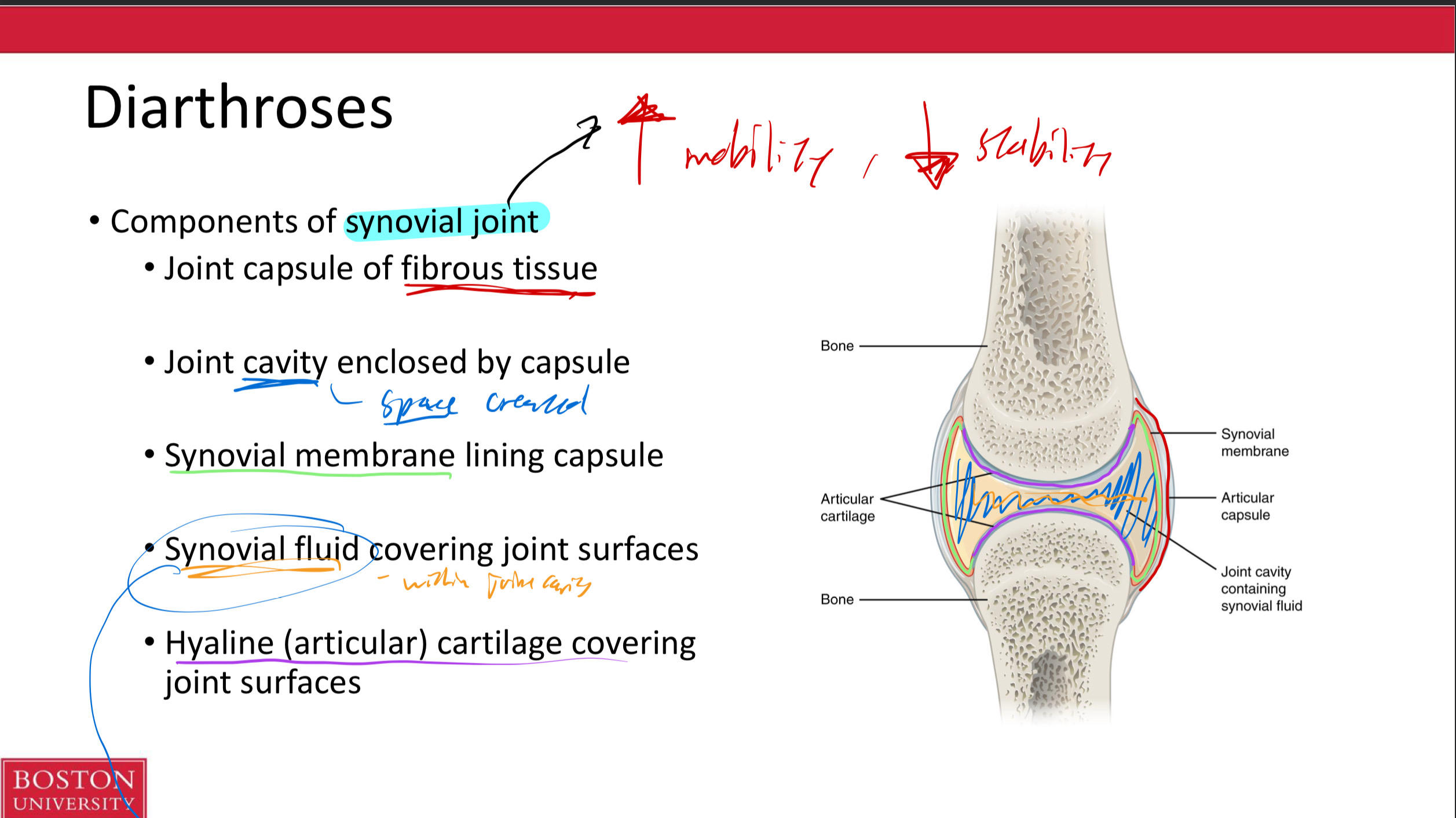
joint cavity enclosed by capsule
synovial membrane lining capsule
synovial fluid covering joint surfaces
hyaline (articular) cartilage covering joint surfaces
87
types of diarthroses (and their subtypes)
Uniaxial
- hinge, pivot
Biaxial
- condyloid, saddle
Triaxial
- plane, ball n socket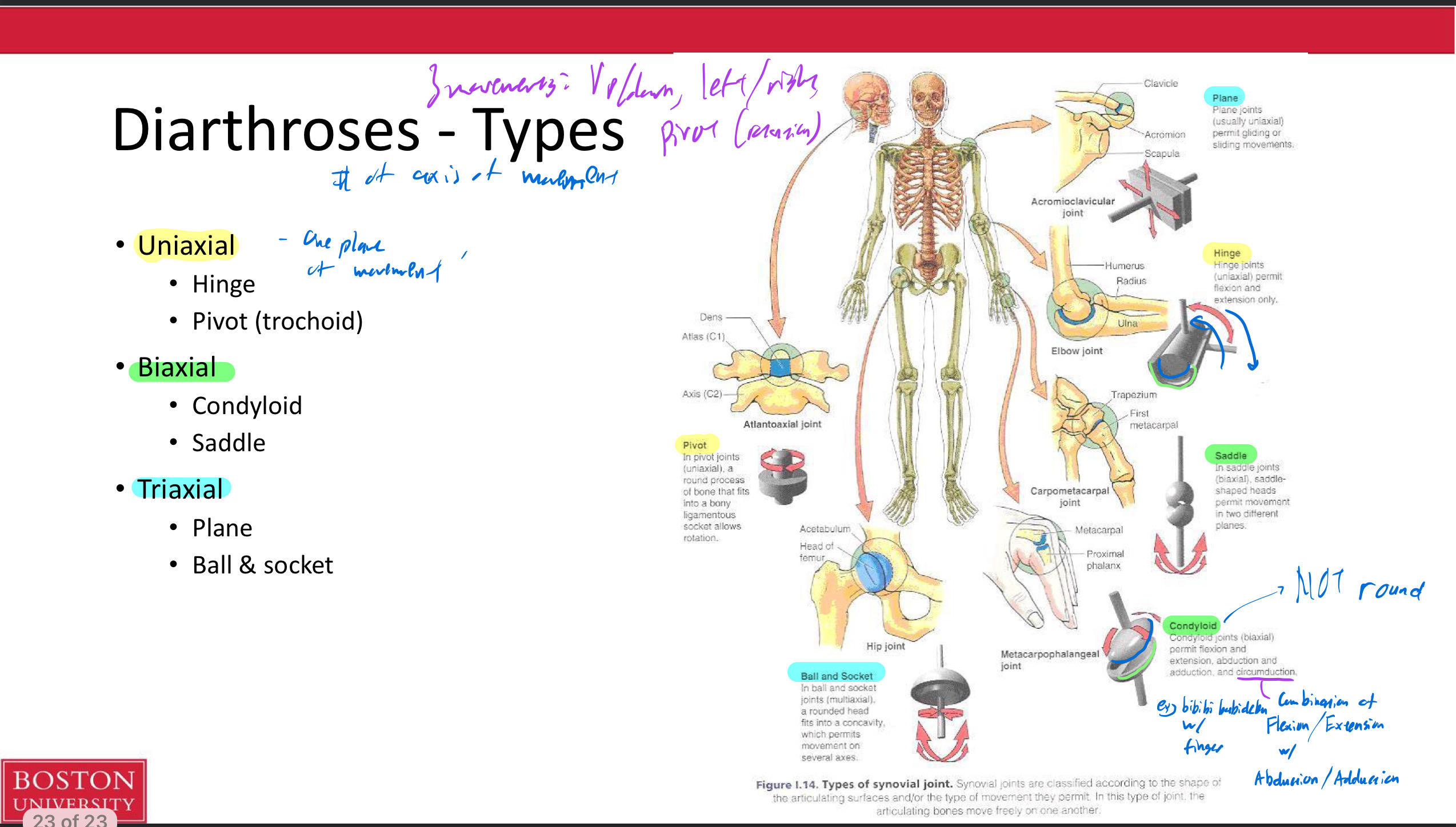
- hinge, pivot
Biaxial
- condyloid, saddle
Triaxial
- plane, ball n socket
88
synovial fluid (where they’re produced, functions, characteristics)
-produced by cell in the synovial membrane
-nourishes the hyaline cartilage
-made up w similar things as blood plasma, +2 ingredients that add viscosity and lubrication
-synovial fluid viscosity decreases when joints move quickly and when temps are higher
-nourishes the hyaline cartilage
-made up w similar things as blood plasma, +2 ingredients that add viscosity and lubrication
-synovial fluid viscosity decreases when joints move quickly and when temps are higher
89
Central nervous system (CNS) consists of the...
the brain and spinal cord
90
Peripheral nervous system (PNS) consist of...
all the nerves that exit from brain or spinal cord
91
Cranial nerves are...
bundles of axons thhat emerge from the brain
92
Spinal nerves are...
bundles of axons that emerge from the spinal cord
93
Do neurons have a high or low metabolic rate?
HIGH, need lots of glucose and oxygen
94
Neurons (NS cells), (functions, characteristics)
Neurons: conduct nerve impulses from one part of body to another
-High metabolic rate, needs alot of glucose and oxygen
-most last the lifetime of an individual
Non-mitotic (諸説あり)
-High metabolic rate, needs alot of glucose and oxygen
-most last the lifetime of an individual
Non-mitotic (諸説あり)
95
Neuron Structure (three main components)
Cell body (Nucleus)
Dendrites (Short processes off the body that receive nerve impulses)
Axon (Long process through which the neuron sends an impulse)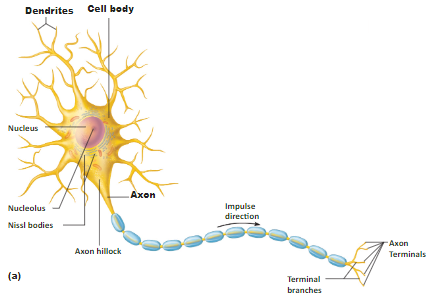
Dendrites (Short processes off the body that receive nerve impulses)
Axon (Long process through which the neuron sends an impulse)
96
Myelin Sheath
the "bubbles" covering the axon
Allows signals to travel well and fast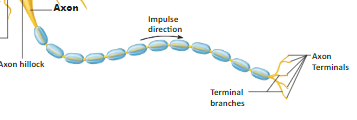
Allows signals to travel well and fast
97
Glial cells (function and characteristics compared to neurons)
No nerve impulses, but support, protect and nourish neurons
Aid in recovery from injury
compared to neurons, glial cells are smaller and mitotic
Cell body~~Astrocyte
Axons n myelin sheaths~~Oligodendrocyte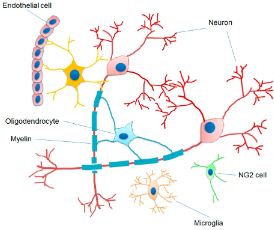
Aid in recovery from injury
compared to neurons, glial cells are smaller and mitotic
Cell body~~Astrocyte
Axons n myelin sheaths~~Oligodendrocyte
98
microglia
Specialized immune cells for the brain
99
Synapse
A junction btwn neurons
-May contain many synapses due to each cell having many dendrites
-May contain many synapses due to each cell having many dendrites
100
pre- vs post- synaptic neurons
Presynaptic neuron is before the synapse, postsynaptic is after ther synapse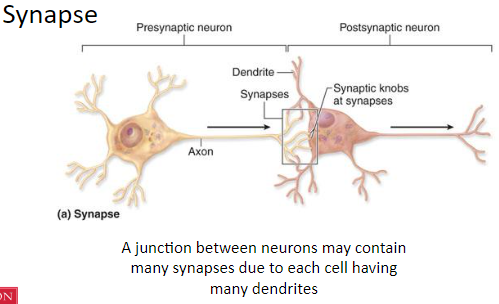
101
Schwann cells
glial cells that makes the myelin sheath
102
Dura mater
thick layer right under the skull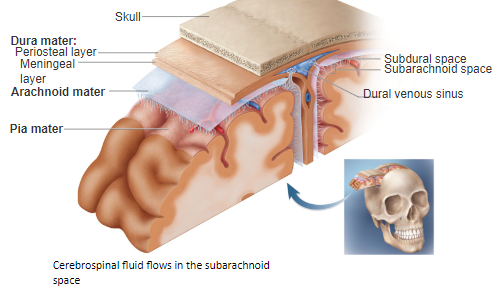
103
Arachnoid mater
Second layer, under the Dura mater
-Has little spider-ish legs, allows to lift iself away from under layer to create the subarachnoid space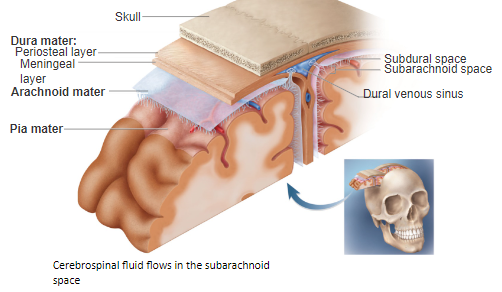
-Has little spider-ish legs, allows to lift iself away from under layer to create the subarachnoid space
104
Subarachnoid space, what does it store?
cerebral spinal fluid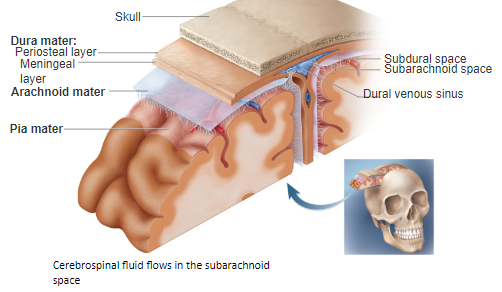
105
Pia mater
Layer directly on the brain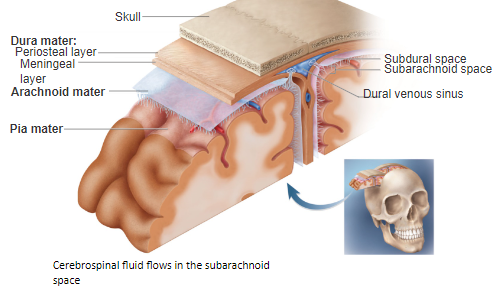
106
When looking at the brain w/ pia mater, we see two types of brain structures called...
syrius (the bumps)
and
Sulcus (Valleys inward)
and
Sulcus (Valleys inward)
107
Grey matter is made by ____ and white matter is made by ____
cell bodies, tracts
Cell bodies have nucleus, so tend to be lying near the middle to be protected
Cell bodies have nucleus, so tend to be lying near the middle to be protected
108
the brain is divided into 3 parts...
Cerebrum, Brain stem, and cerebellum
109
Cerebrum is the location of...
Thought/consciousness/intellect
reasoning
language
memory
judgment
voluntary motor
visual
auditory
reasoning
language
memory
judgment
voluntary motor
visual
auditory
110
5 lobes of the cerebral hemispheres
Frontal
Parietal
Occipital
Temporal
Insula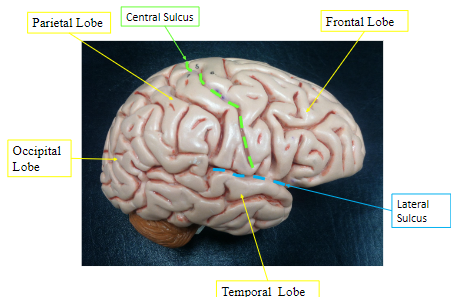
Parietal
Occipital
Temporal
Insula
111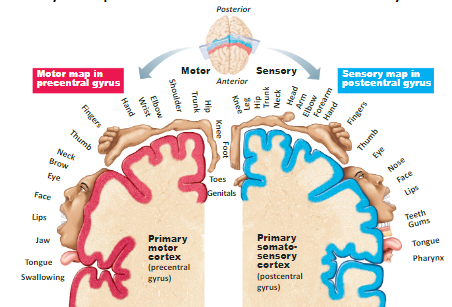
Body maps in pre- and postcentral gyri
112
Primary motor complex : skeletal muscle activity
Pre-motor cortex: planes and coordinates skeletal muscle movement
Other functions: Personality, cognition, decision making, planning, language functions
Pre-motor cortex: planes and coordinates skeletal muscle movement
Other functions: Personality, cognition, decision making, planning, language functions
Primary motor complex : skeletal muscle activity
Pre-motor cortex: planes and coordinates skeletal muscle movement
Other functions: Personality, cognition, decision making, planning, language functions
Pre-motor cortex: planes and coordinates skeletal muscle movement
Other functions: Personality, cognition, decision making, planning, language functions
113
Parietal lobes function
Somatosensory cortex: Postcentral gyrus, interprets sensory info coming in
114
Temporal lobe function
Olfactory(smell) and auditory info
115
Occipital function
Primary visual cortex: receives visual input
Other functions: interprets visual input and associated memories
Other functions: interprets visual input and associated memories
116
Insula lobe function
Taste
117
cerebellum is responsible for...
proprioception (where your body is in space)
-used to learn skills
-used to learn skills
118
Deep/Middle brain structures (3 of them)
Hypothalamus
limbic system
thalamus
limbic system
thalamus
119
brainstem structures
Medulla oblongata
Pons
Midbrain
Pons
Midbrain
120
Hypothalamus has master control over what systems?
Autonomic nervous system and endocrine system
121
Nuclei in the hypothalamus control
Regulation of body temp
Control of emotional behavior
control of food and water intake
Control of emotional behavior
control of food and water intake
122
Amygdala
Fear center
123
Hippocampus
Forms, consolidates and retrieves memories
124
Thalamus (function)
Acts as a filter for somatosensory info
-Directs sensory info to the correctcerebrum location and sends info abt where the sensation is coming from
-can also edit, amplify, or diminish info heading to the cerebral cortex
-Directs sensory info to the correctcerebrum location and sends info abt where the sensation is coming from
-can also edit, amplify, or diminish info heading to the cerebral cortex
125
All info coming from the body to the brain goes first through the ____
Thalamus
126
Midbrain (Structure, what it's made up of, centers of control for__)
-Made up of many individual nuclei w/ discrete functions
-Many centers of control for limb and eye motor movements
-Many centers of control for limb and eye motor movements
127
Pons (what it is)
Sensory and motor tracts that connect the brain to the spinal cord
128
Medulla Oblongata (why it's so important)
All communication btwn brain an spinal cord involves tracts through Medulla
Also has several nuclei for the cardiac and respiratory center
Also has several nuclei for the cardiac and respiratory center
129
Medulla oblongata, descending ____ tracts and ascending ____ tracts
motor, sensory
130
Spinal cord (major conduction pathway btwn___, where it's continuous from and ends in)
Brain and body
Continous w/ brainstem
Cord itself extends from foramen magnum to L1-L2 then ends in cauda equina
Continous w/ brainstem
Cord itself extends from foramen magnum to L1-L2 then ends in cauda equina
131
Where does the spinal cord travels in? what's it protected by?
Travels in vertebral canal, protected by bone, ligaments, meninges, and CSF