Q4 econ3333
Study these flashcardsFree · spaced repetition · iPhone, Android, Mac & web
All cards
1
K-means try to assign all N samples to the K clusters in a way that
minimizes between-cluster variation
maximizes between-cluster variation
minimizes within-cluster variation
maximizes within-cluster variation
minimizes between-cluster variation
maximizes between-cluster variation
minimizes within-cluster variation
maximizes within-cluster variation
minimizes within-cluster variation
2
which ones are true for K-means?
K-means does not perform well with the clusters have different densities
K-means is insensitive to initial conditions.
K-means does not perform well with the clusters have different sizes
K-means does not perform well with the clusters have non-spherical shapes
K-means does not perform well with the clusters have different densities
K-means is insensitive to initial conditions.
K-means does not perform well with the clusters have different sizes
K-means does not perform well with the clusters have non-spherical shapes
K-means does not perform well with the clusters have different densities
K-means does not perform well with the clusters have different sizes
K-means does not perform well with the clusters have non-spherical shapes
K-means does not perform well with the clusters have different sizes
K-means does not perform well with the clusters have non-spherical shapes
3
Which ones are a method to select the optimal number of clusters in K-means?
gap statistics
inertia with elbow method
learning rate
silhouette score
gap statistics
inertia with elbow method
learning rate
silhouette score
gap statistics
inertia with elbow method
silhouette score
inertia with elbow method
silhouette score
4
Based on the above plot with the silhouette_score,
the optimal number of clusters for K-means is: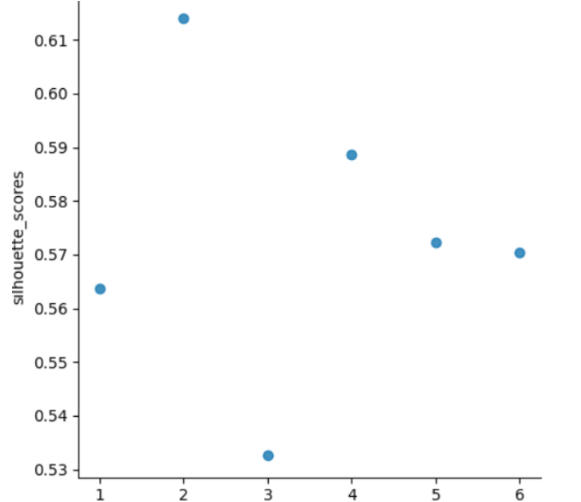
the optimal number of clusters for K-means is:
2
5
What is the key hyperparameter of K-means?
Principal components
Learning rates
Correlation
The number of clusters
Principal components
Learning rates
Correlation
The number of clusters
# of clusters
6
Text data is ___________________
structured / unstructured data
structured / unstructured data
unstructured data
7
Which of these are true in text-mining?
Vocabulary is the set of all words in the text corpus (i.e., the entire documents)
A corpus is an entire textual document dataset.
Token is the smallest unit of text (e.g., word)
Tokenization is a process that separate text into the smaller unit of text (i.e., token)
Vocabulary is the set of all words in the text corpus (i.e., the entire documents)
A corpus is an entire textual document dataset.
Token is the smallest unit of text (e.g., word)
Tokenization is a process that separate text into the smaller unit of text (i.e., token)
A corpus is an entire textual document dataset.
Token is the smallest unit of text (e.g., word)
Tokenization is a process that separate text into the smaller unit of text (i.e., token)
Token is the smallest unit of text (e.g., word)
Tokenization is a process that separate text into the smaller unit of text (i.e., token)
8
Based on the above figure, _______________ is a process to split the sentence into words. 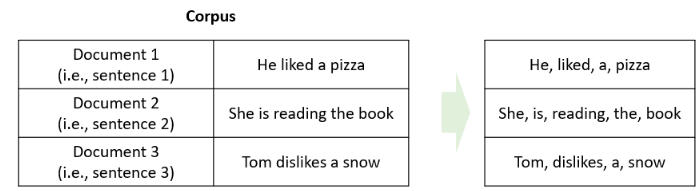
tokenization
9
A is the removal process for _____________ that contains unnecessary words without useful information.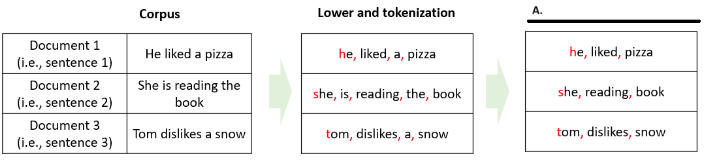
stop words
10
_____________ is a process to convert a word into the base form (e.g., liked → like, reading → read),
because we want to minimize the effect of the forms of a word on the performance of the text-mining task.
because we want to minimize the effect of the forms of a word on the performance of the text-mining task.
lemmatization
11
Which ones are true for Term frequency-inverse document frequency (TF-IDF)
TF-IDF weights more frequency words in the given document, while less weights common words over documents
TF-IDF creates a high-dimensional spare matrix with many zeros
TF-IDF is a context-based embedding method that understand the semantic meaning of the text data
TF-IDF requires a pre-processing such as lower, tokenization, stop-words removal, lemmatization
TF-IDF weights more frequency words in the given document, while less weights common words over documents
TF-IDF creates a high-dimensional spare matrix with many zeros
TF-IDF is a context-based embedding method that understand the semantic meaning of the text data
TF-IDF requires a pre-processing such as lower, tokenization, stop-words removal, lemmatization
TF-IDF weights more frequency words in the given document, while less weights common words over documents
TF-IDF creates a high-dimensional spare matrix with many zeros
TF-IDF requires a pre-processing such as lower, tokenization, stop-words removal, lemmatization
TF-IDF creates a high-dimensional spare matrix with many zeros
TF-IDF requires a pre-processing such as lower, tokenization, stop-words removal, lemmatization
12
The dimension of TF-IDF depends on _
Token
Lemmatization
Vocabulary
Corpus
Token
Lemmatization
Vocabulary
Corpus
vocabulary
13
___________ is a method to map each textual data into a numerical vector
Tokenization
Word embedding
Lemmatization
Sentiment analysis
Tokenization
Word embedding
Lemmatization
Sentiment analysis
Word embedding
14
_____________ is a way to find emotional information from textual data (positive, negative, etc.)
TF-IDF
Tokenization
Word embedding
Sentiment analysis
TF-IDF
Tokenization
Word embedding
Sentiment analysis
Sentiment analysis
15
Based on the above lexicon based sentiment analysis,
the sentiment of the first, 2nd and 3rd document is ____________________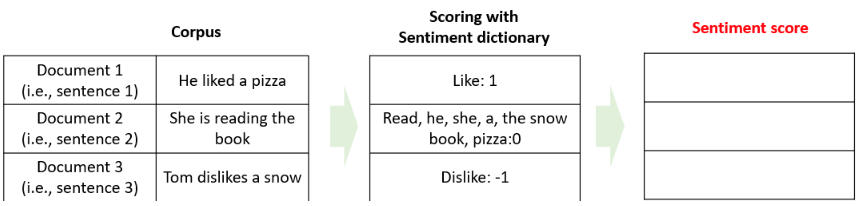
the sentiment of the first, 2nd and 3rd document is ____________________
positive, neutral, negative
16
LDA is a Bayesian unsupervised learning to find latent topics and its shares in each document.
LDA assumes that:
each document is a mixture of (1)____________
and each topic is a mixture of (2)____________
1. topics 2. documents
1. sentences 2. words
1. words 2. topics
1. topics 2. words
LDA assumes that:
each document is a mixture of (1)____________
and each topic is a mixture of (2)____________
1. topics 2. documents
1. sentences 2. words
1. words 2. topics
1. topics 2. words
1. topics 2. words
17
Which ones are true for Latent Dirichlet Allocation (LDA)?
The number of topics is pre-determined before LDA
LDA provides a specific name for each topic.
LDA is not a frequency based method.
LDA cannot provide a sentiment of each document.
The number of topics is pre-determined before LDA
LDA provides a specific name for each topic.
LDA is not a frequency based method.
LDA cannot provide a sentiment of each document.
The number of topics is pre-determined before LDA
LDA is not a frequency based method.
LDA cannot provide a sentiment of each document.
LDA is not a frequency based method.
LDA cannot provide a sentiment of each document.
18
Based on the above graph for coherence score, the optimal number of topics in LDA is ___________________
4
3
5
2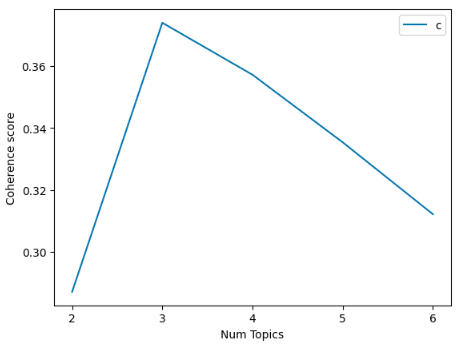
4
3
5
2
3
19
After applying LDA for 1208 review text data, we get the above table for 1208 reviews.
In here, the value for each column means ________________ for each review.
the share of each topic
the correlation of each topic
the sentiment of each topic
the share of each word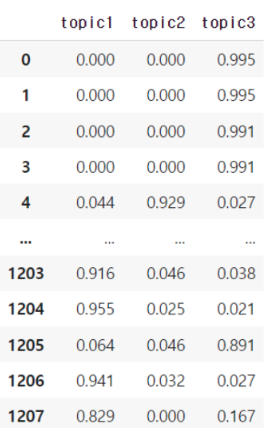
In here, the value for each column means ________________ for each review.
the share of each topic
the correlation of each topic
the sentiment of each topic
the share of each word
the share of each topic
20
After LDA with 1208 online product reviews, we can generate the share of each topic for each review.
Then, we plug the share of topics 1 and 2 as independent variables for linear regressions.
Here, the dependent variable is a star rating from 1 to 5 star ratings.
Based on the model 2, increasing the share of topic 1 in reviews __________________ the reviewers' star ratings at statistically significant 10%.
increases
decreases
does not change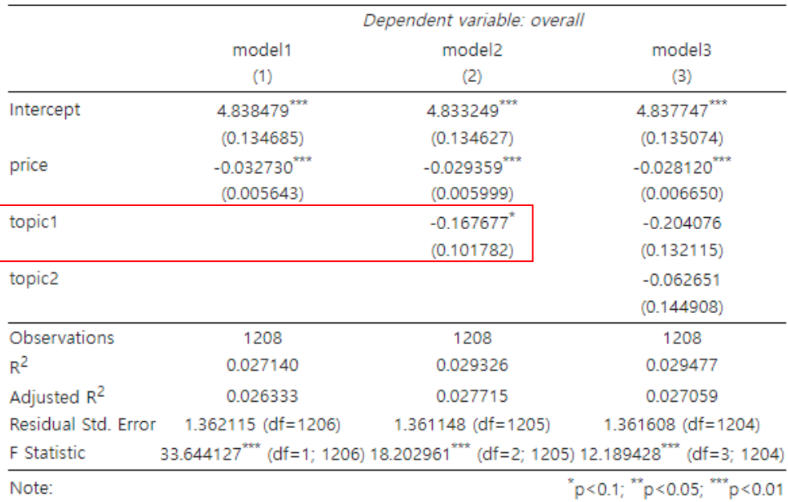
Then, we plug the share of topics 1 and 2 as independent variables for linear regressions.
Here, the dependent variable is a star rating from 1 to 5 star ratings.
Based on the model 2, increasing the share of topic 1 in reviews __________________ the reviewers' star ratings at statistically significant 10%.
increases
decreases
does not change
decreases