MIDTERM 2: Ch. 11, 13-16, 21, 26, 27
Study these flashcardsFree · spaced repetition · iPhone, Android, Mac & web
All cards
1
factors decreasing biodiversity
• Extreme environmental conditions
• Large environmental disturbance
• Intense environmental stress
• Simplified habitat
• Introduction of non-native species
• Geographic isolation (eg clearcutting)
• Large environmental disturbance
• Intense environmental stress
• Simplified habitat
• Introduction of non-native species
• Geographic isolation (eg clearcutting)
2
Factors Increasing Biodiversity
• Middle stage of succession
• Moderate environmental disturbance
• Small environmental changes
• Physically diverse habitat
• Evolution
• Moderate environmental disturbance
• Small environmental changes
• Physically diverse habitat
• Evolution
3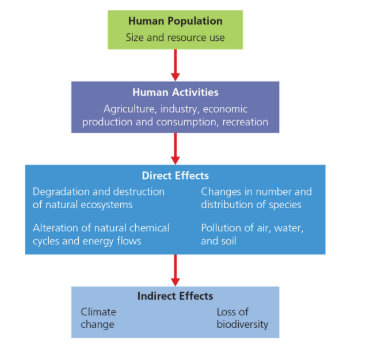
Human Impacts on Biodiversity
4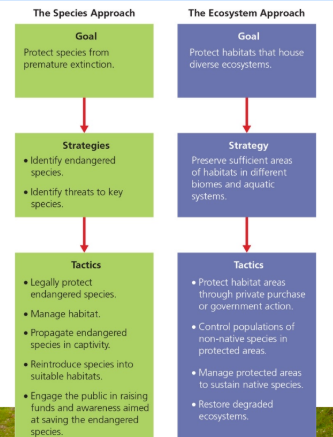
Strategies for Protecting Biodiversity: What are the two approaches?
5
Why Should We Care About Biodiversity?
• Intrinsic or existence value
• Instrumental value
• Use value (goods and services)
• Nonuse values
• Existence
• Aesthetic
• Bequest
• Instrumental value
• Use value (goods and services)
• Nonuse values
• Existence
• Aesthetic
• Bequest
6
What Is Conservation Biology?
• Multidisciplinary science
• Uses rapid response strategies
• Aims to slow loss and degradation
of biodiversity
• Prioritize most endangered, species-
rich ecosystems or “hot spots”
• Uses rapid response strategies
• Aims to slow loss and degradation
of biodiversity
• Prioritize most endangered, species-
rich ecosystems or “hot spots”
7
Natural Capital: Value of Forests
ecological services
ecological services
• Support energy flow and chemical cycling
• Reduce soil erosion,
• Absorb and release water
• Purify water
• Purify air
• Influence local and regional climate
• Store atmospheric carbon
• Provide habitats supporting biodiversity
• Reduce soil erosion,
• Absorb and release water
• Purify water
• Purify air
• Influence local and regional climate
• Store atmospheric carbon
• Provide habitats supporting biodiversity
8
Natural Capital: Value of Forests
economic services
economic services
• Fuelwood
• Lumber
• Pulp to make paper
• Biomass
• Non-wood forest products
• Ecotourism
• Recreation
• Many different jobs
• Lumber
• Pulp to make paper
• Biomass
• Non-wood forest products
• Ecotourism
• Recreation
• Many different jobs
9
How are trees harvested? the methods and what those mean?
Goal: Select silvicultural methods that incorporate both harvest and regeneration.
selection cutting: cut middle aged trees
shelterwood cutting: have several cuts, ony take 1/3 every 10 years
seed-tree cutting: leave a few big trees to spread seeds - unregulated
strip cutting
clear cutting
selection cutting: cut middle aged trees
shelterwood cutting: have several cuts, ony take 1/3 every 10 years
seed-tree cutting: leave a few big trees to spread seeds - unregulated
strip cutting
clear cutting
10
Clear-Cutting Forests: Trade-offs
Pick an advantage and disadvantage
Pick an advantage and disadvantage
Advantage: Max economic return in shortest time
Disadvantages: Destroys and fragments some wildlife habitats
Disadvantages: Destroys and fragments some wildlife habitats
11
What Are the Harmful Effects of Deforestation?
• Decreased soil fertility from erosion
• Runoff of eroded soil into aquatic systems
• Premature species extinction
• Regional climate change
• CO2 released from burning and decay
• Flooding acceleration
• Runoff of eroded soil into aquatic systems
• Premature species extinction
• Regional climate change
• CO2 released from burning and decay
• Flooding acceleration
12
methods for sustainable forestry
• Longer rotations
• Selective or strip cutting
• Minimize fragmentation
• Reduce road building
• Leave most dead trees and fallen timber
• Certify sustainably grown timber
• Add ecological value of trees to economic models
• Adjust buffer zones
• Selective or strip cutting
• Minimize fragmentation
• Reduce road building
• Leave most dead trees and fallen timber
• Certify sustainably grown timber
• Add ecological value of trees to economic models
• Adjust buffer zones
13
What Threatens Certain Tree Species Across Canada?
Native and non-native insect species
14
How to Reduce the Need for Forest Harvest
• Improve efficiency of wood use
• Up to 60% wasted in North America
• Use tree-free fibres (eg. hemp)
• Agricultural wastes or rapid-growth crops
• Paper and sawmill fibre recycling
• Up to 60% wasted in North America
• Use tree-free fibres (eg. hemp)
• Agricultural wastes or rapid-growth crops
• Paper and sawmill fibre recycling
15
National Parks: How Are They Threatened?
• Inadequate protection
• Often too small to sustain biodiversity
• Invasion by non-native species
• Too many human visitors
• Too little funding and too few park staff
• Often too small to sustain biodiversity
• Invasion by non-native species
• Too many human visitors
• Too little funding and too few park staff
16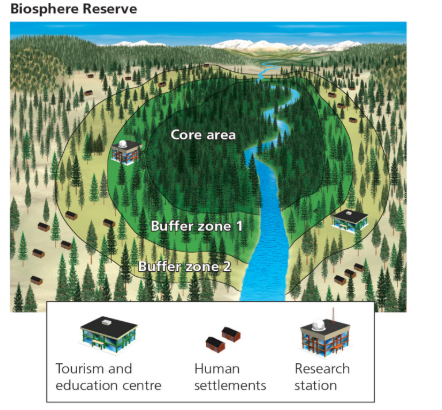
What are Biosphere Reserves
17
Four Principles of Adaptive Ecosystem Management
Four principles of adaptive management:
1. Integrate ecological, economic, and social
principles.
2. Stakeholder consensus
3. Decisions and strategies are experiments to
be improved.
4. Continued monitoring and innovation
1. Integrate ecological, economic, and social
principles.
2. Stakeholder consensus
3. Decisions and strategies are experiments to
be improved.
4. Continued monitoring and innovation
18
Ecological Restoration: Approaches and principles
Approaches
• Restoration
• Rehabilitation
• Remediation
• Replacement
Principles
• Mimic nature
• Recreate lost niches
• Rely on pioneer species
• Control non-native species
• Reconnect small patches
• Restoration
• Rehabilitation
• Remediation
• Replacement
Principles
• Mimic nature
• Recreate lost niches
• Rely on pioneer species
• Control non-native species
• Reconnect small patches
19
Patterns of Marine Biodiversity:
Highest diversity habitats are:
Highest diversity habitats are:
• Coral reefs
• Estuaries
• Deep-ocean floor
• Coastal diversity > Open sea
• Benthic (bottom) diversity > Pelagic (surface)
• Lowest diversity in the mid-depth open ocean
• Estuaries
• Deep-ocean floor
• Coastal diversity > Open sea
• Benthic (bottom) diversity > Pelagic (surface)
• Lowest diversity in the mid-depth open ocean
20
Strategies to Protect North American Coastal Waters
• Comprehensive legislation
• Federal funding
• Focus fisheries management on whole ecosystems and habitats
• Establish marine network linked by corridors
• Federal funding
• Focus fisheries management on whole ecosystems and habitats
• Establish marine network linked by corridors
21
What Human Activities/Practices have Impacts on Aquatic Biodiversity
- Commercial fishing
- Non-native species (intentionally intruduced or accidentially from balast water)
- Non-native species (intentionally intruduced or accidentially from balast water)
22
Protecting and Sustaining Marine Biodiversity
challenges
challenges
Challenges
• Rapid coastal
development
• Damage not visible
• International waters
under no single
jurisdiction
• Rapid coastal
development
• Damage not visible
• International waters
under no single
jurisdiction
23
Endangered Sea Turtles: why are they endangered
• Loss of beach habitat where eggs laid
• Human removal of eggs
• Use of turtles for food, medicine, clothing
• Bycatching
• Human removal of eggs
• Use of turtles for food, medicine, clothing
• Bycatching
24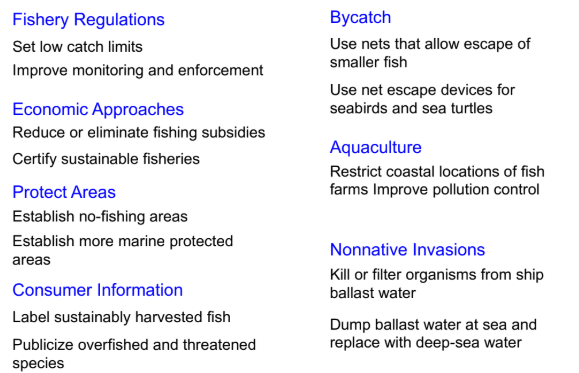
Managing and Sustaining Marine Fisheries
what are some solutions?
what are some solutions?
25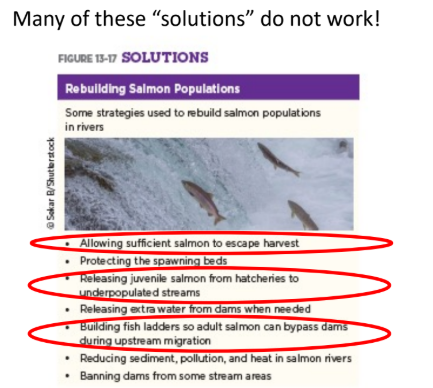
Rebuilding Salmon Populations: solutions
26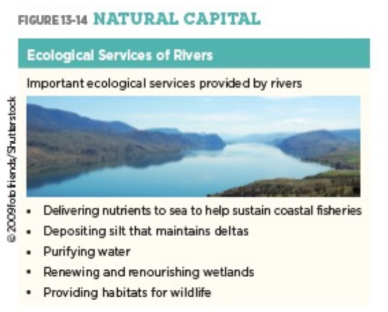
Important Ecological Services Provided by Lakes and Rivers
27
What Systems Provide Us With Food? Where is food procuced
Croplands 77%
• Grains (primarily)
• Wheat, corn, rice > 50% of all food calories
• Annual crops
Rangelands 16%
• Meat, mostly from grazing livestock
Ocean fisheries 7%
• Grains (primarily)
• Wheat, corn, rice > 50% of all food calories
• Annual crops
Rangelands 16%
• Meat, mostly from grazing livestock
Ocean fisheries 7%
28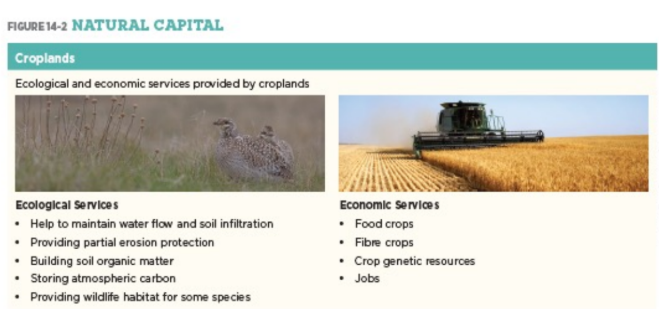
economic and ecologial services of croplands
29
What Are the Major Types of Food Production?
Industrialized Agriculture (80%)
• High input, high-throughput
• For example, plantation agriculture
(cash crops)
Traditional Agriculture
• Low-throughput agriculture
• Subsistence agriculture
• Traditional intensive agriculture
• Not economically feasible to produce the food
needed to sustain earth’s population
• High input, high-throughput
• For example, plantation agriculture
(cash crops)
Traditional Agriculture
• Low-throughput agriculture
• Subsistence agriculture
• Traditional intensive agriculture
• Not economically feasible to produce the food
needed to sustain earth’s population
30
Producing Food by Green Revolution:
3 steps to increase yield per area?
3 steps to increase yield per area?
Three steps to increase yield per unit of cropland:
1. Monocultures
• Selectively-bred/engineered for high yield
2. Increased fertilizer, pesticides, water
3. Multiple cropping (only where possible)
Advanced technology
• Decrease fertilizer, fuel while increasing
yield
1. Monocultures
• Selectively-bred/engineered for high yield
2. Increased fertilizer, pesticides, water
3. Multiple cropping (only where possible)
Advanced technology
• Decrease fertilizer, fuel while increasing
yield
31
Changing Habits: food
cultivating new foods
avoidind food waste
avoidind food waste
32
How Are Rangelands Used to Produce Meat?
types of rangeland use and their impacts
types of rangeland use and their impacts
Overgrazing
• Soil erosion
• Soil compaction
• Productivity loss
• Desertification
Light grazing
• Stimulate growth
• Increase diversity
• Soil erosion
• Soil compaction
• Productivity loss
• Desertification
Light grazing
• Stimulate growth
• Increase diversity
33
Is Producing More Meat the Answer?
What are the drawbacks
What are the drawbacks
Energy inefficient
Health consequences
Feedlots
Health consequences
Feedlots
34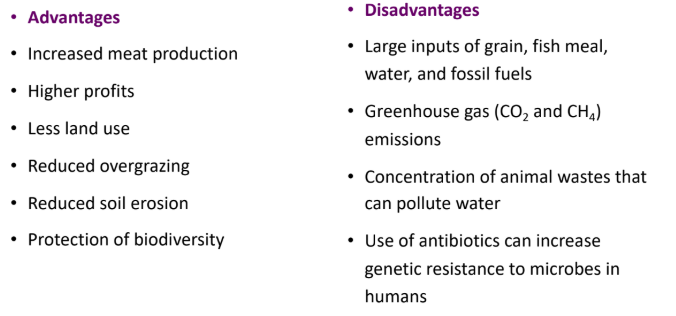
Trade-offs: Animal Feedlots
advantages and disadvantages
advantages and disadvantages
35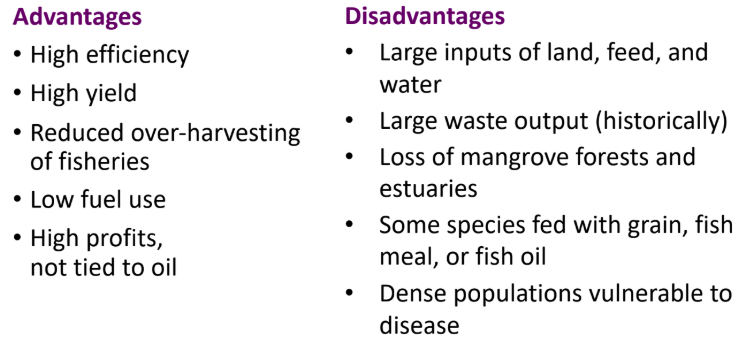
Trade-offs: Aquaculture
advantages and disadvantages
advantages and disadvantages
36
Freshwater Shortage: Causes
Dry climate
Drought
– Prolonged period with 70% lower precipitation and
increased evaporation
Desiccation
– Drying of exposed soil due to external activities
Water stress
– Low per capita availability due to increased demand
Drought
– Prolonged period with 70% lower precipitation and
increased evaporation
Desiccation
– Drying of exposed soil due to external activities
Water stress
– Low per capita availability due to increased demand
37
Degrees of Water Stress
Water Stressed
• Reliable runoff per person < 1,700 m3/yr
• Typically, demand 20% more than supply
Water Scarcity
• Reliable runoff per person < 1,000 m3/yr
• Reliable runoff per person < 1,700 m3/yr
• Typically, demand 20% more than supply
Water Scarcity
• Reliable runoff per person < 1,000 m3/yr
38
How Can We Increase Freshwater Supplies?
all have negative effects
• Building dams
• Transferring water from another place
• Withdrawing groundwater
• Converting salt water to fresh
• Consider access rights and ownership
• Building dams
• Transferring water from another place
• Withdrawing groundwater
• Converting salt water to fresh
• Consider access rights and ownership
39
Best solution for groundwater depletion
set and enforce minimum stream-flow levels
40
What Causes Flooding?
Natural phenomena, aggravated by human activities
Heavy rain, rapid snowmelt, removal of vegetation (deforestation), destruction of wetlands
Heavy rain, rapid snowmelt, removal of vegetation (deforestation), destruction of wetlands
41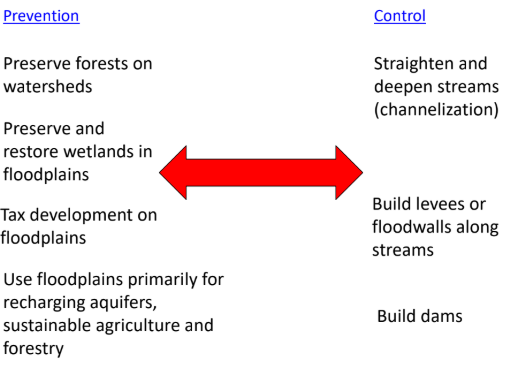
How Can We Reduce Flood Risks?
42
Case Study: Heating Up the Arctic
What are the impacts?
What are the impacts?
• Temperature is increasing significantly.
• Sea ice thinner and less extensive
• Opens up Northwest Passage to shipping
• Impact on wildlife (polar bears, caribou)
• Warming in the Arctic can affect whole world
o Release of CH4 and CO2 from permafrost
o Increasing meltwater
• Sea ice thinner and less extensive
• Opens up Northwest Passage to shipping
• Impact on wildlife (polar bears, caribou)
• Warming in the Arctic can affect whole world
o Release of CH4 and CO2 from permafrost
o Increasing meltwater
43
How Have the Earth’s Temperature and Cimate Changed in the Past?
• Past global temperatures
- Prolonged periods of global cooling and warming
• Recent trends in global temperatures
- Stable(ish) over past 12 000 years
- Regional climate changes
- In past 1000 years, temperatures dropped slightly, then started to rise 200 years ago with the Industrial Revolution
- Prolonged periods of global cooling and warming
• Recent trends in global temperatures
- Stable(ish) over past 12 000 years
- Regional climate changes
- In past 1000 years, temperatures dropped slightly, then started to rise 200 years ago with the Industrial Revolution
44
What Are the Major Greenhouse Gases?
• Carbon dioxide
• Methane
• Nitrous oxide
• Chlorofluorocarbons
• Hydrochlorofluorocarbons
• Hydrofluorocarbons
• Halons
• Carbon tetrachloride
• Methane
• Nitrous oxide
• Chlorofluorocarbons
• Hydrochlorofluorocarbons
• Hydrofluorocarbons
• Halons
• Carbon tetrachloride
45
Activities Contributing to Increased Greenhouse Gases
• Increased use of fossil fuels
• Deforestation and clearing
• Raising large number of cattle
- unnatural feed (corn, etc.) leads to inc. methane from digestion
• Planting rice
• Using inorganic fertilizers
• Deforestation and clearing
• Raising large number of cattle
- unnatural feed (corn, etc.) leads to inc. methane from digestion
• Planting rice
• Using inorganic fertilizers
46
Factors Affecting the Earth’s Temperature:
Can the Oceans Store More CO2 and Heat?
Can the Oceans Store More CO2 and Heat?
• Oceans remove ~29% of excess CO2 from atmosphere
• Absorb heat and transfer to deep ocean for storage
• We don’t fully understand the impacts of ocean currents.
• How quickly can they transfer heat?
• How long will that heat be stored?
• Ocean acidification
• Absorption of CO2 forms carbonic acid – pH dropping
up to 0.5 units
• Many effects on marine life – dissolve many shelled
organisms
• long will that heat be stored?
• Absorb heat and transfer to deep ocean for storage
• We don’t fully understand the impacts of ocean currents.
• How quickly can they transfer heat?
• How long will that heat be stored?
• Ocean acidification
• Absorption of CO2 forms carbonic acid – pH dropping
up to 0.5 units
• Many effects on marine life – dissolve many shelled
organisms
• long will that heat be stored?
47
Factors Affecting the Earth’s Temperature
Cloud Cover and Outdoor Air Pollution
Increased Photosynthesis
Increased Photosynthesis
48
How Might a Warmer Troposphere Affect Canada?
• Longer growing season
• Warmer in both summer and winter
• Higher seas in British Columbia and Eastern Canada
• More droughts in Prairies
• Arctic and Subarctic subject to widespread changes
• Great Lakes—more heat waves and lower lake levels
• Warmer in both summer and winter
• Higher seas in British Columbia and Eastern Canada
• More droughts in Prairies
• Arctic and Subarctic subject to widespread changes
• Great Lakes—more heat waves and lower lake levels
49
Dealing With the Threat of Global Warming: What Are Our Options?
Wait and see
• Do more research before we act.
Act now
• Follow the precautionary principles.
• We pay to insure our homes and lives against far less certain events.
Act now with no regrets
• Strategies have benefit regardless of the extent of global warming.
• Do more research before we act.
Act now
• Follow the precautionary principles.
• We pay to insure our homes and lives against far less certain events.
Act now with no regrets
• Strategies have benefit regardless of the extent of global warming.
50
Solutions to Global Warming: Prevention (list some)
Cut fossil fuel use
(especially coal).
Shift from coal to natural
gas.
Improve energy efficiency.
Shift to renewable energy
resources.
Transfer energy efficiency
and renewable energy
technologies to developing
countries.
Reduce deforestation.
Use more sustainable
agriculture.
Limit urban sprawl.
Reduce poverty.
Slow population growth.
(especially coal).
Shift from coal to natural
gas.
Improve energy efficiency.
Shift to renewable energy
resources.
Transfer energy efficiency
and renewable energy
technologies to developing
countries.
Reduce deforestation.
Use more sustainable
agriculture.
Limit urban sprawl.
Reduce poverty.
Slow population growth.
51
Solutions to Global Warming: Cleanup (list some)
Remove CO2 from
smokestack and vehicle
emissions.
Store (sequester) CO2 by
planting trees.
Sequester CO2 deep
underground.
Sequester CO2 in soil by
using no-till cultivation
and taking crop land out
of production.
Sequester CO2 in the deep ocean.
Repair leaky natural gas pipelines
and facilities.
Use feeds that reduce CH4
emissions by belching cows.
smokestack and vehicle
emissions.
Store (sequester) CO2 by
planting trees.
Sequester CO2 deep
underground.
Sequester CO2 in soil by
using no-till cultivation
and taking crop land out
of production.
Sequester CO2 in the deep ocean.
Repair leaky natural gas pipelines
and facilities.
Use feeds that reduce CH4
emissions by belching cows.
52
Carbon and Energy Taxes
Advantages and disadvantages
Advantages and disadvantages
Advantages
• Simple to administer
• Clear price on carbon
• Covers all emitters
• Predictable revenues
Disadvantages
• Tax laws can get complex.
• Vulnerable to loopholes
• Doesn’t guarantee lower emissions
• Politically unpopular
• Simple to administer
• Clear price on carbon
• Covers all emitters
• Predictable revenues
Disadvantages
• Tax laws can get complex.
• Vulnerable to loopholes
• Doesn’t guarantee lower emissions
• Politically unpopular
53
Cap-and-Trade Policies
Advantages and disadvantages
Advantages and disadvantages
Advantages
• Clear legal limit on emissions
• Rewards cuts in emissions
• Record of success
• Low expense for consumers
Disadvantages
• Revenues not predictable
• Vulnerable to cheating
• Rich polluters can keep polluting
• Puts variable price on carbon
• Clear legal limit on emissions
• Rewards cuts in emissions
• Record of success
• Low expense for consumers
Disadvantages
• Revenues not predictable
• Vulnerable to cheating
• Rich polluters can keep polluting
• Puts variable price on carbon
54
Ozone Depletion in the Stratosphere: Causes
• Numerous persistent chemicals
• Former Uses of CFCs
• Former Uses of CFCs
55
What Supports and Drives Economies?
• Economic System
• Social institution to produce, distribute, consume goods and services
• Relies on capital
• Sustains business or produces wealth
• Natural capital
• Human capital
• Physical or manufactured capital
• Social institution to produce, distribute, consume goods and services
• Relies on capital
• Sustains business or produces wealth
• Natural capital
• Human capital
• Physical or manufactured capital
56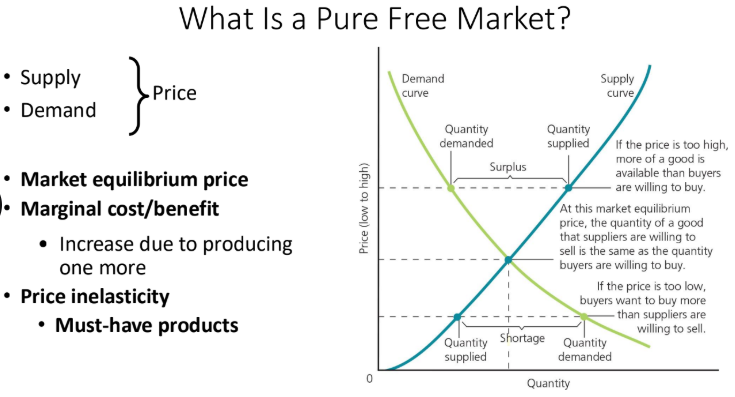
What Is a Pure Free Market?
57
Shifting to an Eco-Economy
• Efficient use of resources
• Economic and environmental monitors
• Full-cost pricing
• Phase out environmentally harmful government subsidies
• tax breaks
• New laws and regulations
• Limits on overall pollution
• Eco-labelling
• Economic and environmental monitors
• Full-cost pricing
• Phase out environmentally harmful government subsidies
• tax breaks
• New laws and regulations
• Limits on overall pollution
• Eco-labelling
58
Technological Developments and Market Efficiency
• Increased production efficiency
• Decreased resource use
• Decreased production cost and equilibrium price
• Often driven by resource scarcity
• Decreased resource use
• Decreased production cost and equilibrium price
• Often driven by resource scarcity
59
Case Study: What Is Cost–Benefit Analysis (CBA)?
• Challenging to estimate cost/ benefit for different stakeholders
• Improving consistency of CBA
• Improving consistency of CBA
60
Monitoring Environmental Progress
Do our indicators adequately measure environmental quality and
human health? (types)
Do our indicators adequately measure environmental quality and
human health? (types)
• Gross domestic product (GDP)
• Genuine progress indicator (GPI)
• Human Development Index (HDI)
• Canadian Index of Well-being (CIW)
• Genuine progress indicator (GPI)
• Human Development Index (HDI)
• Canadian Index of Well-being (CIW)
61
Harmful External Costs and Full-Cost Pricing
• Internal (Direct) Costs
• External (Indirect) Costs
• Full-Cost Pricing
• External (Indirect) Costs
• Full-Cost Pricing
62
Improving Environmental Quality and Shifting to Full- Cost Pricing: Methods
• Government Tax Reform
• Regulations
• Tradable Permits
• Eco-Labelling
• Regulations
• Tradable Permits
• Eco-Labelling
63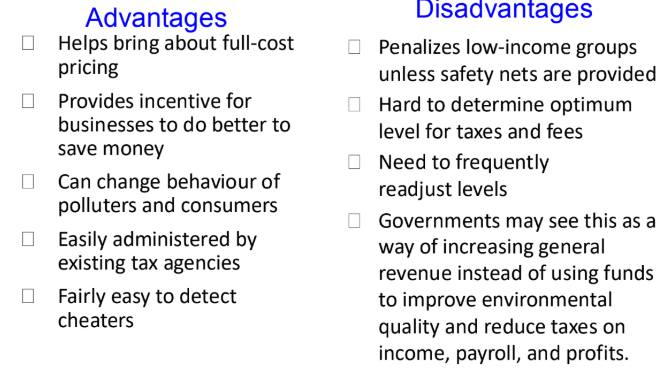
Use of Environmental Taxes and Fees: Trade-offs
pros and cons
pros and cons
64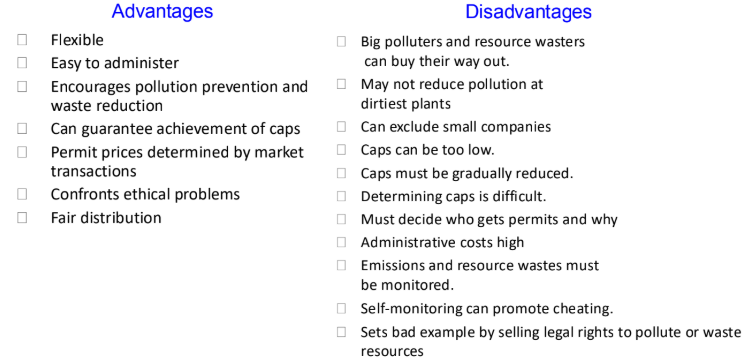
Tradable Environmental Permits: Trade-offs
pros and cons
pros and cons
65
Making the Transition to More Environmentally Sustainable Economies
How?
How?
• Mimic natural systems
• Sunset businesses
• More Eco-friendly businesses
• Improve public awareness
• Sunset businesses
• More Eco-friendly businesses
• Improve public awareness
66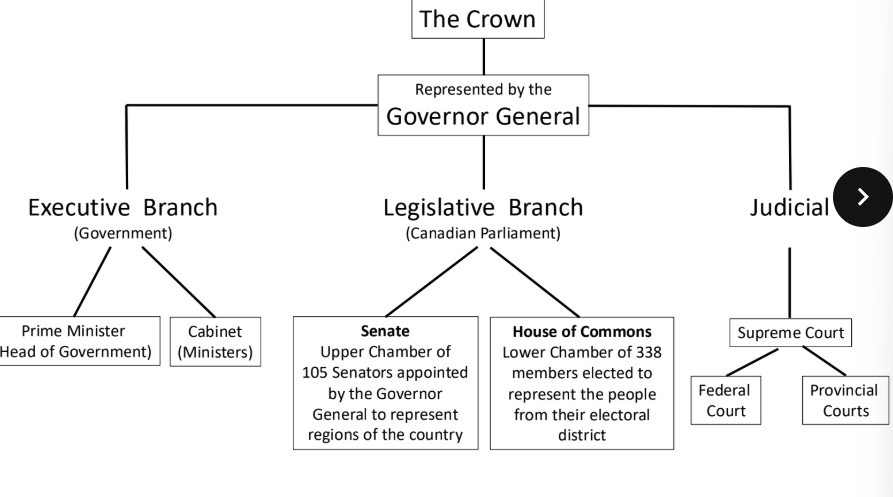
how the canadian federal government is structured
67
Factors Hindering Democracies in Dealing with Environmental Problems
• Short time between elections shifts the focus to short-term
issues.
• Politicians often lack ecological literacy.
issues.
• Politicians often lack ecological literacy.
68
Principles to Guide Environmental Policy Decisions
• Humility
• Reversibility
• Precautionary
• Prevention
• Polluter pays
• Integrative
• Public participation
• Human rights
• Environmental justice
• Reversibility
• Precautionary
• Prevention
• Polluter pays
• Integrative
• Public participation
• Human rights
• Environmental justice
69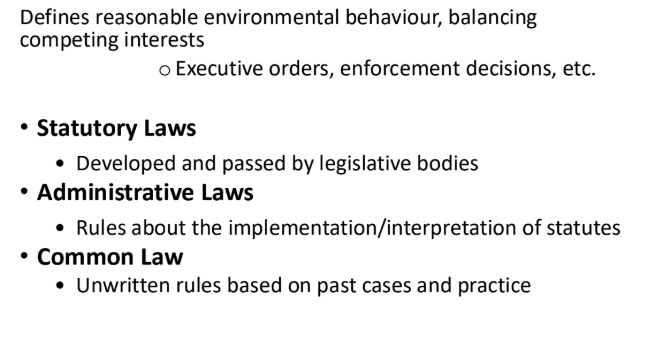
What Is Environmental Law? What different types are there?
70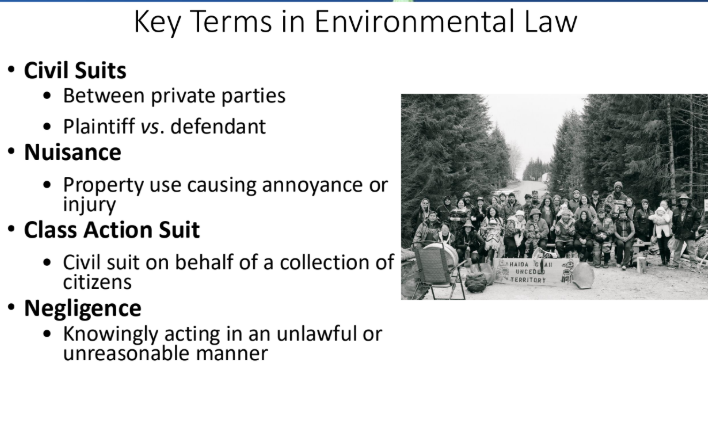
4 key terms in environmental law and their meanings
71
What Factors Hinder the Effectiveness of Environmental Lawsuits?
1. Challenging to establish legal right or legal standing
2. Expensive, especially for individuals
• Legal fees may be tax-deductible for corporations but not for public-interest firms
3. Must establish that the defendant caused
the harm
4. Statute of limitations
5. Court decisions may take years
6. Countersuits by corporations
Mediation provides a faster, less costly alternative.
2. Expensive, especially for individuals
• Legal fees may be tax-deductible for corporations but not for public-interest firms
3. Must establish that the defendant caused
the harm
4. Statute of limitations
5. Court decisions may take years
6. Countersuits by corporations
Mediation provides a faster, less costly alternative.
72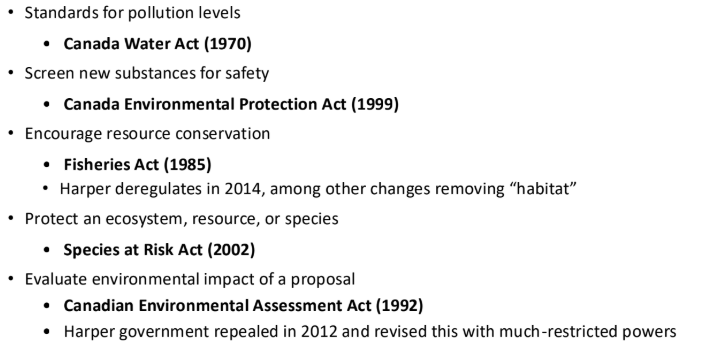
Case Study: What Are Some Major Environmental Laws in Canada?
73
What Are the Roles of Major Environmental Groups?
• Monitor environmental activities
• Lobby for new or stronger environmental laws
• Collaborate with companies on environmental solutions
• Raise awareness of issues
• Includes grassroots, global, and issue-based groups
• Execute change
• Lobby for new or stronger environmental laws
• Collaborate with companies on environmental solutions
• Raise awareness of issues
• Includes grassroots, global, and issue-based groups
• Execute change
74
Role of International Environmental Organizations
• Gather and evaluate environmental data.
• Develop environmental treaties.
• Provide funds and loans for sustainable economic development.
• Develop environmental treaties.
• Provide funds and loans for sustainable economic development.
75
Developing and Measuring Environmental Progress:
Goals and Measures
Goals and Measures
Goals
• Creative solutions at a local level
• Cooperation between citizens, businesses, officials
Measures
• Environmental Sustainability Index (ESI)
• Environmental Performance Index (EPI)
• Creative solutions at a local level
• Cooperation between citizens, businesses, officials
Measures
• Environmental Sustainability Index (ESI)
• Environmental Performance Index (EPI)
76
What is a mineral
A mineral is an element or inorganic compound that occurs naturally,
is solid, and has a regular internal crystalline structure
is solid, and has a regular internal crystalline structure
77
What is a rock
A rock: part of the earth’s crust, solid combination of one or more
minerals
minerals
78
What is an ore
An ore: a rock containing enough of one or more metallic minerals to
be mined profitably
be mined profitably
79
What is a resource
Resource: anything obtained from the environment to meet our
needs and wants
needs and wants
80
What are mineral resources
Mineral resources: nonrenewable materials that we can extract from
the earth’s crust and process into useful materials
the earth’s crust and process into useful materials
81
What is the slowest of the Earth's cyclic processes
rock cycle
82
Categories of nonrenewable mineral
resources
resources
• Identified resources: known deposits
• Undiscovered resources: potential deposits assumed to exist
• Reserves: identified resources yet to be extracted
• Other resources: identified or undiscovered resources not classified as reserves
• Undiscovered resources: potential deposits assumed to exist
• Reserves: identified resources yet to be extracted
• Other resources: identified or undiscovered resources not classified as reserves
83
How are buried mineral deposits found?
• Satellite and air imagery
• Radiation detectors
• Magnetometers
• Gravity differences
• Seismic surveys
• Chemical analyses
• Radiation detectors
• Magnetometers
• Gravity differences
• Seismic surveys
• Chemical analyses
84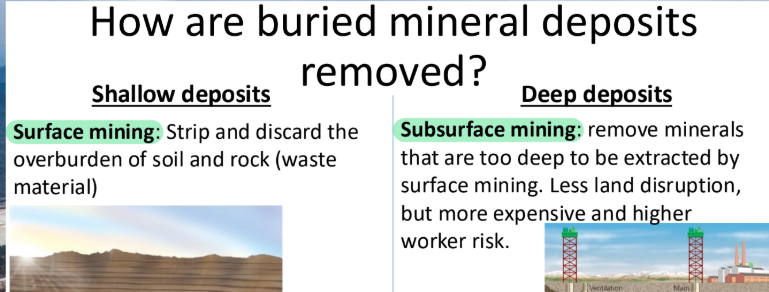
How are buried mineral deposits removed?
85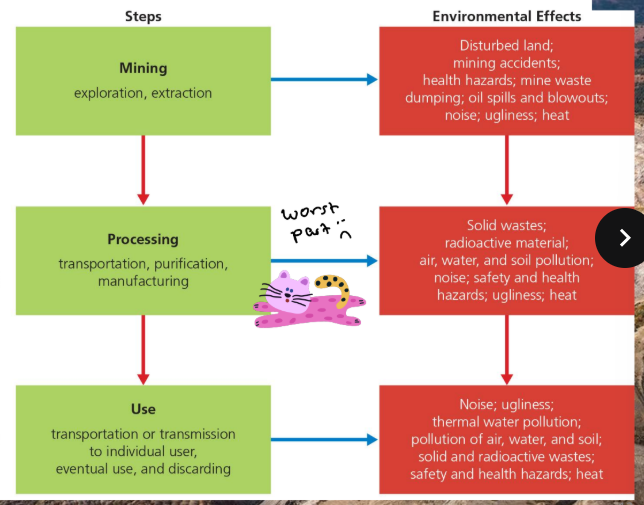
Environmental impacts of nonrenewable resources (from each phase)
Which is the worst for the environment?
Which is the worst for the environment?
86
What is the ore waste produced from processing ores called? What does smelting realease?
tailings
air pollutants
air pollutants
87
Factors affecting environmental impacts of nonrenewable resources
• its percentage of metal content, or grade. (ratio of waste to mineral)
• its accessibility
• its accessibility
88
What is acid mine drainage
• Acid mine draining - water flows through iron sulfide minerals that have been exposed forming sulfuric acid and dissolved iron.
• Contaminates water supplies, can destroy aquatic life
• Contaminates water supplies, can destroy aquatic life
89
What is the biggest environmental impact of mining
tailings
90
Acid rain in Sudbury, Ontario
- long running nickle mine, lots of nickle ore
- but it was inside sulphide ore
- was one of the worlds biggest polluters at one point
- the inco superstack was made in the 70s made to make the waste gas dissipate better, making the gas other areas' problem
- the Inco superstack emitted SO2 into the air, which reacted with the rain to make sulphuric acid rain
- the path of the smoke had dead vegetation and dead lakes
- early 80s they faced pressure, eventually the gov't stepping in and telling them to clean stuff up or shut down
- they cleaned stuff up and creating scrubbing techniques yippee
- but it was inside sulphide ore
- was one of the worlds biggest polluters at one point
- the inco superstack was made in the 70s made to make the waste gas dissipate better, making the gas other areas' problem
- the Inco superstack emitted SO2 into the air, which reacted with the rain to make sulphuric acid rain
- the path of the smoke had dead vegetation and dead lakes
- early 80s they faced pressure, eventually the gov't stepping in and telling them to clean stuff up or shut down
- they cleaned stuff up and creating scrubbing techniques yippee
91
what is the biggest limitation to the availability of nonrenewable mineral resources
Environmental damage, not supply exhaustion, may be the greatest
limitation to the availability of nonrenewable mineral resources
limitation to the availability of nonrenewable mineral resources
92
who produces the most rare earth metals
china
93
why are rare earth metals more environmentally damaging than regular metals
- super toxic gas is emitted
- more tailings
- more waste
- so little desired material
- more tailings
- more waste
- so little desired material
94
The future supply of nonrenewable minerals depends on two factors:
• The actual or potential supply of the mineral
• The rate at which we use it
• The rate at which we use it
95
A mineral becomes economically depleted when it costs more to supply than
it is worth. At that point, there are 5 options:
it is worth. At that point, there are 5 options:
• Recycle or reuse existing supplies
• Waste less
• Use less
• Find a substitute
• Do without
• Waste less
• Use less
• Find a substitute
• Do without
96
what is depletion time
Depletion time: how long it takes to use up a certain proportion –
usually 80% - of the reserves of a mineral at a given rate of use.
usually 80% - of the reserves of a mineral at a given rate of use.
97
When a resource becomes scarce, its price rises → encourage:
• find new deposits
• Develop better mining technology
• make it profitable to mine lower grade ores
• Find substitutes
• promote resource conservation
• Develop better mining technology
• make it profitable to mine lower grade ores
• Find substitutes
• promote resource conservation