All cards
1
factors decreasing biodiversity
• Extreme environmental conditions
• Large environmental disturbance
• Intense environmental stress
• Simplified habitat
• Introduction of non-native species
• Geographic isolation (eg clearcutting)
• Large environmental disturbance
• Intense environmental stress
• Simplified habitat
• Introduction of non-native species
• Geographic isolation (eg clearcutting)
2
Factors Increasing Biodiversity
• Middle stage of succession
• Moderate environmental disturbance
• Small environmental changes
• Physically diverse habitat
• Evolution
• Moderate environmental disturbance
• Small environmental changes
• Physically diverse habitat
• Evolution
3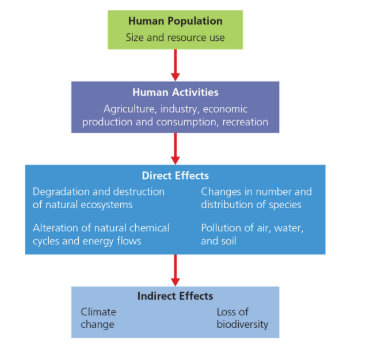
Human Impacts on Biodiversity
4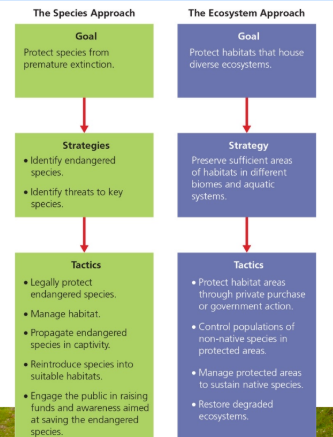
Strategies for Protecting Biodiversity
5
Why Should We Care About Biodiversity?
• Intrinsic or existence value
• Instrumental value
• Use value (goods and services)
• Nonuse values
• Existence
• Aesthetic
• Bequest
• Instrumental value
• Use value (goods and services)
• Nonuse values
• Existence
• Aesthetic
• Bequest
6
What Is Conservation Biology?
• Multidisciplinary science
• Uses rapid response strategies
• Aims to slow loss and degradation
of biodiversity
• Prioritize most endangered, species-
rich ecosystems or “hot spots”
• Uses rapid response strategies
• Aims to slow loss and degradation
of biodiversity
• Prioritize most endangered, species-
rich ecosystems or “hot spots”
7
Natural Capital: Value of Forests
ecological services
ecological services
• Support energy flow and chemical cycling
• Reduce soil erosion,
• Absorb and release water
• Purify water
• Purify air
• Influence local and regional climate
• Store atmospheric carbon
• Provide habitats supporting biodiversity
• Reduce soil erosion,
• Absorb and release water
• Purify water
• Purify air
• Influence local and regional climate
• Store atmospheric carbon
• Provide habitats supporting biodiversity
8
Natural Capital: Value of Forests
economic services
economic services
• Fuelwood
• Lumber
• Pulp to make paper
• Biomass
• Non-wood forest products
• Ecotourism
• Recreation
• Many different jobs
• Lumber
• Pulp to make paper
• Biomass
• Non-wood forest products
• Ecotourism
• Recreation
• Many different jobs
9
How are trees harvested? the methods and what those mean?
Goal: Select silvicultural methods that incorporate both harvest and regeneration.
selection cutting: cut middle aged trees
shelterwood cutting: have several cuts, ony take 1/3 every 10 years
seed-tree cutting: leave a few big trees to spread seeds - unregulated
strip cutting
clear cutting
selection cutting: cut middle aged trees
shelterwood cutting: have several cuts, ony take 1/3 every 10 years
seed-tree cutting: leave a few big trees to spread seeds - unregulated
strip cutting
clear cutting
10
Clear-Cutting Forests: Trade-offs
Pick an advantage and disadvantage
Pick an advantage and disadvantage
Advantage: Max economic return in shortest time
Disadvantages: Destroys and fragments some wildlife habitats
Disadvantages: Destroys and fragments some wildlife habitats
11
What Are the Harmful Effects of Deforestation?
• Decreased soil fertility from erosion
• Runoff of eroded soil into aquatic systems
• Premature species extinction
• Regional climate change
• CO2 released from burning and decay
• Flooding acceleration
• Runoff of eroded soil into aquatic systems
• Premature species extinction
• Regional climate change
• CO2 released from burning and decay
• Flooding acceleration
12
Sustainable Forestry
• Longer rotations
• Selective or strip cutting
• Minimize fragmentation
• Reduce road building
• Leave most dead trees and fallen timber
• Certify sustainably grown timber
• Add ecological value of trees to economic models
• Adjust buffer zones
• Selective or strip cutting
• Minimize fragmentation
• Reduce road building
• Leave most dead trees and fallen timber
• Certify sustainably grown timber
• Add ecological value of trees to economic models
• Adjust buffer zones
13
What Threatens Certain Tree Species Across Canada?
Native and non-native insect species
14
Reducing the Need for Forest Harvest
• Improve efficiency of wood use
• Up to 60% wasted in North America
• Use tree-free fibres (eg. hemp)
• Agricultural wastes or rapid-growth crops
• Paper and sawmill fibre recycling
• Up to 60% wasted in North America
• Use tree-free fibres (eg. hemp)
• Agricultural wastes or rapid-growth crops
• Paper and sawmill fibre recycling
15
National Parks: How Are They Threatened?
• Inadequate protection
• Often too small to sustain biodiversity
• Invasion by non-native species
• Too many human visitors
• Too little funding and too few park staff
• Often too small to sustain biodiversity
• Invasion by non-native species
• Too many human visitors
• Too little funding and too few park staff
16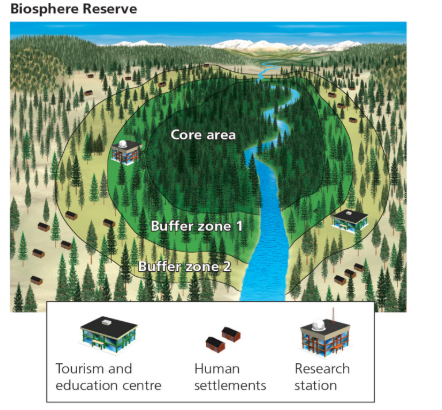
Biosphere Reserves
17
Adaptive Ecosystem Management
Four principles of adaptive management:
1. Integrate ecological, economic, and social
principles.
2. Stakeholder consensus
3. Decisions and strategies are experiments to
be improved.
4. Continued monitoring and innovation
1. Integrate ecological, economic, and social
principles.
2. Stakeholder consensus
3. Decisions and strategies are experiments to
be improved.
4. Continued monitoring and innovation
18
Ecological Restoration: Approaches and principles
Approaches
• Restoration
• Rehabilitation
• Remediation
• Replacement
Principals
• Mimic nature
• Recreate lost niches
• Rely on pioneer species
• Control non-native
species
• Reconnect small
patches
• Restoration
• Rehabilitation
• Remediation
• Replacement
Principals
• Mimic nature
• Recreate lost niches
• Rely on pioneer species
• Control non-native
species
• Reconnect small
patches