All cards
1
What Supports and Drives Economies?
• Economic System
• Social institution to produce, distribute, consume goods and services
• Relies on capital
• Sustains business or produces wealth
• Natural capital
• Human capital
• Physical or manufactured capital
• Social institution to produce, distribute, consume goods and services
• Relies on capital
• Sustains business or produces wealth
• Natural capital
• Human capital
• Physical or manufactured capital
2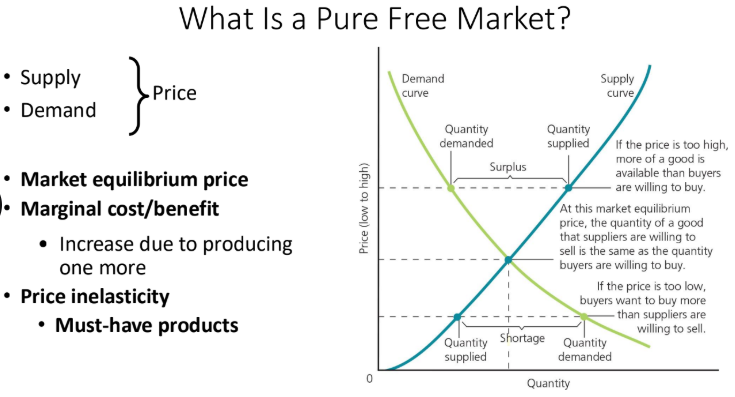
What Is a Pure Free Market?
3
Shifting to an Eco-Economy
• Efficient use of resources
• Economic and environmental monitors
• Full-cost pricing
• Phase out environmentally harmful government subsidies
• tax breaks
• New laws and regulations
• Limits on overall pollution
• Eco-labelling
• Economic and environmental monitors
• Full-cost pricing
• Phase out environmentally harmful government subsidies
• tax breaks
• New laws and regulations
• Limits on overall pollution
• Eco-labelling
4
Technological Developments and Market Efficiency
• Increased production efficiency
• Decreased resource use
• Decreased production cost and equilibrium price
• Often driven by resource scarcity
• Decreased resource use
• Decreased production cost and equilibrium price
• Often driven by resource scarcity
5
Case Study: What Is Cost–Benefit Analysis (CBA)?
• Challenging to estimate cost/ benefit for different stakeholders
• Improving consistency of CBA
• Improving consistency of CBA
6
Monitoring Environmental Progress
Do our indicators adequately measure environmental quality and
human health? (types)
Do our indicators adequately measure environmental quality and
human health? (types)
• Gross domestic product (GDP)
• Genuine progress indicator (GPI)
• Human Development Index (HDI)
• Canadian Index of Well-being (CIW)
• Genuine progress indicator (GPI)
• Human Development Index (HDI)
• Canadian Index of Well-being (CIW)
7
Harmful External Costs and Full-Cost Pricing
• Internal (Direct) Costs
• External (Indirect) Costs
• Full-Cost Pricing
• External (Indirect) Costs
• Full-Cost Pricing
8
Improving Environmental Quality and Shifting to Full- Cost Pricing: Methods
• Government Tax Reform
• Regulations
• Tradable Permits
• Eco-Labelling
• Regulations
• Tradable Permits
• Eco-Labelling
9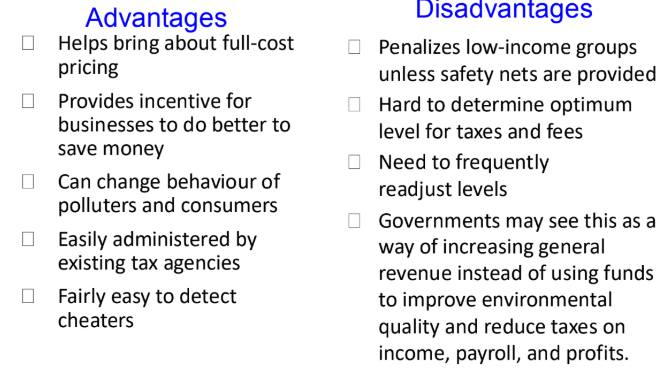
Use of Environmental Taxes and Fees: Trade-offs
pros and cons
pros and cons
10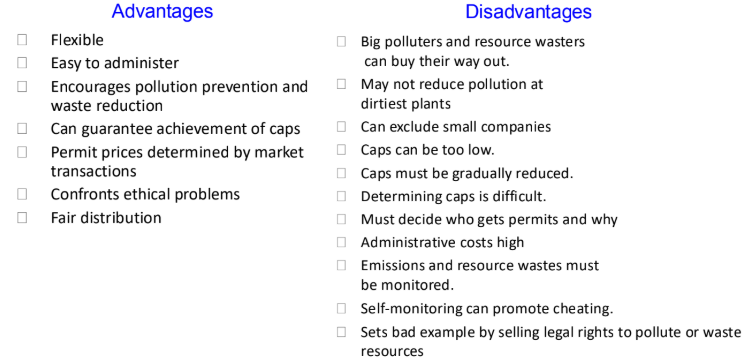
Tradable Environmental Permits: Trade-offs
pros and cons
pros and cons
11
Making the Transition to More Environmentally Sustainable Economies
How?
How?
• Mimic natural systems
• Sunset businesses
• More Eco-friendly businesses
• Improve public awareness
• Sunset businesses
• More Eco-friendly businesses
• Improve public awareness