CHEM1877 Midterm
Study these flashcardsFree · spaced repetition · iPhone, Android, Mac & web
All cards
1
How to dress for the lab (3 most important things)
- Safety goggles (most important)
- Lab coat
- Long pants and closed toe shoes
- Lab coat
- Long pants and closed toe shoes
2
Engineering control
- Engineered machinery or equipment that lowers or avoids exposure to a chemical or physical hazard
- Fume hoods for vapour control (4 in lab)
- Fume hoods for vapour control (4 in lab)
3
Fire extinguishers use
PASS
- Pull pin
- Aim at base of flame
- Squeeze trigger
- Sweep across base
- Pull pin
- Aim at base of flame
- Squeeze trigger
- Sweep across base
4
Fire protocol
- Determine if you can put it out with extinguisher
- If you can’t or unsure, don’t risk it
- Evacuate building via stairs and stand far away
- If you can’t or unsure, don’t risk it
- Evacuate building via stairs and stand far away
5
Why bags can’t be on the floor
- Tripping hazard
- Avoid contamination with hazardous chemicals (health hazard)
- Avoid contamination with hazardous chemicals (health hazard)
6
Double check chemicals before using, otherwise it could
- Waste time
- Wrong result
- Catch fire, explode, toxic gas
- Personal injury
- Waste expensive chemicals
- Wrong result
- Catch fire, explode, toxic gas
- Personal injury
- Waste expensive chemicals
7
Hand washing
- Washing hands often lowers chemicals entering through skin, mouth, eyes, nose
- Before leaving lab, wash hands to reduce health risks
- Before leaving lab, wash hands to reduce health risks
8
How to minimizechemicals entering body for different routes of entry
- All: wash hands
- Eyes: safety goggles, use fume hood, avoid fumes
- Nose: AVOID FUMES, use fume hood, respirator
- Mouth: no eating/drinking, use fume hood, avoid fumes
- Skin: Lab coat, long pants, closed toe shoes
- Eyes: safety goggles, use fume hood, avoid fumes
- Nose: AVOID FUMES, use fume hood, respirator
- Mouth: no eating/drinking, use fume hood, avoid fumes
- Skin: Lab coat, long pants, closed toe shoes
9
What to do if injury occurs
- Report all injuries
- What to do if injury occurs
o Start first aid while you call for help
- What to do if injury occurs
o Start first aid while you call for help
10
How to clean glassware
o Clean it with water/soap and brush
o Rinse with tap water 3 times
o Rinse with small amounts of distilled water 3 times
o Rinse with tap water 3 times
o Rinse with small amounts of distilled water 3 times
11
How to use plumbed eyewash
o Swing arm over sink
o Press paddle lever down
o Hold eyelid open and lower eyes into water
o Rinse for ~10 mins
o Press paddle lever down
o Hold eyelid open and lower eyes into water
o Rinse for ~10 mins
12
3 Rs in order, why this order
- 3 Rs in order:
o Reduce
o Reuse
o Recycle
o Treatment and disposal
- Why this order
o Less expensive
o Less energy
o Reduces pollution
o Reduce
o Reuse
o Recycle
o Treatment and disposal
- Why this order
o Less expensive
o Less energy
o Reduces pollution
13
When to use tap water
- When to use tap water
o Initial glass rinse
o Handwashing
o Initial glass rinse
o Handwashing
14
When to use distilled water
Why should we conserve it
Why should we conserve it
- When to use distilled water
o Final glass rinse (3 times with small amounts)
o Any time water needed for experiment (adding to system, solutions)
- Why conserve distilled water
o Takes energy to make
o Limited amount
o Final glass rinse (3 times with small amounts)
o Any time water needed for experiment (adding to system, solutions)
- Why conserve distilled water
o Takes energy to make
o Limited amount
15
How to dispose of toxic waste
How to dispose of non-toxic insoluable waste
How to dispose of non-toxic insoluable waste
- Toxic waste disposal
o Put in designated container
- Non-toxic insoluble waste
o Put in garbage NOT sink
o Put in designated container
- Non-toxic insoluble waste
o Put in garbage NOT sink
16
- What does the unit “ppm” stand for? Is mg/mL is an expression of ppm?
Ppm stands for parts per million. Yes because 1 mg/mL is 1000 ppm.
17
- Does the seawater contain Na+ and Cl- ions only? If not, give a couple of examples.
No. Seawater also contains other ions like magnesium, sulfate, and calcium.
18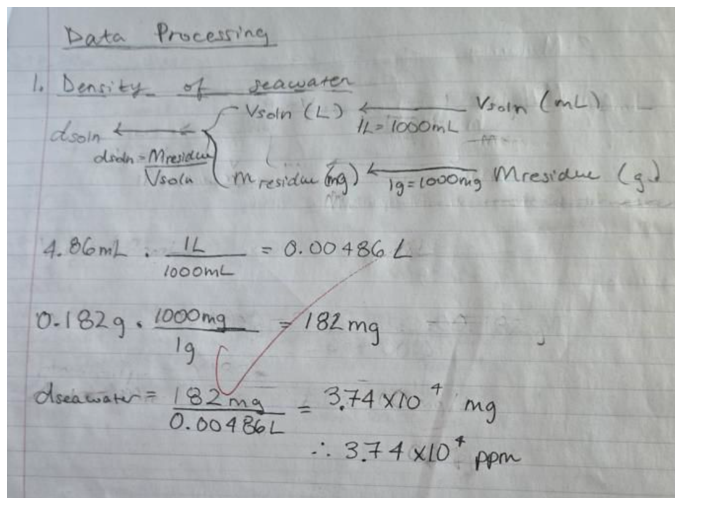
- Calculate the total dissolved solids in seawater in units of ppm (mg/L). (3 steps)
PLAN ONLY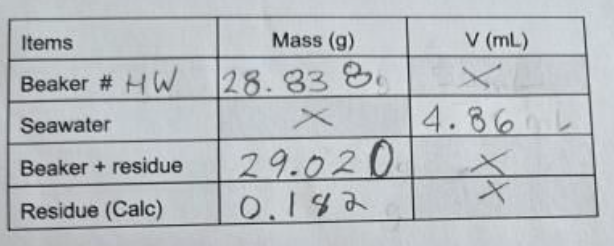
PLAN ONLY
19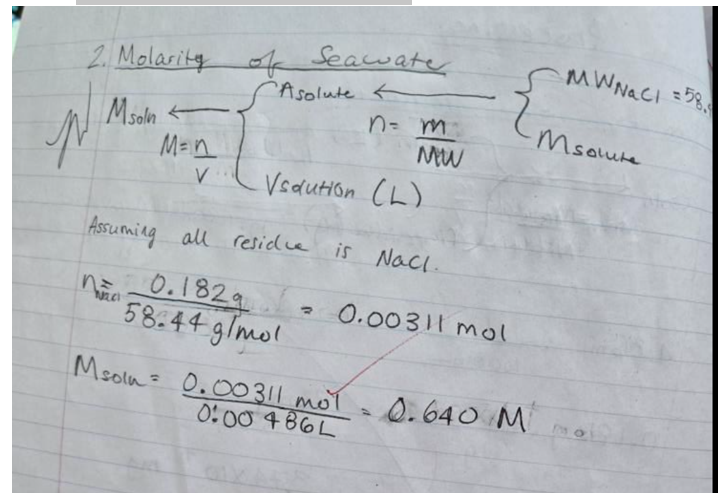
- Express the result in terms of molarity of NaCl (keeping in mind that seawater contains a variety of salts). (2 steps)
PLAN ONLY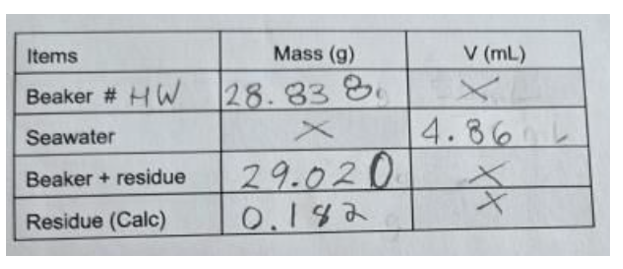
PLAN ONLY
20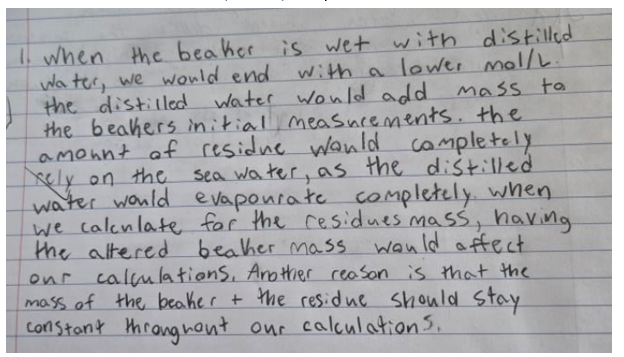
- The beaker must be dry initially in this lab. If it was wet with distilled water, would it raise or lower the result (mol/L)? Explain.
SEAWATER LAB
SEAWATER LAB
21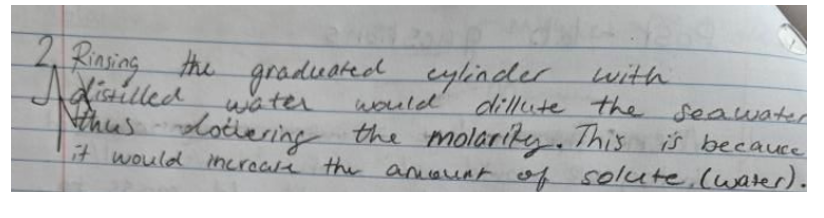
- It was important to rinse the graduated cylinder with the seawater before it was used. If the graduated cylinder was left wet with distilled water, would the final result be too high or too low? Explain.
SEAWATER LAB
SEAWATER LAB
22
- In this lab, you will be boiling down an ethylene glycol/water solution. Why is it important to not let the volume drop down too far?
If it drops down too far, toxic ethyl alcohol may be evaporated.
23
- Salt is used to turn icy roads into wet roads. Discuss possible reasons why CaCl2 would be a better choice than NaCl and Hg2Cl2.
Hg2Cl2 is toxic. CaCl2 would melt snow better than NaCl because it has a higher van’t hoff factor (3 > 2), so it would lower the ice’s freezing point. CaCl2 is less expensive and more available than NaCl.
24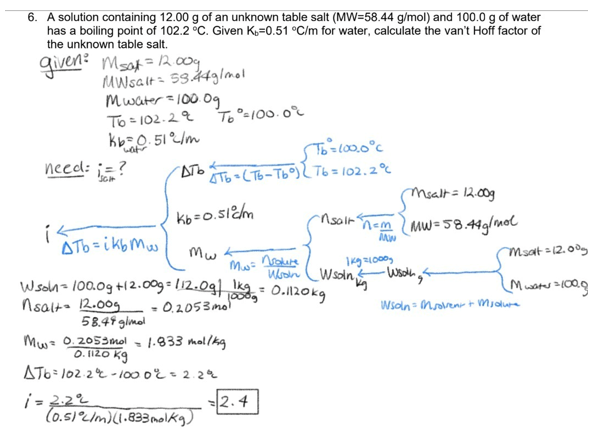
- A solution containing 12.00 g of an unknown table salt (MW=58.44 g/mol) and 100.0 g of water has a boiling point of 102.2 C. Given Kb=0.51 C/m for water, calculate the van’t Hoff factor of the unknown table salt.
25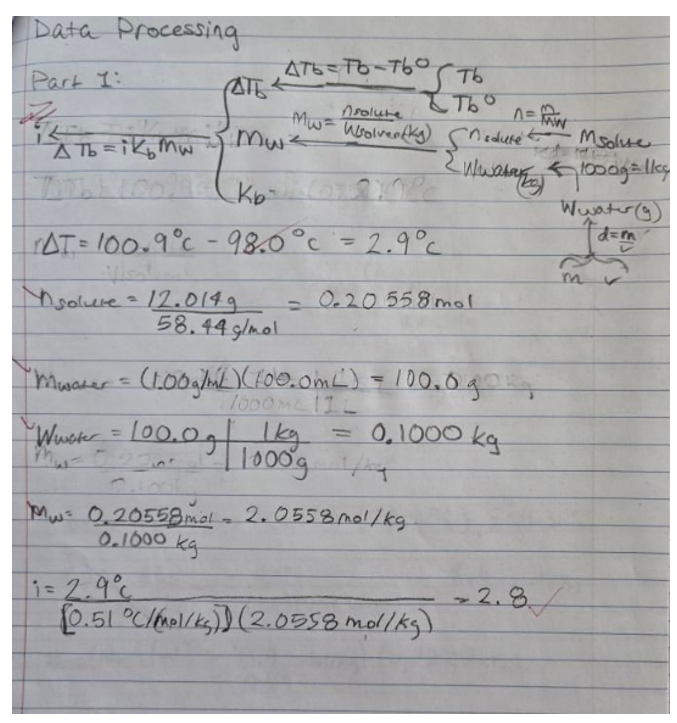
- Part I: Calculate the van’t Hoff factor for the Table salt (6 steps)
PLAN ONLY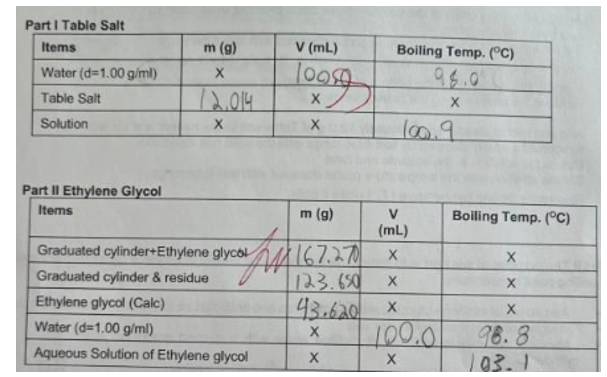
PLAN ONLY
26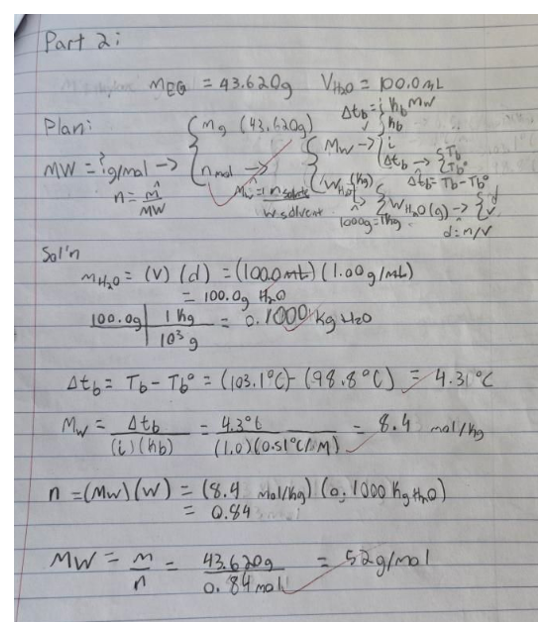
- Part II: Calculate the molecular weight of the ethylene glycol (6 steps)
PLAN ONLY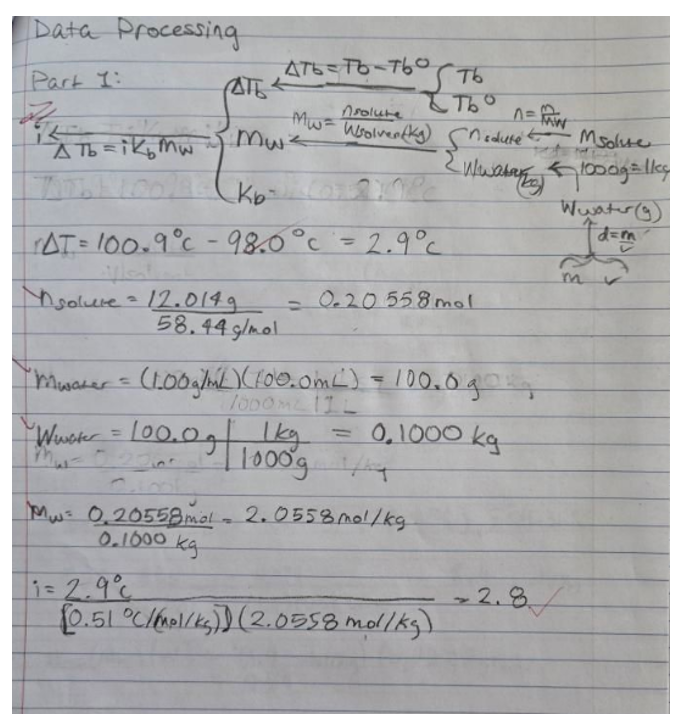
PLAN ONLY
27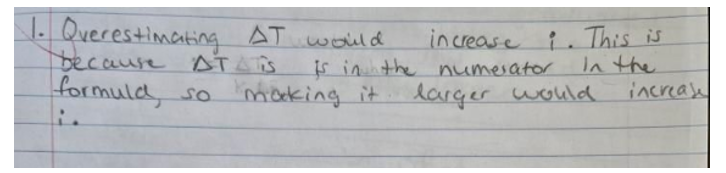
- If the change in boiling temperatures (ΔT) was overestimated, in which way would that alter your calculated van’t Hoff factor in part I: the factor would be larger than theoretical or smaller than theoretical? Explain your answer.
COLLIGATIVE LAB
COLLIGATIVE LAB
28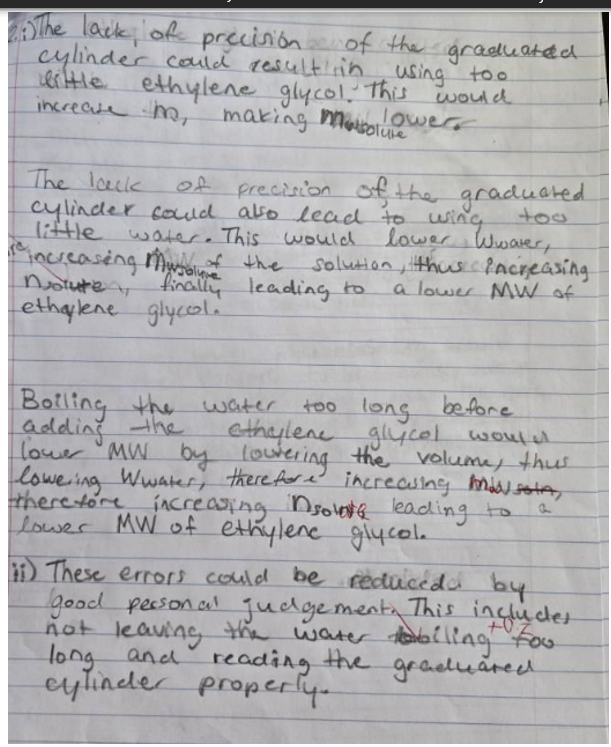
- If the experimental molecular weight of ethylene glycol is lower than the theoretical value in part II. Suggest i) possible errors that could cause this lower molecular weight, and explain it, and ii) how to minimize these errors (bonus marks).
COLLIGATIVE LAB
COLLIGATIVE LAB
29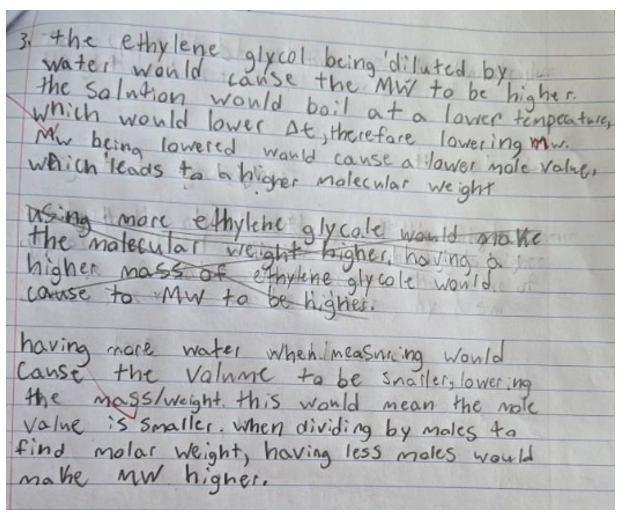
- If the experimental Molecular Weight is higher than the theoretical value for part II. Suggest possible errors that could cause this higher molecular weight and explain it.
COLLIGATIVE LAB
COLLIGATIVE LAB
30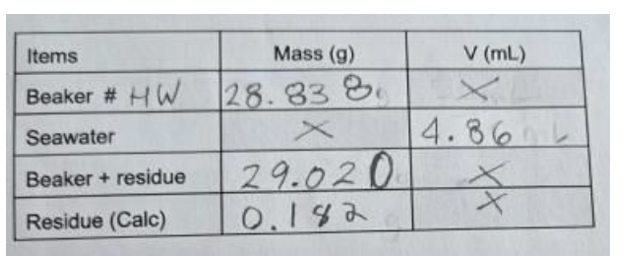
- (a) What is the molecular formula of alum, and (b) Calculate the molecular weight of alum.
31
- During the moistening filter paper and suction filtration, should we press down firmly on the circumference of the funnel by covering the entire funnel surface?
RECYCLING LAB
RECYCLING LAB
32
- (a) Can the final filtrate be disposed of down the drain? Yes or No (b) Explain your choice in part (a)
RECYCLING LAB
RECYCLING LAB
33
- Explain why the filtrate was used to transfer residue from the beaker to the Buchner funnel if the desired product is solid in this lab.
RECYCLING LAB
RECYCLING LAB
Filtrate is used because it reduces the risk of dissolving any of the desired solids since the filtrate is already saturated with solids. The solid would be dissolved (lost) if water was used.
34
- Explain why small amounts of cold distilled water are used to rinse the solid product in this lab.
RECYCLING LAB
RECYCLING LAB
Remove soluble undesired ions. Cold to lower solubility and minimize loss of desired solid. Small amount to dissolve fewer solids.
35
- Explain why acetone was used in this lab.
RECYCLING LAB
RECYCLING LAB
It would rinse off water since water and acetone are miscible, leaving the solids dry. Removing acetone is easy due to lower boiling point.
36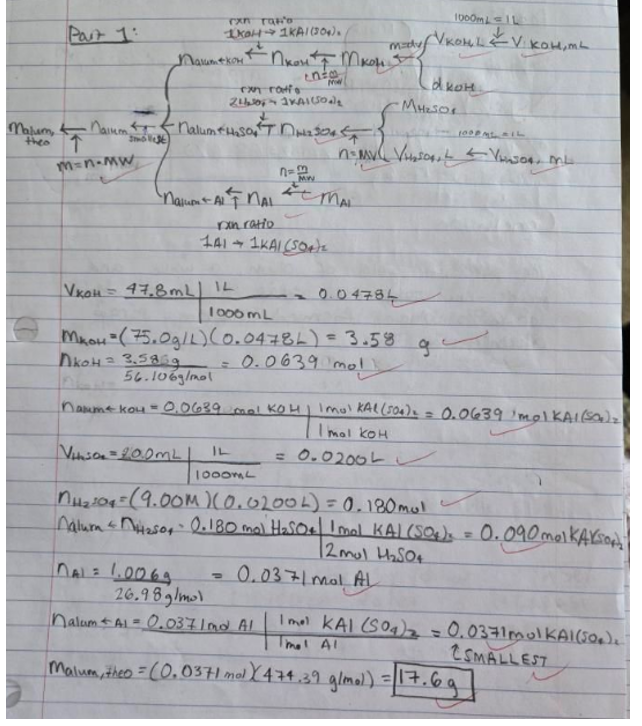
- Part I Calculate the theoretic yield of alum in grams (7 steps)
PLAN ONLY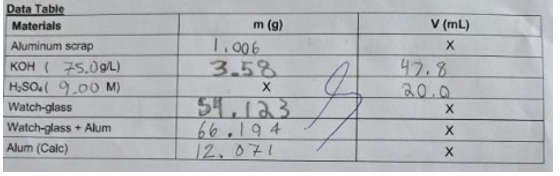
PLAN ONLY
37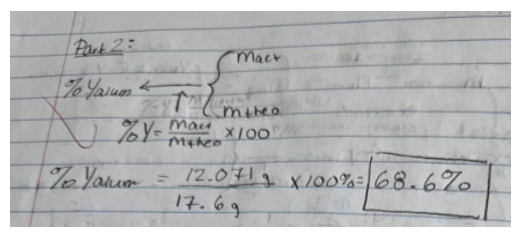
- Part II Calculate the percent yield of alum (1 step)
(theo yield of 17.6g)
PLAN ONLY
(theo yield of 17.6g)
PLAN ONLY
38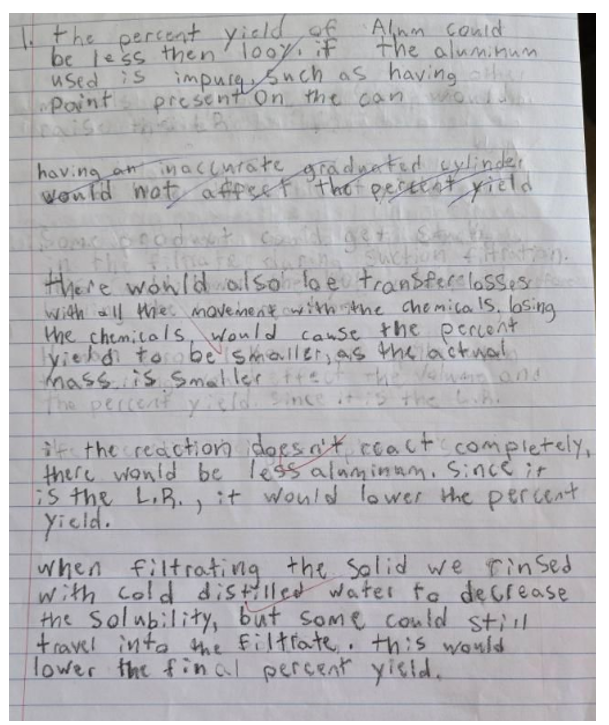
- What would cause the percent yield of the alum to be less than 100% (if Al is the LR)?
RECYCLING LAB
RECYCLING LAB
39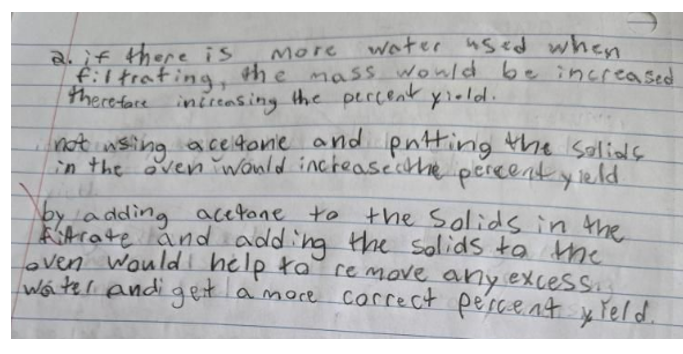
- What would cause the percent yield of the alum to be greater than 100%? How can this error be minimized?
RECYCLING LAB
RECYCLING LAB
40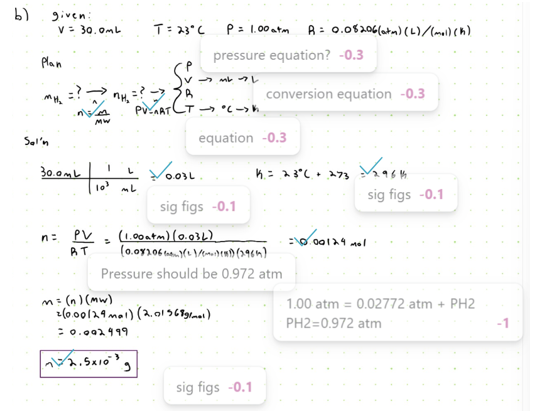
- If 30.0 mL of hydrogen gas was collected over water (at 23 oC) and 1.000 atm pressure, what mass of Hydrogen would be present?
PLAN
PLAN
41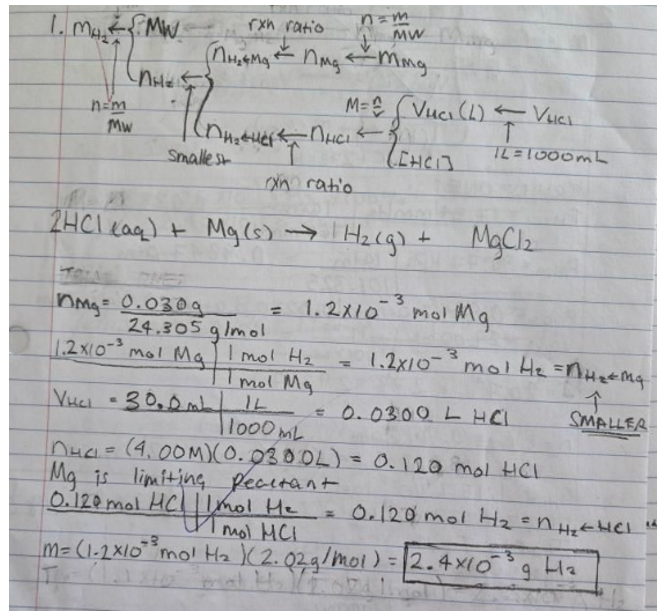
- Calculate the theoretical yield of hydrogen gas in grams (5 steps)
PLAN ONLY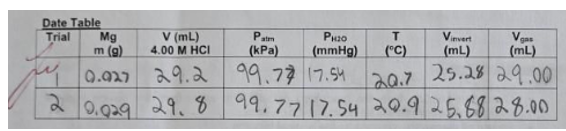
PLAN ONLY
42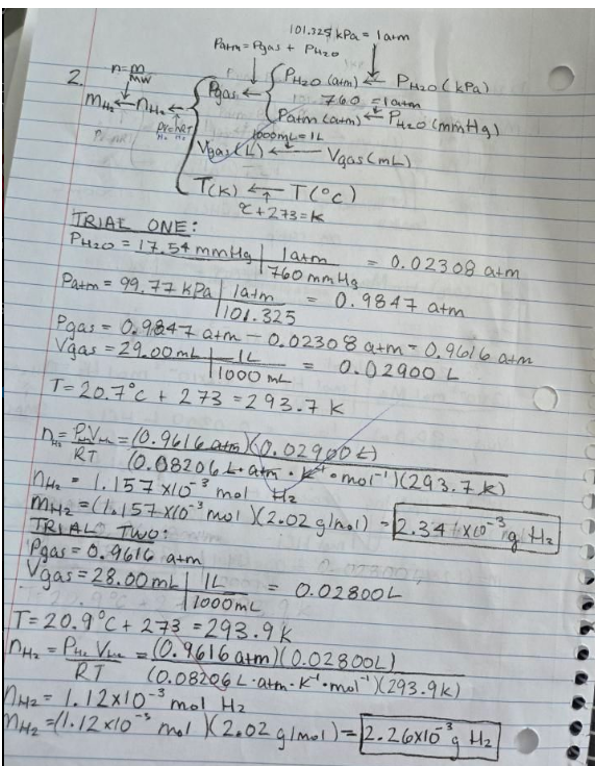
- Calculate the actual yield of hydrogen gas in grams (7 steps)
PLAN ONLY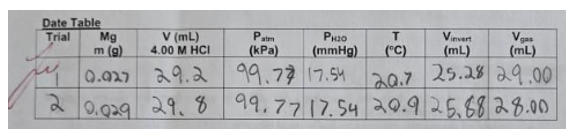
PLAN ONLY
43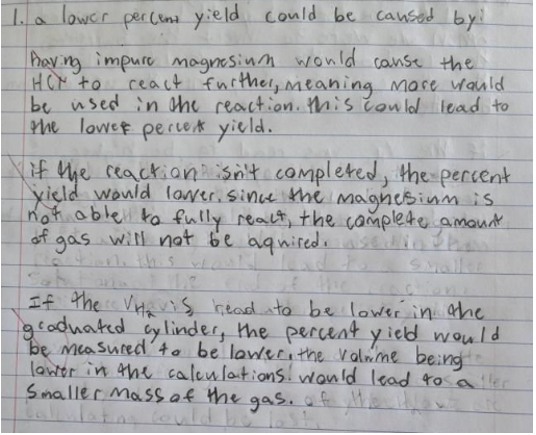
- Identify three reasons for a lower percent yield (100%) that would account for this discrepancy. Identify two reasons for a higher percent yield (>100%) that would account for this discrepancy.
GAS LAB
GAS LAB