All cards
1
Environment
A complex, dynamic universe of events that differ from instances to instance. A behavior cannot exist in the absence of an environment
2
Phylogeny
The history of the natural of a species.
3
Antecedent
an environmental condition or stimulus change existing or occurring prior to a behavior of interest.
4
Stimulus
An energy change that affects an organism through its receptor cells.
5
Stimulus class
any group of stimuli sharing a predetermined set of common topological or functional elements.
6
Stimulus Control
A situation where the frequency, latency, duration, or amplitude of a Behavior is altered by the presence or absence of an antecedent stimulus.
7
Discrimination Stimulus (SD)
stimulus in the presence of which responses of some type have been reinforce and in the absence of which the same type of response has occurred and not been reinforce; this history of differential reinforcement is the reason that SD increases the momentary frequency of the behavior.
8
Behavior
an organisms interaction the environment that is characterized by detectable in space through time that results in measurable change in at least one aspect of the environment.
9
Response
a specific instance of behavior
10
Structural Response
refers to the form or physical characteristics of the response
11
Functional Response
refers to the effects of the behavior on the environment.
12
Response Class
a ground of responses with the same function (i.e. each response in the group produces the same effect on the environment.)
13
Consequence
stimulus change that follows a Behavior of interest
14
Reinforcement
occurs when a stimulus change immediately follows a response and increases the frequency of that type of behavior in similar conditions.
15
Positive Reinforcement
occurs when a Behavior is followed immediately by the presentation of a stimulus that increases the future frequency of the behavior in similar conditions.
16
Negative Reinforcement
occurs when a behavior is followed immediately by the removal of a stimulus that increases the future frequency of the behavior in similar conditions.
17
Reinforcer
a stimulus change that increases the future frequency of behavior that immediately precedes it.
18
Conditional Reinforcer (CR)
a stimulus change that functions as a reinforcer because of prior pairing with one or more other reinforces. Also known as secondary reinforcer.
19
Unconditional Reinforcer (UR)
the stimulus change that increases the frequency of any behavior that immediately precedes it irrespective of the organizms learning history with the stimulus. URs are the produce of evolutionary development of the species. Also known as a primary reinforcer.
20
Reflex
A stimulus-response relation consisting of an antecedent stimulus and the respondent behavior it elicits.
21
Respondent Behavior
The response component of a reflex; behavior that is elicited. or induced, by antecedent stimuli.
22
Punishment ncon
occurs when a Behavior is followed by a stimulus change that decreases the future frequency of that type of behavior 8n similar conditions.
23
Respondent ConditioningU
A stimulus-stimulus pairing procedure in which a neutral stimulus (NS) is presented with an unconditional stimulus (US) until the neutral stimulus becomes stimulus that elicits the condition response.
24
Stimulus-Stimulus Pairing
A procedure in which two stimulus are presented at the same time, usually repeatedly for a number of trail, which often results in one stimulus acquiring the function of other stimulus.
25
Unconditional Stimulus (US)
The stimulus component of an unconditional reflex; a stimulus change that elicits respondent behavior without any prior learning.
26
Neutral Stimulus (NS)
A stimulus change that does not elicit respondent behavior.
27
Conditional Stimulus
The stimulus component of a conditioned reflex; a formerly neutral stimulus change that elicits respondent behavior only after it has been paired with an unconditional stimulus (US) or another CS.
28
Respondent Extinction
The repeated presentation of a conditioned stimulus (CS) in the absence of the unconditional stimulus (US); the CS gradually loses its ability to elicit the conditioned response until the conditioned reflex no longer appears in the individual 's repertoire.
29
Higher Order Conditioning
Development of a conditioned reflex by pairing of a neutral stimulus (NS) with a conditioned stimulus (CS).
30
Respondent Conditioning "Equation"
NS = CS and US = CR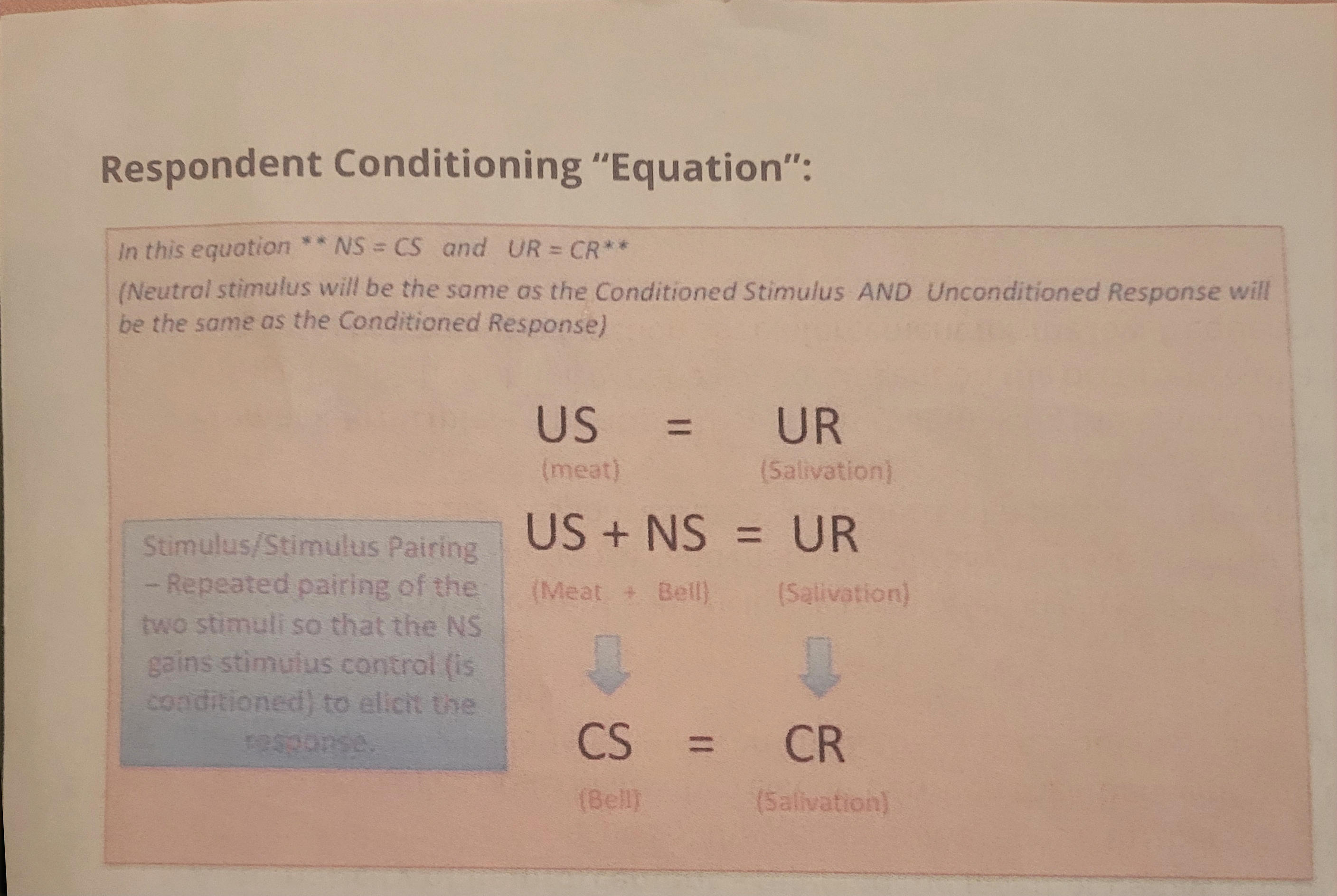
31
Operant Behavior
behavior that is selected, maintained, and brought under stimulus control as a function of its consequences; each person's repertoire of operant behavior is a product of his history of interactions with the environment .
32
Operant Conditioning
the basic process by which operant learning occurs: consequences (stimulus changes immediately following responses) resulting in increased (reinforcement) or decreased (punishment) frequency of the same type of behavior under stimulus motivational and environmental conditions in the future.
33
Contingency
refers to dependents and/or temporal relations between operant behavior and its controlling variables.
34
Three-term Contingency
the basic unit of analysis in the analysis of operant behavior, encompasses the temporal end possibly dependent relations among an antecedent stimulus, behavior, and consequences.
35
Automaticity of Reinforcement
refers to the fact that behavior is modified by its consequences irrespective of the person's awareness the person does not have to recognize or verbalize the relation between their behavior and the reinforcement consequences, or even known that a consequence ls has occurred, for reinforcement to "work."
36
History of Reinforcement
an inclusive term referring in general to all of the person's learning experiences and more specifically, to past conditioning with respect to particular response classes or aspects of a person's repertoire.
37
Premack Principle
a principle that states that making the opportunity to engage in a high probability behavior contingent on the occurrence of low-frequency behavior will function as reinforcement for the low-frequency behavior