1.5 Solids under stress
Study these flashcardsFree · spaced repetition · iPhone, Android, Mac & web
All cards
1
What does Hookes law state?
For an elastic spring, the extension is directly proportional to the force applied to its end
2
What is the equation for Hookes law?
F = kx
(F=force, k=spring constant, x=extension)
(F=force, k=spring constant, x=extension)
3
What does having a larger spring constant mean?
A larger force needs to be applied to get the same extension, the spring is stiffer
4
What does having a low spring constant mean?
Less force needs to be applied to get the same extension, the spring is less stiff
5
Why are force and extension measurements only useful for comparing the same material?
Because the spring constant will vary depending on original length and cross sectional area
6
What is the equation for Stress?
force
—————
cross-sectional area
(σ= F/A)
—————
cross-sectional area
(σ= F/A)
7
What is the equation for Strain?
Extension
—————-
original length
(ε= Δl/l)
—————-
original length
(ε= Δl/l)
8
What are stress and strain both?
Tensile properties, they are used when a material is in tension
9
What is constant for a material?
Young modulus
10
How is the young modulus found?
Taking the ratio of stress to strain when the sample is obeying Hookes law
11
What is the equation for Young modulus?
stress (σ)
E= ——————
strain (ε)
E= ——————
strain (ε)
12
The area under the graph is equal to..a
the work done in extending the material
13
Which type of extension obeys Hookes law?
Elastic extension
14
Which type of extension doesn’t obey Hookes law?
Plastic extension
15
What does is mean when a material expands plastically?
The force is no longer proportional to extension
16
What is plastic extension?
The material cannot return to its original shape or length after being released
17
What is elastic extension?
The material can still return to its original shape or length after being released
18
What equation is used for a straight portion of a graph that obeys Hookes law?
The EPE equation (W=1/2kx^2)
19
Why is the EPE equation used?
Because as work is done extending material elastically, energy is transferred into EPE and is stored
20
What happens when the material expands beyond the elastic region (Hookes law region)?
Additional work is done to break bonds in material to permanently deform it. Can’t say work done is to increase EPE now.
21
What are solids classified into?
Crystalline
Amorphous
Polymeric
Amorphous
Polymeric
22
What are Crystalline solids?
Materials that have atoms arranged in an ordered structure- making a crystal lattice.
23
What are examples of Crystalline solids? Why?
Most metals, they can extend elastically for a small strain
24
How is the structure of Crystallines formed?
Atoms in metals are ionised, positive ions form a regular lattice and can slip meaning metals are ductile and tough
25
What are Amorphous solids?
Materials where atoms or molecules are arranged in a non-ordered structure.
26
What are examples of Amorphous solids?
Glasses and ceramics
27
How are ceramics formed?
Formed by directional covalent bonds locking atoms into place, gives them a rigid structure
28
What type of solid is this?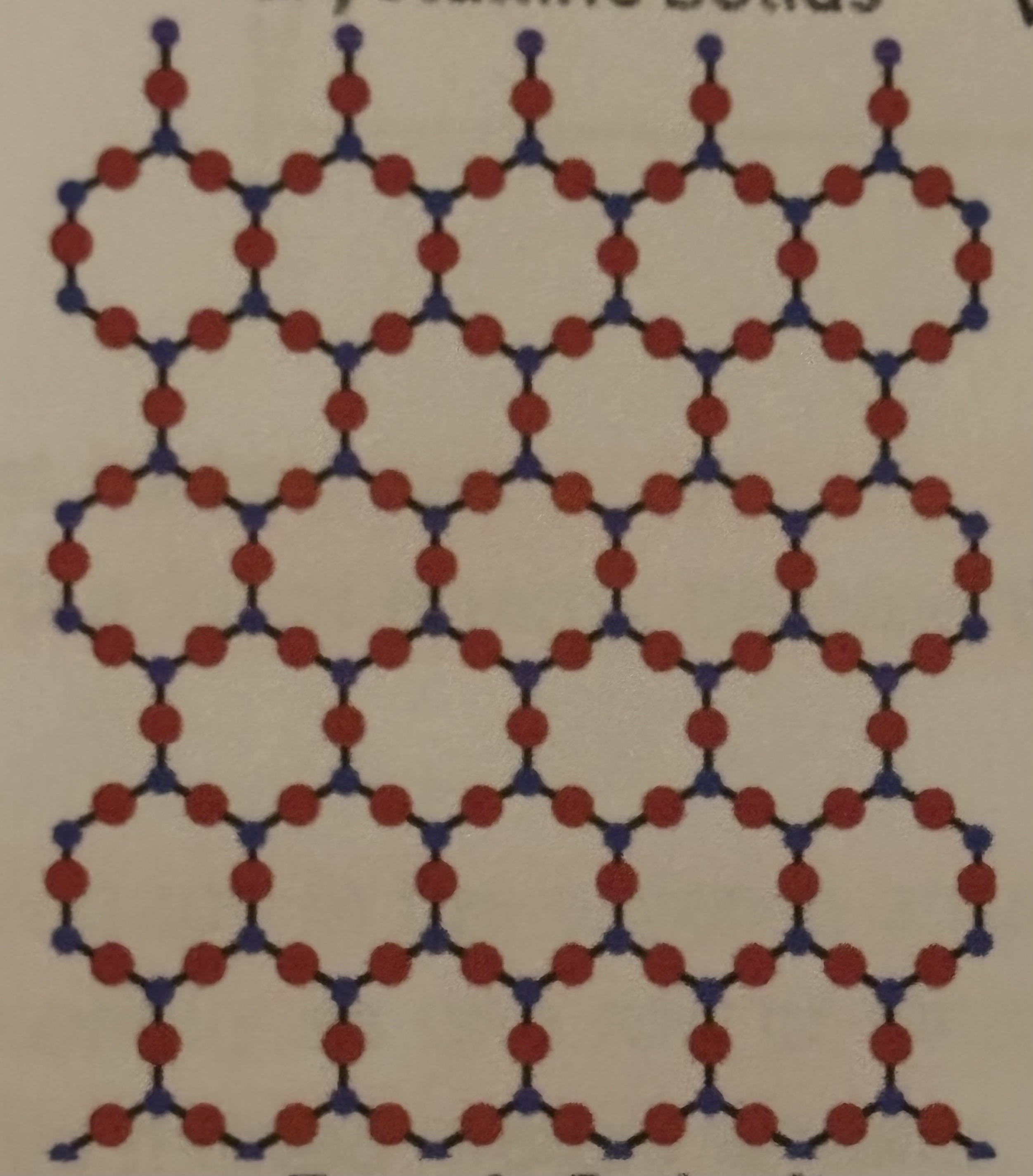
Crystalline
29
What type of solid is this?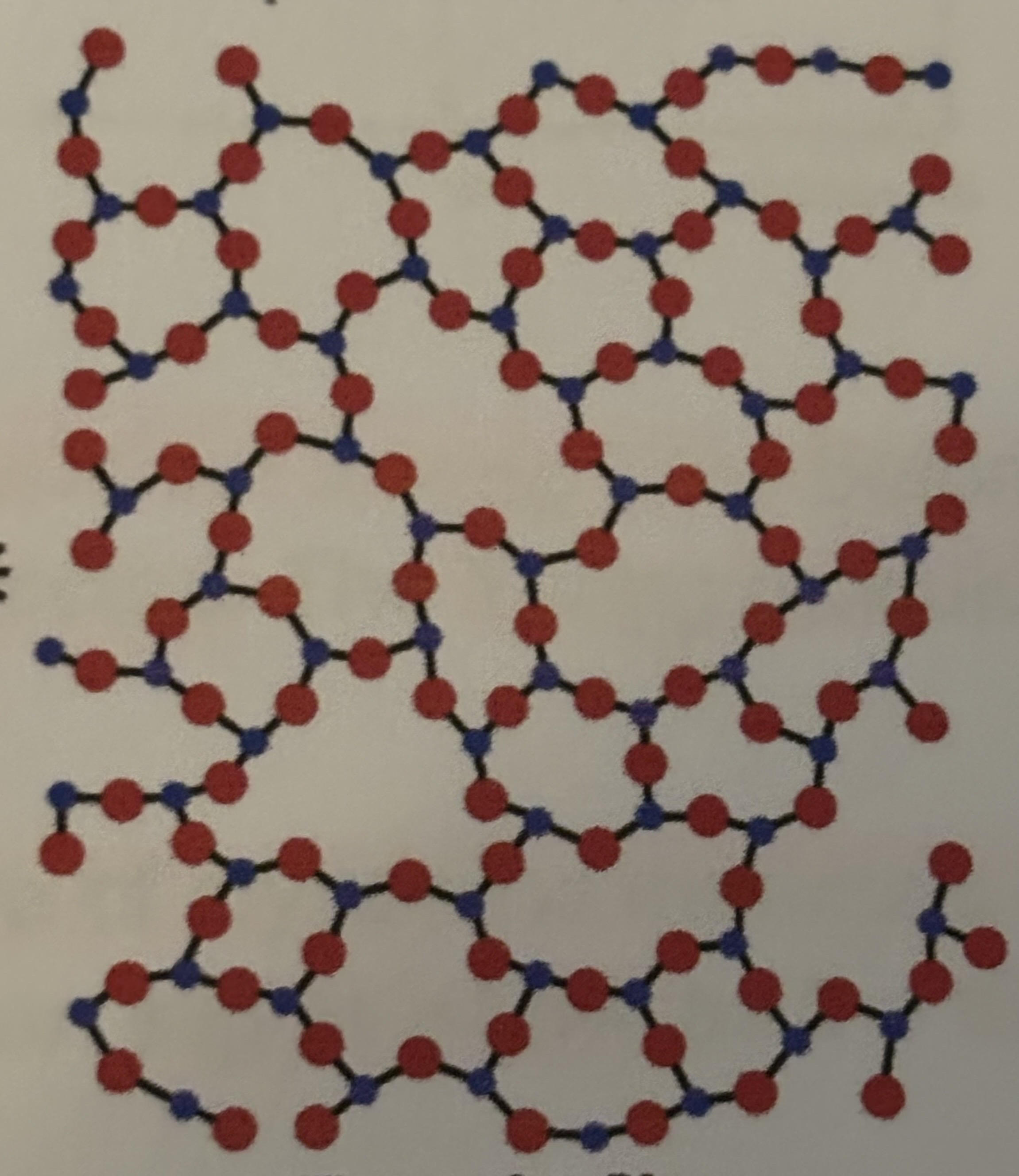
Amorphous
30
What type of solid is this?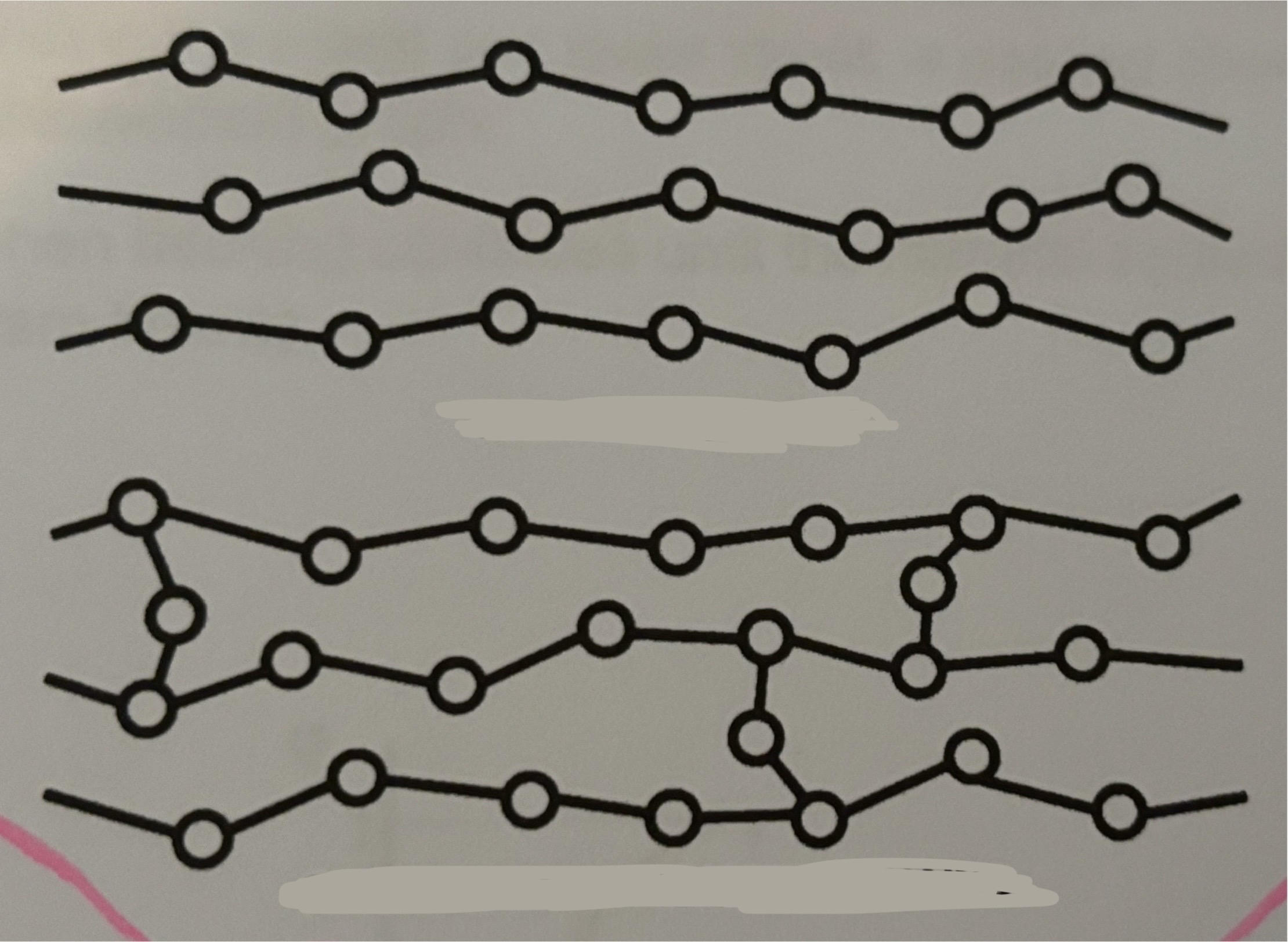
Polymeric
31
What are polymeric solids?
Materials that contain long chain polymer molecules
32
Describe the properties of polymeric solids
Bonds in them are strong and can rotate (strong and flexible)
33
What can be added to polymeric chains to make them stiffer?
Cross-links (tieing chains together)
34
What is the young modulus on a stress-strain graph?
The gradient of the straight line section
35
What can metals do for a long time before they break? Why?
Plastically deform, they absorb a lot of energy before breaking (young modulus is high as metals are very strong)
36
What are dislocations?
Small gaps in the ordered structure of Crystalline materials
37
What do dislocations do?
Allow planes of atoms to slip more easily, one row of atoms can slip at a time as the dislocation is passed through the metal
38
What do dislocations do to a metal?
Make it weaker
39
How do you reduce the effect of dislocations?
Introduce foreign atoms or create more grain boundaries
40
What do foreign atoms do?
Fill the gaps to prevent them from moving
41
What do grain boundaries do?
Make it so there are fewer dislocations per grain, becomes harder for dislocations to move across boundaries
42
What is necking?
Cross-sectional area of metal reduces as it deforms plastically
43
When does ductile fracture happen?
When necking continues until the material separates at a point
44
What are the properties of brittle material?
Very strong (high Young modulus)
Not tough
Dont absorb much energy before fracturing
Not tough
Dont absorb much energy before fracturing
45
How does crack propagation cause brittle fracture?
Small imperfections on surface which concentrate the stress and cause a crack to open, causing material to fracture
46
What is brittle fracture?
The material hardly extends before breaking due to a crack
47
What do surface imperfections reduce?
The breaking stress of a material, bc allows for cracks to develop
48
What type of Young modulus does rubber have?
Low, not very stiff
49
What happens when you stretch rubber?
Long chain polymer molecules inside begin all tangled up and gradually line up together until straight
50
What is hysteresis?
When the stress-strain graph is different depending on wether ur loading or unloading material
51
What is the area between two curves equal to on a stress-strain graph?
Equal to energy per unit per volume stored as thermal energy in the rubber after loading and unloading it