Cell membranes and transport unit 1
Study these flashcardsFree · spaced repetition · iPhone, Android, Mac & web
All cards
1
Describe the fluid mosaic model?
Fluid- phospholipid bilayer can move around
Mosaic- Proteins are all diff sizes
Mosaic- Proteins are all diff sizes
2
Why are cell membranes selectively permeable?
They only allow certain molecules thru
3
What can permeability be increased by?
Temp-increase vibrations of phospolipids, moving them further apart
Organic solvents- dissolve phospholipids
Organic solvents- dissolve phospholipids
4
What can dissolve and move directly thru the phospholipid bilayer?
Lipid soluble substances, eg. Vitamin A
Small mols, eg. O2 and CO2
Small mols, eg. O2 and CO2
5
What cannot pass thru, why? what must they use to help them pass?
Water soluble substances
Cant get thru hydrophobic tails
Has to use intrinsic proteins to pass thru
Cant get thru hydrophobic tails
Has to use intrinsic proteins to pass thru
6
What is a channel protein?
Pores lined with polar (hydrophobic) groups, allow charged ions thru
7
What is a carrier protein?
Allow large polar mols thru, eg. amino acids, water soluble sugars
Cell changes shape as mol binds to move it in or out
Cell changes shape as mol binds to move it in or out
8
What does the polarity of a protein depend on?
Whether its extrinsic or intrinsic
9
What is the phospholipid bilayer made up of?
Hydrophilic phosphate head
Hydrophobic fatty acid tail
Hydrophobic fatty acid tail
10
What are the extrinsic proteins?
Found on outer surface of bilayer
Can have a sugar attached
Can have a sugar attached
11
What are the extrinsic proteins with sugars attached called?
Glycoproteins
12
What do the glycoproteins form?
A glycocalyx layer of the membrane
13
What does the glycocalyx layer do?
Plays a role in cell to cell recognition or hormone receptor sites
14
Where is cholesterol found? What does it do?
Found inbetween the phospholipids
Makes them more rigid and stable
Makes them more rigid and stable
15
Describe osmosis?
Diffusion of water
High to low wp
Across selectively permeable membrane
High to low wp
Across selectively permeable membrane
16
What is water potential?
The tendency of water molecules to move
17
What is the solute potential?
The osmotic strength of the solution, measures how easily water mols move out of solution
18
What does it mean for movement of water if there is high level of solute?
Harder for water mols to move out of solution, held together more tightly
19
What does it mean when a plant cell becomes turgid?
Lots of water moves into plant cell
Pressure potential of cell increases
Cytoplasm pushes on cell wall, cw becomes turgid to stop it from exploding
Pressure potential of cell increases
Cytoplasm pushes on cell wall, cw becomes turgid to stop it from exploding
20
What is incipient plamolysis in plants?
Plant cell has lost enough water for cell membrane to seperate from cell wall
Pressure potential is 0
Pressure potential is 0
21
What does plasmolysed mean in plants?
Cell becomes flaccid when in hypertonic solution
22
Why is it important that animal cells are in a isotonic solution?
Because they lack a cell wall
23
What happens to animal cells in a hypotonic solution?
They burst
24
What happens to animal cells in a hypertonic solution?
They shrink
25
What does tonicity mean?
The concentration of solute
26
What does hypertonic mean?
High conc of solute, low water potential
27
What does hypotonic mean?
Low conc of solute, high water potential
28
What does isotonic mean?
Same conc of solute and same water potential
No net movement of water between the solutions
No net movement of water between the solutions
29
What is simple diffusion?
Movement of molecules
High conc to low conc, down conc gradient
Passive process
Thru phospholipid bilayer
High conc to low conc, down conc gradient
Passive process
Thru phospholipid bilayer
30
What are diffusion rates increased by?
Higher conc gradient
Shorter diffusion distance (thinner membrane)
Large surface area
Smaller mols
Non-polar / fat soluble mols
High temp
Shorter diffusion distance (thinner membrane)
Large surface area
Smaller mols
Non-polar / fat soluble mols
High temp
31
What is facilitated diffusion?
Same as simple diffusion but for polar mols or ions that cant get thru bilayer
Use the channel / carrier proteins
Use the channel / carrier proteins
32
Why does a respiratory inhibitor have no effect on diffusion?
Because its a passive process
33
What is co transport?
Type of faciliated diffusion
2 diff substances use same carrier protein at same time
2 diff substances use same carrier protein at same time
34
What is active transport?
Movement of mols against conc gradient
Low to high conc
Requires ATP from respiration (activates the carrier proteins to move mols)
Low to high conc
Requires ATP from respiration (activates the carrier proteins to move mols)
35
What happens when you add a respiratory inhibitor during active transport?
Prevents ATP from being avaliable, prevents transport
36
What is bulk transport?
Movement of large molecules across cell membrane
37
What are the 2 types of bulk transport?
Endocytosis
Exocytosis
Exocytosis
38
What are the 2 types of endocytosis?
Phagocytosis (solids enter cell)
Pinocytosis (liquids enter cell)
Pinocytosis (liquids enter cell)
39
What are the steps of endocytosis?
Plas membrane fold in
Engulfs material
Vesicle formed enters cell
Engulfs material
Vesicle formed enters cell
40
What are the steps of exocytosis?
Vesicle formed by golgi moves to plas membrane
Fuses with plas membrane
Vesicle empties contents of cell
Fuses with plas membrane
Vesicle empties contents of cell
41
What type of process is endo/exocytosis?
Active process, requires ATP to move vesicles
42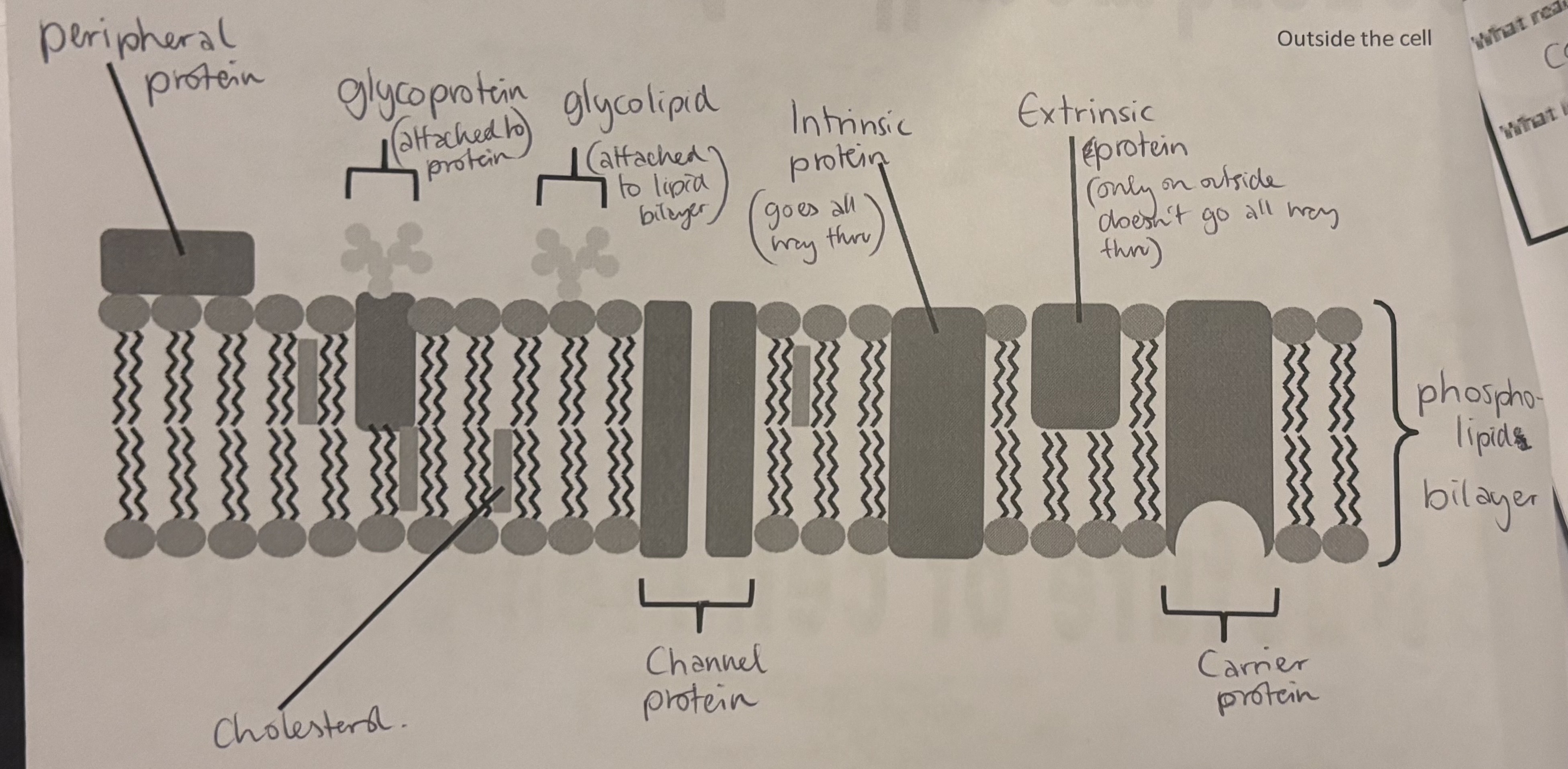
Image occlusion: name the hidden labels
43
Image occlusion: name the hidden labels
44
Image occlusion: name the hidden labels
45
Image occlusion: name the hidden labels
46
Image occlusion: name the hidden labels
47
Image occlusion: name the hidden labels
48
Image occlusion: name the hidden labels
49
Image occlusion: name the hidden labels
50
Image occlusion: name the hidden labels
51
Image occlusion: name the hidden labels