biological compounds unit 1
Study these flashcardsFree · spaced repetition · iPhone, Android, Mac & web
All cards
1
What does Iron do for animals?
Used to make haemoglobin in red blood cells which transport oxygen around the body.
2
What does Magnesium do for plants?
Magnesium is needed in the chlorophyll for photosynthesis
3
What does Calcium do for plants and animals?
Plants- strengthens cell wall
Animals- Strengthens bones + teeth
Animals- Strengthens bones + teeth
4
What does phosphate do for plants and animals?
Needed in cell membranes
Needed in ATP
Needed to make RNA and DNA
Needed in ATP
Needed to make RNA and DNA
5
How is water formed?
Covalent bonds of hydrogen and oxygen atoms cause the hydrogen ends to be s p+ and the oxygen end to be s p-, which causes hydrogen bonds to form between O and H of different bonds.
6
How does water have high specific heat capacity?
Many hydrogen bonds means lots of energy is needed to raise temp of water.
7
How does water have high latent heat of vaporisation?
Many hydrogen bonds means that lots of energy is needed to evaporate water.
Sweat evaporates from us which cools us down so our enzymes dont denature.
Sweat evaporates from us which cools us down so our enzymes dont denature.
8
How does water have strong cohesion?
Strong attraction between water molecules due to hydrogen bonds.
Cohesion lets water move in columns through an organism and allows it to carry substances with it. eg. cohesion lets water move up the xylem in plants.
Cohesion lets water move in columns through an organism and allows it to carry substances with it. eg. cohesion lets water move up the xylem in plants.
9
How is water a transport medium?
Its a liquid at room temp
Water in plants
Plasma in blood
Water in plants
Plasma in blood
10
How is water a solvent in a reaction?
Its a dipole (2 charges)
It has ions which can dissolve non polar and polar molecules.
It has ions which can dissolve non polar and polar molecules.
11
How does water have high surface tension?
Because of hydrogen bonds
Animals can walk across it
Find food/ escape predators
Can form habitats on surface of water
Animals can walk across it
Find food/ escape predators
Can form habitats on surface of water
12
How is water a metabolite?
Chemical reactions
A+B->C+water=hydrolysis
Water+B->C+D=condensation
A+B->C+water=hydrolysis
Water+B->C+D=condensation
13
What is hydrolysis?
Splitting molecules with water, breaking the glycosidic bond
14
What is condensation?
A glycosidic bond is formed in a condensation reaction
15
What is the general formula of monosaccharides?
Cn H2n On
16
What are disaccharides?
2 monosaccharides joined by a glyco bond during a condensation reaction
17
What is sucrose
Sugar store in fruit, plants. transported in the phloem
18
What is lactose
Sugar energy store in mammalian milk
19
What is maltose
Sugar store in seeds
20
What does b glucose and b glucose make
Maltose and water
21
What does b glucose and fructose make
sucrose and water
22
What does b glucose and galactose make
Lactose and water
23
What is a monosaccharide
a singular non bonded sugar
24
What is a triose sugar used for
intermediate in reactions, photosynthesis, respiration
25
What is a pentose sugar used for
Make DNA in deoxyribose, RNA in ribose and ATP
26
Different hexose sugars
b glucose, alpha glucose, galactose, fructose, aribose
27
What is starch
Storage molecule in plants
28
What is the structure of starch
Large so it cant diffuse
Compact- stores lots of enery in small space
Insoluble- doesnt affect water potential of cell
Easily hydrolysed to release glucose for respiration to produce ATP
Compact- stores lots of enery in small space
Insoluble- doesnt affect water potential of cell
Easily hydrolysed to release glucose for respiration to produce ATP
29
What is starch made from
Its a polsaccharide, made from many alpha glucose
30
What are the 2 forms of starch
Amylose and Amylopectin
31
Describe amylose
1,4 glyco bonds
Long chain which coils into helix
Compact, insoluble and large
Long chain which coils into helix
Compact, insoluble and large
32
Describe amylopectin
1,4 and 1,6 glyco bonds
Branched out with terminal ends that r easily accessible
Easily hydrolysed by Amylose and turned into glucose for respiration
Branched out with terminal ends that r easily accessible
Easily hydrolysed by Amylose and turned into glucose for respiration
33
What is glycogen
Used for storage in animals
34
What is glycogen made from
Polysaccharide, made from alpha glucose
35
Describe glycogen
Similar to Amylopectin
1,4 and 1,6 glyco bonds
Very highly branched with terminal ends
Easily hydrolysed bc of ends to release glucose for respiration to produce ATP
Insoluble- doesnt affect water potential of cell
1,4 and 1,6 glyco bonds
Very highly branched with terminal ends
Easily hydrolysed bc of ends to release glucose for respiration to produce ATP
Insoluble- doesnt affect water potential of cell
36
What is cellulose
A structural polysaccharide, Makes up the cell wall in plants
37
Describe the structure of cellulose
Polysaccharide made of beta glucose
1,4 glyco bonds
Inverted beta glucoses
1,4 glyco bonds
Inverted beta glucoses
38
How is cellulose structurally strong
Because it is in straight chains, multiple chains can lie next to eachother and they form hydrogen bonds called crosslinks.
Chains->microfibrils->fibres, fibres layer and laminate at 90°
Chains->microfibrils->fibres, fibres layer and laminate at 90°
39
How is cellulose permeable
The gaps between the laminated layers of fibres means that water can pass through
40
How are the cellulose chains straight
The inversion of every other beta glucose means that it can’t coil up
41
What is chitin
A structural polysaccharide, makes up cell wall in fungi, exoskeleton in insects
42
Describe the structure of chitin
Similar to cellulose, polysaccharide made of beta glucose
1,4 glyco bonds
Inverted beta glucoses
Acetylamine group bonded to every inverted b glucose
1,4 glyco bonds
Inverted beta glucoses
Acetylamine group bonded to every inverted b glucose
43
How is chitin structurally strong
The inversion of b glucose means that chains are straight, so they can lie next to eachother. they form hydrogen bonds called crosslinks.
Chains->microfibrils->fibres, fibres layer and laminate at 90°
Chains->microfibrils->fibres, fibres layer and laminate at 90°
44
Why is chitin impermeable
The acetylamine group blocks up the gaps between laminated layers.
meaning water can’t get in or out, easy to carry and light cant pass through
meaning water can’t get in or out, easy to carry and light cant pass through
45
What is one amino acid, two aminos acids and multiple amino acids called?
1 (Monomer)= amino acid
2= dipeptide
2+= polypeptide
2= dipeptide
2+= polypeptide
46
What is the functional form of an amino acid called?
Protein
47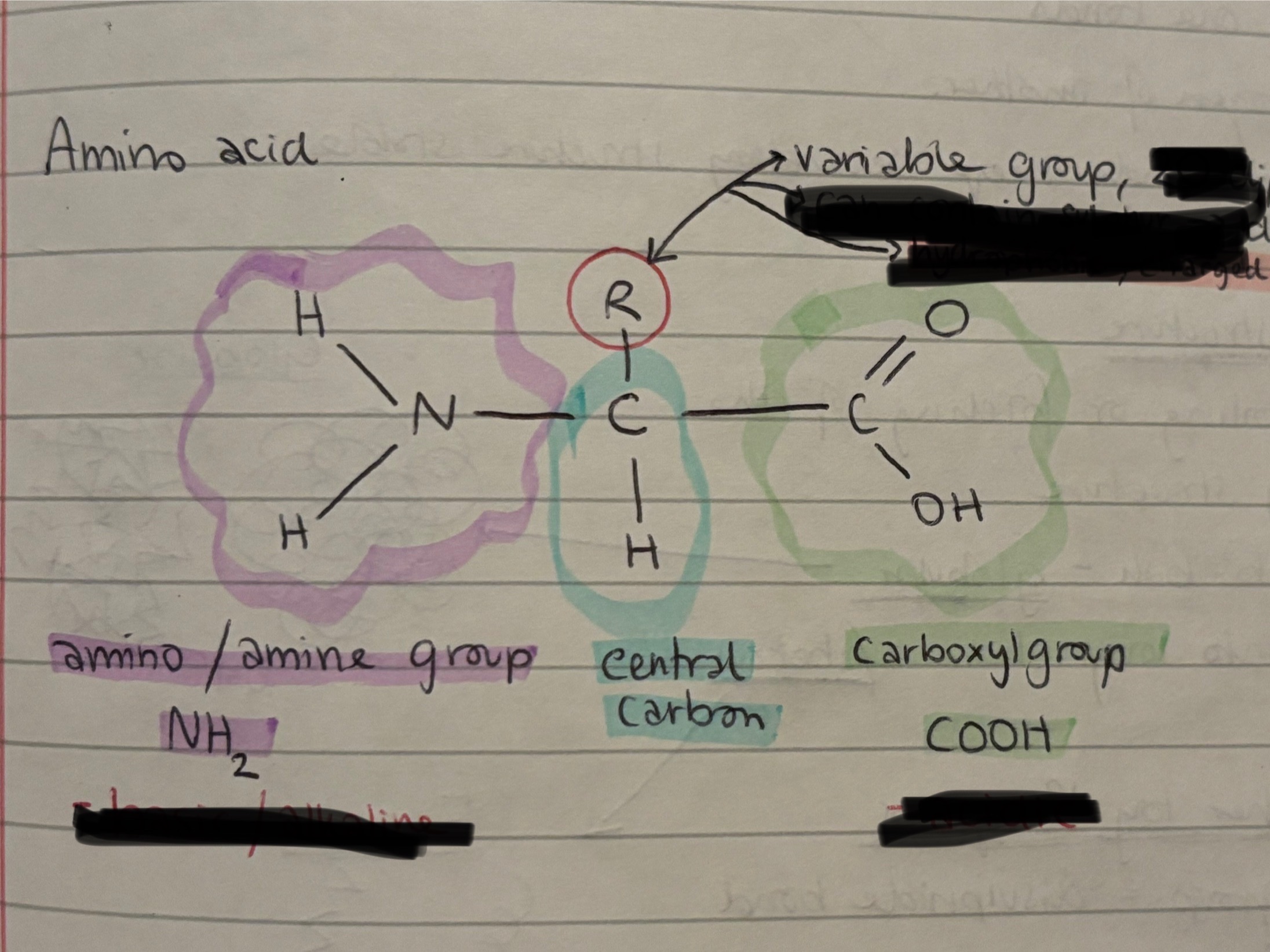
Image occlusion: name the hidden labels
48
Image occlusion: name the hidden labels
49
Image occlusion: name the hidden labels
50
Image occlusion: name the hidden labels
51
What is the chemical formula of the carboxyl group?
COOH
52
What is the chemical formula of the amine group?
NH2
53
How many different variable R groups are there?
20
54
What amino acids can be made?
Non-essential amino acids
55
What amino acids can’t be made?
Essential amino acids
56
What is the pH level of the carboxyl group?
Acidic
57
What is the pH level of the amine group?
Alkaline / basic
58
What are the 4 different R groups? Strongest to weakest.
Sulfur R group
Charged R group
Hydrophoic R group
Polar R group
Charged R group
Hydrophoic R group
Polar R group
59
Describe the sulfur R group
Has disulphide bonds S=S, strongest
60
Describe the charged R group
Ionic bonds
61
Describe the hydrophobic R group
Hydrophobic interactions, doesnt like water
62
Describe the polar R group
Hydrogen bonds, weakest
63
What is the primary structure of a protein?
Sequence of amino acids, controlled by a gene
Peptide bonds between the (amino acid) monomers
Peptide bonds between the (amino acid) monomers
64
Describe the secondary structure of a protein
Sequence either coils or folds
Coils into alpha helix
Folds into beta-pleated sheet
Hydrogen bonds form, keep 2ndary structure stable
Coils into alpha helix
Folds into beta-pleated sheet
Hydrogen bonds form, keep 2ndary structure stable
65
What is a hydrogen bond?
Where the neg oxygen of one bonds with the pos hydrogen of another
66
Describe the tertiary structure of a protein
Further coiling or folding of 2ndary structure
Curls into ball (globular)
Turns into long chain (fiberous)
Curls into ball (globular)
Turns into long chain (fiberous)
67
Describe the quarternary structure of a protein
Has 2 different types of polypeptide chains (in the tertiary structure) interacting
Sometimes has a functional group
Sometimes has a functional group
68
What are examples of quarternary structures?
Collagen, Haemoglobin, Enzymes and Hormones
69
What is the function of collagen?
Keeps the tendons strong and our skin
70
What is the function of haemoglobin?
Carry oxygen in red blood cells
71
Describe lipids
carbon, hyrdogen, oxygen
More carbon and hydrogen, less oxygen
Non-polar, doesnt dissolve in water
Can dissolve in organic solvents
More carbon and hydrogen, less oxygen
Non-polar, doesnt dissolve in water
Can dissolve in organic solvents
72
What are organic solvent examples?
Ethanol
Alcohol
Chlorophorm
Ether
Alcohol
Chlorophorm
Ether
73
Describe triglycerides
1 glycerol and 3 fatty acid molecules
Glycerol always same, fatty acid varies
Joined by condensation
Ester bond is formed between each fatty acid and glycerol
Non-polar, hydrophobic
Glycerol always same, fatty acid varies
Joined by condensation
Ester bond is formed between each fatty acid and glycerol
Non-polar, hydrophobic
74
How can fatty acids vary?
Length
Type (saturated or unsaturated)
Type (saturated or unsaturated)
75
What are the different types of unsaturated fats?
Monounsaturated
Polyunsaturated
Polyunsaturated
76
Describe saturated fatty acids
No double C=C bonds (carbon=carbon)
Straight
General formula is Cn H2n+1 (COOH)
Bad fat
Straight
General formula is Cn H2n+1 (COOH)
Bad fat
77
Describe monounsaturated fatty acids
Kinks at the double bond
General formula Cn H2n-1 (COOH)
General formula Cn H2n-1 (COOH)
78
Describe polyunsaturated fatty acids
Very kinked
Good fat
General formula= none
Good fat
General formula= none
79
Describe phospholipids
Hydrophilic head, hydrophobic tail
Phosphate group attached to glycerol chain
2 fatty acid chains
Phosphate group attached to glycerol chain
2 fatty acid chains
80
What is this?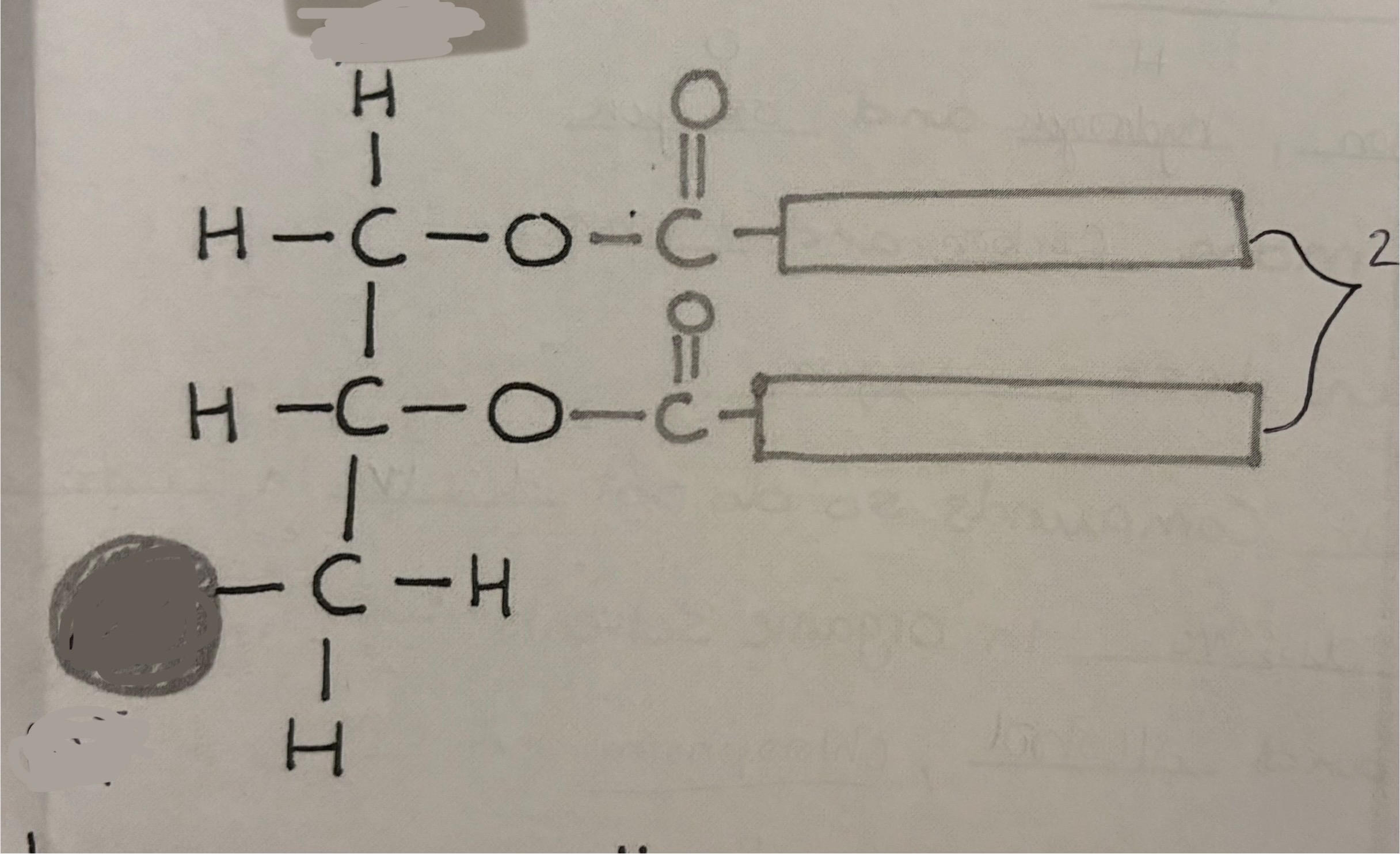
Phospholipid
81
What is this?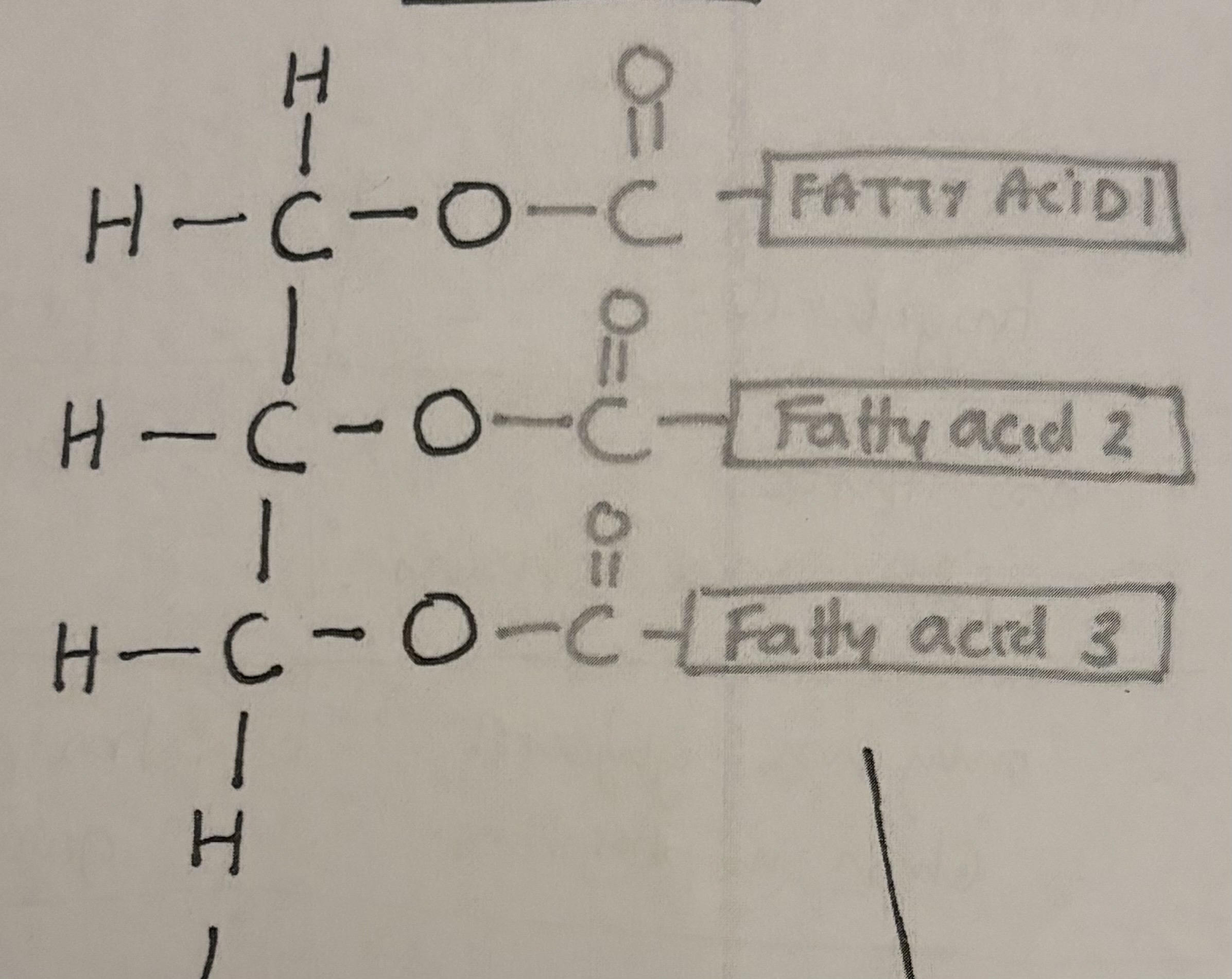
Triglyceride
82
How can you test for proteins?
Biuret solution that is blue, if positive for proteins it turns purple
83
How can you test for starch?
Iodine solution thats orange, if positive for starch it turns black
84
How can you test for reducing sugar?
Benedicts reagent that is blue, the more reducing sugar in solution, the further along the colour spectrum it goes
85
How to test for non reducing sugar?
Have to hydrolysed by boiling in hydrochloric acid before using benedicts reagent method
86
How to test for lipids?
Mix solution with absolute ethanol and then add equal volumes of water, if positive- cloudy emulsion formed
87
What does a high intake of saturated fats do?
Contributes to heart disease by raising the LDL cholesterol level