Biology, Response and regulation
Study these flashcardsFree · spaced repetition · iPhone, Android, Mac & web
All cards
1
What are the 5 sense organs?
Eyes
Ears
Nose
Tongue
Skin
Ears
Nose
Tongue
Skin
2
What is the stimulus for eyes?
Light
3
What is the stimulus for ears?
Sound
4
What is the stimulus for nose?
Smell
5
What is the stimulus for tongue?
Taste
6
What is the stimulus for skin?
Pain
Pressure
Temperature
Pressure
Temperature
7
What is a reflex response always?
Rapid
Automatic
Protective
Automatic
Protective
8
What is a reflex arc?
The path taken by an electrical impulse from stimulus to response by an effector
9
What is an effector?
A muscle or gland
10
What is a coordinator?
Spinal cord
11
What is negative feedback?
Any change from the balance in optimal internal conditions
12
What does negative feedback result in the body doing?
Body’s hormonal and nervous systems compensate for the change and restore the balance
13
What is homeostasis?
The maintainance of a constant internal environment
14
What is blood glucose controlled by?
Hormones
15
What are hormones?
A chemical messenger released from a gland (eg. pancreas), they travel in the blood
16
What is the normal level of blood glucose?
7
17
Where is insulin produced?
Pancreas
18
What is glucose?
A molecule involved in respirating
19
What detects the levels of glucose in the blood?
The brain
20
How does the body make glycogen?
1- Brain detects low levels of glucose in blood
2- Pancreas releases insulin
3- Insulin travels to liver which stimulates it to release glucose from the blood
4- The glucose released is converted into glycogen which makes blood levels go down
2- Pancreas releases insulin
3- Insulin travels to liver which stimulates it to release glucose from the blood
4- The glucose released is converted into glycogen which makes blood levels go down
21
What does Glycogen do?
Lowers blood levels
22
What is diabetes?
Where the body cannot properly use glucose for energy, which results in the body using energy from alternative sources (eg, proteins, carbs)
23
What is gestational diabetes?
Occurs in pregnant women
24
What is hypoglycaemia?
Where there is not enough sugar in blood
25
What is hyperglycaemia?
Where there is too much sugar in the blood
26
Describe type 1 diabetes
Occurs in kids+teens
Pancreas doesn’t make enough insulin
High levels of glucose in blood
Happens due to genetic, viral + autoimmune factors
Controlled by insulin injections
Pancreas doesn’t make enough insulin
High levels of glucose in blood
Happens due to genetic, viral + autoimmune factors
Controlled by insulin injections
27
Describe type 2 diabetes
Occurs in obese, poor-dieted adults
Body cant respond to its own insulin/ impaired secretion of insulin
Controlled by exercise, good diet
Can possibly take glucose lowering pills
Body cant respond to its own insulin/ impaired secretion of insulin
Controlled by exercise, good diet
Can possibly take glucose lowering pills
28
Difference between type 1 and 2 diabetes?(insulin wise)
Type 1- body doesn’t produce insulin
Type 2- body doesn’t respond to chemical signal from insulin
Type 2- body doesn’t respond to chemical signal from insulin
29
What decreases levels of glucose in blood?
Exercise
30
What increases levels of glucose in blood?
Eating
31
What needs to be controlled in the body?
Temperature
Water levels
Blood glucose levels
Oxygen levels
CO2 levels
Blood pH
Water levels
Blood glucose levels
Oxygen levels
CO2 levels
Blood pH
32
What is thermoregulation?
Keeping temperature in your body the same
33
What are humans? (temperature wise)
Endotherms (warm blooded)
34
What is the normal human internal temp?
37°
35
What internal temp is too warm for humans?
40°
36
What internal temp is too cold for humans?
35°
37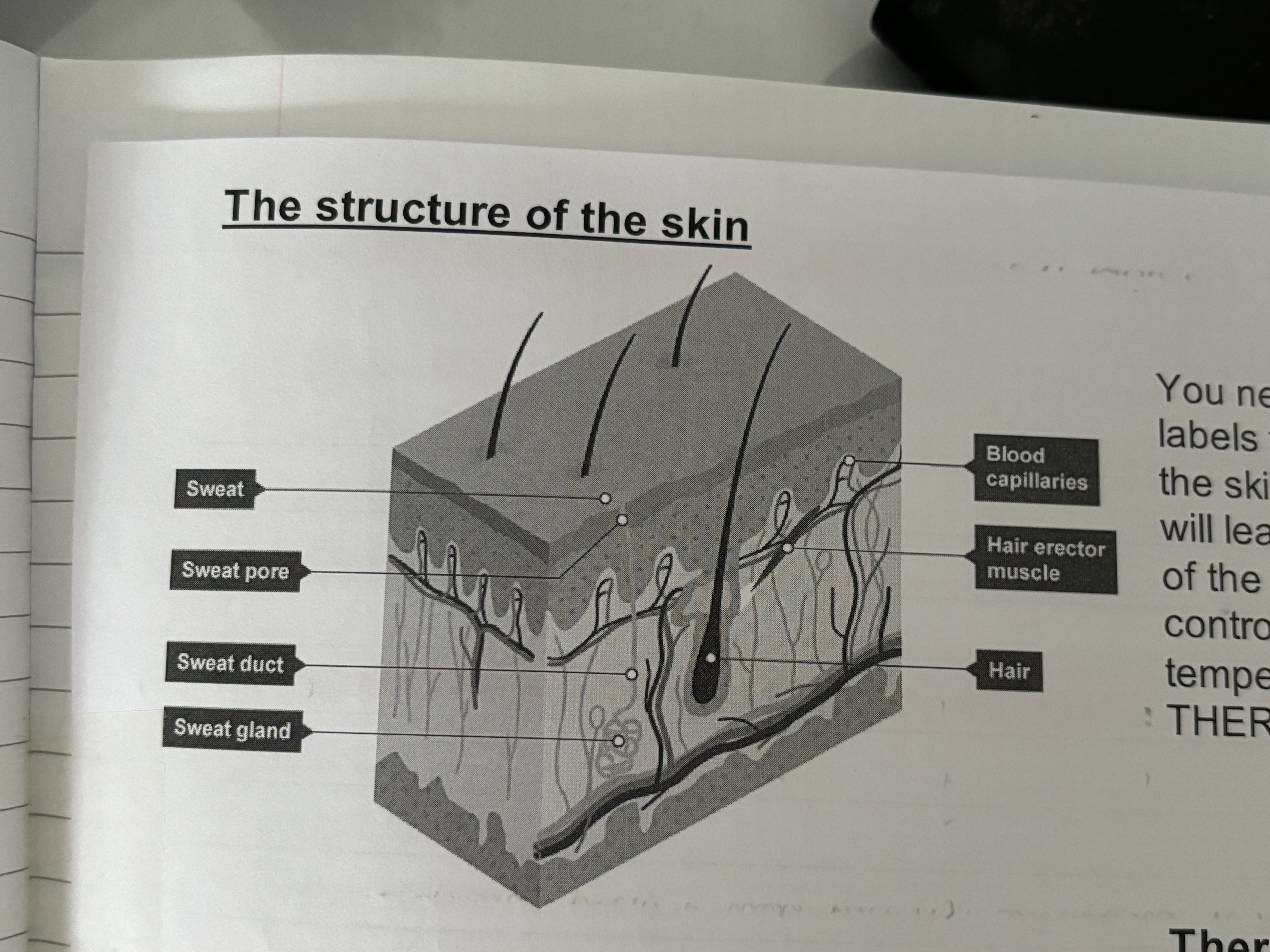
Image occlusion: name the hidden labels
38
Image occlusion: name the hidden labels
39
Image occlusion: name the hidden labels
40
Image occlusion: name the hidden labels
41
Image occlusion: name the hidden labels
42
Image occlusion: name the hidden labels
43
Image occlusion: name the hidden labels
44
What happens when you’re too warm?
1- hypothalamus + receptors in skin detect it
2- Blood vessels dilate, you sweat, your hairs lie flat
3- Decreases body temp by removing heat energy- blood flows close to skin surface
2- Blood vessels dilate, you sweat, your hairs lie flat
3- Decreases body temp by removing heat energy- blood flows close to skin surface
45
What happens when you’re too cold?
1- hypothalamus + receptors in skin detect it
2- Blood vessels constrict, hairs stand up, shivering
3- Increases body temp by producing heat energy, your hairs trap air for insulation
2- Blood vessels constrict, hairs stand up, shivering
3- Increases body temp by producing heat energy, your hairs trap air for insulation
46
What is it called when your blood vessels dilate?
Vasodilation (when too warm)
47
What is it called when your blood vessels constrict?
Vasoconstriction (when too cold)
48
How is information passed from the sensory to motor neurones
Through a synapse- as a chemical
49
Sensory neurones are attached to what?
Receptors
50
What neurone makes you move?
Motor neurone
51
The relay neurone in the CNS is linked to what?
The sensory + motor neurones
52
What is the moro reflex?
In newborns, 4-5 months
Infant feels like its falling- spreads its arms, curls them in and then cries
Infant feels like its falling- spreads its arms, curls them in and then cries
53
What is a neurone?
A specialised nerve cell
54
What is a synapse?
A junction between 2 neurones
55
What is a receptor?
A specialised cell that detects stimuli
56
What does a sensory neurone do?
Carries the nerve impulse from the receptor to the CNS
57
What does the motor neurone do?
Carries the nerve impulse from the CNS to an effector
58
What is reflex?
A automatic response to a stimulus that doesn’t involve conscious thought
59
What is a relay neurone?
Connects a motor and a sensory neurone in the CNS and is involved in a reflex arc
60
What is stimulus?
Changes in the environment
61
What does an effector do?
Carries out the response
62
What is the CNS?
The brain and spinal cord
63
What is a nerve?
A bundle of neurones
64
What is a nerve impulse?
Electrical message passed along a neurone
65
What is the sequence of events when a stimulus is detected?
Stimulus -> receptor -> coordinator (relay neurone) -> effector -> response
66
What is the structure + function of the nervous system?
Branched out from brain + spinal cord (CNS)
Makes our receptor cells respond to stimulus
Makes our receptor cells respond to stimulus
67
What are the 2 parts of nervous system?
Central and peripheral
68
What is the peripheral system made up of?
Nerves
69
What are the 3 types of neurones/nerves?
Sensory
Relay
Motor
Relay
Motor