adaptation for gas exchange in animals unit 2
Study these flashcardsFree · spaced repetition · iPhone, Android, Mac & web
All cards
1
What does the amount of oxygen needed depend on?
The organisms volume
2
What does the rate that oxygen is absorbed at depend on?
The surface area of organism
3
What does the SA:V ratio of an organism affect?
The surface adapted for use for gas exchange
The level of activity of the organism
The level of activity of the organism
4
What happens as organisms get larger?
Their SA:V ratio gets lower- specialised respiratory surfaces are needed
5
Why can insects not use their external surface for gas exchange?
Because they are covered in an impermeable cuticle (chitin) to reduce water loss by evaporation
6
How do insects ventilate in and out?
Thoracic spiracles open, abdominal closed
Abdomen expands
Decrease in pressure which pulls air in thru thoracic spiracles
(opposite for ventilation out)
Abdomen expands
Decrease in pressure which pulls air in thru thoracic spiracles
(opposite for ventilation out)
7
What are spiracles
Holes in the exoskeleton that open and close
Thoracic and abdominal spiracles
Lead to tracheae
Thoracic and abdominal spiracles
Lead to tracheae
8
What is the tracheae?
Connected to spiracles
System of chitin lined tubes- supports and stops from collapsing
Lead to tracheoles
System of chitin lined tubes- supports and stops from collapsing
Lead to tracheoles
9
What are the tracheoles?
The gas exchange surface
Close to the cells of insect
Oxygen diffuses toward cells, CO2 diffuses away from cells (conc gradient)
Fluid-filled at rest
Close to the cells of insect
Oxygen diffuses toward cells, CO2 diffuses away from cells (conc gradient)
Fluid-filled at rest
10
What is this?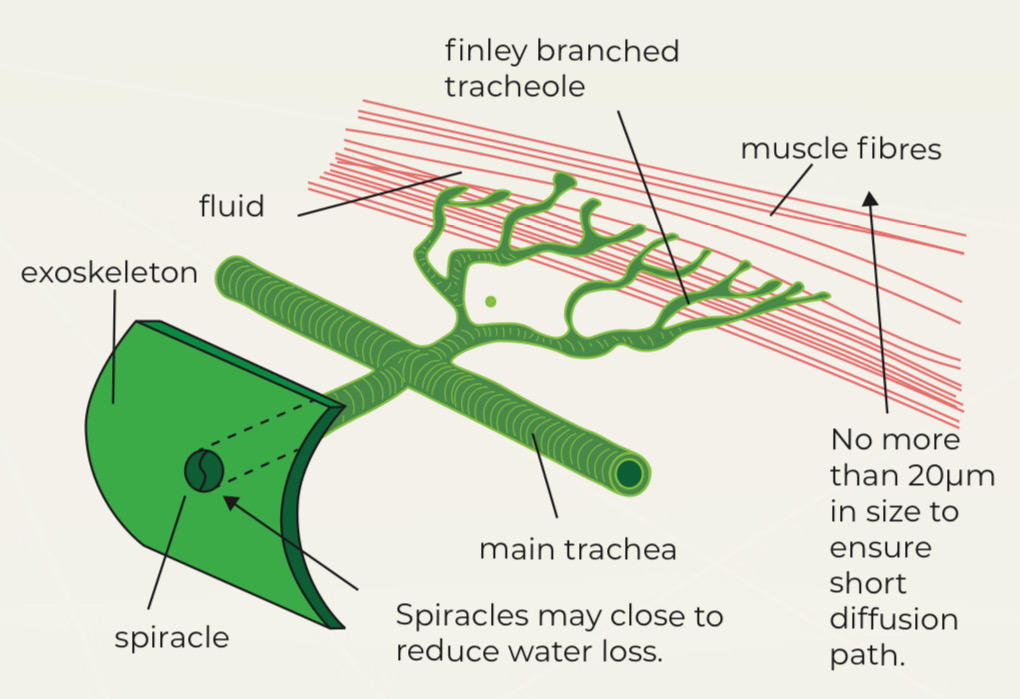
Insect respiratory system
11
What is insect flight muscle?
Highly active tissue
Contains many mitochondria for oxygen in aerobic respiration and ATP for muscle contrctin
Contains many mitochondria for oxygen in aerobic respiration and ATP for muscle contrctin
12
How does increased respiration of muscle cells increase the rate of diffusion of gases into the respiring cells? (insect)
•Aerobic respiration uses oxygen for ATP, oxygen conc drops
•Fluid-filled tracheole diffuses oxygen into muscle-causing conc gradient
•Anaerobic resp produce lactic acjd which lowers WP
•Causes H2O to leave tracheloes thru osmosis containing dissolved oxygen
•Higher SA for oxygen to diffuse
•Fluid-filled tracheole diffuses oxygen into muscle-causing conc gradient
•Anaerobic resp produce lactic acjd which lowers WP
•Causes H2O to leave tracheloes thru osmosis containing dissolved oxygen
•Higher SA for oxygen to diffuse
13
What happens when oxygen requirements increase during flight? (insects)
Fluid in tracheoles decrease to shorten diffusion path
Whole body contractions ventilate tracheal system by speeding up airflow thru spiracles
Whole body contractions ventilate tracheal system by speeding up airflow thru spiracles
14
Why do fish need a specialised gas exchange surface?
Smaller SA:V ratio
Have high metabolic rates due to high activity- oxygen reqments high
Need to maintain conc gradient for gas exchange with ventilation mechanism
Have high metabolic rates due to high activity- oxygen reqments high
Need to maintain conc gradient for gas exchange with ventilation mechanism
15
Why do fish need a ventilation mechanism?
To push water (low oxygen content) over the high SA gill filaments
16
What happens to gill filaments when fish is removed from water?
Gill filaments collapse, stick together and gas exchange surface becomes too small for survival
17
How do fish ventilate?
•Mouth opens, buccal cavity floor lowers- Vol increase, pressure decrease
•Water goes in
•Mouth closes, buccal cavity floor rises- increases pressure which pushes water over gills
•Water goes into opercular cavity- buccal pressure decreases, opercular pressure increases
•Operculum opens and water moves out
•Water goes in
•Mouth closes, buccal cavity floor rises- increases pressure which pushes water over gills
•Water goes into opercular cavity- buccal pressure decreases, opercular pressure increases
•Operculum opens and water moves out
18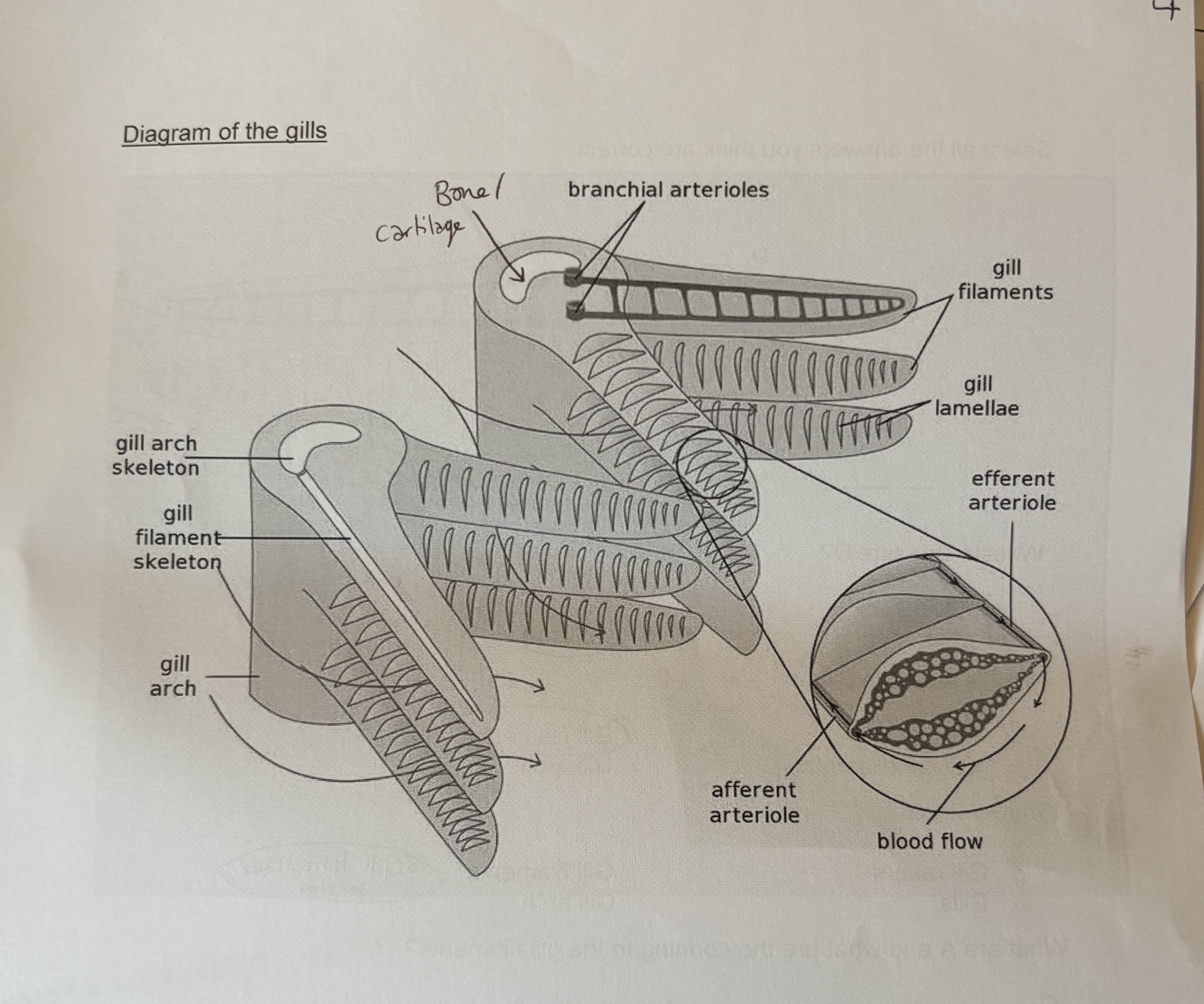
Image occlusion: name the hidden labels
19
Image occlusion: name the hidden labels
20
Image occlusion: name the hidden labels
21
Image occlusion: name the hidden labels
22
Image occlusion: name the hidden labels
23
Image occlusion: name the hidden labels
24
Image occlusion: name the hidden labels
25
Image occlusion: name the hidden labels
26
Image occlusion: name the hidden labels
27
Image occlusion: name the hidden labels
28
What is the gas exchange surface in fish?
Gill filaments, made out of gill plates/lamellae
29
What prevents things from entering and obstructing the gills?
The gill rakers
30
What must gas exchange surfaces be?
Thin- short diffusion pathway
Moist (terrestrial animals)
Large SA
Permeable to gases
Good blood supply to maintain conc gradients (large animals only)
Moist (terrestrial animals)
Large SA
Permeable to gases
Good blood supply to maintain conc gradients (large animals only)
31
What is concurrent/continuous flow?
Water and blood flow in same direction
Equilibrium is reached, oxygen diffusion reaches 0 net movement halfway across gill plate
Equilibrium is reached, oxygen diffusion reaches 0 net movement halfway across gill plate
32
What is counter current flow?
Water and blood flow in opposite directions across gill plate
Conc gradient is maintained, oxygen diffuses into blood across entire gill plate
Conc gradient is maintained, oxygen diffuses into blood across entire gill plate
33
What type of flow is this?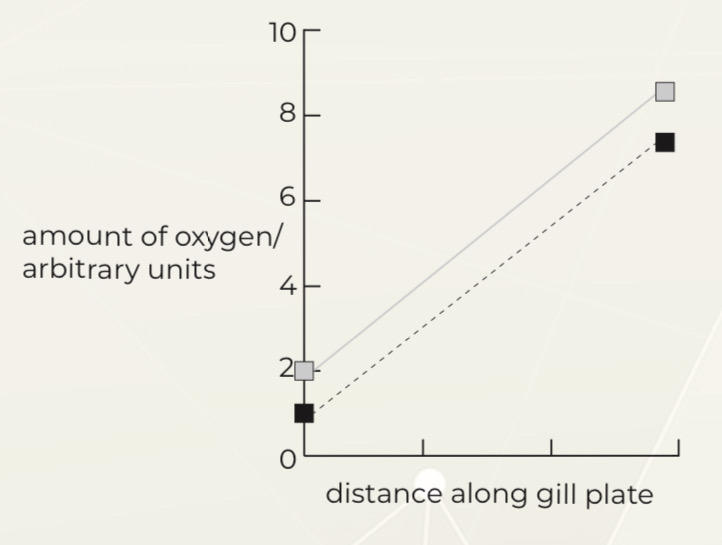
Counter current flow
34
What type of flow is this?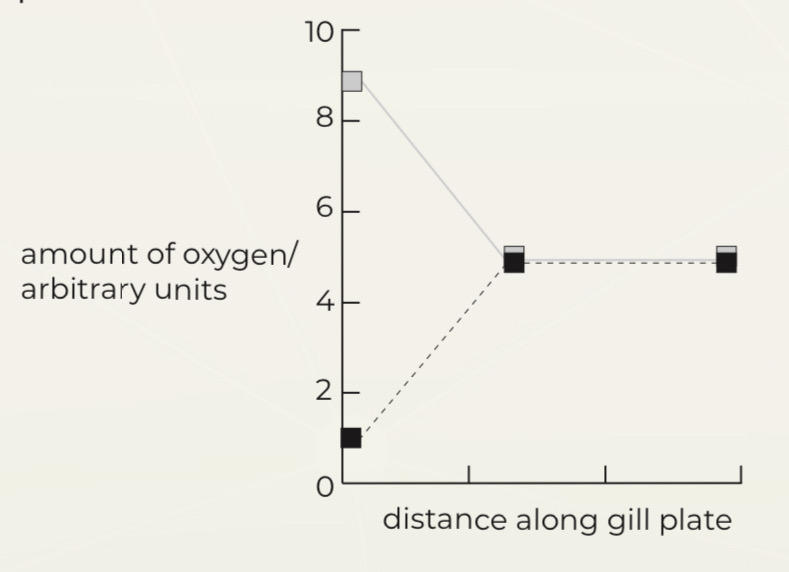
Concurrent/continuous flow
35
How do Amoeba adapt to gas exchange?
Single celled organism
Large SA:V ratio
Short diffusion distance to middle of cell
Low metabolic rate-oxygen demand low
Large SA:V ratio
Short diffusion distance to middle of cell
Low metabolic rate-oxygen demand low
36
How do flatworms adapt to gas exchange?
Muticellular organism
Smaller SA:V ratio than amoeba
Flattened and long body to reduce diffusion pathway, sufficiently gains oxygen
Smaller SA:V ratio than amoeba
Flattened and long body to reduce diffusion pathway, sufficiently gains oxygen
37
How do earthworms adapt to gas exchange?
Multicellular
Even smaller SA:V ratio than both amoeba and flatworm.
Body surface is used for gas exchange but circulatory system needed to distribute oxygen.
Blood vessels close to skin surface- blood has haemoglobin with high affinity for oxygen.
Mucus secreted to moisten surface, slow moving to reduce O demand.
Even smaller SA:V ratio than both amoeba and flatworm.
Body surface is used for gas exchange but circulatory system needed to distribute oxygen.
Blood vessels close to skin surface- blood has haemoglobin with high affinity for oxygen.
Mucus secreted to moisten surface, slow moving to reduce O demand.
38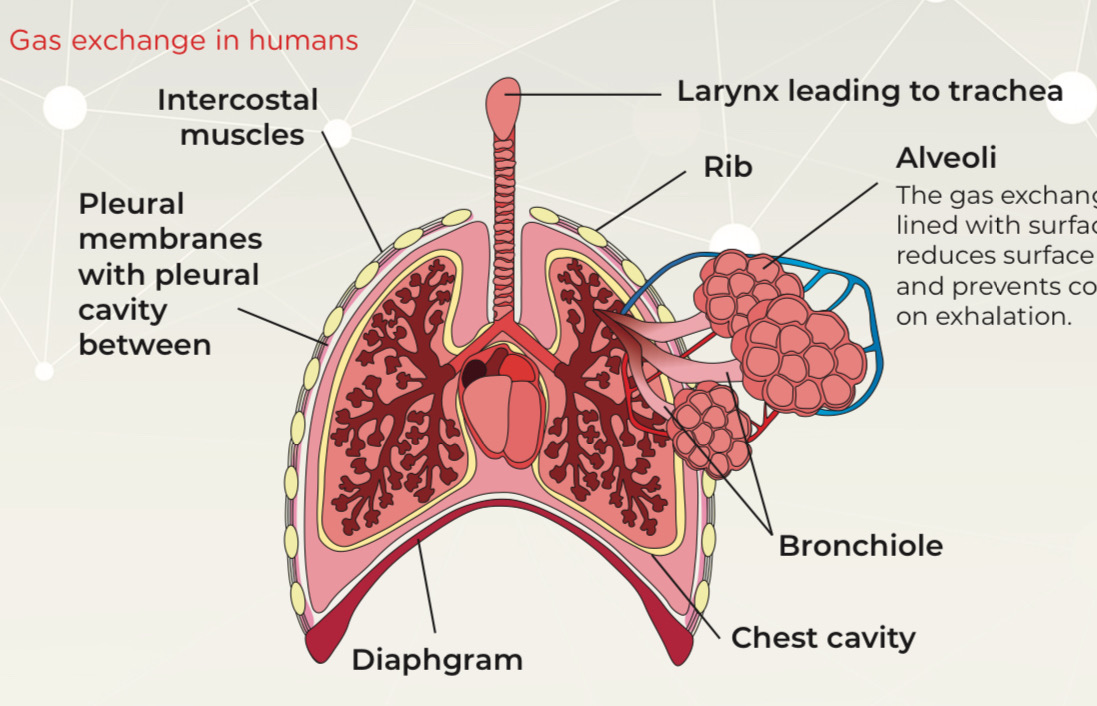
Image occlusion: name the hidden labels
39
Image occlusion: name the hidden labels
40
Image occlusion: name the hidden labels
41
Image occlusion: name the hidden labels
42
Image occlusion: name the hidden labels
43
Image occlusion: name the hidden labels
44
Image occlusion: name the hidden labels
45
Image occlusion: name the hidden labels
46
How do humans ventilate? (in)
Intercostal muscles contract, ribcage goes up and out
Outer pleural membrane pulled out- pressure reduced..
..Inner p membrane pulled out
Pulls on lungs surface- increase in volume of alveoli
Alveolar pressure goes below atmospheric pressure and air pulled in
Outer pleural membrane pulled out- pressure reduced..
..Inner p membrane pulled out
Pulls on lungs surface- increase in volume of alveoli
Alveolar pressure goes below atmospheric pressure and air pulled in
47
How does gas exhange happen in amphibians?
Have aquatic tadpoles- have feathery gills
Dont ventilate same as fish but movement of water over gills maintains conc gradient
Dont ventilate same as fish but movement of water over gills maintains conc gradient
48
Describe amphibias surface
Soft
Moist
Gas exchange surface at rest
Moist
Gas exchange surface at rest
49
What type of circulatory system do frogs have? what circulates it?
Closed system
Oxygen and CO2 circulate in haemoglobin
Oxygen and CO2 circulate in haemoglobin
50
How do frogs ventilate when active?
Movements of buccal cavity ventilate lungs
Lungs are simple with a few alveoli
Lungs are simple with a few alveoli