nucleic acids and their functions unit 1
Study these flashcardsFree · spaced repetition · iPhone, Android, Mac & web
All cards
1
What does a nucleic acid consist of?
Pentose sugar
Nitrogenous Organic Base
Phosphate group
Nitrogenous Organic Base
Phosphate group
2
What is the difference in the pentose sugar when its in DNA / RNA nucleotides
DNA- pentose sugar deoxyribose
RNA- pentose sugar ribose
RNA- pentose sugar ribose
3
What are the NOBs of DNA nucleotides?
Adenine
Thymine
Guanine
Cytosine
Thymine
Guanine
Cytosine
4
What are the NOBs of RNA nucleotides?
Adenine
Uracil
Guanine
Cytosine
Uracil
Guanine
Cytosine
5
What elements are part of the organic in NOB?
Carbon
Hydrogen
Oxygen
Nitrogen
Hydrogen
Oxygen
Nitrogen
6
How is ATP formed?
In an endergonic reaction during respiration
7
How much energy is stored in the bonds formed for ATP? What happens when the bonds are hydrolysed?
30.6 kJ
Hydrolysed in ADP and Pi (inorganic phosphate)
Hydrolysed in ADP and Pi (inorganic phosphate)
8
Why is ATP called the universal energy currency?
Used to provide energy to all reactions in all organisms
Releases energy in one hydrolysis reaction, controlled by one enzyme
Releases energy in small, usuable amounts
Travels easily to where its needed
Releases energy in one hydrolysis reaction, controlled by one enzyme
Releases energy in small, usuable amounts
Travels easily to where its needed
9
What are the 3 types of RNA?
Messenger RNA
Ribosomal RNA
Transfer RNA
Ribosomal RNA
Transfer RNA
10
What is Messenger RNA?
mRNA
Complementary copy of DNA genetic code in nucleus during transcription
Attaches to ribosome in cytoplasm
Complementary copy of DNA genetic code in nucleus during transcription
Attaches to ribosome in cytoplasm
11
What is Ribosomal RNA?
rRNA
Forms ribosomes
Forms ribosomes
12
What is Transfer RNA?
tRNA
Carries amino acid and anticodon arm to attach to mRNA
Carries amino acid and anticodon arm to attach to mRNA
13
How are RNA nucleotides linked together?
In a single stranded polynucleotide
14
How are DNA nucleotides linked together?
Made from one strand of nucleotides, linked by hydrogen bonds between bases to another strand antiparallel to it
15
What are the 2 types of DNA bases?
Purines- Adenine and Guanine.
Pyrimidines- Cytosine and Thymine.
Forms double helix by complimentary bases bonding.
Pyrimidines- Cytosine and Thymine.
Forms double helix by complimentary bases bonding.
16
Whats the difference in RNA and DNA in terms of polynucleotide length?
RNA- short pnucleotides
DNA- long pnucleotides
DNA- long pnucleotides
17
Whats the difference in RNA and DNA in terms of no. of strands?
RNA- single stranded
DNA- double stranded
DNA- double stranded
18
How does DNA replication happen?
1-DNA helicase hydrolyses hydrogen bonds between bases in double helix
2-Unwinds DNA and exposes unpaired bases
3-Free nucleotides join to complimentary bases
4-DNA polymerase joins nucleotides together by condensation between sugar and phosphate of adjacent groups
5-2 new DNA mols made of 1 old strand and 1 new.
2-Unwinds DNA and exposes unpaired bases
3-Free nucleotides join to complimentary bases
4-DNA polymerase joins nucleotides together by condensation between sugar and phosphate of adjacent groups
5-2 new DNA mols made of 1 old strand and 1 new.
19
What is the name for DNA replication?
Semi-conservative replication
20
What is this?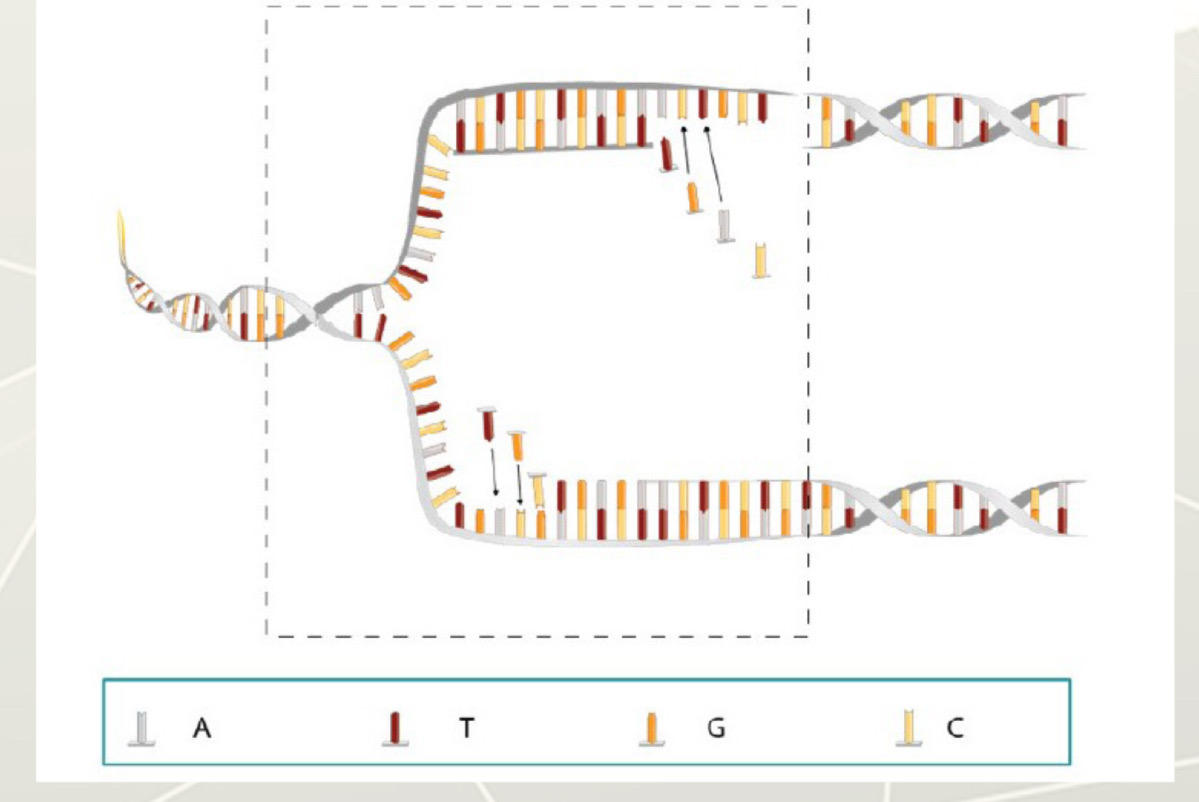
Semi conservative replication
21
What experiment gave evidence to semi conservative replication theory?
Meselson and Stahl experiment
22
How did Meselson and Stahl keep their experiment accurate?
Spun tube at same amount of time
Same speed
Same temp
Same density
Same speed
Same temp
Same density
23
What were the Meselson and Stahl experiment steps?
1-Grow bacteria with heavy nitrogen (N15), centrifuge the same and low band is seen.
2-Remove bacteria with heavy nitrogen and put it in a medium with light nitrogen, let them divide- create N15+N14 intermediate band.
3-Let them divide for one more generation, hybrid strands now are 50% light, 50% heavy (intermediate band)
2-Remove bacteria with heavy nitrogen and put it in a medium with light nitrogen, let them divide- create N15+N14 intermediate band.
3-Let them divide for one more generation, hybrid strands now are 50% light, 50% heavy (intermediate band)
24
What is conservative replication?
Copies itself and creates new strand
25
What is dispersive replication?
DNA strand cut up randomly
New DNA comes in and attaches
New DNA comes in and attaches
26
What is the genetic code?
A linear, universal code for production of polypeptides
27
What happens in transcription
Occurs in Nucleus
1-DNA helicase hydrolyses hydrogen bonds between complimentary bases
2-RNA polymerase forms phosphodiester bonds between complementary RNA/DNA bases (pre mRNA)
3-Stops joining bases at a stop codon
4-Pre mRNA leaves DNA, non-coding introns removed, only coding sections (exons) left in the mRNA
1-DNA helicase hydrolyses hydrogen bonds between complimentary bases
2-RNA polymerase forms phosphodiester bonds between complementary RNA/DNA bases (pre mRNA)
3-Stops joining bases at a stop codon
4-Pre mRNA leaves DNA, non-coding introns removed, only coding sections (exons) left in the mRNA
28
How many possible triplicate codes are there for the four bases?
64 (some amino acids have more than one code)
29
Why is the code termed degenerate?
Bc theres 64 combos but only 20 amino acids, theres more than one code for each amino acid
30
What is the triplicate code?
3 bases= 1 amino acid
31
What happens in translation?
1-mRNA is linear chain of 3 base codons, tRNA has complimentary anticodon
2-mRNA leaves nucleus attaches to small subunit of ribosome
3-Large subunit has 2 attachment sites for tRNA, holds them in place for amino acids to form peptide bonds to form polypeptide chain
4-Codon on mRNA finds out tRNA, tRNA must have complementary 3 base code
5-tRNA that matches codon on mRNA has specific amino acids attached.
6-Ribosome moves along the mRNA and holds each tRNA until amino acid has attached
7-tRNA leaves and ribosome moves on
2-mRNA leaves nucleus attaches to small subunit of ribosome
3-Large subunit has 2 attachment sites for tRNA, holds them in place for amino acids to form peptide bonds to form polypeptide chain
4-Codon on mRNA finds out tRNA, tRNA must have complementary 3 base code
5-tRNA that matches codon on mRNA has specific amino acids attached.
6-Ribosome moves along the mRNA and holds each tRNA until amino acid has attached
7-tRNA leaves and ribosome moves on
32
One polypeptide =…
one gene
33
What does the mRNA carry a code for?
The formation of a polypeptide chain with amino acids set out in particular order
34
How can new polypeptides be modified?
W addition of carbohydrates, lipids or phosphates
Can be combined together (eg. haemoglobin)
Can be combined together (eg. haemoglobin)