digital forensics
Study these flashcardsFree · spaced repetition · iPhone, Android, Mac & web
All cards
1
- Security information and event management
2
What is a Screened subnet?
• Previously known as the demilitarized zone (DMZ)
– An additional layer of security between the Internet and you
– Public access to public resources
– An additional layer of security between the Internet and you
– Public access to public resources
3
What is LDAP?
• Protocol for reading and writing directories over an IP network
– An organized set of records, like a phone directory
• X.500 specification was written by the International Telecommunications Union (ITU)
– They know directories!
• DAP ran on the OSI protocol stack
– LDAP is lightweight, and uses TCP/IP (tcp/389 and udp/389)
• LDAP is the protocol used to query and update an X.500 directory
– Used in Windows Active Directory, Apple OpenDirectory, OpenLDAP, etc.
• Hierarchical structure - Builds a tree
• Container objects
– Country, organization, organizational units
• Leaf objects
– Users, computers, printers, files
– An organized set of records, like a phone directory
• X.500 specification was written by the International Telecommunications Union (ITU)
– They know directories!
• DAP ran on the OSI protocol stack
– LDAP is lightweight, and uses TCP/IP (tcp/389 and udp/389)
• LDAP is the protocol used to query and update an X.500 directory
– Used in Windows Active Directory, Apple OpenDirectory, OpenLDAP, etc.
• Hierarchical structure - Builds a tree
• Container objects
– Country, organization, organizational units
• Leaf objects
– Users, computers, printers, files
4
What is TACACS?
• Terminal Access Controller Access-Control System
– Remote authentication protocol
– Created to control access to dial-up lines to ARPANET
• TACACS+
– The latest version of TACACS, not backwards compatible
– More authentication requests and response codes
– Released as an open standard in 1993
– Remote authentication protocol
– Created to control access to dial-up lines to ARPANET
• TACACS+
– The latest version of TACACS, not backwards compatible
– More authentication requests and response codes
– Released as an open standard in 1993
5
What is DNS poisoning?
• Modify the DNS server
– Requires some crafty hacking
• Modify the client host file
– The host file takes precedent over DNS queries
• Send a fake response to a valid DNS request
– Requires a redirection of the original request or the resulting response
– Real-time redirection
– This is an on-path attack
– Requires some crafty hacking
• Modify the client host file
– The host file takes precedent over DNS queries
• Send a fake response to a valid DNS request
– Requires a redirection of the original request or the resulting response
– Real-time redirection
– This is an on-path attack
6
What is Switch spoofing?
• Some switches support automatic configuration
– Is the switch port for a device, or is it a trunk?
• There’s no authentication required
– Pretend to be a switch
– Send trunk negotiation
• Now you’ve got a trunk link to a switch
– Send and receive from any configured VLAN
• Switch administrators should disable trunk negotiation
– Administratively configure trunk interfaces and device/access interfaces
– Is the switch port for a device, or is it a trunk?
• There’s no authentication required
– Pretend to be a switch
– Send trunk negotiation
• Now you’ve got a trunk link to a switch
– Send and receive from any configured VLAN
• Switch administrators should disable trunk negotiation
– Administratively configure trunk interfaces and device/access interfaces
7
What is VLAN hopping?
• Define different VLANs
• You only have access to your VLAN
– Good security best practice
• “Hop” to another VLAN - this shouldn’t happen
• Two primary methods
– Switch spoofing and double tagging
• You only have access to your VLAN
– Good security best practice
• “Hop” to another VLAN - this shouldn’t happen
• Two primary methods
– Switch spoofing and double tagging
8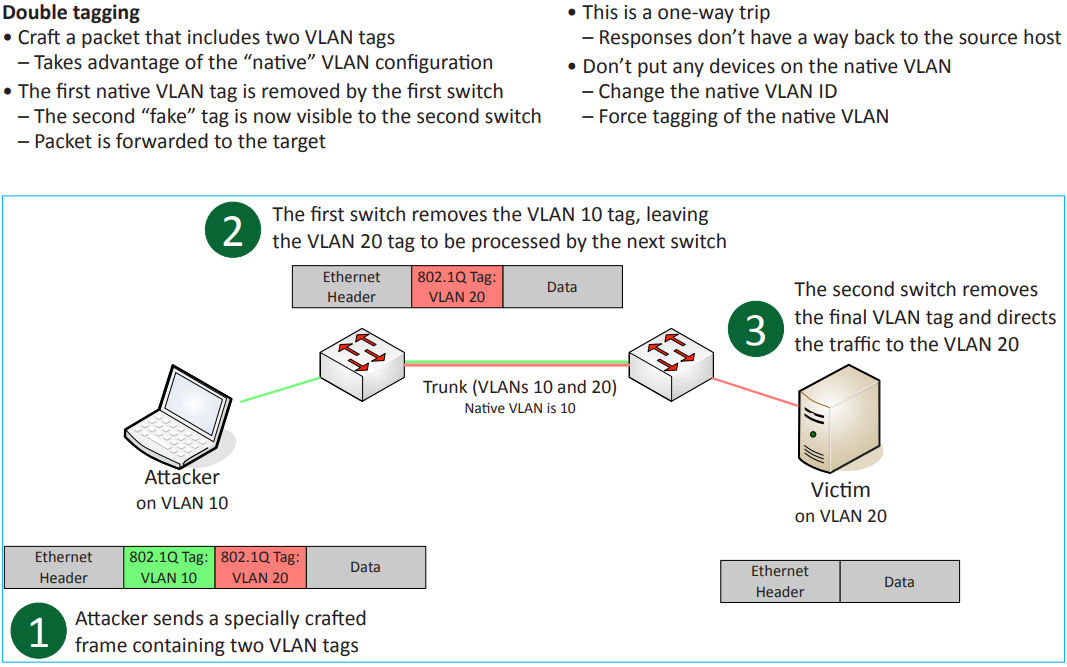
What is Double tagging?