All cards
1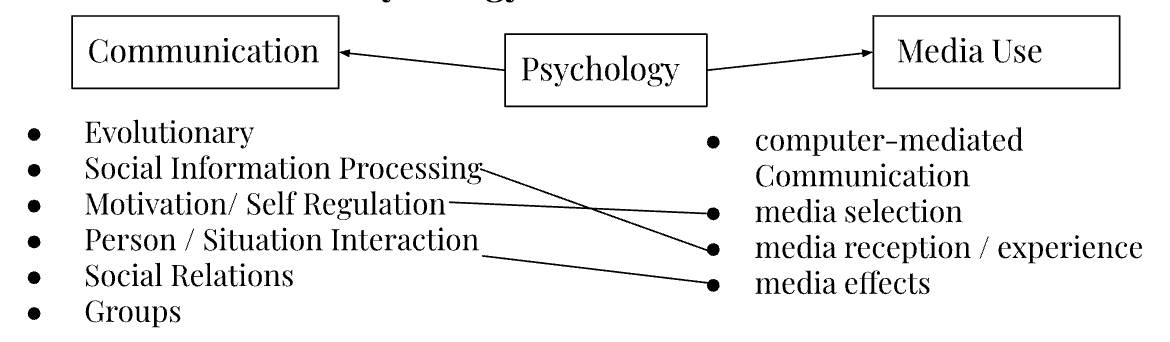
Introduction into the Psychology of Communication and Media Use
2
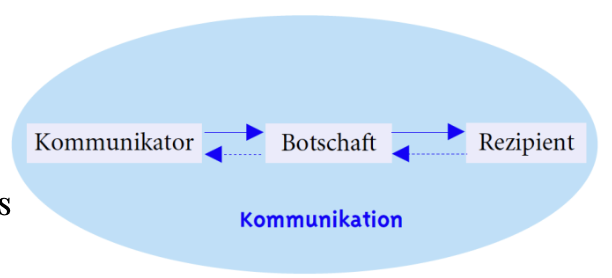
Human communication Formal features:
Actors / Participants
Message / Symbol / Signs
Symbol carriers / media / channels
Contexts / situations
Interactivity
Intentionality / Goals
Message / Symbol / Signs
Symbol carriers / media / channels
Contexts / situations
Interactivity
Intentionality / Goals
3
Actors / Participants
two or more persons, groups or institutions
communicator and recipient
Actors bring different goals, presuppositions and experiences to the table
communicator and recipient
Actors bring different goals, presuppositions and experiences to the table
4
Message / Symbol / Sign
Message is encoded by the communicator and decoded by the recipient
communication requires a minimum of common understanding of the sign and symbol stock
sent and received message may differ
communication requires a minimum of common understanding of the sign and symbol stock
sent and received message may differ
5
Symbol carrier
Immaterial symbol carriers (e.g. air)
Material symbol carriers (e.g. paper, board, fabric, skin, metal)
Material symbol carriers (e.g. paper, board, fabric, skin, metal)
6
Electronic tools for coding, transmission, retrieval and encoding
Encoder / encryption (e.g. telephone, computer)
Encoder / Decryption (e.g. telephone, radio, computer)
Amplifier (e.g. loudspeaker, neon sign)
Transmission and retrieval (e.g. radio, cable)
Encoder / Decryption (e.g. telephone, radio, computer)
Amplifier (e.g. loudspeaker, neon sign)
Transmission and retrieval (e.g. radio, cable)
7
Media
Definition
Definition
"Media in this context are all technology -based means of encoding and transmitting, storing, and retrieving and decoding information relevant to participation in mass communication and media individual communication."
8
Criteria for categorizing media
Type of technologies used (by communicator and recipient).
Extent of interactivity
Type and range of sensory channels addressed and extent of multi-mediality
Number of participants and extent of publicity
Extent of synchronicity between communication and reception
Extent of interactivity
Type and range of sensory channels addressed and extent of multi-mediality
Number of participants and extent of publicity
Extent of synchronicity between communication and reception
9
Contexts / Situations e.g.
Communication culture (in an organization)
Relationship quality (between communicating persons)
Communication occasion
Extent of publicity
Relationship quality (between communicating persons)
Communication occasion
Extent of publicity
10
Interactivity
Change of roles between communicator and recipient
Synchronous and asynchronous forms of interactivity
Extent of interactivity depends on how much individuals orient to their own and / or communication partners' mental processes (Jones & Gerard, 1967)
1. reciprocal contingency (e.g. open dialogue)
2. pseudo-interaction (e.g. scripted dialogue, parallel play of children)
3. asymmetric interaction (e.g. communication with strong power imbalance)
4. reactive interaction (e.g. behavior during group panic)
Synchronous and asynchronous forms of interactivity
Extent of interactivity depends on how much individuals orient to their own and / or communication partners' mental processes (Jones & Gerard, 1967)
1. reciprocal contingency (e.g. open dialogue)
2. pseudo-interaction (e.g. scripted dialogue, parallel play of children)
3. asymmetric interaction (e.g. communication with strong power imbalance)
4. reactive interaction (e.g. behavior during group panic)
11
Intentionality
Human communication is based on a goal or motivation (e.g., convincing someone, obtaining information, developing relationships).
The goals of the involved communication partners do not have to be identical.
The goal in question does not necessarily have to be conscious (e.g. uncertainty reduction, self-expression).
- Habits lose their consciousness
- Biological programs are evolutionary functional, but not accessible to consciousness in the sense of goals
The goals of the involved communication partners do not have to be identical.
The goal in question does not necessarily have to be conscious (e.g. uncertainty reduction, self-expression).
- Habits lose their consciousness
- Biological programs are evolutionary functional, but not accessible to consciousness in the sense of goals
12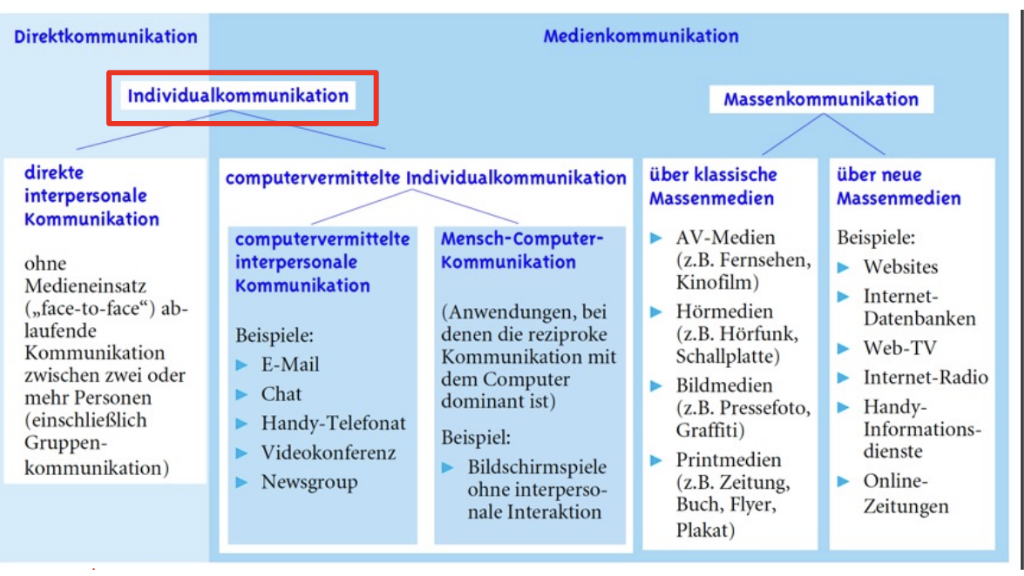
Forms of communication
13
Computer mediated interpersonal communication
"The interactive process, occurring between two or more people, of creating, exchanging, and receiving information using computers." Trepte & Reinecke (2013, S.158)
interactive
reduced sensory impressions
one-to-one / one-to-many
synchronous & asynchronous
interactive
reduced sensory impressions
one-to-one / one-to-many
synchronous & asynchronous
14
Human -Computer Communication
"The interactive process of creating, exchanging, and receiving information that occurs between a human and an information -technology system." Trepte & Reinecke (2013, S.158)
unidirectional / (interactive )
reduced sensory impressions
one-to-one / one-to-many
synchronous & asynchronous
unidirectional / (interactive )
reduced sensory impressions
one-to-one / one-to-many
synchronous & asynchronous
15
Classical Mass Media
"Mass media that are produced by professional communicators in a division of labor and according to specific routines, and whose content, design, and handling are familiar to the audience." Schweiger (2007, S. 17)
unidirectional / (interactive)
reduced sensory impressions
one -to -one / one -to -many
synchronous & asynchronous
unidirectional / (interactive)
reduced sensory impressions
one -to -one / one -to -many
synchronous & asynchronous
16
„New“ Mass Media
As distinguished from computer - mediated interpersonal communication....
(more or less) public
spatio-temporal distance between recipients (dispersed audience & asynchronous communication )
limited interactivity
(more or less) public
spatio-temporal distance between recipients (dispersed audience & asynchronous communication )
limited interactivity
17
Hybridization of communication
The Internet has created intersections between mass communication and individual communication
e.g. social networks: public posts both mass and individual communication
Besides a problem of definition, also difficulty for users: current communication private or public?
e.g. social networks: public posts both mass and individual communication
Besides a problem of definition, also difficulty for users: current communication private or public?
18
Communication is the subject of many scientific disciplines:
Communication and media studies
Literature studies
Speech science
Linguistics and philology
Literature studies
Speech science
Linguistics and philology
19
What is the specific perspective of the psychology of communication?
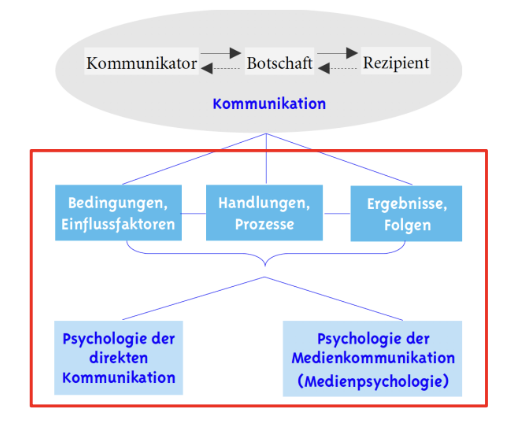
The perspective of psychology is on individuals (as single persons or as members of social communities) in their immediate and medial communication environment, i.e., the psychology of communication examines communicative behavior and experience as well as influencing factors and consequences (effects) at the micro level .
20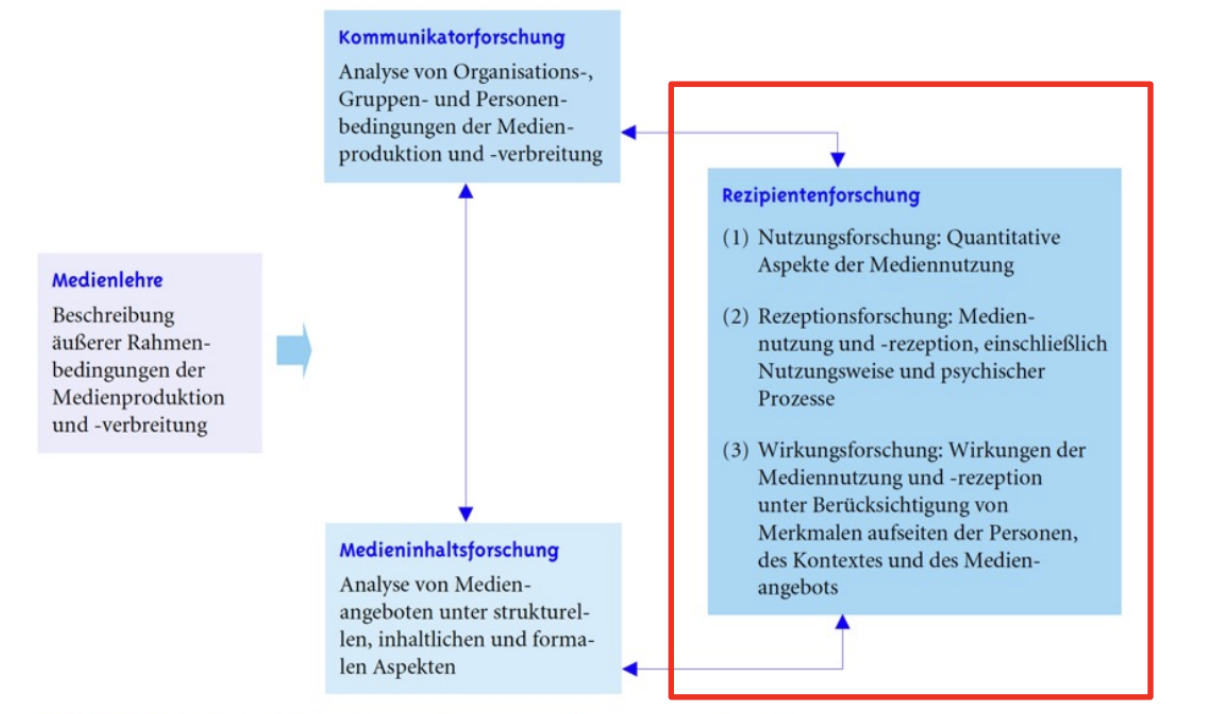
Media Psychology
Forschung
Forschung
21
Definition Media Psycology
Media psychology research is concerned with describing, explaining, and predicting the experiences and behaviors that occur as (a) as a predictor, (b) during, or (c) as an effect of media use.
22
Media and media-mediated communication
The term "media" is used to describe a class of tools and structures that is heterogeneous in content
What media have in common in all these meanings is that they enable novel forms of communication through the use of technology.
These media-mediated forms of communication differ in terms of various characteristics
- technological framework
- selection motivation
What media have in common in all these meanings is that they enable novel forms of communication through the use of technology.
These media-mediated forms of communication differ in terms of various characteristics
- technological framework
- selection motivation
23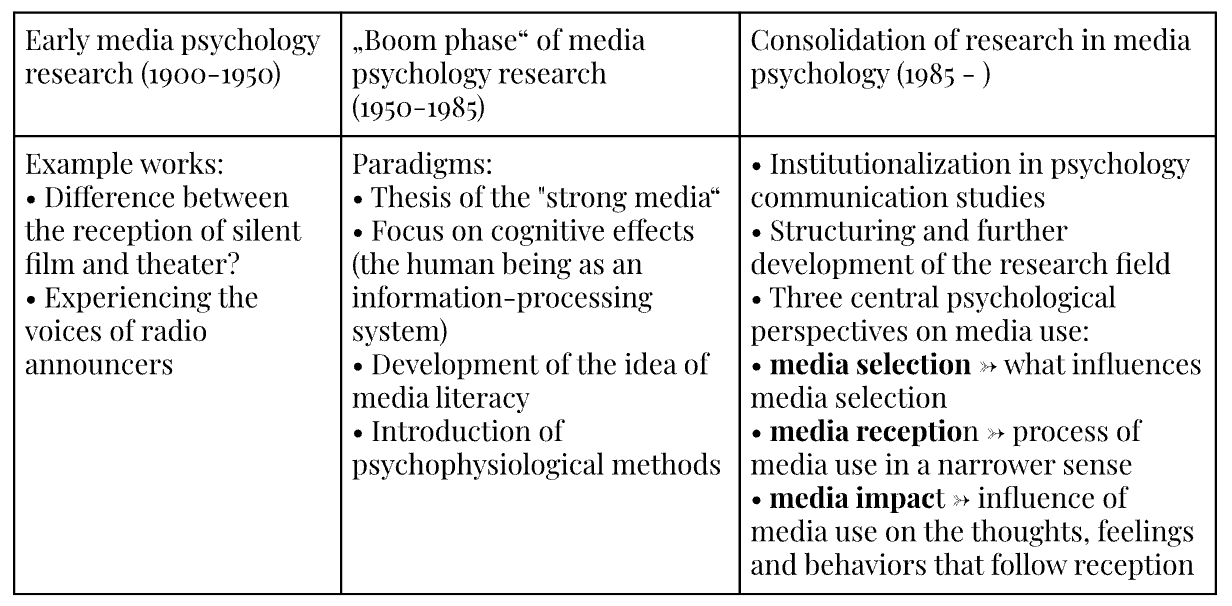
Phases
24
Media selection
... as behavior to be explained
Aim: To explain media selection against the background of motivational, cognitive and emotional processes and to make it understandable.
Sample research questions:
Who likes to watch sad movies and why?
How do moods influence the selection of entertainment formats?
Do political discussions with others influence news media selection and preference?
Aim: To explain media selection against the background of motivational, cognitive and emotional processes and to make it understandable.
Sample research questions:
Who likes to watch sad movies and why?
How do moods influence the selection of entertainment formats?
Do political discussions with others influence news media selection and preference?
25
Media reception
→ as an area of experience to be explained
Aim: explain and understand motivational, cognitive and emotional aspects of media reception processes against the background of dispositional and situational factors.
Sample research questions:
How does the experience of tension arise when watching a film?
Under what conditions is political misinformation not recognized?
What does it depend on how deeply people "sink" into a narrative?
Aim: explain and understand motivational, cognitive and emotional aspects of media reception processes against the background of dispositional and situational factors.
Sample research questions:
How does the experience of tension arise when watching a film?
Under what conditions is political misinformation not recognized?
What does it depend on how deeply people "sink" into a narrative?
26
Media impact
→ as a consequence of media use
Aim: to explain and make understandable short- and long-term effects on experience and behavior following media use.
Sample research questions:
Do violent experiences in film and video games lead to an increased propensity to aggression in the recipient?
What influence does the use of social media have on life satisfaction?
What influence does political advertising have on attitudes and voting behavior?
Aim: to explain and make understandable short- and long-term effects on experience and behavior following media use.
Sample research questions:
Do violent experiences in film and video games lead to an increased propensity to aggression in the recipient?
What influence does the use of social media have on life satisfaction?
What influence does political advertising have on attitudes and voting behavior?
27
Nonverbal Behavior
Modalities of communication
Verbal: spoken word, content of speech
Paraverbal: vocal means accompanying speech, i.e. linked to sounds, which are important for communication (e.g. volume, speech rate, pitch, pauses in speech)
Nonverbal: Communication through other sensory channels
Verbal: spoken word, content of speech
Paraverbal: vocal means accompanying speech, i.e. linked to sounds, which are important for communication (e.g. volume, speech rate, pitch, pauses in speech)
Nonverbal: Communication through other sensory channels
28
Nonverbal communication
-> Physical characteristics: E.g. physical attractiveness, body size and shape as cues, clothing as sign or signal
-> Kinesics: A subdiscipline of communication science that examines the communicative relevance of movement behavior.
-> Haptic signals: E.g. touching, handshake → The type and extent of touching is related to social status. People of higher status touch more frequently and in a less formal manner.
-> Proxemics (from Latin proximus "the neighbor"): as a subfield of psychology and communication studies, examines the regulation of proximity and distance in interpersonal interactions.
- The intimate distance (approx. 15 to 45 cm)
- The socio-personal distance (approx. 45 cm to 1.20 m)
- The social distance (approx. 1.20 to 3.70 m)
- The public distance (approx. 3.70 m to seeing or hearing distance)
->Body language For example, gestures, facial expressions, head movements, body posture, eye and gaze contact.
-> Kinesics: A subdiscipline of communication science that examines the communicative relevance of movement behavior.
-> Haptic signals: E.g. touching, handshake → The type and extent of touching is related to social status. People of higher status touch more frequently and in a less formal manner.
-> Proxemics (from Latin proximus "the neighbor"): as a subfield of psychology and communication studies, examines the regulation of proximity and distance in interpersonal interactions.
- The intimate distance (approx. 15 to 45 cm)
- The socio-personal distance (approx. 45 cm to 1.20 m)
- The social distance (approx. 1.20 to 3.70 m)
- The public distance (approx. 3.70 m to seeing or hearing distance)
->Body language For example, gestures, facial expressions, head movements, body posture, eye and gaze contact.
29
Thesis on Proximity
Depending on the culture, these zones have different dimensions.
• The regulation of proximity and distance seems to be controlled by the amygdala.
• The amygdala is an evolutionarily old neuronal structure. It plays an important role in the emotional evaluation of situations, e.g. the analysis of possible dangers and the control of avoidance and approach tendencies.
• The regulation of proximity and distance seems to be controlled by the amygdala.
• The amygdala is an evolutionarily old neuronal structure. It plays an important role in the emotional evaluation of situations, e.g. the analysis of possible dangers and the control of avoidance and approach tendencies.
30
Types of gestures
Emblems
Emblems are socially clearly established "codes" in our body language. Emblems can replace language and can have different meanings in different cultures
ex.: Peace sign
-> high controllability
Illustrators
Illustrators serve as speech-accompanying gestures to supplement and clarify what is said and can be used consciously or unconsciously.
ex.: Gestik
-> mid controllability
Adaptors
Adaptors (manipulations, bodydirected movements) are rather language-independent movements that do not convey semantic content. They are related to general arousal and emotions.
-> nose scratching
-> low controllability
Emblems are socially clearly established "codes" in our body language. Emblems can replace language and can have different meanings in different cultures
ex.: Peace sign
-> high controllability
Illustrators
Illustrators serve as speech-accompanying gestures to supplement and clarify what is said and can be used consciously or unconsciously.
ex.: Gestik
-> mid controllability
Adaptors
Adaptors (manipulations, bodydirected movements) are rather language-independent movements that do not convey semantic content. They are related to general arousal and emotions.
-> nose scratching
-> low controllability
31
Significance of the theory of evolution in psychology
Charles Darwin (1809-1888)
Charles Darwin (1809-1888)
→ Established the principle of the reciprocal relationship between variation and selection as the basis for the evolution of organisms:
Variation: Individuals of animal and plant species are not the same, but have differences in the structural and performance characteristics of the DNA, which are passed on to the next generation.
Variation: Individuals of animal and plant species are not the same, but have differences in the structural and performance characteristics of the DNA, which are passed on to the next generation.
32
The human genome
Genome: complete set of genes of an organism
Human genome: 20,000 - 25,000 genes on 23 chromosomes
Genotype: genetic makeup of a specific individual
Variation in DNA
Alleles: different variants of the same gene
Genetic relatedness = match of the genotype
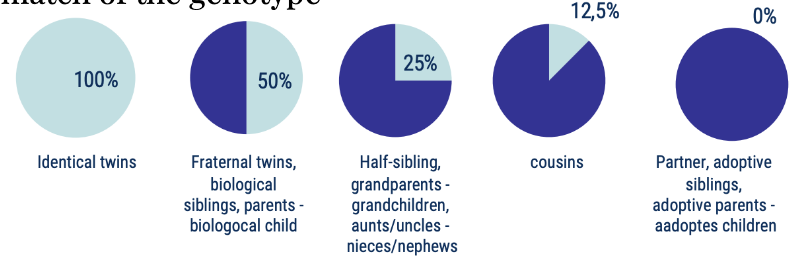
Human genome: 20,000 - 25,000 genes on 23 chromosomes
Genotype: genetic makeup of a specific individual
Variation in DNA
Alleles: different variants of the same gene
Genetic relatedness = match of the genotype
33
Charles Darwin (1809-1888)
Established the principle of the reciprocal relationship between variation and selection as the basis for the evolution of organisms:
Variation: Individuals of animal and plant species are not the same, but have differences in the structural and performance characteristics of the DNA, which are passed on to the next generation.
Selection: Environmental factors (selection factors) influence the reproductive success of an individual. Depending on the fit of a variation to the environmental factors, the chance of reproductive success increases or decreases.
→ natuaral selection
Variation: Individuals of animal and plant species are not the same, but have differences in the structural and performance characteristics of the DNA, which are passed on to the next generation.
Selection: Environmental factors (selection factors) influence the reproductive success of an individual. Depending on the fit of a variation to the environmental factors, the chance of reproductive success increases or decreases.
→ natuaral selection
34
Selection factors
Abiotic selection factors: environmental factors from the inanimate environment, e.g. light (brightness), temperature, pressure, humidity, wind conditions, nutrients, etc.
Biotic selection factors: originate from other organisms. Distinction between interspecific selection (e.g. by predators or parasites) and intraspecific selection (e.g. competition for food and sexual partners).
Biotic selection factors: originate from other organisms. Distinction between interspecific selection (e.g. by predators or parasites) and intraspecific selection (e.g. competition for food and sexual partners).
35
Evolutionary psychology
Assumptions:
Assumptions:
Humans have a genome that enables and favors the formation of certain cognitive abilities (e.g., language, communication, morality).
These cognitive skills are the result of natural selection because they represented an evolutionary advantage for our ancestors.
An understanding of the evolutionary conditions of emergence allows a better understanding of the basic principles and functioning of the skills.
These cognitive skills are the result of natural selection because they represented an evolutionary advantage for our ancestors.
An understanding of the evolutionary conditions of emergence allows a better understanding of the basic principles and functioning of the skills.
36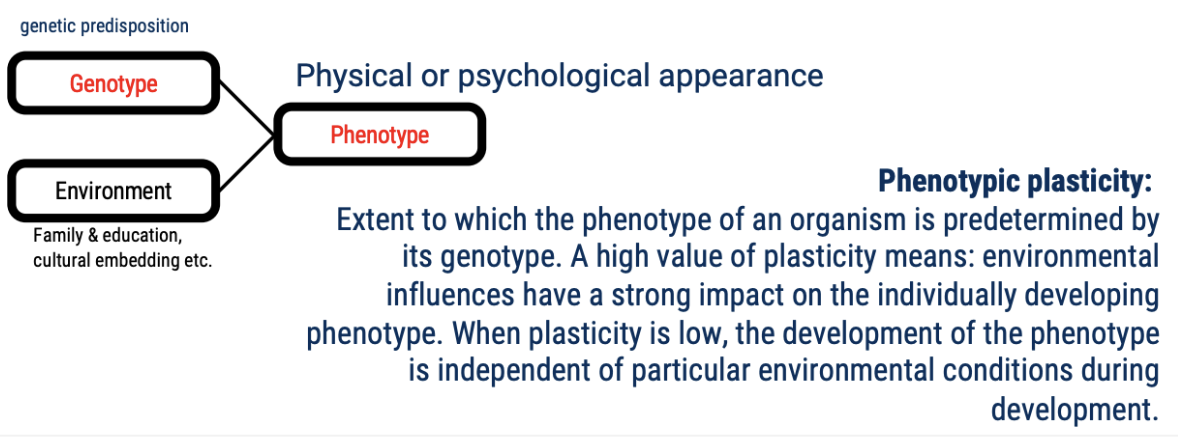
Phenotypic plasticity
37
Evolutionary significant forms of communication
Communicative function of the phenotype
Communicative function of the phenotype
Cues // features of the physical appearance (phenotype) of a communicator that do not require active communication by the sender (e.g., attractiveness features). The communicative function of cue stimuli is in principle always active. e.g. - Mate choice - Parental care
38
cues as phenotype communication
Cue stimuli and sexual attractiveness
Assumption: It represented an evolutionary advantage for our ancestors to perceive cue stimuli as physically attractive in the context of their reproductive choice.
Genetic advantages for own offspring
Material advantages for self or offspring (e.g. protection, care)
Secondary sexual characteristics as a feature of attractiveness
Men prefer feminine faces with small chins, large eyes, high cheekbones, and full lips (Cunningham, 1986).
→ Why?
Indicator of vitality and quality of genetic makeup?
Expected reproductive success is age related to these characteristics in females
Average faces as an attractiveness feature
"Average" faces are perceived as more attractive by both sexes (z.B. Langlois & Roggman, 1990)
→ Why?
Deviation from the descriptive norm increases the probability of genetic mutations or diseases?
Assumption: It represented an evolutionary advantage for our ancestors to perceive cue stimuli as physically attractive in the context of their reproductive choice.
Genetic advantages for own offspring
Material advantages for self or offspring (e.g. protection, care)
Secondary sexual characteristics as a feature of attractiveness
Men prefer feminine faces with small chins, large eyes, high cheekbones, and full lips (Cunningham, 1986).
→ Why?
Indicator of vitality and quality of genetic makeup?
Expected reproductive success is age related to these characteristics in females
Average faces as an attractiveness feature
"Average" faces are perceived as more attractive by both sexes (z.B. Langlois & Roggman, 1990)
→ Why?
Deviation from the descriptive norm increases the probability of genetic mutations or diseases?
39
Communicative function of behavioral traces
Signs //(Traces of) experiences and behaviors of communicators that are perceived as informative by others (e.g., footprints of predators or prey victims, facial expressions).
40
Facial Action Coding System (FACS, Ekman und Friesen 1978; Ekman et al. 2002)
Description of facial expressions based on micro-movements of individual facial muscles.
44 Action Units
44 Action Units
41
Neurocultural theory of emotions (Ekman, 1972)
There is a set of basic emotions (joy, sadness, anger, disgust) that are triggered by specific stimuli.
Basic emotions represent automatic and involuntarily triggered expressions of an internal state.
→ Assumption of non-controllability: micromovements are visible even when a person tries to suppress the emotion expression.
Basic emotions represent automatic and involuntarily triggered expressions of an internal state.
→ Assumption of non-controllability: micromovements are visible even when a person tries to suppress the emotion expression.
42
Behavioral ecology view of facial displays (BECV, Fridlund, 1997)
Functional approach: universals in facial expressions say less about the inner state - facial expressions are interculturally understandable and thus innate behaviors with communicative meaning.
→ Assumption of controllability: Emotional expressions convey behavioral intentions in social contexts and are in principle controllable
→ Assumption of controllability: Emotional expressions convey behavioral intentions in social contexts and are in principle controllable
43
Evolutionary advantage of communication
Signals // communicative behavior that refers to changes in the environment and is associated with costs for the sender (e.g. warning call when a predator is approaching, call during mating behavior)
e.g. Cooperation in social groups
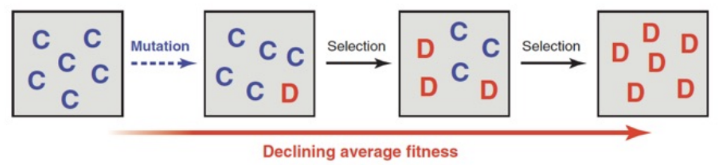
e.g. Cooperation in social groups
44
Through cooperation in a group, it can develop organizations and structures that represent a selection advantage for all group members (e.g., defense against enemies, division of labor, etc.).
Within a cooperative group, egoism represents a selection advantage.
On the evolution of cooperation (Nowak, 2006)
On the evolution of cooperation (Nowak, 2006)
Assumptions:
Assumptions:
Through cooperation in a group, it can develop organizations and structures that represent a selection advantage for all group members (e.g., defense against enemies, division of labor, etc.).
Within a cooperative group, egoism represents a selection advantage.
On the evolution of cooperation (Nowak, 2006)
45
How can a cooperating group deal with this problem?
Kinship selection
Direct reciprocity
Indirect reciprocity
Network reciprocity
Group selection
Direct reciprocity
Indirect reciprocity
Network reciprocity
Group selection
46
Kin Selection
I will jump into the river to save two brothers or eight cousins. (J. B. S. Haldane)
Assumption:
Support of relatives with partially identical genotypes brings an evolutionary advantage because the continuation of one's own genetic makeup is ensured.
→ But under what conditions does it also bring an advantage to cooperate with those who are genetically non-related?
Assumption:
Support of relatives with partially identical genotypes brings an evolutionary advantage because the continuation of one's own genetic makeup is ensured.
→ But under what conditions does it also bring an advantage to cooperate with those who are genetically non-related?
47
Tit-For-Tat strategy (Axelrod, 1984)
„Tit-For-Tat has only four lines of code. The program opens by cooperating with its opponent. It then plays exactly as the other side played in the previous game. If the other side defected in the previous game, the program also defects; but only for one game. If the other side cooperates, the program continues to cooperate.“ (www.wikipedia.com)
Problem: tit for tat only works when there are repeated interactions and it can get stuck in defection when both partners follow the rule.
Problem: tit for tat only works when there are repeated interactions and it can get stuck in defection when both partners follow the rule.
48
Direct reciprocity
Organization of tournaments to study the game-theoretic foundations of reciprocal cooperation strategies using repeated prisoner's dilemma situations.
49
Indirect reciprocity
Indirect reciprocity is observed in complex form only in humans; it requires higher cognitive abilities:
- memory of own and others' interactions
- linguistic forms of communication about cooperation of others.
The selection of indirect reciprocity has probably played an important role in the evolution of human intelligence.
- memory of own and others' interactions
- linguistic forms of communication about cooperation of others.
The selection of indirect reciprocity has probably played an important role in the evolution of human intelligence.
50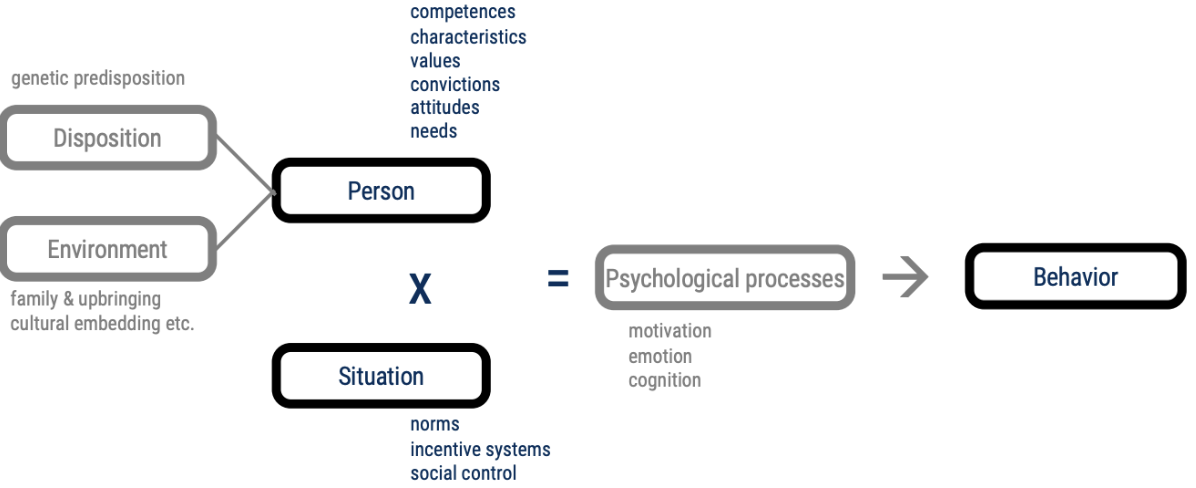
▶︎ Extended "behavioral formula" in psychology
51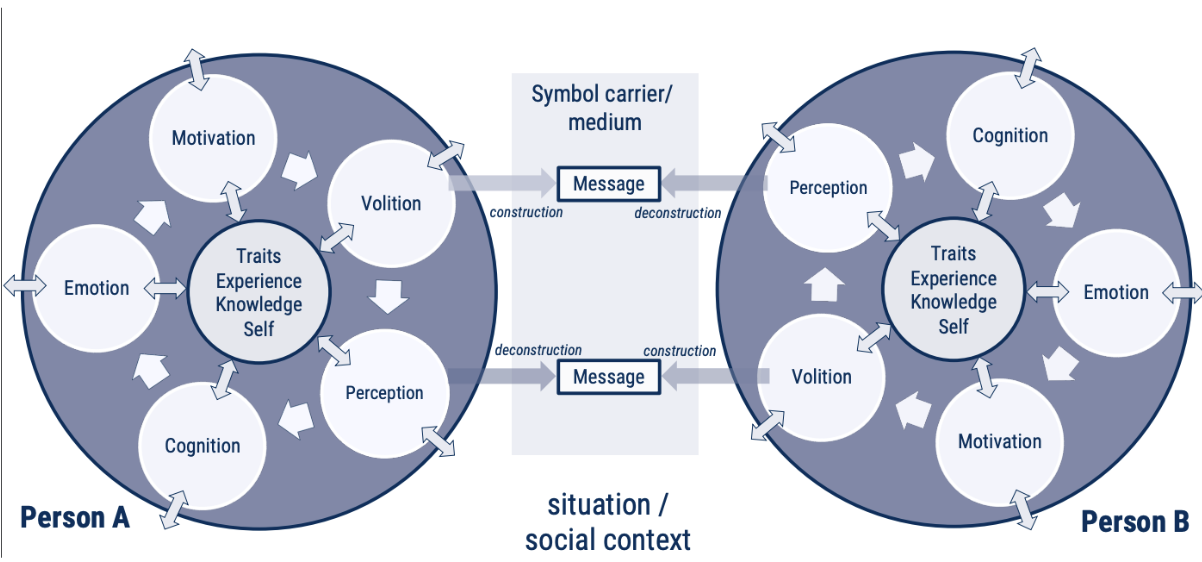
Psychological framework model of communicative action (adapted from Hargie & Dickson, 2004, Hargie, 2016)
52
model of communicative action
Basic assumptions:
Basic assumptions:
People's communication behavior serves a psychological function and can (but most not) be a product of conscious self-regulation (goal orientation and motivation).
Motivation = processes of behavioral drive
Volition = processes of self and behavior control → how we are able to control ourselves and how we behave
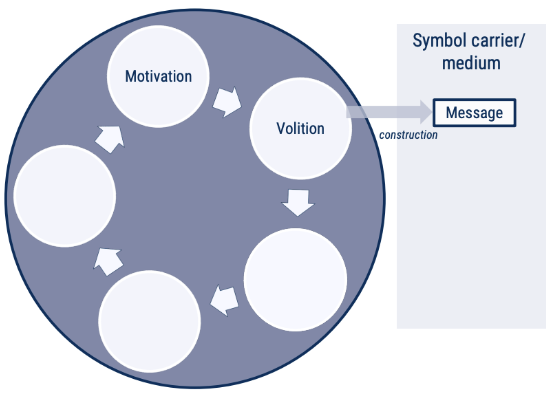
Motivation = processes of behavioral drive
Volition = processes of self and behavior control → how we are able to control ourselves and how we behave
53
Motivation: Needs as dispositions
Motivational Psychology
People have a number of innate needs and acquired motives or value orientations toward the satisfaction or fulfillment of which they direct their behavior.
In situations, needs, motives and value orientations translate into goals or motivation that guide communicative behavior.
People have a number of innate needs and acquired motives or value orientations toward the satisfaction or fulfillment of which they direct their behavior.
In situations, needs, motives and value orientations translate into goals or motivation that guide communicative behavior.
54
Hierarchy of needs according to Maslow (1943)
Basic assumption:
Few basic needs
Needs are hierarchically structured, i.e. some needs must be satisfied before others become active.
Criticism:
Some needs are not represented (e.g. relaxation, structure, performance, understanding).
Hierarchical structure cannot be confirmed empirically, i.e. people strive for higher needs even if hierarchically lower ones are not satisfied.
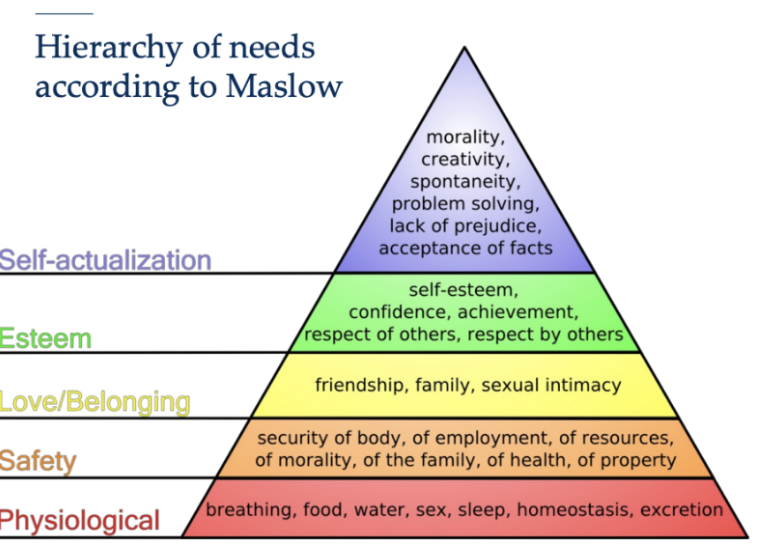
Few basic needs
Needs are hierarchically structured, i.e. some needs must be satisfied before others become active.
Criticism:
Some needs are not represented (e.g. relaxation, structure, performance, understanding).
Hierarchical structure cannot be confirmed empirically, i.e. people strive for higher needs even if hierarchically lower ones are not satisfied.
55
▶︎ The Self
Conceptualizations in research on self-perception
Self-concept = Descriptive image, i.e., descriptive statements about oneself.
Examples: - I like to play World of Warcraft. - I am interested in astronomy.
Self-esteem = Evaluation of this image, i.e., extent of positive or negative evaluations of one's own person.
Examples: - I am a failure. - I am proud of my general knowledge.
→ Difficulty: Most traits are descriptive and evaluative (e.g., intelligence, neuroticism)
Self-concept = Descriptive image, i.e., descriptive statements about oneself.
Examples: - I like to play World of Warcraft. - I am interested in astronomy.
Self-esteem = Evaluation of this image, i.e., extent of positive or negative evaluations of one's own person.
Examples: - I am a failure. - I am proud of my general knowledge.
→ Difficulty: Most traits are descriptive and evaluative (e.g., intelligence, neuroticism)
56
The self-concept includes...
... a person's assumptions about who he or she is (real self)
objective characteristics (age, gender, star sign)
biographical memories (best friends, good experiences, failures, losses)
descriptive beliefs (facts like: I am more intelligent than 50% of the population)
... assumptions of a person about who he should be (ideal self)
persoal goals
normative beliefs (e.g. I should lose weight.)
If the real and ideal selves diverge too much, this results in negative selfevaluations
→ negative self-esteem
objective characteristics (age, gender, star sign)
biographical memories (best friends, good experiences, failures, losses)
descriptive beliefs (facts like: I am more intelligent than 50% of the population)
... assumptions of a person about who he should be (ideal self)
persoal goals
normative beliefs (e.g. I should lose weight.)
If the real and ideal selves diverge too much, this results in negative selfevaluations
→ negative self-esteem
57
Needs Theory by Carl Rogers
Most important representative of humanism
Psychotherapist, founder of client-centered, non-directive conversational psychotherapy
Basic human need for self-actualization ("to expand, to extend, to develop, to become autonomous, to mature")
Striving for self-congruence
i.e. congruence between real and ideal self
Signs of healthy personality ("fully functioning person")
Psychotherapist, founder of client-centered, non-directive conversational psychotherapy
Basic human need for self-actualization ("to expand, to extend, to develop, to become autonomous, to mature")
Striving for self-congruence
i.e. congruence between real and ideal self
Signs of healthy personality ("fully functioning person")
58
Personality theory by Carl Rogers (1902-1987)
Healthy personality development with unconditional appreciation by parents
Person valued as a whole, even if individual behaviors are disapproved of
Problematic with conditional appreciation by parents
Person only valued if behavior conforms to rules of others
Leads to ideal self, which does not correspond to own potentials
→ Positive/negative feedback on self-revelation has an impact on the (de)stabilization of the self-concept in terms of perceived self-congruence
Person valued as a whole, even if individual behaviors are disapproved of
Problematic with conditional appreciation by parents
Person only valued if behavior conforms to rules of others
Leads to ideal self, which does not correspond to own potentials
→ Positive/negative feedback on self-revelation has an impact on the (de)stabilization of the self-concept in terms of perceived self-congruence
59
▶︎ Self-Regulation
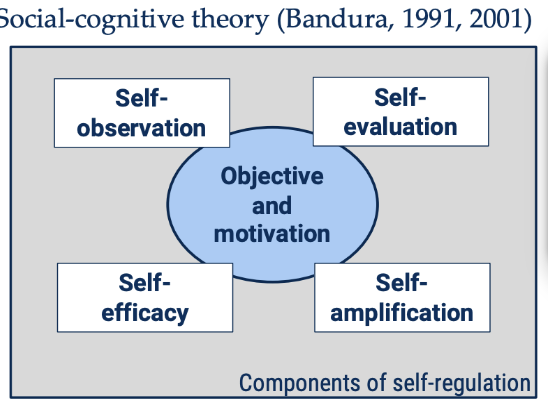
Social-cognitive theory (Bandura, 1991, 2001)
Social-cognitive theory (Bandura, 1991, 2001)
most cited living psychologist
influential in social and personality psychology,
especially through the social-cognitive theory
of thought and action
Basic assumption
Image of the "human being as an agent" with the ability for
Intentionality
foresighted thinking
Self-regulation
influential in social and personality psychology,
especially through the social-cognitive theory
of thought and action
Basic assumption
Image of the "human being as an agent" with the ability for
Intentionality
foresighted thinking
Self-regulation
60
Social-cognitive theory (Bandura, 1991, 2001)
-> Components of Self-regulation
-> Components of Self-regulation
Self-efficacy =subjective expectation of being able to competently perform certain behavior in given situation.
- Implementation of actions to achieve goals depends on self-efficacy expectations.
- Self-efficacy expectations are influenced by experiences in self-regulation.
Self-observation = People observe and monitor their own actions and their consequences
Self-evaluation = People evaluate the behavior shown as well as corresponding consequences in relation to goal achievement
Self-amplification = People respond to selfassessment in that they can reinforce themselves positively or negatively.
- Implementation of actions to achieve goals depends on self-efficacy expectations.
- Self-efficacy expectations are influenced by experiences in self-regulation.
Self-observation = People observe and monitor their own actions and their consequences
Self-evaluation = People evaluate the behavior shown as well as corresponding consequences in relation to goal achievement
Self-amplification = People respond to selfassessment in that they can reinforce themselves positively or negatively.
61
Social-cognitive theory (Bandura, 1991, 2001)
-> reinforcment aspects
-> reinforcment aspects
External reinforcement: Behavior can be reinforced or punished by events and reactions in the social environment (e.g., rewards, social recognition, etc.).
Internal reinforcement: Behavior can be reinforced or punished by events and reactions within a person.
Positive affective self-reaction (pride) when approaching goals.
Negative affective self-reaction (shame, guilt) when goals are missed.
Self-reinforcement crucial for new goal setting
Internal reinforcement: Behavior can be reinforced or punished by events and reactions within a person.
Positive affective self-reaction (pride) when approaching goals.
Negative affective self-reaction (shame, guilt) when goals are missed.
Self-reinforcement crucial for new goal setting
62
Self-determination theory (Deci & Ryan, 1985)
Central assumption: people as active, growth oriented motivational agents.
→ Striving for competence and autonomy as central sources of intrinsic motivation.
→ Extrinsic incentive systems can damage intrinsic motivation structures.
→ Extrinsic motivation can be internalized and transformed into intrinsic motivation

→ Striving for competence and autonomy as central sources of intrinsic motivation.
→ Extrinsic incentive systems can damage intrinsic motivation structures.
→ Extrinsic motivation can be internalized and transformed into intrinsic motivation
63
Self-regulation
We need and want to control and steer our communicative behavior in many contexts. However, this self-regulation requires cognitive energy, which is only available to a limited extent.
64
Self-presentation
Self-representation (impression management) is defined as "any behavior of a person or a group that aims to control the impression that other people form of that person or group in a desirable way" (Stapf & Heil, 2014, p. 736).
Possible goals:
Attainment of social recognition
Attainment of social power
Shaping of the self-concept
Possible goals:
Attainment of social recognition
Attainment of social power
Shaping of the self-concept
65
Theory of symbolic self-completion (Wicklund & Gollwitzer, 1982)
Assumptions:
Self-related goals (ideal self) that have not (yet) been achieved can be represented by symbols.
The effect of symbols is bound to their social awareness.
Self-related goals (ideal self) that have not (yet) been achieved can be represented by symbols.
The effect of symbols is bound to their social awareness.
66
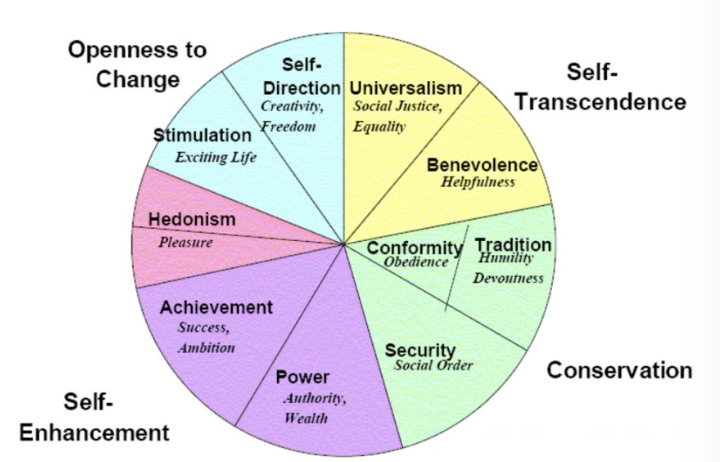
Universal human value orientations (Schwartz, 1992)
Personal values reflect general cross-situational goals that motivate individuals' behavior and serve as guiding principles for their lives.
- Values can motivate the behavior of individuals (Personal Values) and social groups (Cultural Values).
- Values are hierarchically ordered according to their importance.
- People differ in the prioritization of values.
- Values can motivate the behavior of individuals (Personal Values) and social groups (Cultural Values).
- Values are hierarchically ordered according to their importance.
- People differ in the prioritization of values.
67
Circumplex model of personal values
Hedonism
Performance / Success
Power / Dominance
Security
Tradition
Conformity
Benevolence
Equality
Self-determination
Stimulation
two central dimensions :
Openness to new experiences vs. preservation of the status quo
Self -optimization vs. principle orientation
Performance / Success
Power / Dominance
Security
Tradition
Conformity
Benevolence
Equality
Self-determination
Stimulation
two central dimensions :
Openness to new experiences vs. preservation of the status quo
Self -optimization vs. principle orientation
68
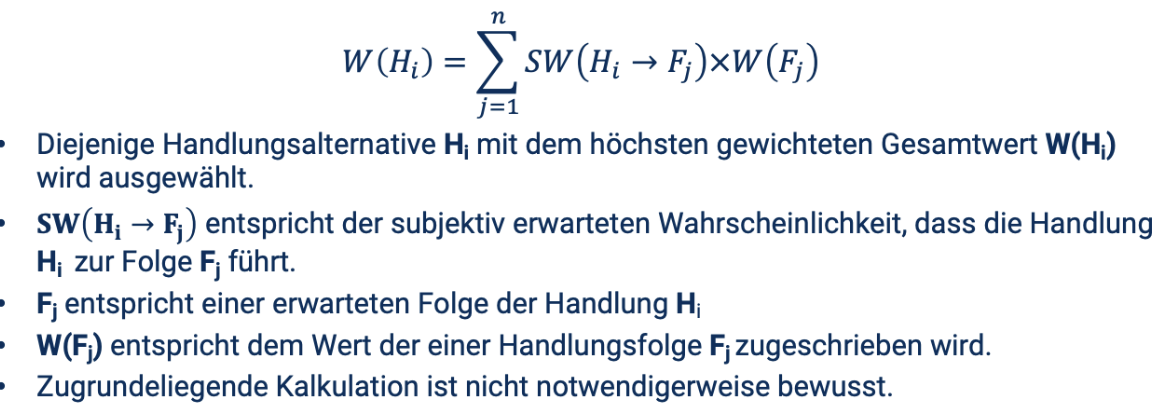
Expectancy x Value Theories:
Individuals attempt to do what they believe will lead to what they desire (Reisenzein 2006)
Every action can have different consequences. positive or negative.
The expected probability (EP) of a consequence varies for persons.
The value (V) of each expected consequence varies for individuals.
Every action can have different consequences. positive or negative.
The expected probability (EP) of a consequence varies for persons.
The value (V) of each expected consequence varies for individuals.
69
Expectation x Value Theories of Motivation (Rational Approach)
The subjective probability (SP) of a sequence varies for individuals.
The value of each expected consequence V(Cj) varies for individuals.
IMPORTANT!! Subjective expectations and subjective value of a sequence of actions vary depending on person characteristics and situation characteristics
The value of each expected consequence V(Cj) varies for individuals.
IMPORTANT!! Subjective expectations and subjective value of a sequence of actions vary depending on person characteristics and situation characteristics
70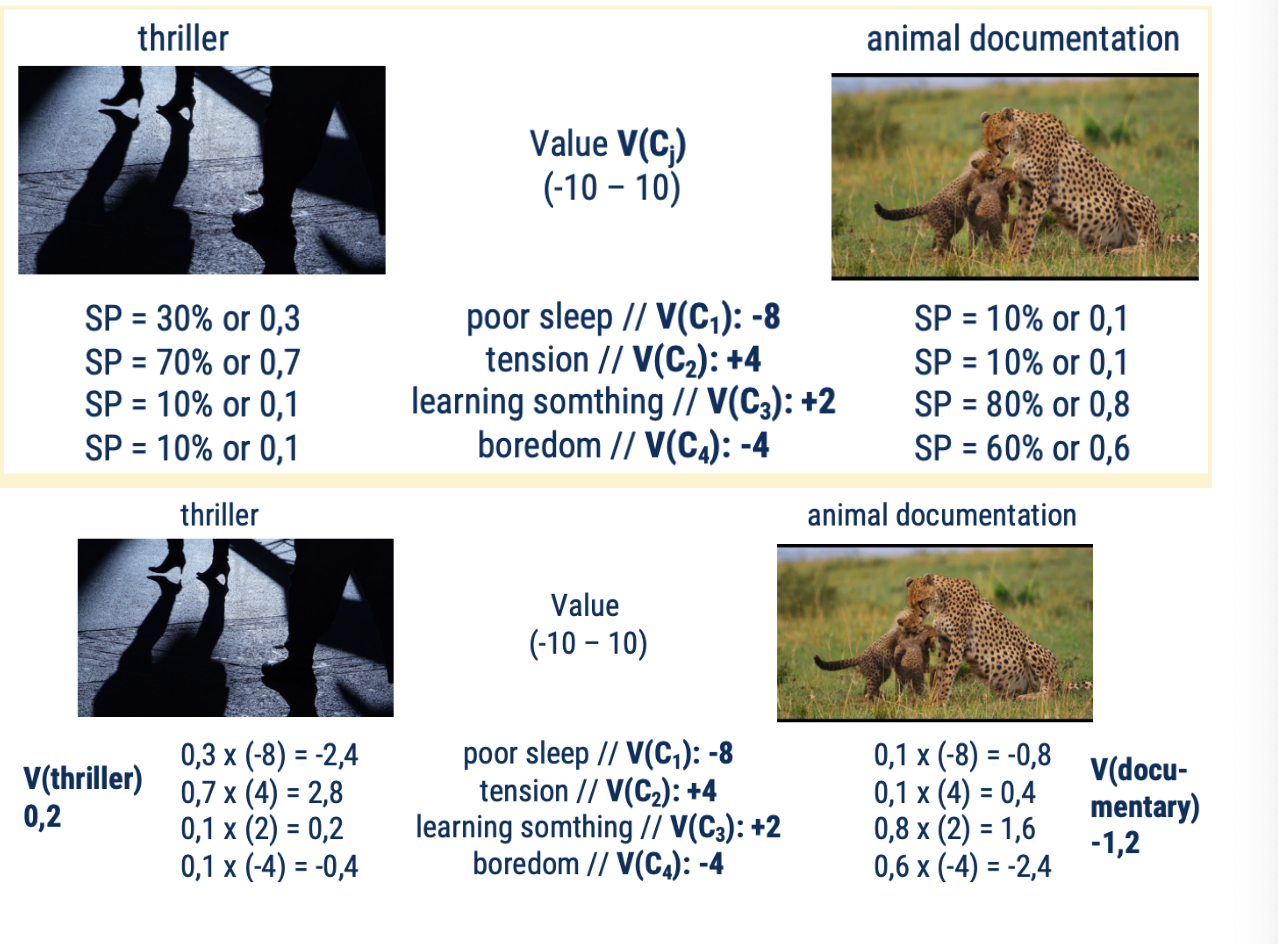
Rechnung Expectation x Value Theories of Motivation
71
Conceptual differentiation of properties according to Cattell (1908-1998)
Abilities describe how well a person does something or performs a task (e.g. intelligence).
Temperament traits describe how a person does something (anxiety).
Dynamic traits explain why a person does something (drives, motives, goals).
Temperament traits describe how a person does something (anxiety).
Dynamic traits explain why a person does something (drives, motives, goals).
72
▶︎ Characteristics of the person / personality
Personality as the totality of all characteristics that make up the uniqueness of the individual.
Narrow definition: personality = temperamental traits
Broad definition: all psychological characteristics in which individuals differ from one another in a relatively stable manner (traits)
Narrow definition: personality = temperamental traits
Broad definition: all psychological characteristics in which individuals differ from one another in a relatively stable manner (traits)
73
Stability of traits
▶︎ States and Traits
▶︎ States and Traits
Stable traits ex. dispositional traits: Characteristics, needs, motives
vs.
States ex. for states: moods, emotions
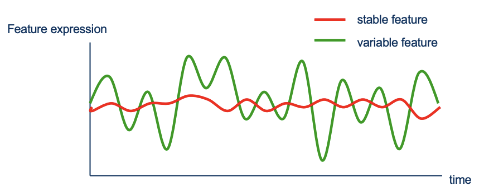
vs.
States ex. for states: moods, emotions
74
▶︎ Different forms of temporal stability
The term stability is used in two ways:
Absolute stability = characteristic shows the same expression over time
Relative Stability = Trait differences between persons are stable in their expression over time
More appropriate conditions for using traits to describe personality because:
-> Influence of situations considered
-> Influence of age / historical background taken into account
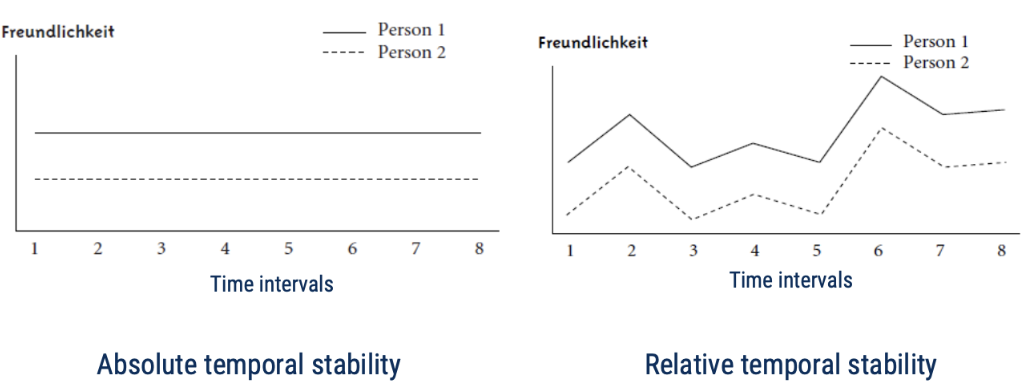
Absolute stability = characteristic shows the same expression over time
Relative Stability = Trait differences between persons are stable in their expression over time
More appropriate conditions for using traits to describe personality because:
-> Influence of situations considered
-> Influence of age / historical background taken into account
75
Example of Relative Stability: Intelligence
Differences between individuals remain constant over time.
→ Correlation as an indicator of relative stability
other terms:
Rank series continuity
Differential stability
Interindividual continuity
Expression of a disposition remains constant over time
↳ No absolute but relative stability!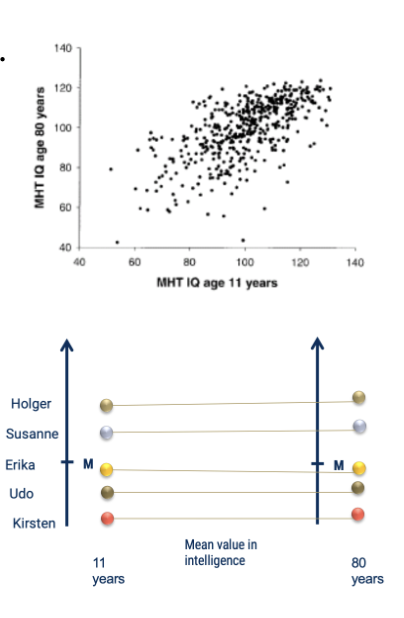
→ Correlation as an indicator of relative stability
other terms:
Rank series continuity
Differential stability
Interindividual continuity
Expression of a disposition remains constant over time
↳ No absolute but relative stability!
76
▷ The structure of personality (Big5)
Lexical approach to structuring properties
Objective: To map personality differences economically and comprehensively at the same time (Describe)
→ „Sedimentation hypothesis“ as a starting point
Differences between people that are important in social interaction were perceived and discussed and became part of natural language (Goldberg, 1981)
▶︎ Criteria for determining important traits:
Synonym frequency
Intercultural universality
Objective: To map personality differences economically and comprehensively at the same time (Describe)
→ „Sedimentation hypothesis“ as a starting point
Differences between people that are important in social interaction were perceived and discussed and became part of natural language (Goldberg, 1981)
▶︎ Criteria for determining important traits:
Synonym frequency
Intercultural universality
77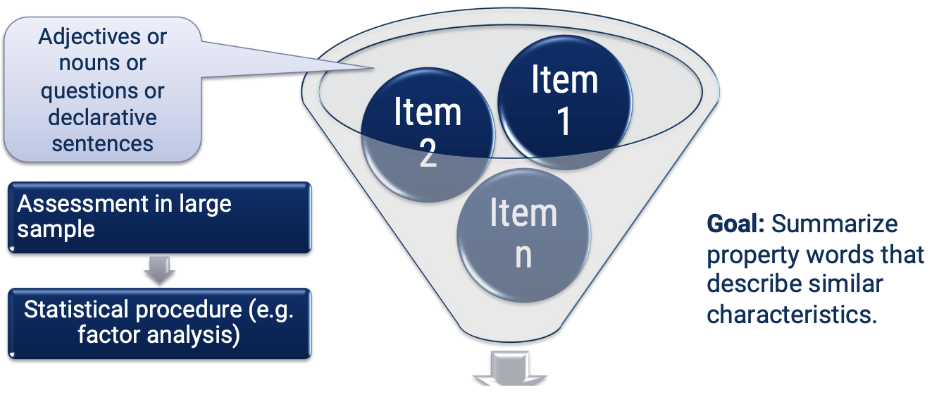
▶︎ Statistical approach to structuring properties
78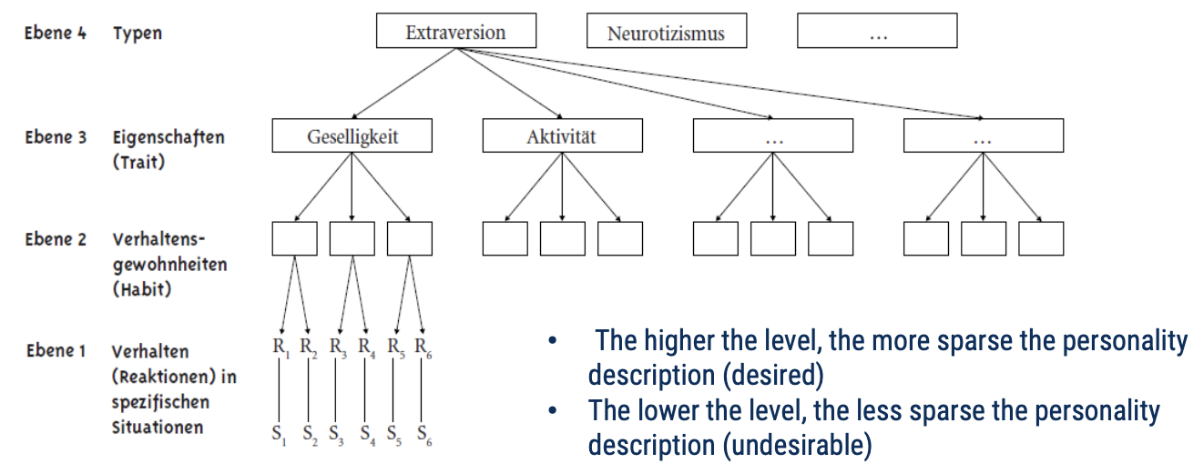
Hierarchical organization of properties
79
Big 5 as a description system for properties
→ 5 Faktors / Basic dimensions
→ 5 Faktors / Basic dimensions
→ 5 Faktors / Basic dimensions
Openness = Open-minded individuals are more accessible, engage more easily in communication in novel situations, and are receptive to novel ideas, views, or suggestions.
Curiosity, Aesthetic, sensibility Ingenuity
Conscientiousness = Conscientious people are reliable interlocutors and like to adhere to rules and structures of communication.
Orderliness, Diligence, Reliability
Extraversion = Extraverts talk more, show gaze behavior more often, smile and nod more than introverts.
Sociability, Assertiveness, Energy
Agreeableness = Agreeable people are benevolent, cooperative, and supportive in communication.
Trust, Compassion, Respect
Neuroticismn = Negative emotional individuals are anxious in social interaction and often prefer indirect forms of communication (e.g., mail) to direct communication.
Anxiousness, Dejection, Volatility
Openness = Open-minded individuals are more accessible, engage more easily in communication in novel situations, and are receptive to novel ideas, views, or suggestions.
Curiosity, Aesthetic, sensibility Ingenuity
Conscientiousness = Conscientious people are reliable interlocutors and like to adhere to rules and structures of communication.
Orderliness, Diligence, Reliability
Extraversion = Extraverts talk more, show gaze behavior more often, smile and nod more than introverts.
Sociability, Assertiveness, Energy
Agreeableness = Agreeable people are benevolent, cooperative, and supportive in communication.
Trust, Compassion, Respect
Neuroticismn = Negative emotional individuals are anxious in social interaction and often prefer indirect forms of communication (e.g., mail) to direct communication.
Anxiousness, Dejection, Volatility
80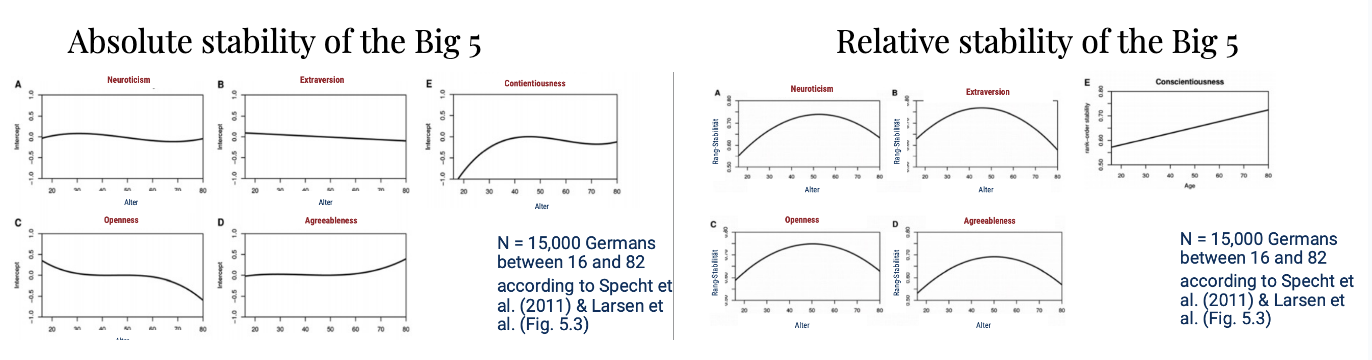
Stability od the big %
81
▷ Situational features
▷ Situational features
Situational influence factors as the totality of all characteristics that make up the uniqueness of the situational framework.
Incentive structure
Roles (e.g.)
Environmental stimuli (e.g. threat)
Incentive structure
Roles (e.g.)
Environmental stimuli (e.g. threat)
82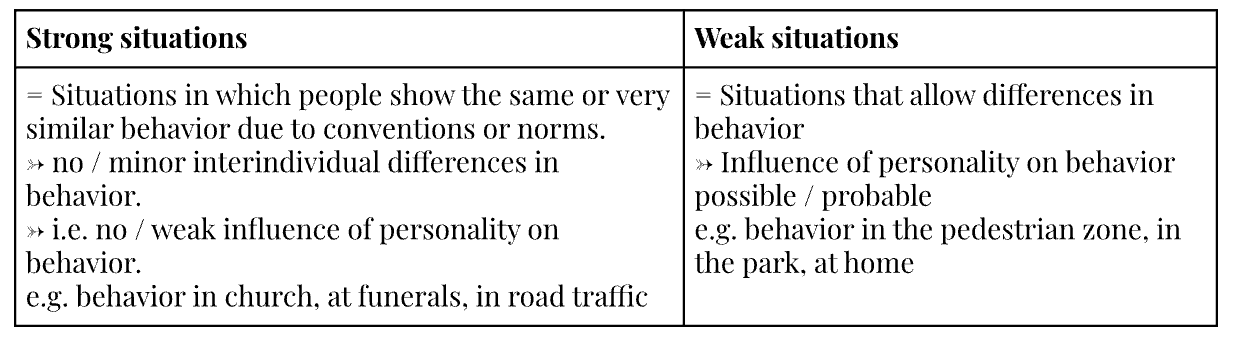
What are strong and weak situations?
83
Situational strength and situational difficulty
In strong situations the influence of the situation on the behavior is great. These situations are either...
... easy: behavior easy to show / frequent
... difficult: behavior difficult to show / rarely
In weak situations the influence of the situation on the behavior is low. These situations are...
... moderately diffcult: Whether behavior is shown depends on personality
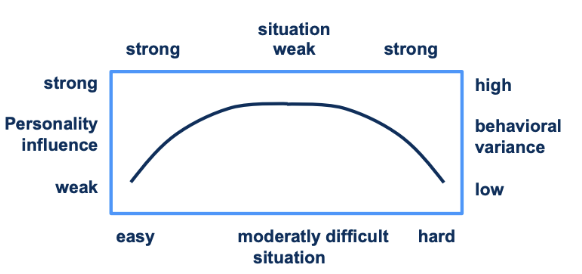
... easy: behavior easy to show / frequent
... difficult: behavior difficult to show / rarely
In weak situations the influence of the situation on the behavior is low. These situations are...
... moderately diffcult: Whether behavior is shown depends on personality
84
▶︎Interaction mechanisms and processes
Reactive interaction
People react differently to the same situational stimuli.
Situations are perceived and evaluated subjectively
Large differences between individuals in ambiguous situations (smaller in unambiguous situations).
Ex: Aggression as reaction to provocation
Evocative interaction
Persons elicit different reactions from interaction partners. These have an effect on the person.
Example: Self-fulfilling prophecies through jealousy tendency in relationships.
Proactive interaction
People actively choose situations. By specifically seeking out and avoiding situations that fit their personality, people actively control the influence that situations can have on their behavior.
Example: Anxiousness and threatening situations
Manipulative interaction
People actively shape their environment. People actively shape their environment and thus influence the situation to which they are exposed.
Example: Extraverts shape their environment in such a way that they signal: Visitors are welcome!
People react differently to the same situational stimuli.
Situations are perceived and evaluated subjectively
Large differences between individuals in ambiguous situations (smaller in unambiguous situations).
Ex: Aggression as reaction to provocation
Evocative interaction
Persons elicit different reactions from interaction partners. These have an effect on the person.
Example: Self-fulfilling prophecies through jealousy tendency in relationships.
Proactive interaction
People actively choose situations. By specifically seeking out and avoiding situations that fit their personality, people actively control the influence that situations can have on their behavior.
Example: Anxiousness and threatening situations
Manipulative interaction
People actively shape their environment. People actively shape their environment and thus influence the situation to which they are exposed.
Example: Extraverts shape their environment in such a way that they signal: Visitors are welcome!
85
Modern Interactionism
The influence of situations and personality on behavior is interdependent
Influence of personality factors on behavior varies systematically across situations.
The influence of situations varies in strength for different individuals.
Personality influences on behavior can only be generalized across situations to a limited extent.
Situational influences on behavior can only be generalized across individuals to a limited extent.
Influence of personality factors on behavior varies systematically across situations.
The influence of situations varies in strength for different individuals.
Personality influences on behavior can only be generalized across situations to a limited extent.
Situational influences on behavior can only be generalized across individuals to a limited extent.
86
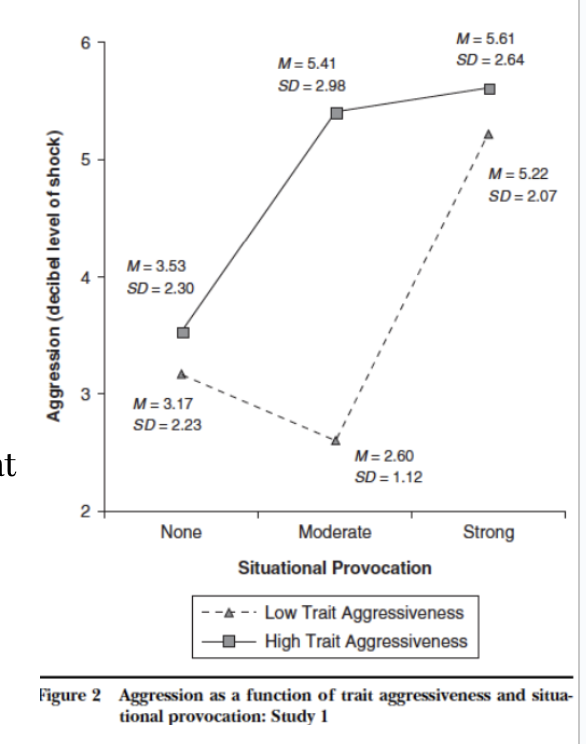
Study by Marshall & Brown (2006) → Reactive Interaction
Experiment with 101 US students
Aggression propensity (Buss-Perry Aggression Self-Report Questionnaire, Buss & Perry, 1992).
high vs. medium vs. low aggressive
Students write an essay and receive feedback
Without provokation („good essay“)
with weaker provokation („ essay needs work and it does not seem like much effort was put into it“)
With stronger provokation („worst essay that I have ever read“)
Competitive Reaction Time Task (CRTT, Bushman & Baumeister, 1998) for measuring aggression
0 = no noise
10 = 110 decibels (chainsaw)
Differences in aggression propensity do not affect behavior without provocation and with higher provocation.
Non-aggressive individuals also react aggressively to higher provocation.
In aggressive individuals, lower and higher provocation equally lead to aggression.
Aggression propensity (Buss-Perry Aggression Self-Report Questionnaire, Buss & Perry, 1992).
high vs. medium vs. low aggressive
Students write an essay and receive feedback
Without provokation („good essay“)
with weaker provokation („ essay needs work and it does not seem like much effort was put into it“)
With stronger provokation („worst essay that I have ever read“)
Competitive Reaction Time Task (CRTT, Bushman & Baumeister, 1998) for measuring aggression
0 = no noise
10 = 110 decibels (chainsaw)
Differences in aggression propensity do not affect behavior without provocation and with higher provocation.
Non-aggressive individuals also react aggressively to higher provocation.
In aggressive individuals, lower and higher provocation equally lead to aggression.
87
Evocative interaction
Persons elicit different reactions from interaction partners. These have an effect on the person.
Example: Self-fulfilling prophecies through jealousy tendency in relationships
Example: Self-fulfilling prophecies through jealousy tendency in relationships
88
Proactive interaction
People actively choose situations. By specifically seeking out and avoiding situations that fit their personality, people actively control the influence that situations can have on their behavior.
Example: Anxiousness and threatening situations.
Example: Anxiousness and threatening situations.
89
Manipulative interaction
People actively shape their environment. People actively shape their environment and thus influence the situation to which they are exposed.
Example: Extraverts shape their environment in such a way that they signal: Visitors are welcome!
Example: Extraverts shape their environment in such a way that they signal: Visitors are welcome!
90
Social information processing
Psychological framework model of communicative action (adapted from Hagie & Dickson, 2004, Hargie, 2016)
Basic assumptions:
Psychological framework model of communicative action (adapted from Hagie & Dickson, 2004, Hargie, 2016)
Basic assumptions:
Communicative goals and actions result from social information processing (social cognition).
91
➡ Social cognition as a field of research
Information technology approaches to communication
Starting point: theories of transfer technology
Focus on information transfer (mathematical description of a transfer process)
Social cognition research
Research on social influence on information processing
"Understanding how people arrive at their respective constructions of the social environment is the field of research in social cognition." (Fiske & Taylor,1991)
Starting point: theories of transfer technology
Focus on information transfer (mathematical description of a transfer process)
Social cognition research
Research on social influence on information processing
"Understanding how people arrive at their respective constructions of the social environment is the field of research in social cognition." (Fiske & Taylor,1991)
92
Transmitter-receiver model by Shannon & Weaver (1949)
Transmitter as information source
Transmission device as encoder
Signal as message
Channel as signal carrier
Possible technical interference during signal transmission ("noise")
Receiver device as decoder
Receiver as addressee
Transmission device as encoder
Signal as message
Channel as signal carrier
Possible technical interference during signal transmission ("noise")
Receiver device as decoder
Receiver as addressee
93
Psychological criticism of the information technology approach
People don't process information, they generate meaning.
→ Meaning is constructed subjectively by sender and receiver and cannot simply be understood in terms of an information technology code.
→ Meaning is constructed subjectively by sender and receiver and cannot simply be understood in terms of an information technology code.
94
People generate meaning
→ Different knowledge of signs and meanings, i.e. the same signs can have different meanings (e.g. problem for intercultural communication)
→ Decoding and processing of signals is influenced by a variety of psychological factors ( → social cognition research)
→ Decoding and processing of signals is influenced by a variety of psychological factors ( → social cognition research)
95
Subprocesses of social information processing
Subprocesses of social information processing
Perception = processes of sensory experience
Cognition = processes of evaluation, interpretation and memory
Emotion = processes of affective experience
Motivation = processes of behavioral drive
Volition = processes of self and behavior control
Cognition = processes of evaluation, interpretation and memory
Emotion = processes of affective experience
Motivation = processes of behavioral drive
Volition = processes of self and behavior control
96
Social cognition
Examples of this research area:
Examples of this research area:
Social perceptions
Attribution of reasons and causes for behavior
Construction and categorization of the social environment
Social influence on inferences
Attribution of reasons and causes for behavior
Construction and categorization of the social environment
Social influence on inferences
97
Principles of social information processing in humans
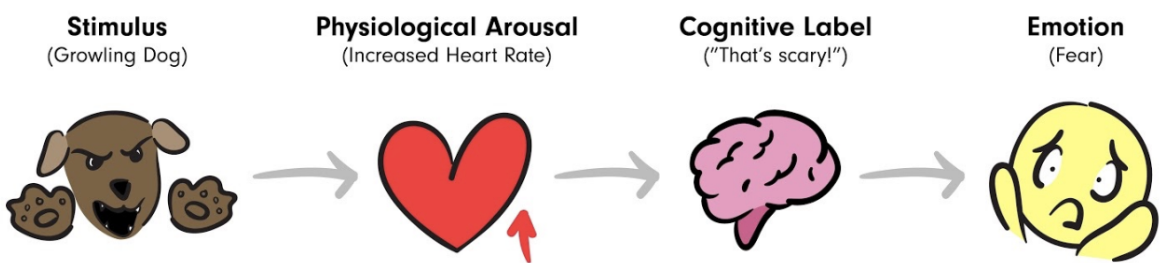
▶︎ 1. The processing of social information is sequential, but all subprocesses work simultaneously, i.e. in parallel
→ Social information processing is sequential in the sense that there is a certain degree of temporal order of processes.
Example: Emotional reactions presuppose that information has been perceived.
↳ Example: Appraisal Theory of Emotion (Schachter & Singer, 1962)
→ Emotion requires cognitive interpretation
→ Social information processing is sequential in the sense that there is a certain degree of temporal order of processes.
Example: Emotional reactions presuppose that information has been perceived.
↳ Example: Appraisal Theory of Emotion (Schachter & Singer, 1962)
→ Emotion requires cognitive interpretation
98
→ Social information processing is parallel
in the sense that all sub-processes take place simultaneously and thus influence each other.
Example: An emotional state influences the way information is perceived and interpreted.
Example: Motivated evaluation of political events
1. Measurement of political attitudes
2. Contextualizing TV images so that they speak either for or against one's political views group. (Protests against abortion vs. protests against discrimination against LGBTQ)
3. Measurement of truthful perception / evaluation / recall of information.
Example: An emotional state influences the way information is perceived and interpreted.
Example: Motivated evaluation of political events
1. Measurement of political attitudes
2. Contextualizing TV images so that they speak either for or against one's political views group. (Protests against abortion vs. protests against discrimination against LGBTQ)
3. Measurement of truthful perception / evaluation / recall of information.
99
People tend to construct their social world in such a way that it is coherent.
Consistency Theories
A class of psychological theories that attribute a motivational role to the coherence, compatibility, or harmony of perceptions, memories, attitudes, judgments.
E.g.:
Dissonance theory (Festinger)
Cognitive dissonance refers to a situation in which perceptions, thoughts, opinions, attitudes, values, beliefs, and/or behaviors are not in harmony.
Balance theory (Heider)
A class of psychological theories that attribute a motivational role to the coherence, compatibility, or harmony of perceptions, memories, attitudes, judgments.
E.g.:
Dissonance theory (Festinger)
Cognitive dissonance refers to a situation in which perceptions, thoughts, opinions, attitudes, values, beliefs, and/or behaviors are not in harmony.
Balance theory (Heider)
100
People mutually validate their experiences and constructions of reality
Social influence on conclusions
Example: Asch-Experiments (Asch, 1955)
Setting: groups with 8-10 persons, only one person is a "real" test participant
Task: which of the lines on the right is the same length as the line on the left? 18 runs
Manipulation: confederates consistently give the wrong line in 12 runs
Result:
without wrong group solution: only 1% of the test participants with wrong solution
with wrong group solution: 75% of the test participants in at least one run with wrong solution
28% of the test participants in half of the runs with wrong solution
Explanations
▷ Informative social influence
The influence of other people that leads us to conformity because we view them as a source of information to guide our behavior. (Aronson et al., 2004, p. 272)
▷ Normative influence
The influence of other people that leads us to conform in order to be liked and accepted by them. (Aronson et al., 2004, p. 281)
Example: Asch-Experiments (Asch, 1955)
Setting: groups with 8-10 persons, only one person is a "real" test participant
Task: which of the lines on the right is the same length as the line on the left? 18 runs
Manipulation: confederates consistently give the wrong line in 12 runs
Result:
without wrong group solution: only 1% of the test participants with wrong solution
with wrong group solution: 75% of the test participants in at least one run with wrong solution
28% of the test participants in half of the runs with wrong solution
Explanations
▷ Informative social influence
The influence of other people that leads us to conformity because we view them as a source of information to guide our behavior. (Aronson et al., 2004, p. 272)
▷ Normative influence
The influence of other people that leads us to conform in order to be liked and accepted by them. (Aronson et al., 2004, p. 281)
101
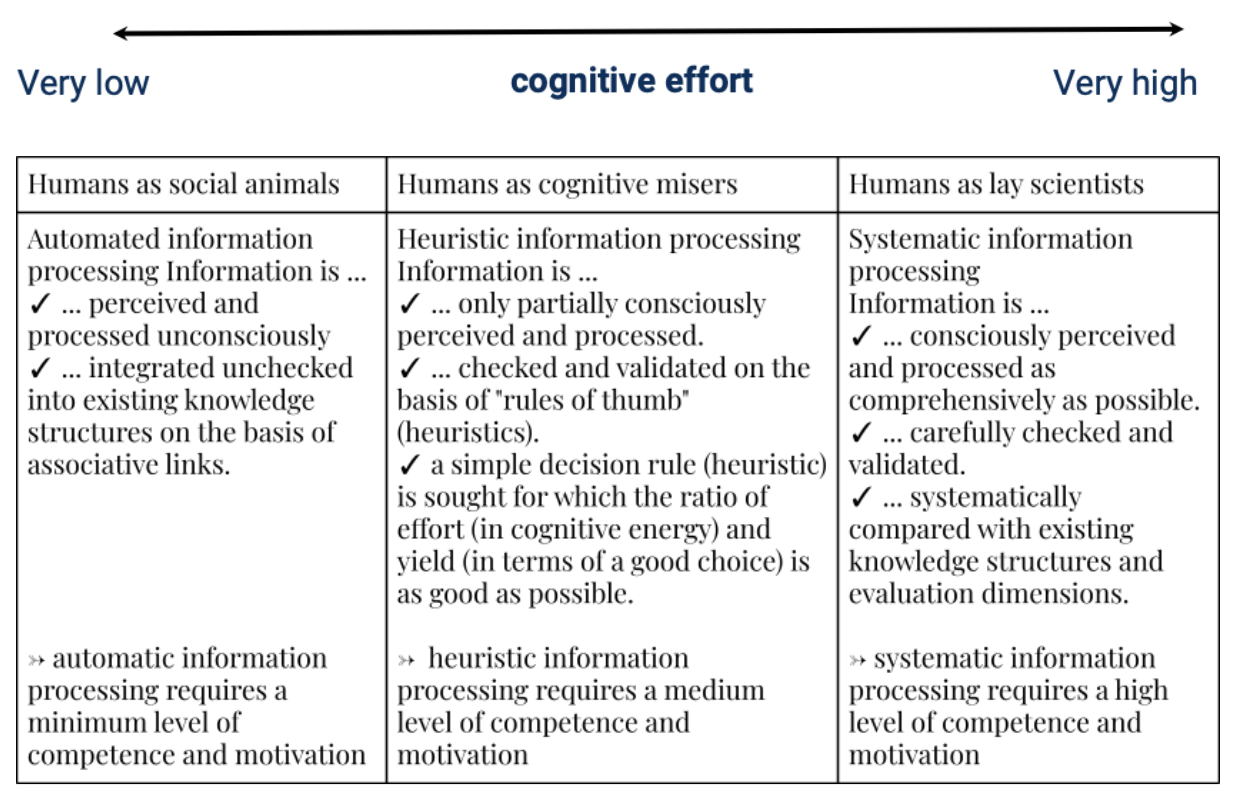
▶︎ 4. Social information processing can involve more or less cognitive effort.
We are surrounded by a vast number of communicative messages every day. How do we deal with them?
102
Dual-process models of information processing
Assumption in two-process models of information processing.
Two different cognitive systems exist in which information is processed in different ways.
System 1: automatic, little cognitive effort
System 2: reflected, much cognitive effort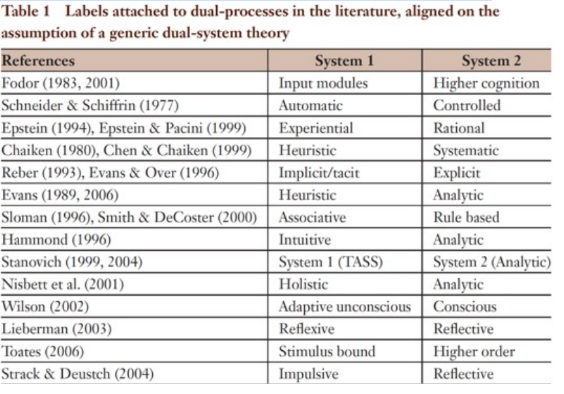
Two different cognitive systems exist in which information is processed in different ways.
System 1: automatic, little cognitive effort
System 2: reflected, much cognitive effort
103
Social Relations and Interdependence
Basic assumptions:
Basic assumptions:
Communication is contextualized in social relationships and serves to shape relationships (relationship context)
104
▶︎ Systems Theory
Systems theory approaches
Starting point: cybernetics, systems theories, constructivism
Focus on feedback structures of communication in social systems
Starting point: cybernetics, systems theories, constructivism
Focus on feedback structures of communication in social systems
105
Systems theory (e.g. Luhmann, 1984)
A (social) system is composed of elements (people).
Recursivity of social processes: Behaviors of individuals are (co-)conditioned by those of others and in turn simultaneously condition those.
Interaction and communication is understood as a system with rules, patterns and structures. The focus is not on the individual, but on the structures of the social system. The structures become manifest and can be observed as communication
So far, human behavior research has taken a view limited to the individual, which must inevitably lead to erroneous conclusions because the context is not taken into account.
Systems theory approaches do not focus on the traditional sendersign relation (semantics), but on the sender-receiver relation (pragmatics) and the mutual effect of the interaction partners on each other.
each behavior can only be understood in its interpersonal context and is meaningful in a larger framework
Recursivity of social processes: Behaviors of individuals are (co-)conditioned by those of others and in turn simultaneously condition those.
Interaction and communication is understood as a system with rules, patterns and structures. The focus is not on the individual, but on the structures of the social system. The structures become manifest and can be observed as communication
So far, human behavior research has taken a view limited to the individual, which must inevitably lead to erroneous conclusions because the context is not taken into account.
Systems theory approaches do not focus on the traditional sendersign relation (semantics), but on the sender-receiver relation (pragmatics) and the mutual effect of the interaction partners on each other.
each behavior can only be understood in its interpersonal context and is meaningful in a larger framework
106
Watzlawick „Pragmatics of human communication“
▷Axioms
One cannot not communicate
One cannot not behave.
Every behavior has potentially a communicative meaning.
Every communication has a content aspect and a relationship aspect, the latter determining the former.
The content aspect conveys the data, the relationship aspect indicates how these data are to be understood.
The nature of a relationship is conditioned by the punctuation of the communication processes on the part of
the partners.
Stimulus-response structures can be understood or constructed in communication processes in a variety of ways.
Human communication uses digital and analog modalities.
Digital modalities (e.g. language) have complex and versatile logical syntax, but inadequate semantics in the field of relations.
→ predominantly content aspect
Analog modalities (e.g., facial expressions) have this semantic potential, but lack the logical syntax necessary for unambiguous communications. → predominantly relational aspect
Interpersonal communication processes are either symmetrical or complementary, depending on whether the relationship between the partners is based on equality or difference.
Complementary relationships are often observed in dependency relationships (e.g. supervisor and employee, mother and child, doctor and patient).
One cannot not communicate
One cannot not behave.
Every behavior has potentially a communicative meaning.
Every communication has a content aspect and a relationship aspect, the latter determining the former.
The content aspect conveys the data, the relationship aspect indicates how these data are to be understood.
The nature of a relationship is conditioned by the punctuation of the communication processes on the part of
the partners.
Stimulus-response structures can be understood or constructed in communication processes in a variety of ways.
Human communication uses digital and analog modalities.
Digital modalities (e.g. language) have complex and versatile logical syntax, but inadequate semantics in the field of relations.
→ predominantly content aspect
Analog modalities (e.g., facial expressions) have this semantic potential, but lack the logical syntax necessary for unambiguous communications. → predominantly relational aspect
Interpersonal communication processes are either symmetrical or complementary, depending on whether the relationship between the partners is based on equality or difference.
Complementary relationships are often observed in dependency relationships (e.g. supervisor and employee, mother and child, doctor and patient).
107
▷ Criticism of systems theoretical approaches
Partly very theoretical and abstract in the basic assumptions.
Unclear to what extent the assumptions are empirically testable. Scientificity?
Role of the individual is neglected.
Unclear to what extent the assumptions are empirically testable. Scientificity?
Role of the individual is neglected.
108
▶︎ Psychology of Social Relations
The concept of relationship is complex and ambiguous.
Being related to each other by thoughts, feelings, behaviors between two people or groups.
Social relationships can have positive or negative qualities.
There are role-typical relationships of people to each other (e.g. neighborhood relationship, intimate relationship).
Extent of common previous experiences (e.g. "We don't have a common relationship.").
Social relations can be (at least temporarily) asynchronous,
Being related to each other by thoughts, feelings, behaviors between two people or groups.
Social relationships can have positive or negative qualities.
There are role-typical relationships of people to each other (e.g. neighborhood relationship, intimate relationship).
Extent of common previous experiences (e.g. "We don't have a common relationship.").
Social relations can be (at least temporarily) asynchronous,
109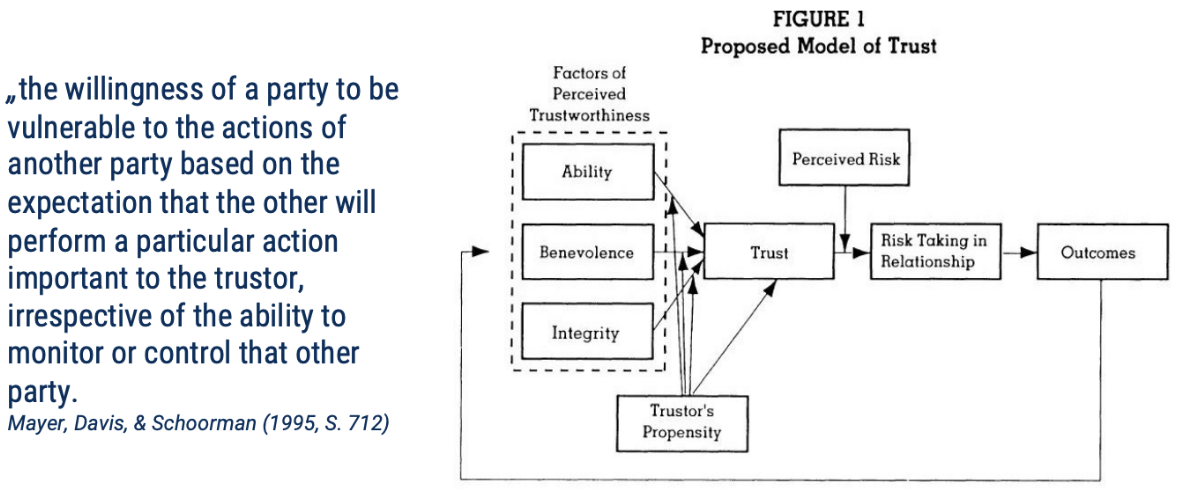
▷ Interpersonal trust as a basis of social relations
110
▷ How does trust develop in social relationships?
Social penetration theory (Altman & Taylor, 1973)
Central assumption: Self-disclosure is key to the development of social relationships.

Central assumption: Self-disclosure is key to the development of social relationships.
111
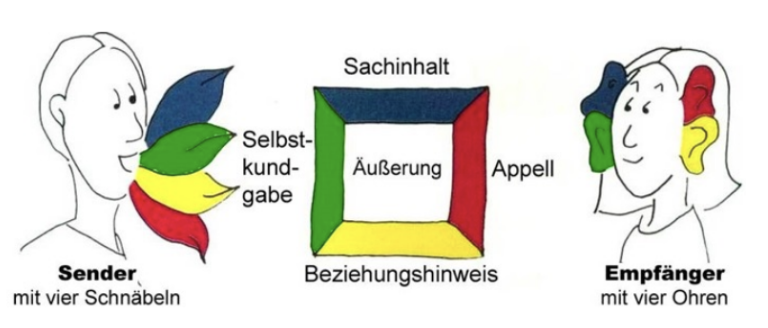
▷ Four sides of a message (Schulz von Thun, 1981-1998)
Four messages
a factual information (what I inform about) - blue
a self-disclosure (what I am revealing about myself) - green
a relationship hint (what I think of you and how I relate to you) - yellow
an appeal (what I would like to achieve with you) - red
integration of the assumptions of Bühler and Watzlawick
a factual information (what I inform about) - blue
a self-disclosure (what I am revealing about myself) - green
a relationship hint (what I think of you and how I relate to you) - yellow
an appeal (what I would like to achieve with you) - red
integration of the assumptions of Bühler and Watzlawick
112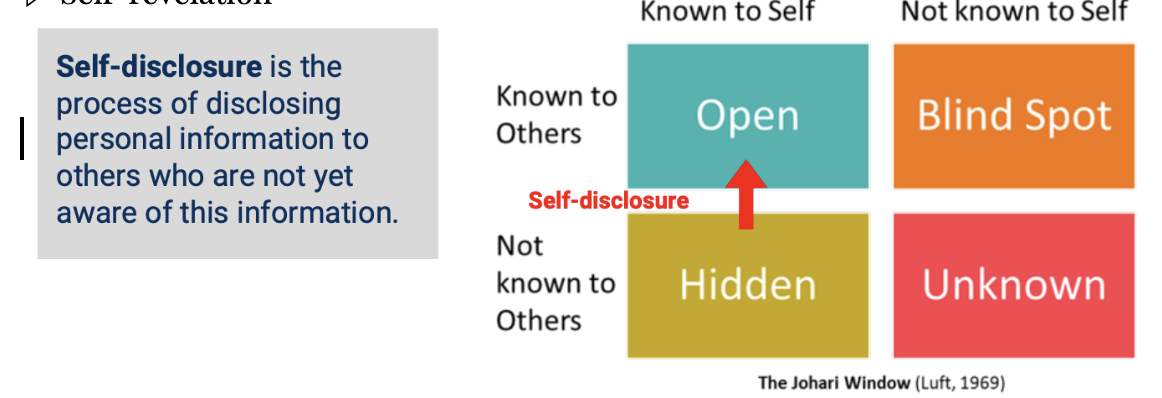
▷ Self-revelation
113
Dimesnosions of Self-disclosure
114
▷ Historical development of research on self-disclosure
Kurt Lewin (1890-1947): Cross-Cultural Differences in the Willingness to Self-Reveal.
Sidney Jourard (1926-1974): Self-revelation is important for the development of a healthy personality and good social relationships
Boom in recent years: Social networking sites are among the important instances of communication and socialization in which self-disclosure can be tried out, learned, and managed (Krämer, Eimler & Neubaum 2017).
Sidney Jourard (1926-1974): Self-revelation is important for the development of a healthy personality and good social relationships
Boom in recent years: Social networking sites are among the important instances of communication and socialization in which self-disclosure can be tried out, learned, and managed (Krämer, Eimler & Neubaum 2017).
115
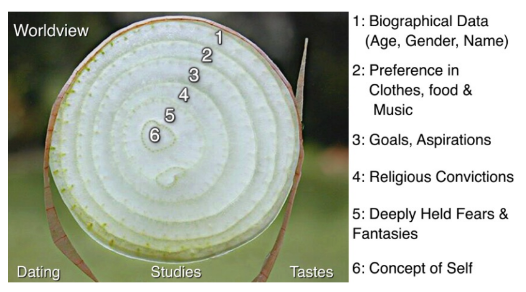
Social Penetration Theory (Altman & Taylor, 1973)
Assumptions: Social relationships evolve from superficial to intimate levels.
116
Social relationships with media figures
Parasocial Relationships (Horton & Wohl, 1956)
Affective Disposition Theory (Zillmann, 1996)
Identification with media figures (e.g., Oatley, 1994)
Uncanny Valley (Mori, 197
Affective Disposition Theory (Zillmann, 1996)
Identification with media figures (e.g., Oatley, 1994)
Uncanny Valley (Mori, 197
117
▷ Parasocial interactions as a form of asymmetric interaction
-> Parasocial Interactions (PSI): Interaction between recipient and media figure (persona / personae) (Horton & Wohl, 1956).
-> Automated and unconscious processes of social perception (Hartmann et al., 2004):
-> perceptual-cognitive PSI: thought processes (attention, memory retrieval, evaluations)
-> affective PSI: emotional reactions (similar to empathy and affective disposition)
-> conative PSI: observable behavior (verbal expressions, facial expressions, gestures)
-> Automated and unconscious processes of social perception (Hartmann et al., 2004):
-> perceptual-cognitive PSI: thought processes (attention, memory retrieval, evaluations)
-> affective PSI: emotional reactions (similar to empathy and affective disposition)
-> conative PSI: observable behavior (verbal expressions, facial expressions, gestures)
118
▷ Parasocial interactions and parasocial relationships
Parasocial relations (PSR): Result from repeated PSI. Prior knowledge, evaluations and judgments of the recipients about the personae are present
PSR more likely to be "acquaintance" than "friendship" (Gleich & Burst, 1996).
"Parasocial breakup": emotions after end of "Friends" comparable to real loss in terms of sadness and loneliness (Eyal & Cohen, 2006)
PSR more likely to be "acquaintance" than "friendship" (Gleich & Burst, 1996).
"Parasocial breakup": emotions after end of "Friends" comparable to real loss in terms of sadness and loneliness (Eyal & Cohen, 2006)
119
Criticism: Parasocial interactions and parasocial relationships
Conceptual vagueness, i.e., PSI and PSR are not always used distinctively.
Methodological imprecision, i.e. measurement instruments are not standardized.
Mostly survey studies, hardly any experiments.
Hardly any research outside the mainstream: e.g., are there parasocial enmities?
Methodological imprecision, i.e. measurement instruments are not standardized.
Mostly survey studies, hardly any experiments.
Hardly any research outside the mainstream: e.g., are there parasocial enmities?
120
Identification with media figures
Identification with the persona or with an avatar: Imaginative process with strong cognitive and emotional connection between recipient and persona.
Adoption of the persona's perspective, identity, feelings, and goals.
Stronger identification with characters in video games?
Klimmt et al. (2010): After video game adoption of corresponding traits (measured with the IAT; Implicit Association Test).
Adoption of the persona's perspective, identity, feelings, and goals.
Stronger identification with characters in video games?
Klimmt et al. (2010): After video game adoption of corresponding traits (measured with the IAT; Implicit Association Test).
121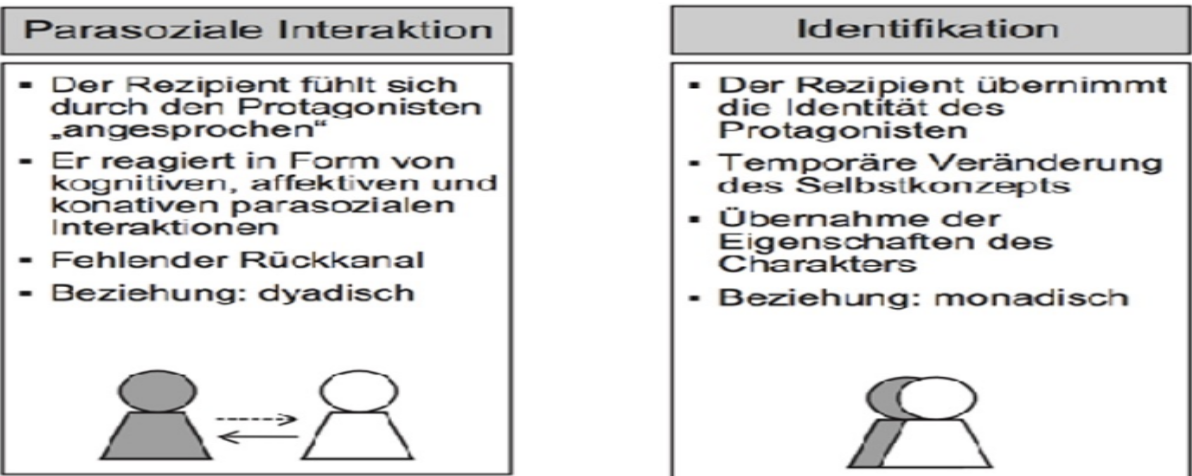
▷ Comparison of the approaches
122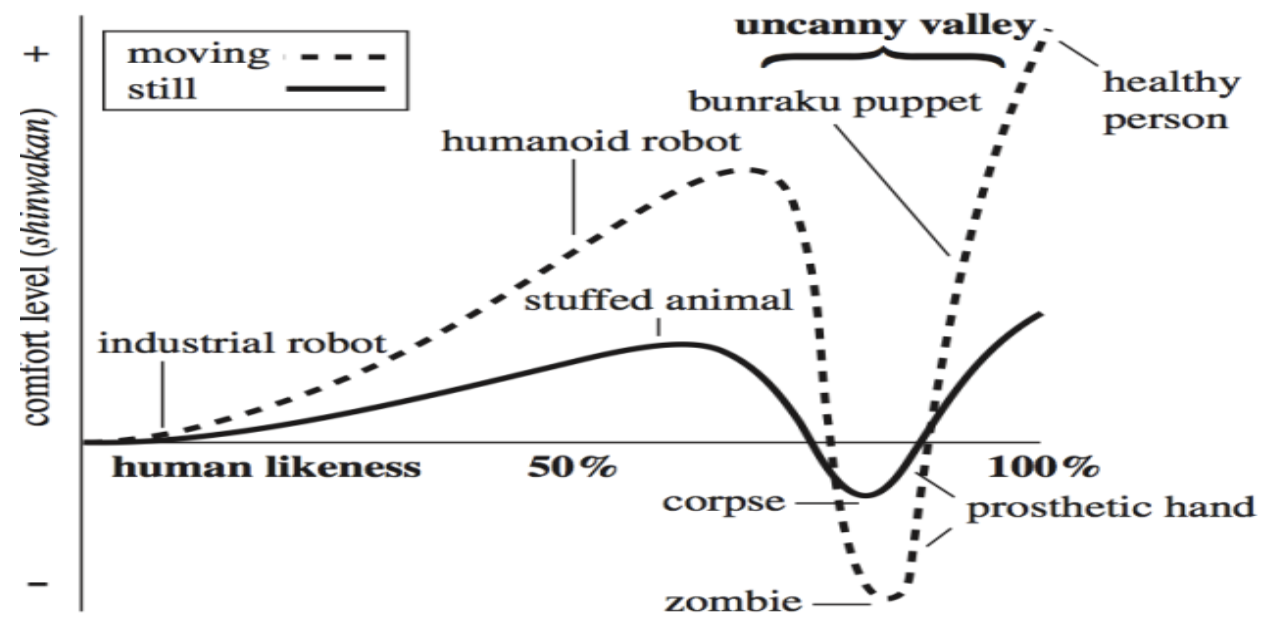
Uncanny Valley Effect (Mori, 1970)
123
Early research on the psychology of groups and masses
»Psychologie des foules« (Gustave Le Bon 1895)
Idea of the "mass mind"
"The conscious personality fades away, the feelings and thoughts of all individuals are oriented in the same direction. A communal soul is formed, which is changeable, but of a very definite kind." (Le Bon 1895; quoted from the German translation 2009, p. 29)
Idea of the "mass mind"
"The conscious personality fades away, the feelings and thoughts of all individuals are oriented in the same direction. A communal soul is formed, which is changeable, but of a very definite kind." (Le Bon 1895; quoted from the German translation 2009, p. 29)
124
What are groups?
What are groups?
Groups in the psychological sense include at least 3 people...
... who perceive themselves as members of the same social category,
... Have an emotional connection to that category,
... and have some consensus about their understanding of the group and its membership.
... who perceive themselves as members of the same social category,
... Have an emotional connection to that category,
... and have some consensus about their understanding of the group and its membership.
125
Minimal Group Paradigm
School children were divided into two groups based on meaningless criteria
Maximum Joint Payoff: Best output for ingroup and outgrpup
Maximum Ingroup Payoff: Best output for ingroup
Maximum Difference: highest difference between ingroup and outgroup
Maximum Joint Payoff: Best output for ingroup and outgrpup
Maximum Ingroup Payoff: Best output for ingroup
Maximum Difference: highest difference between ingroup and outgroup
126
Social Identity Theory (Tajfel & Turner, 1979/1986)
Core Idea: People draw self-esteem from being a member of a group.
Findings:
Groups strive to distinguish themselves positively from other groups (positive social distinctiveness)
This can be achieved by enhancing the value of one's own group or by decreasing the value of the other group.
Basic assumptions:
Individuals strive for a positive self-view and high self-worth.
Membership in a social group can, depending on the evaluation of one's own group, positively or negatively influence one's selfworth.
Evaluations of one's own group always happens in comparison to other groups.
Findings:
Groups strive to distinguish themselves positively from other groups (positive social distinctiveness)
This can be achieved by enhancing the value of one's own group or by decreasing the value of the other group.
Basic assumptions:
Individuals strive for a positive self-view and high self-worth.
Membership in a social group can, depending on the evaluation of one's own group, positively or negatively influence one's selfworth.
Evaluations of one's own group always happens in comparison to other groups.
127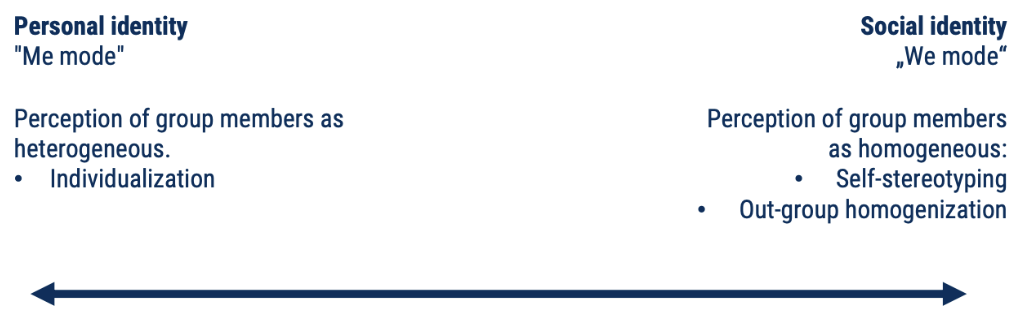
Destinction between personal and social identity
128
Dealing with negative intergroup comparison
Social competition - groups enter into social competition up to and including violent confrontation
Social creativity - re-evaluation processes are expressed in a change of the social comparison dimension. Groups with lower status can emphasize positive group characteristics (e.g. "poor but sexy.").
Social mobility - Describes the attempt to change a social group. Usually a problem when members of lower-status groups want to move to higherstatus groups.
Social creativity - re-evaluation processes are expressed in a change of the social comparison dimension. Groups with lower status can emphasize positive group characteristics (e.g. "poor but sexy.").
Social mobility - Describes the attempt to change a social group. Usually a problem when members of lower-status groups want to move to higherstatus groups.
129
Self-categorisation Theory (Turner et al., 1987)
Original idea: better understanding of the cognitive preconditions and mechanisms that enable people to exhibit particular behaviors as group members.
Basic assumptions:
The self-concept consists of different facets. Self-categorizations can take place on an interindividual or intergroup level.
Depending on personal characteristics and social context, different features of the self concept may be more salient.
Social category (e.g., gender) must be cognitively available.
Fit to the social category (e.g. gender) must be high.
Basic assumptions:
The self-concept consists of different facets. Self-categorizations can take place on an interindividual or intergroup level.
Depending on personal characteristics and social context, different features of the self concept may be more salient.
Social category (e.g., gender) must be cognitively available.
Fit to the social category (e.g. gender) must be high.
130
Conceptualizations in research on self-perception
The self-concept includes...
... a person's assumptions about who he or she is (real self)
objective characteristics (age, gender, star sign)
biographical memories (best friends, good experiences, failures, losses)
descriptive beliefs (facts like: I am more intelligent than 50% of the population)
... assumptions of a person about who he should be (ideal self)
persoal goals
normative beliefs (e.g. I should lose weight.)
If the real and ideal selves diverge too much, this results in
negative selfevaluations → negative self-esteem
... a person's assumptions about who he or she is (real self)
objective characteristics (age, gender, star sign)
biographical memories (best friends, good experiences, failures, losses)
descriptive beliefs (facts like: I am more intelligent than 50% of the population)
... assumptions of a person about who he should be (ideal self)
persoal goals
normative beliefs (e.g. I should lose weight.)
If the real and ideal selves diverge too much, this results in
negative selfevaluations → negative self-esteem
131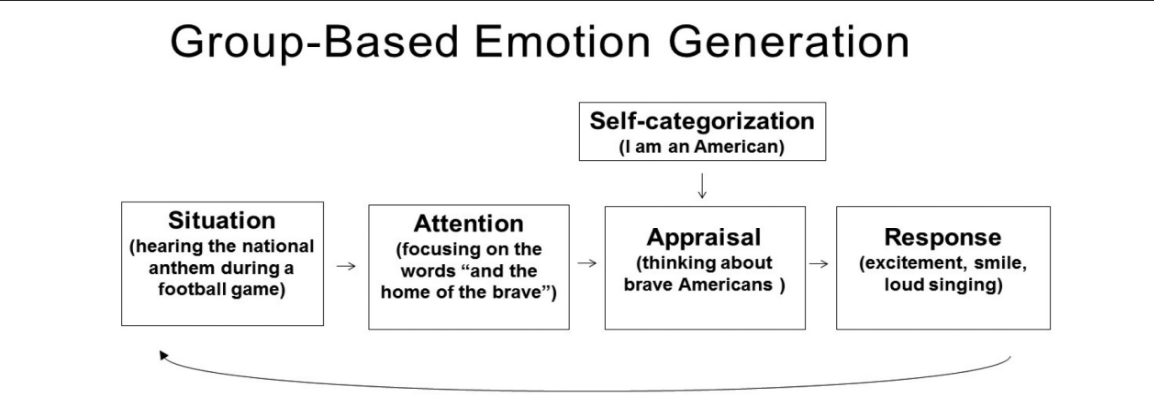
Group-Based Emotions
132
Collective Action
Collective action includes actions taken by members of disadvantaged groups to improve the status or living conditions of that group (German translation after Wright et al. 1990).
133
Intergroup communication
Intergroup communication examines communication between individuals with a focus on how group salience motivates them.
e.g. sexism, e.g. racism
e.g. sexism, e.g. racism
134
Prototypes and stereotypes
Prototypes are understood as typical representatives of a social category.
A stereotype ("All Italians love espresso and ice cream!") is the generalized attribution of certain characteristics and traits to all members of a group. Differences between group members are not taken into account.
A stereotype ("All Italians love espresso and ice cream!") is the generalized attribution of certain characteristics and traits to all members of a group. Differences between group members are not taken into account.
135
Psychological benefits of stereotypes
Stereotypes serve to reduce cognitive complexity.
Stereotypes serve as a form of cognitive heuristic for predicting the behavior and attitudes of other people.
Often, however, these „quick and dirty" classifications are wrong and do not correspond to reality.
Under what conditions do people use stereotypes ?
Stereotypes serve as a form of cognitive heuristic for predicting the behavior and attitudes of other people.
Often, however, these „quick and dirty" classifications are wrong and do not correspond to reality.
Under what conditions do people use stereotypes ?
136
Person characteristics that promote stereotype thinking
e.g. ambiguity intolerance (need for cognitive closure): People with a strong need for closure or clarity like order, decisiveness, and predictability. The structuring of the social experience into groups that are neatly separated from each other, that each seem very homogeneous, and that are easily evaluated according to whether one belongs to them, satisfy this need (Roets & Van Hiel, 2011).
137
Situational features that promote stereotype thinking.
Situational features that promote stereotype thinking.
e.g., cognitive load: Under cognitive load, stereotypes guide to a greater extent the expectations people have about their communication partners.
e.g., intergroup competition: Competition between groups increases the salience of social identity and thereby promotes self-stereotyping and othergroup homogenization.
e.g., cognitive load: Under cognitive load, stereotypes guide to a greater extent the expectations people have about their communication partners.
e.g., intergroup competition: Competition between groups increases the salience of social identity and thereby promotes self-stereotyping and othergroup homogenization.
138
Prejudices
Prejudice ("Anyone who likes classical music is a bore, which I reject!") refers to the negative attitude or negative emotions (affective) toward persons that exist solely because these persons belong to a certain group. Prejudice has both a cognitive (negative evaluations) and affective component, with the latter being the most prominent.
→ Negative attitudes and feelings that result from negative stereotypes
→ Negative attitudes and feelings that result from negative stereotypes
139
Discrimination
Discrimination refers to hostile and pejorative behavior toward individuals that is exhibited because of their membership in a particular group. Discrimination is the behavioral expression of stereotypes or prejudices by members of socially more powerful groups (e.g., based on number or social status) versus members of socially weaker groups (e.g., gender, skin color, religious affiliation…)
140
Theory of realistic group conflict (Sherif, 1966)
limited resources promote conflict between groups
Prejudice and discrimination increase when the situation is tense and there is conflict over resources or goals that are important to both sides.
Prejudice and discrimination increase when the situation is tense and there is conflict over resources or goals that are important to both sides.
141
Intergroup solidarity
Intergroup solidarity includes actions performed by members of privileged groups to improve the status or living conditions of disadvantaged groups.
142
Communication Accommodation Theory (CAT, Giles et al., 1987)
Context of origin: change in the expression of dialect and second language in the context of intergroup relations.
→ is now understood as an "interdisciplinary model of relational and identity processes in communicative interaction" (Coupland & Jaworski, 1997, pp. 241–242)
Basic assumptions:
Interaction partners have expectations about the optimal level of adaptation.
These expectations are based on stereotypes towards members of foreign groups as well as social norms.
Interaction partners use specific communication strategies, specifically convergence and divergence, to signal attitudes toward each other and their social group in question.
→ is now understood as an "interdisciplinary model of relational and identity processes in communicative interaction" (Coupland & Jaworski, 1997, pp. 241–242)
Basic assumptions:
Interaction partners have expectations about the optimal level of adaptation.
These expectations are based on stereotypes towards members of foreign groups as well as social norms.
Interaction partners use specific communication strategies, specifically convergence and divergence, to signal attitudes toward each other and their social group in question.
143
what are convergence and divergence
Convergence
Strategy by which individuals adapt their communication behavior in terms of linguistic (e.g., accent), paralinguistic (e.g., pauses), and non-verbal features (e.g., smile, gaze direction) to their counterpart type.
Divergence
Accentuation of verbal or non-verbal differences to interaction partners
Strategy by which individuals adapt their communication behavior in terms of linguistic (e.g., accent), paralinguistic (e.g., pauses), and non-verbal features (e.g., smile, gaze direction) to their counterpart type.
Divergence
Accentuation of verbal or non-verbal differences to interaction partners
144
Reduction of prejudice
"contact hypothesis" (Allport, 1954) : Contact between members of two groups leads to a reduction in prejudice and hostility.
Prerequisite:
1. The status of both groups should be equal, since negative stereotypes often exist regarding the abilities or competencies of groups with low social status.
2. Both groups should pursue a common goal or have certain tasks to solve together (the example of a joint paper).
3. The groups should be supported in their behavior by established norms (for example, when a teacher establishes prosocial norms).
4. Opportunities for contact with members of the outside group should be high. This can lead to the generalization of positive experiences with one person to the entire foreign group.
Prerequisite:
1. The status of both groups should be equal, since negative stereotypes often exist regarding the abilities or competencies of groups with low social status.
2. Both groups should pursue a common goal or have certain tasks to solve together (the example of a joint paper).
3. The groups should be supported in their behavior by established norms (for example, when a teacher establishes prosocial norms).
4. Opportunities for contact with members of the outside group should be high. This can lead to the generalization of positive experiences with one person to the entire foreign group.
145
Further development of the contact hypothesis (from WE against YOU to...)
Decategorization approach (Brewer & Miller, 1984).
→ Reduce social categorization by minimizing the salience of group membership: Perceiving the other as an individual rather than a group member (...YOU and ME).
Recategorization approach (Gaertner, Dovidio, Anastasio, Bachman & Rust, 1993).
→ Make a superordinate category salient to which both group can be subsumed ("common ingroup identity"): Perceiving the other as a member of the same group (...COMMON WE).
Mutual differentiation approach (Hewstone & Brown, 1986)
→ Mitigate social competition by differentiating different areas of competence. Perceiving the value of both groups (... WE and YOU)
→ Reduce social categorization by minimizing the salience of group membership: Perceiving the other as an individual rather than a group member (...YOU and ME).
Recategorization approach (Gaertner, Dovidio, Anastasio, Bachman & Rust, 1993).
→ Make a superordinate category salient to which both group can be subsumed ("common ingroup identity"): Perceiving the other as a member of the same group (...COMMON WE).
Mutual differentiation approach (Hewstone & Brown, 1986)
→ Mitigate social competition by differentiating different areas of competence. Perceiving the value of both groups (... WE and YOU)
146
Media Definition
"Media in this context are all technology-based means of encoding and transmitting, storing, and retrieving and decoding information relevant to participation in mass communication and media individual communication."
147
How do forms of computer mediated communication differ?
Distinguishing criteria
Distinguishing criteria
Number and quality of the sensory channels involved
Extent of interactivity
Synchronous vs. asynchronous communication
Number of recipients
Extent of interactivity
Synchronous vs. asynchronous communication
Number of recipients
148
Number and quality of the sensory channels involved
1. Remote senses: sense of hearing (oral), sense of sight (visual), sense of smell (olfactory)
Proximate senses: sense of touch (haptic), sense of taste (gustatory)
Other senses: sense of temperature, sense of pain, sense of balance, body perception
→ Human communication usually involves several senses
2. Modalities of verbal communication
Verbal: spoken word, content of speech
Paraverbal: vocal means accompanying speech, i.e. linked to sounds, which are important for communication (e.g. volume, speech rate, pitch, pauses in speech)
Nonverbal: communication via other sensory channels
→ Different modalities can contradict each other
3. Reduction of the number and quality of sensory impressions in computer-mediated communication The communication technology determines which sensory channels are addressed. Examples:
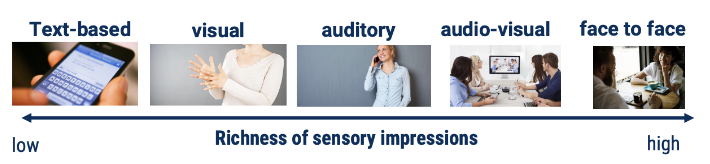
Proximate senses: sense of touch (haptic), sense of taste (gustatory)
Other senses: sense of temperature, sense of pain, sense of balance, body perception
→ Human communication usually involves several senses
2. Modalities of verbal communication
Verbal: spoken word, content of speech
Paraverbal: vocal means accompanying speech, i.e. linked to sounds, which are important for communication (e.g. volume, speech rate, pitch, pauses in speech)
Nonverbal: communication via other sensory channels
→ Different modalities can contradict each other
3. Reduction of the number and quality of sensory impressions in computer-mediated communication The communication technology determines which sensory channels are addressed. Examples:
149
Extent of interactivity
extent of interactivity depends on how much individuals orient to their own and / or communication partners' mental processes (Jones & Gerard, 1967)
1. reciprocal contingency (e.g., sincere dialogue)
2. pseudo-interaction (e.g. escalating argument)
3. asymmetric interaction (e.g., communication with a strong power imbalance)
4. reactive interaction (e.g. behavior during group panic)
1. reciprocal contingency (e.g., sincere dialogue)
2. pseudo-interaction (e.g. escalating argument)
3. asymmetric interaction (e.g., communication with a strong power imbalance)
4. reactive interaction (e.g. behavior during group panic)
150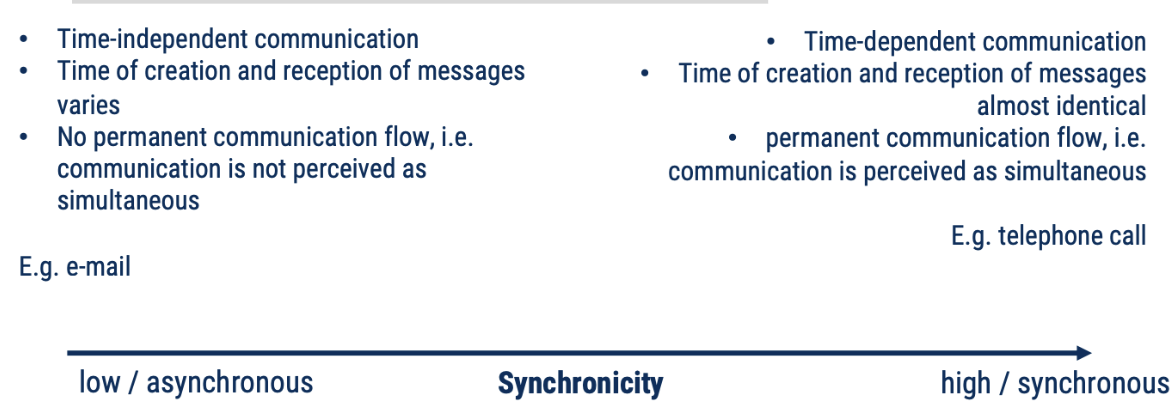
Synchronous vs. asynchronous communication
151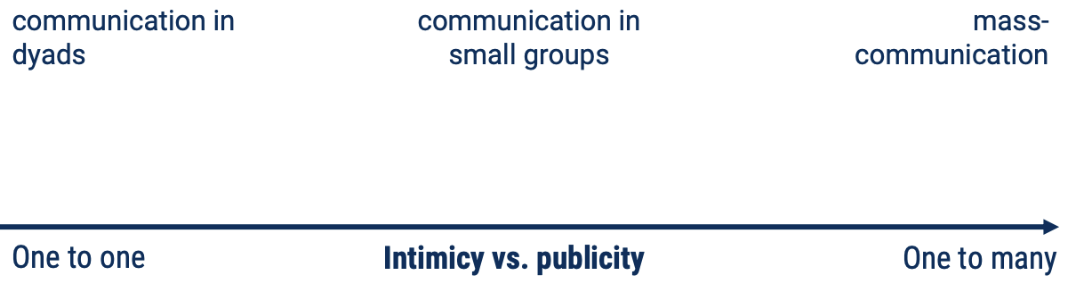
Number of recipients
152
When is which form of media-mediated communication useful?
When is which form of media-mediated communication useful?
Media Richness Model (Daft & Lengel, 1986)
Media Synchronicity Theory (Dennis & Valacich, 1999)
Media Richness Model (Daft & Lengel, 1986)
Media Synchronicity Theory (Dennis & Valacich, 1999)
153
Media Richness Model (Daft & Lengel, 1986)
Central assumption: The success of computer-mediated individual communication depends on the fit between medium and communication context.
Communication contexts are distinguished according to their ambiguity
Media are differentiated according to their richness
Communication contexts are distinguished according to their ambiguity
Media are differentiated according to their richness
154
Ambiguity in the communicative situation
(Media Richness Model (Daft & Lengel, 1986) )
(Media Richness Model (Daft & Lengel, 1986) )
Communication contexts are differentiated according to their ambiguity. High ambiguity implies a large amount of interpretation, i.e., the interaction partners must develop a common understanding of the situation; with low ambiguity, this understanding already exists. low ambiguity high
E.g. scheduling E.g. conflict
E.g. scheduling E.g. conflict
155
Richness of the medium
(Media Richness Model (Daft & Lengel, 1986) )
(Media Richness Model (Daft & Lengel, 1986) )
"Communication media can be characterized as 'rich' or 'lean' based upon their capacity to facilitate shared meaning" (Trevino, Daft & Lengl, 1990, p. 75).
Components of media richness
Speed with which feedback processes are possible (synchronicity)
Number of available sensory channels or cue systems (sensory channels)
Responsiveness of communication in media (interactivity)
Possibility to personalize and convey personal feelings (amount of respondents)
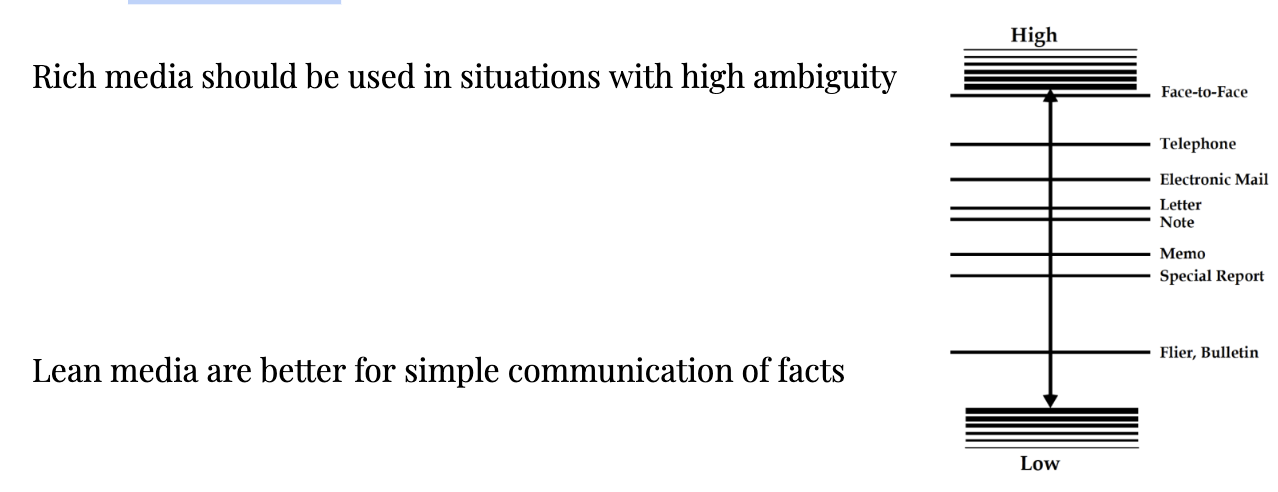
Components of media richness
Speed with which feedback processes are possible (synchronicity)
Number of available sensory channels or cue systems (sensory channels)
Responsiveness of communication in media (interactivity)
Possibility to personalize and convey personal feelings (amount of respondents)
156
Media Synchronicity Theory (Dennis & Valacich, 1999)
Central assumption: Face-to-face communication is not always the richest form of communication. Distinction between two functions of communication
157
Distinction between two functions of communication
(Media Synchronicity Theory (Dennis & Valacich, 1999) )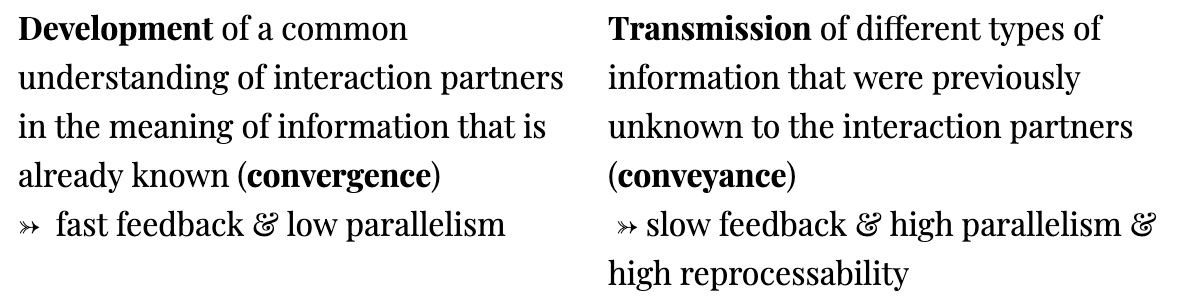
Distinction between two functions of communication
(Media Synchronicity Theory (Dennis & Valacich, 1999) )
158
Computer-mediated communication varies depending on ...
... the immediacy of feedback, i.e. the ability of a medium to allow rapid mutual feedback.
... the variabilityof the linguistic symbols used , i.e. the richness of communicative messages in the sense of media richness theory.
... the parallelism of communication, i.e. the number of simultaneous messages that are possible.
... the editability of communication, i.e. the extent to which communication content can be adapted before it is transmitted
... the processability of communication, i.e. the extent to which communication content can be stored and recalled.
... the variabilityof the linguistic symbols used , i.e. the richness of communicative messages in the sense of media richness theory.
... the parallelism of communication, i.e. the number of simultaneous messages that are possible.
... the editability of communication, i.e. the extent to which communication content can be adapted before it is transmitted
... the processability of communication, i.e. the extent to which communication content can be stored and recalled.
159
How does media use change human communication relationships? -> hypothesis
Example: Personality and online dating
People with a tendency toward depression, fear of commitment, or fear of social rejection are more likely to use online dating.
→ It remains unclear to what extent this actually improves well-being and life satisfaction.
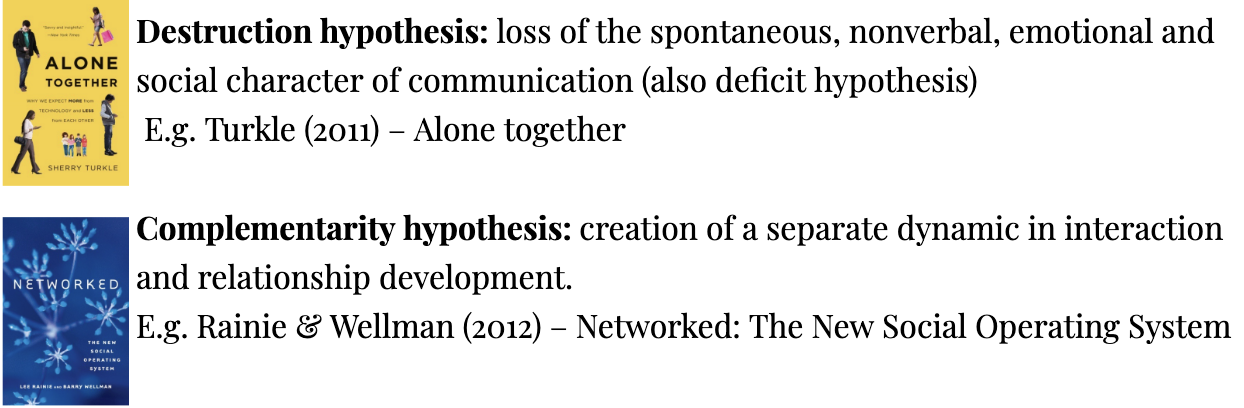
People with a tendency toward depression, fear of commitment, or fear of social rejection are more likely to use online dating.
→ It remains unclear to what extent this actually improves well-being and life satisfaction.
160
How does media use change human communication relationships?
1. Computer-mediated communication filters out social cues and background information
Examples:
Absence of contextual information (e.g., nonverbal or paraverbal signals) in text-based communication.
Regulation of communication (e.g. by illustrators) more difficult
Limited possibility to communicate affective states
No transmission of status information
No immediate feedback on own communication
Absence of established communication norms
2. Computer-mediated communication differs in terms of social cues are filtered out
3. The filtering of social cues can create positive (complementarity hypothesis) and negative psychological effects (destruction hypothesis)
Examples:
Absence of contextual information (e.g., nonverbal or paraverbal signals) in text-based communication.
Regulation of communication (e.g. by illustrators) more difficult
Limited possibility to communicate affective states
No transmission of status information
No immediate feedback on own communication
Absence of established communication norms
2. Computer-mediated communication differs in terms of social cues are filtered out
3. The filtering of social cues can create positive (complementarity hypothesis) and negative psychological effects (destruction hypothesis)
161
Accumulation of misunderstandings in the sense of the media richness model.
Information overload due to parallel processing in the sense of the limited capacity model (see slides on media reception).
Deindividuation as a "state of reduced self-evaluation and evaluation anxiety leading to uninhibited antinormative behavior" (Sassenberg, 1999, p. 10).
Potential effects in the sense of the destruction hypothesis
↳ Negative
↳ Negative
Accumulation of misunderstandings in the sense of the media richness model.
Information overload due to parallel processing in the sense of the limited capacity model (see slides on media reception).
Deindividuation as a "state of reduced self-evaluation and evaluation anxiety leading to uninhibited antinormative behavior" (Sassenberg, 1999, p. 10).
162
What promotes deindividuation in the context of media-mediated communication?
Absence of social cues and background information favors the perception of anonymity.
Absence of established communication norms makes it difficult to evaluate one's own behavior.
Absence of established communication norms makes it difficult to evaluate one's own behavior.
163
Egalization of status differences leads to democratization of communication processes
Compensation of missing social cues and contextual information through written language.
→ Deficits created by technology are creatively compensated by users (Walther, 1992) e.g. by using emoticons
Often computer-mediated communication is more quickly judged as intimate, relationships develop more rapidly. Why?
anonymity of CMC enables risk-free self-disclosure
→ Self-disclosure dependent on the extent of anonymity (Joinson, 2001)
↳ Visual anonymity results in more self revelation in communication among strangers
socially anxious people seek relationships through CMC
→ Individuals who experience low levels of social support in everyday life may experience compensation through CMC (Turner et al., 2001)
↳ But: these individuals also appear to be at higher risk for problematic Internet behavior (online communication addiction, Caplan, 2005).
Potential effects in the sense of the complementarity hypothesis
↳ Positive
↳ Positive
Egalization of status differences leads to democratization of communication processes
Compensation of missing social cues and contextual information through written language.
→ Deficits created by technology are creatively compensated by users (Walther, 1992) e.g. by using emoticons
Often computer-mediated communication is more quickly judged as intimate, relationships develop more rapidly. Why?
anonymity of CMC enables risk-free self-disclosure
→ Self-disclosure dependent on the extent of anonymity (Joinson, 2001)
↳ Visual anonymity results in more self revelation in communication among strangers
socially anxious people seek relationships through CMC
→ Individuals who experience low levels of social support in everyday life may experience compensation through CMC (Turner et al., 2001)
↳ But: these individuals also appear to be at higher risk for problematic Internet behavior (online communication addiction, Caplan, 2005).
164
How can the selection of computer-mediated communication be explained psychologically?
Uses and Gratification Approach
Central assumption:
People select media offerings actively and in a goal-oriented manner
Media selection can serve psychological needs and expectations.
Media selection represents one of several ways of satisfying needs.
If the expectations of media choice are met, the probability increases that the same selection behavior will be shown again.
Central assumption:
People select media offerings actively and in a goal-oriented manner
Media selection can serve psychological needs and expectations.
Media selection represents one of several ways of satisfying needs.
If the expectations of media choice are met, the probability increases that the same selection behavior will be shown again.
165
The human being as an active recipient
“Exposure is always selective.“ (Lazarsfeld, Berelson, & Gaudet, 1944)
Selective exposure to media or their contents as a process of information selection in which recipients pay attention to certain stimuli from the multitude of available offers and examine them more closely. (Zillmann & Bryant, 1985)
Specifically in a „high-choice media environment“ (van Aelst et al., 2017)
Selective exposure to media or their contents as a process of information selection in which recipients pay attention to certain stimuli from the multitude of available offers and examine them more closely. (Zillmann & Bryant, 1985)
Specifically in a „high-choice media environment“ (van Aelst et al., 2017)
166
To what extent is this selection always made consciously?
Degree of reflection dependent on person and situation
characteristics (see twoprocess models)
Habitualized media use does not usually occur consciously
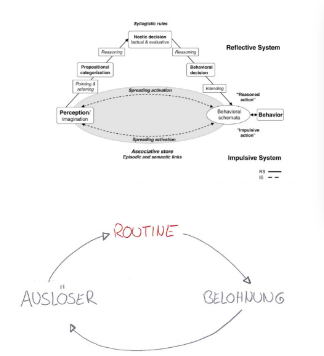
characteristics (see twoprocess models)
Habitualized media use does not usually occur consciously
167
Motivation as a function of expectation and value
Expectancy x Value Theories: Individuals attempt to do what they believe will lead to what they desire (Reisenzein 2006).
IMPORTANT!! Subjective expectations and subjective value of a sequence of actions vary depending on person characteristics and situation characteristics
Every action can have different consequences. These can be positive or negative.
The expected probability (EP) of a consequence varies for persons.
The value (V) of each expected consequence varies for individuals.
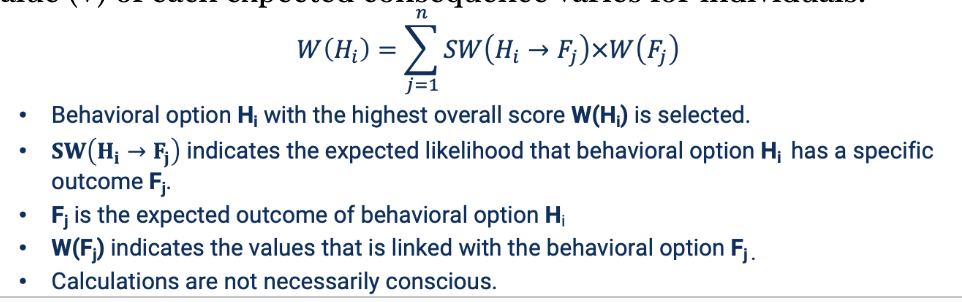
IMPORTANT!! Subjective expectations and subjective value of a sequence of actions vary depending on person characteristics and situation characteristics
Every action can have different consequences. These can be positive or negative.
The expected probability (EP) of a consequence varies for persons.
The value (V) of each expected consequence varies for individuals.
168
Gratification models
Differentiation between
Motivation / reason / gratification sought for media selection
Ex: How important are the following reasons for watching television for you?
the satisfaction of these needs / motives (found gratifications) through media use
Ex: To what extent does television fulfill this need for you?
Motivation / reason / gratification sought for media selection
Ex: How important are the following reasons for watching television for you?
the satisfaction of these needs / motives (found gratifications) through media use
Ex: To what extent does television fulfill this need for you?
169
Expectation-assessment model
Feedback loop: As part of a long-term learning process, individual experiences (in the sense of episodic usage experiences) are condensed into general media knowledge (in the sense of expectations about media, their content, and gratification potentials).

170
What are possible motivations for selecting mediamediated communication offerings?
Mood Management Theory (Zillmann, 1988)
Humans strive to maximize positive moods and minimize negative moods at all times. (Humans are fundamentally hedonistic)
Selection of media offerings based on the current mood
Goal: Maintain or create as good a mood as possible
Humans strive to maximize positive moods and minimize negative moods at all times. (Humans are fundamentally hedonistic)
Selection of media offerings based on the current mood
Goal: Maintain or create as good a mood as possible
171
Which motives / needs are potentially relevant for media selection?
Hedonic motives (fun, relaxation and distraction)
Social motives (closeness and connection with other people, exerting influence on others)
Existential motives (security, integrity, material prosperity)
Epistemic motives (information, orientation, learning, cognition)
Self-related motives (positive self-worth, self-actualization)
Social motives (closeness and connection with other people, exerting influence on others)
Existential motives (security, integrity, material prosperity)
Epistemic motives (information, orientation, learning, cognition)
Self-related motives (positive self-worth, self-actualization)
172
Media experiences differ in:
Hedonic valence
Excitation potential
Absorption potential
Semantic affinity
Excitation potential
Absorption potential
Semantic affinity
173
Hedonic valence
Knobloch & Zillmann (2002)
IV: Manipulation of mood: fake feedback (good, medium, bad) during processing task with ambiguous stimuli.
DV: music choice
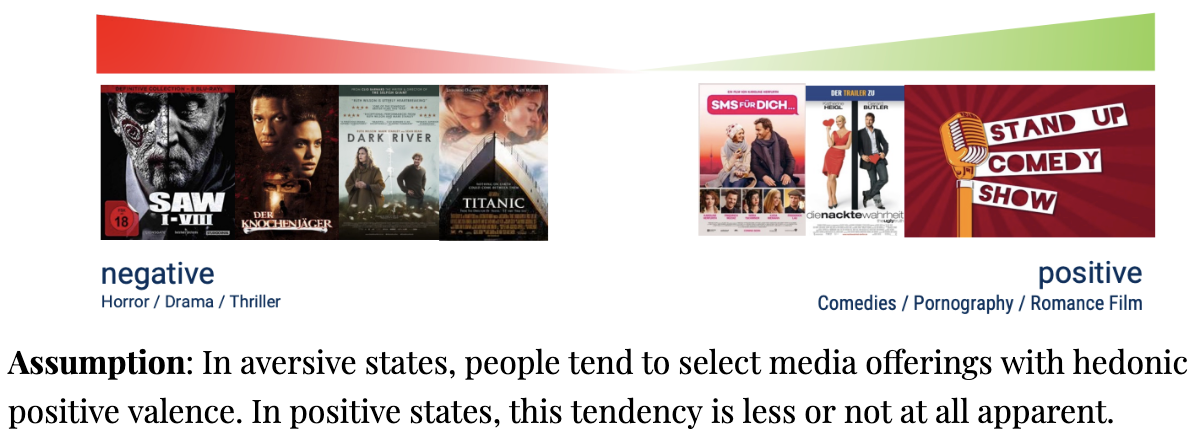
IV: Manipulation of mood: fake feedback (good, medium, bad) during processing task with ambiguous stimuli.
DV: music choice
174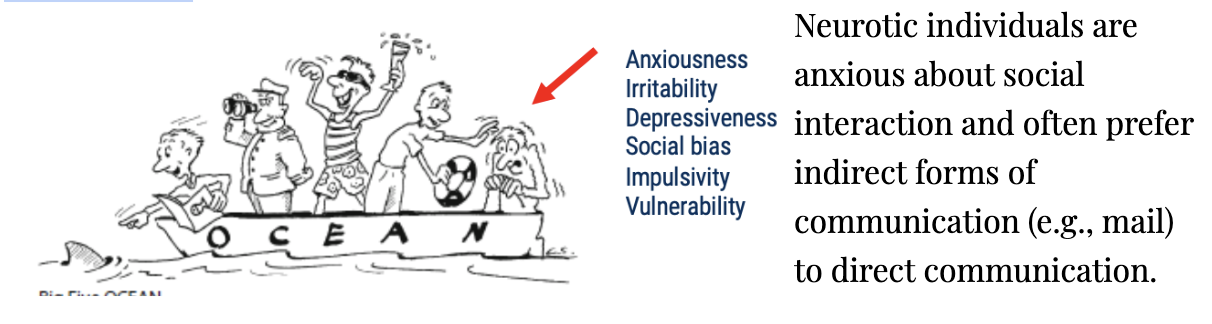
Neuroticism
175
Neuroticism as sensitivity to emotional stimuli
Neuroanatomical substrate: Limbic system
located near the Formatio Reticularis, modulates emotional stimuli and thereby influences the excitation of the autonomic nervous system (in Eysenck "Activation")
→ Interindividual differences are to be expected in that neurotic people use the hedonic valence of emotional situations to a greater extent to regulate their mood by selecting entertainment.
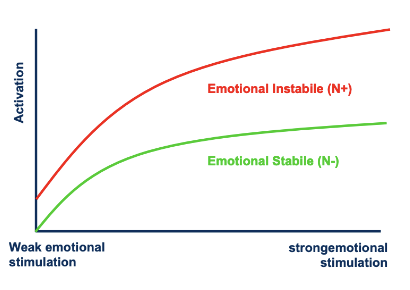
located near the Formatio Reticularis, modulates emotional stimuli and thereby influences the excitation of the autonomic nervous system (in Eysenck "Activation")
→ Interindividual differences are to be expected in that neurotic people use the hedonic valence of emotional situations to a greater extent to regulate their mood by selecting entertainment.
176
Excitation potential
Assumption: If people are in a state of heightened tension (stress), they expose themselves to potentially calming media offerings in order to bring their arousal level to a pleasant level. If they are under-stimulated instead, they select and receive potentially stimulating media offerings.
low: nature movies
high: Horro/Porn/ Sports
Bryant & Zillmann (1984)
IV: Activity: monotonous vs. stress-inducing (3 x 20 minutes each)
DV: choice of TV program and time spent watching it
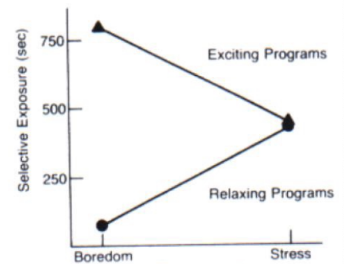
low: nature movies
high: Horro/Porn/ Sports
Bryant & Zillmann (1984)
IV: Activity: monotonous vs. stress-inducing (3 x 20 minutes each)
DV: choice of TV program and time spent watching it
177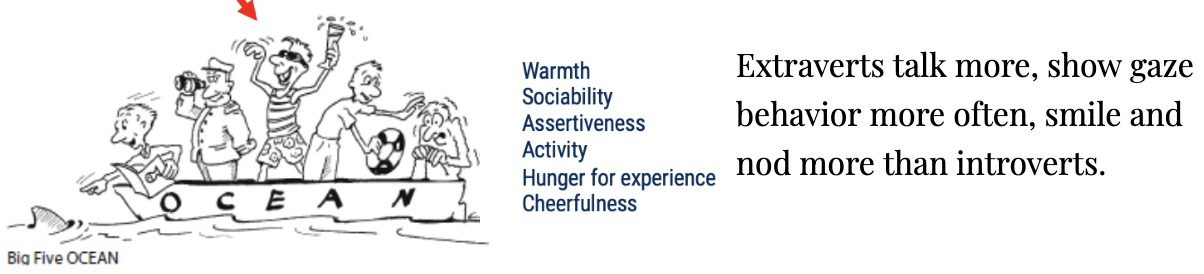
Extraversion
178
Extraversion and cortical arousal
Neuroanatomical substrate: Formatio Reticularis, especially the Ascending Reticular Activation System (ARAS) is a neuronal "brain pacemaker" responsible for the regulation of cortical activity (e.g. sleep-wake rhythm)
-> regulates the degree of wakefulness (continuum from deep sleep to highest arousal)
-> is stimulated by sensory and cognitive stimuli
-> modulates their signal strength
-> thus influences the level of cortical arousal (Eysenck's "arousal")
-> regulates the degree of wakefulness (continuum from deep sleep to highest arousal)
-> is stimulated by sensory and cognitive stimuli
-> modulates their signal strength
-> thus influences the level of cortical arousal (Eysenck's "arousal")
179
Responsiveness of the ARAS, arousability, establishes the individual extraversion score:
Extraverts have lower arousability (and higher threshold) than introverts
Introverts are more easily aroused or activated and reach hedonic tone sooner than extraverts.
Stimulation is actively sought out when the optimal arousal is not reached
→ Extroverts seek out stimulating situations more often than introverts do
If the optimal arousal is exceeded, stimulation is avoided
→ Introverts seek out relaxing situations more often than extroverts do
→ Interindividual differences are to be expected insofar as extraverted people have a higher arousal potential, i.e. they should tend to a greater extent to tension-inducing media offerings.
Now for the criticism...
According to the findings presented so far, how do we explain the devotion to sad media content?
Active selection of sad, devastating, or aversive media content (e.g., movies without happy endings)
According to mood management theory, an avoidance of such content would rather be expected
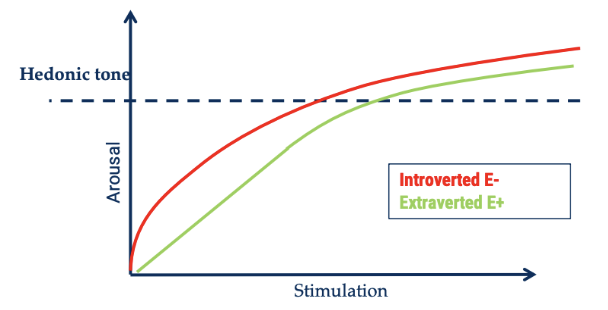
Introverts are more easily aroused or activated and reach hedonic tone sooner than extraverts.
Stimulation is actively sought out when the optimal arousal is not reached
→ Extroverts seek out stimulating situations more often than introverts do
If the optimal arousal is exceeded, stimulation is avoided
→ Introverts seek out relaxing situations more often than extroverts do
→ Interindividual differences are to be expected insofar as extraverted people have a higher arousal potential, i.e. they should tend to a greater extent to tension-inducing media offerings.
Now for the criticism...
According to the findings presented so far, how do we explain the devotion to sad media content?
Active selection of sad, devastating, or aversive media content (e.g., movies without happy endings)
According to mood management theory, an avoidance of such content would rather be expected
180
Why do we watch sad movies? Paradox to the Mood Management Theory
Explanation: Differentiation of hedonic motives
-> hedonic → pleasure as a reward (gratification) vs. eudaimonic Entertainment → sense experience as a reward (gratification)
Explanation: Meta Emotions
-> Meta-emotions i.e. "feelings about feelings" or emotional evaluation of one's own feelings
-> Assumption: people perceive their own emotions during media reception and subject them to evaluation
-> Drama simultaneously negative mood and positive meta-emotions (e.g., experiencing compassion is interpreted as pleasant)
Explanation: Multiple motivations
-> Hedonic motives (fun, relaxation and distraction)
-> Social motives (closeness and connection with other people, exerting influence on others)
- Social comparison process ❖ and social learning
- Parasocial interactions and relationships
-> Existential motives (security, integrity, material prosperity)
- Computer-mediated communication provide orientation and information about problems, social change or the lives of others
-> Epistemic motives (information, orientation, learning, cognition)
- Knowledge of transience and mortality → Strategies for avoiding direct confrontation with this topic
- Symbolic worlds (e.g., sad movies) allow confrontation from a safe distance
-> Self-related motives (positive self-worth, self-actualization)
- Preference for sad films → stabilization of self-image ("I'm not doing so badly")
-> hedonic → pleasure as a reward (gratification) vs. eudaimonic Entertainment → sense experience as a reward (gratification)
Explanation: Meta Emotions
-> Meta-emotions i.e. "feelings about feelings" or emotional evaluation of one's own feelings
-> Assumption: people perceive their own emotions during media reception and subject them to evaluation
-> Drama simultaneously negative mood and positive meta-emotions (e.g., experiencing compassion is interpreted as pleasant)
Explanation: Multiple motivations
-> Hedonic motives (fun, relaxation and distraction)
-> Social motives (closeness and connection with other people, exerting influence on others)
- Social comparison process ❖ and social learning
- Parasocial interactions and relationships
-> Existential motives (security, integrity, material prosperity)
- Computer-mediated communication provide orientation and information about problems, social change or the lives of others
-> Epistemic motives (information, orientation, learning, cognition)
- Knowledge of transience and mortality → Strategies for avoiding direct confrontation with this topic
- Symbolic worlds (e.g., sad movies) allow confrontation from a safe distance
-> Self-related motives (positive self-worth, self-actualization)
- Preference for sad films → stabilization of self-image ("I'm not doing so badly")
181
❖ Example for social comparison in media use
Media choice for self-esteem enhancement: downward comparisons
Hidden camera
Embarrassing situations coerced (e.g., reciting song)
Persons with conspicuous behavior in talk rounds
Hidden camera
Embarrassing situations coerced (e.g., reciting song)
Persons with conspicuous behavior in talk rounds
182
Which basic assumptions apply to the selection of media offerings?
Which basic assumptions apply to the selection of media offerings?
Media selection (like any other behavior) is multidetermined
i. e. ...
different motives / motivations influence media selection behavior
a behavior can be influenced by several motives / motivations at the same time.
computer-mediated communication is capable of delivering specific gratifications to varying degrees.
different aspects of media use can be influenced by different motivations.
i. e. ...
different motives / motivations influence media selection behavior
a behavior can be influenced by several motives / motivations at the same time.
computer-mediated communication is capable of delivering specific gratifications to varying degrees.
different aspects of media use can be influenced by different motivations.
183
Differentiation between media forms based on the selection motivation -> entertainment media
We define entertainment media as media that people use primarily because they expect pleasure or diversion from them - for example, novels, TV and cinema films, music or video games.
→ Only hedonic motives?
Example: Motivation to use Massive Multiplayer Online Games (MMOG)
hedonic motives -> enjoying the game
social motives → connection
self-related motives → pride over achievements, social status, gaining self worth
→ Only hedonic motives?
Example: Motivation to use Massive Multiplayer Online Games (MMOG)
hedonic motives -> enjoying the game
social motives → connection
self-related motives → pride over achievements, social status, gaining self worth
184
Differentiation between media forms based on the selection motivation -> information or news media
We define information or news media as media offerings that people use primarily because they expect to gain information or insights from them - for example, daily newspapers or news broadcasts.
→ only epistemic motives?
Selective exposure
Epistemic Motives →
Self-Related Motives → choose media that relates to your political stances, so they get reassured in their believes
→ only epistemic motives?
Selective exposure
Epistemic Motives →
Self-Related Motives → choose media that relates to your political stances, so they get reassured in their believes
185
Differentiation between media forms based on the selection motivation -> social media
We define social media as media offerings that people use primarily because they expect to feel close to and connected with other people - for example, Facebook or Twitter.
→ Social motives?
→ Social motives?
186
Media reception and experience
Reception Experience:
Reception Experience:
Processes that occur during the use of media
Thoughts and feelings that media stimuli evoke in users
Thoughts and feelings that media stimuli evoke in users
187
Information Processing
Cognitive processing of media messages
Only content that is perceived and cognitively processed can influence media experience
Limited Capacity Model (Lang, 2000)
is based on cognitive psychology and draws on basic information processing processes
transfers these to the context of media reception
The term information processing describes a group of simultaneous cognitive processes that individuals apply to (media) stimuli and their mental representation in working memory. Some of these processes are automatic, while others are under the volitional control of the individual (Lang, 2006).

Only content that is perceived and cognitively processed can influence media experience
Limited Capacity Model (Lang, 2000)
is based on cognitive psychology and draws on basic information processing processes
transfers these to the context of media reception
The term information processing describes a group of simultaneous cognitive processes that individuals apply to (media) stimuli and their mental representation in working memory. Some of these processes are automatic, while others are under the volitional control of the individual (Lang, 2006).
188
→ Three central cognitive processing processes during media reception
1. Encoding into working memory
Mental representation of media message
2. Storage
Part of the working memory representation is transferred to long-term memory
Basis for comprehension processes
3. Retrieval of information during and after media reception
Important for understanding and interpreting the media message

Mental representation of media message
2. Storage
Part of the working memory representation is transferred to long-term memory
Basis for comprehension processes
3. Retrieval of information during and after media reception
Important for understanding and interpreting the media message
189
Limited Capacity Model (Lang, 2000; LC4MP; Lang, 2009)
Basic assumptions of the model
No sequential model, subprocesses work simultaneously and interact with each other
All processes need cognitive resources, these resources are limited and have to be distributed among the sub-processes
Allocation of cognitive resources to process media content is both conscious and unconscious.
Distinction between cognitive resources required for processing and resources provided for processing.
LC4MP Example study: Television news processing
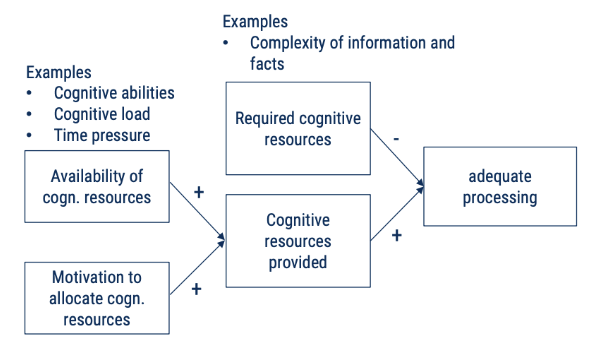
No sequential model, subprocesses work simultaneously and interact with each other
All processes need cognitive resources, these resources are limited and have to be distributed among the sub-processes
Allocation of cognitive resources to process media content is both conscious and unconscious.
Distinction between cognitive resources required for processing and resources provided for processing.
LC4MP Example study: Television news processing
190
Resources needed > resources available?
No complete breakdown of information processing
Non-optimal continuation of individual sub-processes (encoding, storage, retrieval)
Memory for details disturbed
Non-optimal continuation of individual sub-processes (encoding, storage, retrieval)
Memory for details disturbed
191
Evaluation: Limited Capacity Model (Lang, 2000)
Positive
Assumptions are grounded in cognitive psychology
Inspired much research
Negative
Assumptions relatively unspecific and lack detail
Assumptions are grounded in cognitive psychology
Inspired much research
Negative
Assumptions relatively unspecific and lack detail
192
Immersion in media realities. Involvement, Presence, Flow & Co.
Reception experience
Reception experience
A variety of concepts exist, some of which describe very similar phenomena of experience during immersion in virtual worlds.
Involvement (Krugman, 1965; Wirth, 2006)
Flow (Csikszentmihalyi, 1975)
Presence experience (Minsky, 1980; Lombard & Ditton, 1997)
Transportation (Gerrig, 1993)
Narrative Engagement (Busselle & Bilandzic, 2009)
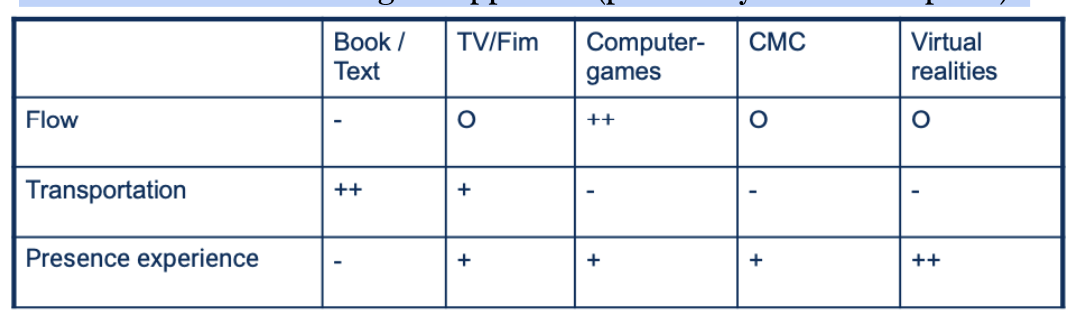
Involvement (Krugman, 1965; Wirth, 2006)
Flow (Csikszentmihalyi, 1975)
Presence experience (Minsky, 1980; Lombard & Ditton, 1997)
Transportation (Gerrig, 1993)
Narrative Engagement (Busselle & Bilandzic, 2009)
193
Flow
→ developed by Mihaly Csikszentmihalyi (1975).
The reflection-free complete absorption in a smoothly running activity, which one has under control despite high demands. (Rheinberg, 1997, p. 142)
6 Features
1. Concentration
2. Merging of activity and consciousness
3. Loss of reflexive self-awareness
4. Feeling of being in control of the situation
5. Distorted sense of time
6. Perception of the action as motivating from itself
A concept used in media psychology, especially for interactive media
Video games: clear objectives, permanent feedback, adaptivity of ability and difficulty
Flow inspired much research in media psychology
Problems:
Unclear definition, unclear processes
Measurement during flow problematic!
Retrospective questioning as well!
Neurological, physiological measures?
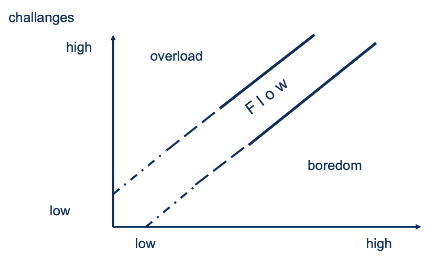
The reflection-free complete absorption in a smoothly running activity, which one has under control despite high demands. (Rheinberg, 1997, p. 142)
6 Features
1. Concentration
2. Merging of activity and consciousness
3. Loss of reflexive self-awareness
4. Feeling of being in control of the situation
5. Distorted sense of time
6. Perception of the action as motivating from itself
A concept used in media psychology, especially for interactive media
Video games: clear objectives, permanent feedback, adaptivity of ability and difficulty
Flow inspired much research in media psychology
Problems:
Unclear definition, unclear processes
Measurement during flow problematic!
Retrospective questioning as well!
Neurological, physiological measures?
194
Transportation
→ Gerrig (1993, p. 10) describes the phenomenon:
"Someone 'the traveler' is transported, by some means of transportation, as a result of performing certain actions. The traveler goes some distance from his or her world of origin, which makes some aspects of the world of origin inaccessible. The traveler returns to the world of origin, somewhat changed by the journey
Critiques of research on reception experience
Concepts developed in parallel (interdisciplinary research field)
No integration of findings
Variety of measurement methods
Measurement methodological approach (previously: self-description)
"Someone 'the traveler' is transported, by some means of transportation, as a result of performing certain actions. The traveler goes some distance from his or her world of origin, which makes some aspects of the world of origin inaccessible. The traveler returns to the world of origin, somewhat changed by the journey
Critiques of research on reception experience
Concepts developed in parallel (interdisciplinary research field)
No integration of findings
Variety of measurement methods
Measurement methodological approach (previously: self-description)
195
Methodological aspects of the research on reception experience
Hypothesis: "Use of violent video games increases the likelihood of aggressive behavior in gamers".
IV: Independent variable / cause
DV: Dependent variable / effect
Isolation of a causal pattern
Mediator hypothesis: "The use of violent video games increases the likelihood of aggressive behavior in gamers because the media violence they experience desensitizes them to the consequences of real violence."
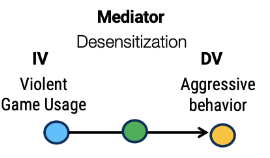
IV: Independent variable / cause
DV: Dependent variable / effect
Isolation of a causal pattern
Mediator hypothesis: "The use of violent video games increases the likelihood of aggressive behavior in gamers because the media violence they experience desensitizes them to the consequences of real violence."
196
▷ Reception experience as a mediator variable
Moderator hypothesis: "The use of violent video games increases the likelihood of aggressive behavior in gamers. This effect exists especially in adolescents and young adults, in whom the personality is still developing.”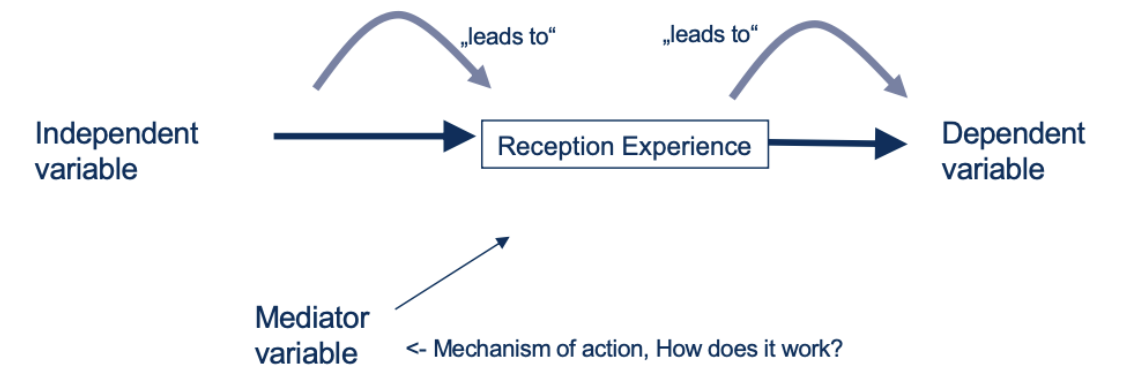
197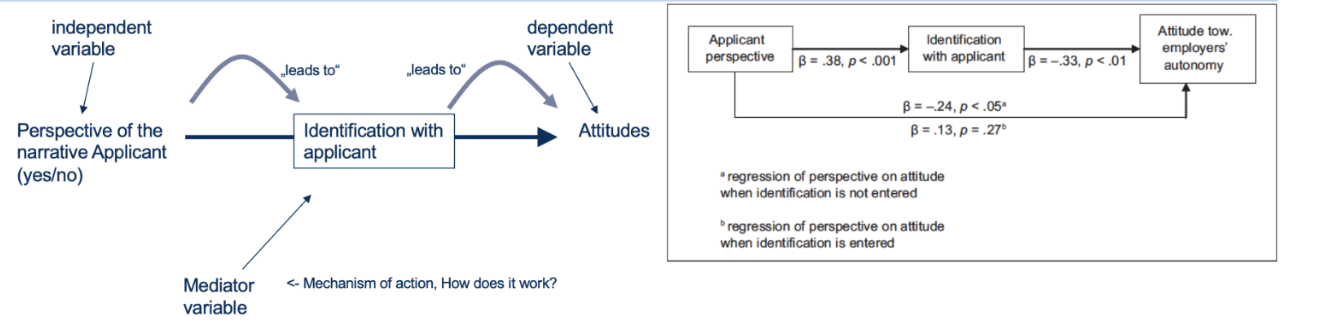
Example: Experiment on the topic "Employment of persons with physical handicap“
198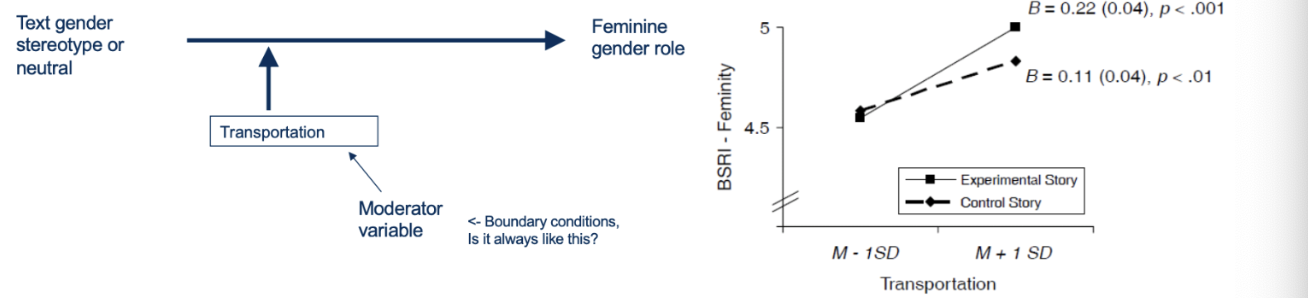
Example: Stories and gender roles
199
Methods of recording peri-receptional processes
Survey methods (often questionnaires to capture a state, but also RTR).
Behavioral observation in the broader sense (e.g. log file analysis)
reading times
eye tracking
Real-time response measurement (RTR)
Facial expression analysis (coder or software, EMG)
loud thinking
Thought listing
Psychophysiology (EDA)
Neurophysiology (EEG, fMRI)
Behavioral observation in the broader sense (e.g. log file analysis)
reading times
eye tracking
Real-time response measurement (RTR)
Facial expression analysis (coder or software, EMG)
loud thinking
Thought listing
Psychophysiology (EDA)
Neurophysiology (EEG, fMRI)
200
RTR (Real-Time Response Measurement)
Continuous second-by-second interviewing by computer during reception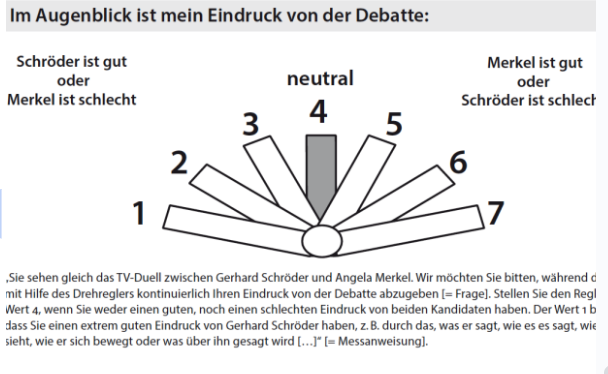
201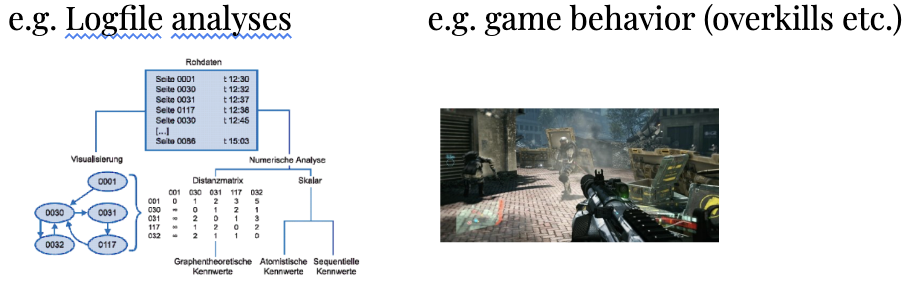
Behavioral observation
202
Eye tracking
Fixations (on average 250 msec during reading) and saccades.
Indicator of attentional focus, processing intensity
eye-mind-assumption (Just & Carpenter, 1980)
Indicator of attentional focus, processing intensity
eye-mind-assumption (Just & Carpenter, 1980)
203
Facial expression analysis
(to capture emotions)
Facial Action Coding System (FACS), after Ekman
Facial Action Coding System (FACS), after Ekman
204
Media Effects
-> the deliberate and non deliberate short and long-term within-person changes in cognitions (including beliefs), emotions, attitudes, and behavior that result from media use. (Valkenburg, Peter, & Walther, 2016)
205
Principles of media-mediated effects
Specifics of the effect
Intended media effects: Media are designed to achieve specific effects (e.g., learning through educational games, persuasion through advertising, education through health campaigns).
Non-intended media effects: Specific effects are not intended but rather result as a byproduct (e.g., aggression as a result of violent game use, decreased life satisfaction as a result of social media use)
Persistence Acquired skills/competencies should remain available after the intervention is completed.
Persistence gradients
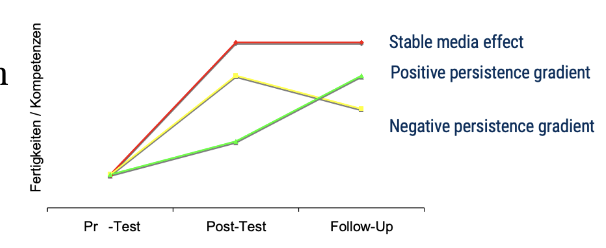
Intended media effects: Media are designed to achieve specific effects (e.g., learning through educational games, persuasion through advertising, education through health campaigns).
Non-intended media effects: Specific effects are not intended but rather result as a byproduct (e.g., aggression as a result of violent game use, decreased life satisfaction as a result of social media use)
Persistence Acquired skills/competencies should remain available after the intervention is completed.
Persistence gradients
206
Four basic principles of the impact of media
1. Effects can be triggered by different characteristics of media.
2. Media effects are usually indirect
3. Media effects are usually conditional, i.e., they depend on personal factors and possibly also contextual factors.
4. Media effects are usually transactional, i.e., effect processes involve interactions among person characteristics, media characteristics, context characteristics, media use, and media effect
Assumption: Selection and effect effects can mutually reinforce each other.
2. Media effects are usually indirect
3. Media effects are usually conditional, i.e., they depend on personal factors and possibly also contextual factors.
4. Media effects are usually transactional, i.e., effect processes involve interactions among person characteristics, media characteristics, context characteristics, media use, and media effect
Assumption: Selection and effect effects can mutually reinforce each other.
207
Effects can be triggered by different characteristics of media.
Modality (e.g. text, auditory, visual, audiovisual)
-> Example „The medium is the message“ = the nature of a medium (the channel through which a message is transmitted) is more important than the meaning or content of the message
content (e.g. violence, character, argument)
-> Example: Negativity bias = people are biologically programmed to pay more attention to negative information than to positive information (Shoemaker 1996).
structural features (e.g. special effects, pacing, editing)
-> Example: Stimulus-oriented attentional control. = Orientation responses are automatically triggered by changes in the environment
-> Example „The medium is the message“ = the nature of a medium (the channel through which a message is transmitted) is more important than the meaning or content of the message
content (e.g. violence, character, argument)
-> Example: Negativity bias = people are biologically programmed to pay more attention to negative information than to positive information (Shoemaker 1996).
structural features (e.g. special effects, pacing, editing)
-> Example: Stimulus-oriented attentional control. = Orientation responses are automatically triggered by changes in the environment
208
Media effects are usually indirect
Effect mediated by media selection.
Effect mediated by reception processes during or shortly after media use.
Effect mediated by changed attitudes or beliefs.
Effect mediated by other persons.
Effect mediated by reception processes during or shortly after media use.
Effect mediated by changed attitudes or beliefs.
Effect mediated by other persons.
209
Media effects are usually transactional
210
Effect Theories
Effect mediated by media selection
• e.g. Selective Exposure
Effect mediated by reception processes during or shortly after media use.
• e.g. Priming, Emotional Desensitization
Effect mediated by changed attitudes or beliefs
• e.g. Social Learning, Cultivation
Effect mediated by other people
• e.g. Two-Step Flow of Communication
• e.g. Selective Exposure
Effect mediated by reception processes during or shortly after media use.
• e.g. Priming, Emotional Desensitization
Effect mediated by changed attitudes or beliefs
• e.g. Social Learning, Cultivation
Effect mediated by other people
• e.g. Two-Step Flow of Communication
211
Priming in media psychology
Priming occurs when an individual’s exposure to a certain stimulus influences his or her response to a subsequent stimulus, without any awareness of the connection. These stimuli are often related to words or images that people see during their day-to-day lives.
-> Relevant in research on the effect of media content (e.g., violence, pornography, stereotypes) on the accessibility of thoughts and attitudes
-> Relevant in research on the effect of media content (e.g., violence, pornography, stereotypes) on the accessibility of thoughts and attitudes
212
▶︎ Priming: Psychological Explanation
Theoretical starting point: Memory as an associative network
Individual nodes (knowledge units, concepts) are linked to each other to varying degrees
When an element is activated in memory, the associated content also becomes cognitively more readily available, i.e., retrievable.
-> Priming = increased availability of certain cognitive structures and contents.
Individual nodes (knowledge units, concepts) are linked to each other to varying degrees
When an element is activated in memory, the associated content also becomes cognitively more readily available, i.e., retrievable.
-> Priming = increased availability of certain cognitive structures and contents.
213
Priming Example: Sexism
Yao, Mahood, & Linz (2010)
Yao, Mahood, & Linz (2010)
16 sexual words (e.g. sex, penis, etc.)
16 neutral words (e.g. door, bank, etc.)
10 derogatory terms for women (e.g. slut, whore, bitch, etc.)
10 neutral terms for women (e.g. sister, nurturer, caregiver, niece, etc.)
Equal number of pseudowords (e.g. xse, nepis, bnak, rodo).
Dependent variable: Word recognition (reaction time)
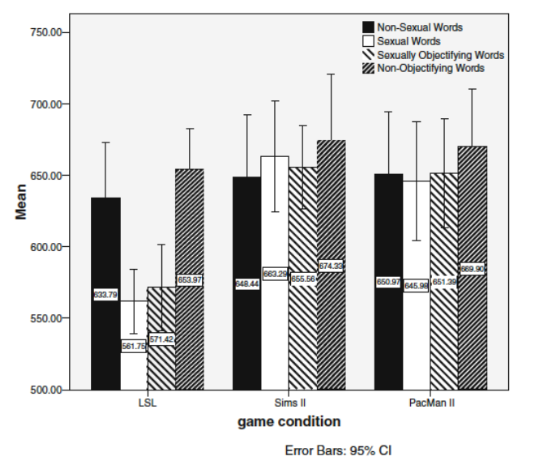
16 neutral words (e.g. door, bank, etc.)
10 derogatory terms for women (e.g. slut, whore, bitch, etc.)
10 neutral terms for women (e.g. sister, nurturer, caregiver, niece, etc.)
Equal number of pseudowords (e.g. xse, nepis, bnak, rodo).
Dependent variable: Word recognition (reaction time)
214
Priming in media psychology - limitations
Short duration of priming effects
Robustness of priming effects is disputed
Weak empirical basis for long-term effects -> chronic availability
Robustness of priming effects is disputed
Weak empirical basis for long-term effects -> chronic availability
215
Emotional Desensitization
"Process of emotional numbing to emotionally arousing (media) stimuli that is triggered by repeated confrontation with the same or similar stimuli." (Trepte & Reinecke, 2012, S. 134)
… can be perceived as a positive or negative phenomenon
Positive consequences, e.g. psychological behavioral therapy to free patients from specific fears / phobia, e.g., of spiders.
Negative consequences, e.g. reception of media content containing violence can lead to a reduced emotional response to depictions of violence (less pronounced physiological responses
… can be perceived as a positive or negative phenomenon
Positive consequences, e.g. psychological behavioral therapy to free patients from specific fears / phobia, e.g., of spiders.
Negative consequences, e.g. reception of media content containing violence can lead to a reduced emotional response to depictions of violence (less pronounced physiological responses
216
emontional Desensitization Example: Study on the effect of media violence on helping behavior
Experimental study of student helping behavior (Bushman, Anderson & Carnegy, 2007)
Experimental study of student helping behavior (Bushman, Anderson & Carnegy, 2007)
20 min video game
Response to a simulated argument
Results -> Individuals are less likely to help after violent game, take longer to help, and think the argument is less severe.
Response to a simulated argument
Results -> Individuals are less likely to help after violent game, take longer to help, and think the argument is less severe.
217
Social learning / learning from models
"The concept of social learning describes the phenomenon that direct personal experience is not a necessary prerequisite for learning processes. To learn the consequences of an action, people can vicariously observe other people (models) in their actions and learn from them." (Trepte & Reinecke, 2012, S. 122)
Mechanism: building new cognitive structures (attitudes, knowledge,...).
Basis: Social Learning Theory (Bandura, 1986)
Mechanism: building new cognitive structures (attitudes, knowledge,...).
Basis: Social Learning Theory (Bandura, 1986)
218
social learing Example
The Rocky Experiment (Bandura, Ross, & Ross, 1963)
The Rocky Experiment (Bandura, Ross, & Ross, 1963)
4-year-olds watch movie in which an adult (Rocky) maltreats (insults, knocks over, boxes, punches) a doll (Bobo).
Experimental conditions
Positive feedback for Rocky
Negative feedback for Rocky
Rocky's behavior without consequences.
Children get the opportunity to play with Bobo themselves.
Experimental conditions
Positive feedback for Rocky
Negative feedback for Rocky
Rocky's behavior without consequences.
Children get the opportunity to play with Bobo themselves.
219
↳ Social Learning Theory (Bandura, 1986)
I. Acquisition phase (acquisition)
I. Acquisition phase (acquisition)
-> Is observer's attention focused on model's behavior?
Influencing factors on the part of the observer:
cognitive factors (ability to concentrate, control of attention)
motivational factors (needs and motives)
Influencing factors on the part of the model
conspicuousness of the model and its behavior (salience) - strong behavioral consequences
similarity of the model to the observer
-> Is model behavior stored?
-> Storage by pictorial and verbal coding
Influencing factors on the part of the observer: cognitive abilities (intelligence, memory) •
Influencing factors on the part of the model: clarity of action
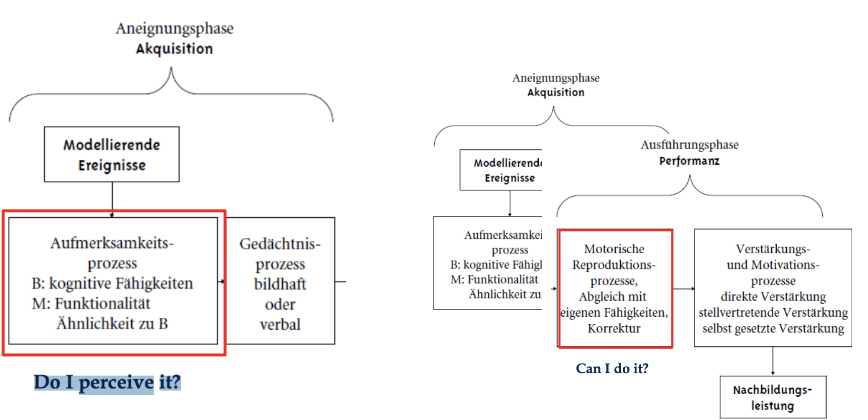
Influencing factors on the part of the observer:
cognitive factors (ability to concentrate, control of attention)
motivational factors (needs and motives)
Influencing factors on the part of the model
conspicuousness of the model and its behavior (salience) - strong behavioral consequences
similarity of the model to the observer
-> Is model behavior stored?
-> Storage by pictorial and verbal coding
Influencing factors on the part of the observer: cognitive abilities (intelligence, memory) •
Influencing factors on the part of the model: clarity of action
220
↳ Social Learning Theory (Bandura, 1986)
II. Execution phase (performance)
II. Execution phase (performance)
-> Can the person perform observed action?
-> Trial action:
Mental rehearsal to check the complete recollection of the course of action
Real trial action to test the person's own competence to act
-> Does the person want to perform the observed action?
-> Motivated execution decision Influencing factors:
Behavioral consequences for the model: vicarious reinforcement/punishment
Behavioral consequences for the observer:
direct external reinforcement or external punishment
self-reinforcement or self-punishment
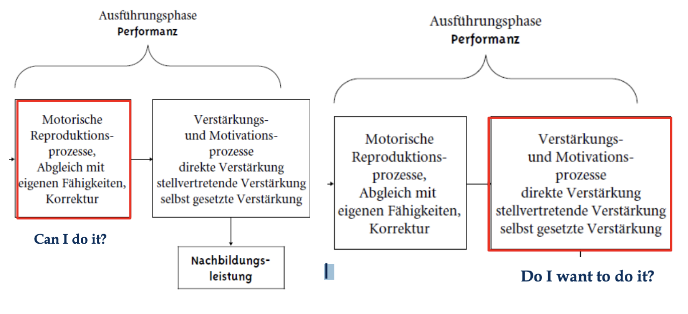
-> Trial action:
Mental rehearsal to check the complete recollection of the course of action
Real trial action to test the person's own competence to act
-> Does the person want to perform the observed action?
-> Motivated execution decision Influencing factors:
Behavioral consequences for the model: vicarious reinforcement/punishment
Behavioral consequences for the observer:
direct external reinforcement or external punishment
self-reinforcement or self-punishment
221
Cultivation hypothesis
George Gerbner, 1909-2005
George Gerbner, 1909-2005
People are cultivated by television and see the world as it is conveyed on television. Television represents a socialization instance that creates distorted ideas of reality in consumers.
-> Two-stage methodological approach (Cultural Indicators Approach):
'Message System Analysis' - analysis of the prevalence of representation on TV.
'Cultivation Analysis' - analysis of the cultivation of beliefs through TV.
-> Two-stage methodological approach (Cultural Indicators Approach):
'Message System Analysis' - analysis of the prevalence of representation on TV.
'Cultivation Analysis' - analysis of the cultivation of beliefs through TV.
222
Original focus on overrepresentation of violence on television
**Note on Gerbner's Research Findings**
- **Relationship Between TV Consumption and Fear of Crime:**
- Surveys by Gerbner show a small but statistically significant link between TV watching and fear of crime.
- Light TV viewers estimate their weekly odds of being a crime victim at 1 in 100.
- Heavy TV viewers estimate their risk at 1 in 10.
- Actual crime statistics suggest a risk of 1 in 10,000.
- **Perceptions of Others Among Heavy TV Viewers:**
- Heavy TV viewers are more suspicious of others' motives.
- They tend to believe cautionary statements about human nature, such as:
- "Most people are just looking out for themselves."
- "In dealing with others, you can't be too careful."
- "Do unto others before they do unto you."
-> This mindset is what Griffin calls the mean world syndrome
- **Relationship Between TV Consumption and Fear of Crime:**
- Surveys by Gerbner show a small but statistically significant link between TV watching and fear of crime.
- Light TV viewers estimate their weekly odds of being a crime victim at 1 in 100.
- Heavy TV viewers estimate their risk at 1 in 10.
- Actual crime statistics suggest a risk of 1 in 10,000.
- **Perceptions of Others Among Heavy TV Viewers:**
- Heavy TV viewers are more suspicious of others' motives.
- They tend to believe cautionary statements about human nature, such as:
- "Most people are just looking out for themselves."
- "In dealing with others, you can't be too careful."
- "Do unto others before they do unto you."
-> This mindset is what Griffin calls the mean world syndrome
223
Specifications of the cultivation hypothesis
Mainstreaming: convergence of worldviews among viewers with intensive TV consumption into otherwise disparate groups (e.g., demographics, education, political views).
Resonance: Viewers whose life experiences are congruent with television are most influenced by television.
Resonance: Viewers whose life experiences are congruent with television are most influenced by television.
224
cultivation hypothesis
Empirical findings
Empirical findings
Frequentists overestimate the number of lawyers in the population, as well as the risk of terrorist attacks and natural disasters (e.g., Gunter & Wober, 1983)
Meta-analysis (Shanahan & Morgan, 1999): small but consistent relationship between television viewing and frequency estimates of real world events.
Meta-analysis (Shanahan & Morgan, 1999): small but consistent relationship between television viewing and frequency estimates of real world events.
225
cultivation hypothesis
Criticism of the approach
Criticism of the approach
Studies are cross-sectional, say nothing about causality.
Assumption of a passive recipient (-> What role does selective exposure play?)
Mechanisms of cultivation are unclear (heuristic information processing?, Shrum, 2001)
Assumption of a passive recipient (-> What role does selective exposure play?)
Mechanisms of cultivation are unclear (heuristic information processing?, Shrum, 2001)
226
Two Step Flow of Communication
»The traditional image of the mass persuasion process must make room for ›people‹ as intervening factors between the stimuli of the media and resultant opinions, decisions, and actions« (Katz & Lazarsfeld 1955, S. 32 f.).
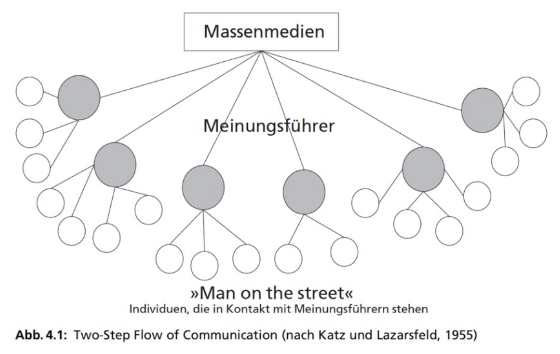
227
Prominent effect assumptions
Thesis: Consumption of media violence increases the propensity to aggression in the short and long term
Meta-analyses (e.g. Greitemeyer & Mügge, 2014)
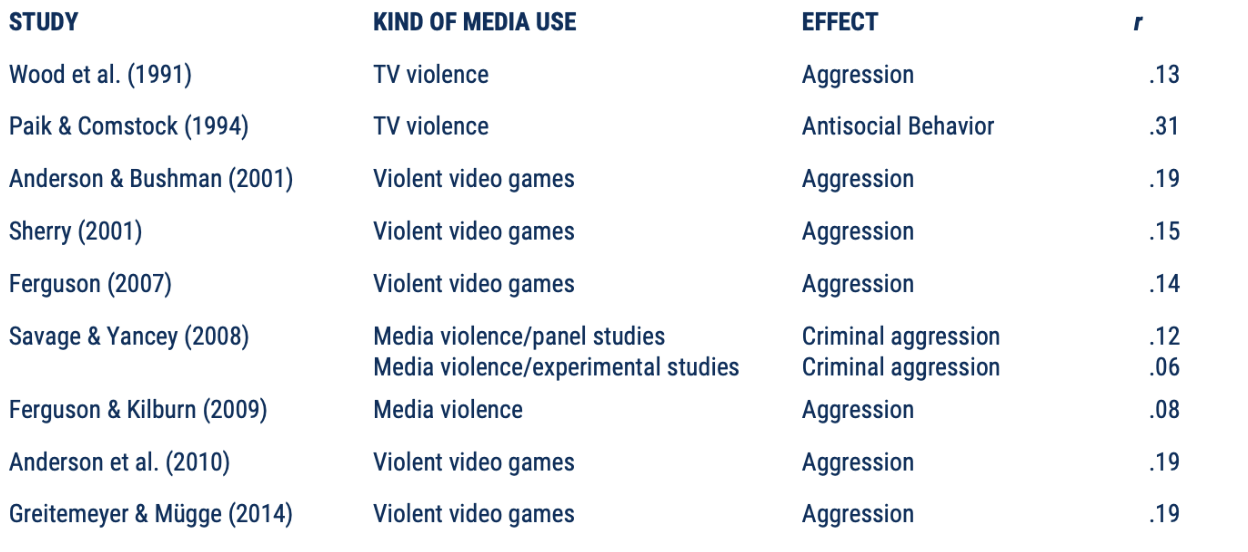
Meta-analyses (e.g. Greitemeyer & Mügge, 2014)
228
Risk and protective factors model
-> Known risk factors for aggressive behavior Youth Violence: A Report of the Surgeon General (2001)
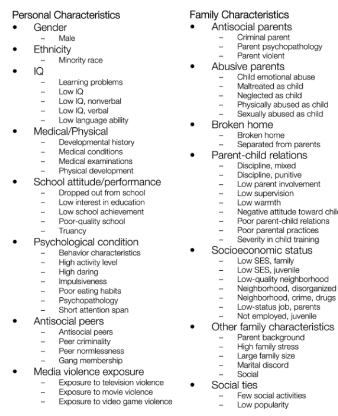
229
How do risk and protective factors work together ?
Results of a longitudinal analysis with 5th and 6th grade students in the U.S. (Anderson, Gentile, & Buckley, 2007)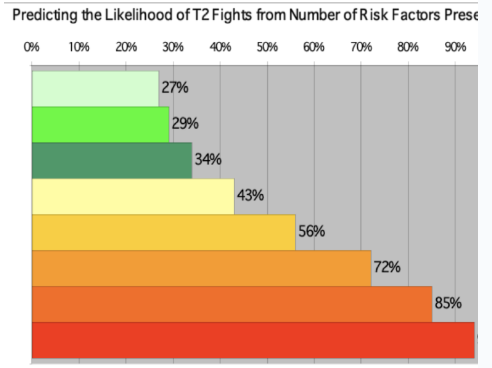
230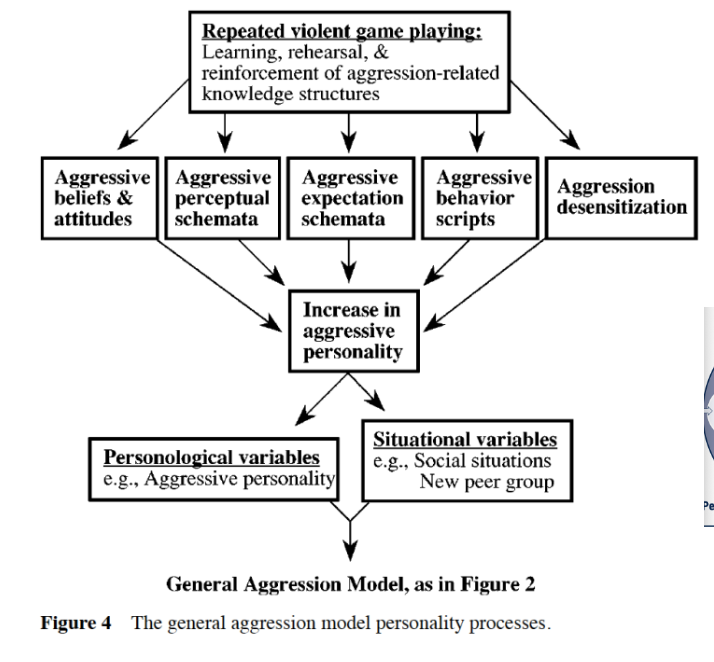
General Human Aggression Model
231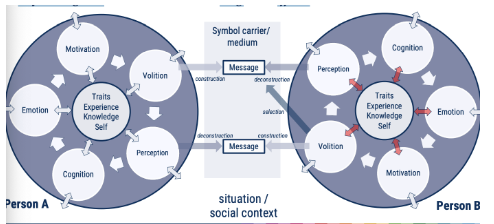
Psychological framework
model: long-term effects
model: long-term effects
232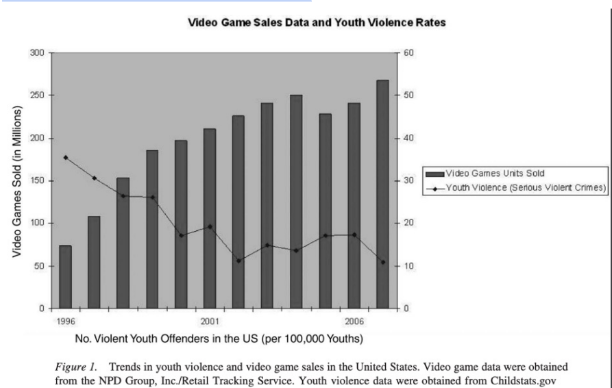
Criticism of the research or the findings
• Relevance criticism
• Relevance criticism
233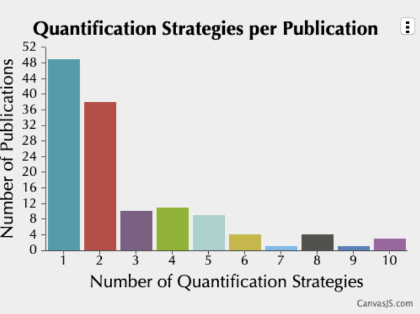
Criticism of the validity of
measurement instruments for aggression
measurement instruments for aggression
234
"Positive" effects of computer games
-> Video games have a positive impact on eyehand coordination in children and skills of surgeons during laparoscopy (Dobnik, 2004; Rosenberg et al., 2005)
-> Moderate consumption of computer and video games is positively related to intelligence in children (van Schie & Wiegman, 1997; Durkin & Barber, 2002)
-> Moderate consumption of computer and video games is positively related to intelligence in children (van Schie & Wiegman, 1997; Durkin & Barber, 2002)
235
Thesis: Consumption of media violence increases the propensity to aggression in the short and long term
There is relatively consistent empirical evidence that violence in video games can increase aggressive tendencies (at least in the short-term).
This does not rule out the possibility that violent video games may have other positive effects at the same time.
Methodological criticism of the available studies is useful. Therefore, the state of research can only be interpreted as preliminary
This does not rule out the possibility that violent video games may have other positive effects at the same time.
Methodological criticism of the available studies is useful. Therefore, the state of research can only be interpreted as preliminary
236
Thesis: Social media lead to loneliness
Social dislocation hypothesis : ‘‘Because online contacts are seen as superficial weak -tie relationships that lack feelings of affection and commitment, the Internet is believed to reduce the quality of adolescents’ existing friendships and, thereby, their well - being’’ (Valkenburg & Peter, p. 1170).
Social compensation hypothesis : Using the Internet for social purposes may have positive effects ''for those with initially impoverished offline world social resources'' (Bessière et al., 2008, p. 8)
Social compensation hypothesis : Using the Internet for social purposes may have positive effects ''for those with initially impoverished offline world social resources'' (Bessière et al., 2008, p. 8)