All cards
1
displacement
d, vector (Δx=xf-xi)
slope is velocity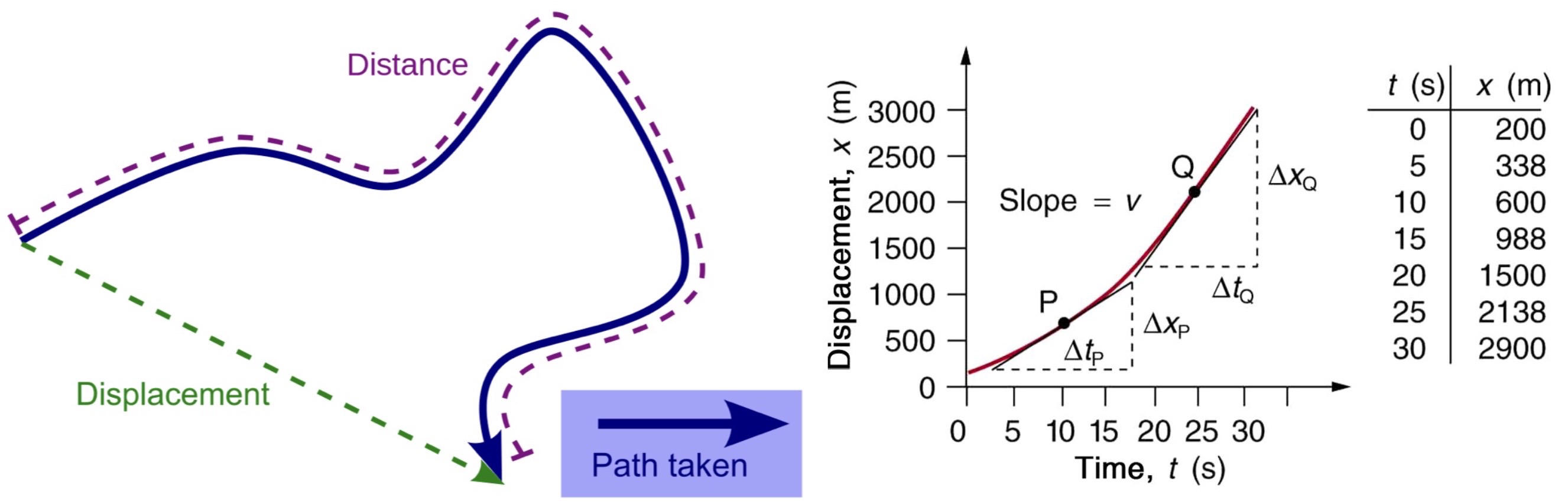
slope is velocity
2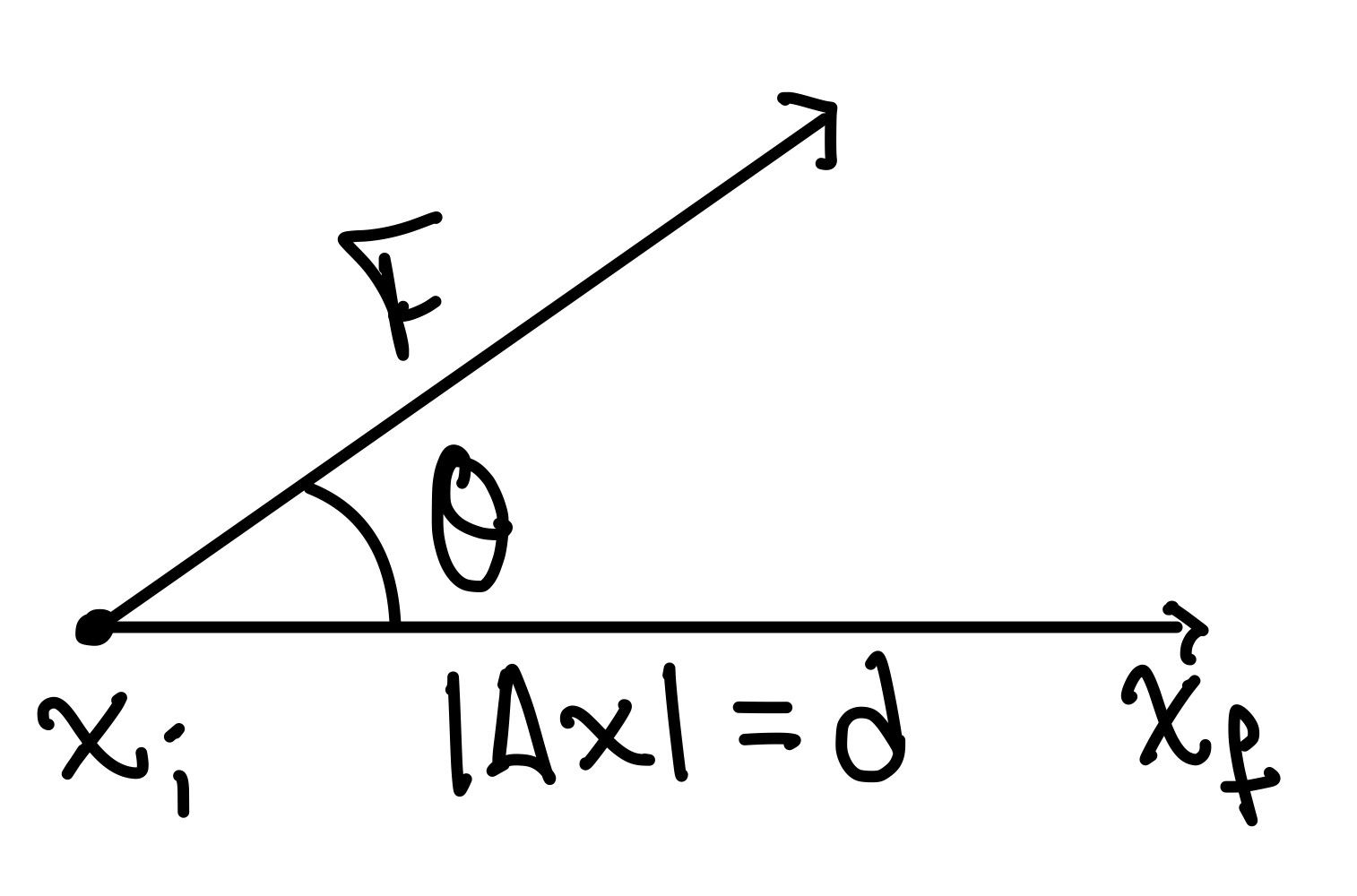
Image occlusion: name the hidden labels
3
velocity
v = d/t, vector
slope is accel, area under curve is displacement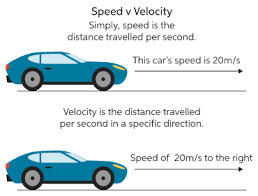
slope is accel, area under curve is displacement
4
acceleration
a = v/t, vector
area under curve is velocity
g = 10 m/s^2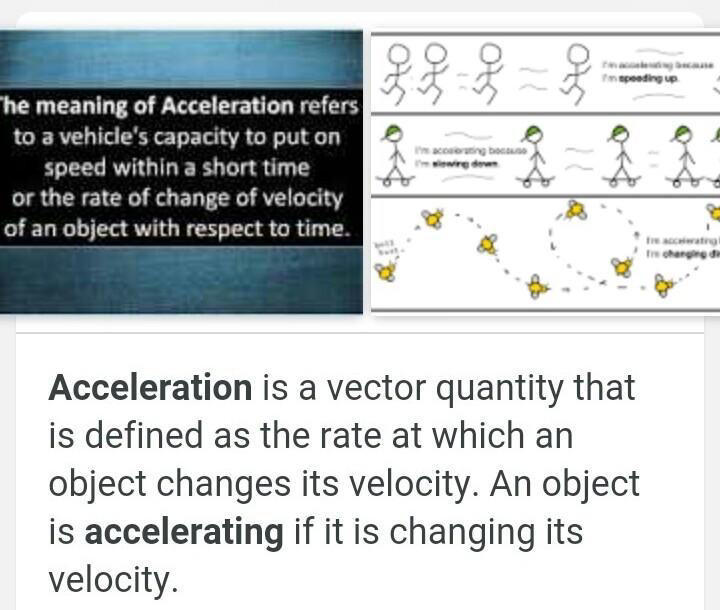
area under curve is velocity
g = 10 m/s^2
5
kinematics
d = (1/2)(vo + vf)t, missing a
v = vo + at, missing d
d = vot + (1/2)at^2, missing vf
d = vft - (1/2)at^2, missing vo
vf^2 = vo^2 + 2ad, missing t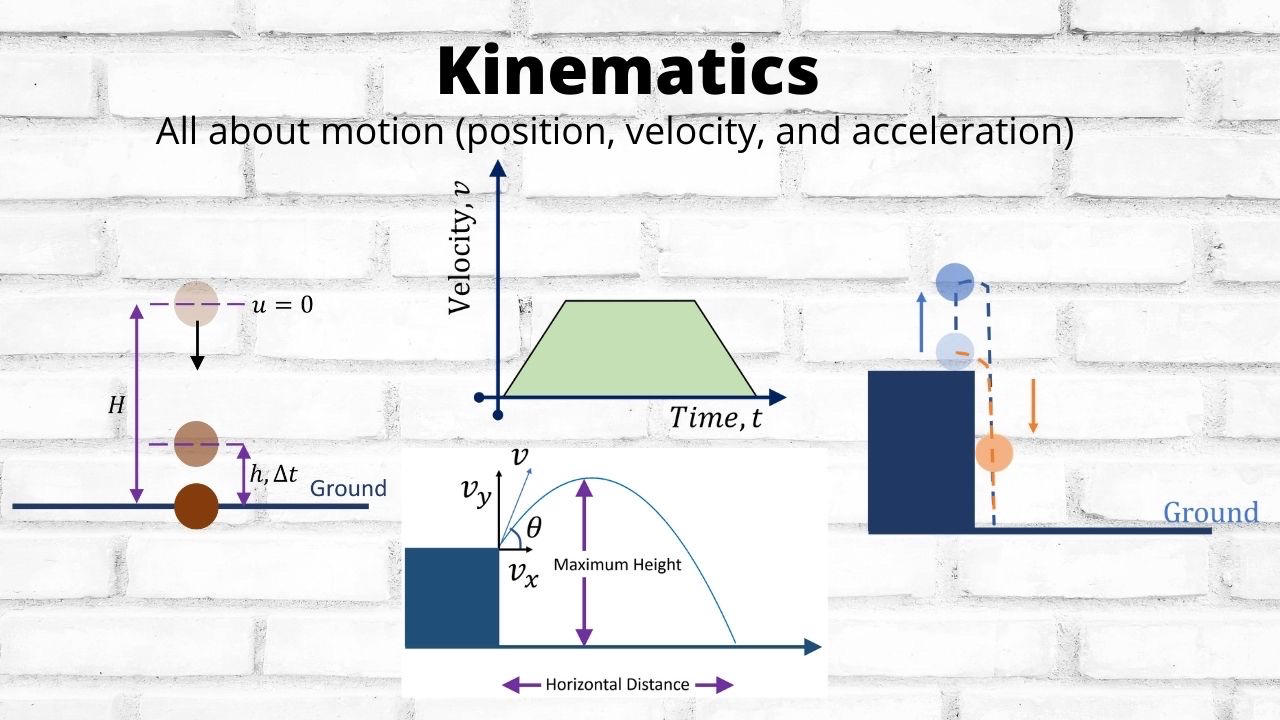
v = vo + at, missing d
d = vot + (1/2)at^2, missing vf
d = vft - (1/2)at^2, missing vo
vf^2 = vo^2 + 2ad, missing t
6
vector addition
place the vectors tip to tip, addition of the vectors is the new shortcut vector
break into component x and y then add up separately
vector magnitude = sqrt(x^2 + y^2)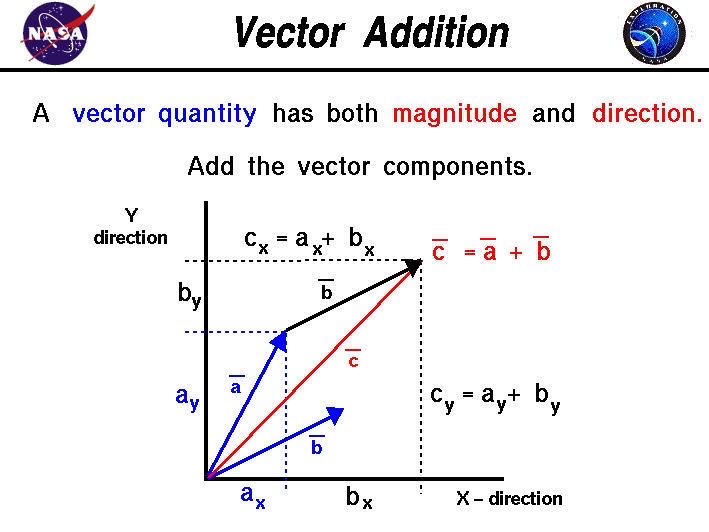
break into component x and y then add up separately
vector magnitude = sqrt(x^2 + y^2)
7
projectile motion
constant a, constant v_x, v_y = 0 at top
break into component v_x and v_y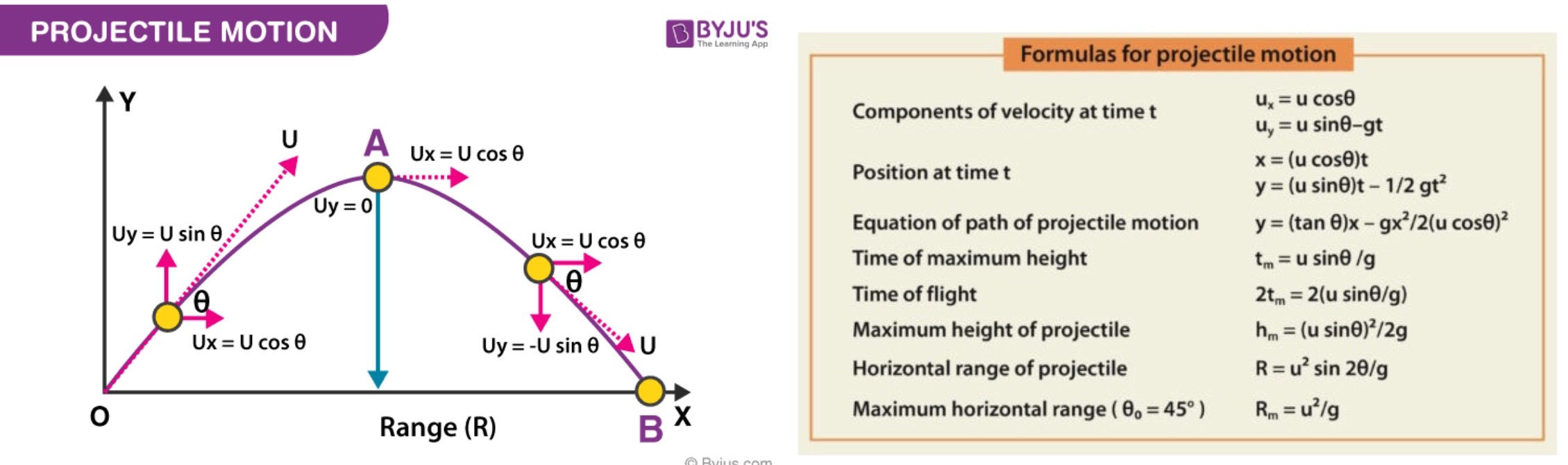
break into component v_x and v_y
8
trig circle
sin(0) = 0, sin(30) = .5, sin(45) = .7, sin(60) = .86, sin(90) = 1
90 = (0, 1)
60 = (1/2, sqrt(3)/2)
45 = (sqrt(2)/2, sqrt(2)/2)
30 = (sqrt(3)/2, 1/2)
0 = (1,0)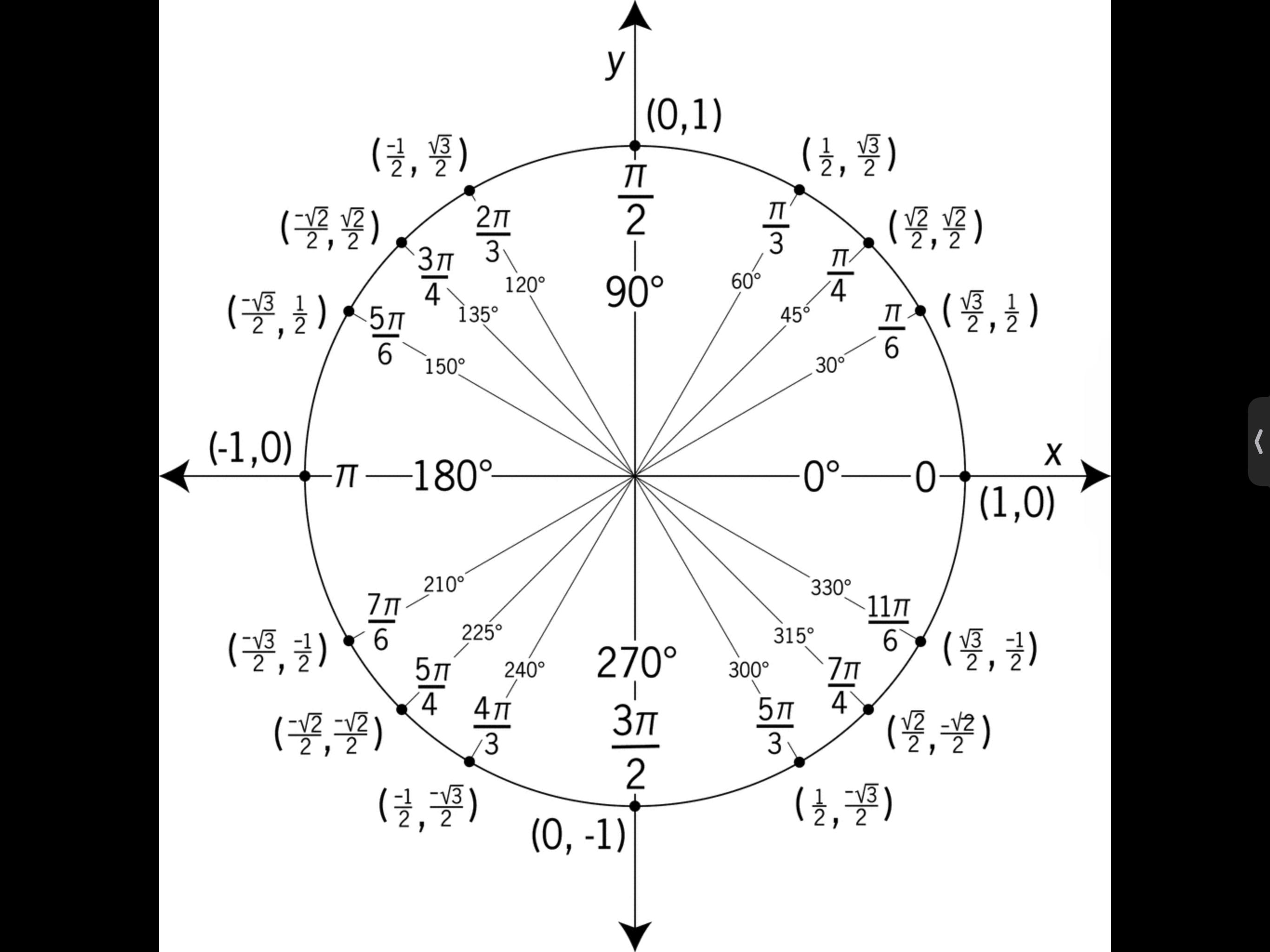
90 = (0, 1)
60 = (1/2, sqrt(3)/2)
45 = (sqrt(2)/2, sqrt(2)/2)
30 = (sqrt(3)/2, 1/2)
0 = (1,0)
9
Newton's laws
1. no force means no acceleration, concept of inertia
2. F_net = ma, concerned with 1 object
3. objects exert the same force on each other in opposite directions, concerned with 2 objects
units: N = kg*m/s^2
solving force problems:
1. draw force diagram on the object
2. break into x and y components, F_net = ma for both
3. solve equations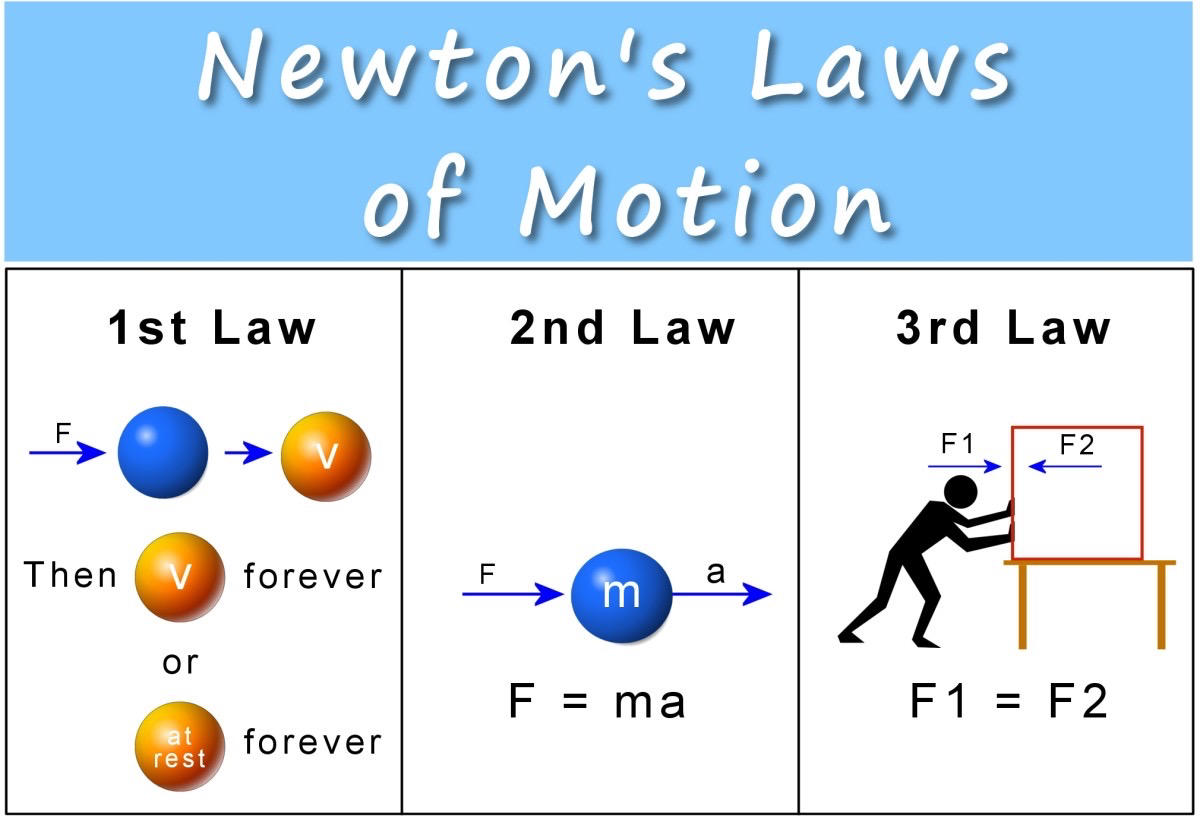
2. F_net = ma, concerned with 1 object
3. objects exert the same force on each other in opposite directions, concerned with 2 objects
units: N = kg*m/s^2
solving force problems:
1. draw force diagram on the object
2. break into x and y components, F_net = ma for both
3. solve equations
10
frictional force
kinetic friction- F = u_kN, while moving/slipping
static friction- F < u_sN, either rolling or not moving
static friction- F < u_sN, either rolling or not moving
11
gravitational force
F = Gm_1m_2/ r^2
mass is scalar (measures inertia)
weight is vector (measures gravitational force)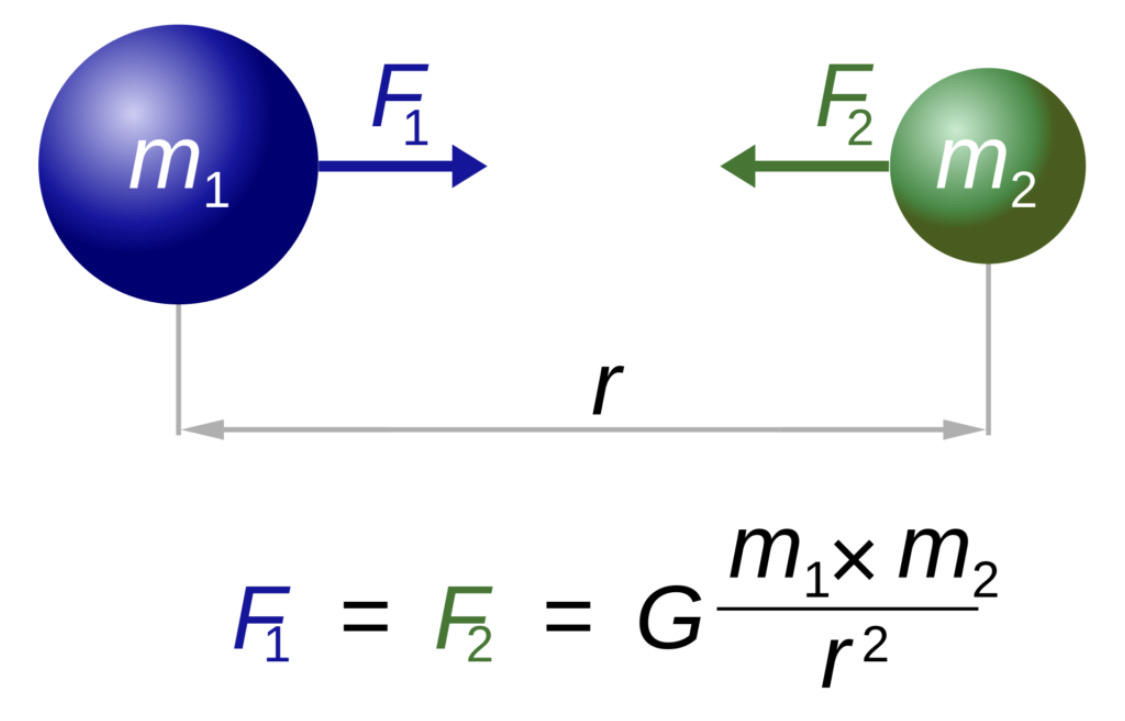
mass is scalar (measures inertia)
weight is vector (measures gravitational force)
12
uniform circular motion - Not on MCAT
turning
F = mv^2/ r
a = v^2/ r
force diagram on the object moving involves centripetal force, usually *normal force* (someone running will need to contact ground at an angle to turn)
at the top of a loop, the absolute minimum velocity would involve no normal force, so centripetal force equals gravitational force
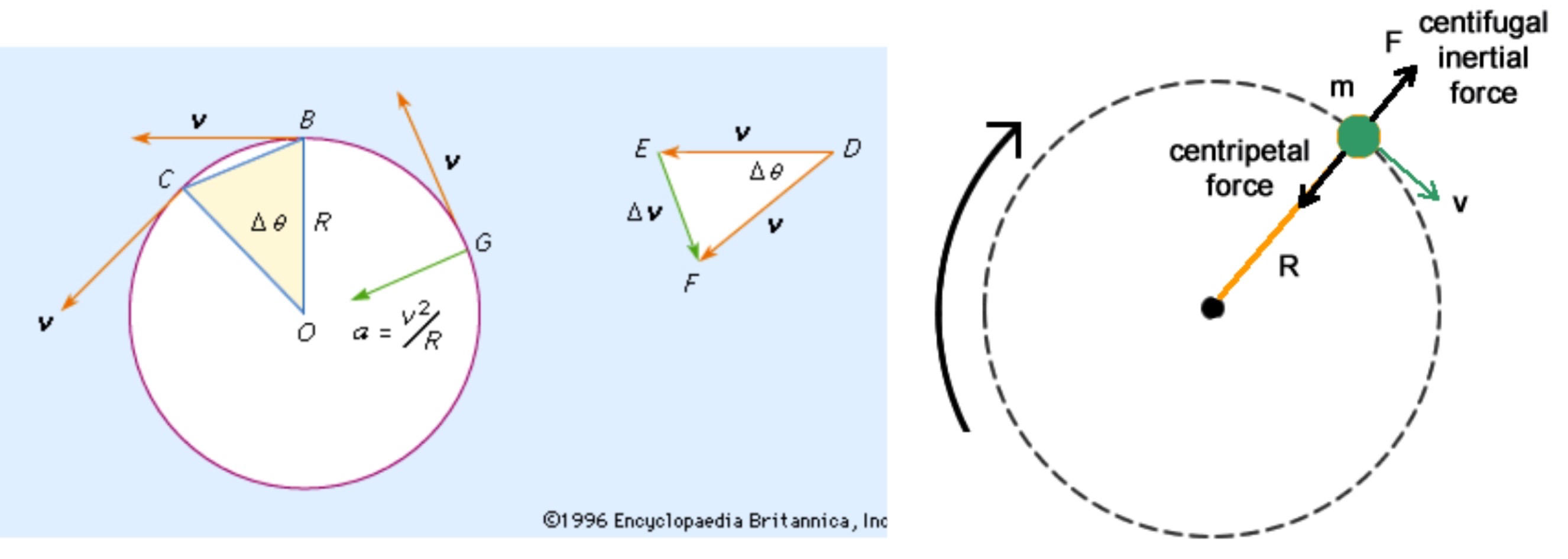
F = mv^2/ r
a = v^2/ r
force diagram on the object moving involves centripetal force, usually *normal force* (someone running will need to contact ground at an angle to turn)
at the top of a loop, the absolute minimum velocity would involve no normal force, so centripetal force equals gravitational force
13
simple harmonic motion
spring:
F = -kx
U = 1/2 k x^2
KE = 1/2 m v^2
angular frequency (w) = sqrt(k/m)
frequency (f) = 1/T = w/2pi
pendulum:
F = -mgsin(theta)
U = mgh
KE = 1/2 m v^2
angular frequency (w) = sqrt(g/L)
frequency (f) = 1/T = w/2pi
max U at ends of swing
max KE at middle of swing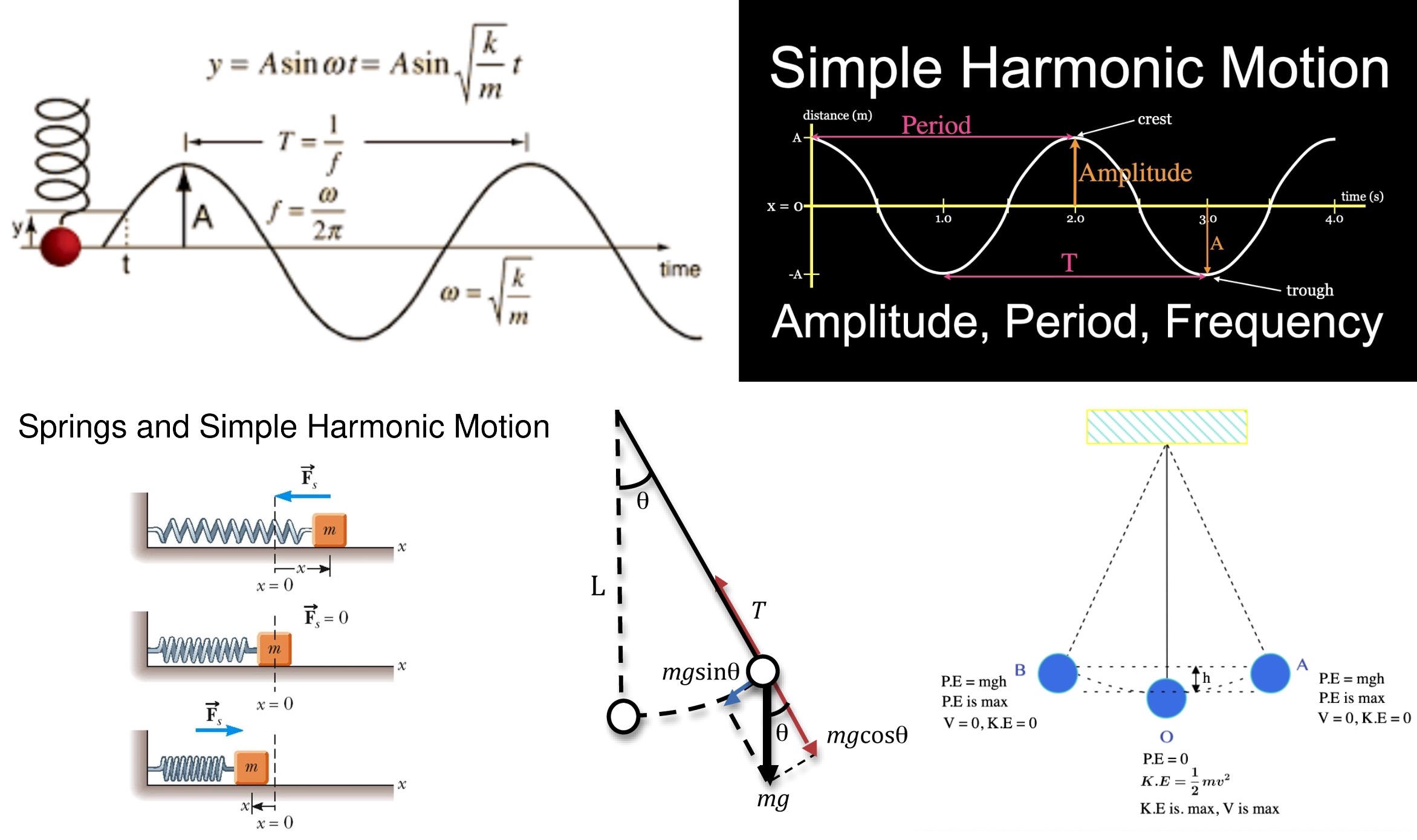
F = -kx
U = 1/2 k x^2
KE = 1/2 m v^2
angular frequency (w) = sqrt(k/m)
frequency (f) = 1/T = w/2pi
pendulum:
F = -mgsin(theta)
U = mgh
KE = 1/2 m v^2
angular frequency (w) = sqrt(g/L)
frequency (f) = 1/T = w/2pi
max U at ends of swing
max KE at middle of swing
14
torque
torque = rFsin(theta)
units are N*m
the greater the distance from the pivot point, the greater the torque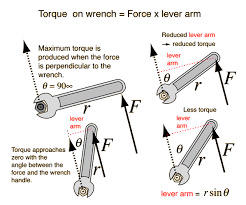
units are N*m
the greater the distance from the pivot point, the greater the torque
15
work
constant force acting on object over a distance
W = F d cos(theta)
units: J = N*m
force perpendicular to displacement does no work
W = P dV , area under a PV curve is work done by the system
when volume expands, work is done by the system
when volume compresses, work is done on the system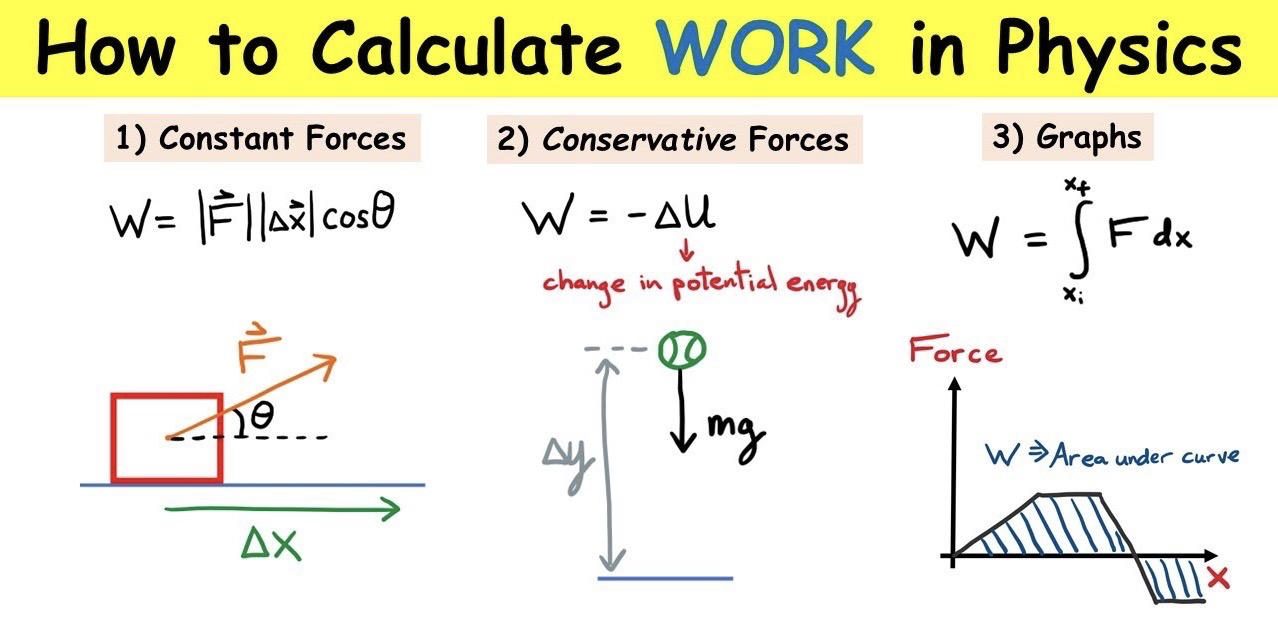
W = F d cos(theta)
units: J = N*m
force perpendicular to displacement does no work
W = P dV , area under a PV curve is work done by the system
when volume expands, work is done by the system
when volume compresses, work is done on the system
16
power
P = work/time = dKE/time
units: watts = J/s, J = ft*lb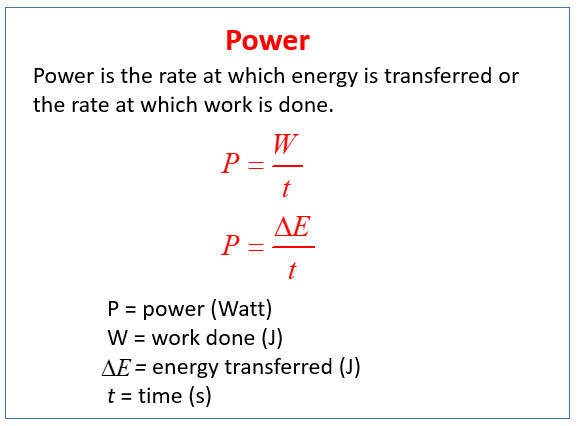
units: watts = J/s, J = ft*lb
17
energy
KE = (1/2) m v^2
PE = m g h
energy is conserved, unless outside forces act on the system
W = dKE
PE = m g h
energy is conserved, unless outside forces act on the system
W = dKE
18
momentum
vector quantity
p = mv
units: kg*m/s
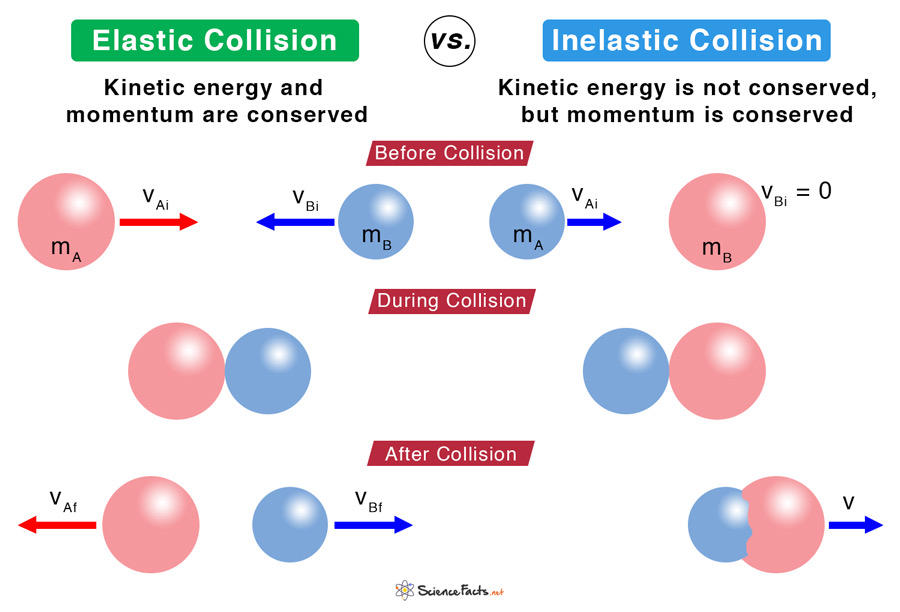
elastic collision- conservation of momentum, conservation of kinetic energy
inelastic collision- conservation of momentum, but *kinetic energy is lost*
impulse = change in momentum (dp) = Ft
p = mv
units: kg*m/s
elastic collision- conservation of momentum, conservation of kinetic energy
inelastic collision- conservation of momentum, but *kinetic energy is lost*
impulse = change in momentum (dp) = Ft
19
thermal expansion
linear expansion: dL = a L dT
volume expansion: dV = b V dT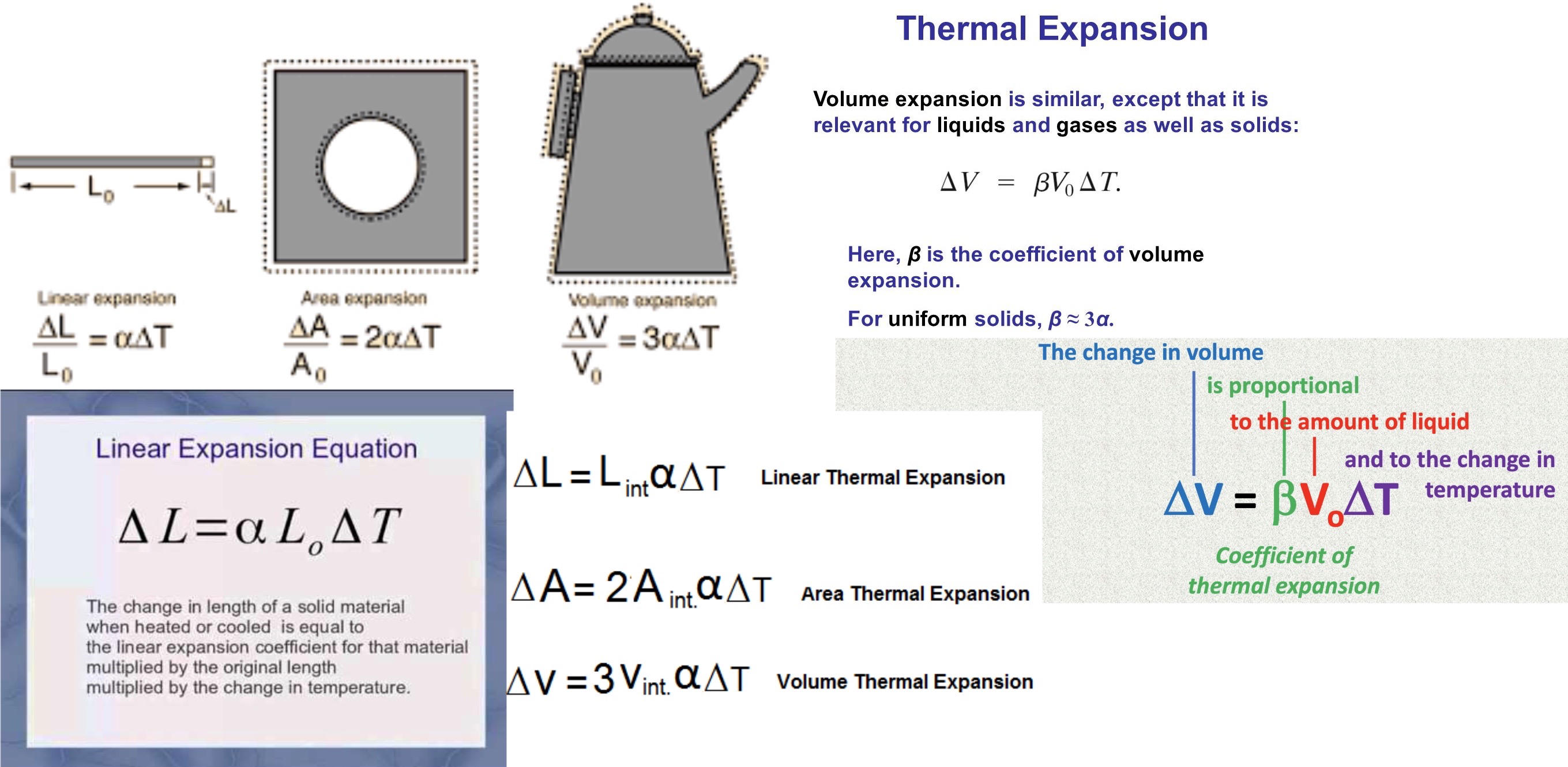
volume expansion: dV = b V dT
20
heat transfer
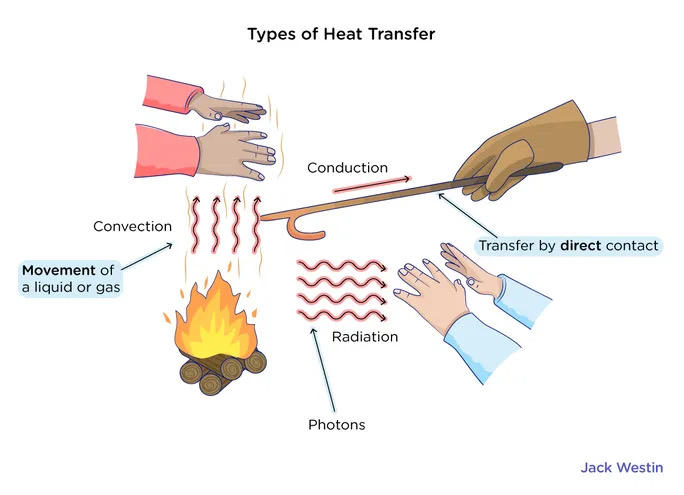
conduction- direct transfer of energy via molecular collisions
convection- transfer of energy via physical motion of heated gas or liquid
radiation- transfer of energy via EM waves
specific heat: c , q = m c dT
q is heat gained, does not apply during phase change
units of q: J or calories
units of c: J/ g*C
heat of transformation: q = m L
units of L: J/ g
convection- transfer of energy via physical motion of heated gas or liquid
radiation- transfer of energy via EM waves
specific heat: c , q = m c dT
q is heat gained, does not apply during phase change
units of q: J or calories
units of c: J/ g*C
heat of transformation: q = m L
units of L: J/ g
21
first law of thermodynamics
dU or dPE = q - W
potential energy = heat gained - work done by system (by system= -, on system= +)
no heat transfer: dPE = -W
no change in volume: dPE = q
no change in energy: q = W
potential energy = heat gained - work done by system (by system= -, on system= +)
no heat transfer: dPE = -W
no change in volume: dPE = q
no change in energy: q = W
22
elastic solids
shear modulus: S = (F/A) / (x/h)
young's modulus: Y = (F/A) / (dL/L)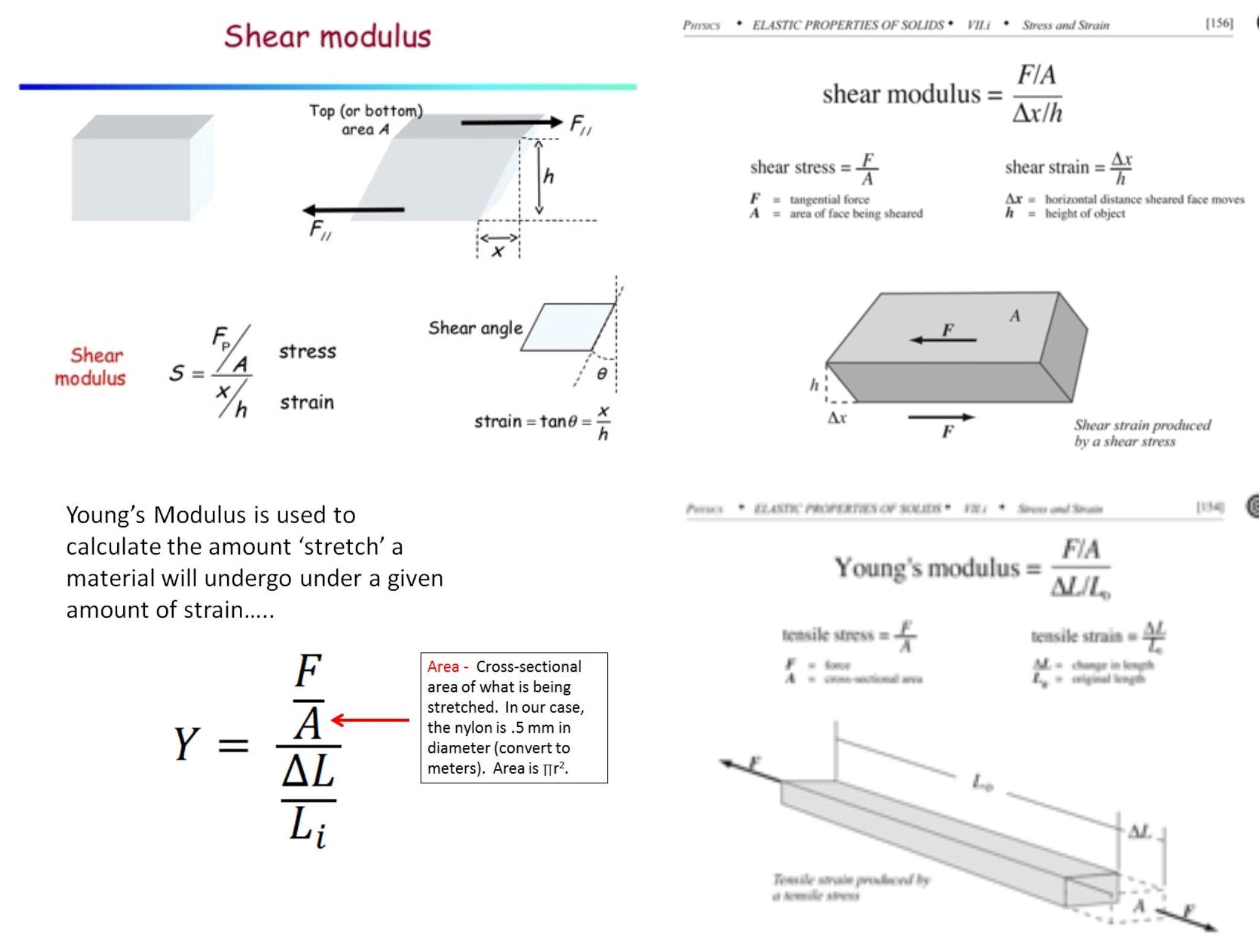
young's modulus: Y = (F/A) / (dL/L)
23
fluid properties
density: p = m/V
units: kg/m^3
weight of fluid: F_g = pVg
units: N
buoyant force (*equals weight of displaced fluid*)
F_b = p_fluid V_displaced g
units: N
archimedes principle:
object weight in water = object weight in air - weight of water displaced
weight of water displaced = p_fluid V_displaced g
object weight in air = p_object V_displaced g
pressure: P = F/A
gauge pressure: P = pgh
absolute pressure: P = P_atm + pgh
units: pascal (P) = N/m^2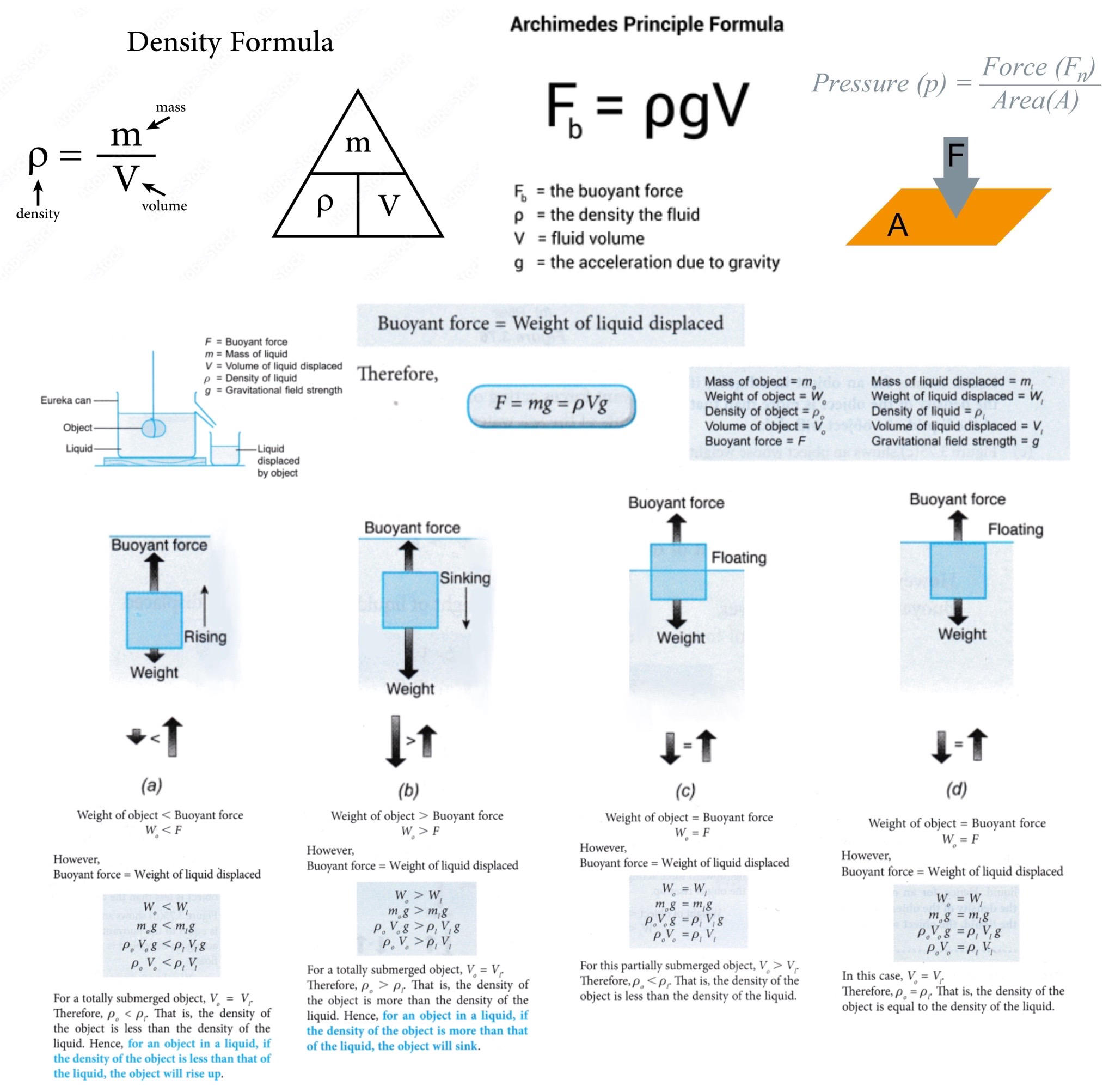
units: kg/m^3
weight of fluid: F_g = pVg
units: N
buoyant force (*equals weight of displaced fluid*)
F_b = p_fluid V_displaced g
units: N
archimedes principle:
object weight in water = object weight in air - weight of water displaced
weight of water displaced = p_fluid V_displaced g
object weight in air = p_object V_displaced g
pressure: P = F/A
gauge pressure: P = pgh
absolute pressure: P = P_atm + pgh
units: pascal (P) = N/m^2
24
specific gravity
density of object/density of water
used in archimedes principle, where volume of object equals volume of water displaced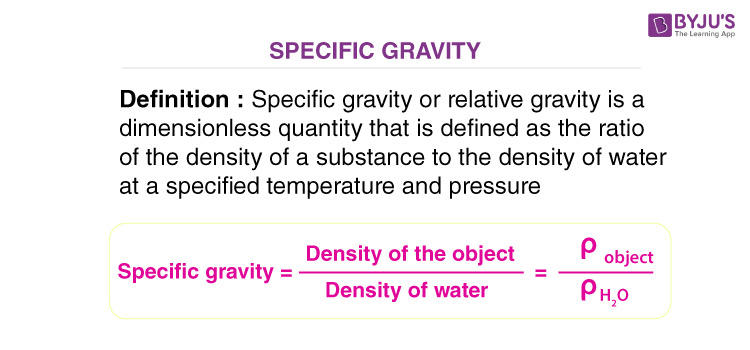
used in archimedes principle, where volume of object equals volume of water displaced
25
poiseuille's law
flow rate = ΔP(πr^4 / 8Lη)
*Q = dP/R*
flow rate depends on pressure difference, and radius, length, and viscosity of liquid
increased resistance can be caused by increased length, increased viscosity, or decreased radius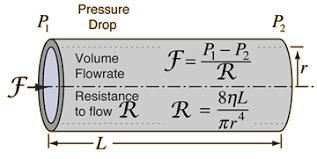
*Q = dP/R*
flow rate depends on pressure difference, and radius, length, and viscosity of liquid
increased resistance can be caused by increased length, increased viscosity, or decreased radius
26
hydrostatic pressure
P_s = ρgy
y = distance belows the surface
shape and surface area of water does not matter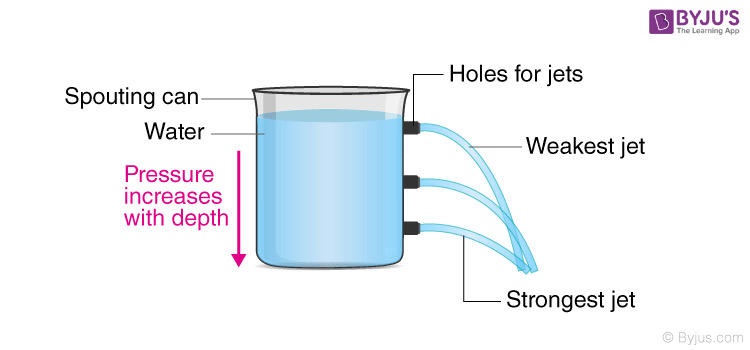
y = distance belows the surface
shape and surface area of water does not matter
27
bernoulli's equation
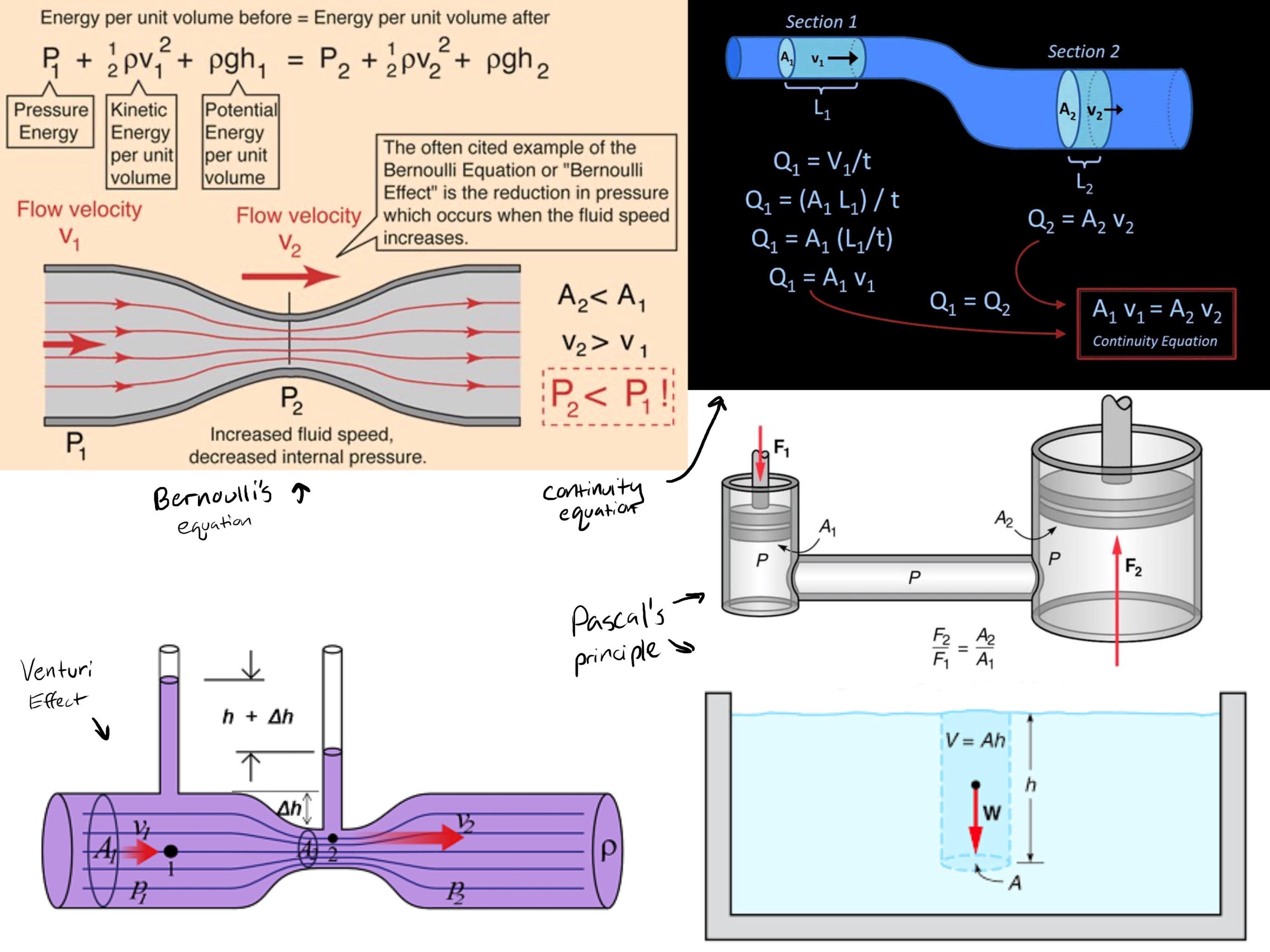
bernoulli's equation:
P + ρgh + 1/2 ρv^2 = constant
continuity equation (volume flow is constant): vA = constant
pascal's principle (pressure is transmitted to every surface):
V = Ad = constant (V1=V2 or A1d1=A2d2)
P = F/A = constant
W = Fd = constant
venturi effect (constriction in pipe causes increased velocity because of continuity equation, thus causes decreased pressure because of bernoulli's equation):
P + 1/2 ρv^2 = constant
P + ρgh + 1/2 ρv^2 = constant
continuity equation (volume flow is constant): vA = constant
pascal's principle (pressure is transmitted to every surface):
V = Ad = constant (V1=V2 or A1d1=A2d2)
P = F/A = constant
W = Fd = constant
venturi effect (constriction in pipe causes increased velocity because of continuity equation, thus causes decreased pressure because of bernoulli's equation):
P + 1/2 ρv^2 = constant
28
pitot tube
determine velocity of air by measuring pressure differential, one side has stagnant air so cross out KE
P1 = P2 + 1/2 ρv^2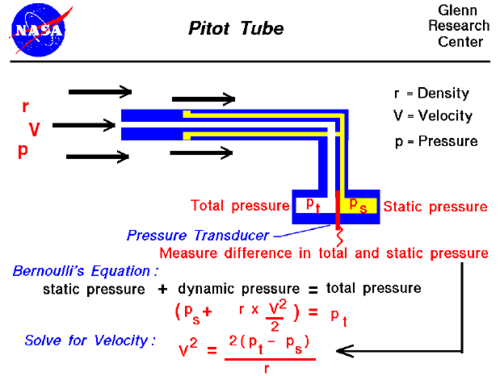
P1 = P2 + 1/2 ρv^2
29
torricelli’s result
KE of water coming out = PE of water at surface (v=square root 2gh)
due to bernoulli's equation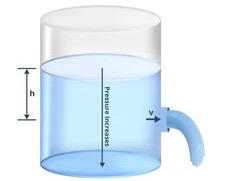
due to bernoulli's equation
30
pressure difference
dP = pg dh
from bernoulli's equation
from bernoulli's equation
31
electrostatics
electrostatic force between two charges (coulomb's law)
F = (k q1 q2) / r^2
units of F = N
units of k: (N m^2) / C^2
electric field (field points from positive to negative charges)
E = F/q = kq/ r^2
E = V/d
*units of E: N/C, V/m*
electric potential energy (work required to move from infinity to this point in the field)
U = q dV = qEd = k q1 q2 / r
electric potential (work required to move positive test charge to this point in the field)
V = U/q = kq/ r
V = Ed (potential difference between two plates)
*units of V: volt = J/C*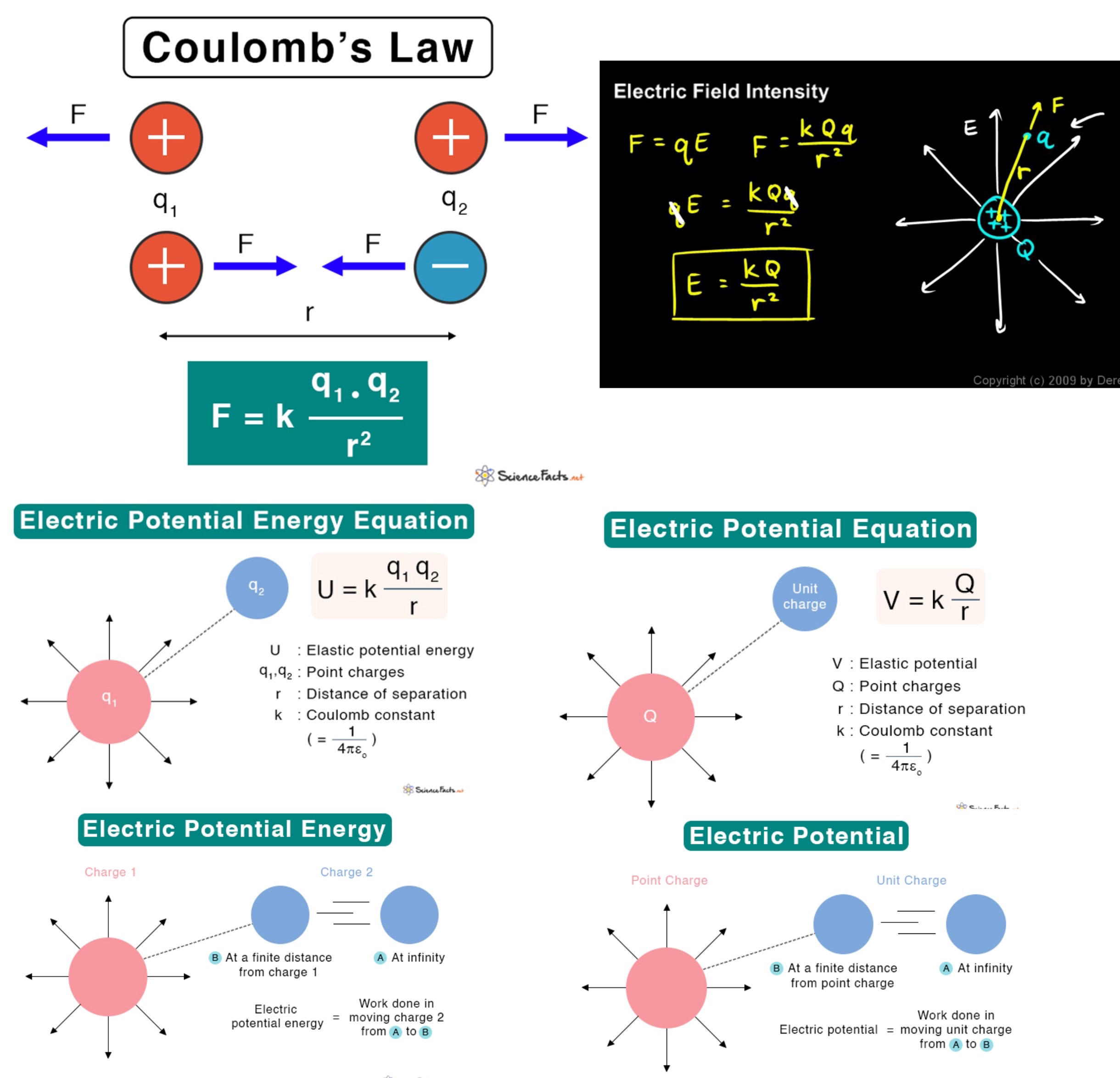
F = (k q1 q2) / r^2
units of F = N
units of k: (N m^2) / C^2
electric field (field points from positive to negative charges)
E = F/q = kq/ r^2
E = V/d
*units of E: N/C, V/m*
electric potential energy (work required to move from infinity to this point in the field)
U = q dV = qEd = k q1 q2 / r
electric potential (work required to move positive test charge to this point in the field)
V = U/q = kq/ r
V = Ed (potential difference between two plates)
*units of V: volt = J/C*
32
magnetism
magnetic field (due to straight wire)
B= μ I / 2 pi r
units: Tesla (T) = N s / m C
magnetic field (due to wire loop)
B = μ I / 2 r
field strength is related to current over radius of loop
RHR
magnetic force (experienced by moving charge)
F = qvBsin(theta)
magnetic force (experienced by current)
F = ILBsin(theta)
force is 0 when charges move parallel/antiparallel to magnetic field
RHR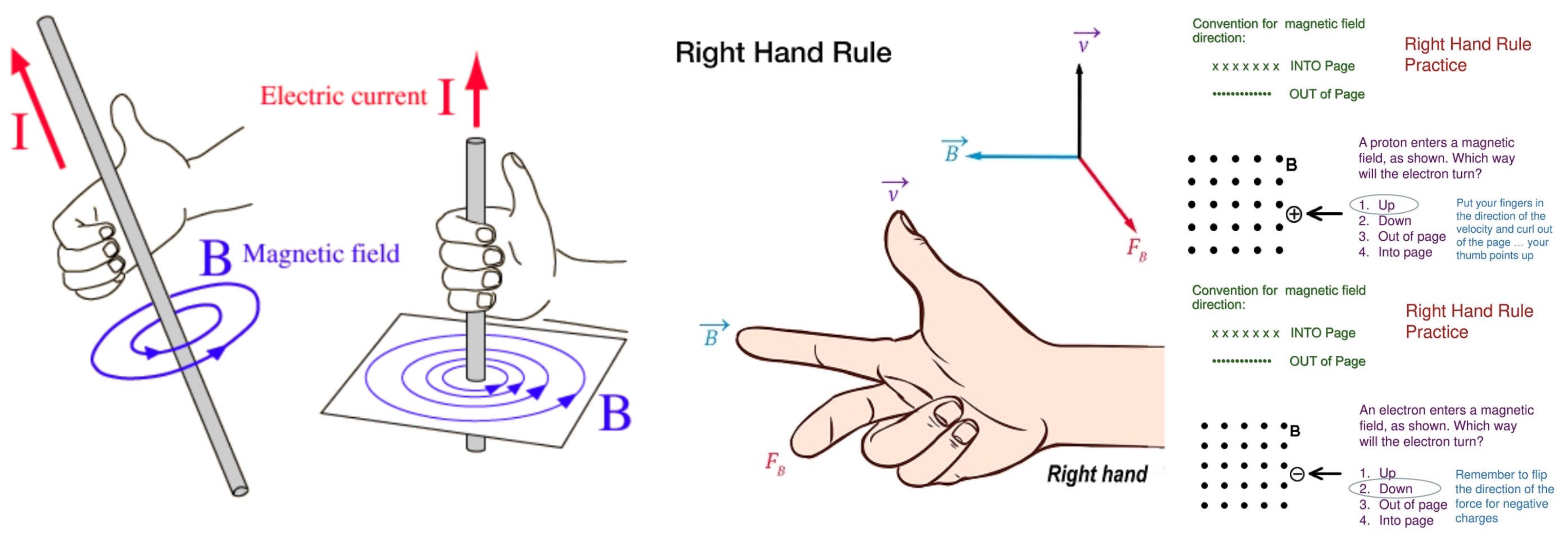
B= μ I / 2 pi r
units: Tesla (T) = N s / m C
magnetic field (due to wire loop)
B = μ I / 2 r
field strength is related to current over radius of loop
RHR
magnetic force (experienced by moving charge)
F = qvBsin(theta)
magnetic force (experienced by current)
F = ILBsin(theta)
force is 0 when charges move parallel/antiparallel to magnetic field
RHR
33
circuit properties
current: I = Q/t
units: amp (A) = C/s
voltage: V = IR
units: V = A*ohm
resistance is a property of the wire, so only V and I can realistically be changed
resistance: R = pL/A
R is directly proportional to T
units: ohm
capacitance: Q = VC
C = keA/d
U = 1/2 C V^2 (potential energy stored by capacitor)
units: farad (F) = C/V
power: P = IV
units: watt (W) = AV
units: amp (A) = C/s
voltage: V = IR
units: V = A*ohm
resistance is a property of the wire, so only V and I can realistically be changed
resistance: R = pL/A
R is directly proportional to T
units: ohm
capacitance: Q = VC
C = keA/d
U = 1/2 C V^2 (potential energy stored by capacitor)
units: farad (F) = C/V
power: P = IV
units: watt (W) = AV
34
power
power: P = IV
units: watt (W) = AV
power delivered = V^2/R
power lost (as heat) = I^2 R
high voltage, low current maximized power transmission!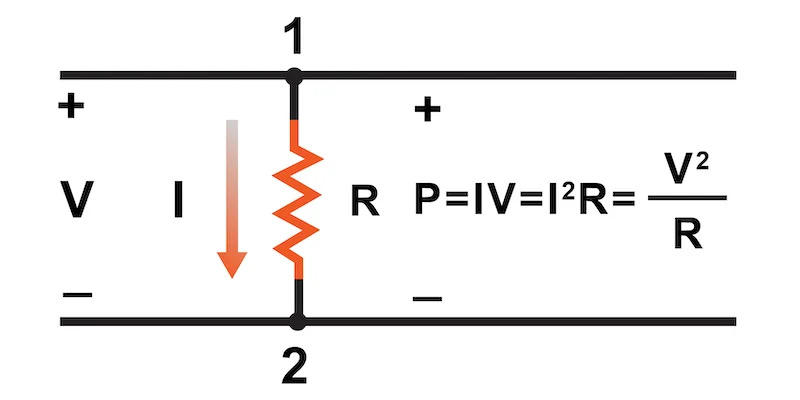
units: watt (W) = AV
power delivered = V^2/R
power lost (as heat) = I^2 R
high voltage, low current maximized power transmission!
35
internal resistance
R = internal resistance
V_actual = V_emf - IR_internal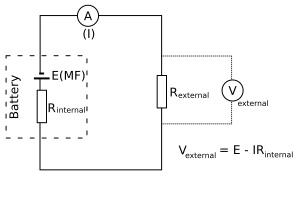
V_actual = V_emf - IR_internal
36
circuits
voltage in series:
V = V1 + V2
voltage in parallel
V = V1 = V2
current in series:
I = I1 = I2
current in parallel:
I = I1 + I2
resistors in series:
R = R1 + R2
resistors in parallel:
1/R = 1/R1 + 1/R2
capacitors in series:
1/C = 1/C1 +1/C2
capacitors in parallel:
C = C1 + C2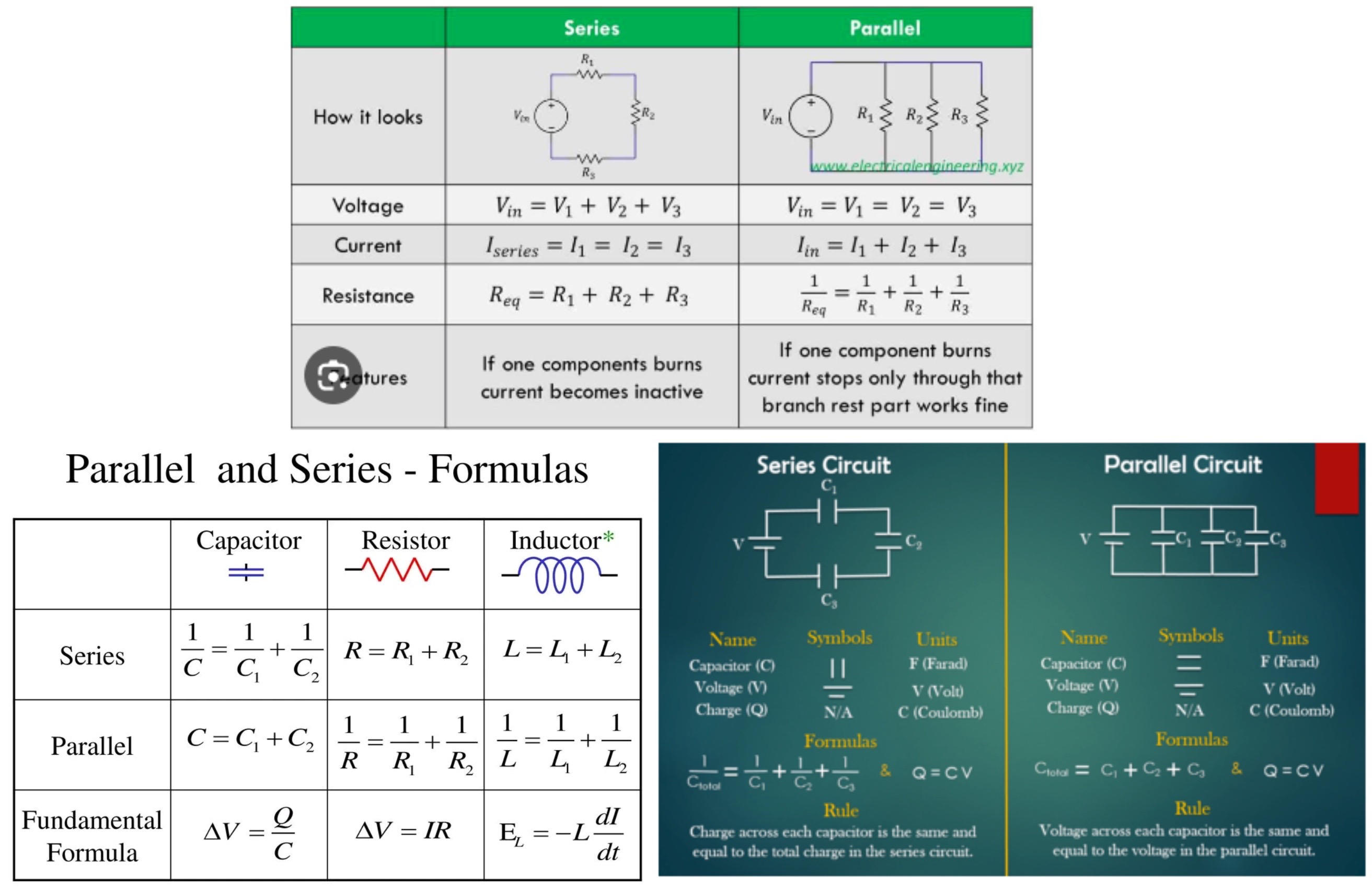
V = V1 + V2
voltage in parallel
V = V1 = V2
current in series:
I = I1 = I2
current in parallel:
I = I1 + I2
resistors in series:
R = R1 + R2
resistors in parallel:
1/R = 1/R1 + 1/R2
capacitors in series:
1/C = 1/C1 +1/C2
capacitors in parallel:
C = C1 + C2
37
speed of sound
343 m/s
v = sqrt(B/p)
depends on:
1. B (or K) = *bulk modulus* of medium (why sound is faster in solids)
2. p = density (why sound is faster in a dense solid)
3. temperature of medium (why sound is faster in hot air)
v = sqrt(B/p)
depends on:
1. B (or K) = *bulk modulus* of medium (why sound is faster in solids)
2. p = density (why sound is faster in a dense solid)
3. temperature of medium (why sound is faster in hot air)
38
decibels
every 10 decibels is a factor of 10 (for intensity)
39
human range of hearing
20 Hz to 20 kHz
ultrasound is greater than 20 kHz
ultrasound is greater than 20 kHz
40
timbre
tone or character of the sound
41
doppler effect
4 variables:
frequency of sound, source
frequency of sound, observed
speed of sound
speed of source
f_obs=(v+-v_o/v+-v_s)f_source
if source is moving towards you, frequency observed is higher
if source is moving away from you, frequency observed is lower
used in Doppler ultrasound to calculate speed of blood or fetus, better than standard ultrasound
linear relationship between speed and frequency
v=(wavelength)(frequency)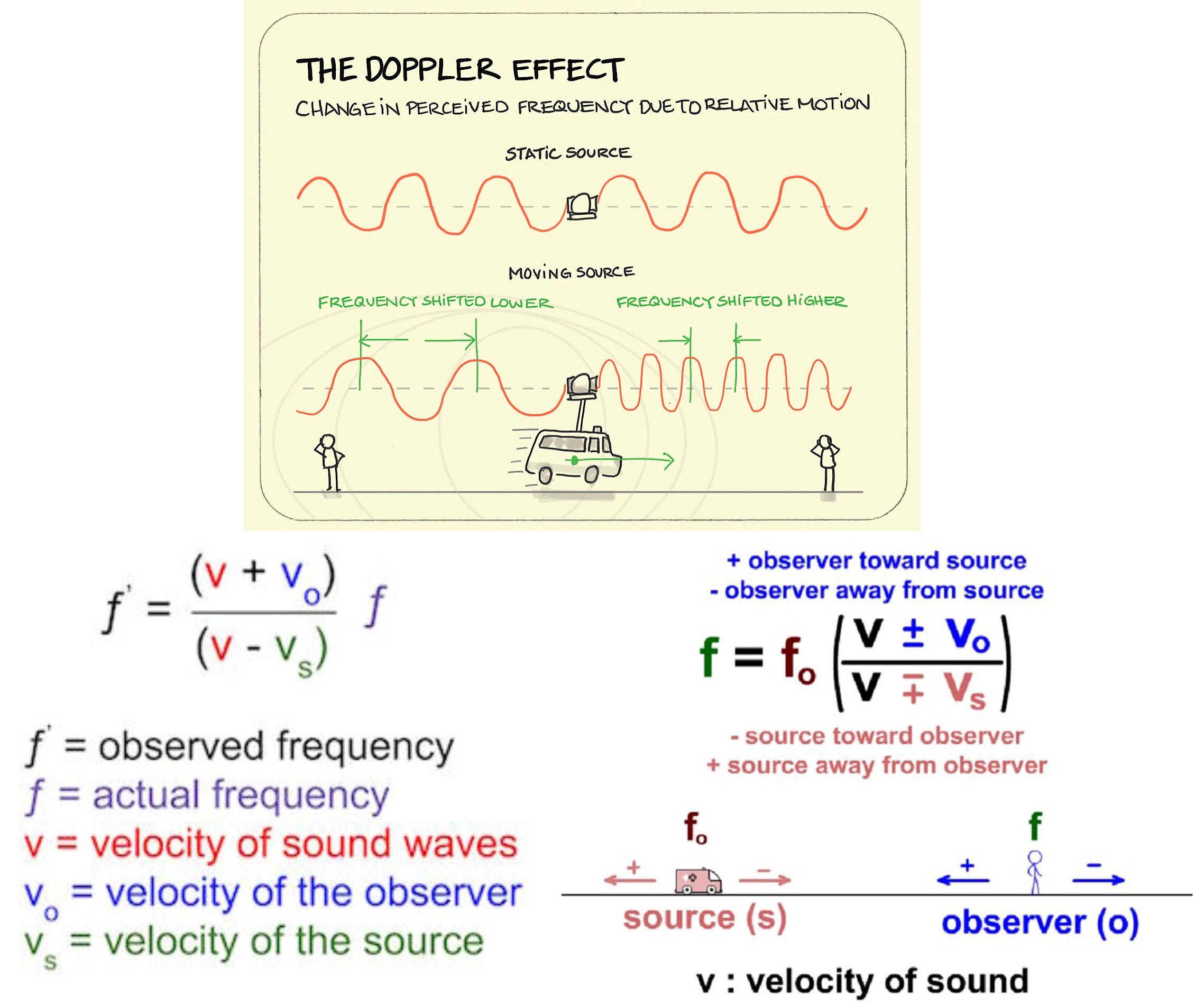
frequency of sound, source
frequency of sound, observed
speed of sound
speed of source
f_obs=(v+-v_o/v+-v_s)f_source
if source is moving towards you, frequency observed is higher
if source is moving away from you, frequency observed is lower
used in Doppler ultrasound to calculate speed of blood or fetus, better than standard ultrasound
linear relationship between speed and frequency
v=(wavelength)(frequency)
42
doppler shift
dwavelength = wavelength*relative velocity/speed of light (also df/f=v/c)
if wave reflects off object (police radar thing), double the doppler effect
stars have red shift (decreased frequency) since they're moving away from us
for moving target or reflector:
df/f=2v/c
if wave reflects off object (police radar thing), double the doppler effect (2 shifted waves coming back at you now)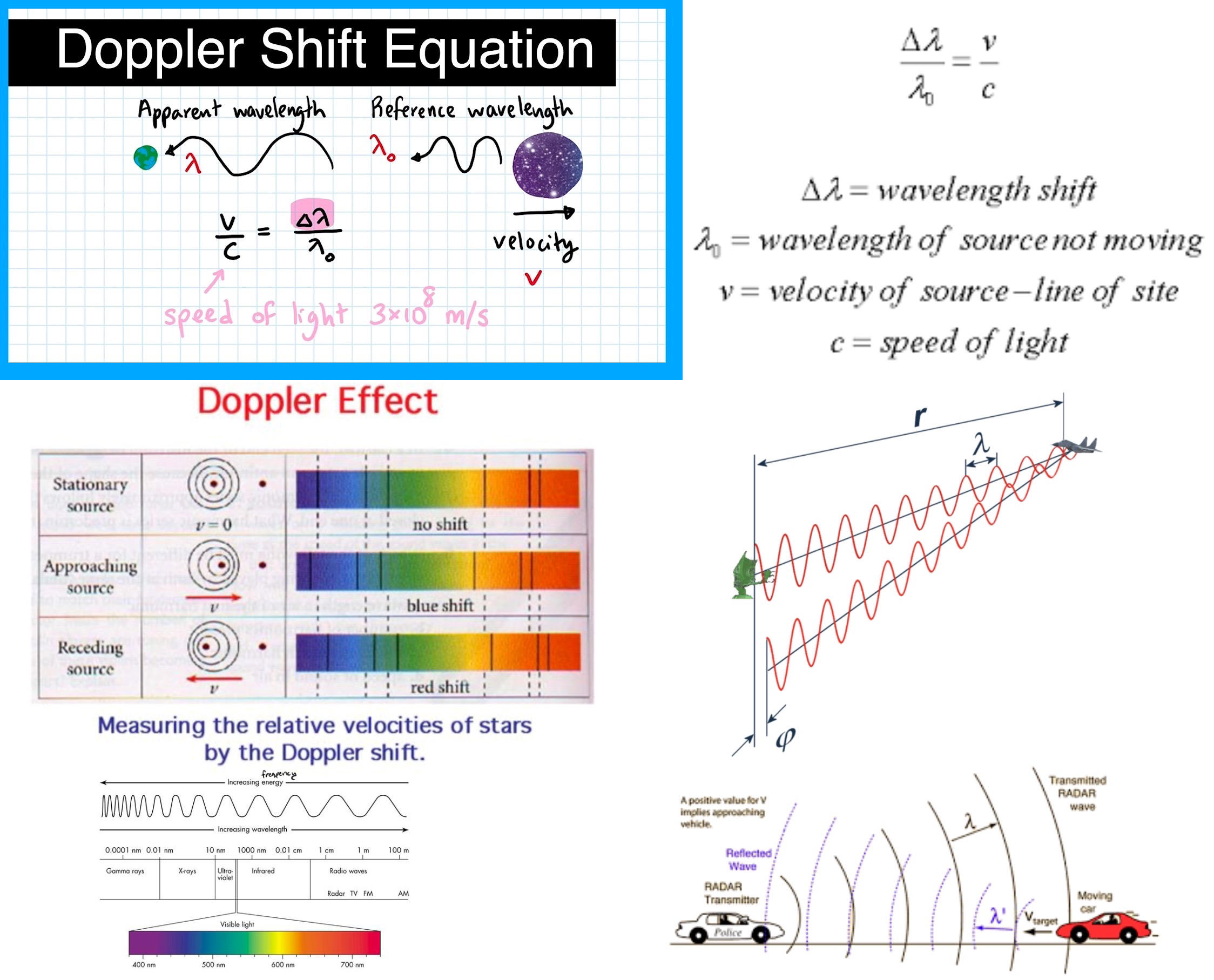
if wave reflects off object (police radar thing), double the doppler effect
stars have red shift (decreased frequency) since they're moving away from us
for moving target or reflector:
df/f=2v/c
if wave reflects off object (police radar thing), double the doppler effect (2 shifted waves coming back at you now)
43
index of refraction
n = speed of light/speed in new medium (n=c/v)
light slows down in a medium with greater index of refraction (light is slower in glass than air) (n: air=1, water=1.3, glass=1.5)
sound is faster in glass than air (sound travels faster in denser objects) (helium is a lie)
while wavelength does change, frequency does not change between mediums (due to e=hf where changing f changes energy of photon)
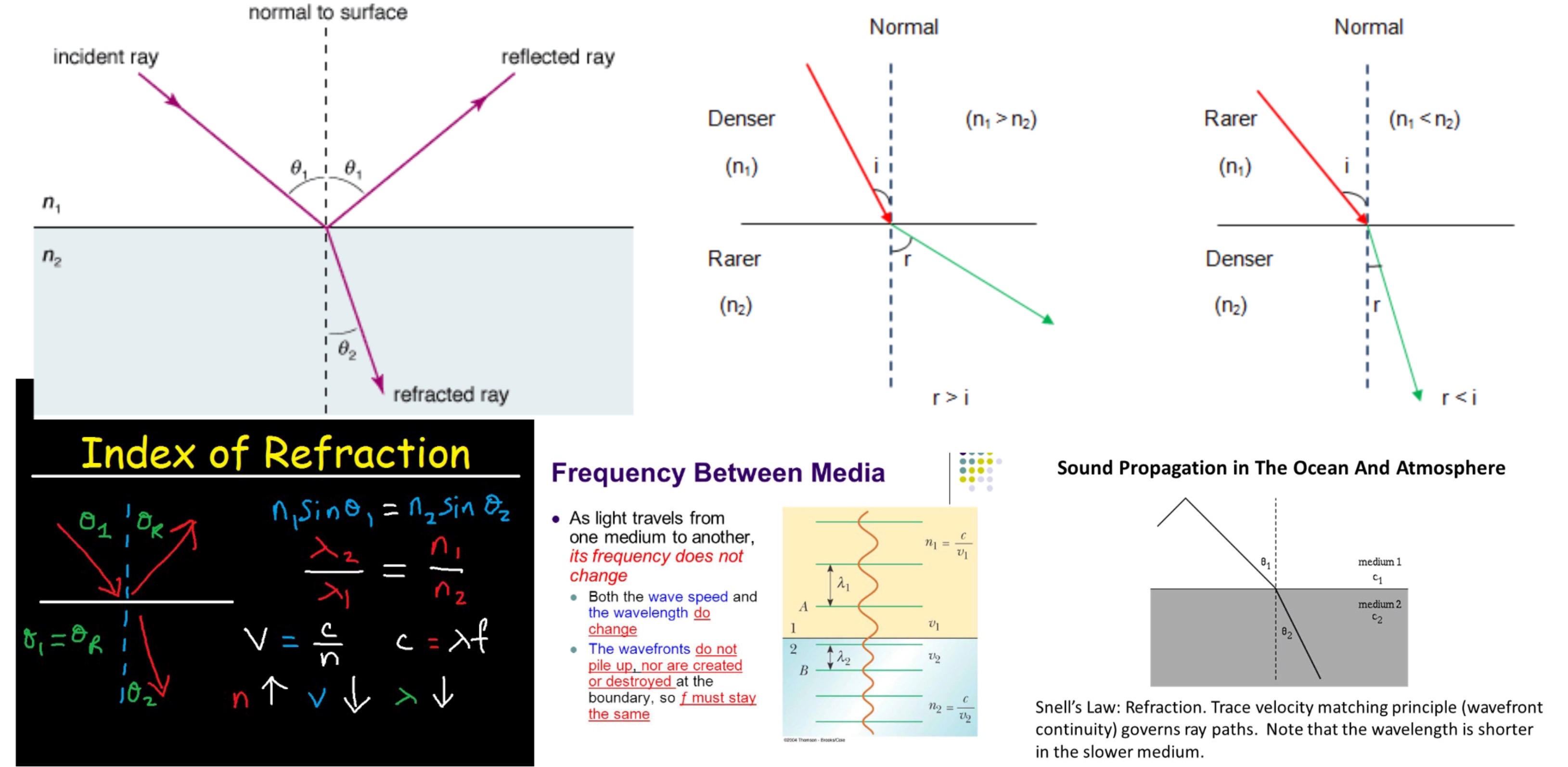
light slows down in a medium with greater index of refraction (light is slower in glass than air) (n: air=1, water=1.3, glass=1.5)
sound is faster in glass than air (sound travels faster in denser objects) (helium is a lie)
while wavelength does change, frequency does not change between mediums (due to e=hf where changing f changes energy of photon)
44
refraction
n = c/v
n1sin(theta1) = n2sin(theta2)
always measure angles from the normal lines
when light enters higher index medium, refracts towards normal line
when light enters a lower index medium, refracts away from normal line
total internal reflection- enters lower index medium and refracts a full 90 degrees away from normal, how fiber optics work
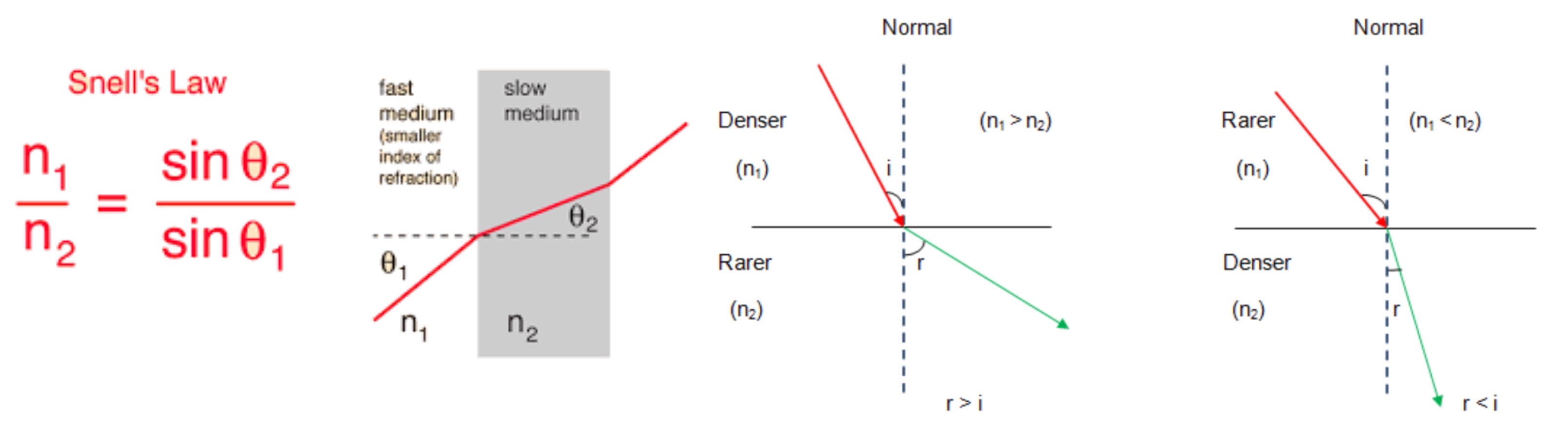
n1sin(theta1) = n2sin(theta2)
always measure angles from the normal lines
when light enters higher index medium, refracts towards normal line
when light enters a lower index medium, refracts away from normal line
total internal reflection- enters lower index medium and refracts a full 90 degrees away from normal, how fiber optics work
45
mirrors
f > 0 means concave mirror
object beyond f means image is real (in front of mirror), inverted
object inside f means image is virtual (behind mirror), upright, enlarged
f < 0 means convex mirror
all images are virtual (behind mirror), upright, smaller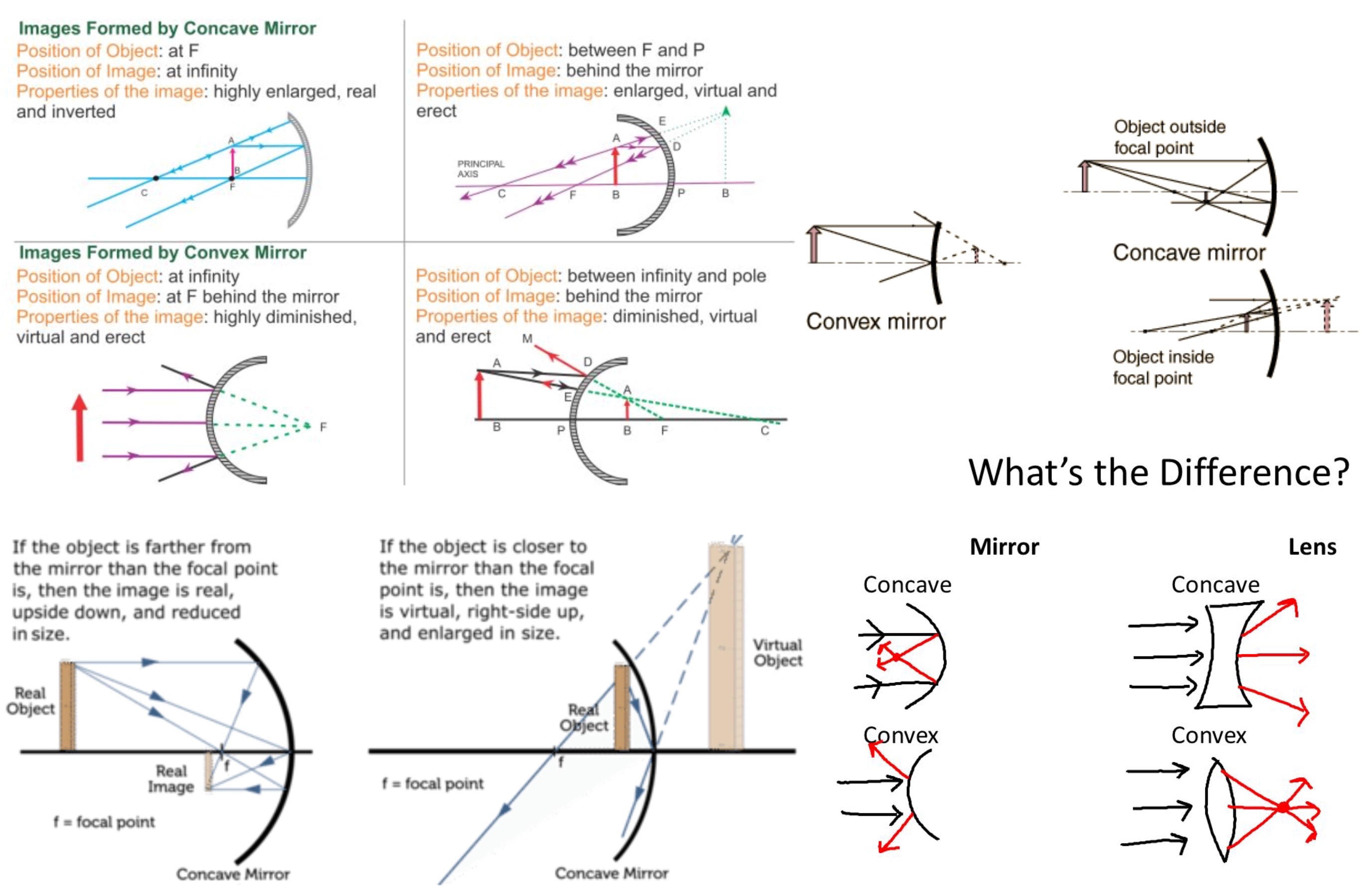
object beyond f means image is real (in front of mirror), inverted
object inside f means image is virtual (behind mirror), upright, enlarged
f < 0 means convex mirror
all images are virtual (behind mirror), upright, smaller
46
thin lens equations
1/do + 1/di = 1/f
-di/do = hi/ho
height of image/object is proportional to distance of image/object
use to calculate magnification factor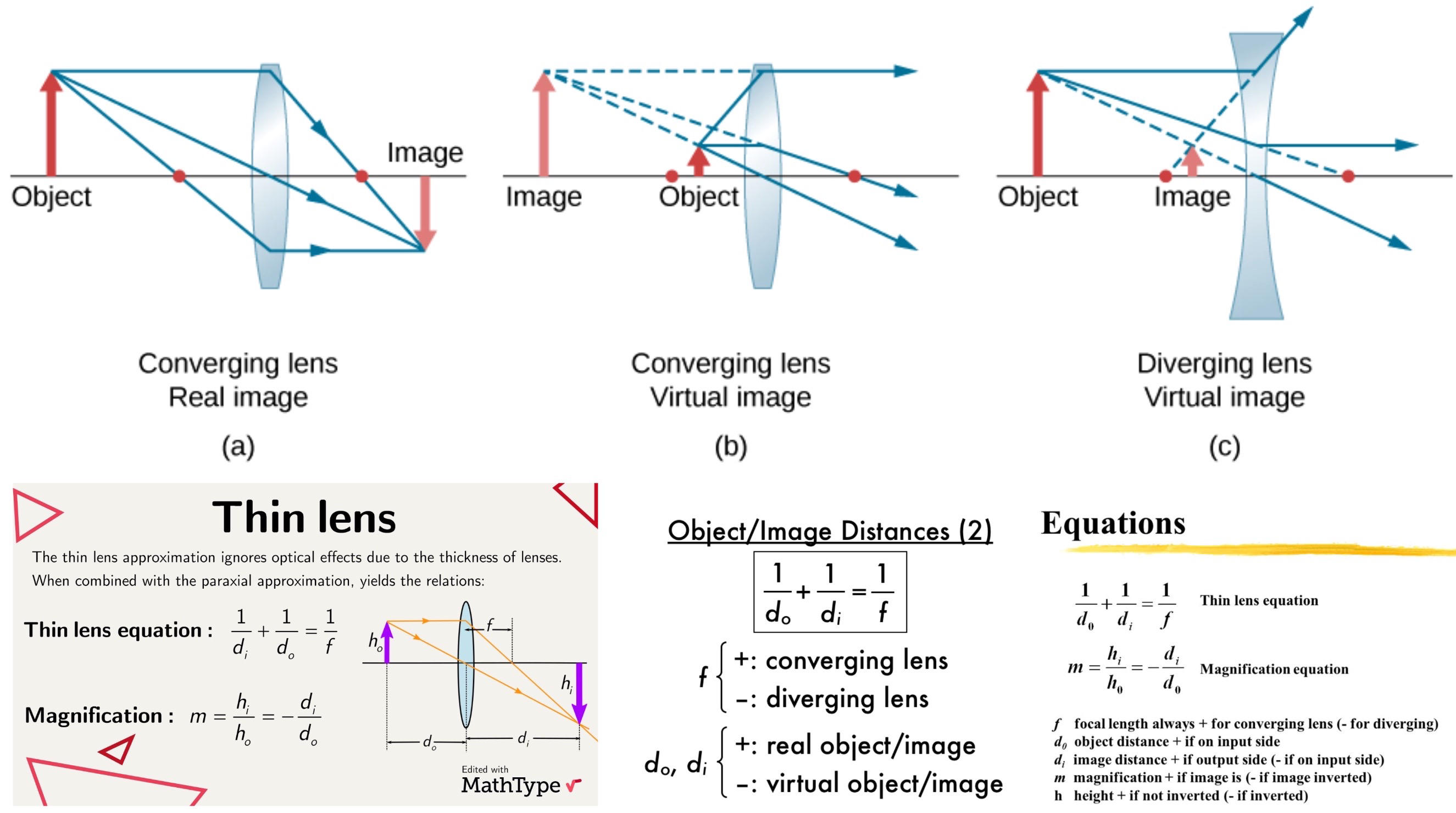
-di/do = hi/ho
height of image/object is proportional to distance of image/object
use to calculate magnification factor
47
lens
f > 0 means converging lens
object beyond f means image is real, inverted
object inside f means image is virtual, upright, enlarged
f < 0 means diverging lens
all images are virtual, upright, smaller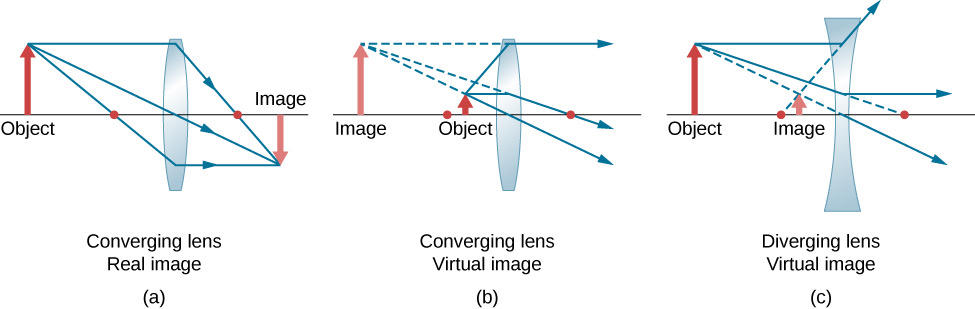
object beyond f means image is real, inverted
object inside f means image is virtual, upright, enlarged
f < 0 means diverging lens
all images are virtual, upright, smaller
48
mirror/lens signs + or -
do (object distance) is always positive
di (image distance) is positive for real images, negative for virtual images
f (focal length) is positive for concave mirrors, converging lens
m (magnification) is positive for upright image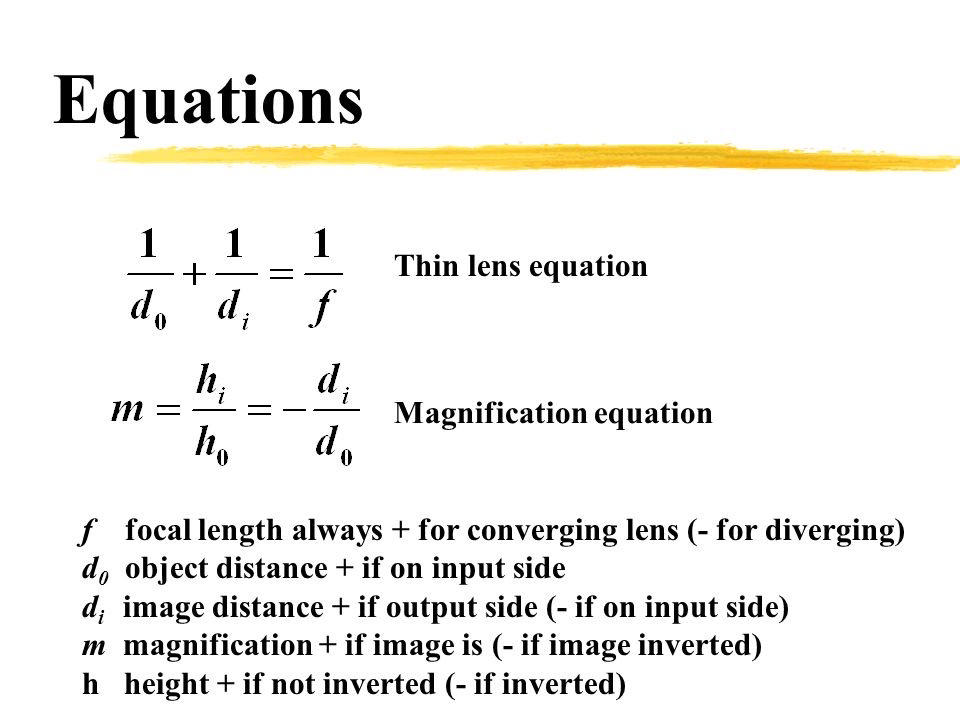
di (image distance) is positive for real images, negative for virtual images
f (focal length) is positive for concave mirrors, converging lens
m (magnification) is positive for upright image
49
magnification
m = -i/o
m < 1 means image is reduced
m > 1 means image is enlarged
negative m means inverted image
positive m means upright image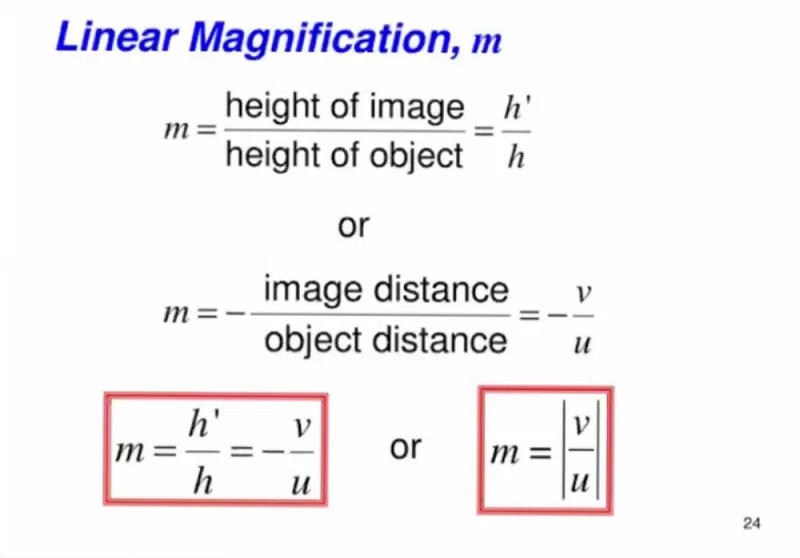
m < 1 means image is reduced
m > 1 means image is enlarged
negative m means inverted image
positive m means upright image
50
diopter
refractive power unit (D = 1/m)
reciprocal of focal length of a lens
smaller focal length means more powerful lens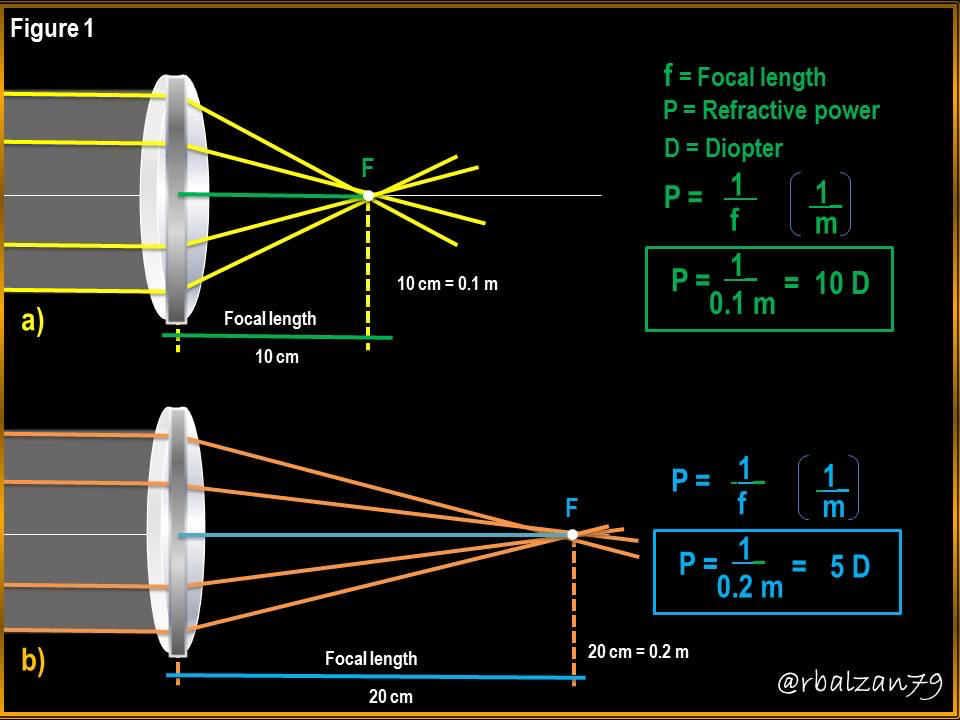
reciprocal of focal length of a lens
smaller focal length means more powerful lens
51
aberration
spherical aberration:
assumption of sin(theta) = theta
light at top of lens is refracted more, shorter focal length
so not all rays go through focal length, inherent property with spherical lens
chromatic aberration:
dispersion says greater wavelengths have smaller index of refraction
red refracts less than blue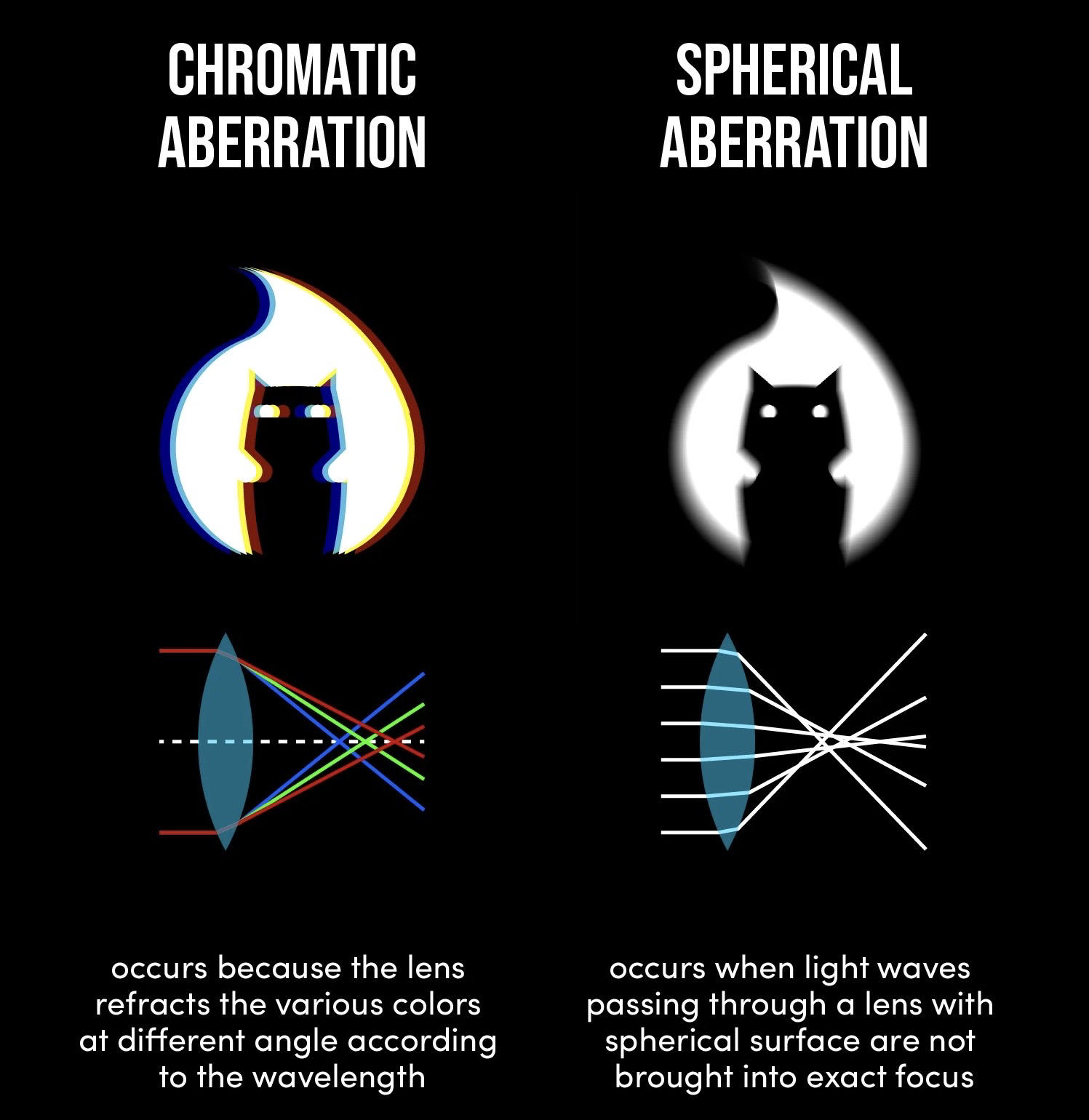
assumption of sin(theta) = theta
light at top of lens is refracted more, shorter focal length
so not all rays go through focal length, inherent property with spherical lens
chromatic aberration:
dispersion says greater wavelengths have smaller index of refraction
red refracts less than blue
52
human eye
ciliary muscles adjust lens to focus image on retina
requires diverging lens (concave)
corrects myopia, nearsightedness, focal length of eye is too short
requires converging lens (convex)
corrects hyperopia, farsightedness, focal length of eye is too long
image on retina is upside down, brain flips it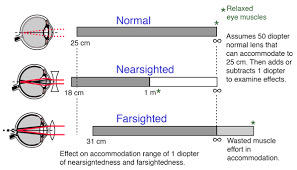
requires diverging lens (concave)
corrects myopia, nearsightedness, focal length of eye is too short
requires converging lens (convex)
corrects hyperopia, farsightedness, focal length of eye is too long
image on retina is upside down, brain flips it
53
efficiency
work output/work input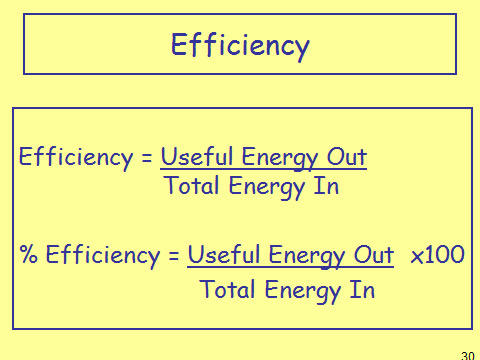
54
standard units
kg
m
s
m
s
55
photoelectric effect
work function is energy to remove an electron
input energy is greater than output energy
KE = hf - W
W = work function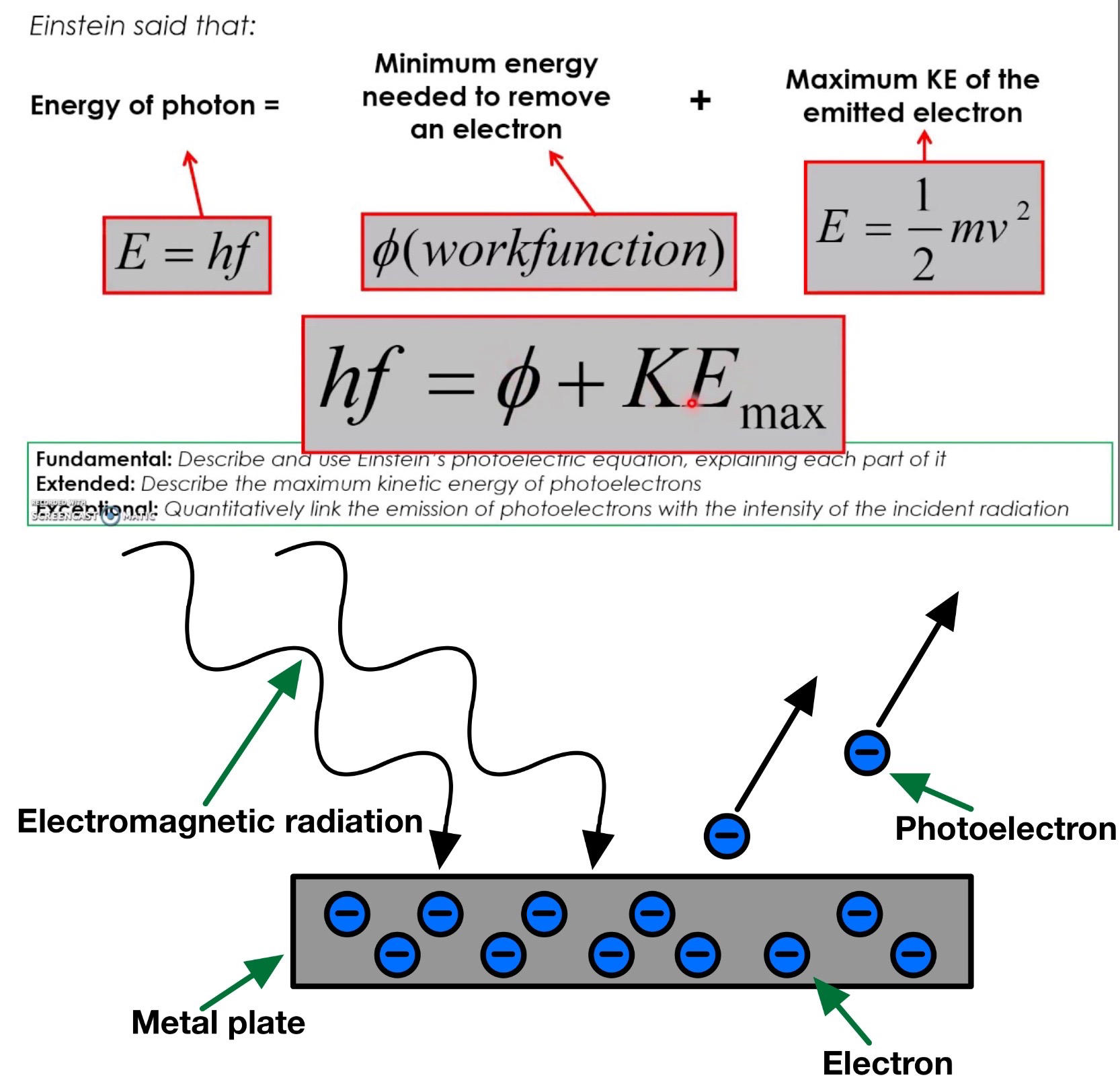
input energy is greater than output energy
KE = hf - W
W = work function
56
photon
E = hf
units of E: J
units of h = J s
units of f: 1/s
photon absorbed by electron raises its energy level; when electron falls back down to lower energy level, it releases light (photon) proportional to the energy that was absorbed when electron moved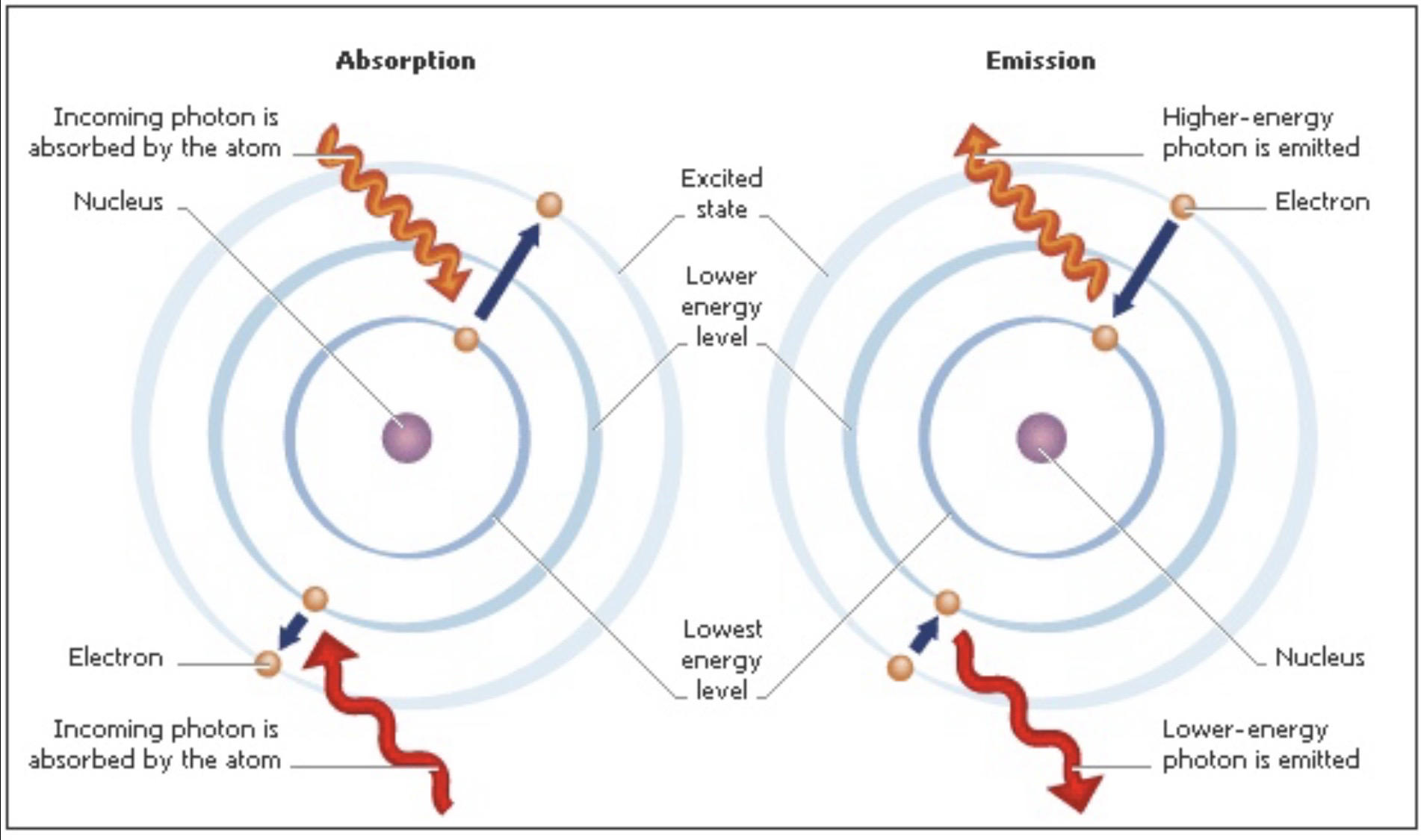
units of E: J
units of h = J s
units of f: 1/s
photon absorbed by electron raises its energy level; when electron falls back down to lower energy level, it releases light (photon) proportional to the energy that was absorbed when electron moved
57
Work
The work done equals the energy transformed.
$\purple{W= \Delta U}$
$\purple{W= \Delta U}$
58
Work done by a force
$\purple {W_{F} = F_{x} \cdot d = F \cos( \theta ) \cdot d = F_{\parallel} d ) $ or as dot product $ \purple {W_{F} = \vec{F} \cdot \Delta \vec{r}} $
$ \red{ \text{Work is NOT a vector }}$
$\purple { \text{The amount of work done equals the amount of energy transformed. }} $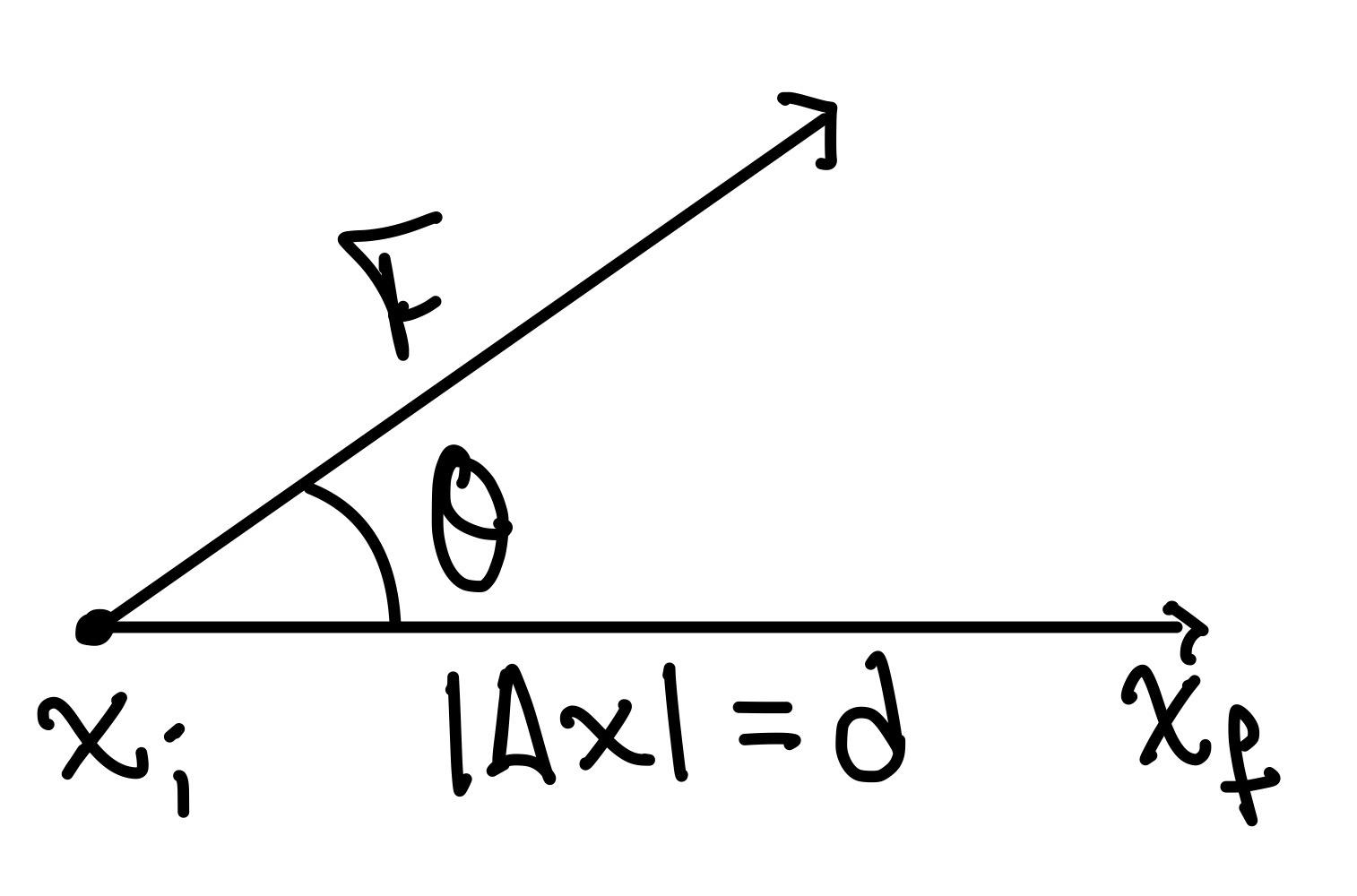
$ \red{ \text{Work is NOT a vector }}$
$\purple { \text{The amount of work done equals the amount of energy transformed. }} $
59
Kinetic energy?
$\purple { KE = \frac{1}{2} mv^{2} [\text{joules}]} $ KE is always positive.
60
Work-Energy Theorem
$ \purple{ \text{The work done by the net force on a single-point object is equal to the change in kinetic energy of than object.} } $
$ \purple{ W_{net} = W_{f net} \Delta KE = KE_{f} - KE_{i} }$
W-E applies in cases where the object is regarded as a point withou deformation or rotation.
$ \purple{ W_{net} = W_{f net} \Delta KE = KE_{f} - KE_{i} }$
W-E applies in cases where the object is regarded as a point withou deformation or rotation.
61
Work Integral
$\purple { W_{F} = \int \vec{F} \cdot d \vec{r} }$
Work along a curved path or done by an inconstant force
Work along a curved path or done by an inconstant force
62
Hooke’s Law
$ \purple {F_{spring} = -ks}$
63
Potential Energy
$ \purple {PE_{gravitational} = mgh}$
$ \purple { PE_{elastic} = \frac{1}{2}kx^2 }$ k is the spring constant
$ \purple { PE_{elastic} = \frac{1}{2}kx^2 }$ k is the spring constant
64
Mechanical Energy
$ E_{mech} = KE +PE $ (ignoring friction within an isolated system)
65
Conservative force’s potential energy
$ \purple { \Delta PE_{F} = -W_{F} = +W_{external} }$
66
The normal force never does , therefore the
The normal force never does work, therefore the potential energy associated with the normal force is zero