Phys 590 - Final Exam
Study these flashcardsFree · spaced repetition · iPhone, Android, Mac & web
All cards
1
How do astronomer's measure distance?
- Radar (in-solar-system)
- Stellar Parallax (out-solar-system)
- Distance Modulus
- Standard Candles (galaxies)
- Stellar Parallax (out-solar-system)
- Distance Modulus
- Standard Candles (galaxies)
2
What is a parsec?
A parsec is the distance at which a star has a parallax angle $\pi^"$ equal to one arcsecond.
3
What is Stellar Parallax and what is the formula for distance?
Stellar Parallax is the apparent motion of stars due to the Earth's motion around the Sun.
$d = \frac{206,265 \space arcsec}{\pi^"}$
$d = \frac{206,265 \space arcsec}{\pi^"}$
4
What is Distance Modulus and how can it be used?
Distance Modulus is the difference between a star's apparent and absolute magnitude.
$m - M = 5logd - 5$
$m - M = 5log(\frac{d}{10pc})$
$m - M = 5logd - 5$
$m - M = 5log(\frac{d}{10pc})$
5
What is a star's intrinsic brightness?
The intrinsic brightness of a star is also known as it's luminosity. Luminosity is the rate at which a star emits energy in the form of elctromagnetic radiation.
6
What is apparent brightness?
Apparent brightness is the flux of a star. Flux is the rate per unit are at which a stars energy strikes a surface held perpendicula to a star.
7
What is the formula for Flux/Luminosity?
$F = \frac{L}{4\pi d^2}$
8
What is apparent magnitude? What is the formula?
The apparent magnitude is a measure of brightness of a star or another astronomical object. The more negative the brighter the object.
$m = C - 2.5logF$
$m = C - 2.5logF$
9
What is absolute magnitude? What is the formula?
Absolute magnitude is the apparent magnitude of a star if it were at a distance of 10 parsecs.
$M = m - 5logd + 5$
$M = m - 5logd + 5$
10
What is bolometric flux? What are the magnitude formulas associated?
Bolometric flux is the total flux of a star integrated over all wavelengths.
$M_{bol} = 4.74 - 2.5log(\frac{L}{L_{sun}})$
$\frac{L}{L_{sun}} = 10^{0.4(4.74 - M_{bol})}$
$M_{bol} = 4.74 - 2.5log(\frac{L}{L_{sun}})$
$\frac{L}{L_{sun}} = 10^{0.4(4.74 - M_{bol})}$
11
What is the color index of a star? What does it allow you to do?
Color index is the differnece of its apparent magnitude seen through two different filters. Using B-V, it allows you to determine the temperature of a star. If B-V > 0 = T > 10,000K and will be bluer than Vega. If B-V < 0 = T < 10,000K and will be redder than Vega.
12
What is the bolometric correction and what does it allow you to tell about a star?
$BC = M_{bol} - M_V$
If this value is a large negative value, it is either a cooler star than the Sun or a hotter star than the Sun. The closer the value is to 0, the closer type of star it is to the Sun.
If this value is a large negative value, it is either a cooler star than the Sun or a hotter star than the Sun. The closer the value is to 0, the closer type of star it is to the Sun.
13
What is the fomula for distance modulus if you include extinction? What does extinction do to the magnitudes?
$m - M = 5logd - 5 + A_V$
Correcting for extinction gives you a better distance measurement and also makes the star bluer due to removing interstellar reddening.
Correcting for extinction gives you a better distance measurement and also makes the star bluer due to removing interstellar reddening.
14
How do you calculate the extinction coefficient $A_V$?
Using,
$R = \frac{A_V}{E(B-V)}$
where R usual equates to a value of 3.1.
$R = \frac{A_V}{E(B-V)}$
where R usual equates to a value of 3.1.
15
What is the flux-magnitude relation? What does it imply?
$\frac{F_1}{F_2} = 100^{\frac{m_2 - m_1}{5}} = 2.512^{m_2 - m_1}$
or
$m_a - m_b = -2.5log(\frac{F_b}{F_a})$
It implied that a difference of 5 magnitudes equals a 100x difference in brightness/flux.
or
$m_a - m_b = -2.5log(\frac{F_b}{F_a})$
It implied that a difference of 5 magnitudes equals a 100x difference in brightness/flux.
16
What is the doppler shift relation?
$\frac{\Delta{\lambda}}{\lambda} = \frac{\Delta{v}}{c}$
17
How do you calculate mass of a star?
Using Kepler's 3rd Law,
$M_A + M_B = \frac{{4{\pi^2}{a^3}}}{GP^2}$
$M_A + M_B = \frac{{4{\pi^2}{a^3}}}{GP^2}$
18
What are the 3 types of binary classes and what do they mean?
* Visual Binary - two stars of the binary are indivdually resolved with large separations and periods.
* Spectroscopic Binary - two stars are unresolved but the system shows absorption lines that oscillate as the radial velocity of the stars changes. They have small orbits and small periods.
* Eclipsing Binary - two stars are unresolved but the orbital plane is edge on in which we can detect a dip in flux. These binaries have small separations and short periods.
* Spectroscopic Binary - two stars are unresolved but the system shows absorption lines that oscillate as the radial velocity of the stars changes. They have small orbits and small periods.
* Eclipsing Binary - two stars are unresolved but the orbital plane is edge on in which we can detect a dip in flux. These binaries have small separations and short periods.
19
What is the difference between Visual and Spectroscopic Binaries?
Visual binaries use a reduced form of Kepler's 3rd Law = $\frac{a^3}{P^2}$.
Spectroscopic binaries use the full form with $(a_A + a_B)^3$ which are calculated using radial velocities $v_a sini$ or $v_b sini$ in the period formula.
Spectroscopic binaries use the full form with $(a_A + a_B)^3$ which are calculated using radial velocities $v_a sini$ or $v_b sini$ in the period formula.
20
What is the binary orbital barycenter and momentum?
$m_1 r_1 = m_2 r_2$
$m_1 v_1 = m_2 v_2$
$m_1 v_1 = m_2 v_2$
21
How is stellar radii calculated from an Eclipsing Binarie's light curve?
22
What is the equation for mean molecular mass? Ionized? Neutral?
$\mu = \frac{\bar{m}}{m_H}$
Ionized:
$\mu (ionized) = \frac{\rho}{nm_p} = {(2X + 3/4Y + 1/2Z)}^{-1}$
Neutral:
$\mu (neutral) = {(X + \frac{Y}{4} + \frac{Z}{A})}^{-1}$
Ionized:
$\mu (ionized) = \frac{\rho}{nm_p} = {(2X + 3/4Y + 1/2Z)}^{-1}$
Neutral:
$\mu (neutral) = {(X + \frac{Y}{4} + \frac{Z}{A})}^{-1}$
23
What is hyrdrostatic equlibrium and what is the formula?
Hydrostatic Equilibrium is when the self gravity and internal pressure are equal.
$\frac{dP}{dr} = -\frac{GM_rp}{r^2}$
$\frac{dP}{dr} = -\frac{GM_rp}{r^2}$
24
What is the ideal gas law?
$P = nkT = \frac{\rho kT}{\mu m_p}$
25
What is the order of spectral classification?
Hot to Cold: QBAFGKMLT
Where including subdivisions, 1 is the hottest and 9 is the coolest.
Where including subdivisions, 1 is the hottest and 9 is the coolest.
26
What are the temperatures of each spectral type?
O - 40000K
B - 20000K
A - 9000K
F - 7000K
G - 5500K
K - 4500K
M - 3000K
L - 2000K
T - <1300K
B - 20000K
A - 9000K
F - 7000K
G - 5500K
K - 4500K
M - 3000K
L - 2000K
T - <1300K
27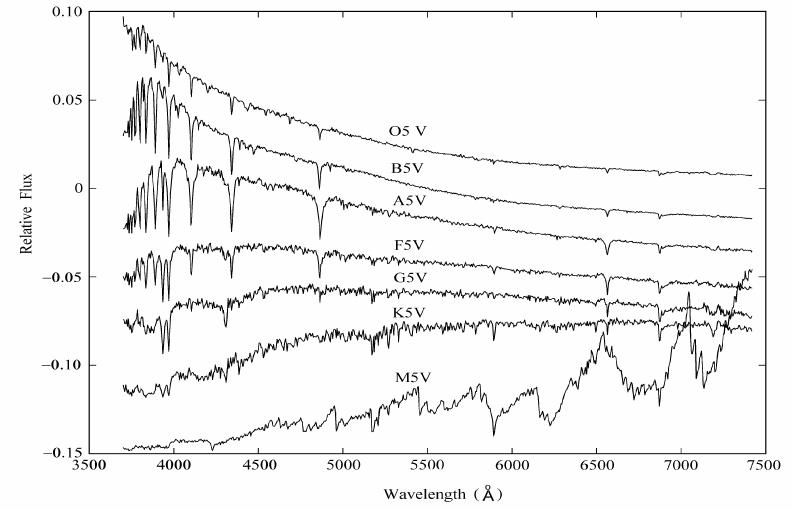
What do the spectrums of each spectral type roughly look like?
28
What is the formula for scale height and what does it tell you?
$H = \frac{kT}{g\mu m_p}$
Distance over which a physical quantity decreases by a factor of e (falling off).
Distance over which a physical quantity decreases by a factor of e (falling off).
29
How do you calculate a cluster age from a color diagram?
Use,
${m_V - M_V} = 5logd - 5 + A_V$
${m_V - M_V} = 5logd - 5 + A_V$
30
What is the equation of mass continuity and what does it tell you?
$\frac{dM}{dr} = 4\pi r^2 \rho (r)$
This formula tells us that the total mass of a spherical star is the sum of masses of infinitesimally thin spherical shells.
This formula tells us that the total mass of a spherical star is the sum of masses of infinitesimally thin spherical shells.
31
What is the equation of state and what does it tell you?
$P(r) = \frac{p(r)kT(r)}{\mu m_p}$
This equation tells you the relationship among density, temperature, and pressure for a gas.
This equation tells you the relationship among density, temperature, and pressure for a gas.
32
How is central temperature, mass, and radius related?
$T_c = \frac{M \mu}{R}$ for masses greater than
$1.66M_{sol}$.
$T_c = \frac{M}{R}$ for low mass stars.
$1.66M_{sol}$.
$T_c = \frac{M}{R}$ for low mass stars.
33
What is the equation for radiative transport?
$\frac{dT}{dr} = -\frac{3p(r)k(r)L(r)}{16\pi ac{T(r)}^3 r^2}$
or
$\frac{dT}{dr} = -\frac{3p(r)k(r)L(r)}{64\pi \sigma _{SB} {T(r)}^3 r^2}$
or
$\frac{dT}{dr} = -\frac{3p(r)k(r)L(r)}{64\pi \sigma _{SB} {T(r)}^3 r^2}$
34
What is the equation for convective transport?
$\frac{dT}{dr} = (1-\frac{1}{\gamma})\frac{T(r)}{P(r)} \frac{dP}{dr}$
35
What is the adiabatic index?
For simple atomic and fully ionized gases,
$\gamma = \frac{5}{3}$
For diatomic gases,
$\gamma = \frac{7}{5}$
$\gamma = \frac{5}{3}$
For diatomic gases,
$\gamma = \frac{7}{5}$
36
What is the equation of energy generation?
$dL = (4\pi r^2 dr)\rho \epsilon$
or
$\frac{dL}{dr} = 4\pi r^2 \rho (r) \epsilon (r)$
or
$\frac{dL}{dr} = 4\pi r^2 \rho (r) \epsilon (r)$
37
What is the random walk process?
Test particles moving from an initial point in a series of steps with the direction of each step being uncorrelated. The direction is independent of which its absorbed predecessor was traveling.
38
How does the PP-chain process work?
Fusion of 4 Hydrogen into Helium. ($T_c < 1.8 * 10^7 K$)
Two protons into H2, a positron, and neutrino.
$p + p => H^2 + e^+ + v_e$
Deutron fuses with protons into light Helium with excess energy carried away by gamma.
$H^2 + p => He^3 + \gamma$
Two light helium fuse to form normal Helium with excess protons spat out to repeat the chain.
$He^3 + He^3 => He^4 + p + p$
Two protons into H2, a positron, and neutrino.
$p + p => H^2 + e^+ + v_e$
Deutron fuses with protons into light Helium with excess energy carried away by gamma.
$H^2 + p => He^3 + \gamma$
Two light helium fuse to form normal Helium with excess protons spat out to repeat the chain.
$He^3 + He^3 => He^4 + p + p$
39
How does the CNO cycle process work?
Fusion of 4 Hydrogen Atoms into Helium with Carbon, Nitrogen, and Oxygen as catalysts. ($T_c > 1.8 * 10^7 K$)
$C^{12} + p => N^{13} + \gamma$
$N^{13} => N^{13} + e^+ + v_e$
$C^{13} + p => N^{14} + \gamma$
$N^{14} + p => O^{15} + \gamma$
$O^{15} => N^{15} + e^+ + v_e$
$N^{15} + p => C^{12} + He^4$
$C^{12} + p => N^{13} + \gamma$
$N^{13} => N^{13} + e^+ + v_e$
$C^{13} + p => N^{14} + \gamma$
$N^{14} + p => O^{15} + \gamma$
$O^{15} => N^{15} + e^+ + v_e$
$N^{15} + p => C^{12} + He^4$
40
How does the Triple-Alpha process work?
Fusion of 3 Normal Helium into Carbon with beryllium as a catalyst.
$He^4 + He^4 => Be^8 + \gamma$
$He^4 + Be^8 => C^{12} + \gamma$
$He^4 + He^4 => Be^8 + \gamma$
$He^4 + Be^8 => C^{12} + \gamma$
41
What is mean free path?
$mfp = \frac{1}{\sigma n}$
where sigma = cross-sectional area and n = number density.
where sigma = cross-sectional area and n = number density.
42
What is color excess?
Color excess is the observed color index subtracted by the intrinsic color index if there were no reddening.
43
What are the types of interstellar medium?
- Cold Molecular Clouds
- Cold Neutral Medium (HI Regions)
- Warm Neutral Medium
- Warm Ionized Medium (HII Regions)
- Hot Ionized Medium
- Cold Neutral Medium (HI Regions)
- Warm Neutral Medium
- Warm Ionized Medium (HII Regions)
- Hot Ionized Medium
44
What is the temperature and density of Cold Molecular Clouds?
$T = 10K, n > 10^9 m^{-3}$
45
What is the temperature and density of Cold Neutral Medium?
$T = 100K, n = 10^8 m^{-3}$
46
What is the temperature and density of Warm Neutral Medium?
$T = 7000K, n = 4 * 10^5 m^{-3}$
47
What is the temperature and density of Warm Ionized Medium?
$T = 10^4 K, n = 10^6 m^{-3}$
48
What is the temperature and density of Hot Ionized Medium?
$T = 10^6 K, n < 10^4 m^{-3}$
49
What is "Bremsstrahlung"?
When an electron is accelerated by a positively charged ion and produces a photon.
50
What are the different types of ISM detection?
- 21 cm (Cool Neutral Medium)
- Radio Lines (GMC, Cool Neutral Medium)
- Absorbtion Lines (ISM Clouds, Cool)
- Emission Lines (Planetary Nebula, Hot)
- Bremsstrahlung/Synchrotron (Supernova Remnants)
- Radio Lines (GMC, Cool Neutral Medium)
- Absorbtion Lines (ISM Clouds, Cool)
- Emission Lines (Planetary Nebula, Hot)
- Bremsstrahlung/Synchrotron (Supernova Remnants)
51
What is the physics of HII regions?
52
What are the stages of star formation?
1. Molecular Cloud is perturbed by a shock wave and starts to collapse.
2. Collapse forms a rotationally supported disk with a protostar at the center.
3. Hot gas moves along magnetic field lines which form stellar wind and carries much angular momentum.
4. In the disk, dust gathers together to form planetesimals and planetesimals collide to form planets. Remaining gas and dust is blown away by the winds.
5. Central regions become hot and dense enough that hydrogen fusion ignites turning the protostar into a star.
2. Collapse forms a rotationally supported disk with a protostar at the center.
3. Hot gas moves along magnetic field lines which form stellar wind and carries much angular momentum.
4. In the disk, dust gathers together to form planetesimals and planetesimals collide to form planets. Remaining gas and dust is blown away by the winds.
5. Central regions become hot and dense enough that hydrogen fusion ignites turning the protostar into a star.
53
What are the stages of evolution of a Sun-like star?
1. ISM Collapses ("free fall")
2. Protostar Formed [50 Myr]
3. Pre-Main Sequence
4. Main Sequence Star [10 Gyr, H -> He (core)]
5. Red Giant Branch [1 Gyr, H -> He (shell)]
Helium Flash (electron degeneracy)
6. Horizontal Branch [100 Myr, H -> He (shell), He -> C (core)]
7. Asymptomatic Giant Branch [20 Myr, H -> He (OS), He -> C (IS)]
8. Planetary Nebula [50 kyr}
9. White Dwarf [infinity]
2. Protostar Formed [50 Myr]
3. Pre-Main Sequence
4. Main Sequence Star [10 Gyr, H -> He (core)]
5. Red Giant Branch [1 Gyr, H -> He (shell)]
Helium Flash (electron degeneracy)
6. Horizontal Branch [100 Myr, H -> He (shell), He -> C (core)]
7. Asymptomatic Giant Branch [20 Myr, H -> He (OS), He -> C (IS)]
8. Planetary Nebula [50 kyr}
9. White Dwarf [infinity]
54
What are the two types of variable stars?
- Cepheid Stars
- RR Lyrae
- RR Lyrae
55
Why do stars pulsating pulsate?
The stars pulsate due the expansion and contraction of the outer layers in an attempt to reach equilibrium. Therefore they are considered unstable.
56
How do you compute the absolute magnitude of a Cepheid variable?
$M_V = -2.76log(P/10 \space days) - 4.16$
57
What are brown dwarfs?
Smallest stars about 13x the mass of Jupiter with Deuterium fusion.
58
What is the white dwarf mass-radius relationship?
$R = 0.01R_{sun} (\frac{M}{0.7M_{sun}})^{-\frac{1}{3}}$
59
What is the Chandrasekhar Mass and what does it tell you?
$M_{Ch} = 1.4M_{sun}$
The maximum possible mass for a white dwarf.
The maximum possible mass for a white dwarf.
60
What are the characteristics of a neturon star?
- Rapid Rotation (conserved angular momentum)
- Supported by Neutron Degeneracy Pressure
- Strong Magnetic Fields
- Small Radius
- High Mass for Size
- Supported by Neutron Degeneracy Pressure
- Strong Magnetic Fields
- Small Radius
- High Mass for Size
61
How do you calculate the radius of a neutron star?
$R_{ns} = 11km (\frac{M_{ns}}{1.4M_{sun}})^{-\frac{1}{3}}$
62
What are the steps in core collapse supernova?
- Iron Core grows larger than Chandrasekhar mass. Collapses.
- Protons and Electrons combine to form neutrons.
- Neutron sphere is compressed beyond neutron degeneracy pressure and bounces back.
- Core Bounce sends a shock wave sending out material.
- Neutrinos sent out interact with gas and heat it up causing the shock wave to move again.
- Outer layers of the star are ejected at high speeds.
- Protons and Electrons combine to form neutrons.
- Neutron sphere is compressed beyond neutron degeneracy pressure and bounces back.
- Core Bounce sends a shock wave sending out material.
- Neutrinos sent out interact with gas and heat it up causing the shock wave to move again.
- Outer layers of the star are ejected at high speeds.
63
What is a type Ia supernova?
A type of supernova with strong absorption lines of iron. They are created by a binary system with a white dwarf and red giant feeding into the white dwarf until it collapses and ejects a lot of iron into the interstellar medium.
64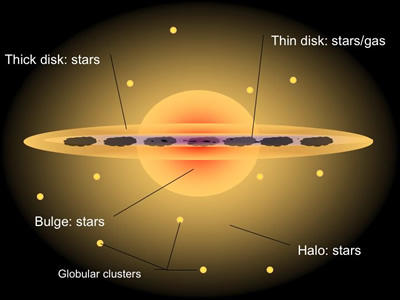
What are the components of a galaxy?
65
Where are stars formed in a spiral galaxy?
In a spiral galaxy, stars are formed in the spiral arms because the arms contain a lot of molecular gas.
66
How do you derive Hydrostatic Balance?
$F_{pressure} = F_{gravity}$
$F_{pressure} = dPA$
$F_{gravity} = -\frac{GM(pAdr)}{r^2}$
$F_{pressure} = dPA$
$F_{gravity} = -\frac{GM(pAdr)}{r^2}$
67
How do you derive central pressure?
Use the Hydrostatic Balance equation
and
$M = \frac{4\pi}{3} p r^3$
and integrate from Pc to 0 and 0 to R.
and
$M = \frac{4\pi}{3} p r^3$
and integrate from Pc to 0 and 0 to R.
68
How do you derive mass-luminosity relationship?
1) Start with central pressure.
2) Assume $p = M/R^3$ and $P = pT_c$
3) Use radiative transport and plug in assumptions for Luminosity.
4) $L=M^\alpha$
2) Assume $p = M/R^3$ and $P = pT_c$
3) Use radiative transport and plug in assumptions for Luminosity.
4) $L=M^\alpha$
69
What is radiation by contraction?
Use $U = -q\frac{GM^2}{R}$
where q = 1.5.
$t_{kh} = \frac{U}{L}$
where q = 1.5.
$t_{kh} = \frac{U}{L}$
70
How do you derive radiative transport?
1) Remember $dF = 4\sigma_{sb} T^3 (dT/dr)dr$ and $dF = -k\rho Fdr$
2) Use $F = \frac{L}{4\pi r^2}$
3) Multiply by 4/3 and solve for dT/dr
2) Use $F = \frac{L}{4\pi r^2}$
3) Multiply by 4/3 and solve for dT/dr
71
How do you derive free-fall time?
1) Start with picture.
2) Remember $M = \frac{4\pi}{3}r^3 \rho$
and
$P^2 = \frac{4\pi^2 a^3}{GM}$.
3) P/2 = fft.
2) Remember $M = \frac{4\pi}{3}r^3 \rho$
and
$P^2 = \frac{4\pi^2 a^3}{GM}$.
3) P/2 = fft.
72
How do you derive Jean's Length?
1) E = nkT, 2E = -U, U = -GMM/L, N=M/2m_h
2) Plug U into 2E = -U and N into E.
3) Equate using Virial.
4) Use $M = L^3 \rho$
5) Solve for L.
2) Plug U into 2E = -U and N into E.
3) Equate using Virial.
4) Use $M = L^3 \rho$
5) Solve for L.
73
How do you derive electron degeneracy?
1) $\Delta{p} = \frac{\bar{h}}{\Delta{x}} = \bar{h} {n_{e}}^{\frac{1}{3}}$
2) $\Delta{v} = \frac{\Delta{p}}{m_e} = \bar{h} {n_{e}}^{\frac{1}{3}} / m_e$
3) $P = nkT = n_e m_e {v_e}^2$
4) Plug v into P.
2) $\Delta{v} = \frac{\Delta{p}}{m_e} = \bar{h} {n_{e}}^{\frac{1}{3}} / m_e$
3) $P = nkT = n_e m_e {v_e}^2$
4) Plug v into P.
74
How do you derive Eddington Luminosity?
1) Use $F_{rad} = \sigma_e F_p = \frac{\sigma_e L}{4\pi cr^2}$
2) Use $F_{grav} = -\frac{GM_{bh} m_p}{r^2}$
3) Equate and solve for L.
2) Use $F_{grav} = -\frac{GM_{bh} m_p}{r^2}$
3) Equate and solve for L.
75
What are the different types of methods to probe Galaxy spectra?
- Radio (strong in spirals)
- Infared (strong in spiral and irregular)
- Ultraviolet (star forming regions)
- X-rays (AGN or Neutron Star)
- Infared (strong in spiral and irregular)
- Ultraviolet (star forming regions)
- X-rays (AGN or Neutron Star)
76
How do you calculate the mass of a galaxy using velocity dispersion?
Use Virial Theorem
$2K = -U$
where
$U = -\frac{GM^2}{r}$
$K = \frac{1}{2}m<v^2>$
and where
$<v^2> = 3\sigma^2$
$\sigma = radial \space velocity \space dispersion$
$2K = -U$
where
$U = -\frac{GM^2}{r}$
$K = \frac{1}{2}m<v^2>$
and where
$<v^2> = 3\sigma^2$
$\sigma = radial \space velocity \space dispersion$
77
What is the Faber-Jackson and Tulley-Fisher Relation?
Assuming the galaxy as a standard candle, the F-J relation is a relationship between $\sigma$ and $L_V$ for elliptical galaxies. For spiral galaxies in the T-F relation, peak rotation speed (v_c) and the absolute magnitude are related.
78
How do we observe quasars?
- Narrow/Broad Emission Lines
- UV Excess
- IR Excess
- AGN
- UV Excess
- IR Excess
- AGN
79
What are the different type of quasar absorbers?
- Lyman Limit Systems
- Metal Absorbers
- Lya Forest
- Damped Systems
- Metal Absorbers
- Lya Forest
- Damped Systems
80
What is superliminal motion?
Apparent motion that appears to be faster than the speed of light.
81
How do you find the probability of stars colliding when a galaxy merges?
1) View the galaxy as a cube.
2) V = N/n
3) $l = V^{\frac{1}{3}}$
3) $P(N) = N*n*\sigma*l$
2) V = N/n
3) $l = V^{\frac{1}{3}}$
3) $P(N) = N*n*\sigma*l$
82
What are some characteristics of superclusters, voids, and fingers of god?
- Superclusters are not virialized and are filamentary or sheetlike.
- Voids cover 75% the volume of the universe and 15% of the mass.
- Fingers of god have a two-sided velocity effect <v^2> ~ 2sigma
- Voids cover 75% the volume of the universe and 15% of the mass.
- Fingers of god have a two-sided velocity effect <v^2> ~ 2sigma