STEM Unit 4
Study these flashcardsFree · spaced repetition · iPhone, Android, Mac & web
All cards
1
locus
A locus (plural, loci) is the location of a gene on a chromosome.
2
Asexual reproduction
In asexual reproduction, a single parent is the sole parent and passes copies of all its genes to its offspring.
In asexual reproduction, the new offspring arise by Mitosis and have virtually exact copies of the parent's genome. An individual that reproduces asexually gives rise to a clone, a group of genetically identical individuals.
In asexual reproduction, the new offspring arise by Mitosis and have virtually exact copies of the parent's genome. An individual that reproduces asexually gives rise to a clone, a group of genetically identical individuals.
3
Sexual reproduction
In sexual reproduction, two individuals (parents) contribute genes to the offspring. This form of reproduction results in greater genetic variation in the offspring than asexual reproduction.
4
karyotype
The karyotype of an organism refers to a picture of its complete set of chromosomes, arranged in pairs of homologous chromosomes from the largest to the smallest. Figure 4.lb is a karyotype made from a human somatic cell. Notice that the 46 chromosomes are paired into 23 homologous chromosomes.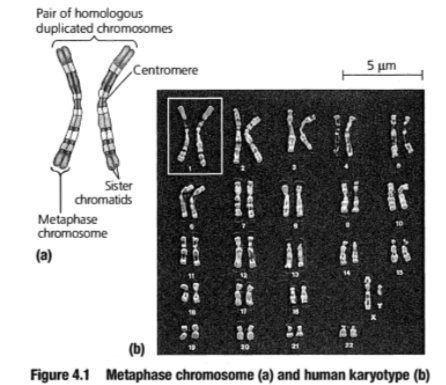
5
homologous chromosomes
Two chromosomes in a pair – normally one inherited from the mother and one from the father.
- Homologous chromosomes are similar in length and centromere position and have the same staining pattern.
- One homologous chromosome from each pair is inherited from each parent; in other words, half of the 46 chromosomes in your somatic cells were inherited from your mother, and the other half was inherited from your father.
- Homologous chromosomes are similar in length and centromere position and have the same staining pattern.
- One homologous chromosome from each pair is inherited from each parent; in other words, half of the 46 chromosomes in your somatic cells were inherited from your mother, and the other half was inherited from your father.
6
sex chromosomes
in humans, it is the X and Y. Human females have a homologous pair of chromosomes, XX, but males have one X chromosome and one Y chromosome.
7
autosomes
all the chromosomes except the X and Y (sex) are called autosomes.
8
gametes
They are reproductive cells
Gametes-meaning sperm and ova (eggs)-are haploid cells. Haploid cells contain half the number of chromosomes of somatic cells. In humans, gametes contain 22 autosomes plus a single sex chromosome (X in female, either X or Yin male), giving them a haploid number of 23. The haploid number of chromosomes is symbolized by n.
Gametes-meaning sperm and ova (eggs)-are haploid cells. Haploid cells contain half the number of chromosomes of somatic cells. In humans, gametes contain 22 autosomes plus a single sex chromosome (X in female, either X or Yin male), giving them a haploid number of 23. The haploid number of chromosomes is symbolized by n.
9
fertilization & zygote
During fertilization (the combination of a sperm cell and an egg cell), one haploid gamete from the father fuses with one haploid gamete from the mother.
The result is a fertilized egg called a zygote. It is diploid (has two sets of chromosomes) and may be symbolized by 2n.
The result is a fertilized egg called a zygote. It is diploid (has two sets of chromosomes) and may be symbolized by 2n.
10
zygote
A fertilized egg
11
how is meiosis different from mitosis
in meiosis this replication is followed by two stages of cell division, meiosis I and meiosis II.
The resulting daughter cells have half as many chromosomes
The resulting daughter cells have half as many chromosomes
12
three events occur during meiosis I that don't occue during mitosis
1. Synapsis and crossing over do not occur during mitosis.
2. At metaphase I, paired homologous chromosomes (tetrads) are positioned on the metaphase plate, rather than individual replicated chromosomes, as in mitosis.
3. At anaphase I, duplicated chromosomes of each homologous pair separate, but the sister chromatids of each duplicated chromosome stay attached. In mitosis, the chromatids separate.
2. At metaphase I, paired homologous chromosomes (tetrads) are positioned on the metaphase plate, rather than individual replicated chromosomes, as in mitosis.
3. At anaphase I, duplicated chromosomes of each homologous pair separate, but the sister chromatids of each duplicated chromosome stay attached. In mitosis, the chromatids separate.
13
synapsis
the joining of homologous chromosomes along their length. This newly formed structure is called a tetrad and precisely aligns the homologous chromosomes gene by gene. This perfect alignment is necessary for the next step-crossing over.
14
crossing over
In crossing over, the DNA from one homolog is cut and exchanged with an exact portion of DNA from the other homolog. Essentially, a small part of the DNA from one parent is exchanged with the DNA from the other parent. The result of crossing over is increased genetic variation. Where crossing over has occurred (two to three times per homologous pair), crisscrossed regions termed chiasmata form hold the homologs together until anaphase I.
15
What happens after crossing over?
After crossing over, the spindle poles move away from each other, the nuclear envelope disintegrates, and the spindle microtubules attach to the kinetochores forming on the chromosomes. The microtubules then begin to move the chromosomes to the metaphase plate of the cell.
16
alleles
These alternative versions of the gene, called alleles, are the result of slightly different DNA sequences.
17
law of segregation
If the parent has two of the same alleles, then the offspring will all get that version of the gene, but if the parent has two different alleles for a gene, each offspring has a 50% chance of getting one of the two alleles.
18
Law of independent assortment
Law of independent assortment was Mendel's second law. It states that each pair of alleles will segregate (separate) independently during gamete formation. This occurs during anaphase I of meiosis.
19
Homozygous
Homozygous organisms have two of the same alleles for a particular trait. RR & rr
20
heterozygous
heterozygous organism has two different alleles for a trait (Rr).
21
phenotype
Phenotype refers to an organism's expressed physical traits
For example, the phenotype of a seed might be round, and its genotype could be RR or Rr.
For example, the phenotype of a seed might be round, and its genotype could be RR or Rr.
22
genotype
Genotype refers to an organism's genetic makeup.
For example, the phenotype of a seed might be round, and its genotype could be RR or Rr.
For example, the phenotype of a seed might be round, and its genotype could be RR or Rr.
23
testcross
A testcross is done to determine if an individual showing a dominant trait is homozygous or heterozygous.
A test cross is always done between the unknown genotype and a homozygous recessive individual. If the unknown parent is homozygous dominant (RR X rr) all the offspring will show the dominant trait, but if the unknown parent is heterozygous (Rr X rr) some of the offspring will show the recessive trait.
A test cross is always done between the unknown genotype and a homozygous recessive individual. If the unknown parent is homozygous dominant (RR X rr) all the offspring will show the dominant trait, but if the unknown parent is heterozygous (Rr X rr) some of the offspring will show the recessive trait.
24
monohybrid cross
A monohybrid cross is a cross involving the study of only one character (for example, flower color),
25
dihybrid cross
dihybrid cross is a cross intended to study two characters (for example, flower color and seed shape).
26
complete dominance
Complete dominance is dominance in which the heterozygote and the homozygote for the dominant allele are indistinguishable.
A Yy yellow seed is just as yellow as a YY yellow seed.
A Yy yellow seed is just as yellow as a YY yellow seed.
27
Codominance
Codominance occurs when two alleles are dominant and affect the phenotype in two different but equal ways.
The traditional example for this type of dominance is human blood types. The alleles for A and B blood are dominant to the allele for type O blood, but A and B are codominant to each other. A person who has alleles for both A and B blood will be blood type AB because these alleles are each completely expressed.
The traditional example for this type of dominance is human blood types. The alleles for A and B blood are dominant to the allele for type O blood, but A and B are codominant to each other. A person who has alleles for both A and B blood will be blood type AB because these alleles are each completely expressed.
28
Incomplete dominance
Incomplete dominance is a type of dominance in which the F1 hybrids have an appearance that is in between that of the two parents.
For example, if two plants, one with white flowers and one with red flowers, were crossed and all of the offspring had pink flowers, you could conclude that the trait for flower color exhibits incomplete dominance. Breeding two of the hybrids with incomplete dominance gives a flower ratio of 1 red:2 pink: 1 white.
For example, if two plants, one with white flowers and one with red flowers, were crossed and all of the offspring had pink flowers, you could conclude that the trait for flower color exhibits incomplete dominance. Breeding two of the hybrids with incomplete dominance gives a flower ratio of 1 red:2 pink: 1 white.
29
polygenic inheritance
In polygenic inheritance, two or more genes have an additive effect on a single character in the phenotype (such as height or skin color in humans).
When several genes are involved, the phenotype usually is described by a bell-shaped curve, with fewer individuals at each extreme and most individuals clustered in the middle.
When several genes are involved, the phenotype usually is described by a bell-shaped curve, with fewer individuals at each extreme and most individuals clustered in the middle.
30
Mutiple alleles
Multiple alleles occur when a gene has more than two alleles. Again, a good example of this is seen in human blood types.
There are three alleles for human blood types: IA, IB, and I, but one person only receives any combination of two alleles.
There are three alleles for human blood types: IA, IB, and I, but one person only receives any combination of two alleles.
31
Pleiotropy
Pleiotropy is the property of a gene that causes it to have multiple phenotypic effects.
For example, sickle-cell disease has multiple symptoms all caused by a single defective gene.
For example, sickle-cell disease has multiple symptoms all caused by a single defective gene.
32
epistasis
In epistasis, a gene at one locus alters the effects of a gene at another locus.
For example, an individual may have genes for heavy skin pigmentation, but if a separate gene that produces the pigment is defective, the genes for pigment deposition will not be expressed. This would lead to a condition known as albinism.
For example, an individual may have genes for heavy skin pigmentation, but if a separate gene that produces the pigment is defective, the genes for pigment deposition will not be expressed. This would lead to a condition known as albinism.
33
Recessively inherited disorders
Recessively inherited disorders require two copies of the defective gene for the disorder to be expressed.
34
lethal dominant alleles
Lethal dominant alleles require only one copy of the allele in order for the disorder to be expressed. Usually, only lethal alleles that act late in life are passed on.
35
Amniocentesis
Amniocentesis occurs when the physician removes amniotic fluid from around the fetus. The amniotic fluid can be utilized to detect some genetic disorders, and the cells in the fluid can be cultured for a karyotype.
36
Chorionic villus sampling
Chorionic villus sampling involves using a narrow tube inserted through the cervix to suction out a tiny sample of the placenta that contains only fetal cells. A karyotype can immediately be developed from these cells.
37
sex-linked genes
A sex-linked gene is one located on a sex chromosome (X or Y in humans). After the chromosome theory of inheritance was formed, Thomas Hunt Morgan discovered the existence of sex-linked genes.
38
Barr Body
The inactive chromosome condenses into a Barr body, which lies along the inside of the nuclear envelope. Still, females are not usually affected as heterozygote carriers of problematic alleles, because half of their sex chromosomes are normal and produce the necessary proteins.
39
Nondisjunction
Nondisjunction occurs when the members of a pair of homologous chromosomes do not separate properly during meiosis I, or sister chromatids don't separate properly during meiosis II.
40
aneuploidy
As a result of nondisjunction, one gamete receives two copies of the chromosome, whereas the other gamete receives none. If the faulty gametes engage in fertilization, the offspring will have an incorrect chromosome number. This is known as aneuploidy.
41
trisomic & monosomic
Fertilized eggs that have received three copies of the chromosome in question are said to be trisomic; those that have received just one copy of a chromosome are said to be monosomic for the chromosome.
42
Polyploidy
Polyploidy is the condition of having more than two complete sets of chromosomes, forming a 3n or 4n individual. Rare in animals, this condition is fairly frequent in plants.
43
deletion
A deletion occurs when a chromosomal fragment is lost, resulting in a chromosome with missing genes.
44
duplication
A duplication occurs when a chromosomal segment is repeated.
45
inversion
An inversion occurs when a chromosomal fragment breaks off and reattaches to its original position but backward, so that the part of the fragment that was originally at the attachment point is now at the end of the chromosome.
46
Translocation
A translocation occurs when the deleted chromosome fragment joins a nonhomologous chromosome.