STEM Unit 5
Study these flashcardsFree · spaced repetition · iPhone, Android, Mac & web
All cards
1
X-ray crystallography
X-ray crystallography is a process used to visualize molecules three dimensionally. X-rays are diffracted as they pass through the molecule, and they bounce back to produce patterns that can be interpreted through mathematical equations. Through this technique, a rough blueprint of the molecule was formed and the helical structure was deduced.
2
antiparallel
The strands are termed antiparallel. The left side runs 5' to 3' and the opposite strand runs 3' to 5'.
3
Replication
Replication is the making of DNA from an existing DNA strand. DNA replication is semiconservative. This means that at the end of replication, each of the daughter molecules has one old strand, derived from the parent strand of DNA, and one strand that is newly synthesized.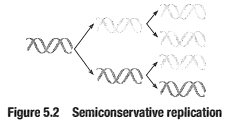
4
Mismatch Pair
Mismatch repair, in which special repair enzymes fix incorrectly paired nucleotides
5
Nucleotide excision repair
Nucleotide excision repair, in which incorrectly placed nucleotides are excised or removed by enzymes termed nucleases, and the gap left over is filled in with the correct nucleotides
6
Gene expression
Gene expression is the process by which DNA directs the synthesis of proteins
7
Transcription
Transcription is the synthesis of RNA using DNA as a template. It takes place in the nucleus of eukaryotic cells.
8
Messenger RNA or mRNA
Messenger RNA, or mRNA, is produced during transcription. It carries the genetic message of DNA to the protein-making machinery of the cell in the cytoplasm, the ribosome.
9
Translation
Translation is the production of a polypeptide chain using the mRNA transcript and occurs at the ribosomes.
10
triplet code
The instructions for building a polypeptide chain are written as a series of three-nucleotide groups; this is called a triplet code.
11
the template strand
During transcription, only one strand of the DNA is transcribed, and it is called the template strand.
12
codons
The mRNA that is produced is said to be complementary to the original DNA strand. The mRNA base triplets are called codons. They are written in the 5' to 3' direction.
13
RNA Polymerase
RNA polymerase is an enzyme that separates the two DNA strands and connects the RNA nucleotides as they base-pair along the DNA template strand.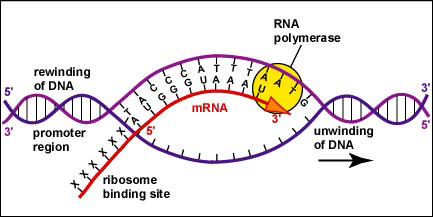
14
promoter and terminator in transcription
The DNA sequence at which RNA polymerase attaches is called the promoter, whereas the DNA sequence that signals the end of transcription is called the terminator.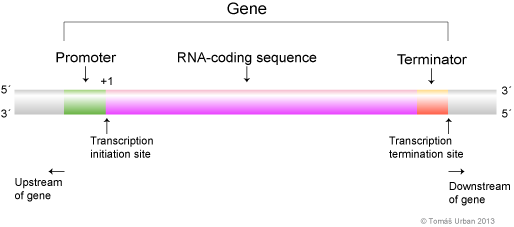
15
transcription unit
A transcription unit is the entire stretch of DNA that is transcribed into an RNA molecule. A transcription unit may code for a polypeptide or an RNA, like transfer RNA or ribosomal RNA.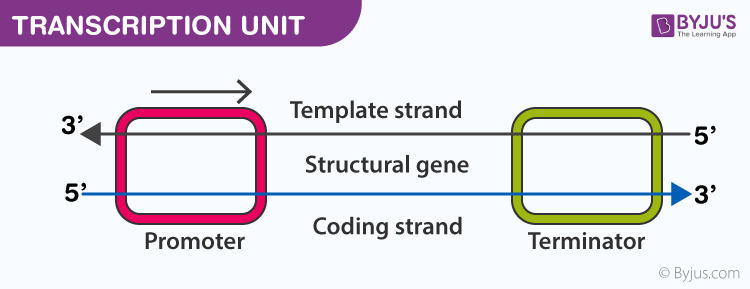
16
What are teh three stages of transcription
1. Initiation
2. Elongation
3. Termination
2. Elongation
3. Termination
17
What is "initiation"?
Initiation is the beginning of transcription. It occurs when the enzyme RNA polymerase binds to a region of a gene called the promoter. This signals the DNA to unwind so the enzyme can ''read'' the bases in one of the DNA strands. The enzyme is now ready to make a strand of mRNA with a complementary sequence of bases.
18
What is elongation?
Transcription elongation is a regulated process in which an RNA chain complementary to the template strand of DNA is synthesized as RNA polymerase moves along DNA. 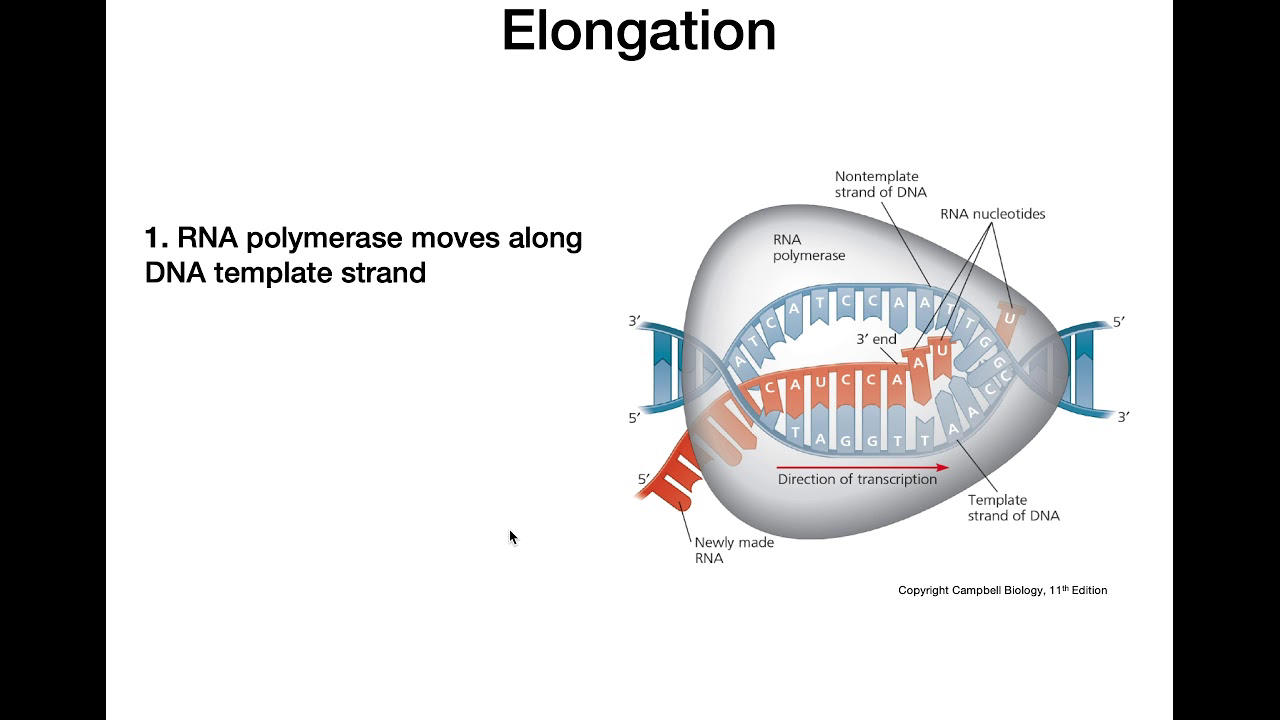
19
What is termination
Termination: After RNA polymerase transcribes a terminator sequence in the DNA, the RNA transcript is released, and the polymerase detaches.
20
RNA splicing
RNA splicing also takes place in eukaryotic cells. In RNA splicing, large portions of the newly synthesized RNA strand are removed. The sections of the mRNA that are spliced out are called introns, and the sections that remain and subsequently spliced together by a spliceosome-are called exons.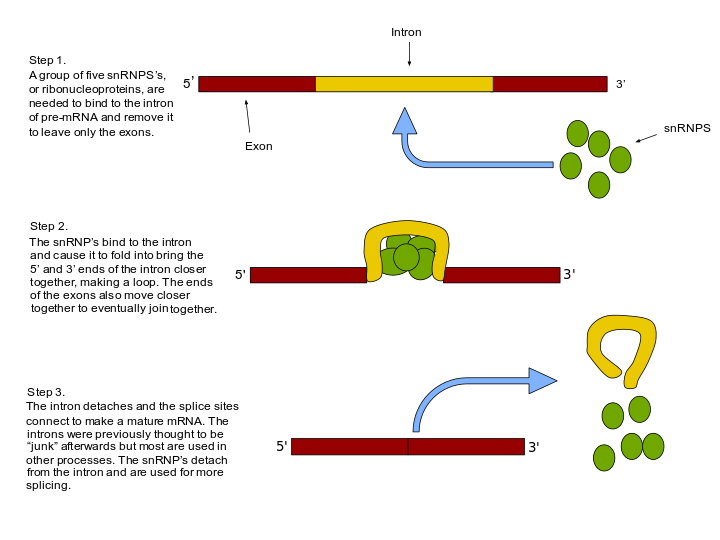
21
snRNA or small RNA
One amazing thing about how spliceosomes work is the role of a special kind of RNA, termed small nuclear RNA (snRNA). The snRNA plays a major role in catalyzing the excision of the introns and joining of exons.
22
ribozyme
When RNA serves a catalytic role, the molecule is termed a ribozyme. For many years it was thought that only proteins could be catalytic, but the discovery of ribozymes totally changed that idea!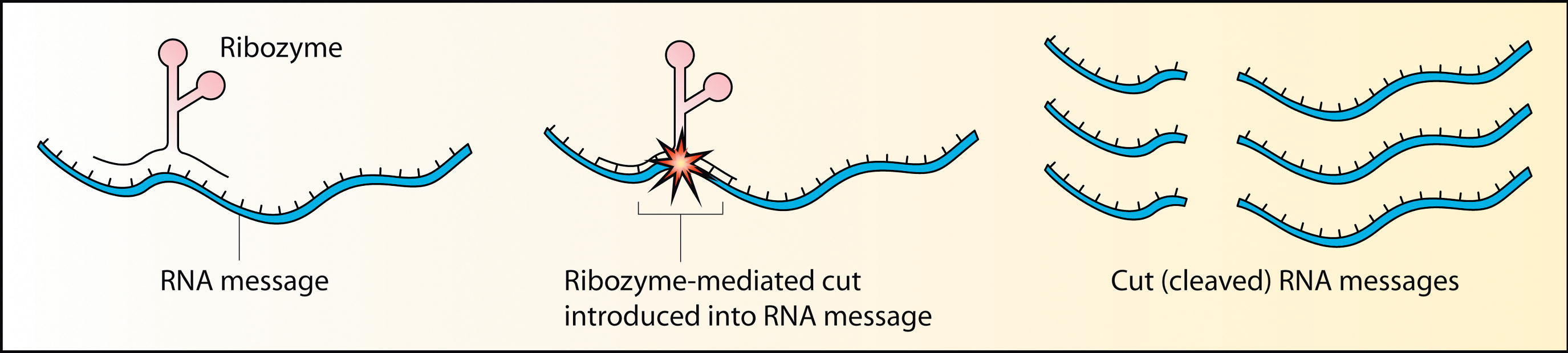
23
tRNA
The tRNA functions in transferring amino acids from a pool of amino acids in the cell's cytoplasm to a ribosome. The ribosome accepts the amino acid from the tRNA and incorporates the amino acid into a growing polypeptide chain.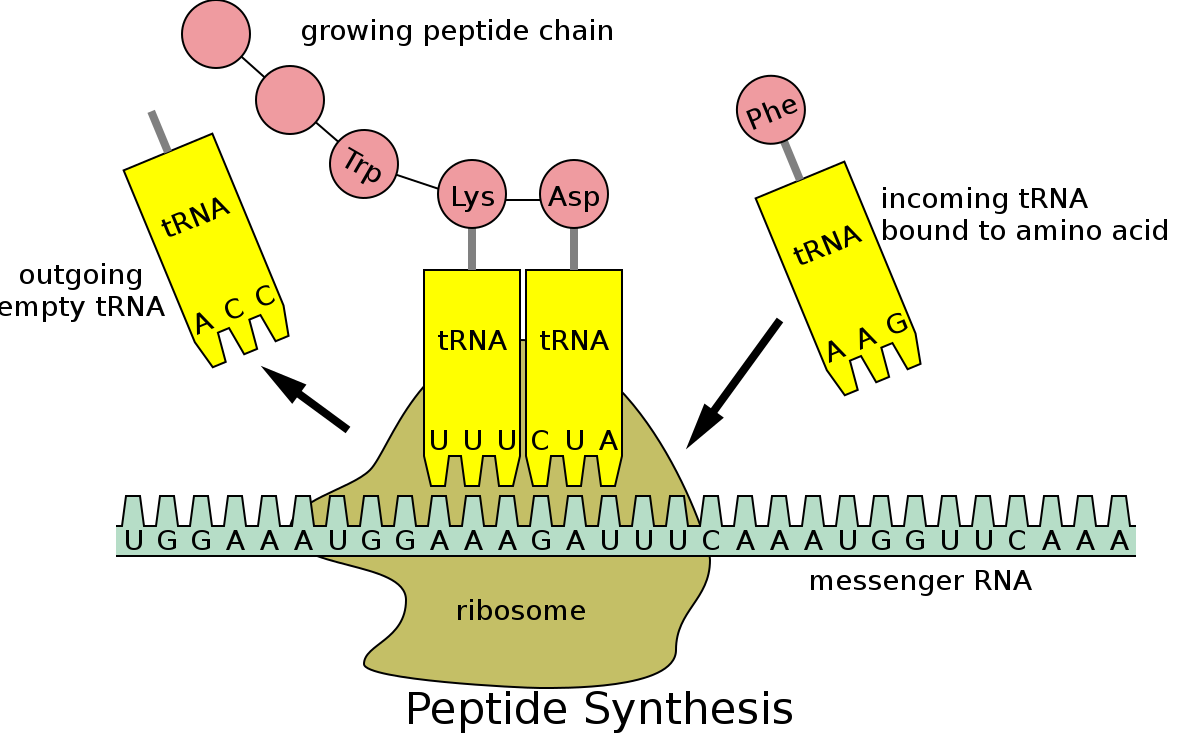
24
anticodon
Each type of tRNA is specific for a particular amino acid; at one end it loosely binds the amino acid, and at the other end it has a nucleotide triplet called an anticodon, which allows it to pair specifically with a complementary codon on the mRNA.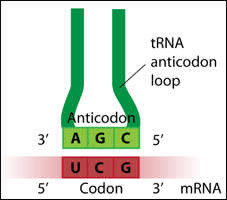
25
P,A, and E site
P site, which holds the tRNA that carries the growing polypeptide chain.
A site, which holds the tRNA that carries the amino acid that will be added to the chain next.
E site, which is the exit site for each tRNA.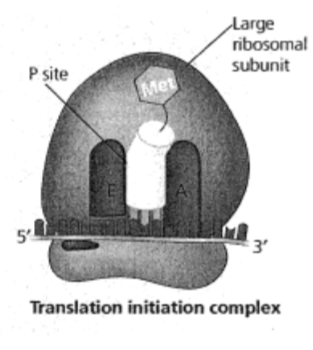
A site, which holds the tRNA that carries the amino acid that will be added to the chain next.
E site, which is the exit site for each tRNA.
26
nucleotide-pair substitution
A nucleotide-pair substitution is the replacement of one nucleotide and its partner with another pair of nucleotides.
27
Missense mutation
Missense mutations are those substitutions that enable the codon to still code for an amino acid, although it might not be the correct one.
28
Nonsense mutation
Nonsense mutations are those substitutions that change a regular amino acid codon into a stop codon, ceasing translation.
29
frameshift mutation
Insertions and deletions refer to the additions and losses of nucleotide pairs in a gene. If they interfere with the codon groupings, they can cause a frameshift mutation, which causes the mRNA to be read incorrectly on each remaining codon.
30
mutagens
Mutagens are substances or forces that interact with DNA in ways that cause mutations. X-rays and other forms of radiation are known mutagens, as are certain chemicals.
31
operons
In bacteria, genes are often clustered into units called operons, which allow the expression of several related genes to be controlled as a unit. Figure 5.9 shows a repressible operon with an inactive repressor. Locate each part of the operon and the regulatory gene as you read the accompanying text.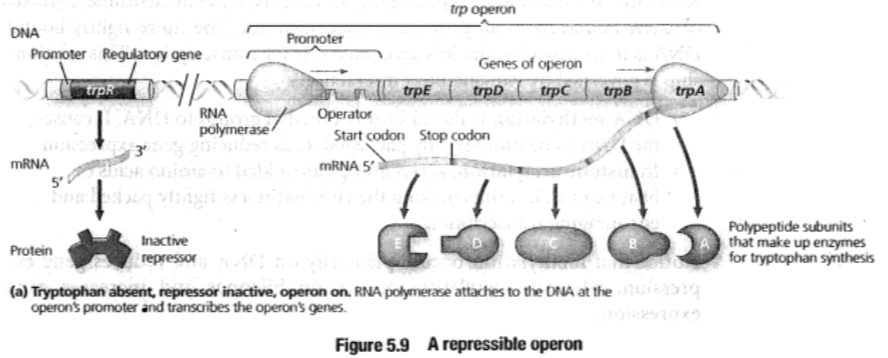
32
An operon consists of three parts:
An operator that controls the access of RNA polymerase to the genes. The operator is found within the promoter site or between the promoter and the protein coding genes of the operon.
The promoter, which is where RNA polymerase attaches.
Thegenes of the operon. This is the entire stretch of DNA required for all the enzymes produced by the operon.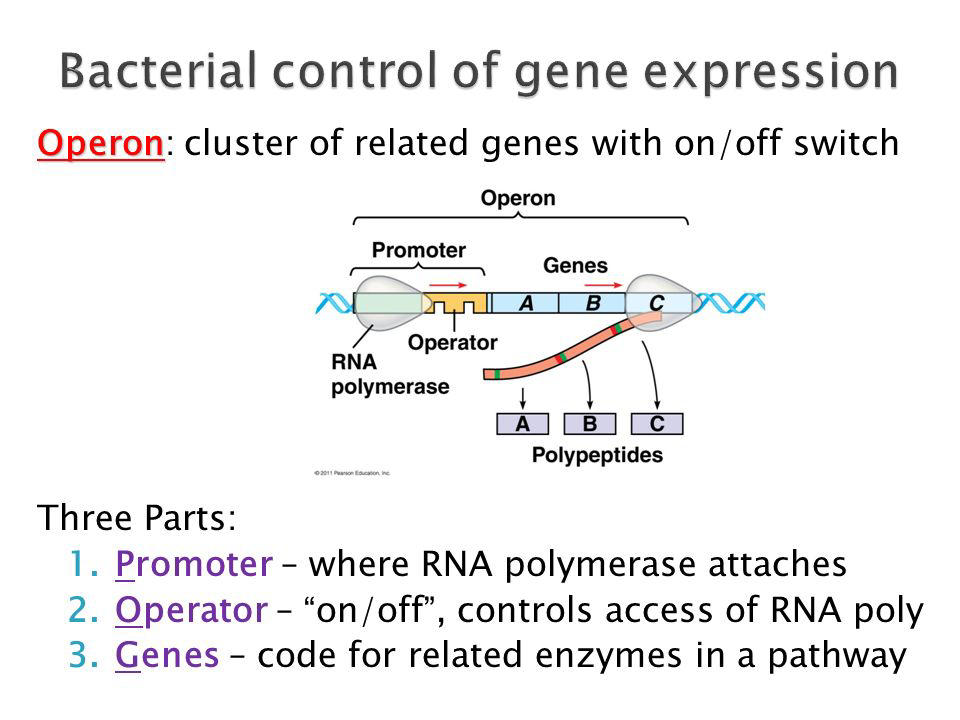
The promoter, which is where RNA polymerase attaches.
Thegenes of the operon. This is the entire stretch of DNA required for all the enzymes produced by the operon.
33
Regulatory genes
Located some distance from the operon is a regulatory gene. Regulatory genes produce repressor proteins that may bind to the operator site. When a regulatory protein occupies the operator site, RNA polymerase is blocked from the genes of the operon. In this situation the operon is off.
34
repressive operon
A repressible operon is normally on but can be inhibited. This type of operon is normally anabolic, building an essential organic molecule. The repressor protein produced by the regulatory gene is inactive.
35
corepressor
If the organic molecule being produced by the operon is provided to the cell, the molecule can act as a corepressor and bind to the repressor protein, activating it. The activated repressor protein binds to the operator site, shutting down the operon.
36
inducible operon
An inducible operon is normally off but can be activated. This type of operon is normally catabolic, breaking down food molecules for energy. The repressor protein produced by the regulatory gene is active. To turn an inducible operon on, a specific small molecule called an inducer, binds to and inactivates the repressor protein. RNA polymerase can access the operon's genes with the repressor out of the operator site.
37
DNA methylation
DNA methylation is the addition of methyl groups to DNA. It causes the DNA to be more tightly packaged, thus reducing gene expression.
38
histone acetylation
In histone acetylation, acetyl groups are added to amino acids of histone proteins, thus making the chromatin less tightly packed and encouraging transcription.
39
difference in DNA methylation and histone acetylation
Notice that methylation occurs primarily on DNA and reduces gene expression, whereas acetylation occurs on histones and increases gene expression.
40
Epigenetic inheritance
Epigenetic inheritance is the inheritance of traits transmitted by mechanisms not directly involving the nucleotide sequence. The DNA sequence is not changed, just its expression.
41
transcription initiation complex
The transcription initiation complex greatly enhances gene expression. Study Figure 5.10 (see next page) and note its essential elements. DNA sequences far from the gene, termed enhancer regions, are bound to the promoter region by proteins termed activators.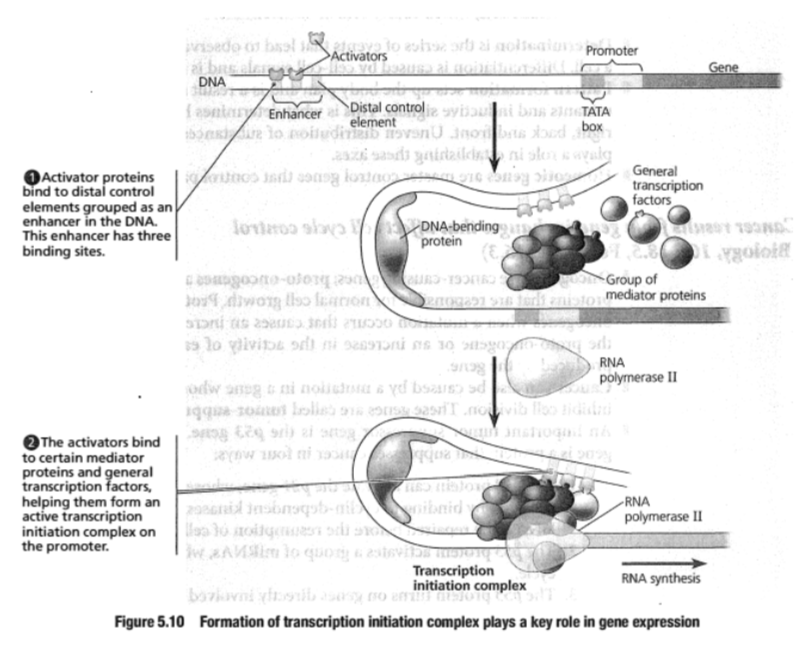
42
The zygote undergoes transformation through three interrelated processes:
1. Cell division is the series of mitotic divisions that increases the number of cells.
2. Cell differentiation is the process by which cells become specialized in structure and function.
3. Morphogenesis gives an organism its shape.
2. Cell differentiation is the process by which cells become specialized in structure and function.
3. Morphogenesis gives an organism its shape.
43
What controls differentiation and morphogenesis?
1. Cytoplasmic determinants are maternal substances in the egg that influence the course of early development. These are distributed unevenly in the early cells of the embryo and result in different effects.
2. Cell-cell signals result from molecules, such as growth factors, produced by one cell influencing neighboring cells, a process called induction, which causes cells to differentiate.
2. Cell-cell signals result from molecules, such as growth factors, produced by one cell influencing neighboring cells, a process called induction, which causes cells to differentiate.
44
Determination
Determination is the series of events that lead to observable differentiation of a cell. Differentiation is caused by cell-cell signals and is irreversible.
45
Pattern formation
Pattern formation sets up the body plan and is a result of cytoplasmic determinants and inductive signals. This is what determines head and tail, left and right, back and front.
Uneven distribution of substances called morphogens plays a role in establishing these axes.
Uneven distribution of substances called morphogens plays a role in establishing these axes.
46
Homeotic genes
Homeotic genes are master control genes that control pattern formation.
47
Oncogenes & proto-oncogenes
Oncogenes are cancer-causing genes; proto-oncogenes are genes that code for proteins that are responsible for normal cell growth. Proto-oncogenes become
oncogenes when a mutation occurs that causes an increase in the product of the proto-oncogene or an increase in the activity of each protein molecule produced by the gene.
oncogenes when a mutation occurs that causes an increase in the product of the proto-oncogene or an increase in the activity of each protein molecule produced by the gene.
48
tumor suppressor genes
Cancer can also be caused by a mutation in a gene whose products normally inhibit cell division. These genes are called tumor-suppressor genes.
49
capsid
The two essential components of a virus are a protein shell or capsid that surrounds the genetic material (either double- or single-stranded DNA or double- or single-stranded RNA).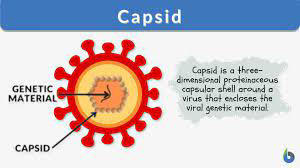
50
viral envelopes
Many viruses found in animals have membranous viral envelopes that surround the capsid and aid the viruses in infecting their hosts.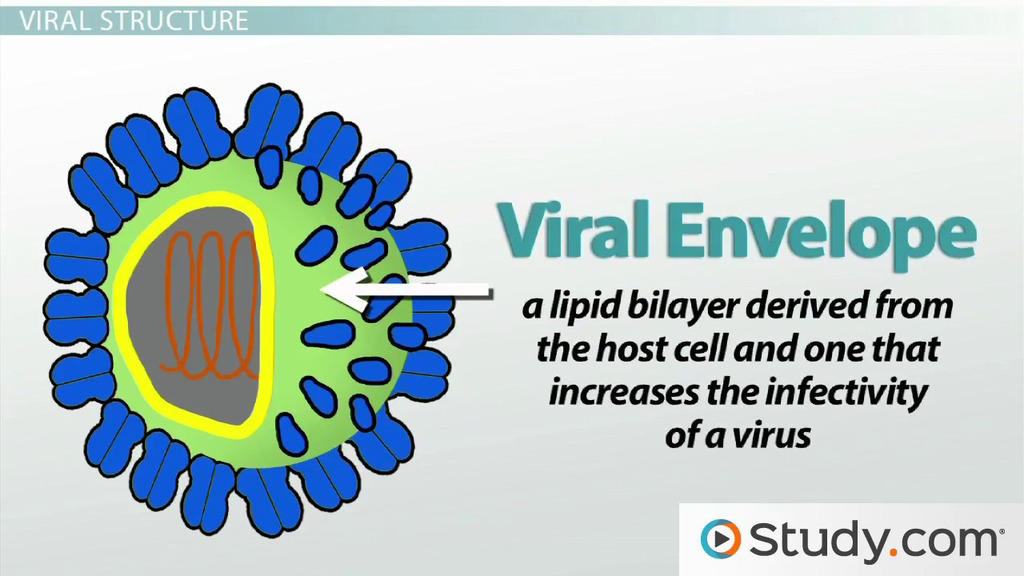
51
Bacteriophages and phages
Bacteriophages, or phages, are viruses that infect bacterial cells.
52
host range
Viruses have a limited host range. This means they can infect only a very limited variety of hosts. Example: Human cold virus infects only cells of the upper respiratory tract.
53
Viral reproduction stages: lytic cycle
The lytic cycle ends in the death of the host cell by rupturing it (lysis). In this cycle, a bacteriophage injects its DNA into a host cell and takes over the host cell's machinery to synthesize new copies of the viral DNA as well as protein coats. These self-assemble, and the bacterial cell is lysed, releasing multiple copies of the virus.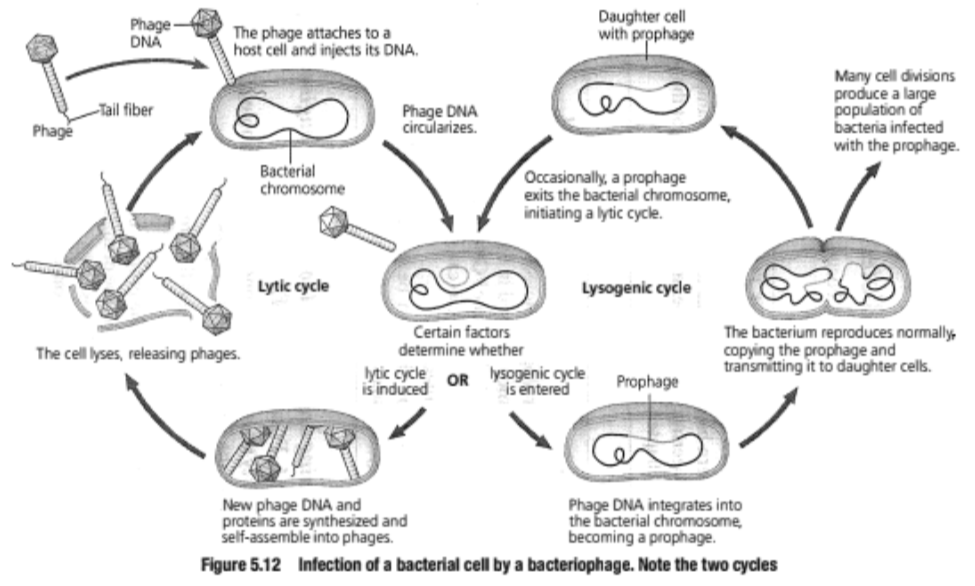
54
Viral reproduction stages: lysogenic cycle
In the lysogenic cycle the bacteriophage's DNA becomes incorporated into the host cell's DNA and is replicated along with the host cell's genome. The viral DNA is known as a prophage. Under certain conditions, the prophage will enter the lytic cycle, described on the previous page.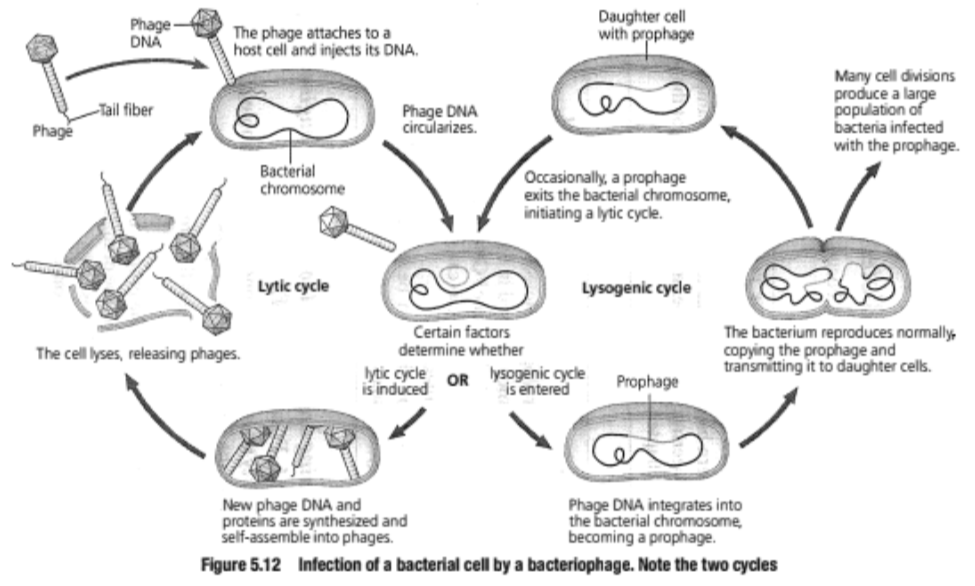
55
retroviruses
Retroviruses are RNA viruses that use the enzyme reverse transcriptase to transcribe DNA from an RNA template. The new DNA then permanently integrates into a chromosome in the nucleus of an animal cell. The host transcribes the viral DNA into RNA that may be used to synthesize viral proteins or may be released from the host cell to infect more cells.
56
Prions
Prions are misfolded, infectious proteins that cause the misfolding of normal proteins in the brains of various animal species. Their damage to the brain accumulates over time and eventually leads to death.
57
genetic engineering
Genetic engineering is the process of manipulating genes and genomes.
58
Biotechnology
Biotechnology is the process of manipulating organisms or their components for the purpose of making useful products.
59
Recombinant DNA
Recombinant DNA is DNA that has been artificially made, using DNA from different sources-and often different species. An example is the introduction of a human gene into an E. coli bacterium.
60
Gene coding
Gene cloning is the process by which scientists can produce multiple copies of specific segments of DNA that they can then work with in the lab. Many bacteria have DNA outside the main circular chromosome in plasmids.
61
Restriction enzymes
Restriction enzymes are used to cut strands of DNA at specific locations (called restriction sites). They are mostly derived from bacteria where they serve the important function of protection against invading viruses.