History of English
Study these flashcardsFree · spaced repetition · iPhone, Android, Mac & web
All cards
1
What is Proto-Indo European?
Prehistoric language to which many languages in Europe and India are genetically related to
2
How do we know about the language?
Similarities and systematic differences in hundreds of words in many languages in Europe and India
3
What does ‘proto’ mean?
Reconstructed
Linguistic reconstruction: comparing languages and working out features of a common ancestor
Linguistic reconstruction: comparing languages and working out features of a common ancestor
4
Give two examples of how words attested in the languages descended from PIE.
*ph2ter: Sanskrit = pita, Greek = pater, Latin = pater, Gothic = fadar, English = father
*bhrater: Sanskrit = bhratar, Greek = phrater, Latin = frater, Gothic = brothar, English = brother
*bhrater: Sanskrit = bhratar, Greek = phrater, Latin = frater, Gothic = brothar, English = brother
5
Provide evidence about the culture or daily life of the people who originally spoke PIE.
Most common/ supported hypothesis: near Caspian and Black Sea, Pontic steppes
Linguistic evidence: words for geographic markers
> cold climate since common word for snow *sneigwh-o-
> no common word for sea/ ocean but lake
> common words for beech, elm, ash, oak, apple, bear, etc.
Agricultural society: cultivated cereals, grinding of corn,
Cattle bearing
Wool weaving
Bronze age technology
Wheels and wagons
Horse riding
Religion: sun worship, patriarchal
Linguistic evidence: words for geographic markers
> cold climate since common word for snow *sneigwh-o-
> no common word for sea/ ocean but lake
> common words for beech, elm, ash, oak, apple, bear, etc.
Agricultural society: cultivated cereals, grinding of corn,
Cattle bearing
Wool weaving
Bronze age technology
Wheels and wagons
Horse riding
Religion: sun worship, patriarchal
6
What is Proto-Germanic?
Reconstructed ancestor of Germanic languages
Major influence (⅓) of nonIE vocabulary
Major influence (⅓) of nonIE vocabulary
7
How did it differ from PIE?
Exklusive Neuerungen:
Word initial stress
Grimm's Law → Verner's Law
Development of PIE nasals and laryngeals *m *n *l *r > germ. *um *un *ul *ur
Weak and strong adjective declension
Weak past tense
Word initial stress
Grimm's Law → Verner's Law
Development of PIE nasals and laryngeals *m *n *l *r > germ. *um *un *ul *ur
Weak and strong adjective declension
Weak past tense
8
I might ask questions that test your knowledge of the basic facts about the early history
of England that are relevant to language. E.g. What happened around 450 A.D. that was
crucial to the development of the English language (or: when did the Anglo-Saxon
invasions happen)? Name two groups of people who had lived in England before
Germanic people got there.
of England that are relevant to language. E.g. What happened around 450 A.D. that was
crucial to the development of the English language (or: when did the Anglo-Saxon
invasions happen)? Name two groups of people who had lived in England before
Germanic people got there.
6000 - 4000 BC: non Indo-Europeans in the British Isles
Language spoken unknown
449 AD: Germanic speakers from northern Germany/ southern Denmark invade the British Isles in waves.
Late 6th century: Anglo-Saxons dominated Britain
Different Germanic varieties spoken = Anglo-Saxon = Old English
Celts were pushes to the West and North of the Island
Very few celtic words were borrowed
Picts
Language spoken unknown
449 AD: Germanic speakers from northern Germany/ southern Denmark invade the British Isles in waves.
Late 6th century: Anglo-Saxons dominated Britain
Different Germanic varieties spoken = Anglo-Saxon = Old English
Celts were pushes to the West and North of the Island
Very few celtic words were borrowed
Picts
9
Be able to describe some syntactic or morphological characteristics that Old English
had but which current English does not have. (Answers might describe e.g. differences
in word order, or the fact that it had a richer inflectional system.)
had but which current English does not have. (Answers might describe e.g. differences
in word order, or the fact that it had a richer inflectional system.)
Morphology
Rich inflectional system
Synthetic language, modern english analytic
Case inflections in Nominative, Genetiv, Dativ, Accusative
Syntax
Similar to modern German word order
Main clauses: verb second order (exactly one constituent before the inflected verb)
Subordinate clauses: verb final order
Free word order: the order of constituents is relatively free after complementizers
OE more word order options: not forced final word position
Pronouns exception: appear more towards the front of the sentence
Rich inflectional system
Synthetic language, modern english analytic
Case inflections in Nominative, Genetiv, Dativ, Accusative
Syntax
Similar to modern German word order
Main clauses: verb second order (exactly one constituent before the inflected verb)
Subordinate clauses: verb final order
Free word order: the order of constituents is relatively free after complementizers
OE more word order options: not forced final word position
Pronouns exception: appear more towards the front of the sentence
10
The Viking (Scandinavian) invasions: When, roughly, did they start and how did they
affect the English language?
affect the English language?
787 AD: for 200 years, viking invasion
Old Norse and Old English mutually comprehensible, inflections different
Around 1000 words borrowed into OE
Everyday words: husband, knife, egg, sister, etc.
Pronouns: they/them/their
Many words with /sk/
Doublets (some semantic differences): heaven/ sky, hide/ skin
Old Norse and Old English mutually comprehensible, inflections different
Around 1000 words borrowed into OE
Everyday words: husband, knife, egg, sister, etc.
Pronouns: they/them/their
Many words with /sk/
Doublets (some semantic differences): heaven/ sky, hide/ skin
11
What was the Norman Conquest, and when did it happen? How did it affect the English
language? (A good answer would explain examples relevant to the social-political
situation in Norman England, such as the introduction of lexemes associated with
government, contrasts like pig/pork, house/mansion etc.)?
language? (A good answer would explain examples relevant to the social-political
situation in Norman England, such as the introduction of lexemes associated with
government, contrasts like pig/pork, house/mansion etc.)?
1066 The Norman Conquest: WIlliam the Conqueror, won the battle of Hastings, became King of England
Appointed his people from Normandy, spoke Norman French dialect > adopting of French language/ dialect
French replaced English in upper classes, English was still spoken by the majority
Lower class could not write → not much written English
England became bilingual, Norman French words were adopted into English
Government: crown, parliament, noble, baron, count
Semantic differences between Germanic/French pairs
house/ mansion: mansion bigger, only rich upper class can afford
pig/ pork: pig the animal, pork meat from pigs → rich people only in contact with the product not the animal
> word and its association used describes social standing
Some derivational affixes from borrowed words became productive: -ation, -ment
Coexisting with affixes of Germanic origin: -dom, -ship, -ing
Binomial expressions: ways and means, love and cherish
Doublets: warden/ guardian, warranty/ guarantee
Appointed his people from Normandy, spoke Norman French dialect > adopting of French language/ dialect
French replaced English in upper classes, English was still spoken by the majority
Lower class could not write → not much written English
England became bilingual, Norman French words were adopted into English
Government: crown, parliament, noble, baron, count
Semantic differences between Germanic/French pairs
house/ mansion: mansion bigger, only rich upper class can afford
pig/ pork: pig the animal, pork meat from pigs → rich people only in contact with the product not the animal
> word and its association used describes social standing
Some derivational affixes from borrowed words became productive: -ation, -ment
Coexisting with affixes of Germanic origin: -dom, -ship, -ing
Binomial expressions: ways and means, love and cherish
Doublets: warden/ guardian, warranty/ guarantee
12
Explain the justification for the dates for the following periods in the history of English:
Old English 450-1066 (or 450-1100), Middle English 1066-1476 (or 1100-1500).
Old English 450-1066 (or 450-1100), Middle English 1066-1476 (or 1100-1500).
450 - 1100 AD Old English: period after settlement, influences from Old Norse
1100 - 1500 Middle English: linguistic effects from Norman conquests solidified
1500 - 1700 Early Modern English: introduction of print, major steps towards standardisation in language (result from invention of printing), renaissance → renewed interest in classical languages, colonisation in america, significant sound and grammatical changes
1700 - now Late Modern English
1100 - 1500 Middle English: linguistic effects from Norman conquests solidified
1500 - 1700 Early Modern English: introduction of print, major steps towards standardisation in language (result from invention of printing), renaissance → renewed interest in classical languages, colonisation in america, significant sound and grammatical changes
1700 - now Late Modern English
13
Describe the Great Vowel Shift. Give four words with different vowels which were
affected by the GVS, indicating their current and Middle English pronunciation.
Describe the different theories of the chronology of the GVS (Jesperson, Luick).
affected by the GVS, indicating their current and Middle English pronunciation.
Describe the different theories of the chronology of the GVS (Jesperson, Luick).
1350 - 1700: series of changes in English vowels
All long vowels moved one step higher
The long high vowels became diphthongs
Jesperson:
High vowels diphthongized first
Pull chain shift whereby mid vowels [e, o] move into the empty space created by change to high vowels
Low vowels moved into former positions of [e, o]
> Evidence: high vowels diphthongized in other languages without mid vowels
raising
Luick:
Push and pull chain shift
1) mid vowels raised first [e, o] moving towards positions of the high vowels [i, u] → high vowels diphthongized to prevent vowel pairs from becoming too similar, threatening communicational efficiency
2) pull chain whereby low vowels moved into the empty space created by the raising of the mid vowels
> Evidence: some dialects in North England and Scotland lack [o] in ME; retention
of original ME [u:] → this follows if diphthongization of [u] was forced by raising
of [o]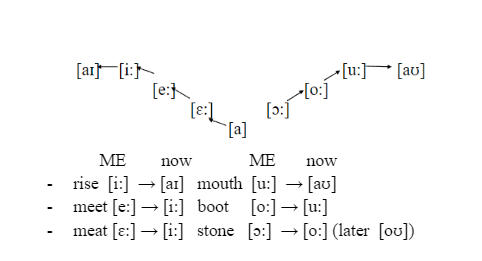
All long vowels moved one step higher
The long high vowels became diphthongs
Jesperson:
High vowels diphthongized first
Pull chain shift whereby mid vowels [e, o] move into the empty space created by change to high vowels
Low vowels moved into former positions of [e, o]
> Evidence: high vowels diphthongized in other languages without mid vowels
raising
Luick:
Push and pull chain shift
1) mid vowels raised first [e, o] moving towards positions of the high vowels [i, u] → high vowels diphthongized to prevent vowel pairs from becoming too similar, threatening communicational efficiency
2) pull chain whereby low vowels moved into the empty space created by the raising of the mid vowels
> Evidence: some dialects in North England and Scotland lack [o] in ME; retention
of original ME [u:] → this follows if diphthongization of [u] was forced by raising
of [o]
14
There might be a question asking you to explain certain features of English orthography
which reflect historical developments in the history of English, e.g. why the vowels in
words like nice, be, name, boot do not correspond to their values in most other
European languages; reasons for <gh> in words like night and laugh. These questions
will be easy if you know the basic details of the most important sound changes that
happened in the Early Modern English period.
which reflect historical developments in the history of English, e.g. why the vowels in
words like nice, be, name, boot do not correspond to their values in most other
European languages; reasons for <gh> in words like night and laugh. These questions
will be easy if you know the basic details of the most important sound changes that
happened in the Early Modern English period.
English orthography largely reflects the pronunciation before the EME period
Vowels in orthography correspond to value before GVS
<gh>: consonant deletion → silent letters
Palatal fricative [ç] was dropped with compensatory lengthening
E.g. night, right
Velar fricative [x] was dropped or became [f]
E.g. [x] slaughter
E.g. [f] laugh, enough
Cluster simplification:
Loss of /l/ in some syllable final clusters
E.g. walk, half, calm
Word initial cluster [wr] looses [w]
E.g. write, wring, wrong
Velar plosives before /n/ lost at start of word
E.g. know, numb, gnaw
Some plosives disappear after nasals at the end of a syllable
E.g. numb, thumb, long, thing, bomb
Vowels in orthography correspond to value before GVS
<gh>: consonant deletion → silent letters
Palatal fricative [ç] was dropped with compensatory lengthening
E.g. night, right
Velar fricative [x] was dropped or became [f]
E.g. [x] slaughter
E.g. [f] laugh, enough
Cluster simplification:
Loss of /l/ in some syllable final clusters
E.g. walk, half, calm
Word initial cluster [wr] looses [w]
E.g. write, wring, wrong
Velar plosives before /n/ lost at start of word
E.g. know, numb, gnaw
Some plosives disappear after nasals at the end of a syllable
E.g. numb, thumb, long, thing, bomb
15
Describe some grammatical differences between Early Modern English and current
English. (Answers might discuss differences in the uses of the auxiliary do, the pronoun
thou, word order differences, etc.)
English. (Answers might discuss differences in the uses of the auxiliary do, the pronoun
thou, word order differences, etc.)
Continued trend towards loss of inflection and use of analytic strategies (auxiliaries, prepositions)
Nouns: no dative or accusative marking on nouns survived, Genitive ‘s has been reinterpreted as an clitical affix that attaches to whole DP’s, not only nouns
Adjectives: all inflection lost except for comparative/ superlative (nice/nicer/nicest)
Pronouns: further simplification of pronoun system
Non-subjects: accusative/ objective survives
you/thou: thou seen as disrespectful to addressees, used to show different hierarchical standings in society, unequal standing
Verb: 3rd P. Sg. affix -eth (southern) replaced by -s (northern)
Inflectional differences lost in past tense > indicative and subjunctive are identical except with ‘be’
Many strong verbs become weak; weak class is now the default
Auxiliary do: use like now by start of LME
EME: not obligatory in questions and negation
Verb position: by LME lexical verbs could no longer appear in pre-negation, pre-adverb, pre-subject positions that now can only be filled by auxiliaries
Nouns: no dative or accusative marking on nouns survived, Genitive ‘s has been reinterpreted as an clitical affix that attaches to whole DP’s, not only nouns
Adjectives: all inflection lost except for comparative/ superlative (nice/nicer/nicest)
Pronouns: further simplification of pronoun system
Non-subjects: accusative/ objective survives
you/thou: thou seen as disrespectful to addressees, used to show different hierarchical standings in society, unequal standing
Verb: 3rd P. Sg. affix -eth (southern) replaced by -s (northern)
Inflectional differences lost in past tense > indicative and subjunctive are identical except with ‘be’
Many strong verbs become weak; weak class is now the default
Auxiliary do: use like now by start of LME
EME: not obligatory in questions and negation
Verb position: by LME lexical verbs could no longer appear in pre-negation, pre-adverb, pre-subject positions that now can only be filled by auxiliaries
16
What are inkhorn terms?
15th - 17th centuries: terms from LAtin/Greek borrowed into English that were perceived as pretentious, unnecessarily hard to understand and redundant because they had English synonyms
E.g. reciprocal, celebrate, encyclopaedia
E.g. reciprocal, celebrate, encyclopaedia
17
What were the main influences in the development of Standard English?
East Midlands dialects: convenient basis since they show features from Northern and Southern dialects
London: capiton and socio-economic centre → indirectly East Midlands influence due to proximity
“Prestigious dialect”
Chancery English: administrative body in Westminster, prepared legal and government documents
1417 Henry V: government documents supposed to be in English not French/Latin
1430: documents reached a relatively unified form ⇒ Chancery Standard
Printing: 1476: William Caxton introduced printing in England
Easier to print one edition in a largely understood variety
First mainly Chancery English
Later London variety
London: capiton and socio-economic centre → indirectly East Midlands influence due to proximity
“Prestigious dialect”
Chancery English: administrative body in Westminster, prepared legal and government documents
1417 Henry V: government documents supposed to be in English not French/Latin
1430: documents reached a relatively unified form ⇒ Chancery Standard
Printing: 1476: William Caxton introduced printing in England
Easier to print one edition in a largely understood variety
First mainly Chancery English
Later London variety
18
Variety/ Lect
Variety/ Lect: any form of language that is systematically distinct from others. A variety can be defined by linguistic features or extralinguistic criteria.
Linguistic features: e.g. rhotic variety
Extralinguistic criteria: geography, gender, age, social class, etc.
Linguistic features: e.g. rhotic variety
Extralinguistic criteria: geography, gender, age, social class, etc.
19
Variable
Variable: a feature of grammar, phonology or lexis that is subject to variation.
E.g. dance [a] vs. dance [ae] in British vs. American varieties
E.g. different from (British) vs, different than (American)
E.g. dance [a] vs. dance [ae] in British vs. American varieties
E.g. different from (British) vs, different than (American)
20
Regiolect
Regiolect = regional variety: a variety particular to a geographically defined space. Variation between regiolects is also called regional variation or diatopic variation.
E.g. Berlin dialect
E.g. Berlin dialect
21
Sociolinguistic variation
Sociolinguistic variation: variation according to social criteria. This often concerns sociolects.
= diastratic variation
Varieties associated with a particular social class
high/low sociolects > no value judgement attached to it
Specific features = sociolectal/ sociolinguistic variables
E.g. Australian English: youse (Pl. of you) in working class population
E.g. ‘whom’ and ‘one’ confined to high sociolects
E,g, Australian letter [h] ist pronounced [hɛɪt͡ʃ] > confined to Roman Catholics
= diastratic variation
Varieties associated with a particular social class
high/low sociolects > no value judgement attached to it
Specific features = sociolectal/ sociolinguistic variables
E.g. Australian English: youse (Pl. of you) in working class population
E.g. ‘whom’ and ‘one’ confined to high sociolects
E,g, Australian letter [h] ist pronounced [hɛɪt͡ʃ] > confined to Roman Catholics
22
Genderlect
Genderlect: a variety specific to a gender.
= gender-preferential variables
E.g. Women use positive minimal responses
E.g. Women interrupt less and change the subject less
E.g. Women use more specialised colour terms; e,g, mauve, paisley
= gender-preferential variables
E.g. Women use positive minimal responses
E.g. Women interrupt less and change the subject less
E.g. Women use more specialised colour terms; e,g, mauve, paisley
23
Idiolect
Idiolect: the variety used by one individual
24
Age-related variation
Age-related variation: since diachronic change never ceases, old and young people speak differently.
E.g. possessive ‘have’ as an auxiliary is confined to older British speech.
E.g. possessive ‘have’ as an auxiliary is confined to older British speech.
25
Register
Register: variety of language used by the same speaker according to the (extralinguistic/social) situation.
Jargon: language associated with specific topics/activities
Style level: variation according to social context. Levels include elevated-formal-informal/colloquial-slang-vulgar
Variables confined to lower style levels (=vernacular)
Increase of taboo words (fuck), fewer euphemisms (pass away)
Faster speech; more contracted forms (it’s. doesn;t)
Certain lexemes (yeah; kick the bucket)
Jargon: language associated with specific topics/activities
Style level: variation according to social context. Levels include elevated-formal-informal/colloquial-slang-vulgar
Variables confined to lower style levels (=vernacular)
Increase of taboo words (fuck), fewer euphemisms (pass away)
Faster speech; more contracted forms (it’s. doesn;t)
Certain lexemes (yeah; kick the bucket)
26
Speaker relations
Speaker relations: intimate/distant; subordinate/equal; reflected in forms used
E.g. German du/Sie
E.g. German du/Sie
27
Medium/mode
Medium/mode: spoken vs. written
E.g. no contractions in written academics
E.g. no contractions in written academics
28
Ethnolect
Ethnolect: variety used by members of a particular ethnic or cultural group. Its distinct characteristics are usually the result of contact with other languages. (e.g. language of a group of immigrants)
29
What do we mean by a standard variety of a language?
Standard variety:
Non region specific or specific to larger regions
More likely to be used in public, official communication while non standard are used in informal situations
Subject to more normativisation
Makes it more stable than local regiolects
Standard has more prestige
Often stigmatisation of non standard varieties, causing problems for speakers of non standard varieties differing greatly from standard
Standards are often masteredsed by relatively educated speakers which may lead to ignorant dismissals of regiolect users as stupid
Standards have various historical sources. They often derive from prestigious regiolects. Socio-cultural importance may help standardisation by attracting people from other regions, resulting in influences from various regiolects.
Non region specific or specific to larger regions
More likely to be used in public, official communication while non standard are used in informal situations
Subject to more normativisation
Makes it more stable than local regiolects
Standard has more prestige
Often stigmatisation of non standard varieties, causing problems for speakers of non standard varieties differing greatly from standard
Standards are often masteredsed by relatively educated speakers which may lead to ignorant dismissals of regiolect users as stupid
Standards have various historical sources. They often derive from prestigious regiolects. Socio-cultural importance may help standardisation by attracting people from other regions, resulting in influences from various regiolects.
30
The pronunciation in that dialect is a simplified (or bad) version of the correct (=standard) pronunciation.”
Children may acquire dialects before ever hearing the standard language
Dialects often make phonological distinctions not present in the standard language
Standard: eins, zwei, Bein
Niedersorbische Mundart: e:ns, zwe:, be:n
Speakers differ on what sounds are easier to pronounce
Dialects often make phonological distinctions not present in the standard language
Standard: eins, zwei, Bein
Niedersorbische Mundart: e:ns, zwe:, be:n
Speakers differ on what sounds are easier to pronounce
31
“That dialect is grammatically simpler than the correct (=standard) language.”
A dialect may lack some grammatical distinctions found in the standard, opposite also possible.
E.g. Irish: you/youse
Cologne: er ertrank vs. er war am ertrinken (wurde aber gerettet)
E.g. Irish: you/youse
Cologne: er ertrank vs. er war am ertrinken (wurde aber gerettet)
32
“That dialect has no grammar”
Trying to say that one particular variety misses a feature that standard or another variety possesses
If no grammar certain distinctions impossible: e.g. The dog bit the cat. vs The cat bit the dog.
If no grammar certain distinctions impossible: e.g. The dog bit the cat. vs The cat bit the dog.
33
Labov’s research on rhotic pronunciations in New York English
Subject: use of / r / in the coda of a syllable e.g. forth floor
Aim: which pronunciation (rhoic or non rhotic) was used by whom and under what conditions
Methods: overcoming observer’s paradox
Asking questions in department stores to which the answer would be ‘fourth floor’
Noting down rhotic/non rhotic in combination with age, sex, race
Result:
Saks (rich, fashion consious): most often pronounciation of / r / (62%) except older people
Macys’ (middle class): less often pronounciation of / r / (51%)
S. Klein (low-price store): least often pronounciation of / r / (20%)
Asking for repetition of answer results in more often pronunciation of / r / in all instances
Standard way of pronunciation, more clear
Aim: which pronunciation (rhoic or non rhotic) was used by whom and under what conditions
Methods: overcoming observer’s paradox
Asking questions in department stores to which the answer would be ‘fourth floor’
Noting down rhotic/non rhotic in combination with age, sex, race
Result:
Saks (rich, fashion consious): most often pronounciation of / r / (62%) except older people
Macys’ (middle class): less often pronounciation of / r / (51%)
S. Klein (low-price store): least often pronounciation of / r / (20%)
Asking for repetition of answer results in more often pronunciation of / r / in all instances
Standard way of pronunciation, more clear
34
Labov’s research on diphthongs in Martha’s Vineyard
Island off New England coast, very touristy during the summer
Subject: variables (ai) (au) centralised pronunciation of the first element of the diphthongs /aɪ/ as [əɪ], /aʊ/ as [əʊ]
Methods:
Result:
Illustration of the importance of social factors in dialect study
Results represent sense of belonging to the island
[əɪ] was dying out but was revived past WWII to set oneself apart from the tourist
[əɪ] more prevalent with people who wanted to stay living on the island, more among fishermen rather than those who worked with tourists, more from people who returned from mainland
Subject: variables (ai) (au) centralised pronunciation of the first element of the diphthongs /aɪ/ as [əɪ], /aʊ/ as [əʊ]
Methods:
Result:
Illustration of the importance of social factors in dialect study
Results represent sense of belonging to the island
[əɪ] was dying out but was revived past WWII to set oneself apart from the tourist
[əɪ] more prevalent with people who wanted to stay living on the island, more among fishermen rather than those who worked with tourists, more from people who returned from mainland
35
Trudgill’s research on language and gender in Norwich
Subject: gender, class and covert prestige > studying of fairly stigmatised dialectal features
(ng): [n] instead of [ŋ] in present participles (working)
[n] instead of [ŋ] is more common he lower the class but also more common in informal talk with higher class individuals
Self evaluation test: women tend to overreport, men tend to underreport use of standard
Suggested explanations for gender differences:
Working class linguistic features are associated with masculinity
Women trying to compensate for their lower social status
Women are more likely to be judged outward appearance than actions, language is a part of appearance
(ng): [n] instead of [ŋ] in present participles (working)
[n] instead of [ŋ] is more common he lower the class but also more common in informal talk with higher class individuals
Self evaluation test: women tend to overreport, men tend to underreport use of standard
Suggested explanations for gender differences:
Working class linguistic features are associated with masculinity
Women trying to compensate for their lower social status
Women are more likely to be judged outward appearance than actions, language is a part of appearance
36
What are isoglosses? In what ways do they sometimes oversimplify the facts?
Isoglosses: lines on maps showing boundaries of areas where a particular feature is used. They can indicate phonological, morphological, syntactic features or items of vocabulary
Rough guide because:
Often drawn between areas known to have particular features, exact positioning lies in guesswork
Don’t reflect social, gender related, age related differences
Not everyone within said area makes use of that feature 100% of the time or at all
Don’t reflect transition zones between areas where mixed lects are common ot fudged lects
Rough guide because:
Often drawn between areas known to have particular features, exact positioning lies in guesswork
Don’t reflect social, gender related, age related differences
Not everyone within said area makes use of that feature 100% of the time or at all
Don’t reflect transition zones between areas where mixed lects are common ot fudged lects
37
They are likely to be historically older
Older features are conservative or relics rather than innovations
Exceptions:
Movement of speakers who use the innovation (australia is non-rhotic)
Innovations can jump from town to town
Genuine coincidence, certain sound changes are more common to appear
E.g. GVS and German diphthongisation
Stepping stone model: innovations hop from important towns/cities to other towns/cities without necessarily affecting the areas in between
Uvular / r / in Europe: from Paris to France to bigger German cities
What can be concluded if one finds a particular feature in geographically disconnected
areas (section 1 plus stuff on stepping stone model in section 2)
areas (section 1 plus stuff on stepping stone model in section 2)
They are likely to be historically older
Older features are conservative or relics rather than innovations
Exceptions:
Movement of speakers who use the innovation (australia is non-rhotic)
Innovations can jump from town to town
Genuine coincidence, certain sound changes are more common to appear
E.g. GVS and German diphthongisation
Stepping stone model: innovations hop from important towns/cities to other towns/cities without necessarily affecting the areas in between
Uvular / r / in Europe: from Paris to France to bigger German cities
38
Negative Concord
Negative concord: double/multiple negation > one clause contains two elements which are inherently associated with negation
E.g. I didn’t buy nothing. > Standard: I didn’t buy anything.
Argument: dismissed as illogical on the grounds that negative elements cancel each other outN
‘Two negatives make a positive’
Debunking: example of ignorantly imposing rules of one variety on another
Nothing two functions in negative concord dialects
Matching anything and nothing from standard english
Standard does the same with ‘anything’
E.g. I didn’t buy anything. You can do anything.
Other languages have this as a possibility in their standard variant such as French, where not using it is considered informal
E.g. I didn’t buy nothing. > Standard: I didn’t buy anything.
Argument: dismissed as illogical on the grounds that negative elements cancel each other outN
‘Two negatives make a positive’
Debunking: example of ignorantly imposing rules of one variety on another
Nothing two functions in negative concord dialects
Matching anything and nothing from standard english
Standard does the same with ‘anything’
E.g. I didn’t buy anything. You can do anything.
Other languages have this as a possibility in their standard variant such as French, where not using it is considered informal
39
Singular ‘they’
Used to be considered old-fashioned
Supposed to be replaced with he
Argument: they is Plural, cannot be in connection with singular objects
Objection:
they has two functions:
Plural
Singular common gender
Other pronouns that do the same, uncriticized
Ich mag sie. (can be analysed as both singular and plural)
Semantics are important in that case and should be recognised since they dont always agree with the grammatical function
E.g. trousers > grammatical plural
Madchen > grammatical neutral, semantically female
Supposed to be replaced with he
Argument: they is Plural, cannot be in connection with singular objects
Objection:
they has two functions:
Plural
Singular common gender
Other pronouns that do the same, uncriticized
Ich mag sie. (can be analysed as both singular and plural)
Semantics are important in that case and should be recognised since they dont always agree with the grammatical function
E.g. trousers > grammatical plural
Madchen > grammatical neutral, semantically female
40
What are the basic differences between diffusional and absolute (neogrammarian)
sound changes?
sound changes?
Diffusional: irregular sound change that allows unsystematic exceptions even in words displaying the right conditioning
Absolute: exceptionless sound change that affects all instances of the sound with the right conditioning
Absolute: exceptionless sound change that affects all instances of the sound with the right conditioning
41
Glottal stop and flap as allophones of /t/
Geographic:
Cockney (London) and several other varieties in England and Scotland
Extension of the environments where [ʔ] appears in fast speech replacing /t/ before syllabic nasals and word final before consonants
> British/American/Southern-Hemisphere
Some american/ australian varieties have developed [ɾ] as an alternative allophone of intervocalic /t/
Absolute: fully systematic
Non-phonemic (doesn’t create a new phoneme)
Conditioned → intervocalic and word final
[t] > [ʔ] / V_V, _#
History: intervocalic glottal stop has been gaining ground in recent decades in South-West England and in contexts where received pronunciation would have been used
Cockney (London) and several other varieties in England and Scotland
Extension of the environments where [ʔ] appears in fast speech replacing /t/ before syllabic nasals and word final before consonants
> British/American/Southern-Hemisphere
Some american/ australian varieties have developed [ɾ] as an alternative allophone of intervocalic /t/
Absolute: fully systematic
Non-phonemic (doesn’t create a new phoneme)
Conditioned → intervocalic and word final
[t] > [ʔ] / V_V, _#
History: intervocalic glottal stop has been gaining ground in recent decades in South-West England and in contexts where received pronunciation would have been used
42
/h/ dropping
/h/ deleted in many English working class accents (informal style)
Ca. 18th-19th century since America unaffected
Unconditioned
Absolute
Phonemic:
Some varieties lack /h/ completely
Only present when use of standard
Possible occurrence of overcorrection
E.g. a. [edʒ] ‘edge or hedge’ vs. [hedʒ] ‘edge or hedge (emphatic)’
Most if not all varieties of English have /h/ dropping in clitic forms of function words
E.g. They’ve seen ‘er; I would’ve seen ‘im
Ca. 18th-19th century since America unaffected
Unconditioned
Absolute
Phonemic:
Some varieties lack /h/ completely
Only present when use of standard
Possible occurrence of overcorrection
E.g. a. [edʒ] ‘edge or hedge’ vs. [hedʒ] ‘edge or hedge (emphatic)’
Most if not all varieties of English have /h/ dropping in clitic forms of function words
E.g. They’ve seen ‘er; I would’ve seen ‘im
43
Why do non-rhotic accents exist?
Arise when speakers delete / r / in syllable codas unless a vowel follows
Deletion very common sound change
Deletion very common sound change
44
What is ‘linking / r /’ and what is ‘intrusive / r /’?
Linking / r /: present in non-rhotic varieties
Instance of / r / that appears in spelling and is pronounced if followed by a vowel
E.g. far away but not far better
Conditioned
Non-phonetmic
absolute
Intrusive / r /: insertion of linking / r /
> epenthetic / r / inserted where / r / had not existed before and is not present in
spelling
E.g. Russia, law and order, drawing
Instance of / r / that appears in spelling and is pronounced if followed by a vowel
E.g. far away but not far better
Conditioned
Non-phonetmic
absolute
Intrusive / r /: insertion of linking / r /
> epenthetic / r / inserted where / r / had not existed before and is not present in
spelling
E.g. Russia, law and order, drawing
45
How did intrusive / r / come into existence?
reanalysation of / r / retention as an insertion of linking / r / to break up vowel-vowel sequences
Depicts that non-rhotic speakers lost the ability to distinguish between word that originally had / r / in the syllable coda and words that didn’t
Intrusive / r / is inserted when the previous vowel is not high
Linking /j/ can be inserted before high front vowels
E.g. my [j] other car
Linking /w/ before high back vowels
E.g. now [w] or never
Depicts that non-rhotic speakers lost the ability to distinguish between word that originally had / r / in the syllable coda and words that didn’t
Intrusive / r / is inserted when the previous vowel is not high
Linking /j/ can be inserted before high front vowels
E.g. my [j] other car
Linking /w/ before high back vowels
E.g. now [w] or never
46
Name three arguments against the view that AAVE has ‘no rules’. The answers need
only be brief. You need only choose three phenomena discussed in my slides or the
article by Pullum on Moodle and indicate that they are rule-governed. (E.g. you could
show that final consonants and the copula are only omitted under certain specific
conditions (describe them briefly) or explain that the distribution of the forms he sick,
he be sick and he been sick are not random but have different meanings.)
only be brief. You need only choose three phenomena discussed in my slides or the
article by Pullum on Moodle and indicate that they are rule-governed. (E.g. you could
show that final consonants and the copula are only omitted under certain specific
conditions (describe them briefly) or explain that the distribution of the forms he sick,
he be sick and he been sick are not random but have different meanings.)
Final consonant devoicing:
/ b, d, g / > /p, t, k/ / _#
Same can be observed in German
Final consonant cluster reduction
Final consonant clusters are omitted where both consonants have the same voicing and place of articulation
Phonological contrained inherited from West African languages spoken by slaves
E.g. post > pos’, desk > des’
Same can be observed in English e.g. bomb, thumb
Pronounced in earlier periods of the language
Negative concord and negative inversion
Auxiliary with incorporated negative particle precedes subject
E.g. Ain’t nothing went down. vs Nothing happened.
French does it. Negative concord seen as normal speech, omittance as informal.
/ b, d, g / > /p, t, k/ / _#
Same can be observed in German
Final consonant cluster reduction
Final consonant clusters are omitted where both consonants have the same voicing and place of articulation
Phonological contrained inherited from West African languages spoken by slaves
E.g. post > pos’, desk > des’
Same can be observed in English e.g. bomb, thumb
Pronounced in earlier periods of the language
Negative concord and negative inversion
Auxiliary with incorporated negative particle precedes subject
E.g. Ain’t nothing went down. vs Nothing happened.
French does it. Negative concord seen as normal speech, omittance as informal.