Chapter 2: Cabling and Technology
Study these flashcardsFree · spaced repetition · iPhone, Android, Mac & web
All cards
1
What are the two main types of network topologies?
Physical Topology – The actual layout of devices and connections (cables, wireless, etc.).
Logical Topology – How data flows between nodes, regardless of physical connections.
Logical Topology – How data flows between nodes, regardless of physical connections.
2
What is a point-to-point topology?
A direct connection between two nodes using a single link (e.g., copper, fiber, wireless).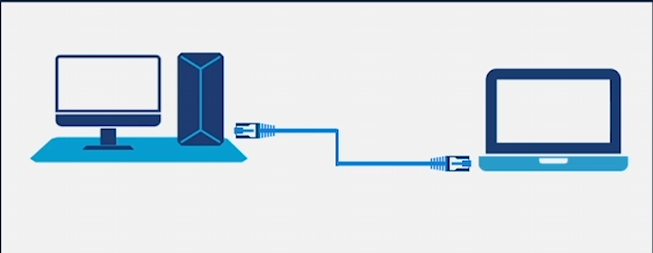
3
What is a star (hub-and-spoke) topology?
Nodes connect to a central device (switch, router, or server).
Evolved from mainframe-terminal setups.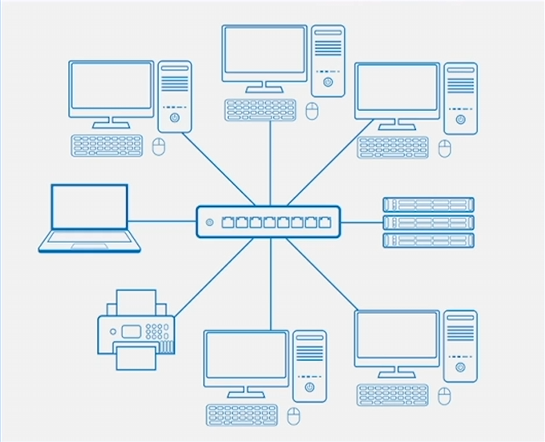
Evolved from mainframe-terminal setups.
4
What is a mesh topology?
Every device connects to every other, providing redundancy.
Can be wired or wireless.
If one link fails, traffic reroutes through another path.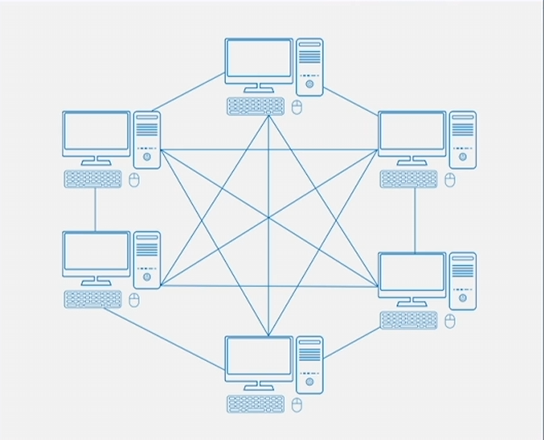
Can be wired or wireless.
If one link fails, traffic reroutes through another path.
5
What is a hybrid topology?
Combines two or more physical topologies (e.g., star + ring + mesh).
Used to meet specific organizational needs.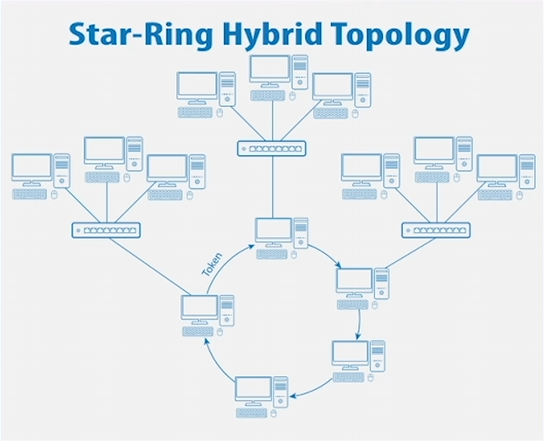
Used to meet specific organizational needs.
6
What is the three-tier hierarchy model?
A logical topology with three layers:
Core Layer – High-speed backbone (connects to WAN/Internet).
Distribution Layer – Routes/filters traffic, provides security (ACLs, load balancing).
Access Layer – Where end-user devices connect (switching, QoS, security).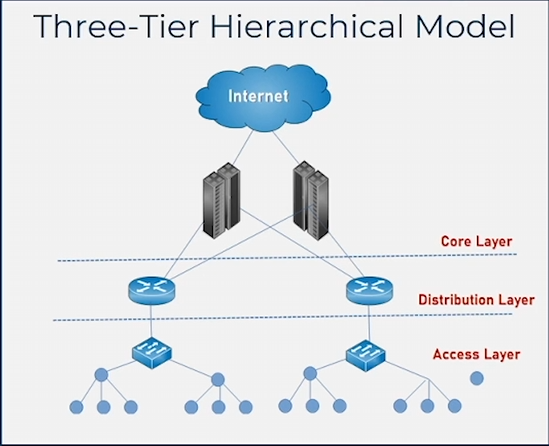
Core Layer – High-speed backbone (connects to WAN/Internet).
Distribution Layer – Routes/filters traffic, provides security (ACLs, load balancing).
Access Layer – Where end-user devices connect (switching, QoS, security).
7
What is a collapsed core model?
Combines distribution and core layers into a single device (e.g., a Layer 3 switch).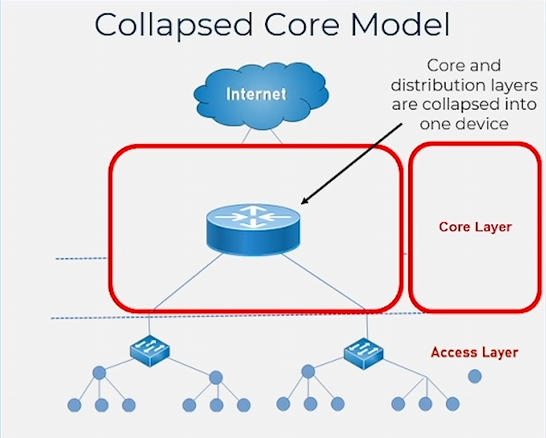
8
What is spine-and-leaf architecture?
A two-layer data center design:
Spine Switches (Layer 3) – Connect in a mesh.
Leaf Switches (Layer 2) – Connect end devices.
Reduces latency for east-west traffic (within the data center).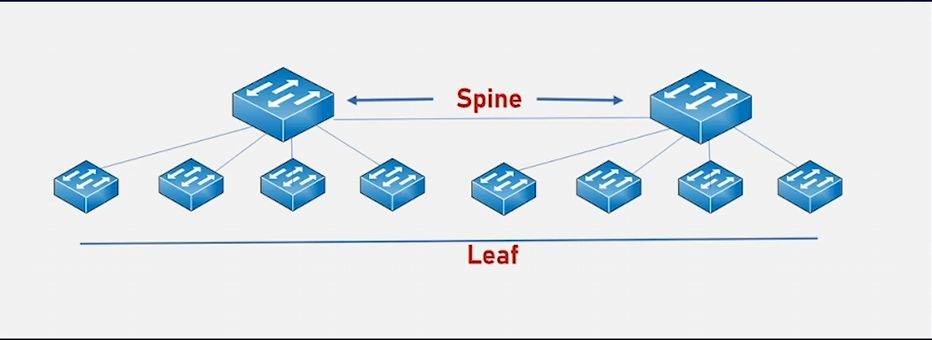
Spine Switches (Layer 3) – Connect in a mesh.
Leaf Switches (Layer 2) – Connect end devices.
Reduces latency for east-west traffic (within the data center).
9
What’s the difference between physical and logical topology?
Physical = Actual hardware connections.
Logical = How data travels (e.g., three-tier hierarchy).
Logical = How data travels (e.g., three-tier hierarchy).
10
What is a Collapsed Core model?
A two-layer version of the three-tier model that merges core and distribution layers.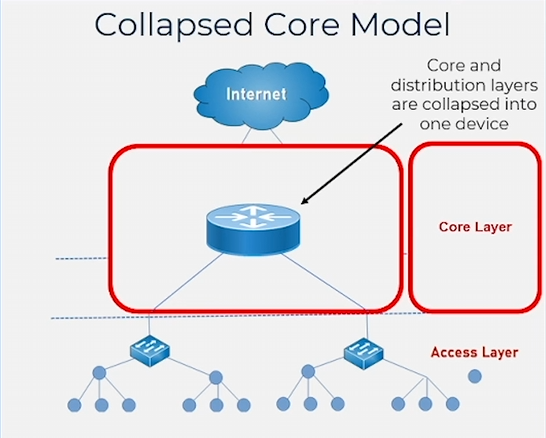
11
What is coaxial cable?
A type of cable dating back to World War II, commonly used for TV and networking.
Has four main parts:
Inner conductor (core) – Carries the signal.
Insulator – Separates inner and outer conductors.
Outer conductor (mesh shield) – Protects against interference.
PVC sheath – Provides durability.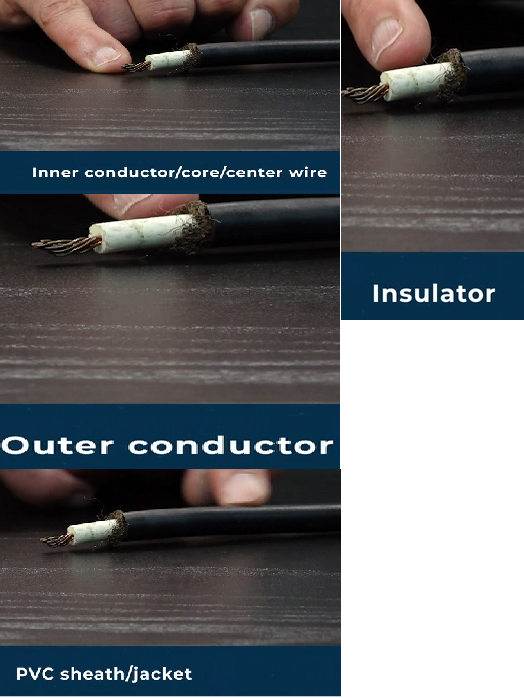
Has four main parts:
Inner conductor (core) – Carries the signal.
Insulator – Separates inner and outer conductors.
Outer conductor (mesh shield) – Protects against interference.
PVC sheath – Provides durability.
12
What is RG (Radio Grade) in coaxial cables?
Determines the type, thickness, and conductor properties of the cable.
RG-6 is the modern standard (replaced RG-59).
RG-6 is the modern standard (replaced RG-59).
13
What is the impedance of RG-6 coaxial cable?
75 ohms (Ω).
14
What are the two main types of coaxial connectors?
F-type (most common today) – Twist-on connector used for cable modems/TV.
BNC (older) – Twist-and-lock connector, used in legacy networks.
BNC (older) – Twist-and-lock connector, used in legacy networks.
15
What is Twinax?
A twinaxial cable with two inner conductors sharing one outer conductor.
Used in SFP cables and some SATA cables.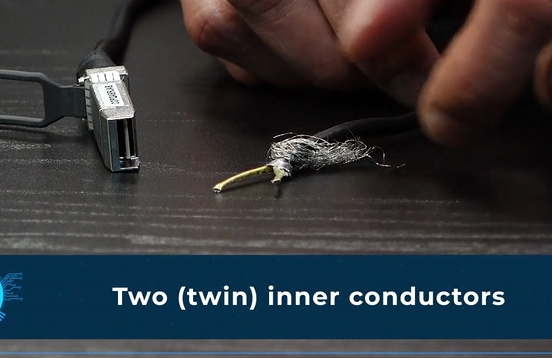
Used in SFP cables and some SATA cables.
16
What are the advantages of coaxial cable?
Highly resistant to EMI (electromagnetic interference).
Durable (strong physical protection).
Durable (strong physical protection).
17
What are the disadvantages of coaxial cable?
Inflexible (hard to install).
Expensive compared to some alternatives.
Expensive compared to some alternatives.
18
Where is an F-type connector used?
Cable modems, cable boxes, and other home devices.
19
What is a BNC connector?
An older twist-lock connector used in legacy systems.
20
What is twisted pair cable?
A commonly used networking cable with pairs of twisted wires to reduce EMI (electromagnetic interference) and crosstalk.
Two main types:
UTP (Unshielded Twisted Pair) – No extra shielding (most common).
STP (Shielded Twisted Pair) – Has a grounded copper/foil shield for extra protection (used in industrial areas).
Two main types:
UTP (Unshielded Twisted Pair) – No extra shielding (most common).
STP (Shielded Twisted Pair) – Has a grounded copper/foil shield for extra protection (used in industrial areas).
21
What is the max distance for UTP/STP?
100 meters (~325 feet) before signal degrades.
22
What connector does twisted pair use?
RJ-45 (for Ethernet)
23
What are the two wiring standards for UTP?
TIA-568A and TIA-568B (dictate wire pinouts).
24
Solid Core vs. Stranded Core
Solid Core – Single copper wire (better for permanent installations, like in walls).
Stranded Core – Multiple thin wires (more flexible, used in patch cables).
Stranded Core – Multiple thin wires (more flexible, used in patch cables).
25
Category (Cat) Ratings & Speeds
Category Max Speed Max Distance Notes
Cat 5 100 Mbps – 1 Gbps 100m Mostly outdated.
Cat 5e 1 Gbps 100m Improved EMI protection.
Cat 6 10 Gbps 55m (100m for 1 Gbps) Better EMI/crosstalk resistance.
Cat 6a 10 Gbps 100m Full 10G support at full distance.
Cat 7 10 Gbps+ 100m Shielded, higher performance.
Cat 8 25-40 Gbps 30m Used for 40GBASE-T, data centers.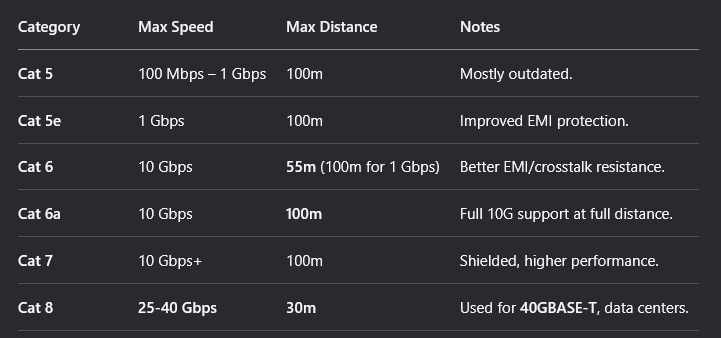
Cat 5 100 Mbps – 1 Gbps 100m Mostly outdated.
Cat 5e 1 Gbps 100m Improved EMI protection.
Cat 6 10 Gbps 55m (100m for 1 Gbps) Better EMI/crosstalk resistance.
Cat 6a 10 Gbps 100m Full 10G support at full distance.
Cat 7 10 Gbps+ 100m Shielded, higher performance.
Cat 8 25-40 Gbps 30m Used for 40GBASE-T, data centers.
26
What is Fiber Optic Cable?
Transmits data as light pulses through a glass/plastic core.
Structure:
Core – Carries light signals.
Cladding – Reflects light back into the core.
Jacket – Outer protective layer.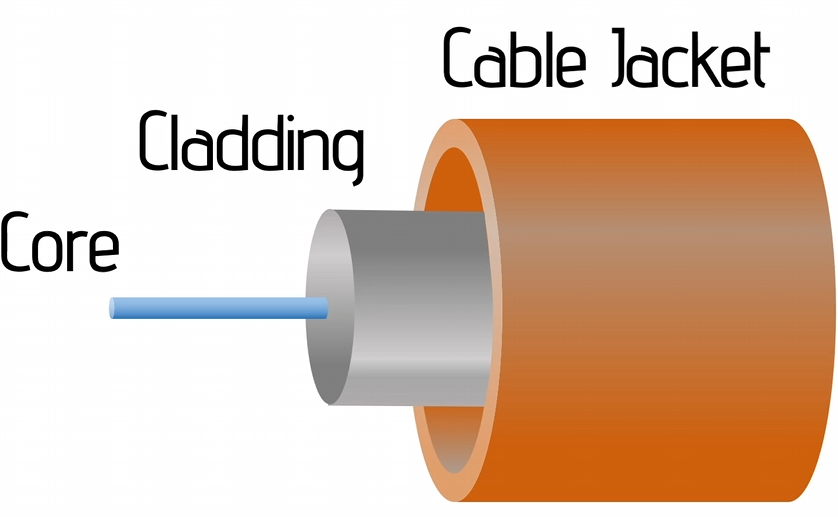
Structure:
Core – Carries light signals.
Cladding – Reflects light back into the core.
Jacket – Outer protective layer.
27
Single Mode vs. Multimode Fiber
Feature Single Mode Multimode
Light Source Laser (narrow, focused) LED (broader light)
Core Size Thinner (~9µm) Thicker (~50-62.5µm)
Distance Long (up to 100km+) Short (~2km max)
Color Code Yellow Orange (Aqua for OM3/4)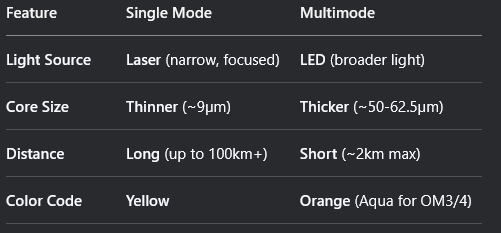
Light Source Laser (narrow, focused) LED (broader light)
Core Size Thinner (~9µm) Thicker (~50-62.5µm)
Distance Long (up to 100km+) Short (~2km max)
Color Code Yellow Orange (Aqua for OM3/4)
28
What are the Fiber Optic Connectors types?
ST (Straight Tip) – Round, twist-lock (old, resembles BNC).
SC (Subscriber Connector) – Square, push-pull (common in older networks).
FC (Ferrule Connector) – Round, screws in (used in high-vibration environments).
LC (Lucent Connector) – Small, duplex (modern, high-density setups).
MTP/MPO – Multi-fiber (used in data centers for high-speed links).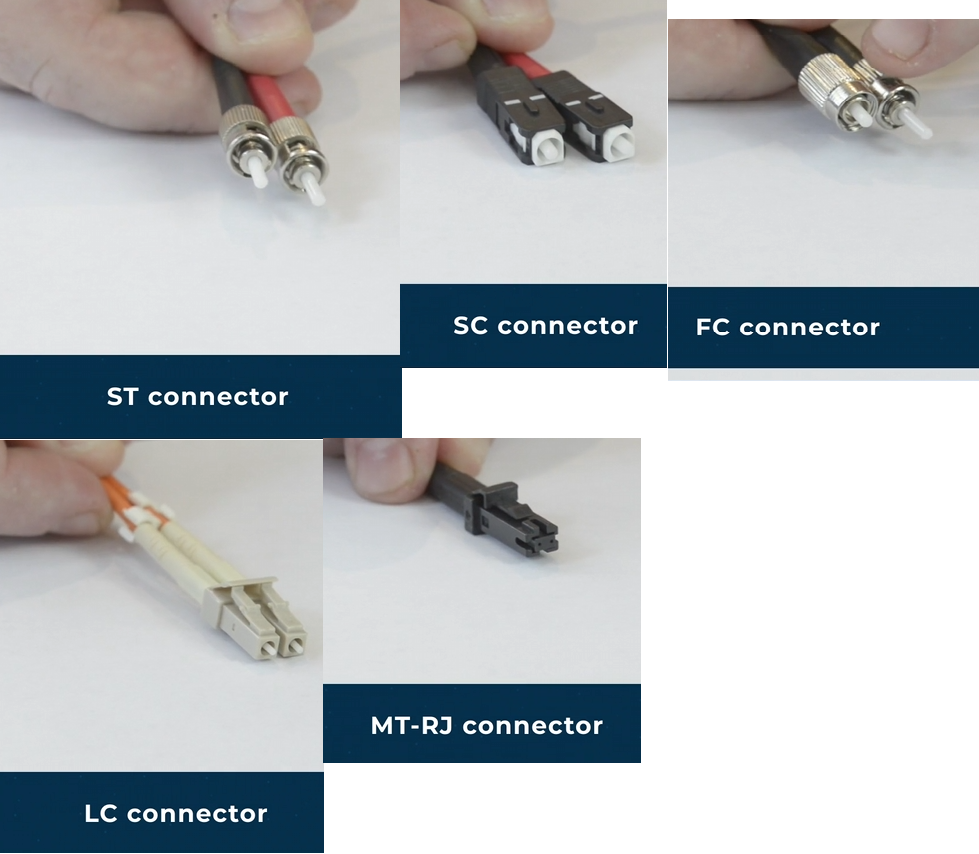
SC (Subscriber Connector) – Square, push-pull (common in older networks).
FC (Ferrule Connector) – Round, screws in (used in high-vibration environments).
LC (Lucent Connector) – Small, duplex (modern, high-density setups).
MTP/MPO – Multi-fiber (used in data centers for high-speed links).
29
What are all the Polishing Types (Ferrule Finish)?
PC (Physical Contact) – Slightly rounded (older, more signal loss).
UPC (Ultra Physical Contact) – More rounded, less loss (common today).
APC (Angled Physical Contact) – 8° angle, best for low reflection (used in high-precision apps).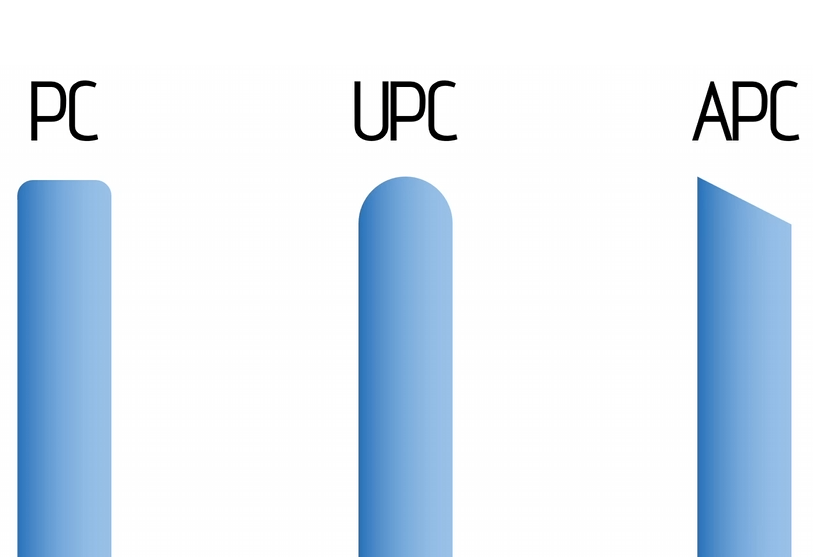
UPC (Ultra Physical Contact) – More rounded, less loss (common today).
APC (Angled Physical Contact) – 8° angle, best for low reflection (used in high-precision apps).
30
Why Do Fire Ratings Matter?
Prevent fire spread & toxic smoke in buildings (like in The Towering Inferno).
Required by building/fire codes for safety.
Required by building/fire codes for safety.
31
Three Cable Fire Ratings
Plenum spaces = Areas for HVAC airflow (e.g., above drop ceilings).
Riser cables rely on firestops to block fire between floors.
PVC cables are cheap but unsafe for enclosed spaces (toxic smoke).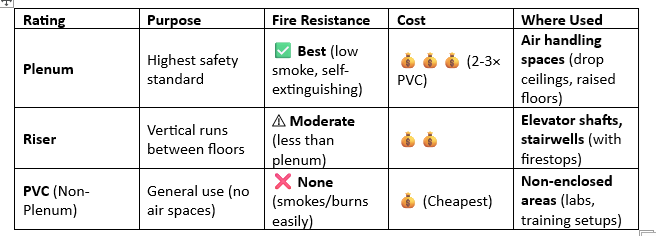
Riser cables rely on firestops to block fire between floors.
PVC cables are cheap but unsafe for enclosed spaces (toxic smoke).
32
What is plenum space in a building?
The area between a drop ceiling and the actual ceiling, or between a raised floor and the true floor—used for HVAC air return.
33
What is plenum-rated cabling?
Cabling with the highest fire resistance, designed for use in plenum spaces. Emits minimal smoke/toxins when burned.
34
Why is plenum cabling required in certain areas?
Because it’s used in spaces with air circulation (HVAC), and safety/fire codes require low-smoke, fire-resistant materials.
35
What is riser-rated cabling?
Cabling meant to run vertically between floors. It has moderate fire resistance but is less resistant than plenum-rated.
36
Why is riser cable acceptable between floors despite lower fire resistance?
Because proper installations include firestops to prevent fire spread.
37
What is PVC/non-plenum cabling?
The least fire-resistant cable type. It's cheaper but emits smoke and fumes when burned. Not allowed in walls or ceilings by most codes.
38
How does PVC cabling behave when burned?
Catches fire quickly, produces noxious smoke and heavy charring.
39
How does plenum cabling behave when burned?
Produces minimal smoke, resists burning better than PVC.
40
Why might PVC still be used?
It’s inexpensive and useful for training or non-critical setups where fire risk is low.