Organisation 2
Study these flashcardsFree · spaced repetition · iPhone, Android, Mac & web
All cards
1
Define Blood
A Tissue & Consists of a Fluid called Plasma in which Red Blood Cells, White Blood Cells and Platelets are Suspended. 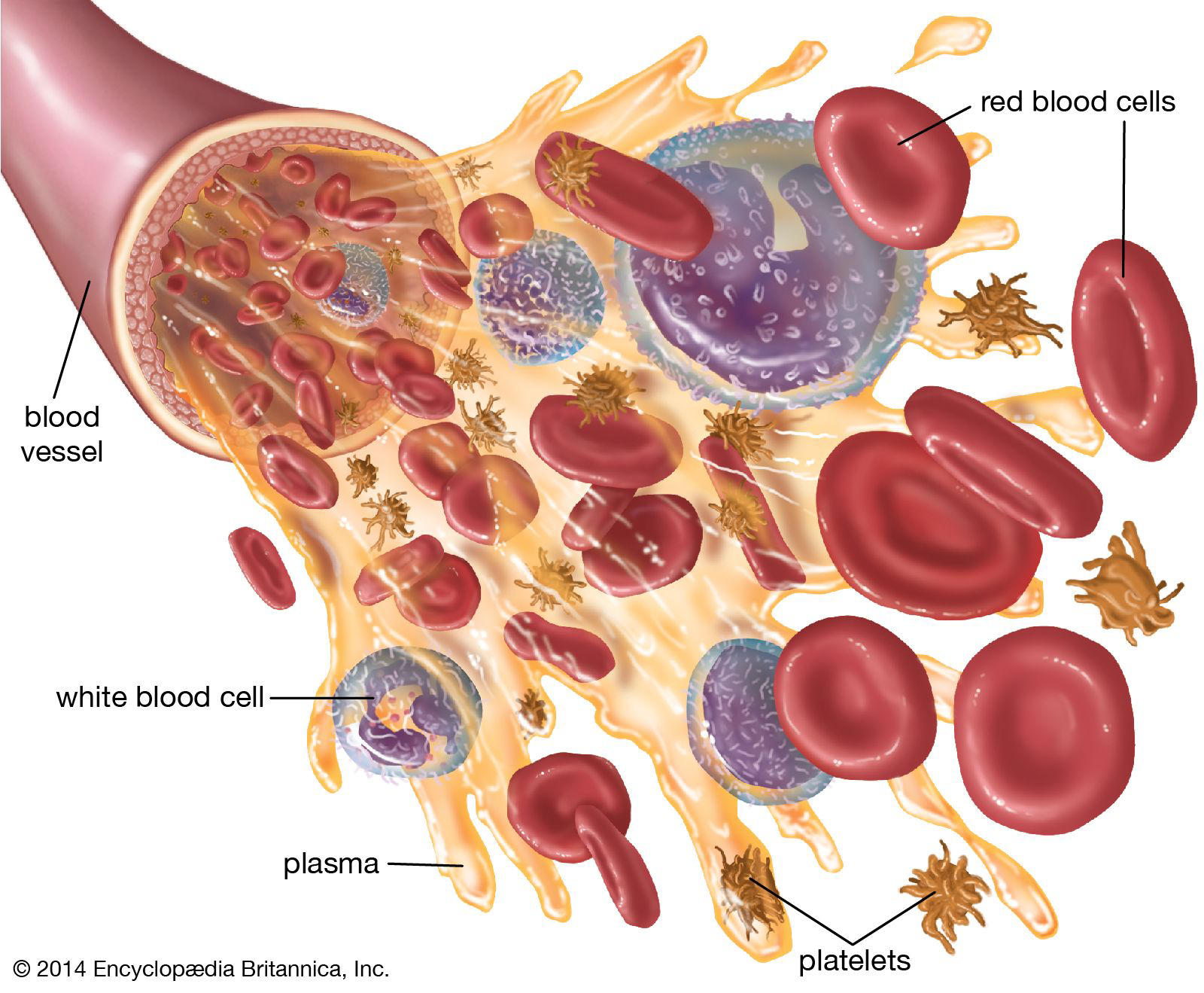
2
Functions and features of White Blood Cell
• Form Part Of the immune System which Defends the Body Against Pathogens
• Often Have a "Lobed" Nucleus
• (Larger than red blood cell)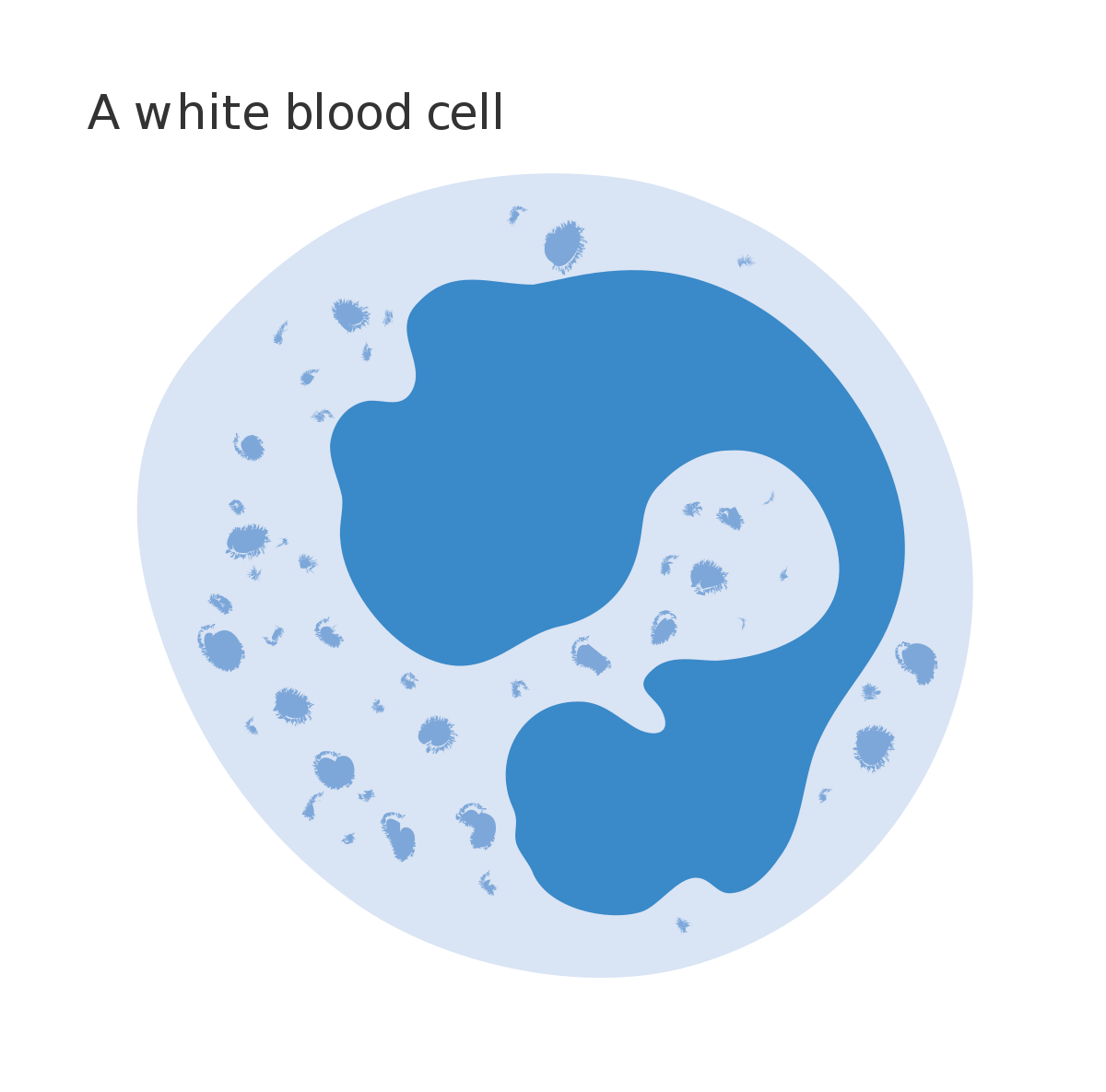
• Often Have a "Lobed" Nucleus
• (Larger than red blood cell)
3
Functions and features of Red Blood Cell
• Transport Oxygen From Lungs Around Body
• Packed with a Red Pigment Called Haemoglobin, which Combines with Oxygen (to Make Oxyhaemoglobin)
• Biconcave Shape to increase Surface Area
• No Nucleus- more room for oxygen (unlike all other human cells)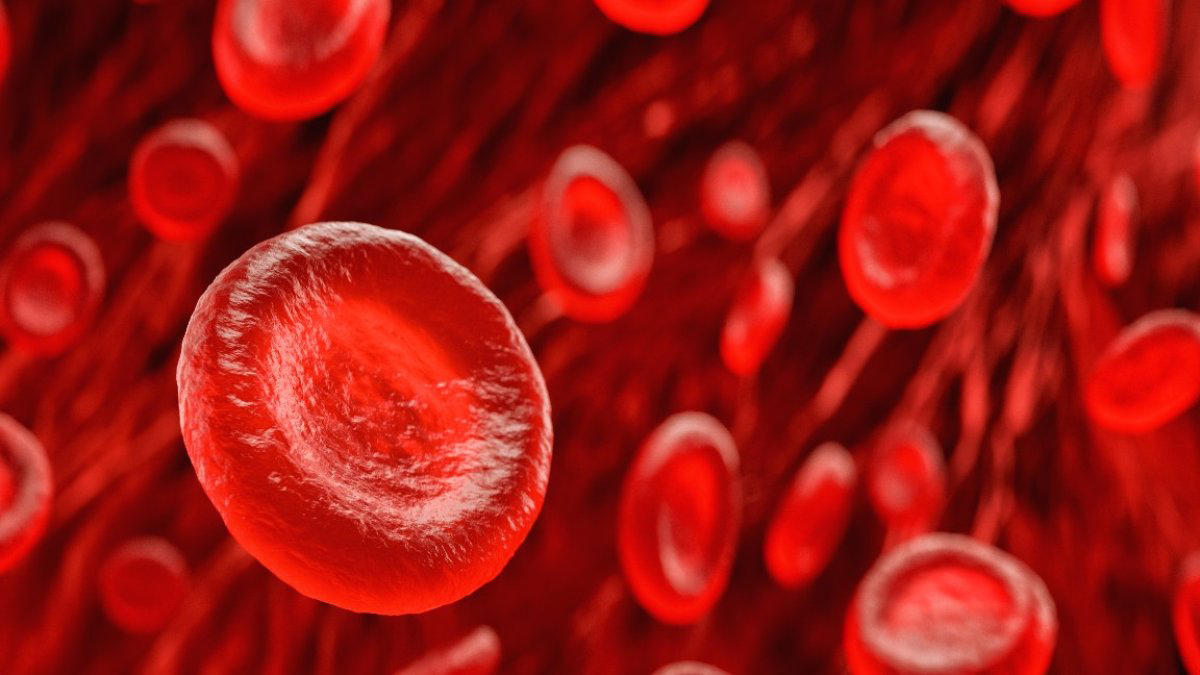
• Packed with a Red Pigment Called Haemoglobin, which Combines with Oxygen (to Make Oxyhaemoglobin)
• Biconcave Shape to increase Surface Area
• No Nucleus- more room for oxygen (unlike all other human cells)
4
Functions of Plasma
• Transports Waste Carbon Dioxide to the Lungs
• Transports Digested Food From the Small Intestine Around the Body (e.g glucose and amino acids)
• Transports Hormones from Glands to Target Organs
• Transports Urea From the Liver to the Kidneys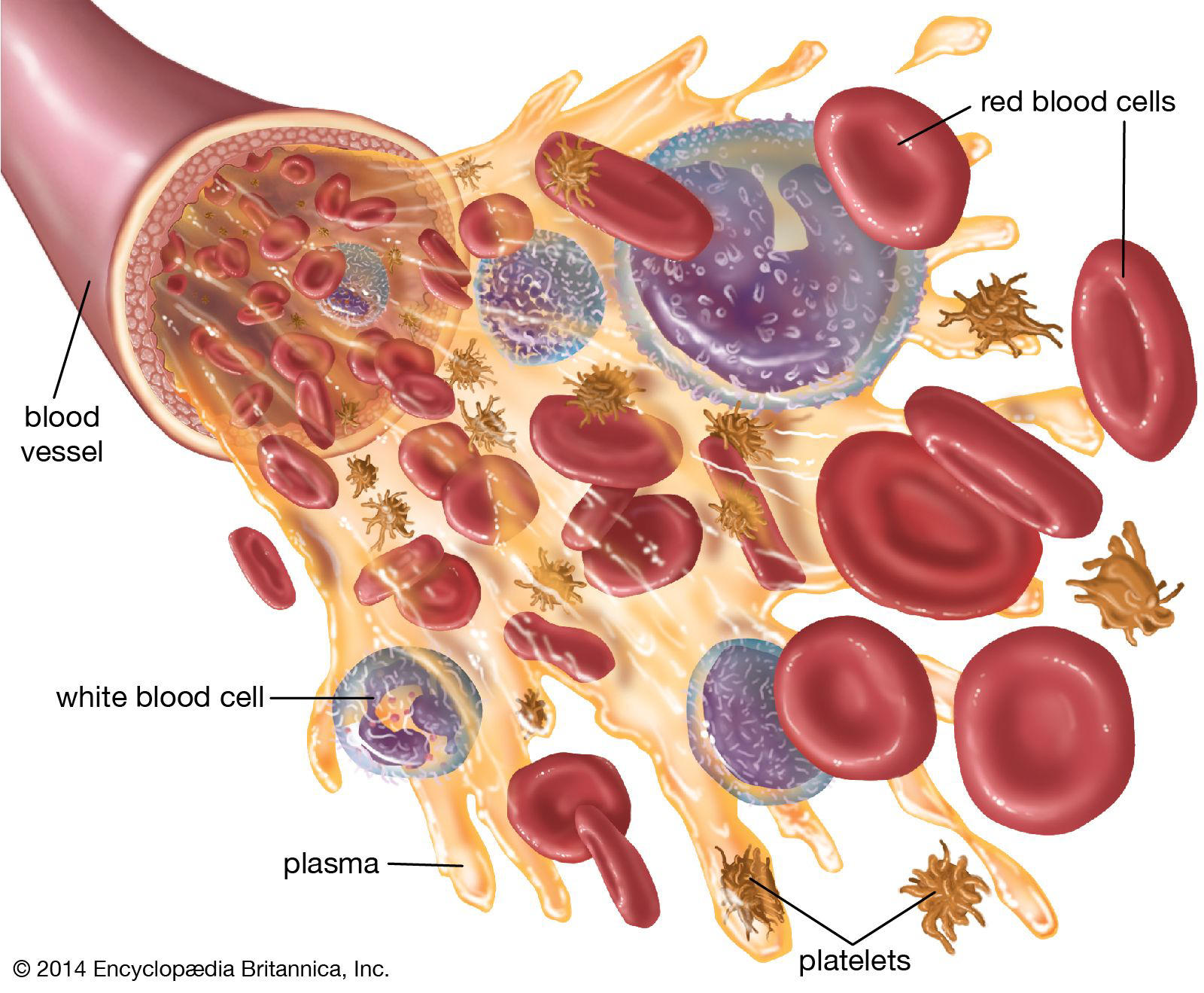
• Transports Digested Food From the Small Intestine Around the Body (e.g glucose and amino acids)
• Transports Hormones from Glands to Target Organs
• Transports Urea From the Liver to the Kidneys
5
Functions and features of Platelets
• Small Fragments of Cells
• No Nucleus
• Help Blood To Clot At the Site Of a Wound
• No Nucleus
• Help Blood To Clot At the Site Of a Wound
6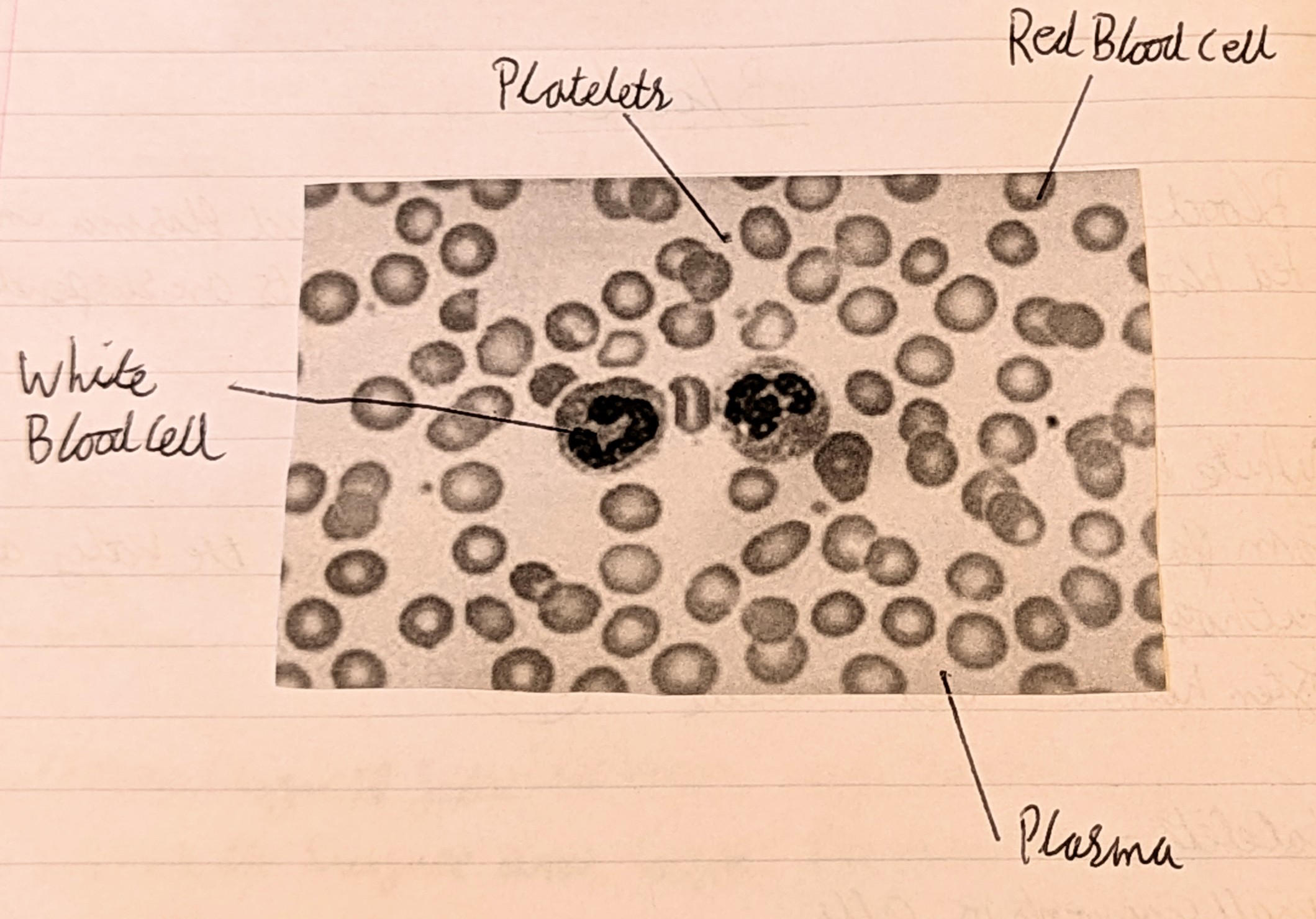
Label Blood Diagram 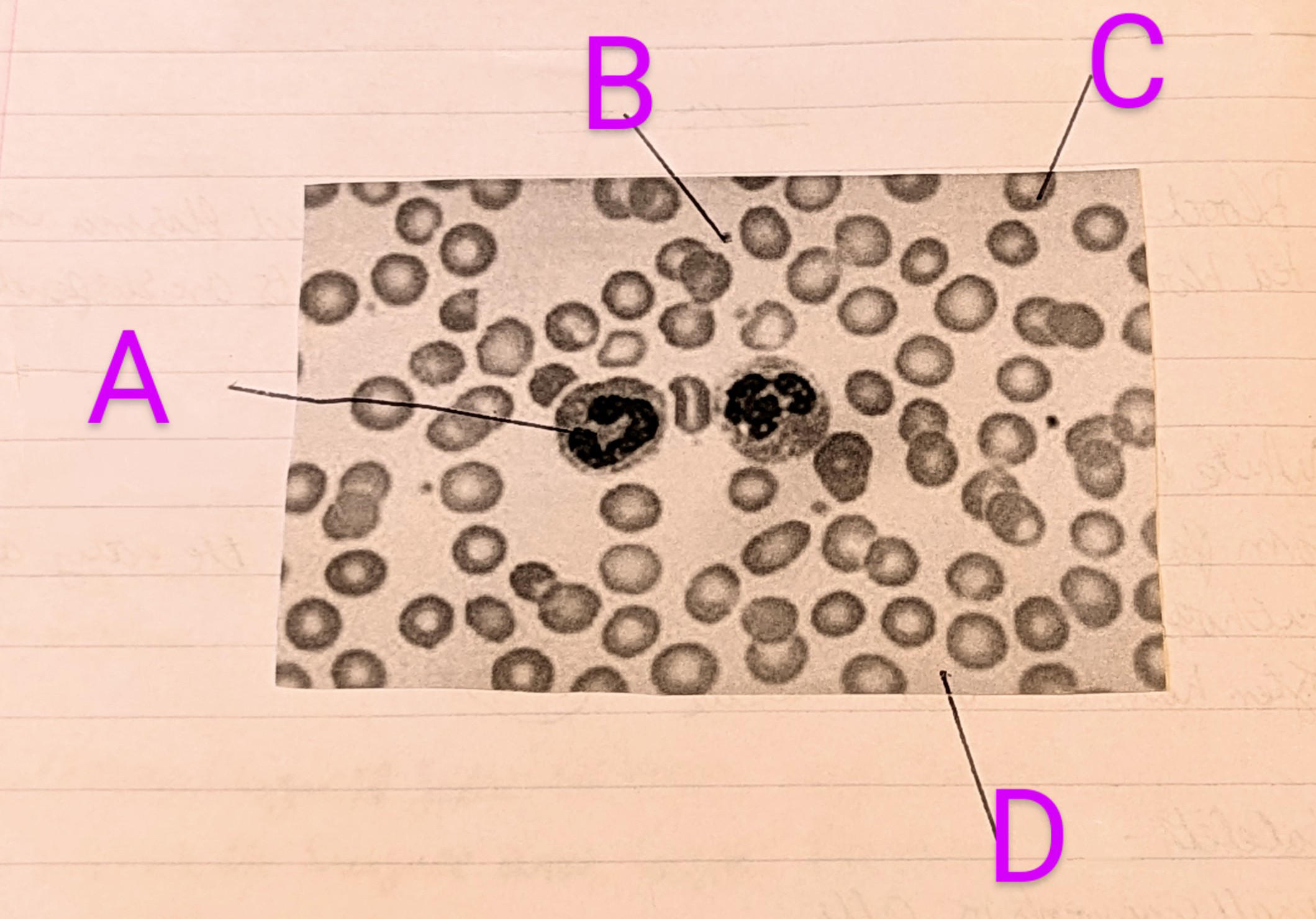
7
What would happen if a person had low number of white blood cells?
they would be more likely to get ill
8
What is somebody's blood didn't have enough platelets?
Blood wouldn't be able to clot at the site of a wound so you could bleed to death
9
What are the Properties & Functions of Arteries?
PROPERTIES
Thicker Walls Containing Muscle & Elastic Fibres to Withstand the High Pressure of Bloods Blowing Through Them.
Narrow Lumen Which Blood Flows.
FUNCTIONS
Carries Blood Away From Heart to the Organs and Tissue of the Body At High Pressure.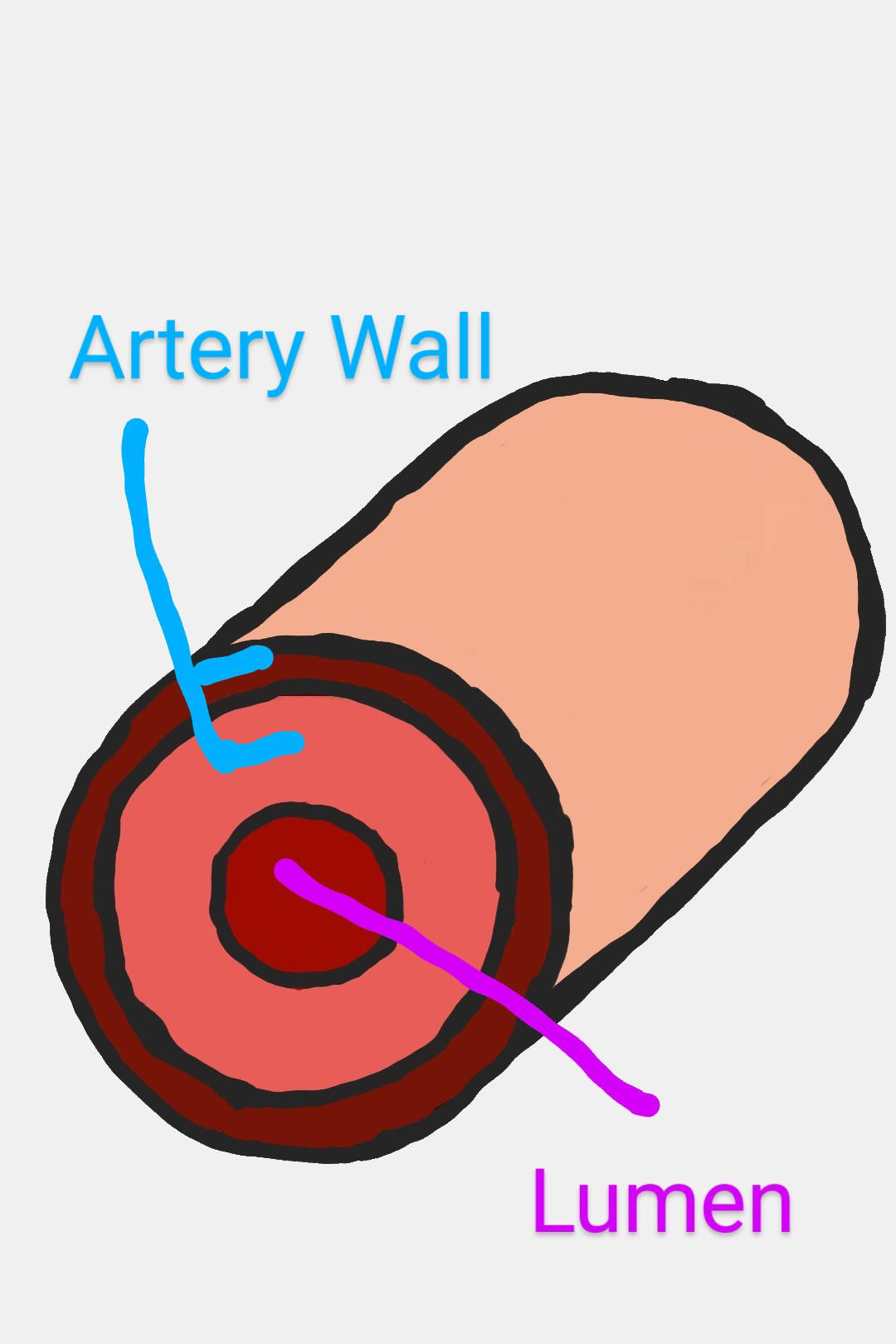
Thicker Walls Containing Muscle & Elastic Fibres to Withstand the High Pressure of Bloods Blowing Through Them.
Narrow Lumen Which Blood Flows.
FUNCTIONS
Carries Blood Away From Heart to the Organs and Tissue of the Body At High Pressure.
10
What are the Properties & Functions of Vein & What do they Have?
PROPERTIES
Relatively Thinner Walls containing Less Muscle and Elastic Fibres compared with Arteries
Wider Lumen than Arteries through which blood flows.
FUNCTIONS
Veins carry blood from the Organs and Tissue of the Body back to Heart Under Lower Pressure than Arteries.
Blood is Under Low Pressure so is Mostly Moving Against Gravity, Veins have Valves in them to Prevent Blood From Flowing Backwards.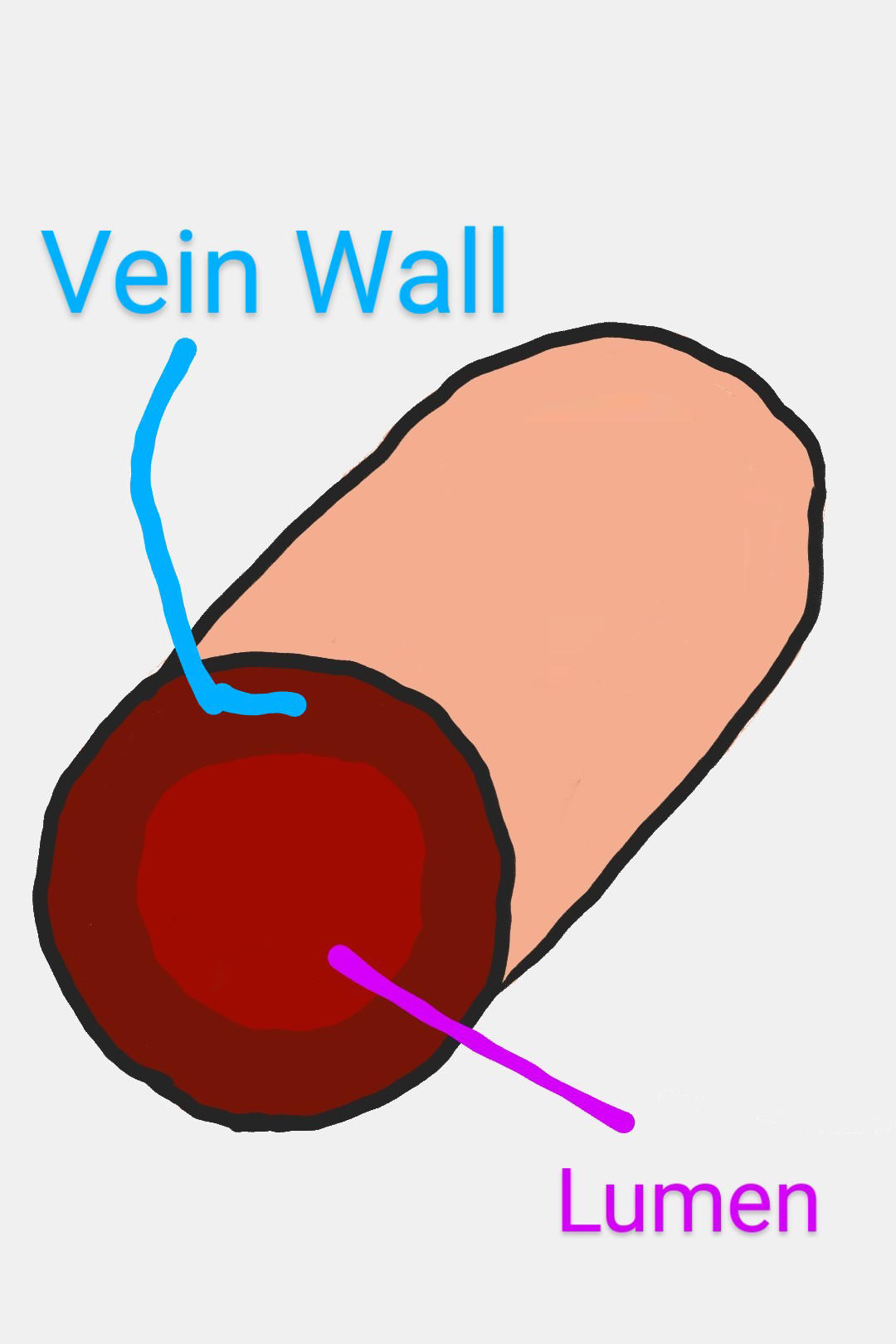
Relatively Thinner Walls containing Less Muscle and Elastic Fibres compared with Arteries
Wider Lumen than Arteries through which blood flows.
FUNCTIONS
Veins carry blood from the Organs and Tissue of the Body back to Heart Under Lower Pressure than Arteries.
Blood is Under Low Pressure so is Mostly Moving Against Gravity, Veins have Valves in them to Prevent Blood From Flowing Backwards.
11
What are the Properties & Functions of Capillary?
PROPERTIES
Walls Only 1 Cell Thick to Let Substances Pass Through Them Easily
Smallest Lumen compared to Arteries & Veins.
FUNCTIONS
Substances Needed By Cells
Carried To Tissue in Arteries & Pass Out of Blood Via Capillaries into Cells.
(such as Glucose & Oxygen)
'Waste' Substances Produced By Cells
Pass Out Of Cells Through Walls of Capillaries into Blood. (such as CO2 and urea)
Waste Products are Eventually Removed From the Blood.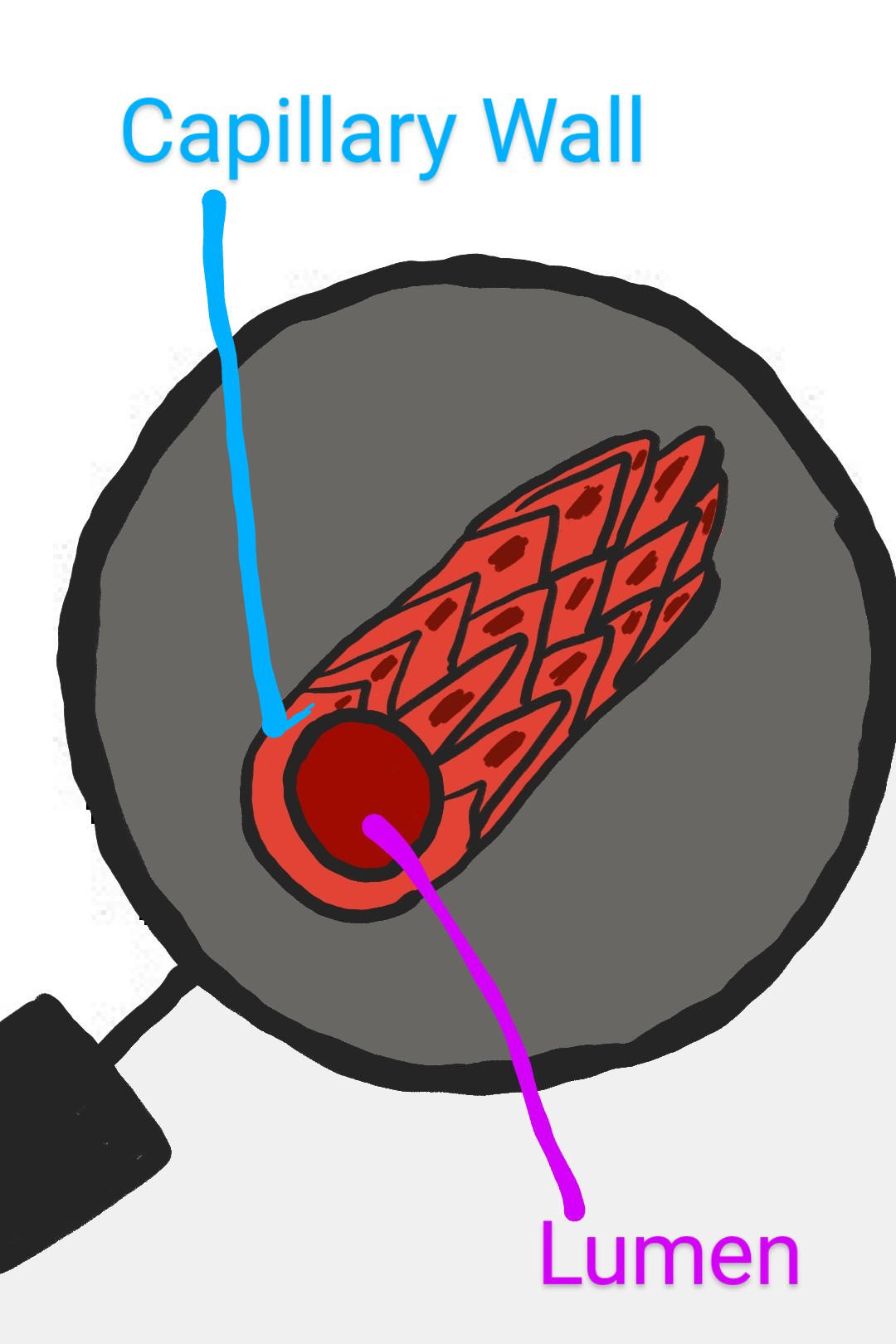
Walls Only 1 Cell Thick to Let Substances Pass Through Them Easily
Smallest Lumen compared to Arteries & Veins.
FUNCTIONS
Substances Needed By Cells
Carried To Tissue in Arteries & Pass Out of Blood Via Capillaries into Cells.
(such as Glucose & Oxygen)
'Waste' Substances Produced By Cells
Pass Out Of Cells Through Walls of Capillaries into Blood. (such as CO2 and urea)
Waste Products are Eventually Removed From the Blood.
12
Define the Heart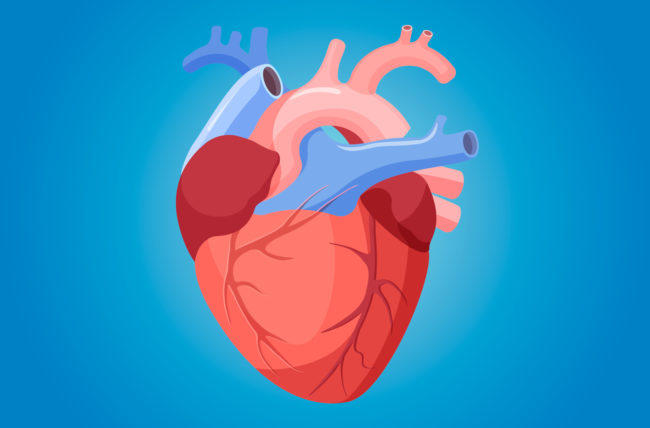
Muscular Organ that Pumps Blood Around the Body. 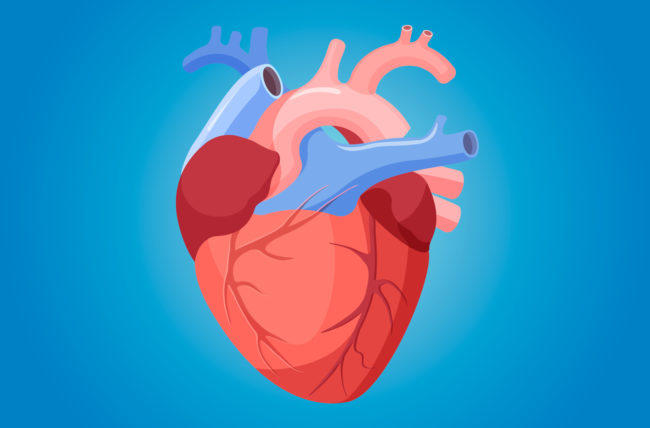
13
How many Chambers does the heart have?
4 Chambers
14
What are the names of the Veins and Arteries on the Heart?
• Vena Cava (Vein)
• Aota (Artery)
• Pullmonary Artery
• Pulmonary Vein
• Aota (Artery)
• Pullmonary Artery
• Pulmonary Vein
15
label the Heart chambers 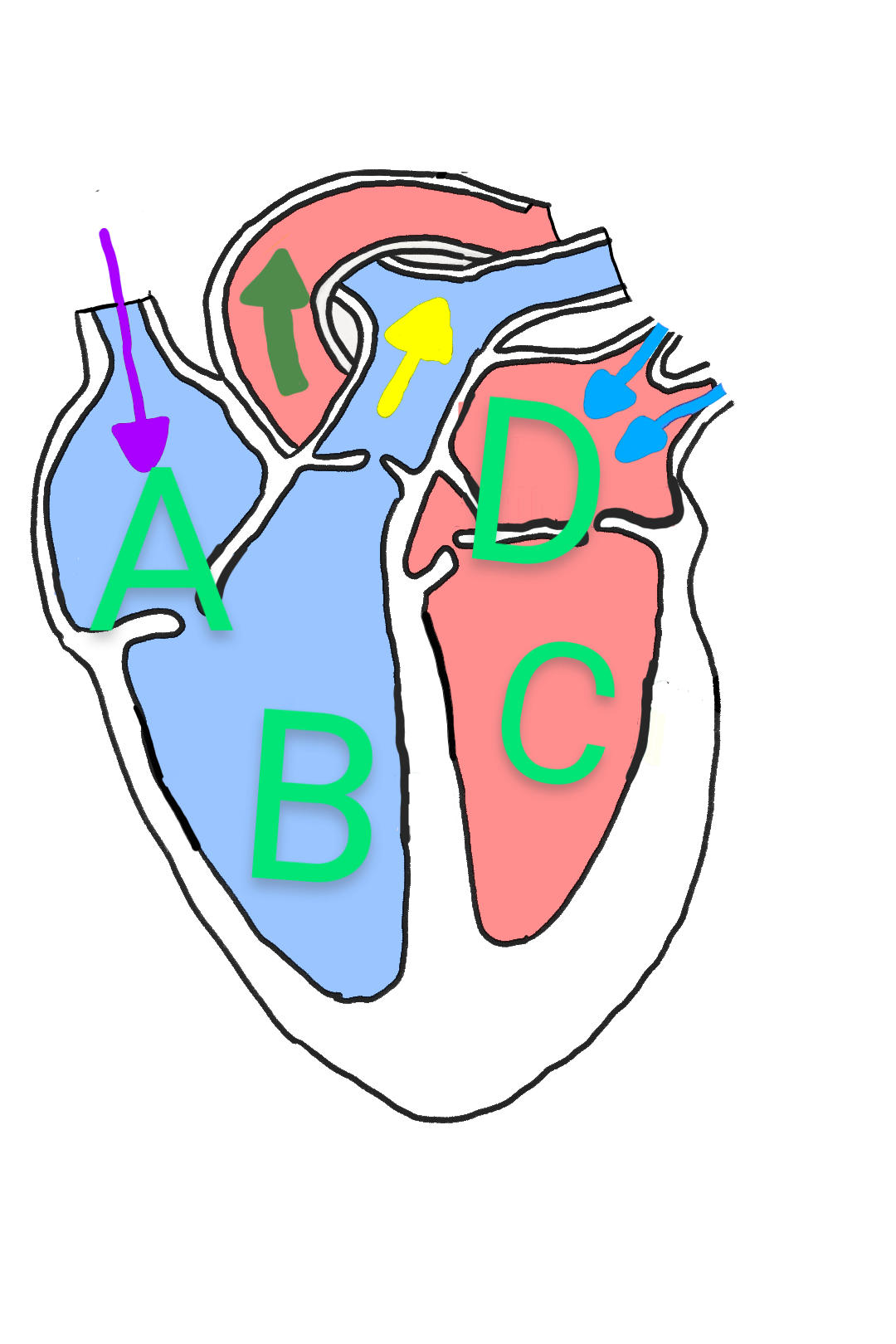
Perspective of Person 1st Person if it Was in them Looking at You.
(so other way around)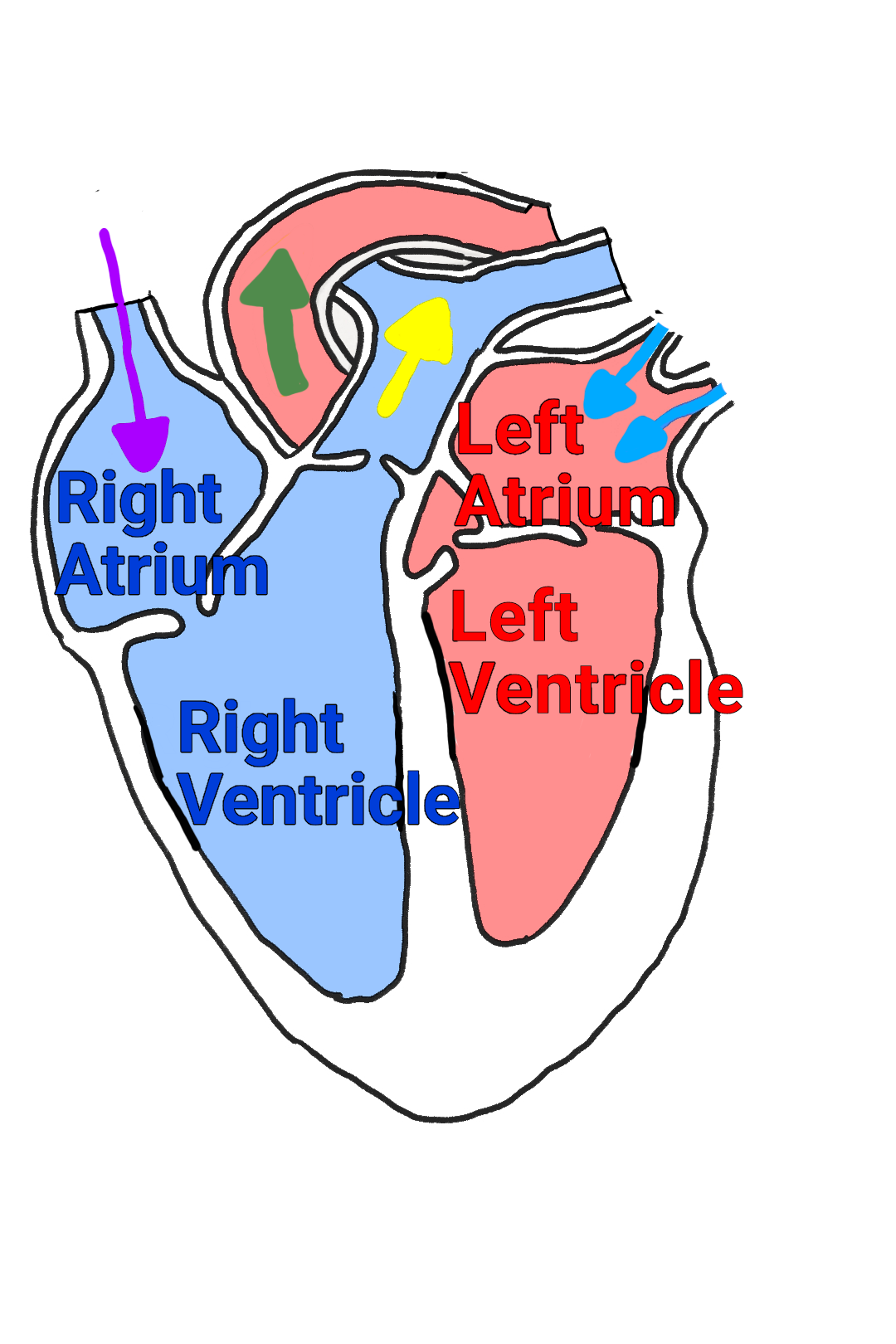
(so other way around)
16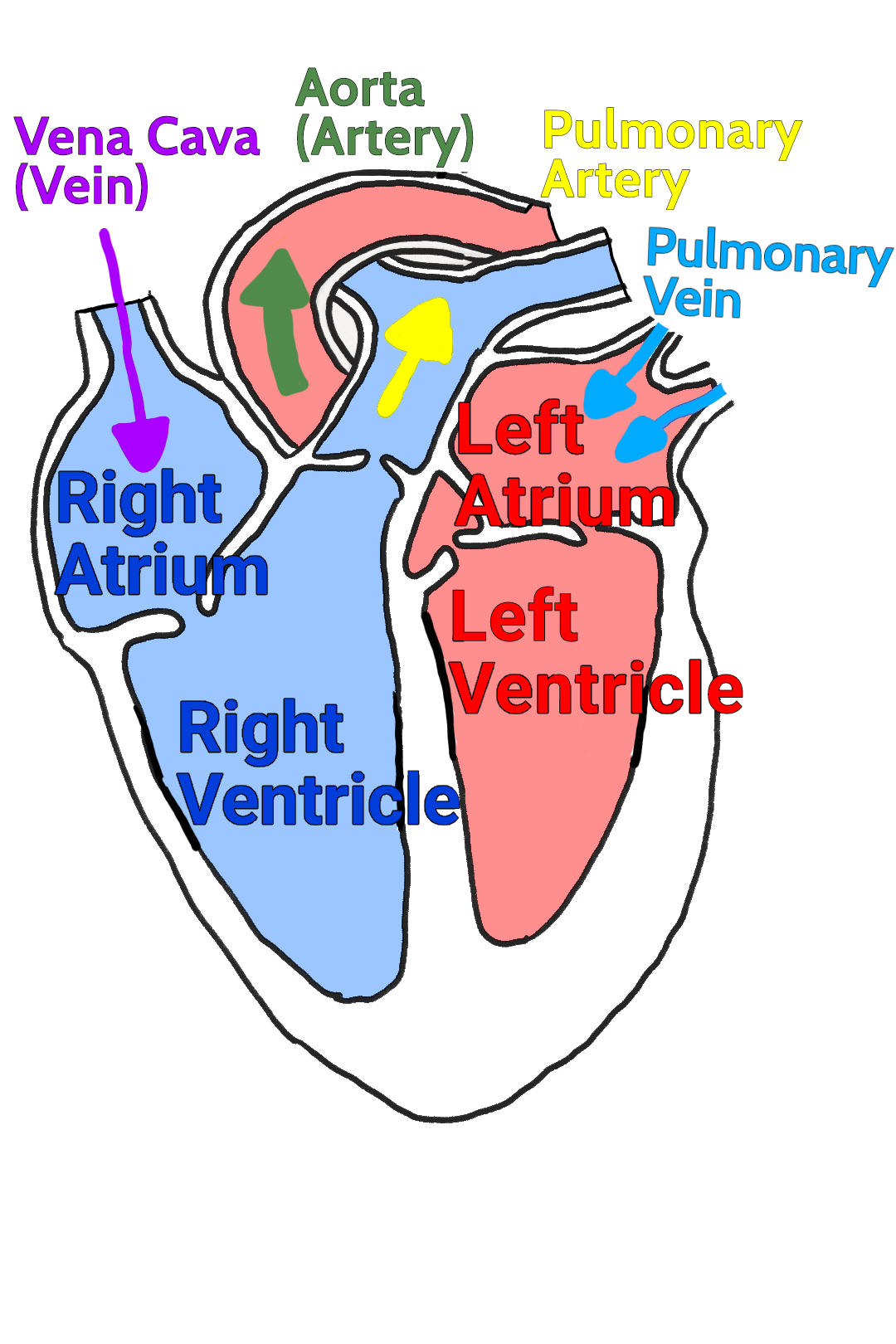
label the Vains and Arteries connecting to the Heart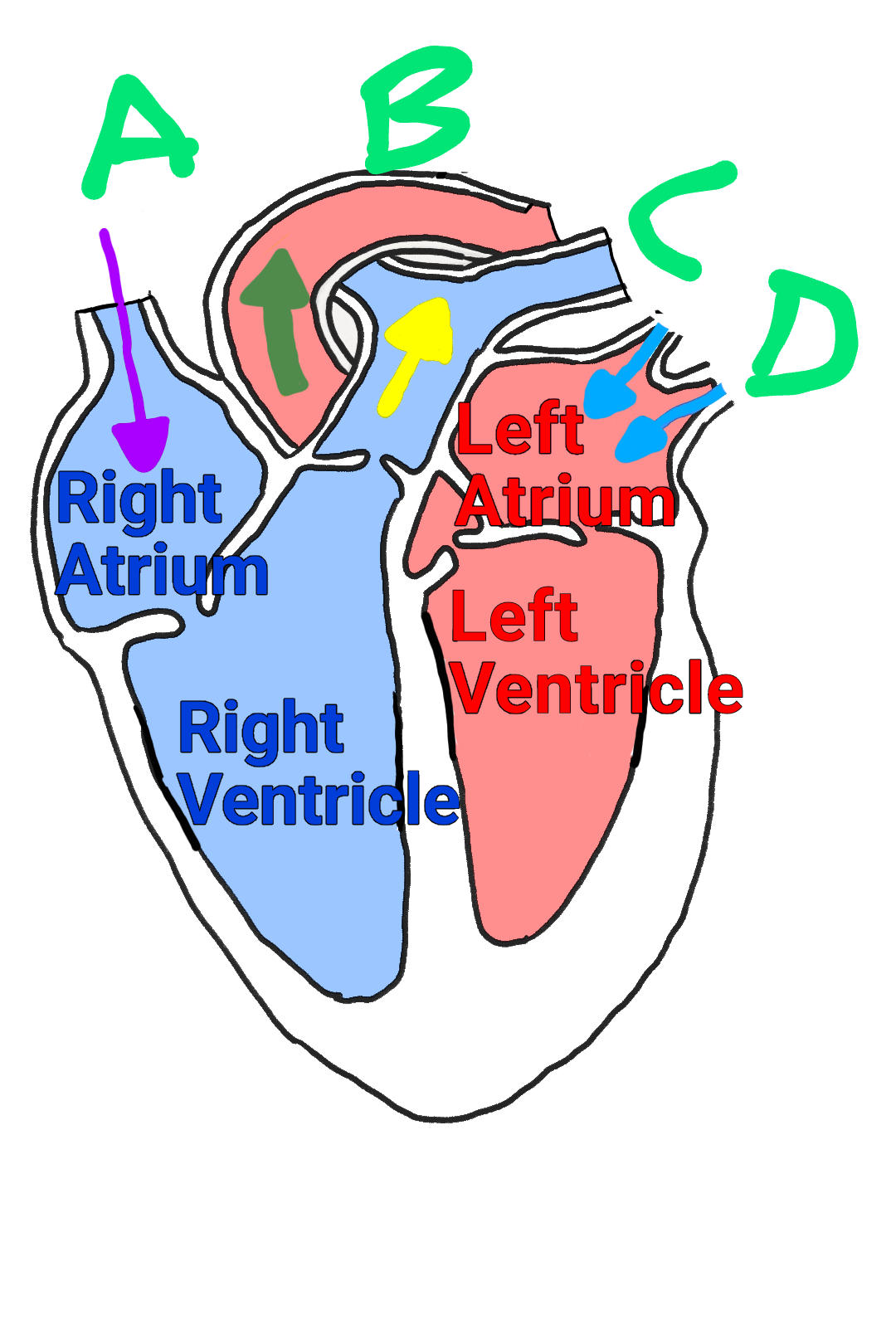
17
where do Veins Pump the Blood?
Pump Blood from the Body to the Heart.
18
where do Arteries Pump the Blood?
Pump Blood Away from the Heart to the Body
19
Where does the Pulmonary Artery Pump Blood to?
To the Lungs 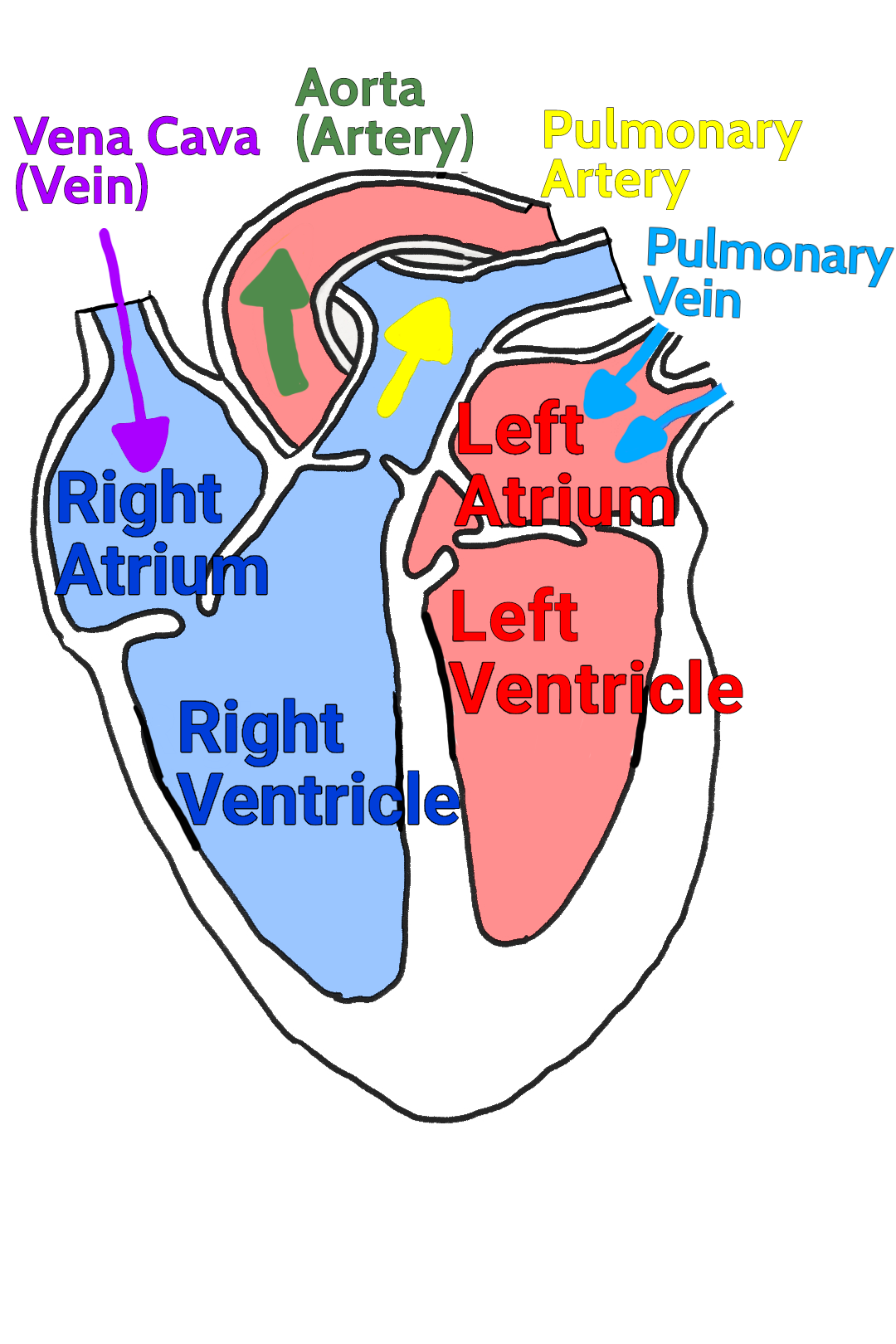
20
Where does the Pulmonary Vein Pump Blood?
From the Lungs 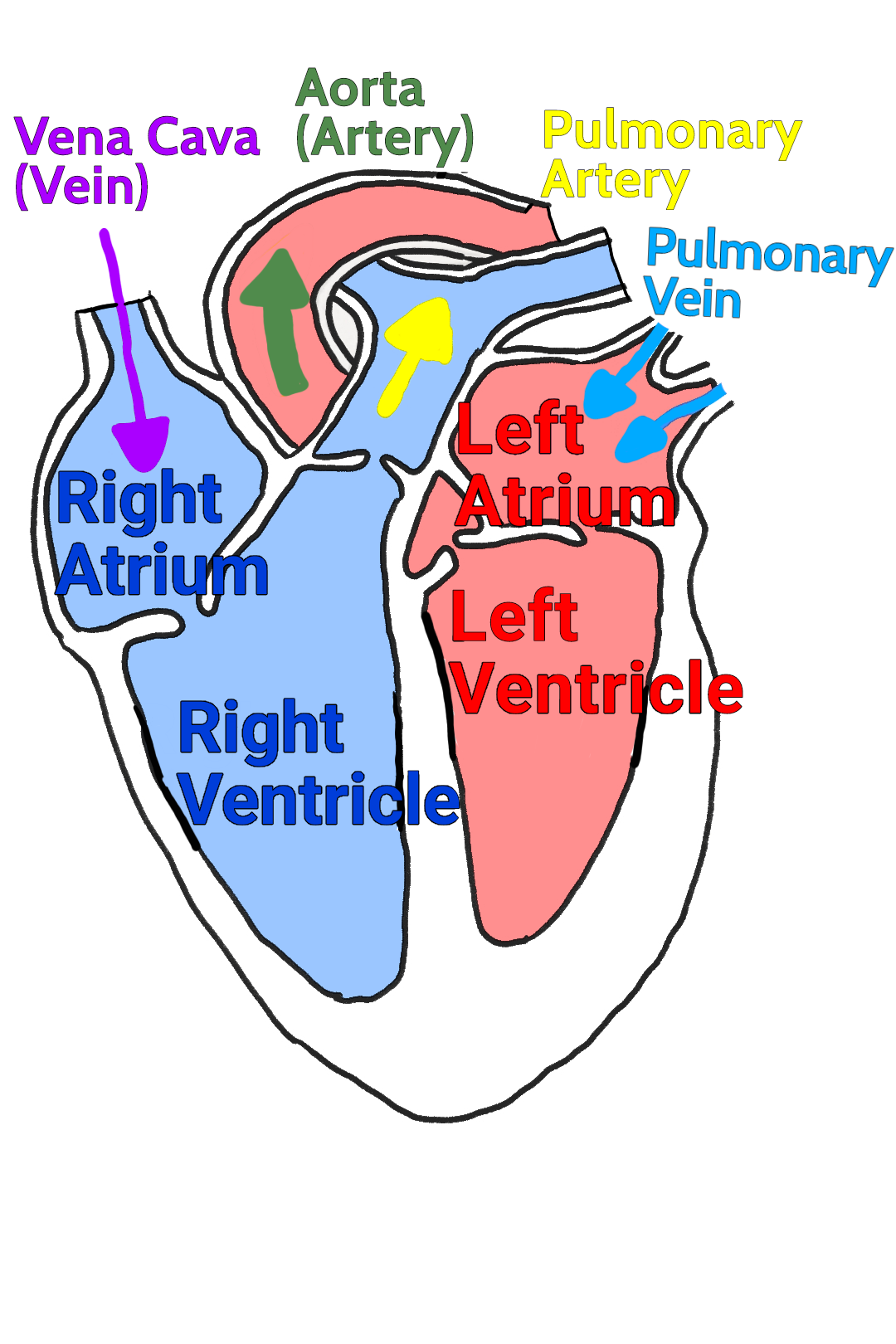
21
Where does the Vena Cava Pump Blood?
From the Body 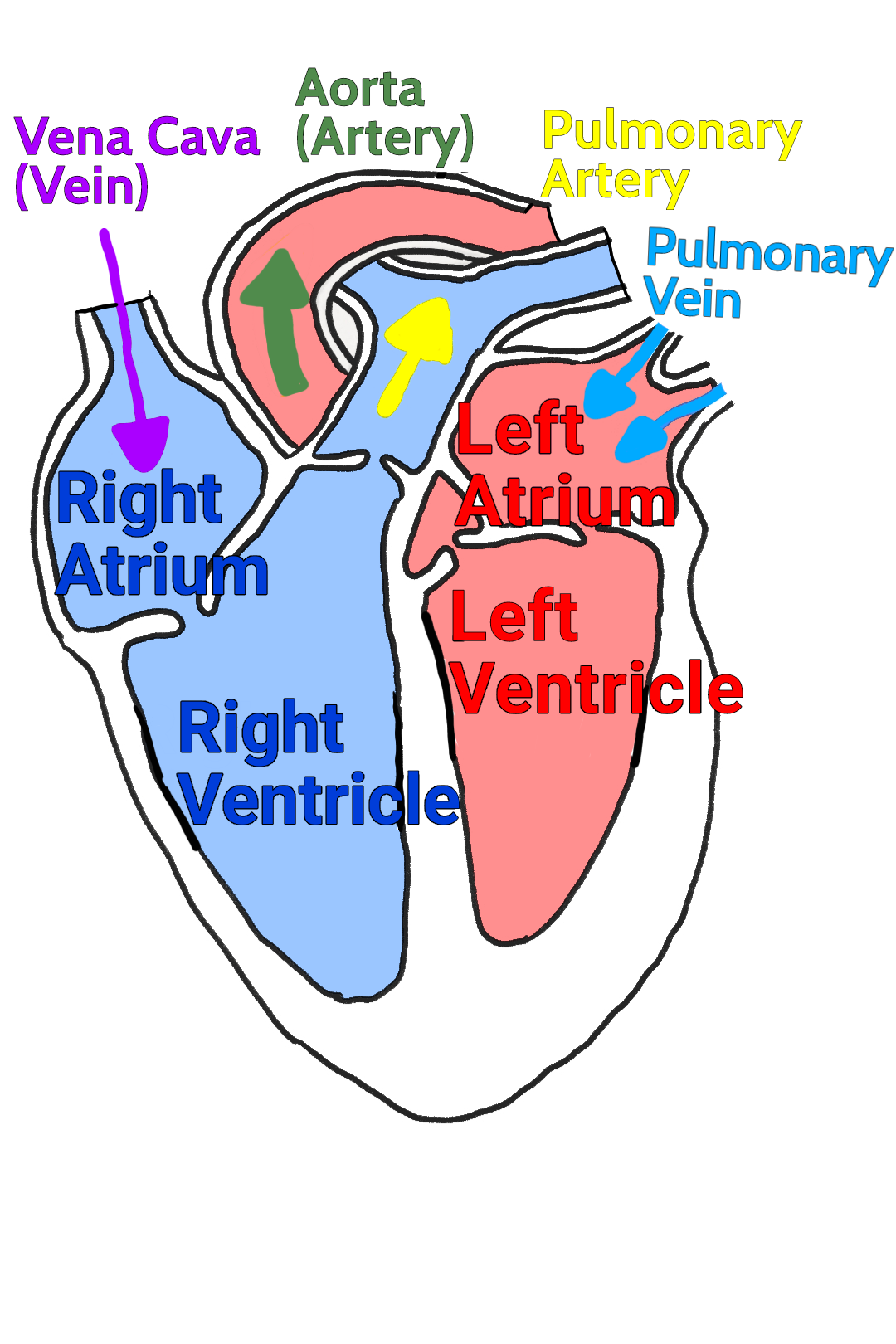
22
Where does the Aorta Pump Blood to?
To the Body 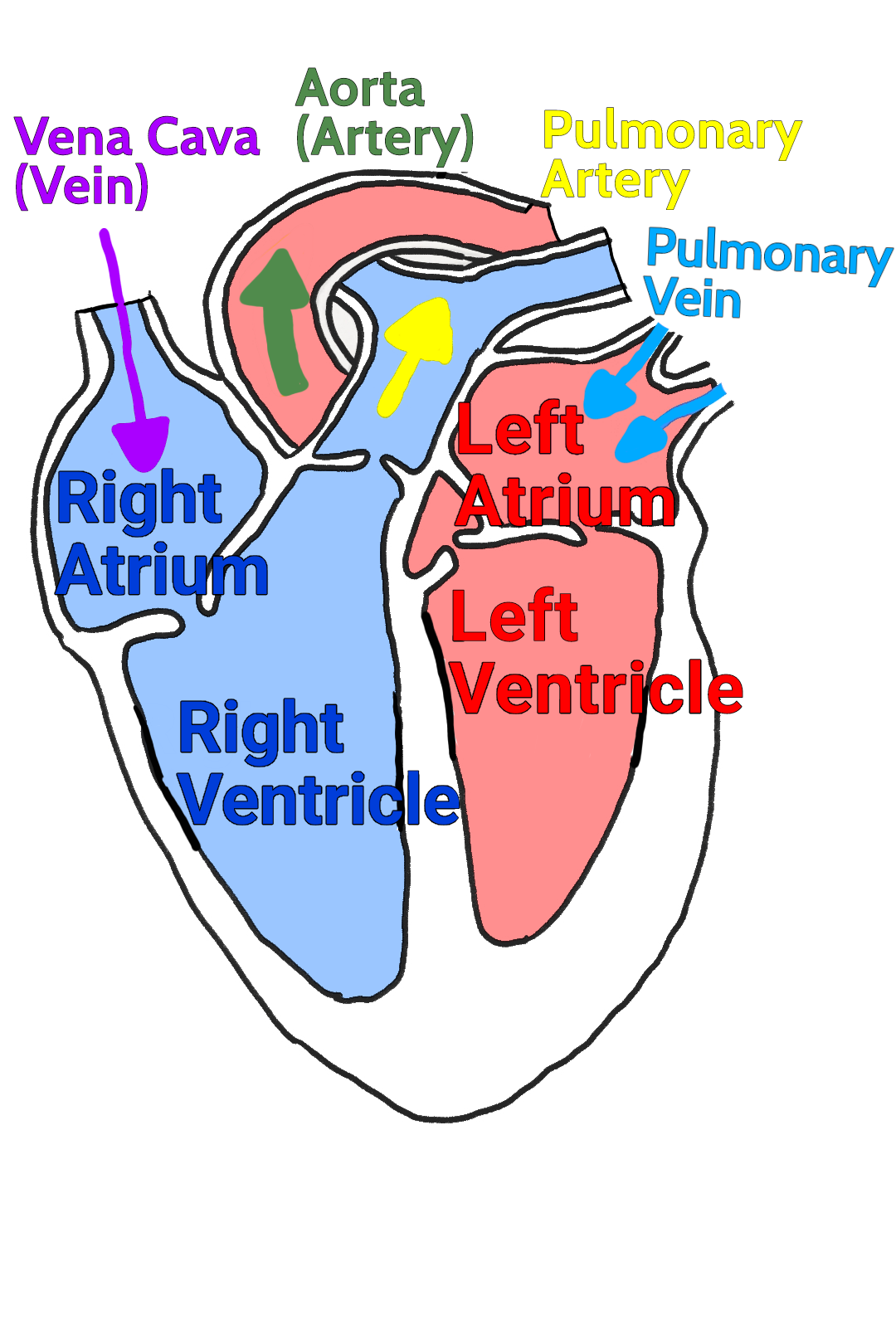
23
Why does the Heart also have Valves & between where?
Valves between Atrium and Ventricle because it is to Stop the Blood Flowing Backwards.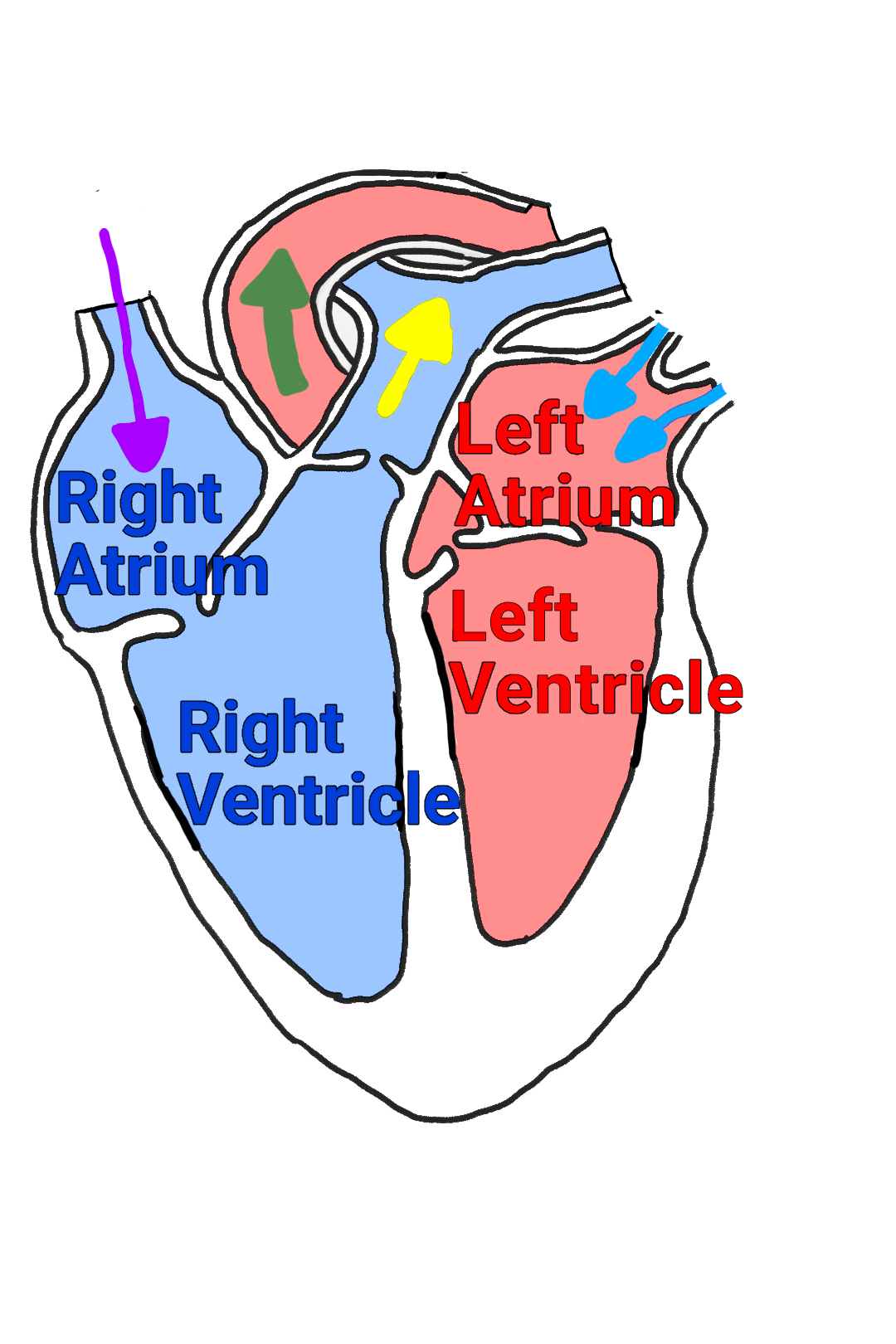
24
Which side of the heart pumps to/from where? 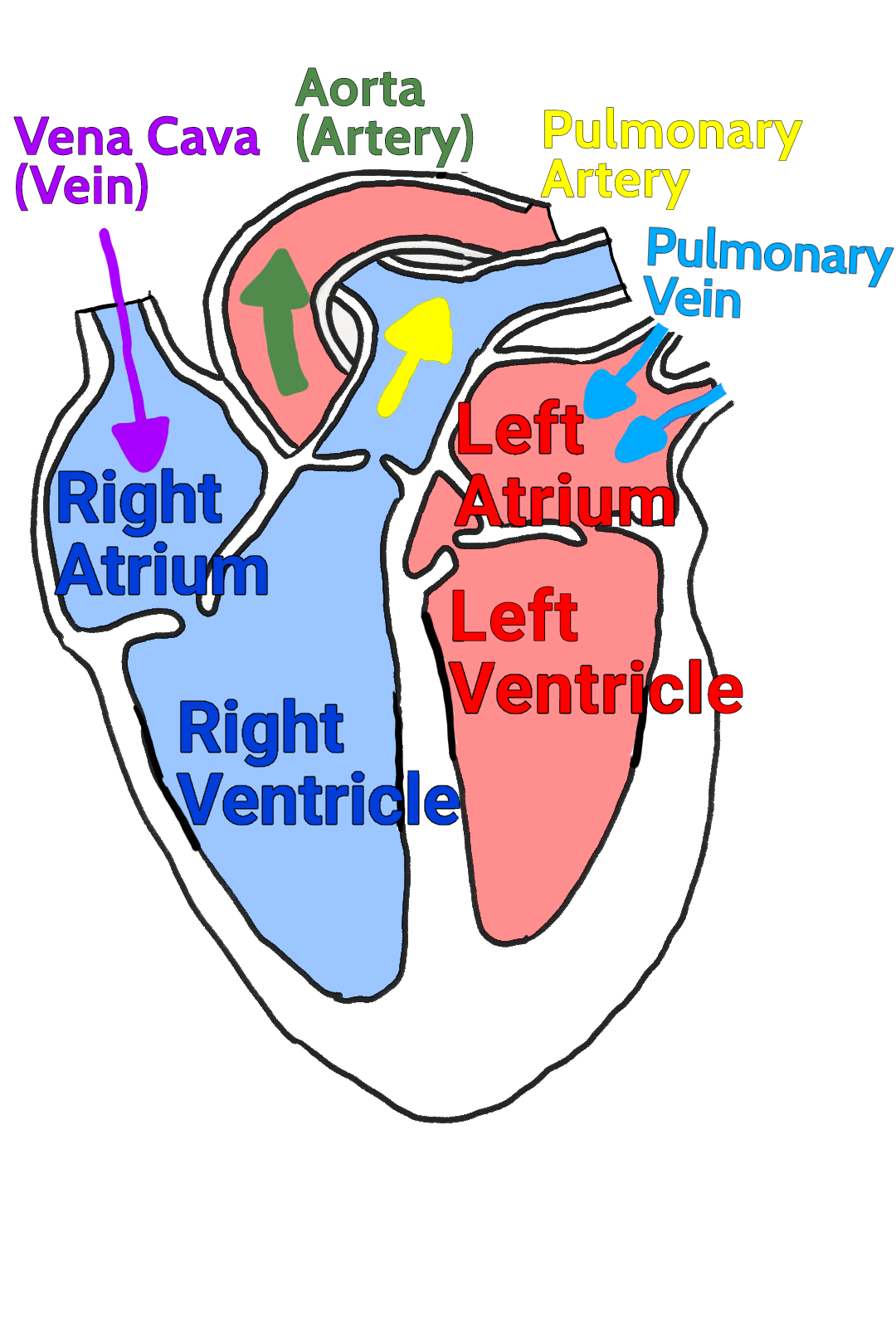
Left to/from Lungs
Right to/from Body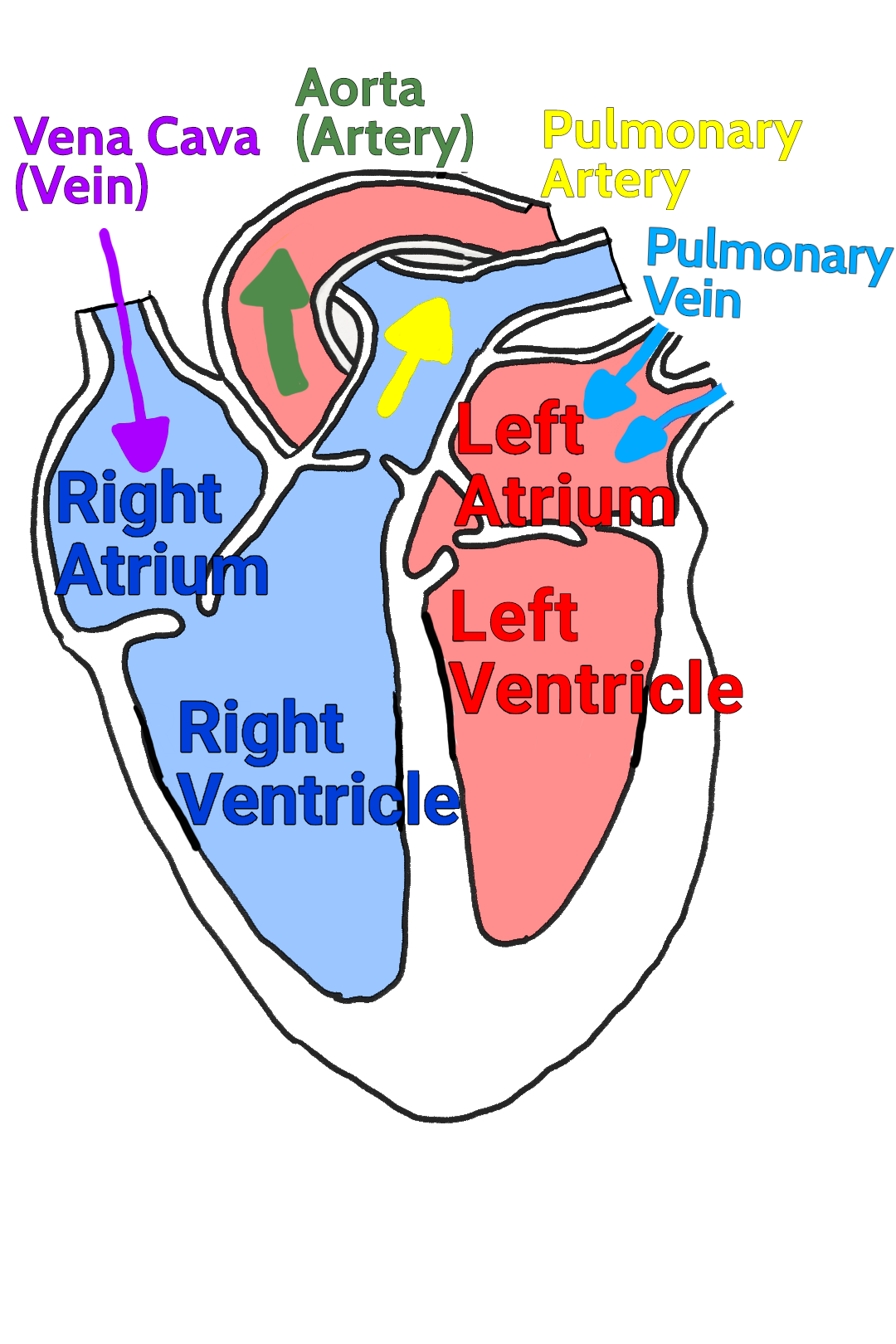
Right to/from Body
25
What is the Human Double Circulatory System?
Blood Enters the Heart Twice Per Circulation.
26
Deoxygenated blood is Blue
Oxygenated blood is Red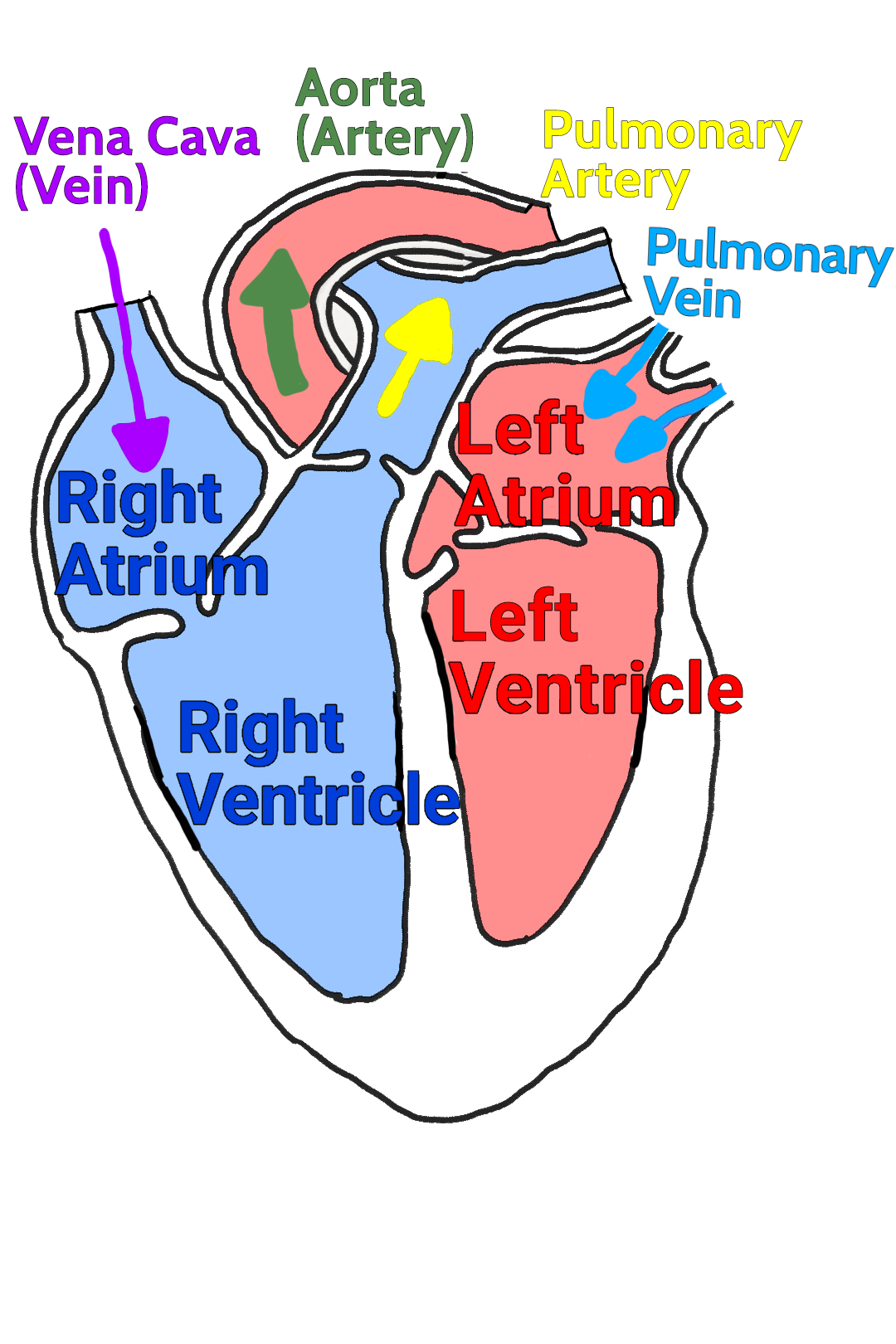
Oxygenated blood is Red
27
Name the Blood Vessels
• Vein
• Capillaries
• Arteries
• Capillaries
• Arteries
28
when does Blood become
De-oxygenated?
De-oxygenated?
Blood becomes De-oxygenated after it has Been Around the Body because of Respiration.
29
where and what is the Natural Resting Heart Rate controlled by?
The Natural Resting Heart Rate is Controlled by a Group of Cells Located in the Right Atrium that Act as a Pacemaker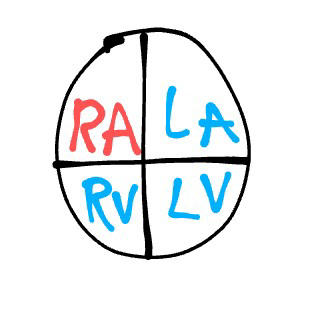
30
What are Artificial Pacemakers & used for ?
Electrical Devices used to Correct irregularities in the Heart Rate. 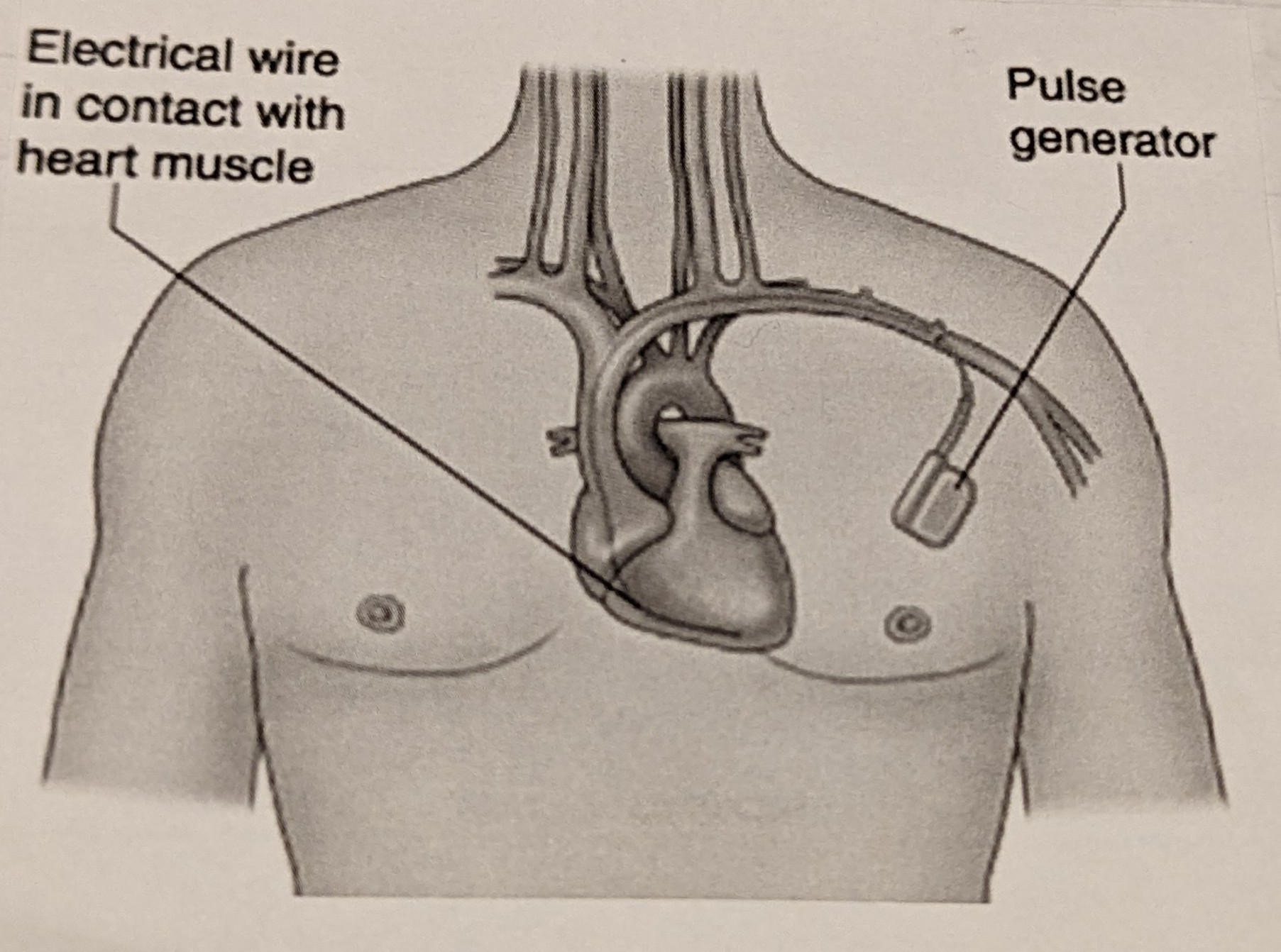
31
why do people need New Heart Valves?
• Valves Don't Open Fully
• Valves Develop Leak
• Valves Develop Leak
32
What can Faulty Heart Valves be replaced with?
Mechanical or Biological Valve 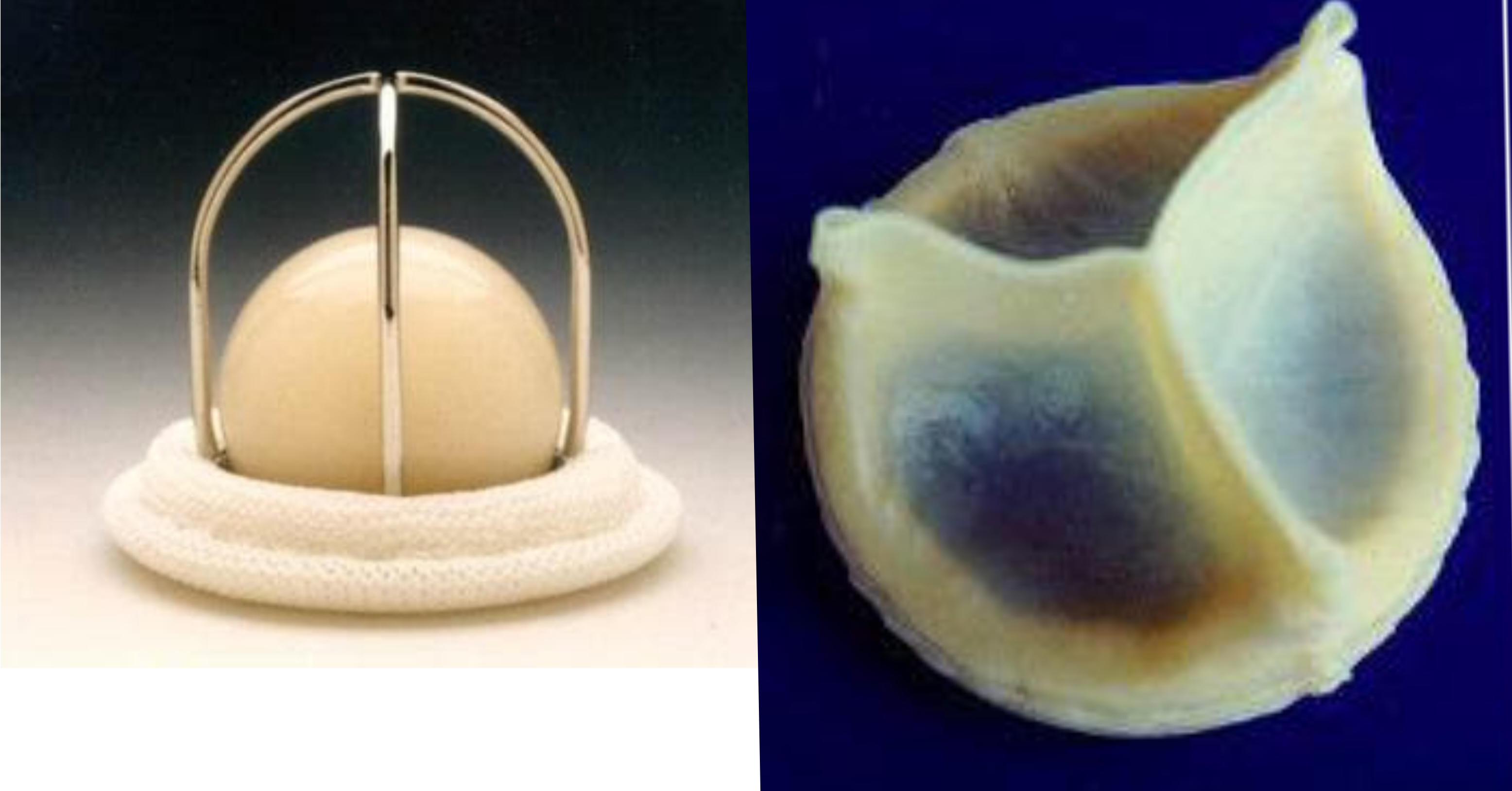
33
What are the pros and cons for Mechanical Valve?
PROS
• Made of Plastic or Metal (No religious or ethical objections)
• Widely Available (no waiting time)
• Last Many Years & May Not be Replaced
• Good Survival Rate After Operation
(almost 94%)
• Very Low Chance Of Valve being Rejected By Body
CONS
• Some patients can Hear Valve Opening & Closing
• Can Cause Blood Clots Around the Valve (medication must be taken for life)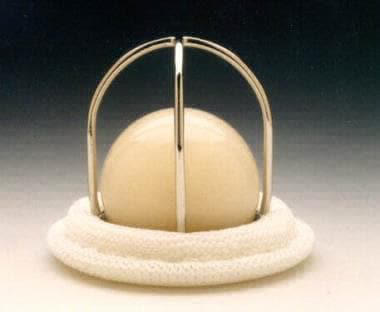
• Made of Plastic or Metal (No religious or ethical objections)
• Widely Available (no waiting time)
• Last Many Years & May Not be Replaced
• Good Survival Rate After Operation
(almost 94%)
• Very Low Chance Of Valve being Rejected By Body
CONS
• Some patients can Hear Valve Opening & Closing
• Can Cause Blood Clots Around the Valve (medication must be taken for life)
34
What are the pros and cons for Biological Valve?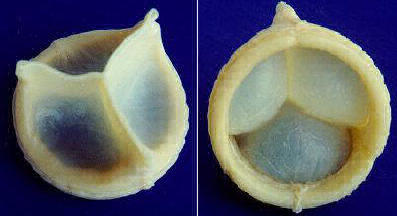
PROS
• Widely Available (no waiting time)
• Valve Opens & Closes Silently
• Very Low Risk of Blood Clots Forming
• Good Survival Rate After Operation (over 90%)
CONS
• Made From Animal Tissueso Religious or Ethical Objections (from cow or pig so may be)
• May need Further Operation to Replace Valve in a Few Years
• Valve may be Rejected By Body (medication maybe needed for life to prevent this)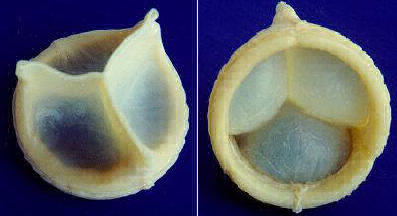
• Widely Available (no waiting time)
• Valve Opens & Closes Silently
• Very Low Risk of Blood Clots Forming
• Good Survival Rate After Operation (over 90%)
CONS
• Made From Animal Tissueso Religious or Ethical Objections (from cow or pig so may be)
• May need Further Operation to Replace Valve in a Few Years
• Valve may be Rejected By Body (medication maybe needed for life to prevent this)
35
what is Coronary Heart Disease?
Layers of Fatty Material Build Up inside the Coronary Arteries, Narrowing Them. 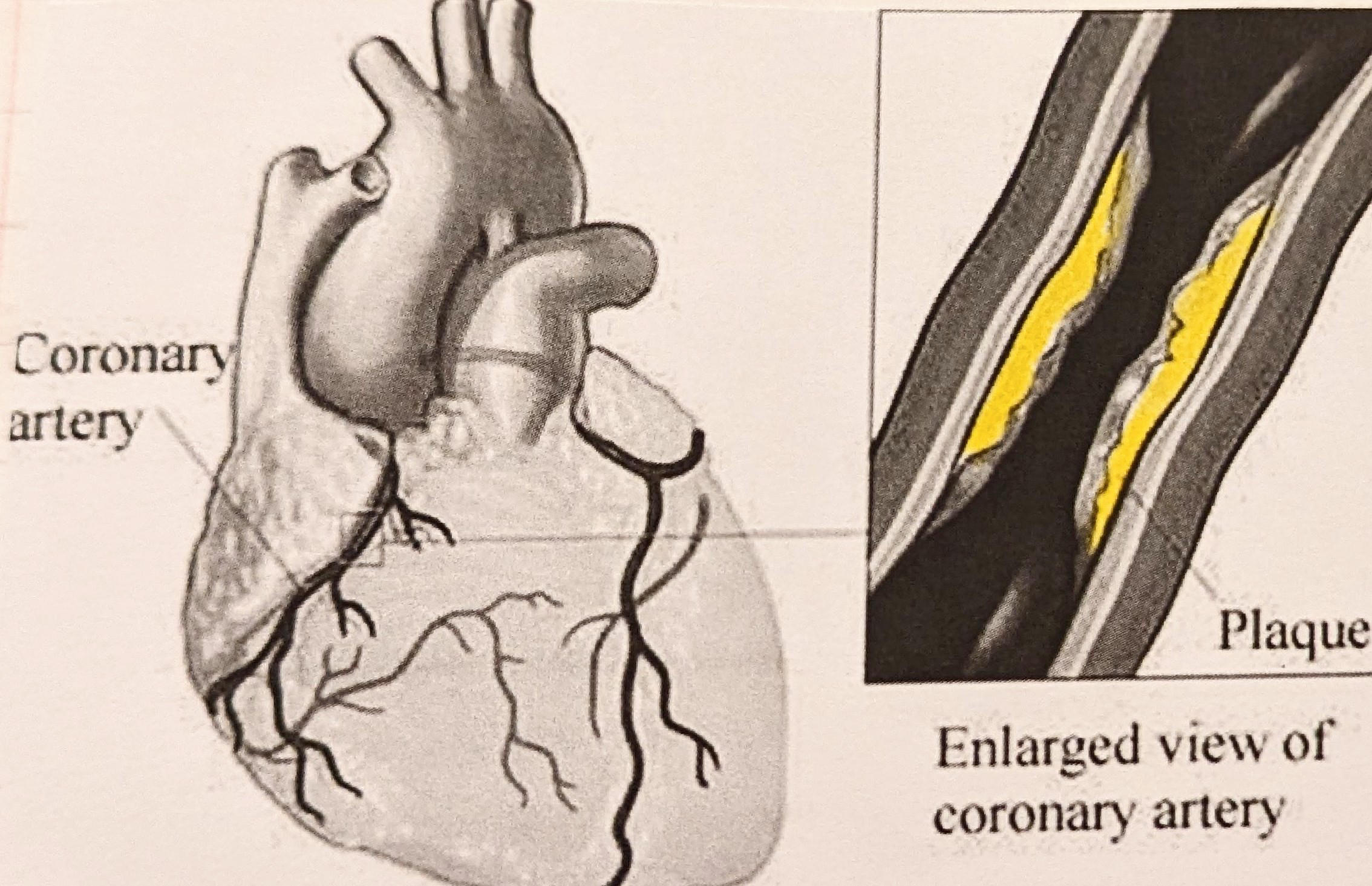
36
What Medicine/Drug can be used to help Coronary Heart Disease, what do they do & Reduce?
Statins can Help To Reduce Levels of Cholesterol a Type Of Fat In the Blood.
Statins therefore Reduce the Risk Of Heart Disease.
Statins therefore Reduce the Risk Of Heart Disease.
37
What is the Treatment for Coronary Heart Disease?
Stents can be Used to Keep the Coronary Arteries Open and the Blood Flowing.
38
How does the Stent Treatment work?
Insert Wire Mesh/Stent Through the Blood Vessels Of the Patient These Get inserted Along with a Balloon.
When inflated it Pushes Against the Wire Mesh/Stent Widening it.
That Widens the Artery & Squashes the Fatty Deposits.
The Balloon then Gets Deflated and Removed From Body.
Wire Mesh Stays Extended and Keeps That Blood Vessel Open To Allow Blood To Flow.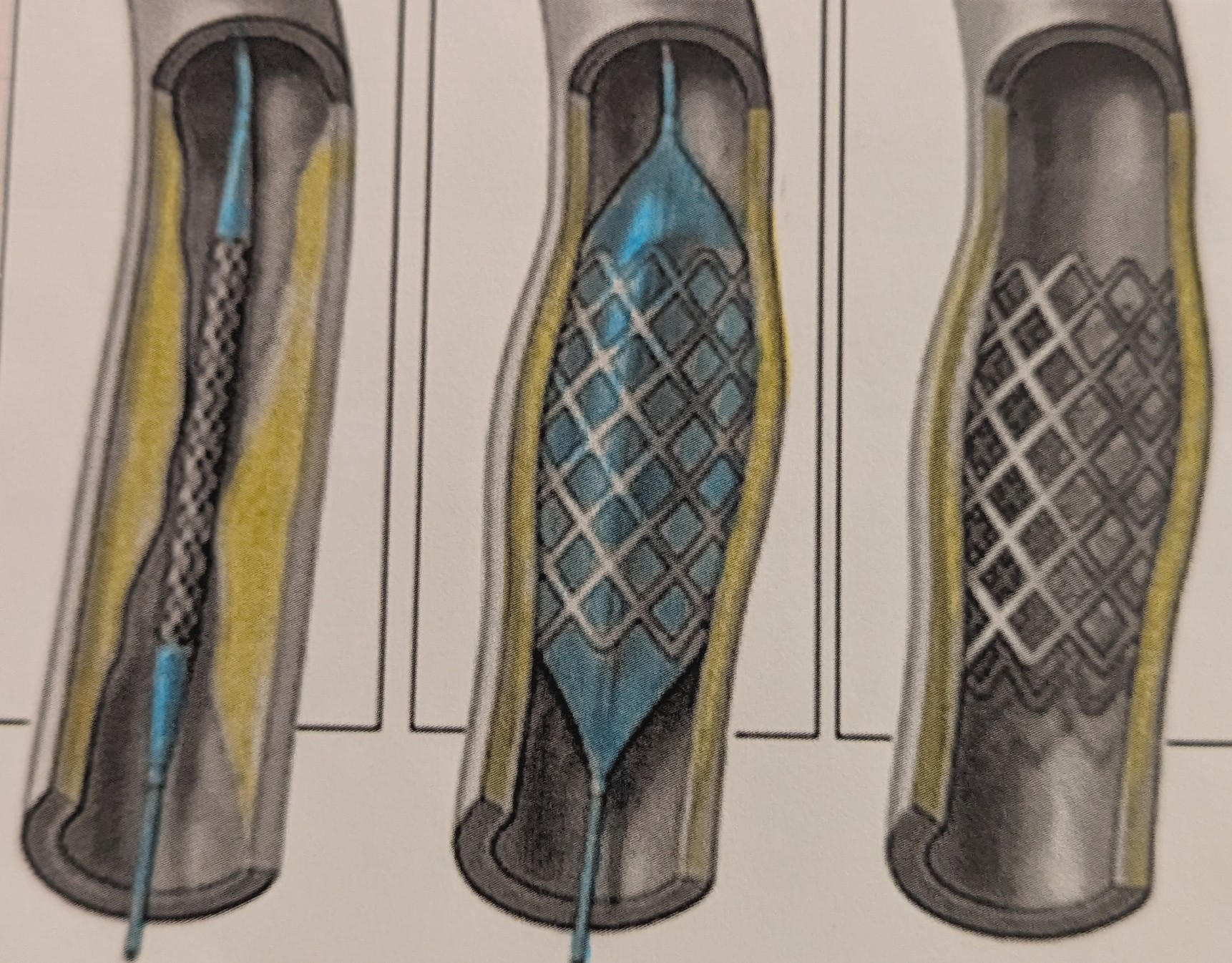
When inflated it Pushes Against the Wire Mesh/Stent Widening it.
That Widens the Artery & Squashes the Fatty Deposits.
The Balloon then Gets Deflated and Removed From Body.
Wire Mesh Stays Extended and Keeps That Blood Vessel Open To Allow Blood To Flow.
39
What type of Disease is the Coronary Heart Disease?
Cardiovascular diseases
40
Explain Why the Stent helps to prevent a Heart Attack?
Stents keep the Coronary Artery open and the Blood Flowing.
Therefore, Oxygen and Glucose can be Supplied to the Heart Muscle allowing it Respire and Release Energy To Contract.
Therefore, Oxygen and Glucose can be Supplied to the Heart Muscle allowing it Respire and Release Energy To Contract.
41
What can a person do if they suffer from Heart Failure?
Donor Heart or Heart Lung can be Transplanted.
42
Why are Artificial Hearts used?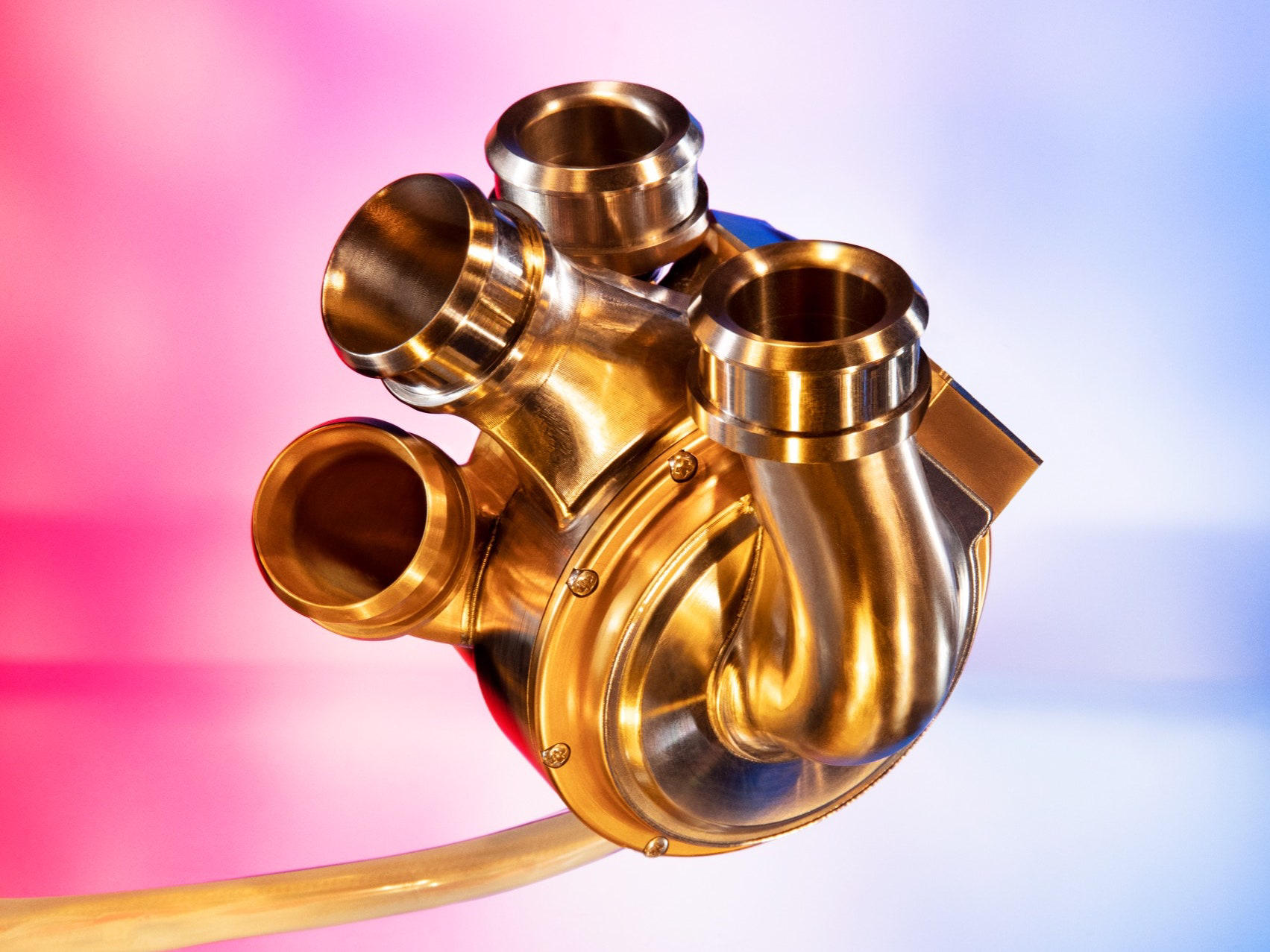
To Keep Patients Alive While Waiting for a Transplant or to Allow the Heart to Rest to Help To Recover.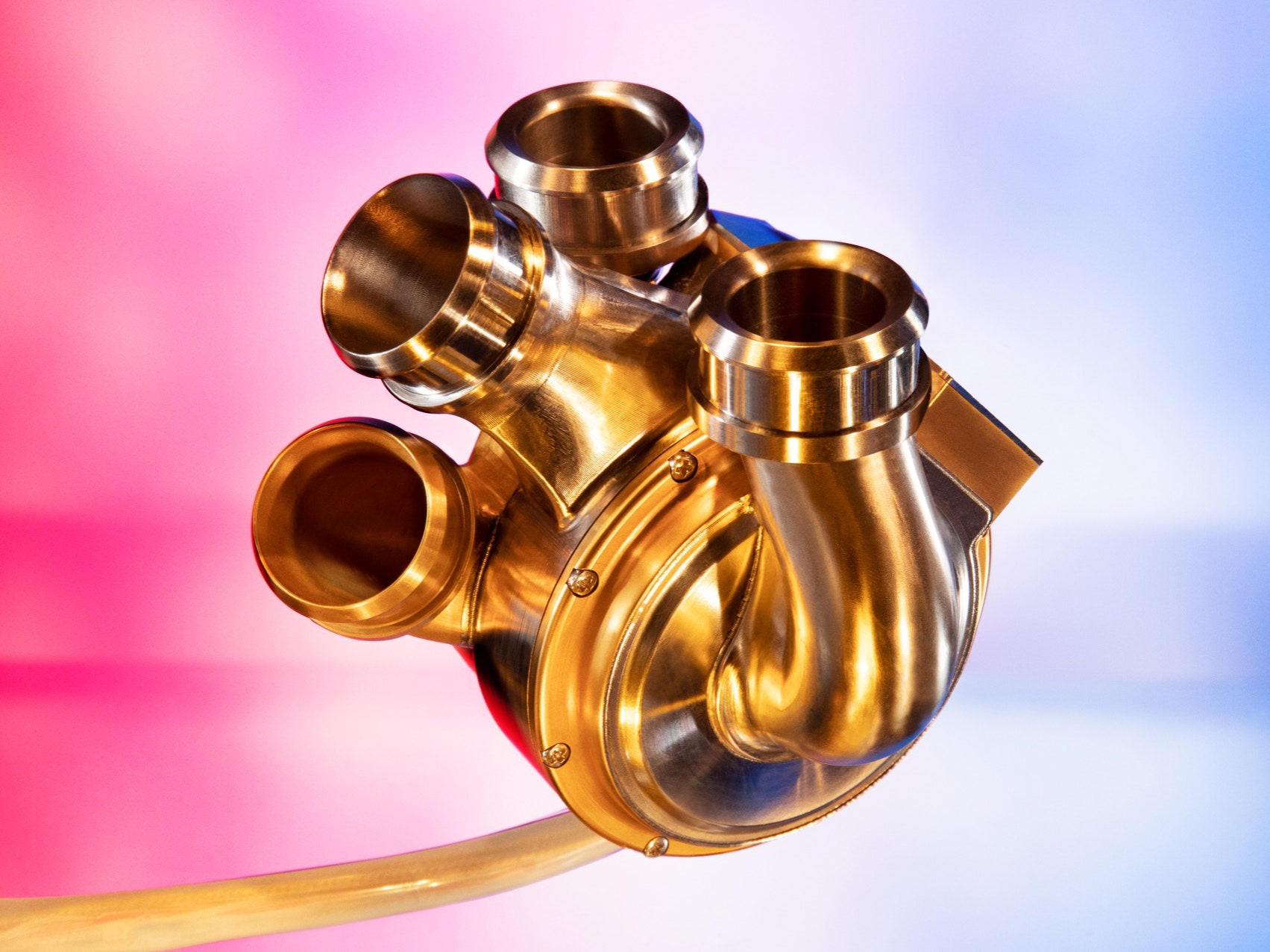
43
What are the Pros and Cons for a Heart Transplant? 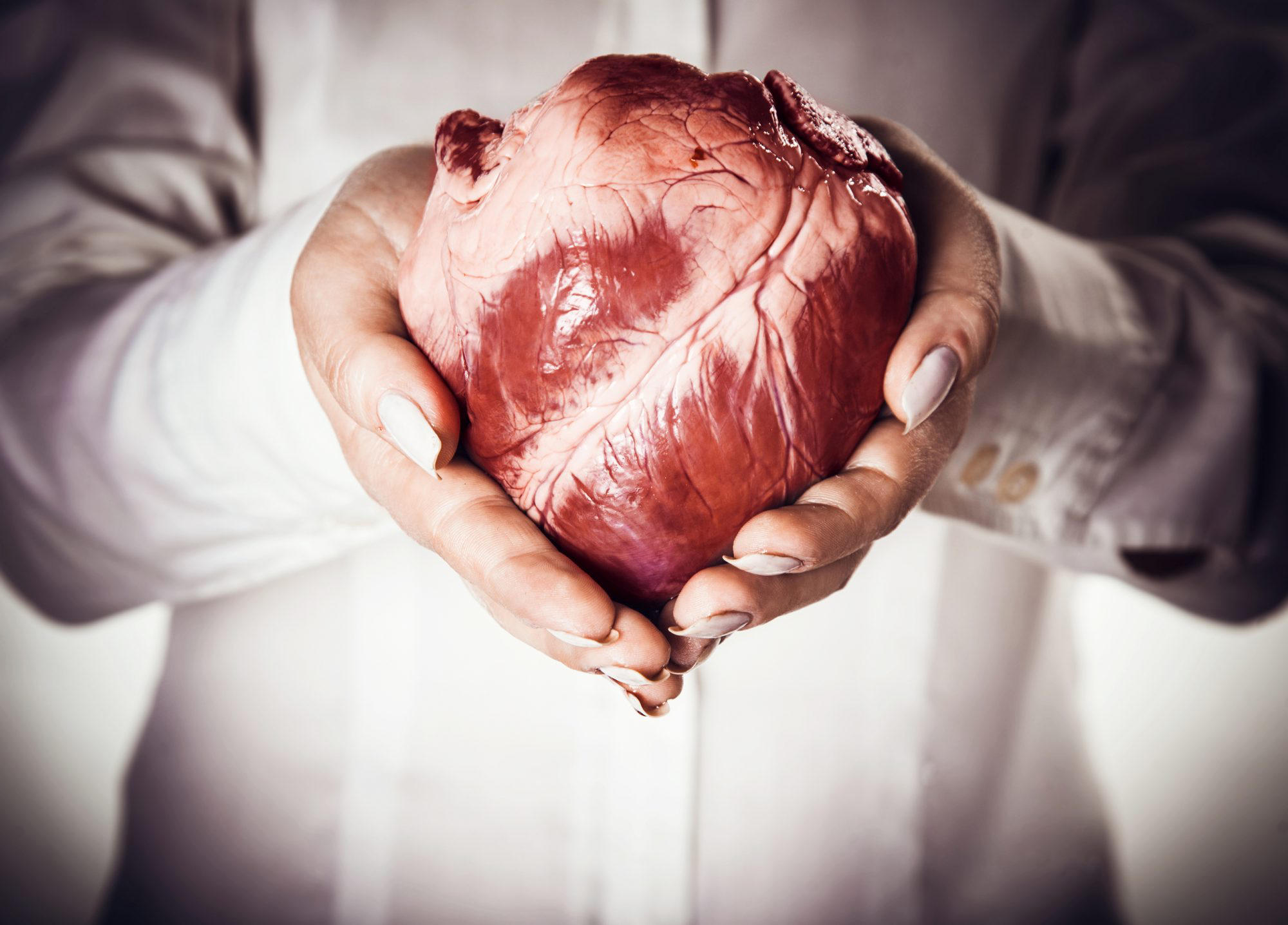
Pros
• Extends Lifespan- 'permanent' solution
• Can lead a More Normal Life.
Cons
• Risks of Operation
• Shortage of Donors
• Risk of Rejection- Immunosuppressive Drugs Needed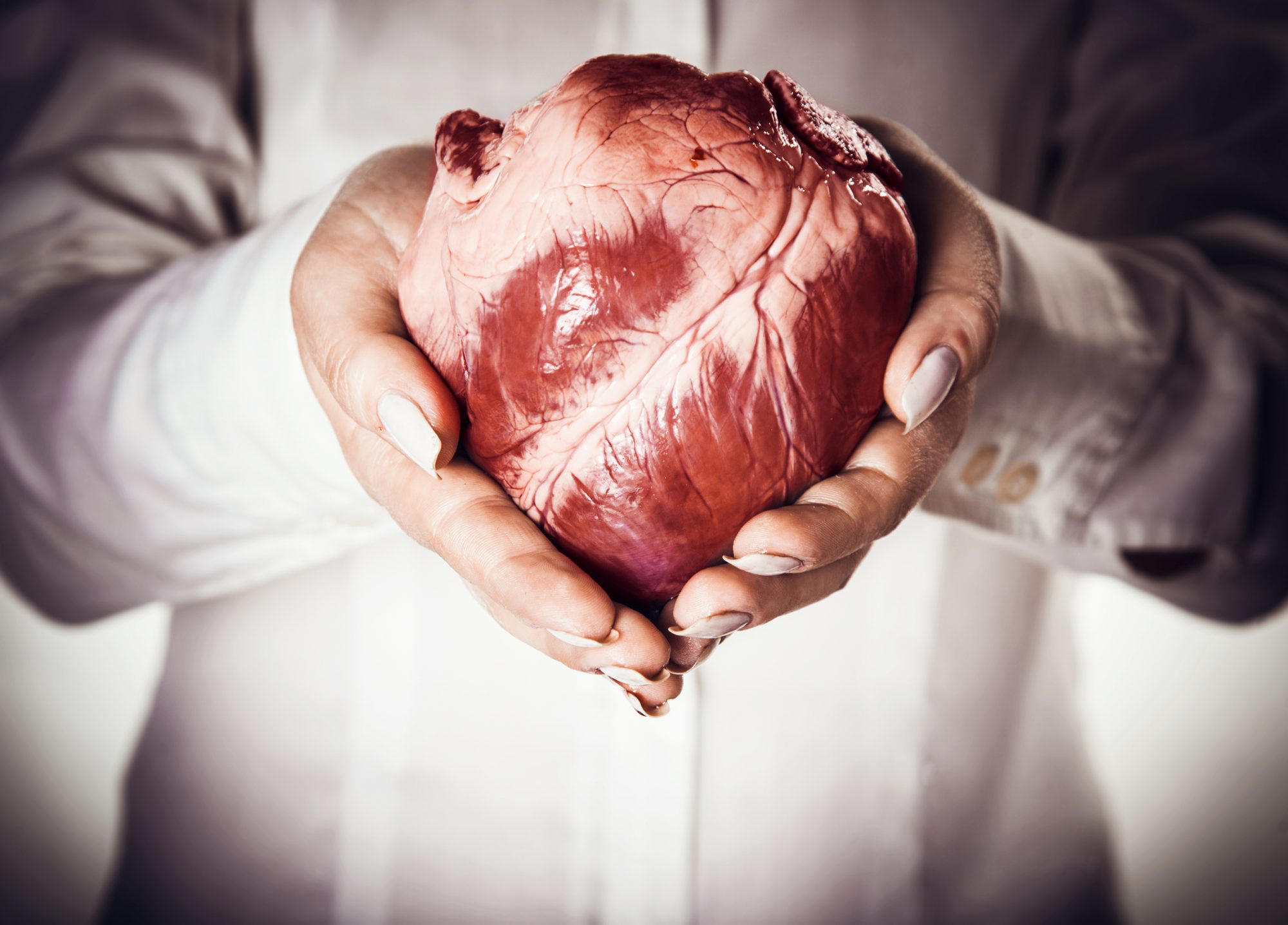
• Extends Lifespan- 'permanent' solution
• Can lead a More Normal Life.
Cons
• Risks of Operation
• Shortage of Donors
• Risk of Rejection- Immunosuppressive Drugs Needed
44
What are the Pros and Cons for an Artificial Heart? 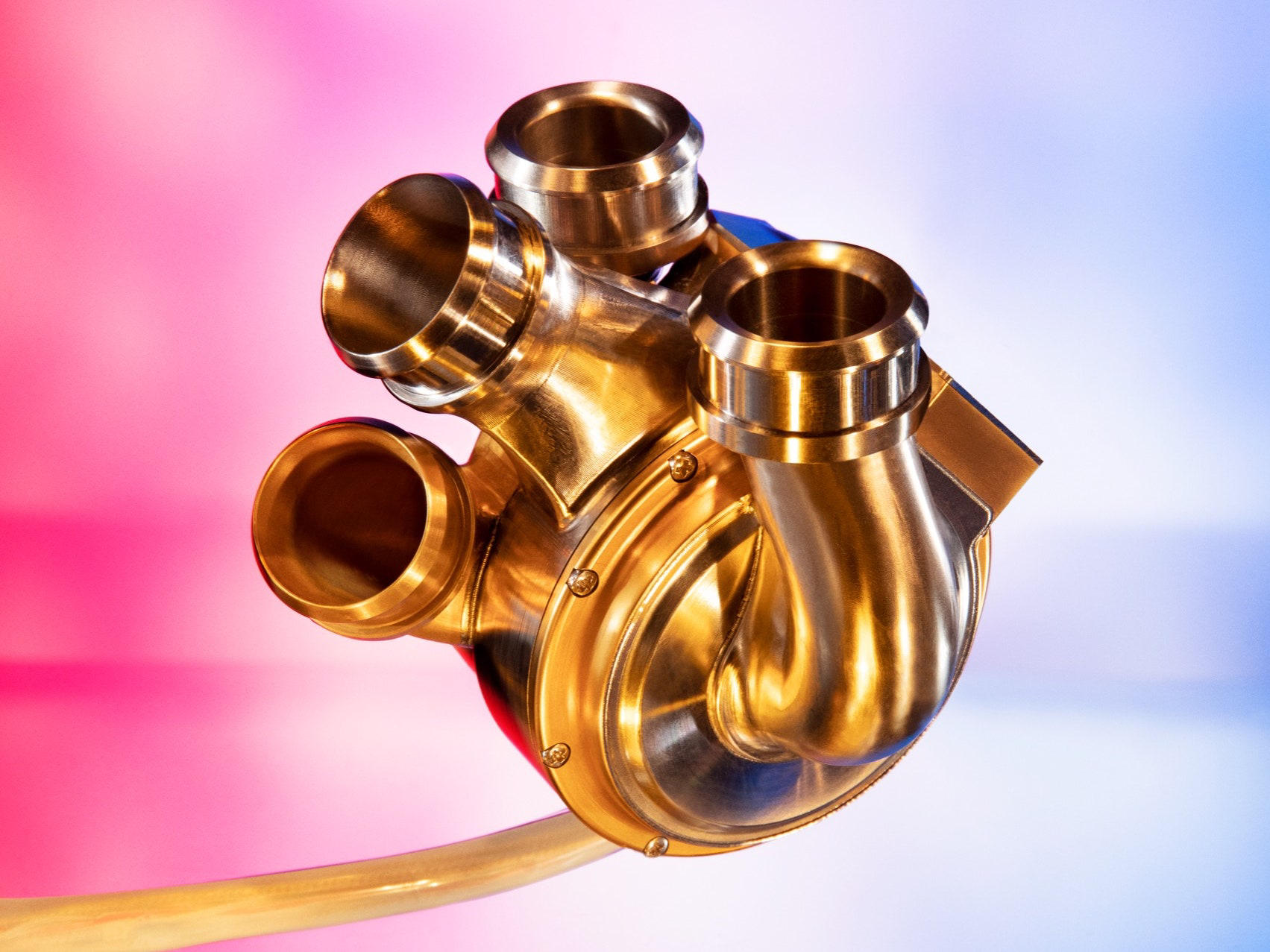
Pros
• Extends lifespan
• Don't need to wait for a donor
Cons
• Risk of Infection or Blood Clots/Stroke
• Device has Limited Lifespan/Battery Needs Changing
• Discomfort from Heart/Battery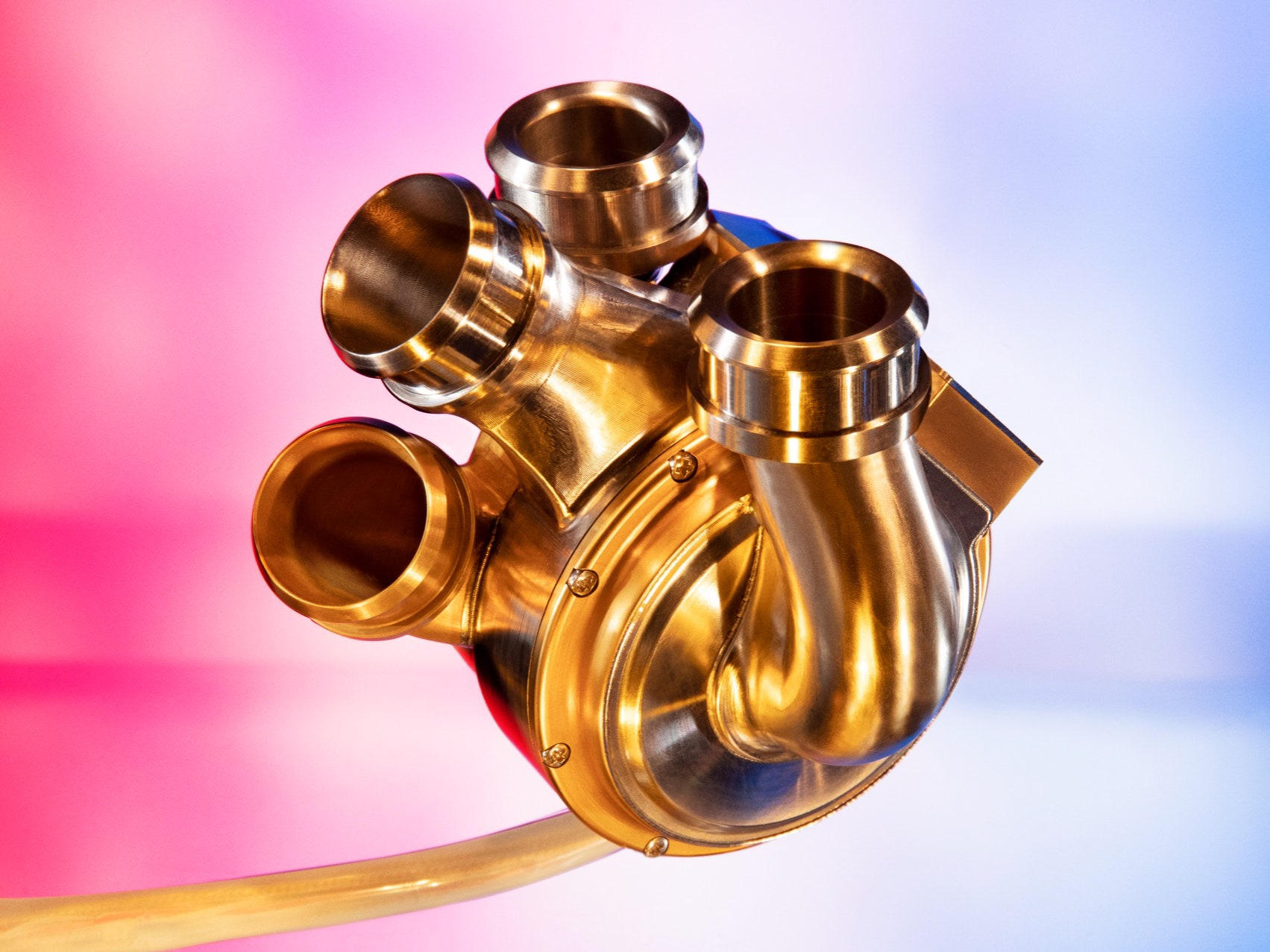
• Extends lifespan
• Don't need to wait for a donor
Cons
• Risk of Infection or Blood Clots/Stroke
• Device has Limited Lifespan/Battery Needs Changing
• Discomfort from Heart/Battery
45
What is Process of Therapeutic Cloning?
• A Human Egg Cell is Donated & Nucleus is Removed & Discarded.
• A Cell is Donated From Patient & Nucleus is Removed & Transferred to Donor Egg Cell .
• The Cell is Stimulated to Divide and it Develops Into An Embryo
• After 4-5 days Stem Cells are Removed and a Cultured for Therapeutic Use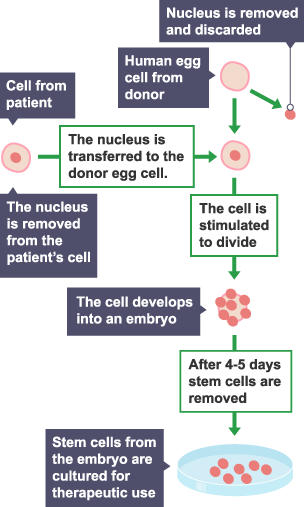
• A Cell is Donated From Patient & Nucleus is Removed & Transferred to Donor Egg Cell .
• The Cell is Stimulated to Divide and it Develops Into An Embryo
• After 4-5 days Stem Cells are Removed and a Cultured for Therapeutic Use
46
What does of Therapeutic Cloning Produce & what are uses from the Stem Cells ?
In Therapeutic Cloning, an Embryo is Produced with Same Genes as Patient.
Stem Cells from the Embryo Are Not Rejected by the Patient's Body & Could Used To Replace Damaged Heart Tissue.
Stem Cells from the Embryo Are Not Rejected by the Patient's Body & Could Used To Replace Damaged Heart Tissue.
47
What is the function of the Respiratory System?
Bring Oxygen into Body and Remove Waste Carbon Dioxide.
48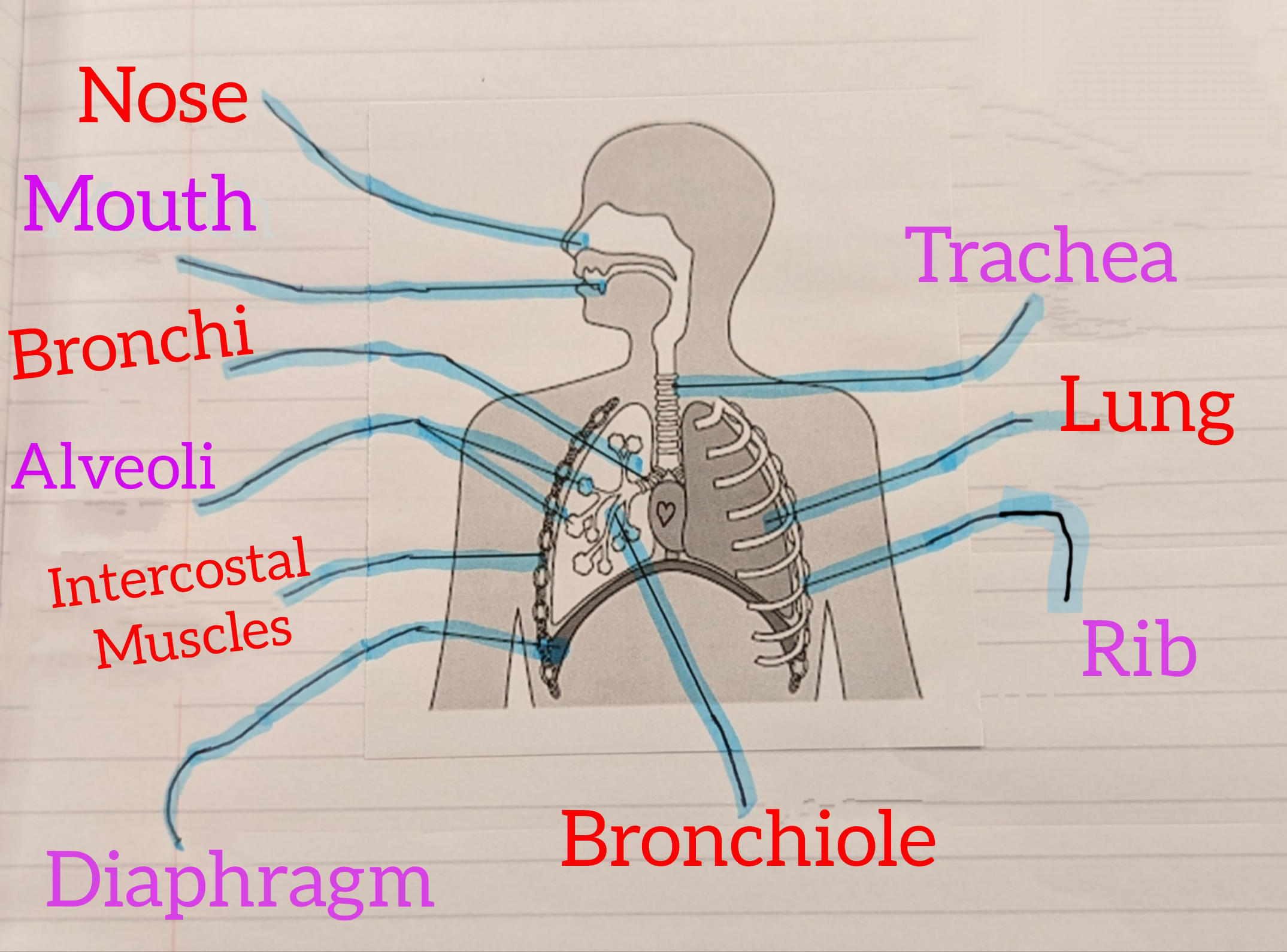
Label the Respiratory System 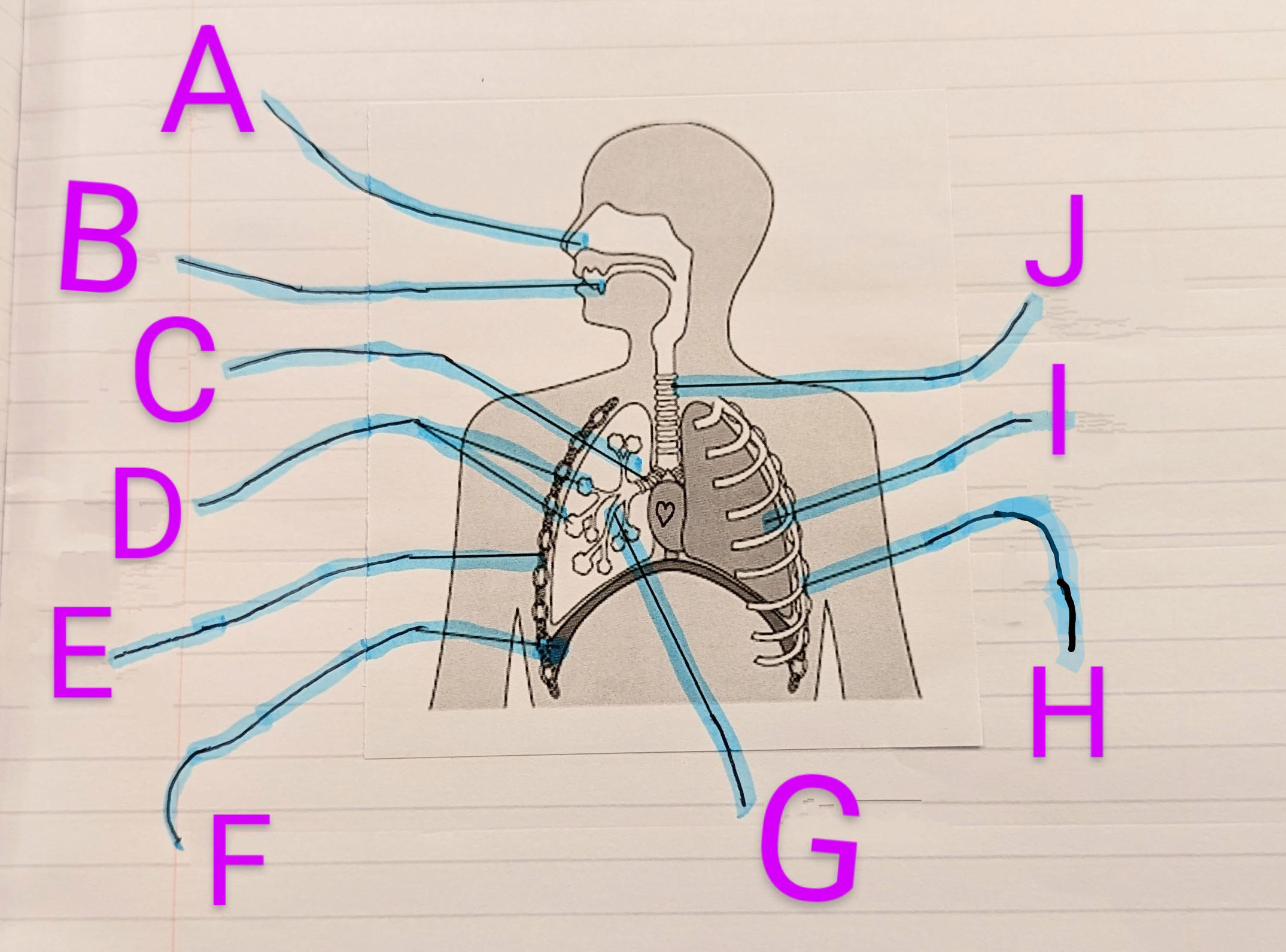
49
Aveoli are the site of what and where?
Aveoli are the site of Gaseous Exchange in the Lungs.
50
where is Oxygen from & where does it diffuse out of....and where does it go into?
Oxygen from the Air Breathed in diffuses out of the Alveoli and into the Blood.
51
where is Carbon Dioxide & then diffused out of and where does it go into & then what happens?
Carbon Dioxide Diffuses Out Of the Blood Into the Alveoli and is Breathed Out.
52
Where is Alveoli found in the body?
The lungs 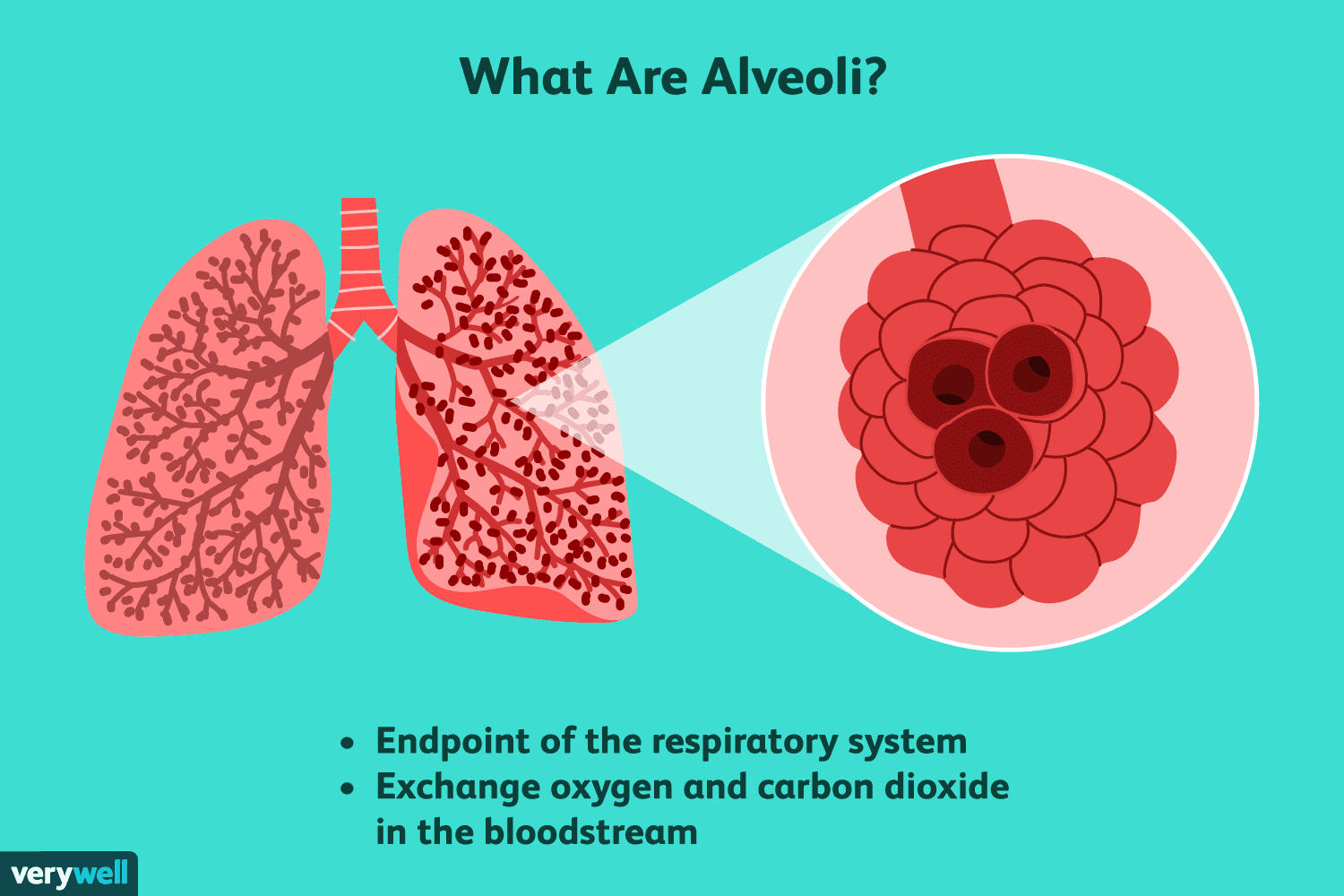
53
define Diffusion
Movement of Substances from a High Concentration to a Low Concentration Down the Concentration Gradient
54
where does oxygen move from to where and What is the Process Called which takes place in the Alveoli ?
Oxygen Moves from Air into the Bloodstream by Diffusion .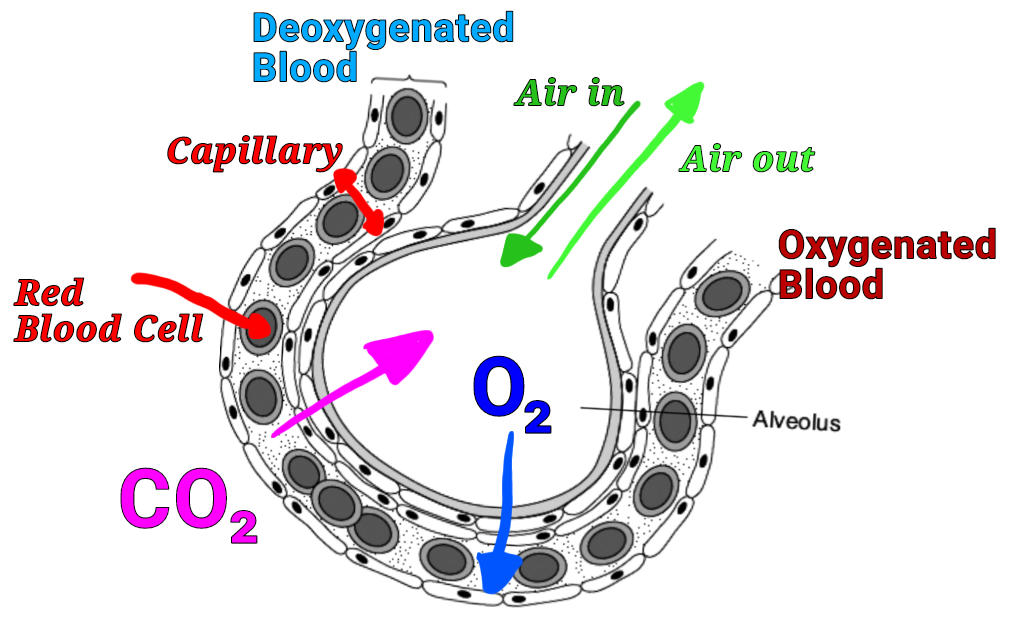
55
where does Carbon Dioxide move from to where and What is the Process in the Alveoli ?
Carbon Dioxide moves by Diffusion from the Bloodstream to the Air. 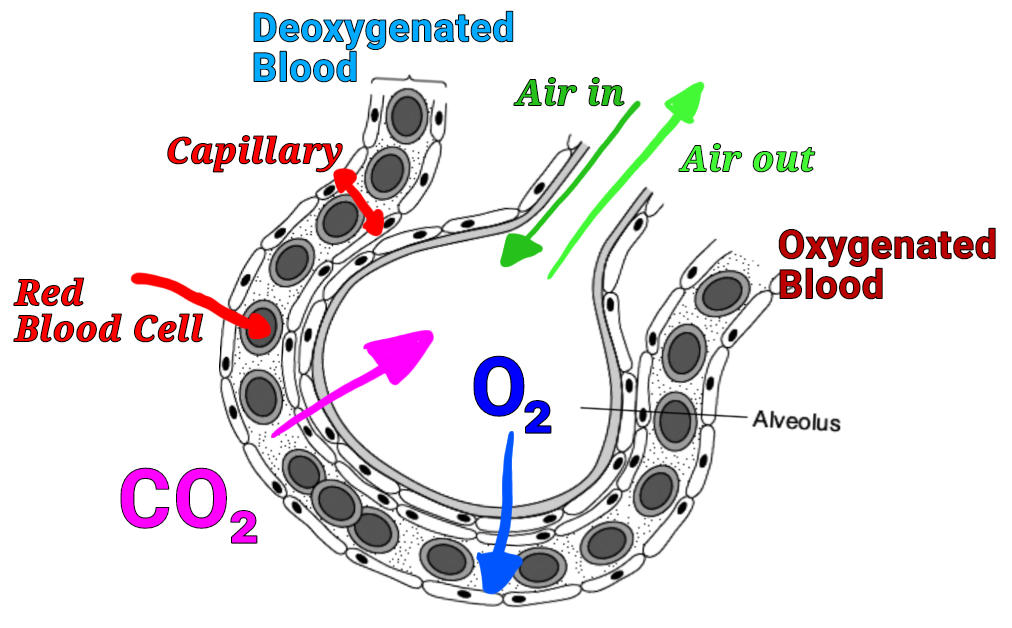
56
Label the Alveolus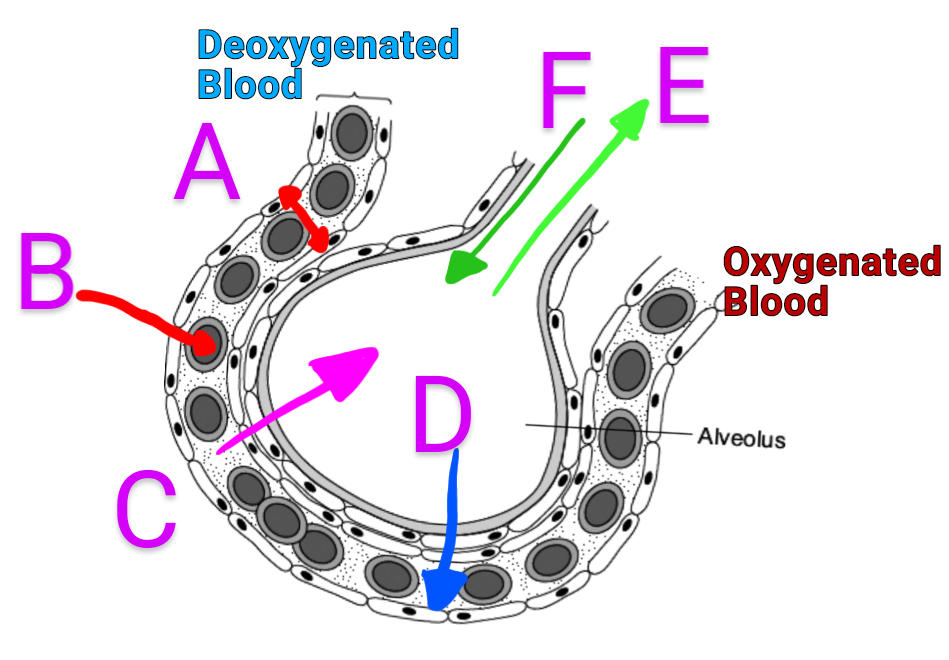
Oxygen & Carbon Dioxide diffuse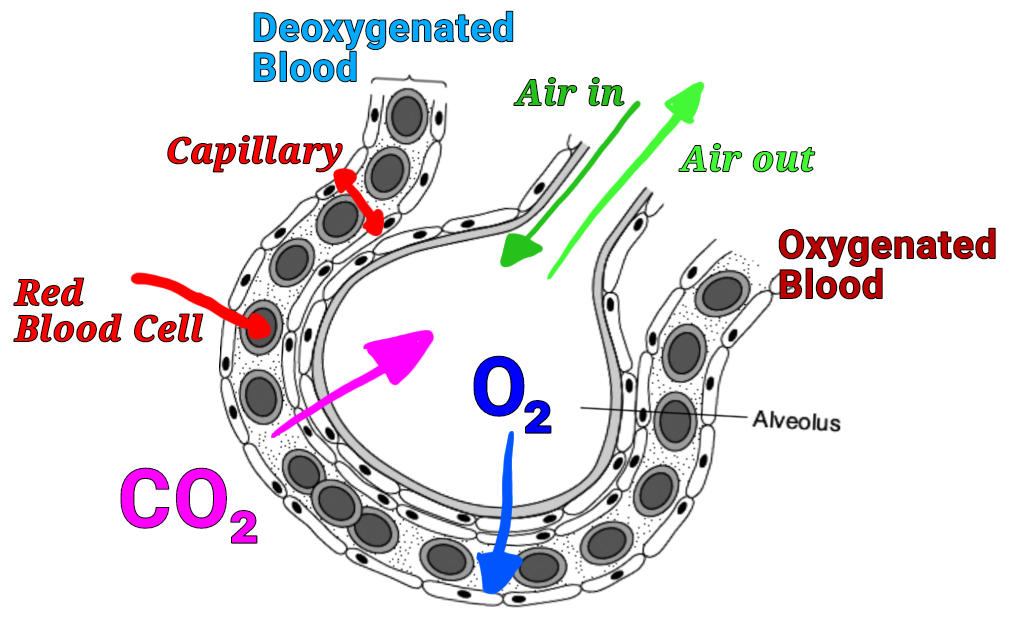
57
In lungs what does it combine with to form Oxyhaemoglobin?
In the lungs, Haemoglobin combines with Oxygen to form Oxyhaemoglobin.
58
How is oxygen delivered to the cells for respiration?
In the Tissue of the Body, Oxyhaemoglobin Splits Up and Oxygen is delivered to the Cells For Respiration.
59
What are the adaptations of the lungs for Gas Exchange?
• Many alveoli provide a Large Surface Area
• Alveoli and Capellaries have Thin Walls (only one cell thick)
• Alveoli have a Good Blood Supply To Maintain a Concentration Gradient
• Lungs are Ventilated (person briefs in and out) to Bring in Fresh Oxygen and Remove Carbon Dioxide- Maintains a Concentration Gradient
• Alveoli and Capellaries have Thin Walls (only one cell thick)
• Alveoli have a Good Blood Supply To Maintain a Concentration Gradient
• Lungs are Ventilated (person briefs in and out) to Bring in Fresh Oxygen and Remove Carbon Dioxide- Maintains a Concentration Gradient
60
What does ventilation involve Physically and where does it move the air?
Ventilation/ breathing involves movement of the Ribs, Intercostal Muscles and Diaphragm.
This moves Air into the Lungs (inhalation) and out of the Lungs (exhalation)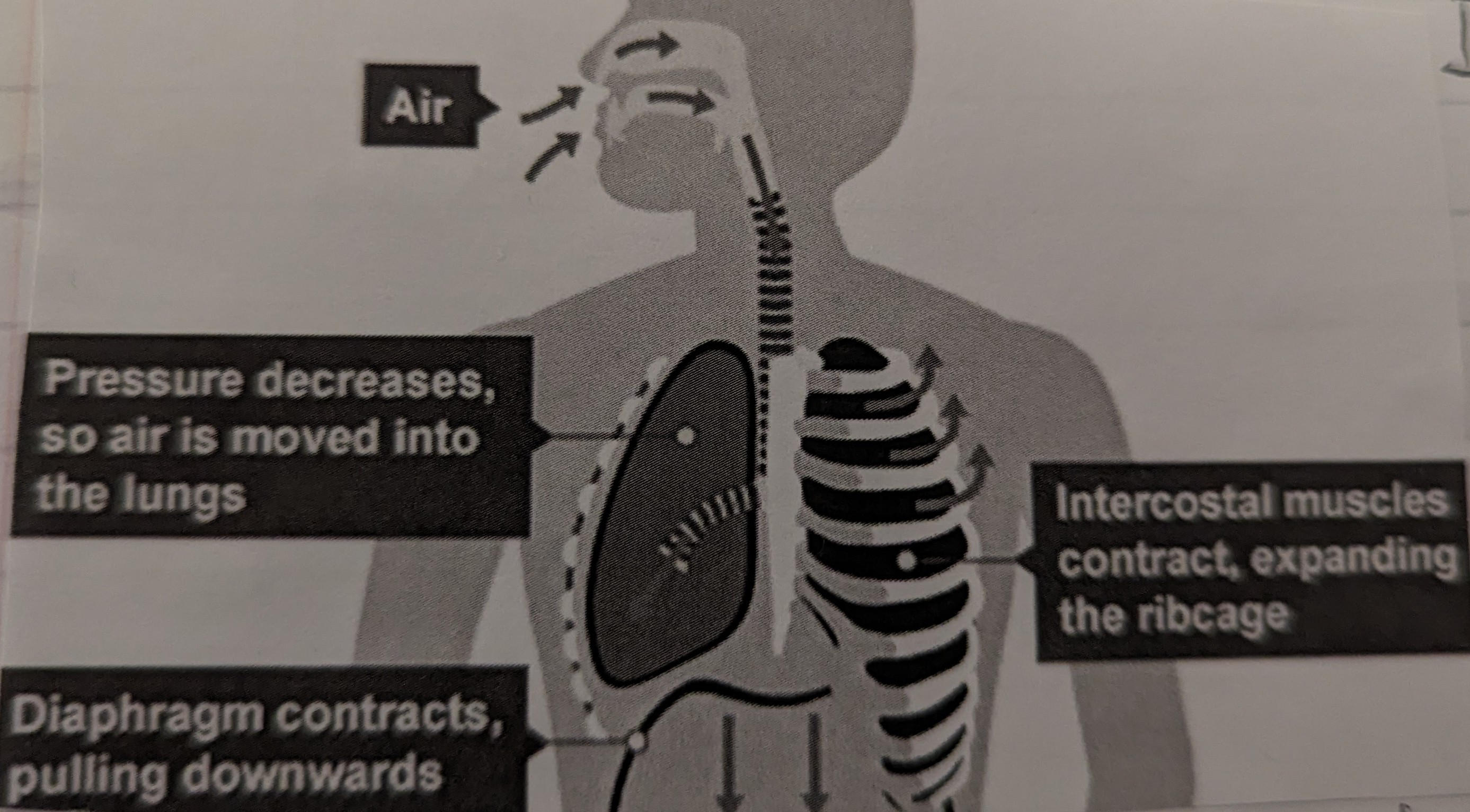
This moves Air into the Lungs (inhalation) and out of the Lungs (exhalation)
61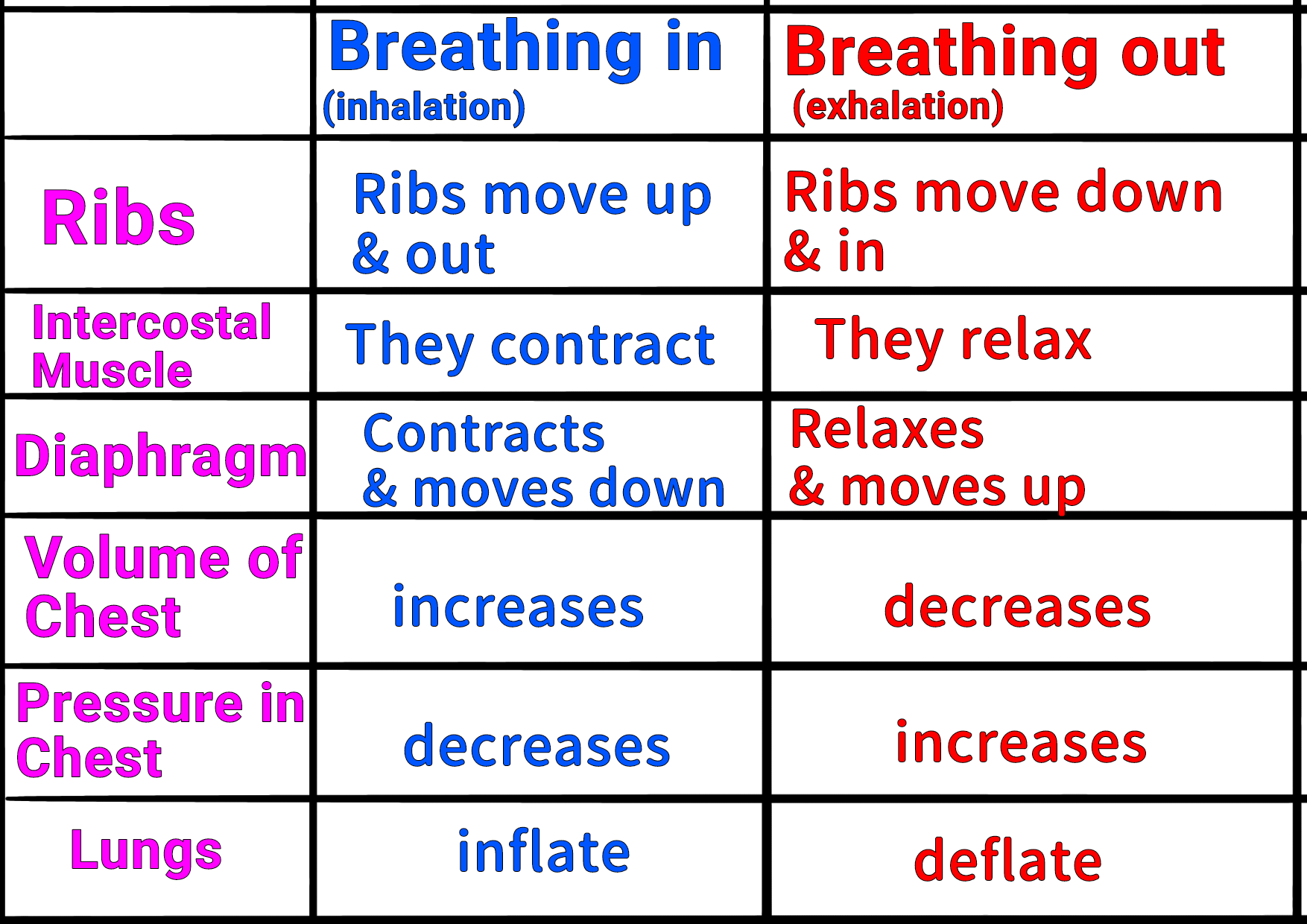
What does each part of the Respiratory System do during Ventilation (breathing)?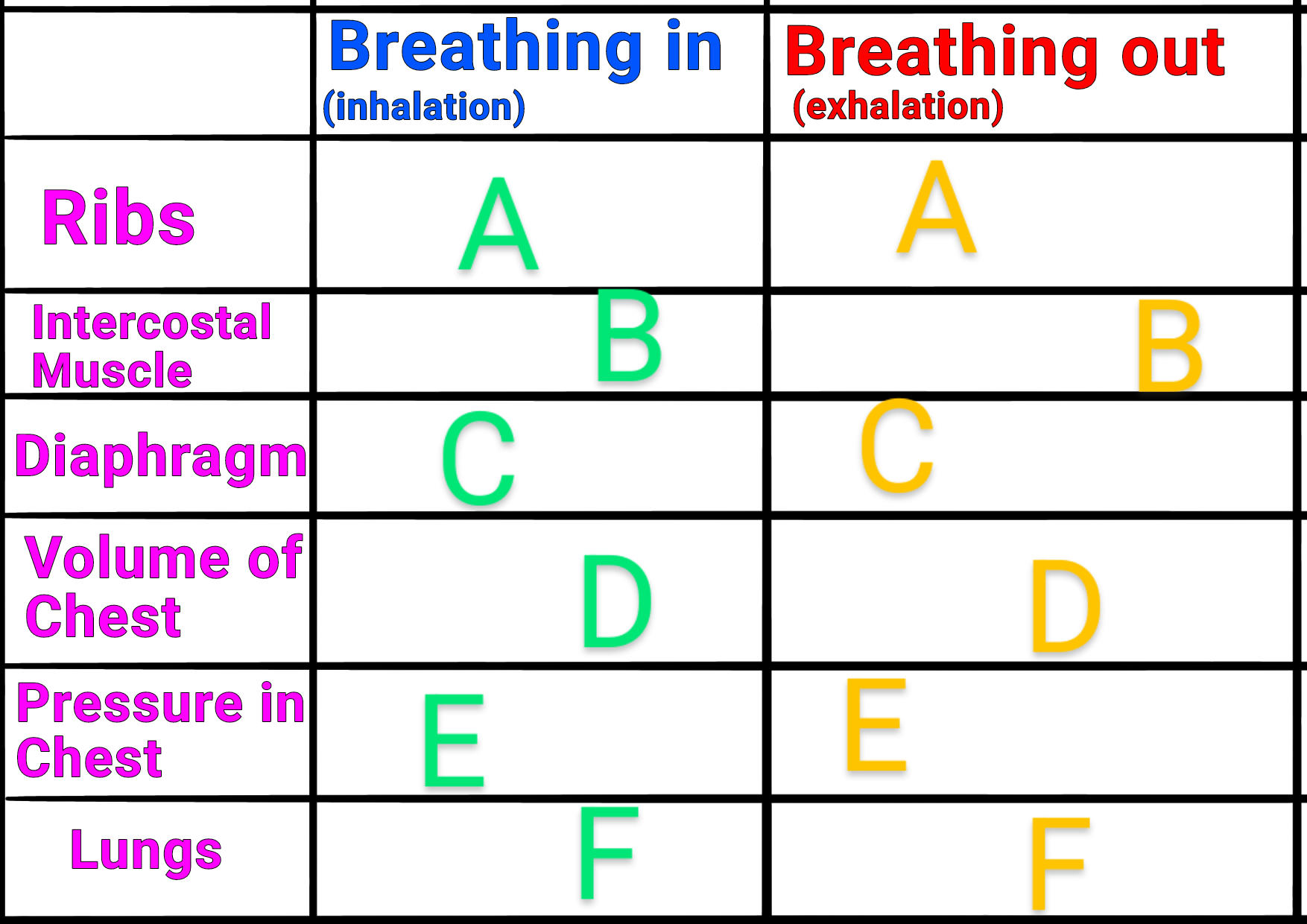
62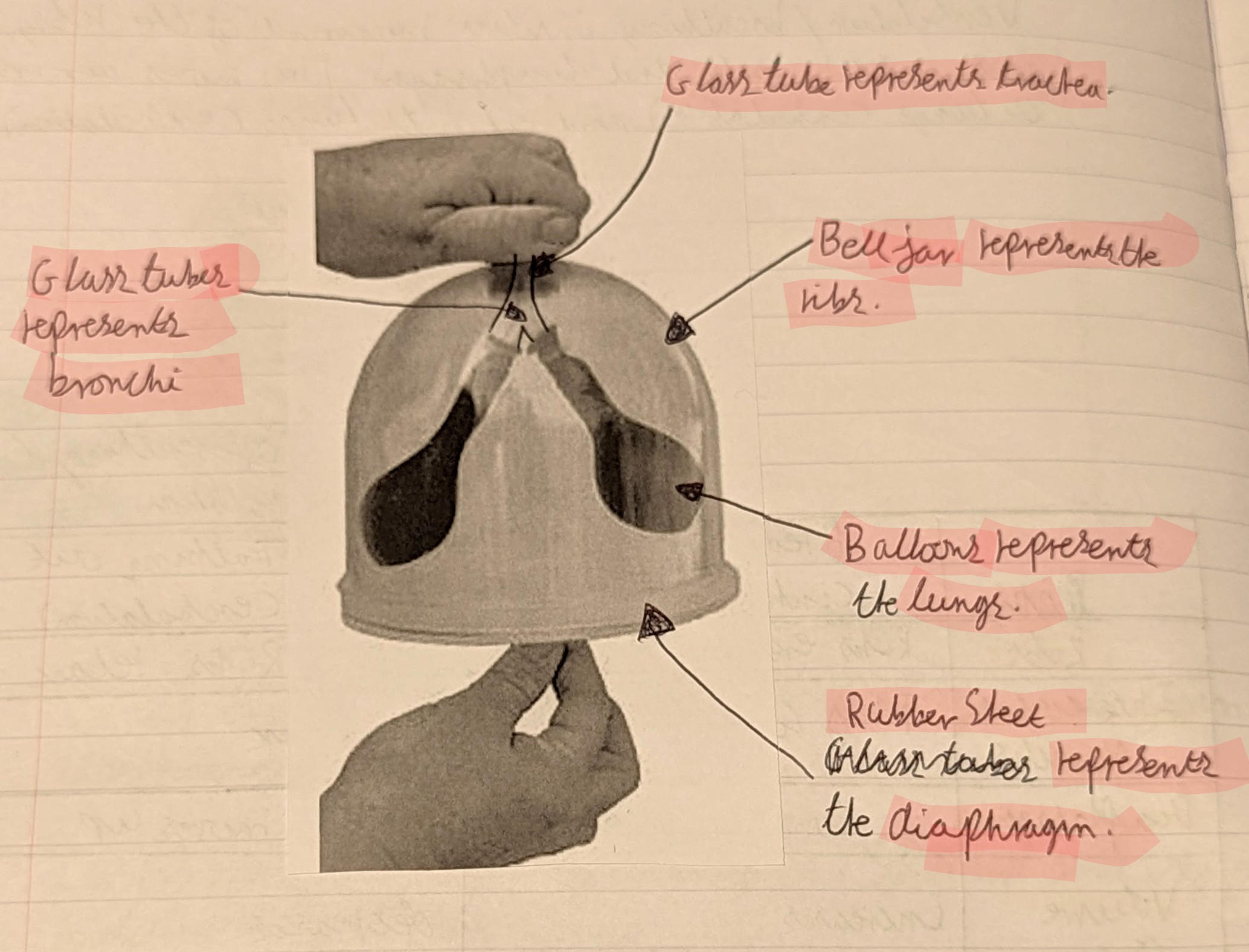
What do you each part of the Model Of The Respiratory System Represent?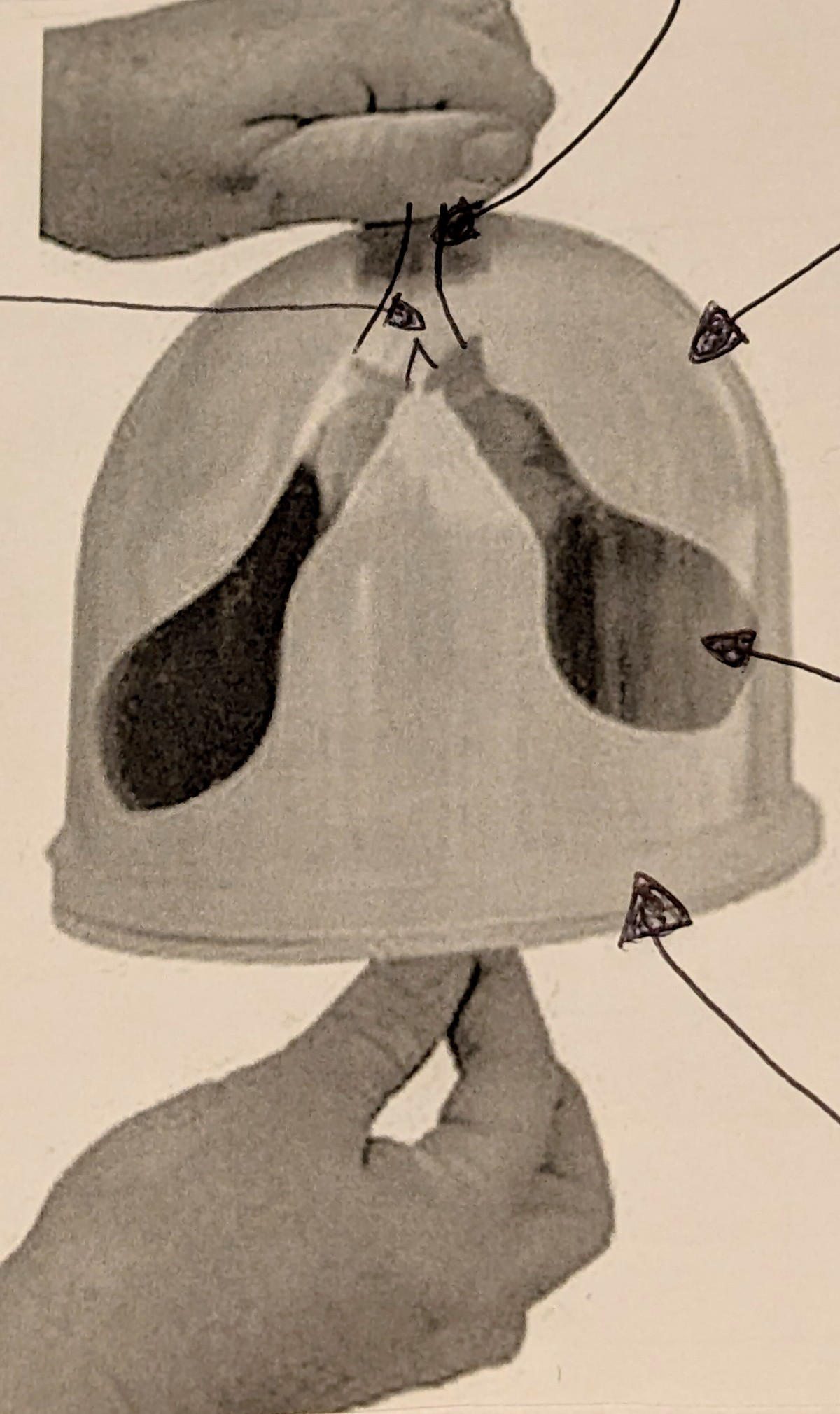
63
What are the pros and cons for the Respiratory System Model?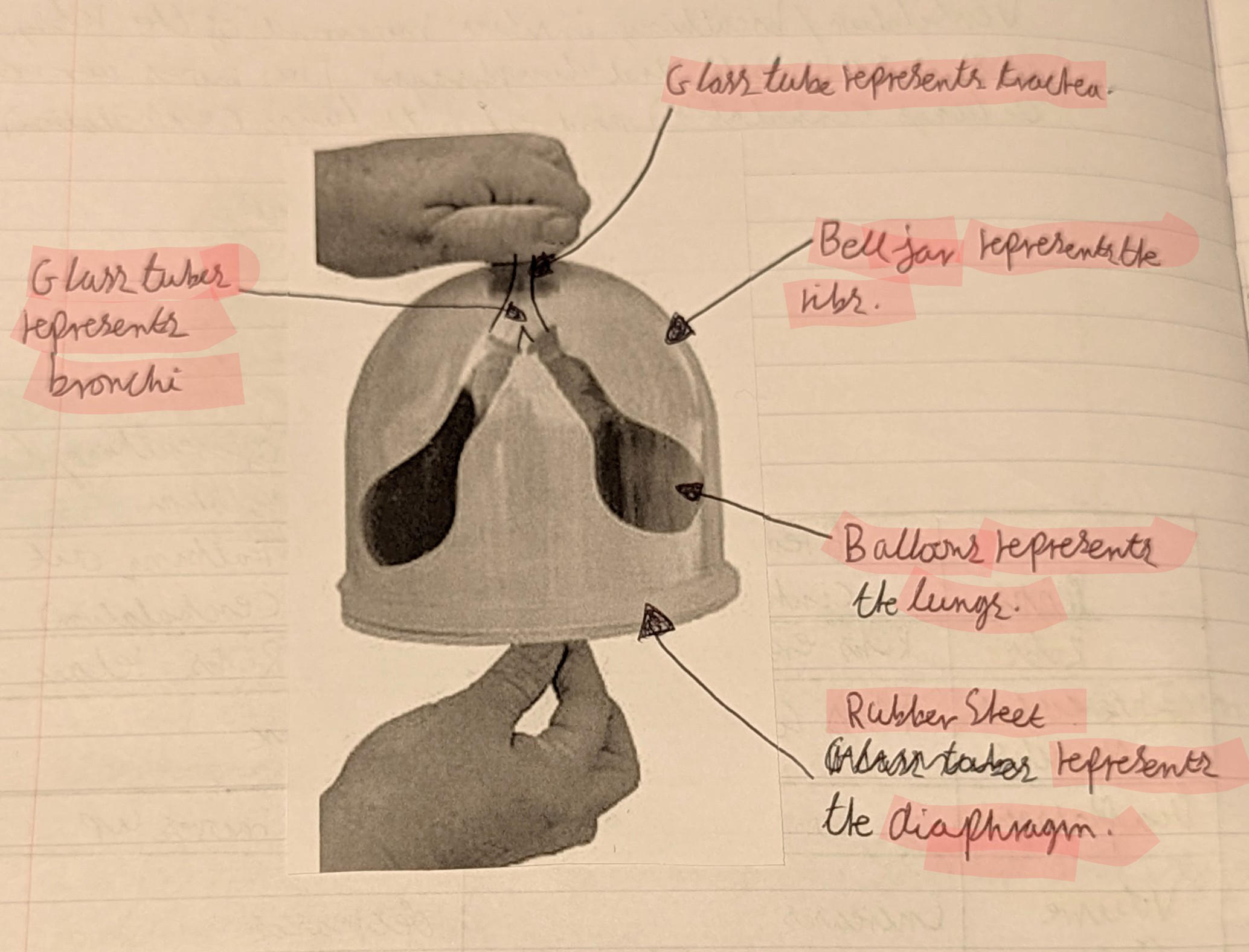
Cons
• The Lungs Are Like Empty Balloons Sacks
• Doesn't Show Movement of Ribs
Pros
• Showes that Moving the Diaphragm Inflates Lungs
• The Lungs Are Like Empty Balloons Sacks
• Doesn't Show Movement of Ribs
Pros
• Showes that Moving the Diaphragm Inflates Lungs
64
What is the equation for respiration?
65
Difference between Respiration & breathing
Humans Breathe to get Oxygen Needed for Respiration and Remove the Carbon Dioxide Produced in Respiration.
66
A disease called pulmonary fibrosis scars and thickens the walls of the alveoli. explain the effect of this on a person with this.
Normally Walls of Alveoli 1 Cell Thick so it is harder for Oxygen to get into the Bloodstream.
So you can't, a because you don't have enough Oxygen so your Muscle Cells have Less Energy.
So you can't, a because you don't have enough Oxygen so your Muscle Cells have Less Energy.
67
Label the Flower and what do each Organ of the Flower do?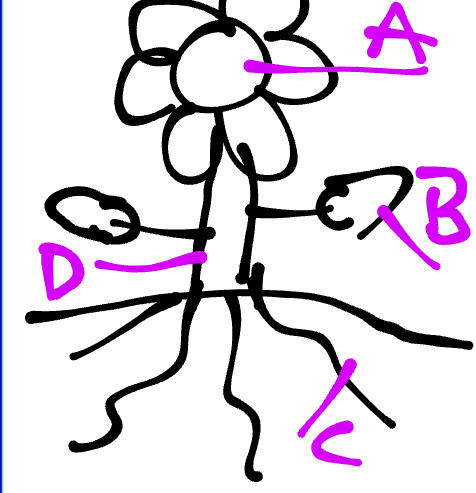
Flower: for Sexual Reproduction
Leaf: for Photosynthesis
Stem: Supports Leaves & Flowers
Roots: Absorbs Water & Mineral Iron and Provides Anchorage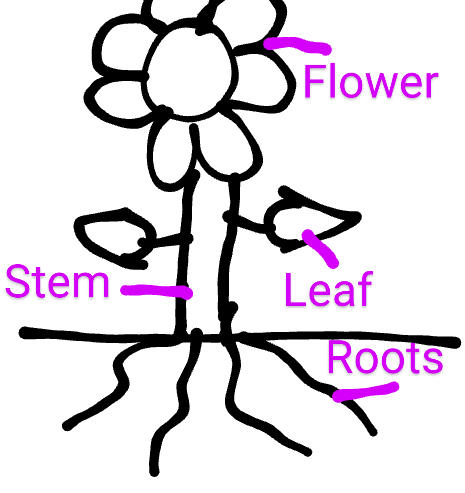
Leaf: for Photosynthesis
Stem: Supports Leaves & Flowers
Roots: Absorbs Water & Mineral Iron and Provides Anchorage
68
What are the Function of Roots?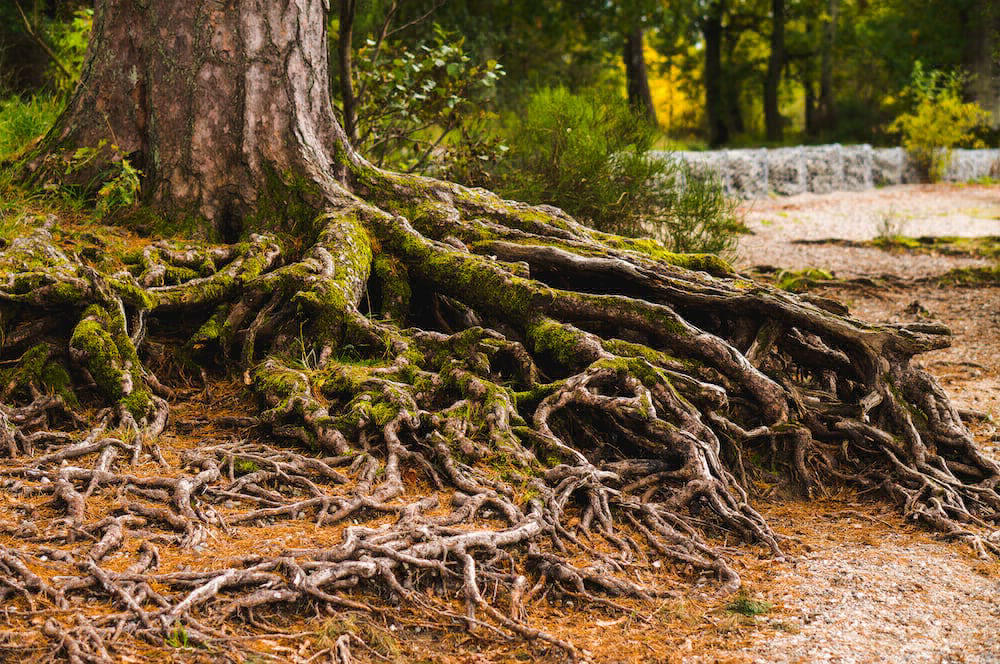
Roots take up Water by Osmosis and Mineral Ions by Active Transport.
Root Hair Cell increase the Root Surface Area.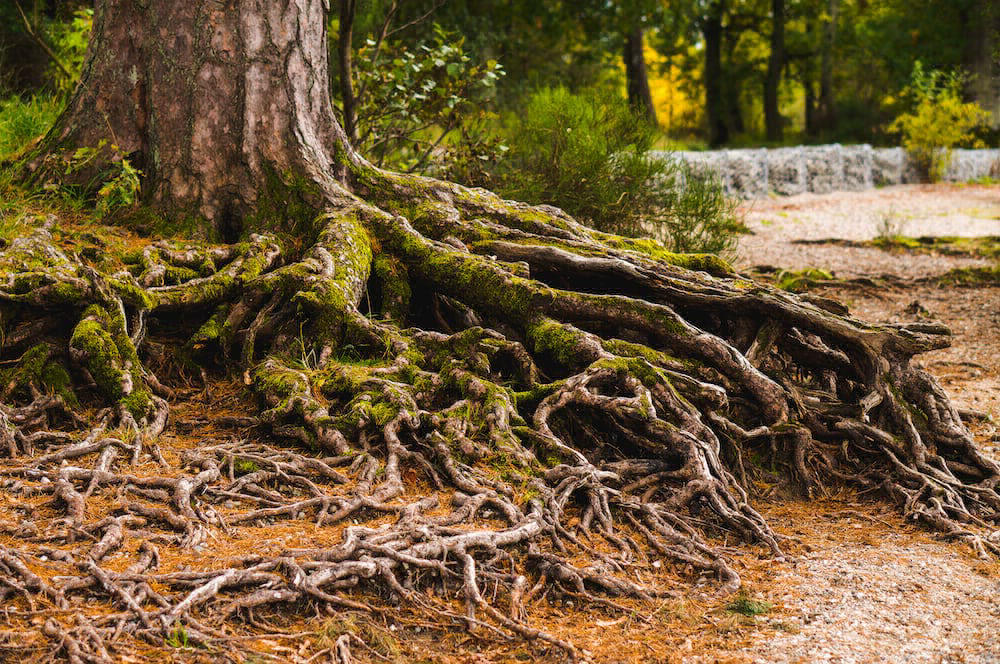
Root Hair Cell increase the Root Surface Area.
69
Define Osmosis
Water moves from a High Concentration Of Water to
Lower Concentration Of Water through a Partly Permeable Membrane.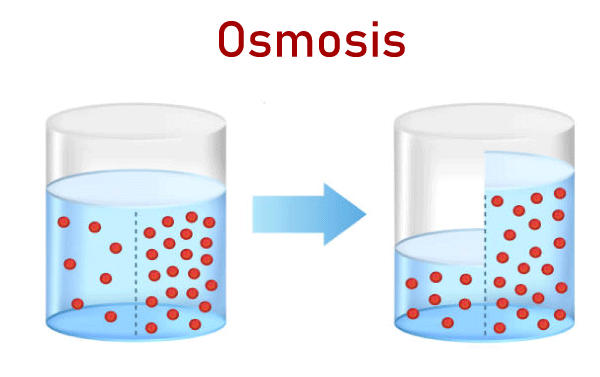
Lower Concentration Of Water through a Partly Permeable Membrane.
70
Define Active Transport
Particles move from Low to High Concentration Requiring Energy For Respiration.
71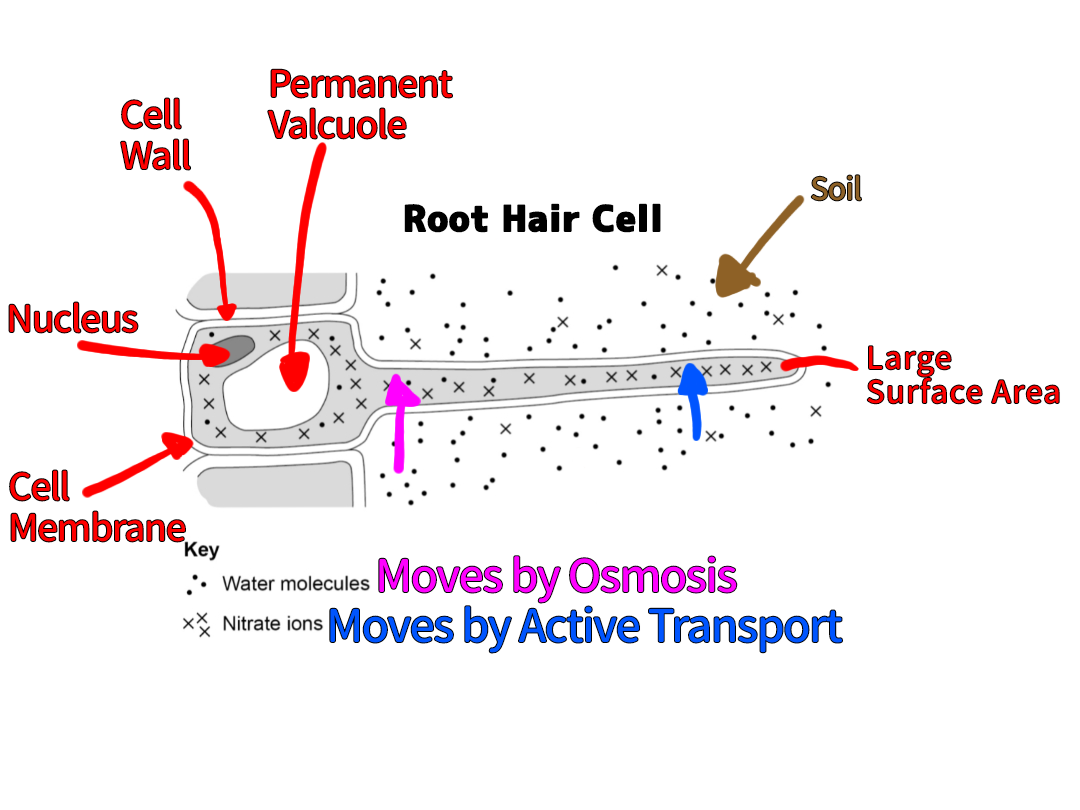
Label the Root Hair Cell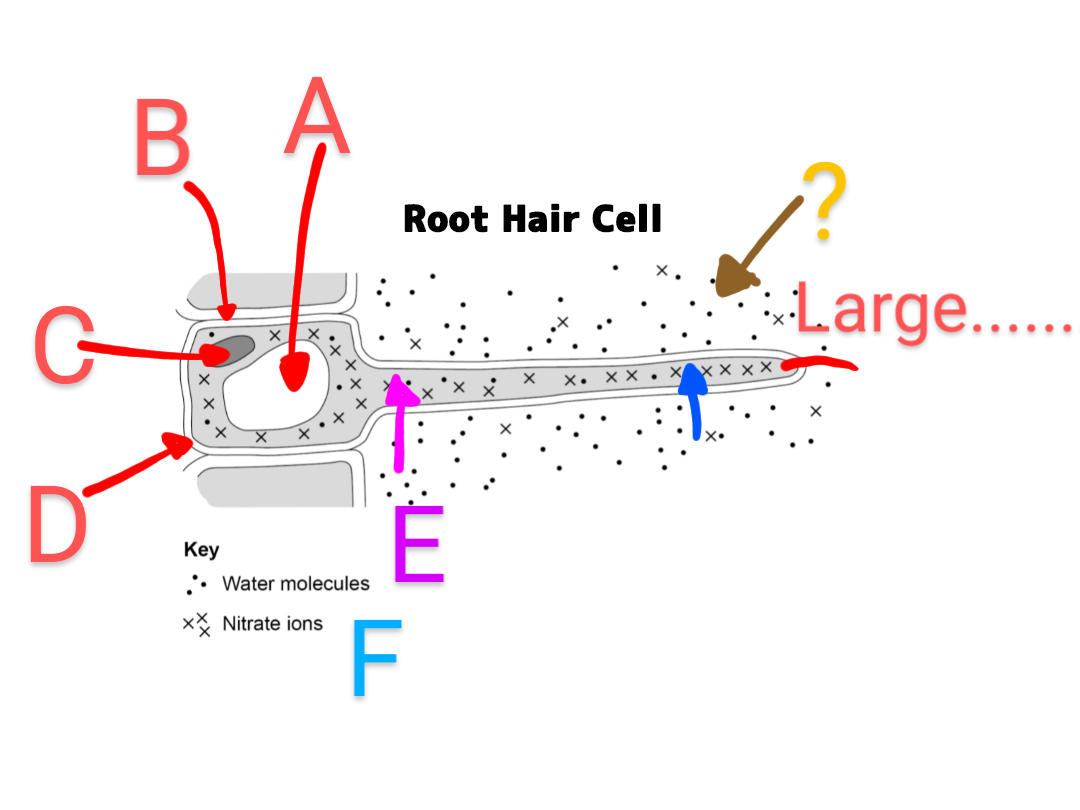
72
How do Water Molecules move by Root Hair Cell?
Water Molecules move by Osmosis.
73
How do Nitrate Ions move by Root Hair Cell?
Nitrate Ions move by Active Transport.
74
The Root Hair Cell has a large...
Large Surface Area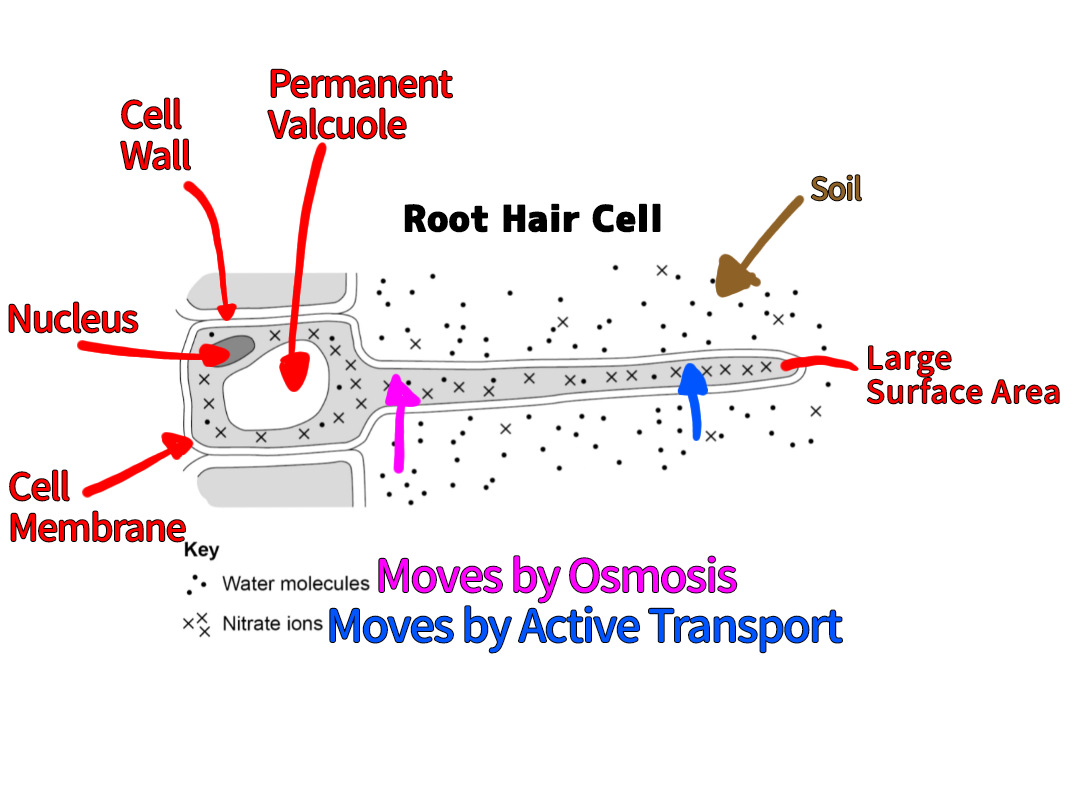
75
What do Leaves Carry Out and Why?
Leaves carry out photosynthesis to make Glucose (sugar) for the Plant.
76
Most leaves are..... (description)
Most Leaves are:
• Broad, Flat & Thin
• Contain Internal Air Spaces
• Broad, Flat & Thin
• Contain Internal Air Spaces
77
how do the adaptions for a leaf affect the surface area and for what?
The adaptions increase the Surface Area for Gas Exchange.
78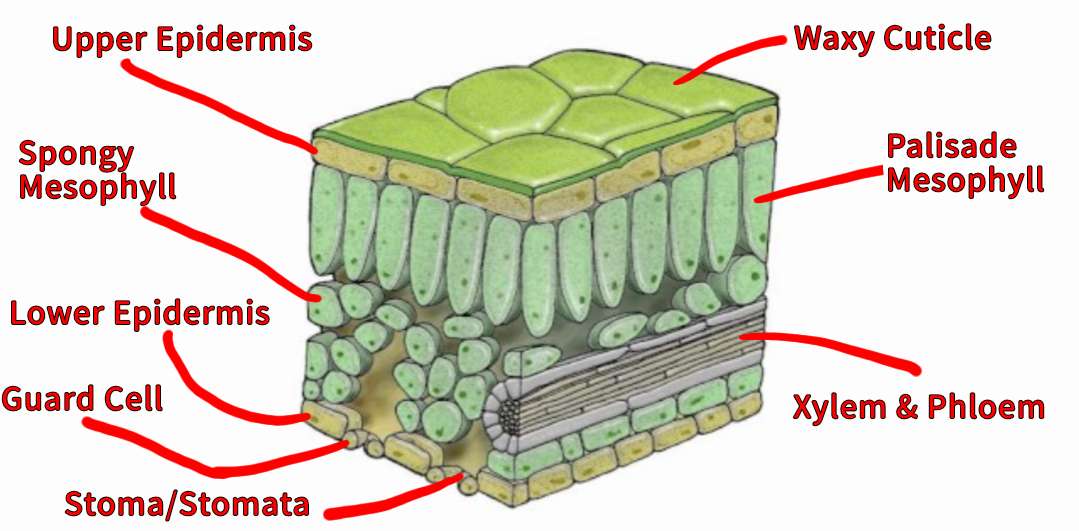
Lable the Leaf Cell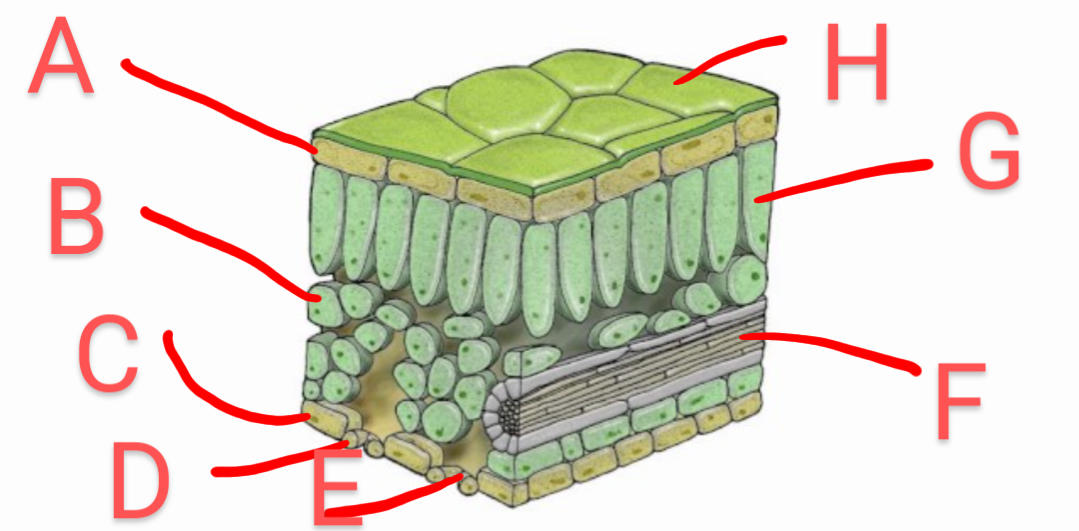
79
What is the Function and Adaptions for Palisade Mesophyll Tissue?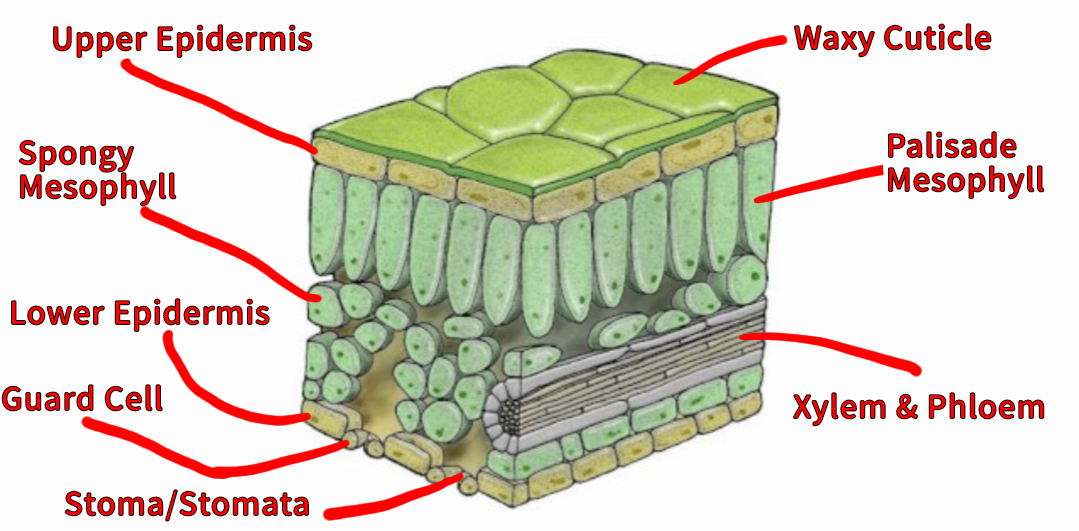
Function
Carries out Photosynthesis at Top of Leaf
Adaptions
Cells almost Rectangular & Packed Very Closely Together. Cells contain Many Chloroplasts to Maximise Photosynthesis.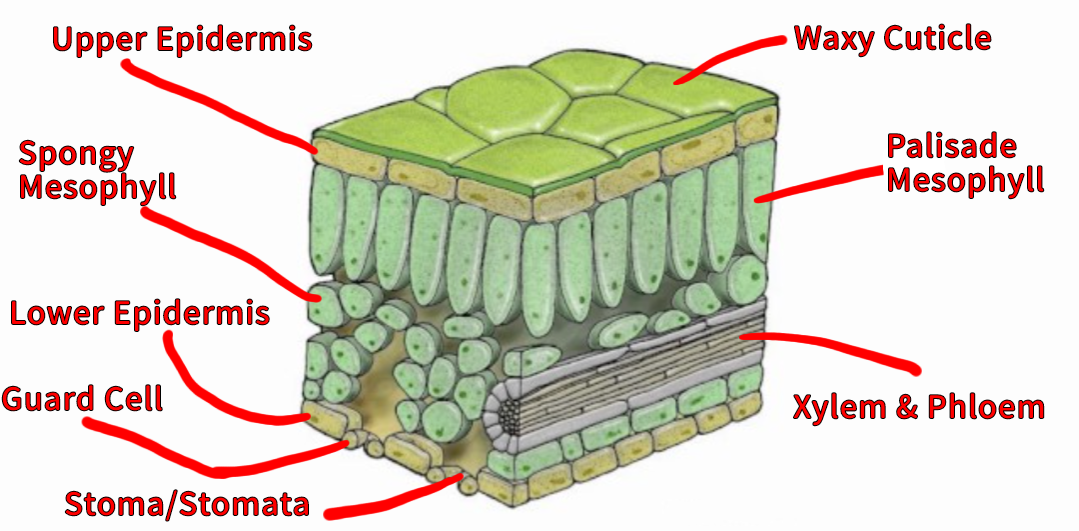
Carries out Photosynthesis at Top of Leaf
Adaptions
Cells almost Rectangular & Packed Very Closely Together. Cells contain Many Chloroplasts to Maximise Photosynthesis.
80
What is the Function and Adaptions for Spongy Mesophyll Tissue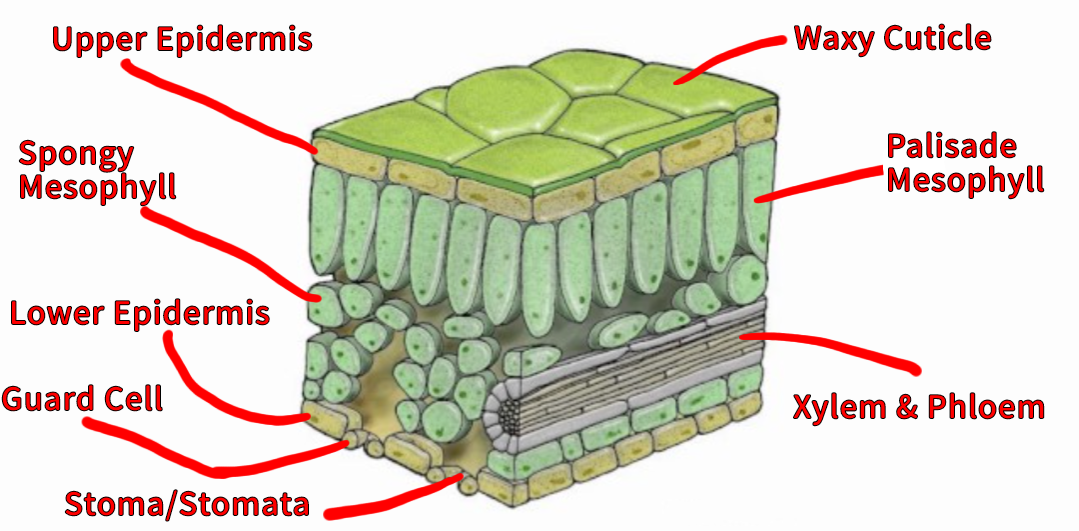
Function
Carries Out Photosynthesis in Middle Of Leaf.
Adaptions
Cells Contain Chloroplast. Cells are Loosely Arranged With Air Spaces in Between to Allow Diffusion of Gases.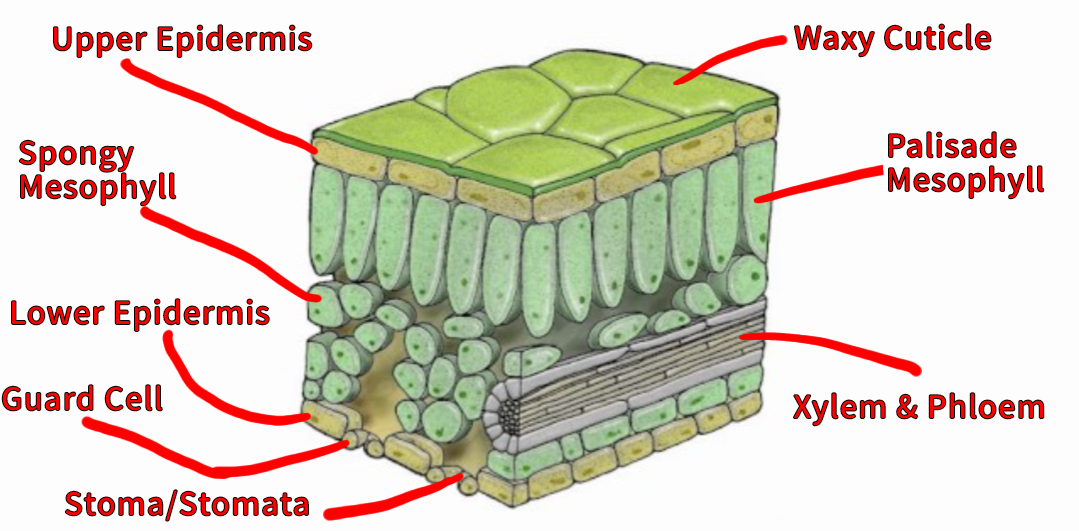
Carries Out Photosynthesis in Middle Of Leaf.
Adaptions
Cells Contain Chloroplast. Cells are Loosely Arranged With Air Spaces in Between to Allow Diffusion of Gases.
81
What is the Function and Adaptions for Xylem Tissue?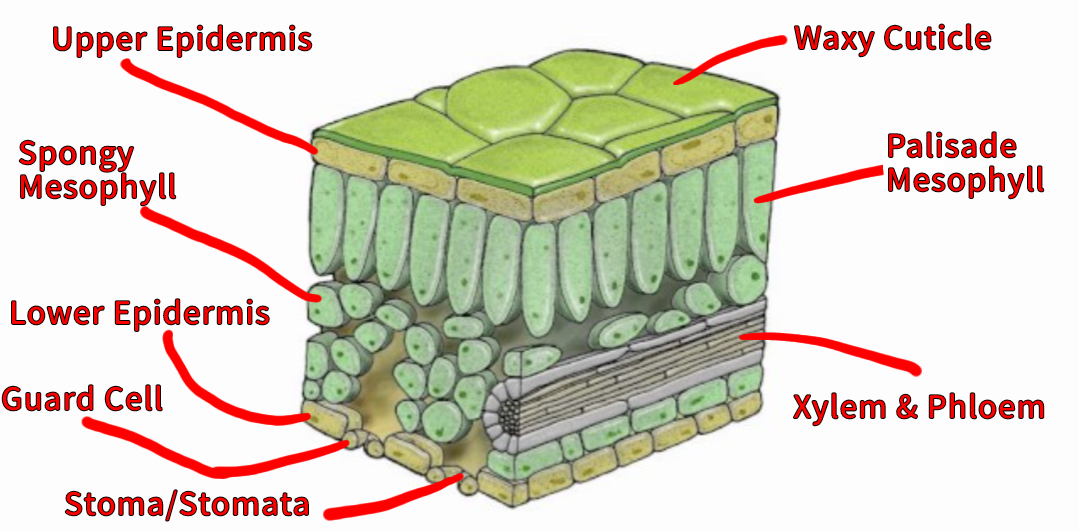
Function
Transports Water & Minerals up to the Leafs.
Adaptions
Composed of Hollow Tubes Strengthened by Lignin to allow the Transport of Water.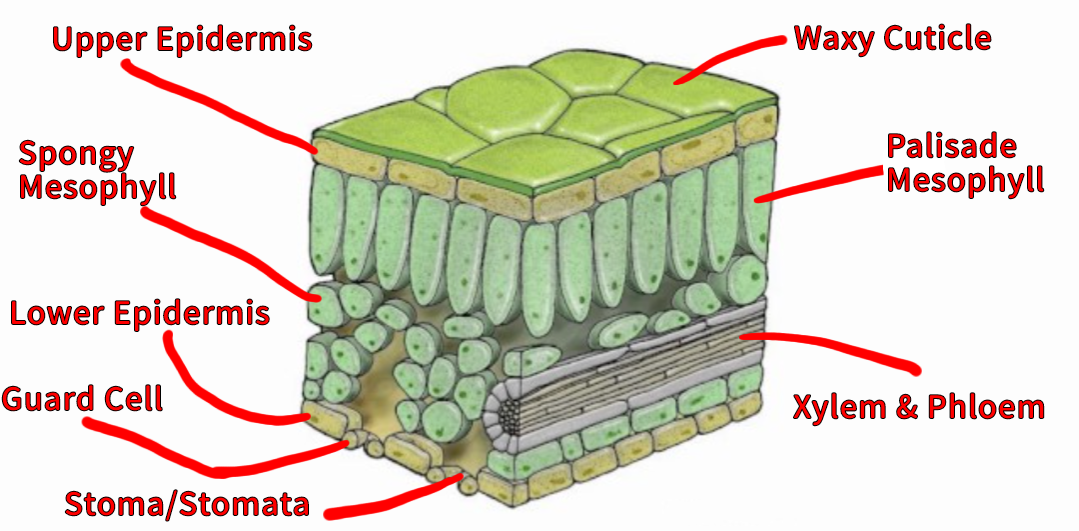
Transports Water & Minerals up to the Leafs.
Adaptions
Composed of Hollow Tubes Strengthened by Lignin to allow the Transport of Water.
82
What is the Function and Adaptions for Epidermal Tissue?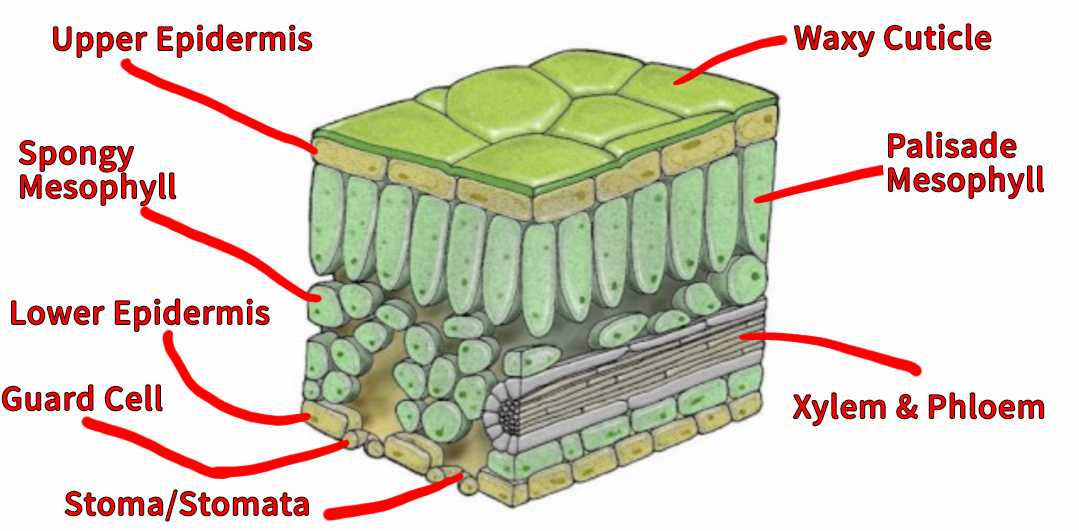
Function
Covers the Plant
Adaptions
Cells have Few if No Chloroplasts & are Almost Transparent to let Light Through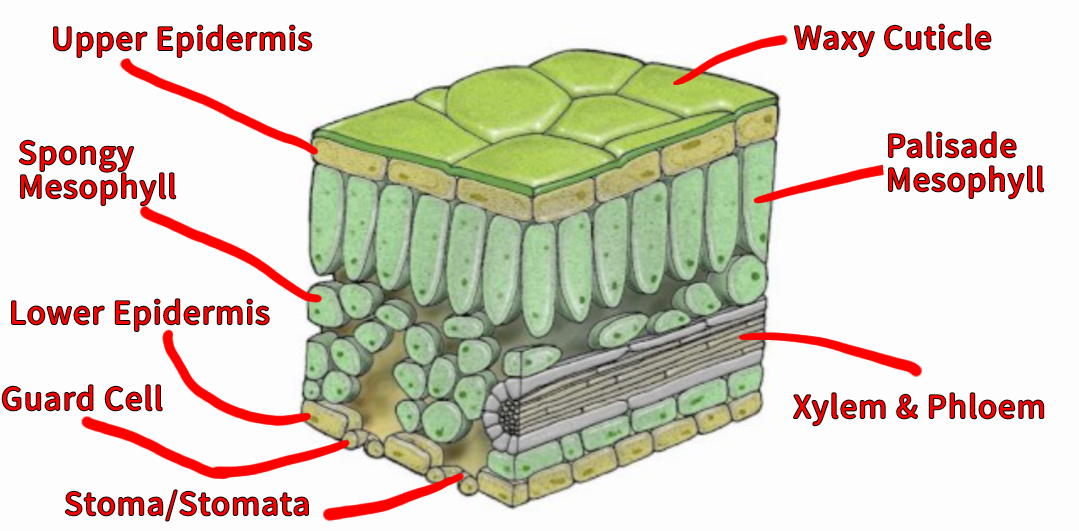
Covers the Plant
Adaptions
Cells have Few if No Chloroplasts & are Almost Transparent to let Light Through
83
What is the Function and Adaptions for Phloem Tissue?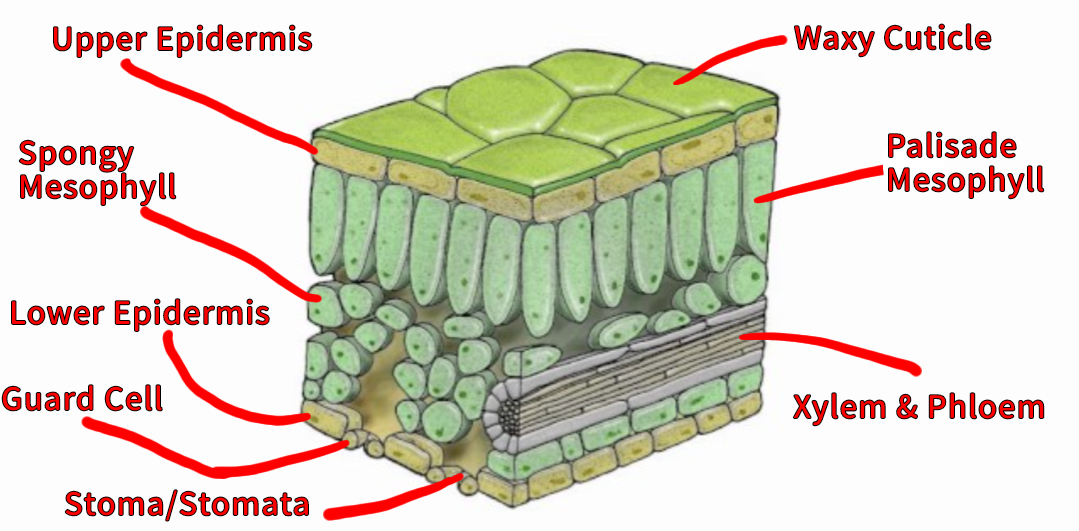
Function
Transports Sugars Around the Plant.
Adaptiond
Composed of Tubes Of Elongated Cells.
Cell Sap containing Sugars can Move Between Cells through Pores in the End Walls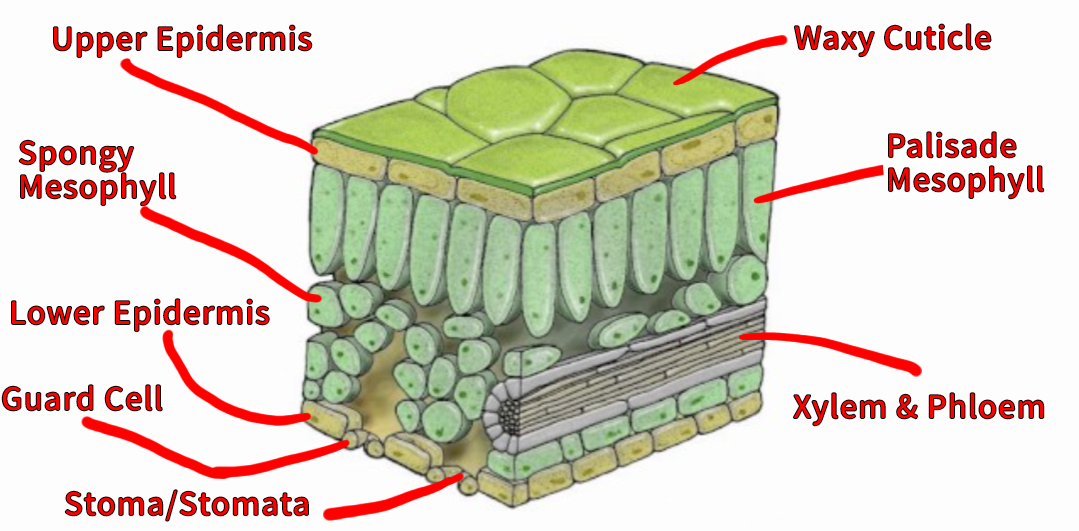
Transports Sugars Around the Plant.
Adaptiond
Composed of Tubes Of Elongated Cells.
Cell Sap containing Sugars can Move Between Cells through Pores in the End Walls
84
What is the Function and Adaptions for Meristem Tissue?
Function
Found in the Growing Tips Of Plants
Adaptions
Made up of Stem Cells which can Divide Quickly to form any other type of Plant Cell.
Found in the Growing Tips Of Plants
Adaptions
Made up of Stem Cells which can Divide Quickly to form any other type of Plant Cell.
85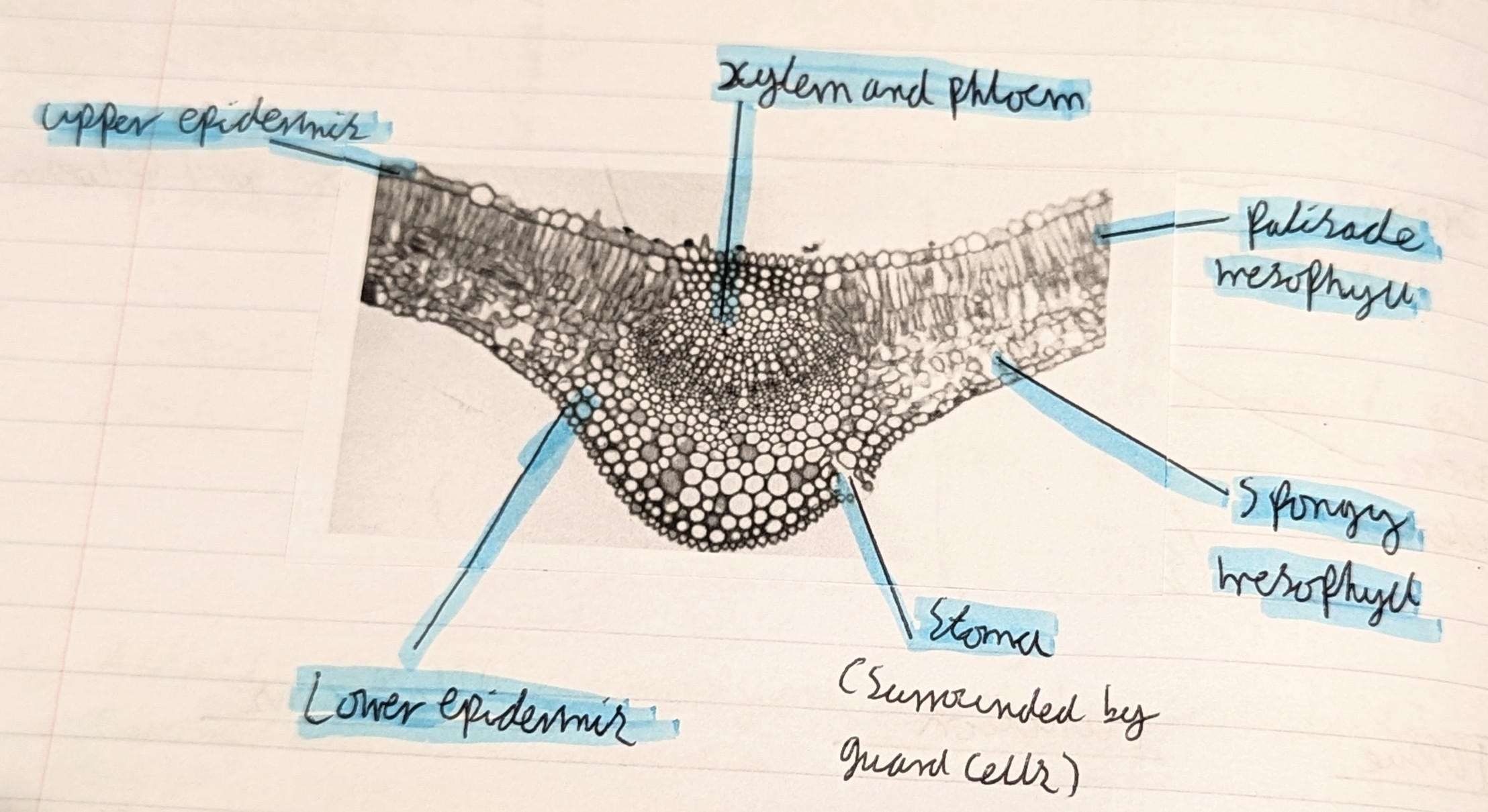
Lable the Leaf Tissues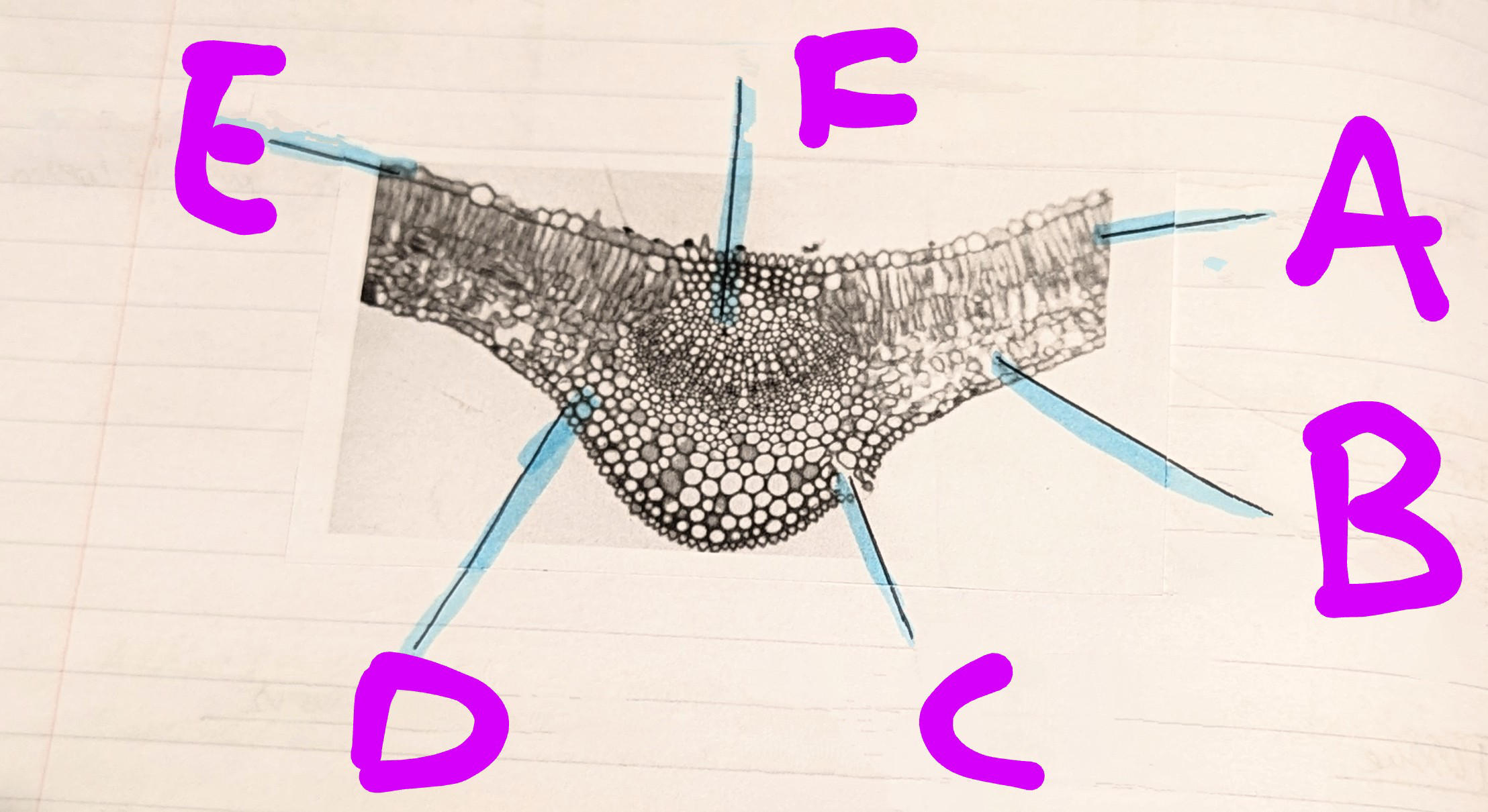
86
What is the main difference in the Internal Structure of the cells from the Epidermal Tissue and Mesophil Tissue?
87
Define Stomata (stoma=singular)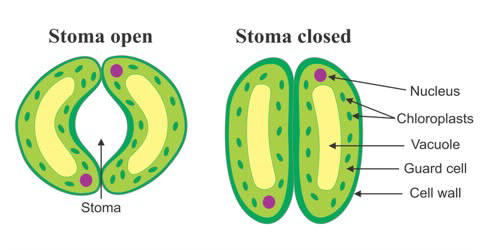
Tinny Holes in the Surface Of Leaves.
Main Function is to Allow CO2 needed for Photosynthesis to Enter the Leaf.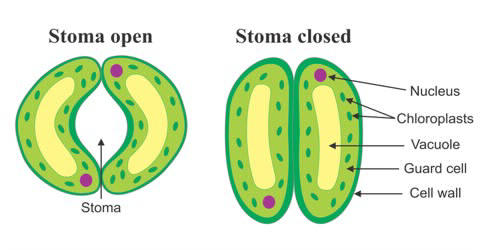
Main Function is to Allow CO2 needed for Photosynthesis to Enter the Leaf.
88
What are Stomata surrounded by & what do they do?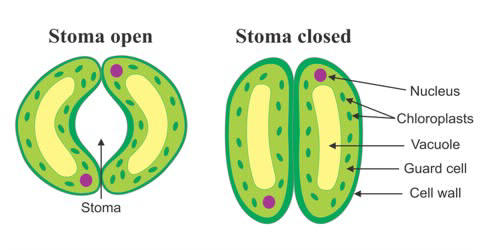
Guard Cells
which can Change Size to Open and Close the Stomata.
(2 guard cells per Stoma)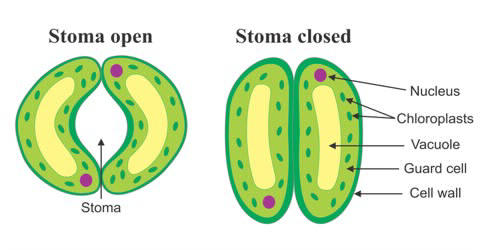
which can Change Size to Open and Close the Stomata.
(2 guard cells per Stoma)
89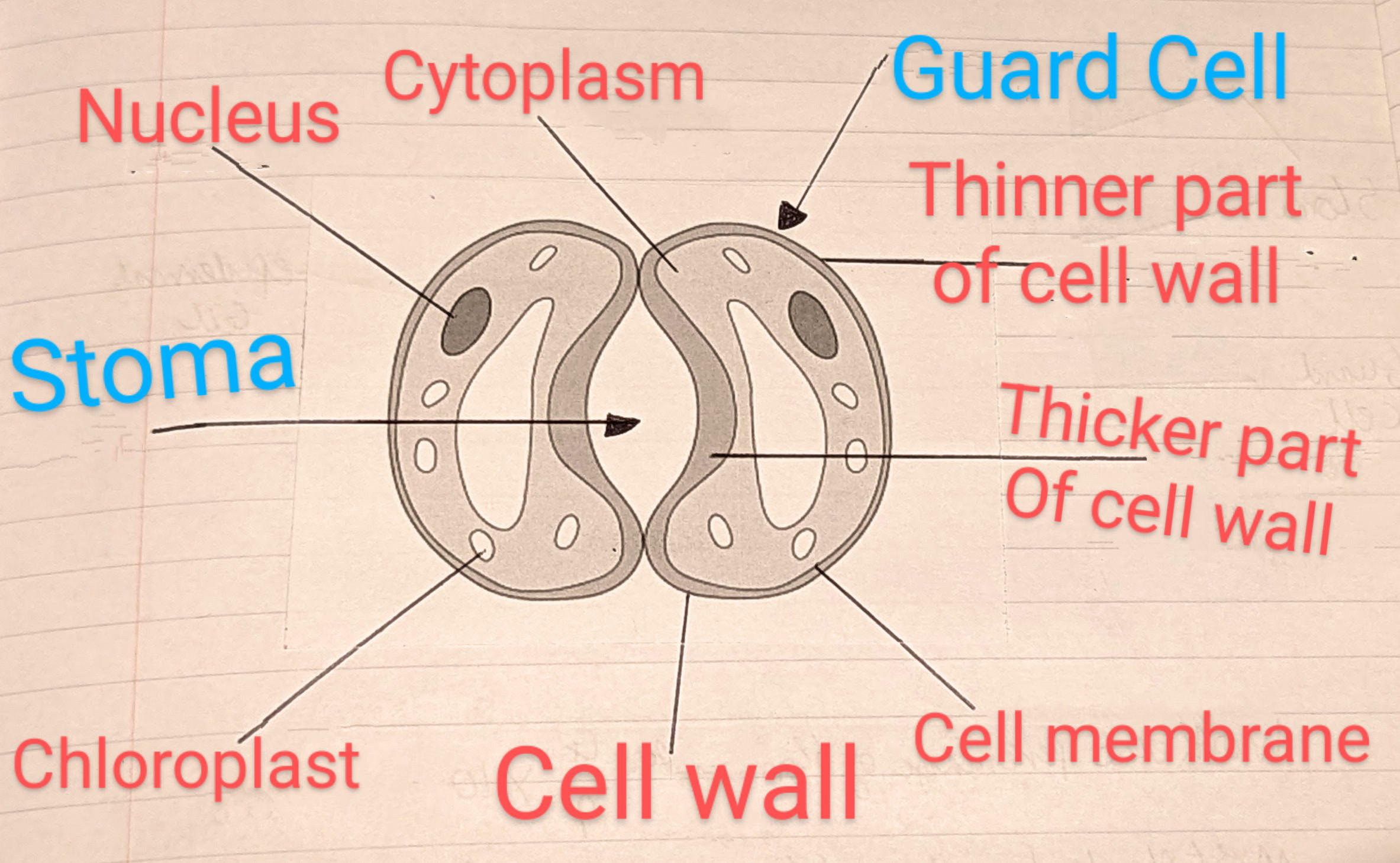
Lable the Stoma and Guard Cells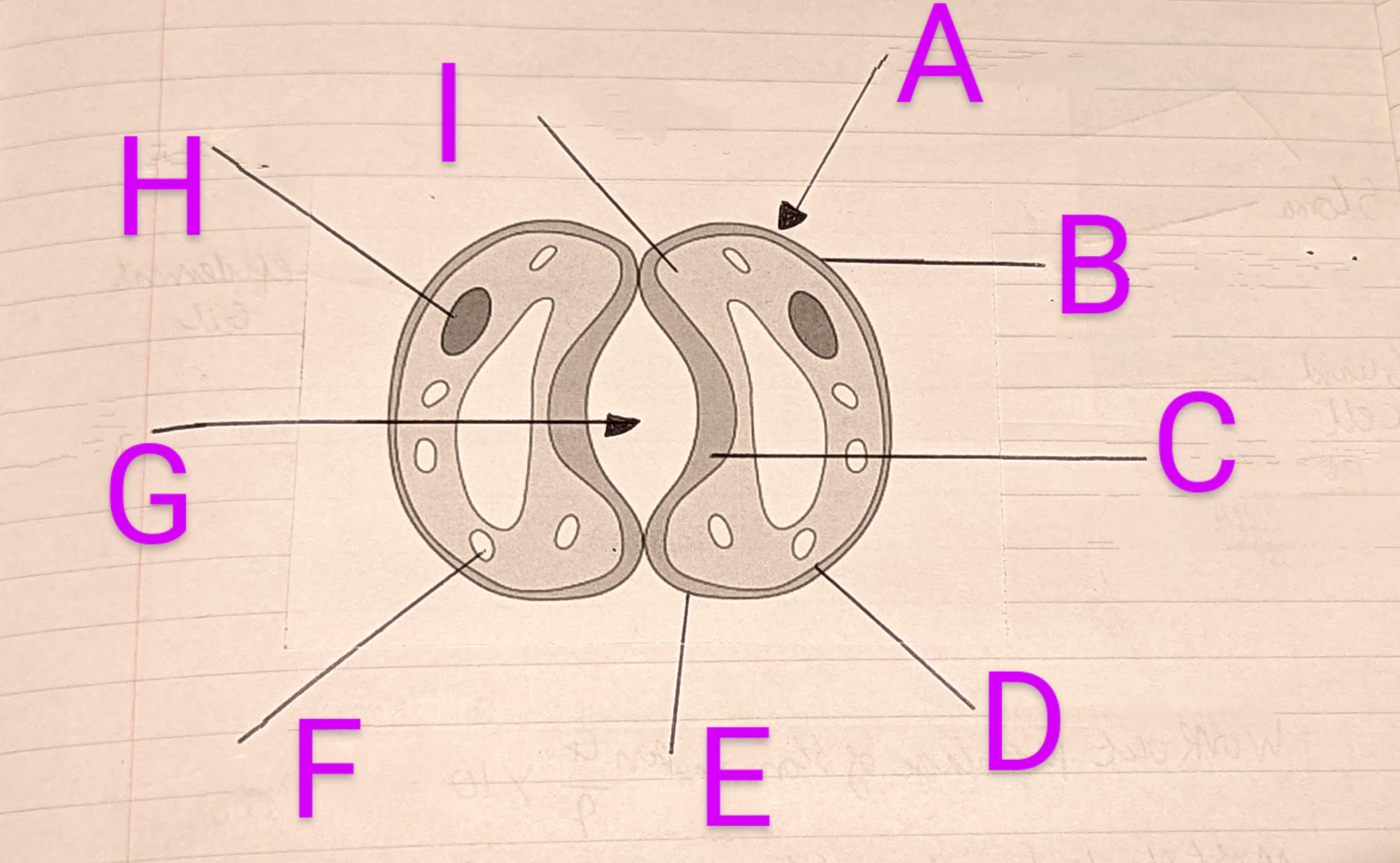
90
Describe how an increasing Glucose concentration in the Guard Cells causes the Stoma to Open?
During the day Glucose is Made in Guard Cells.
Causes Water to Move into Guard Cells by Osmosis from High Concentration to Lower Concentration of Water
Causes Water to Move into Guard Cells by Osmosis from High Concentration to Lower Concentration of Water
91
Most Plants have More Stomata on which side of the Leaf & why? 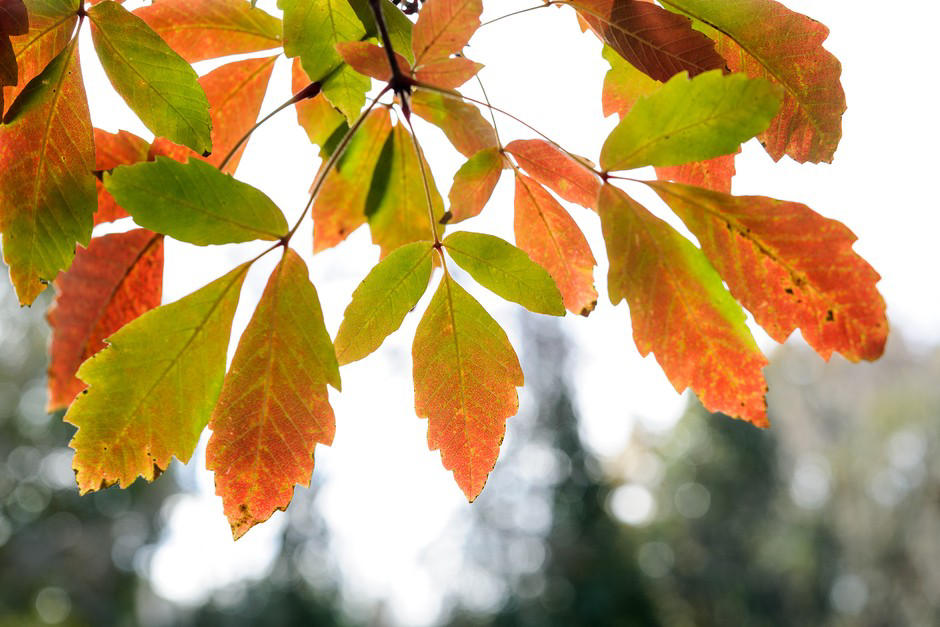
Most Plants have more Stomata on the Lower Surface than the Upper Surface of their Leaves.
Adaptation to Reduce Water Loss.
Adaptation to Reduce Water Loss.
92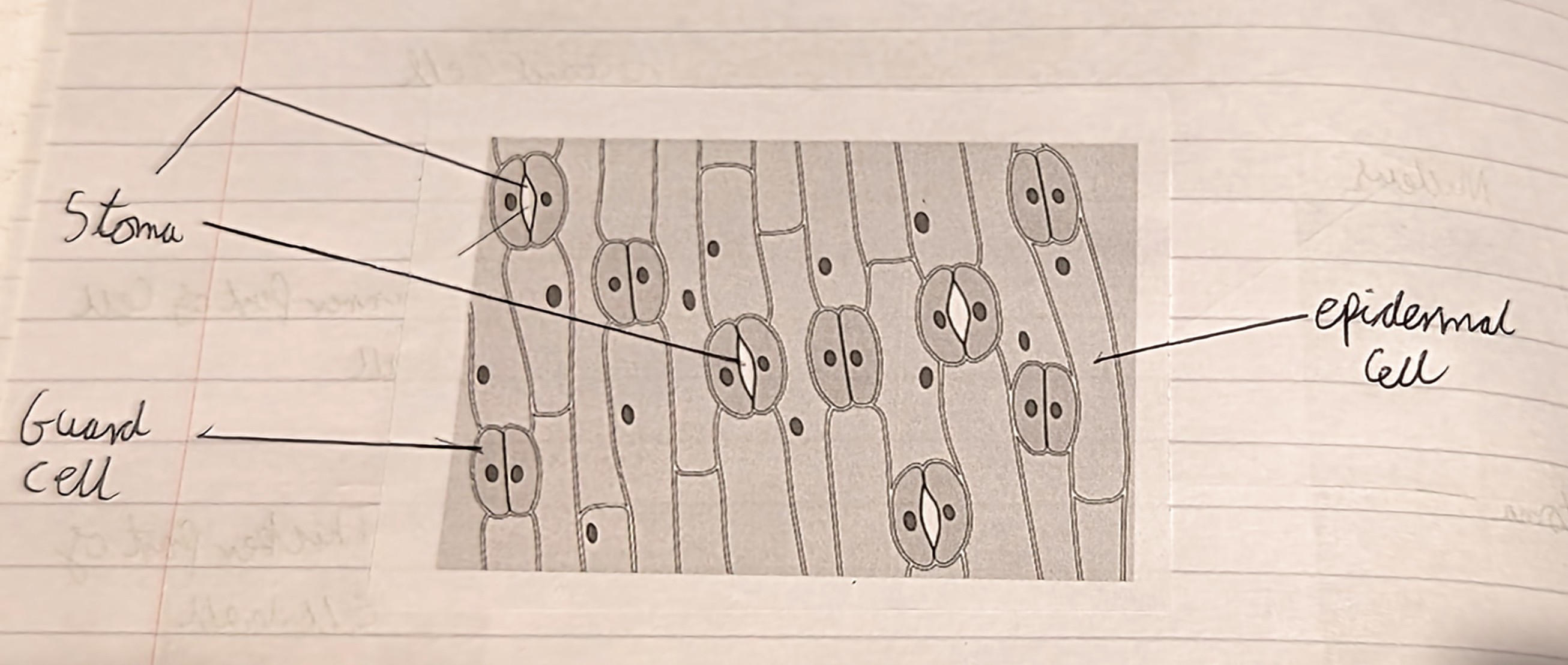
Lable Stoma and Guard Cell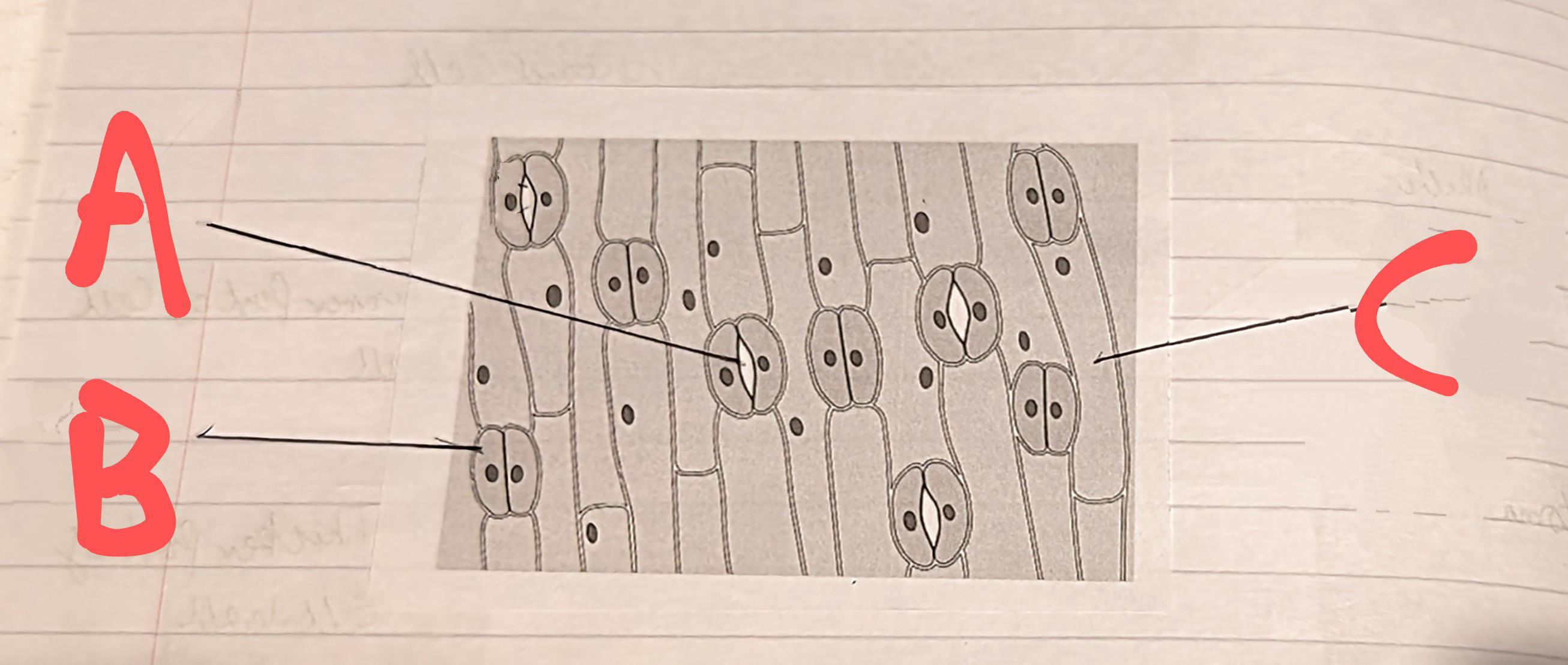
93
where are the Stomata found?
On the bottom side of leafs
94
What do Flowering Plants have that non flowering plants don't have?
Two Separate Transport Systems using Xylum and Phloem Tissue.
95
Xylem What does it transport, in what Direction and what is the Name of the Process?
•Transports Water & Mineral Ions.
• Moves up from Roots to Leaves.
• Process is called Transpiration.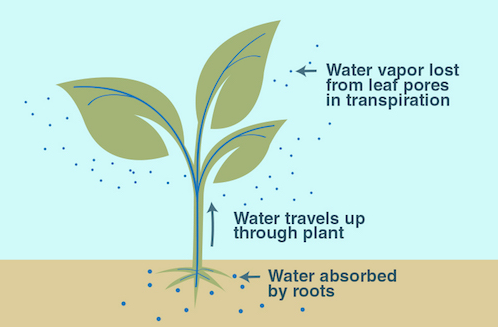
• Moves up from Roots to Leaves.
• Process is called Transpiration.
96
Phloem What does it transport, in what Direction and what is the Name of the Process?
•Transports Dissolved Sugars.
• Moves up & Down from Leaves to the Rest Of The Plant.
• Process is called Translocation
• Moves up & Down from Leaves to the Rest Of The Plant.
• Process is called Translocation
97
How & What Process do Mineral Ions get into the plant?
Mineral Ions go into thr Roots by the Process Active Transport
98
How & What Process do Water get into the plant?
Water goes into the Roots by the Process Osmosis
99
where are Glucose made in the Plant?
Sugar is made in Leaves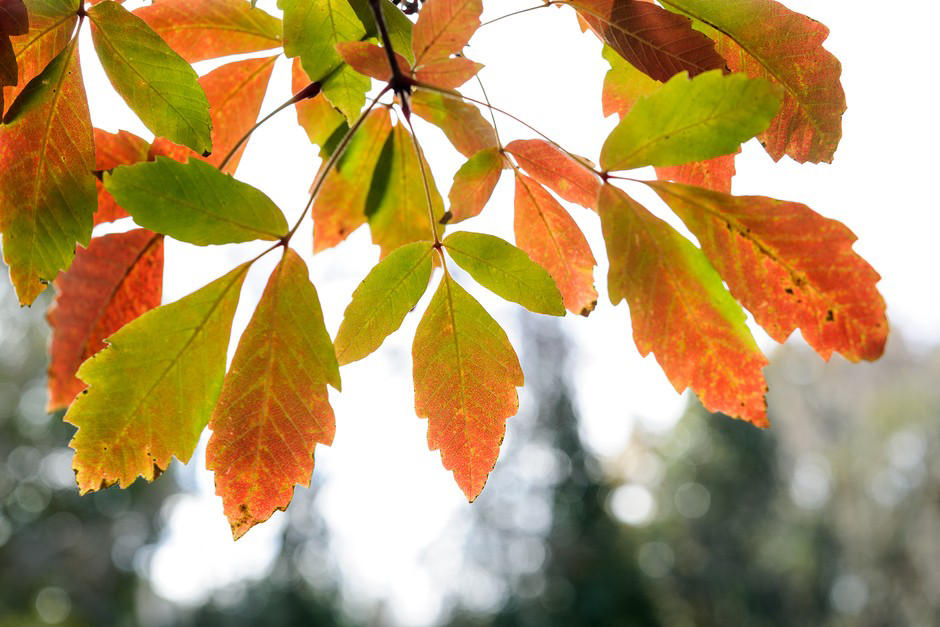
100
How is Sugar Transported through the Plant?
Sugar is transported through the plant through the Phloem (translocation)
101
How is Mineral Ions Transported through the Plant?
Mineral Ions is transported through the plant through the Xylem (transpiration)
102
What would happen if a plant didn't have Xylem and Phloem?
It couldn't get Water and Mineral Ions
103
Define Transpiration
Movement of Water Through the Xylem Tissue from the Roots, Up the Stem & Out through the Stomata by Evaporation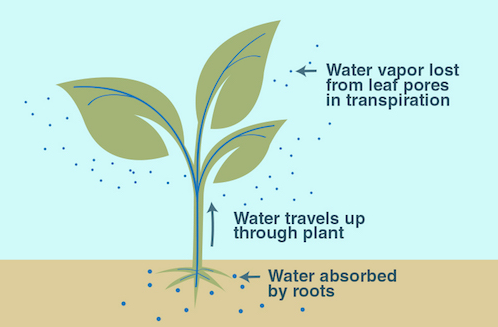
104
When is the Rate of Transpiration Higher?
(Water Loss)
(Water Loss)
• Hotter
• Drier/Less Humid
• Windier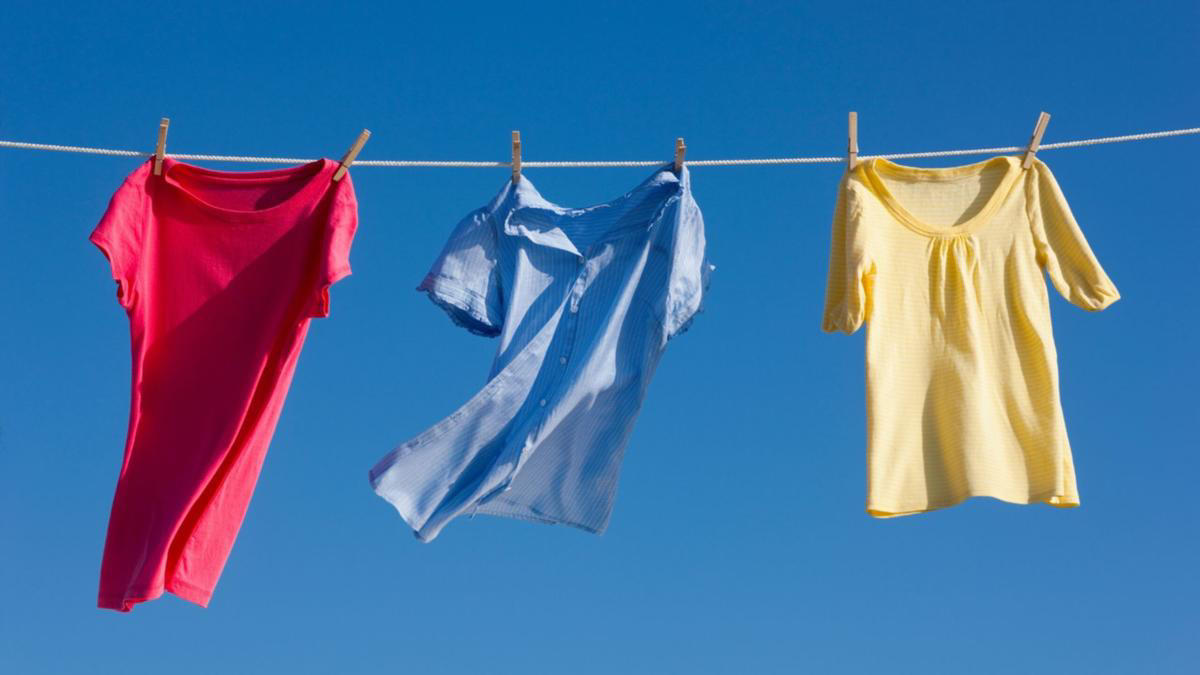
• Drier/Less Humid
• Windier
105
How can the rate of Transpiration be Measured?
Using a Potometer.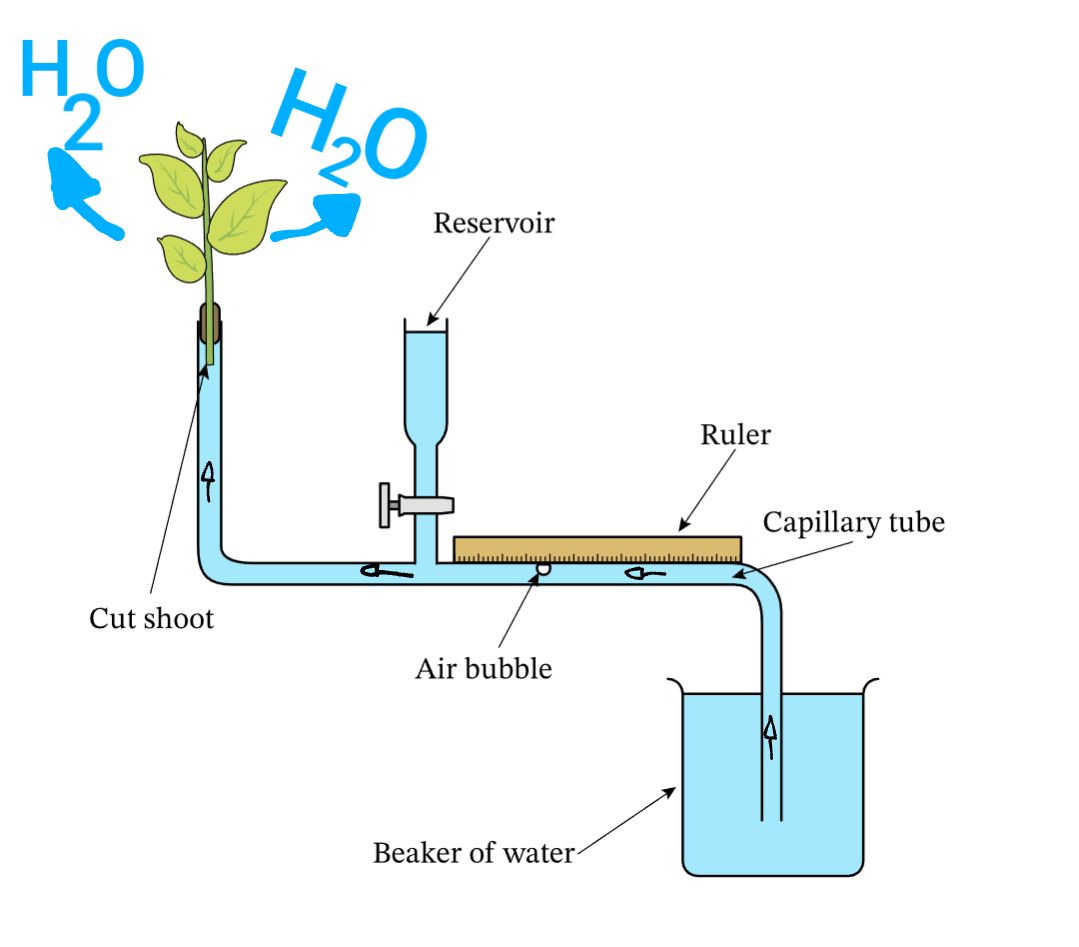
106
How do you use a Potometer to find out the Rate Of Transpiration? 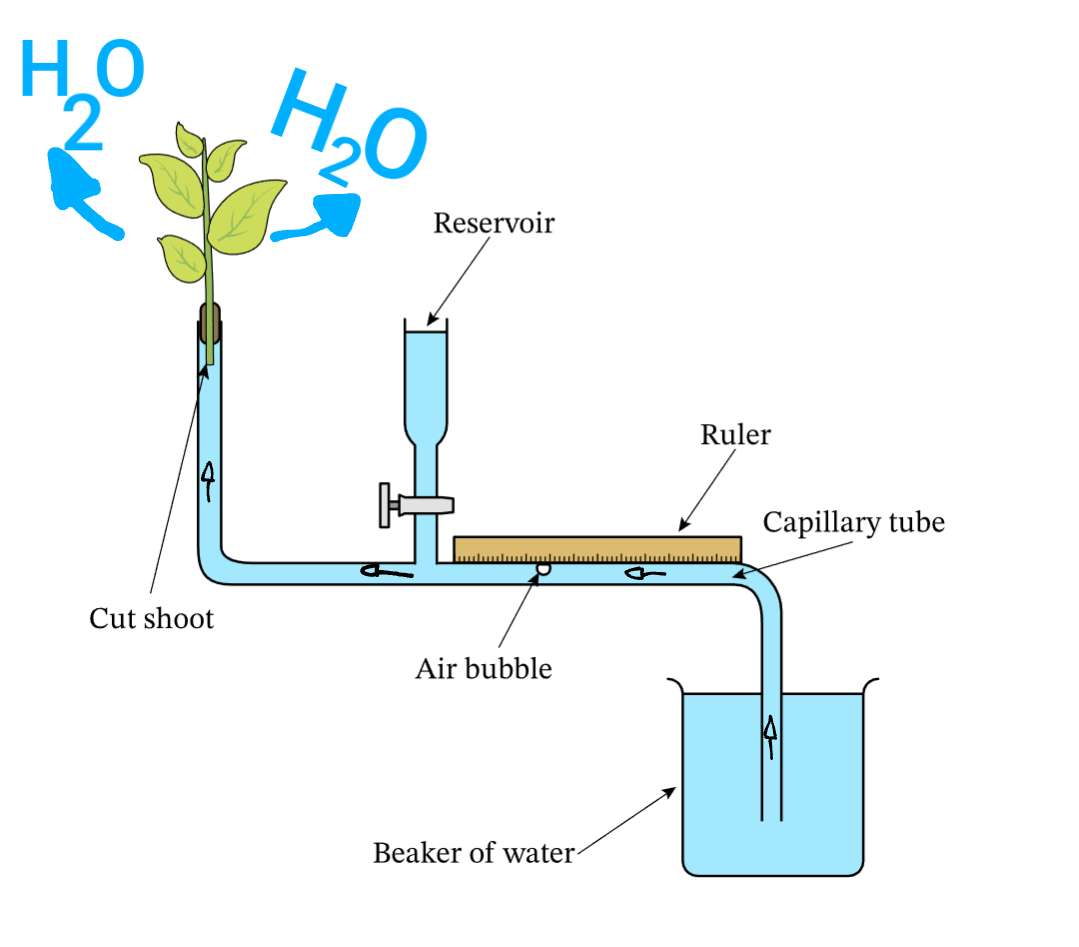
Plant will Lose Water from Evaporation so it Wants To Replace Water Lost. (moves Air Bubble)
Air Bubble which you Deliberately Trap will move Along the Scale and you Measure How Quick the Air Bubble Moves.
Faster Air Bubble Moves Faster Transpiration is Occurring .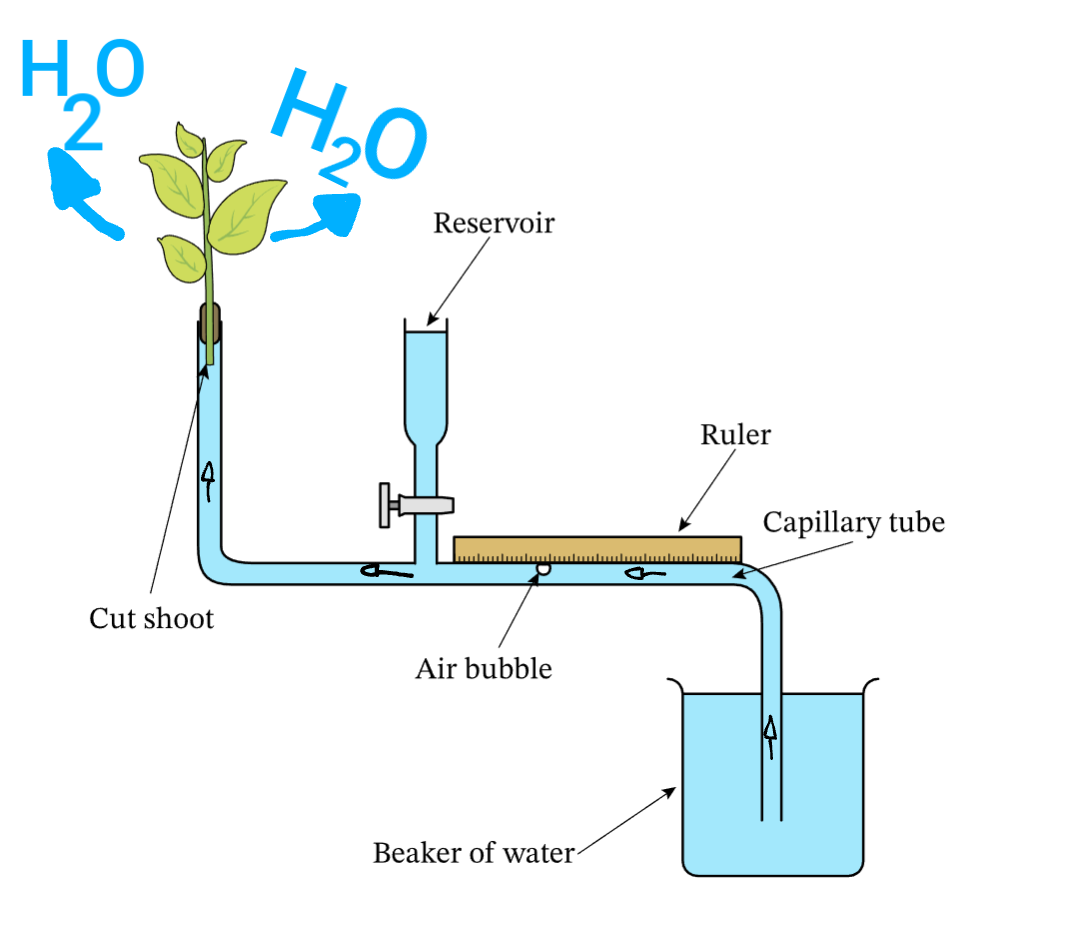
Air Bubble which you Deliberately Trap will move Along the Scale and you Measure How Quick the Air Bubble Moves.
Faster Air Bubble Moves Faster Transpiration is Occurring .
107
What would happen to the rate of transpiration if you removed a leaf?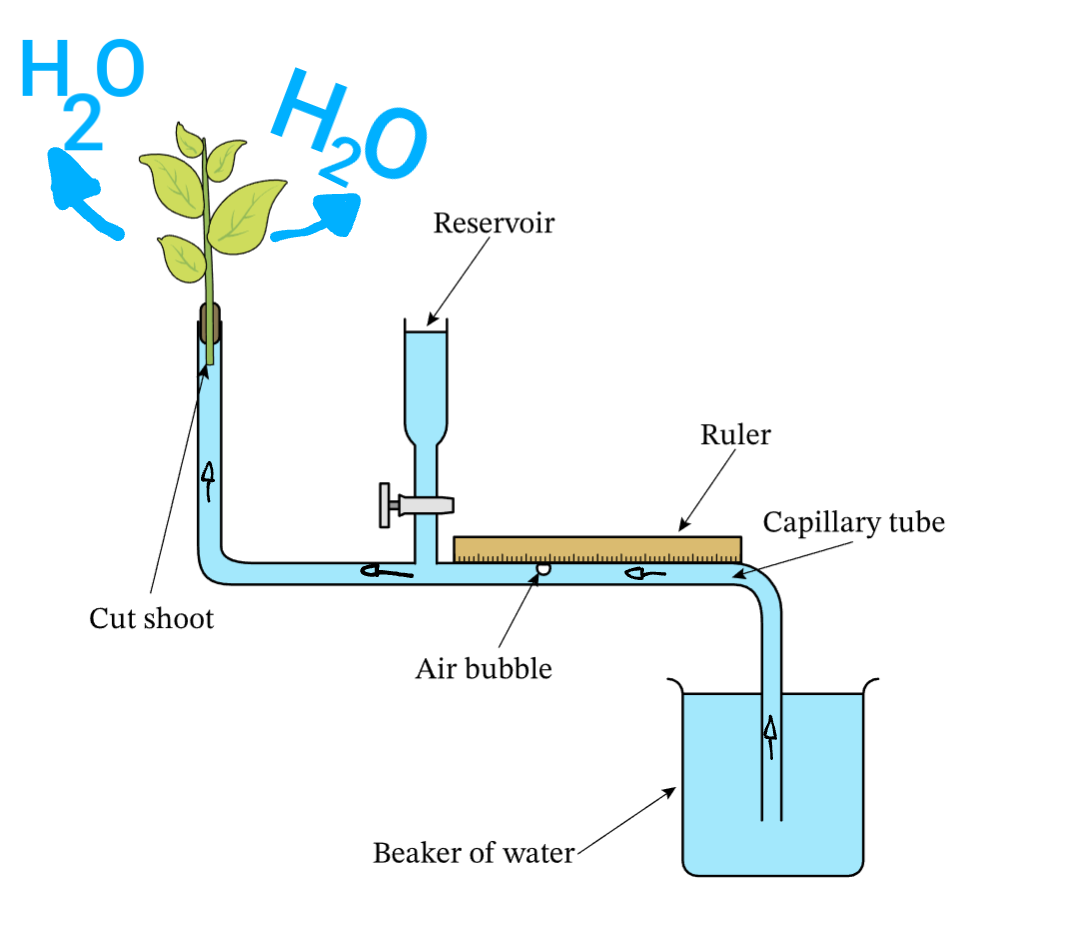
If you removed a leaf the Rate of Transpiration would Slow Down therefore Fewer Stomata because there are Less Leaves to Evaporate Water.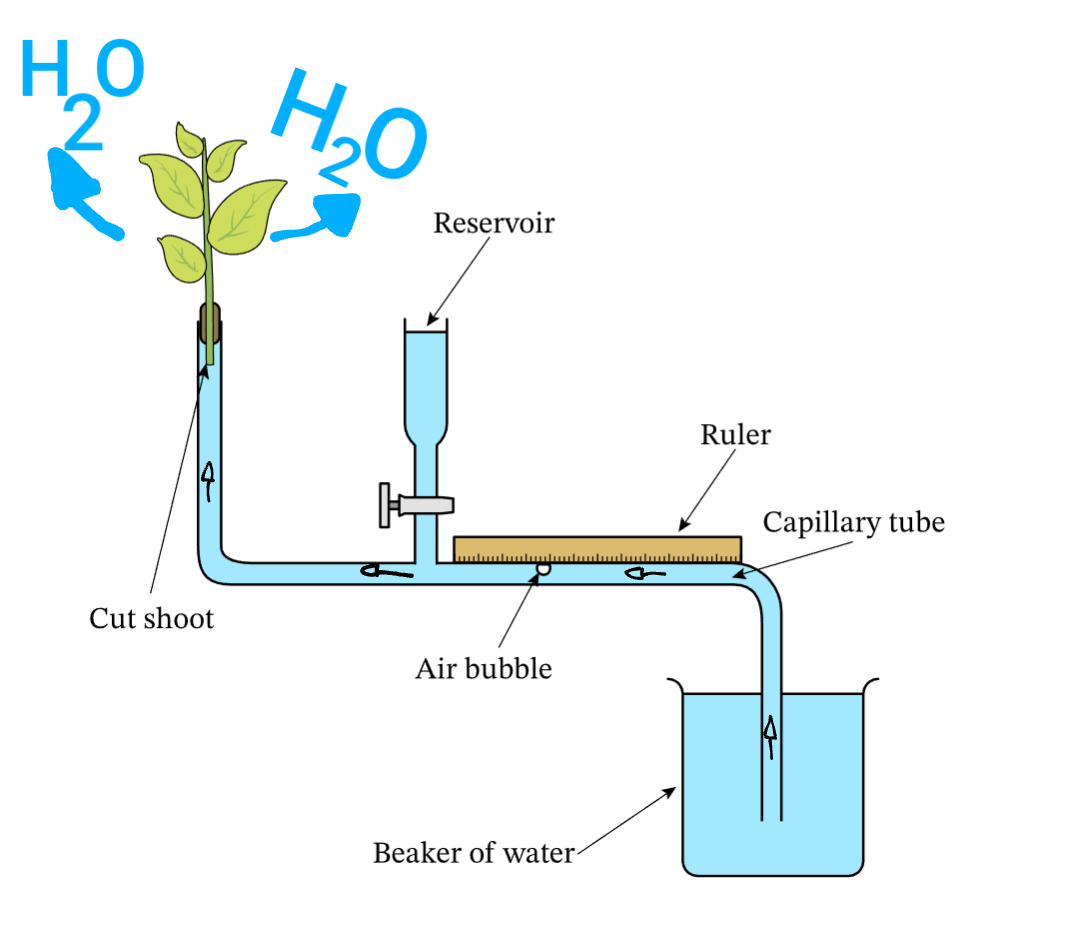
108
What would happen to Rate of Transpiration if you moved into a Warmer Room?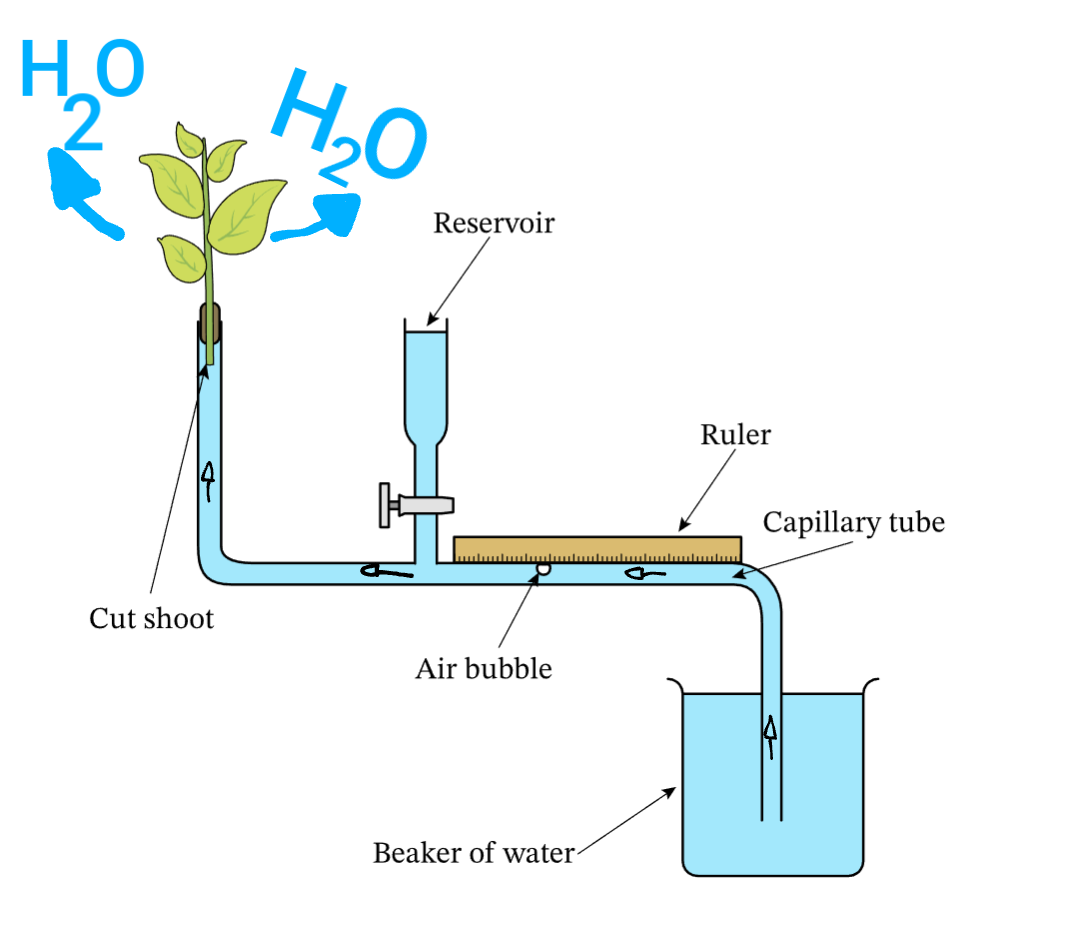
If it moved it into a warm of room. Transpiration would occur Faster because the plant would Release more Water.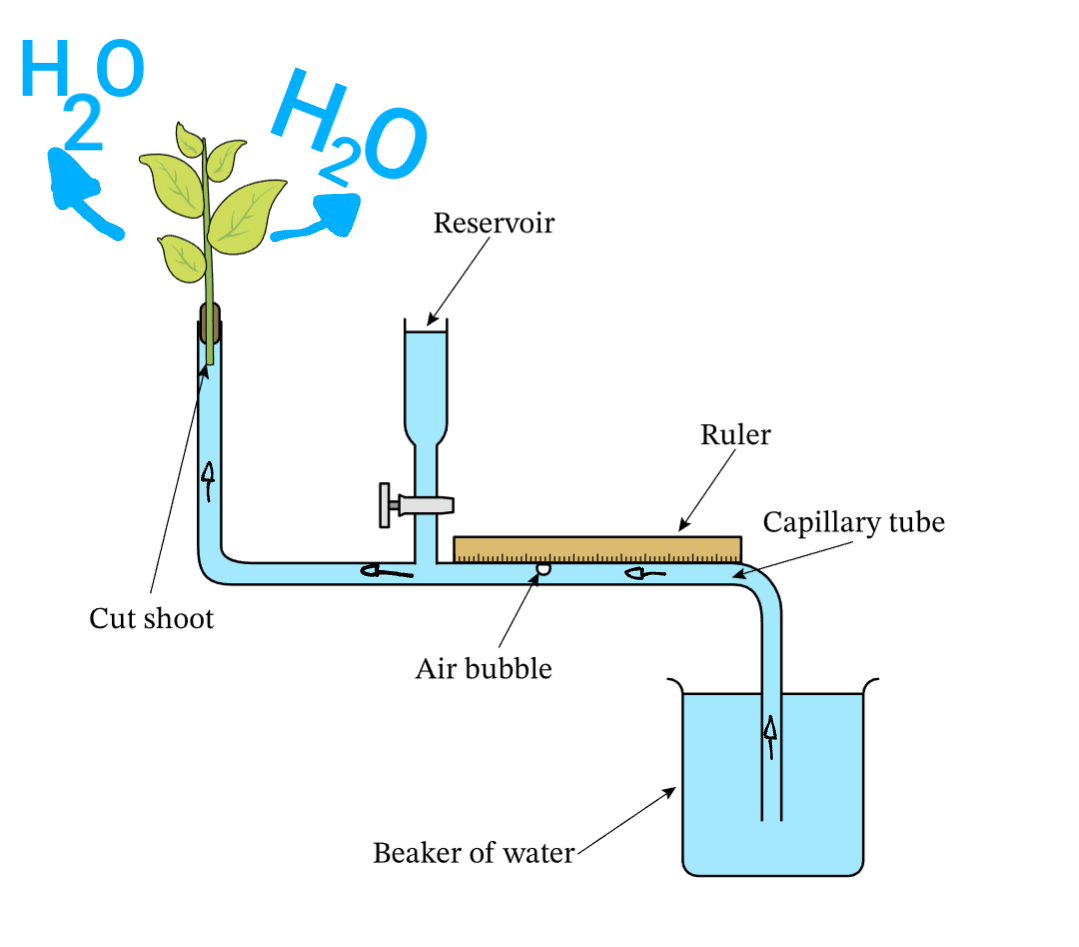
109
Why do plants Wilt?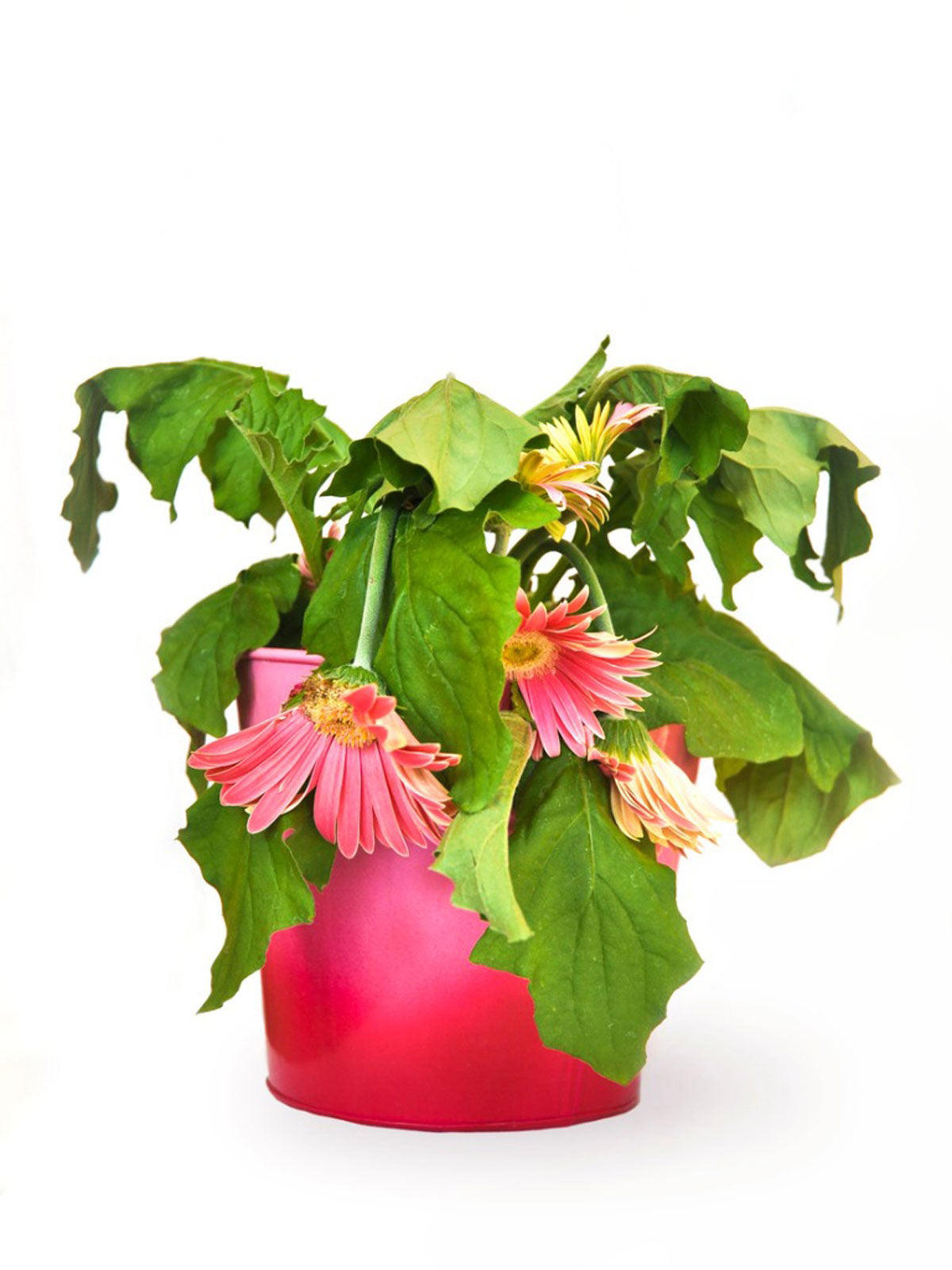
Plants Wilt if they Lose Water Faster than it is Replaced by the Roots.
So they want to Minimise Water Loss by Closing Stomata.
BUT Stomata need to be open to let CO2 in for Photosynthesis.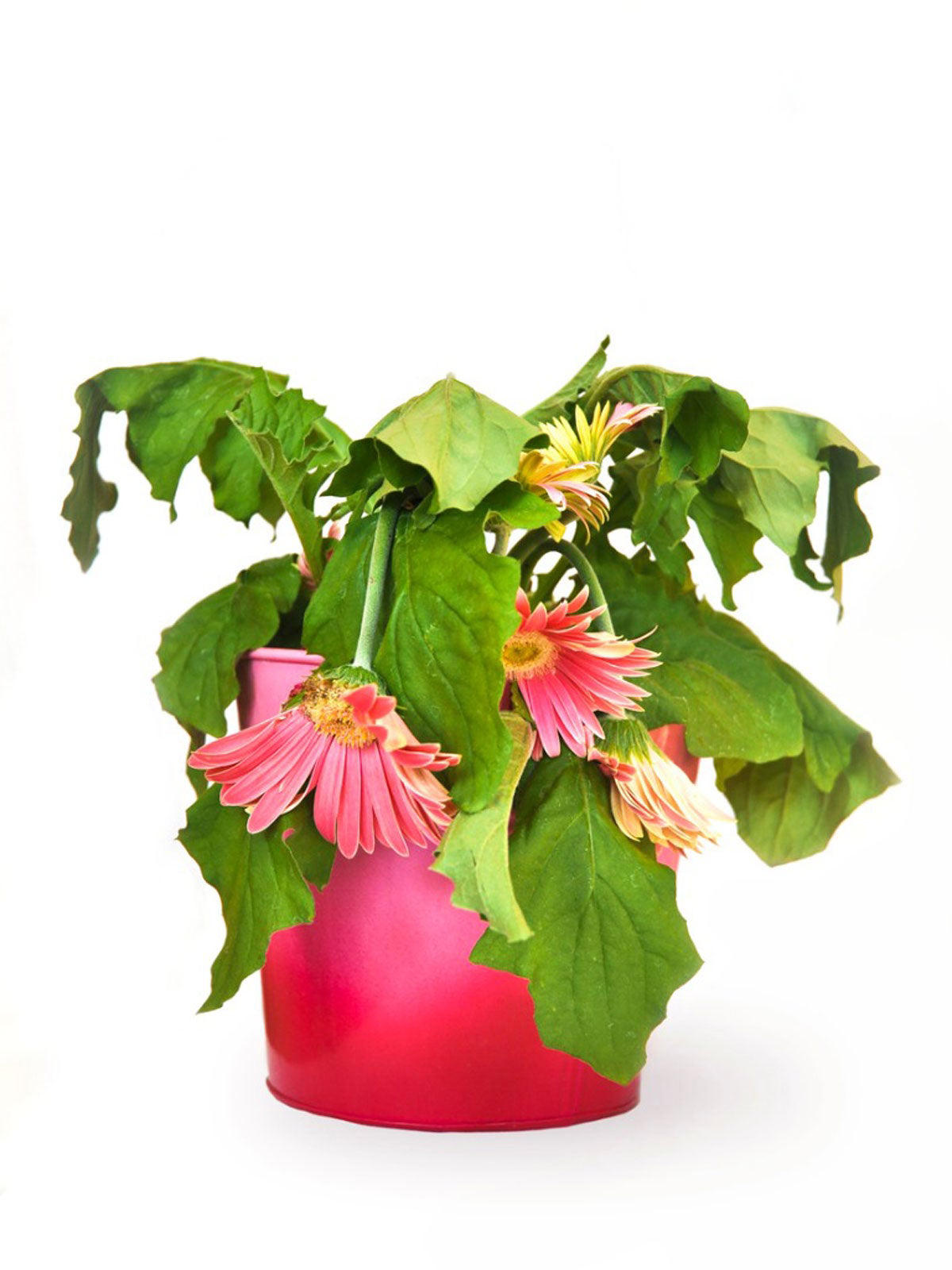
So they want to Minimise Water Loss by Closing Stomata.
BUT Stomata need to be open to let CO2 in for Photosynthesis.
110
Describe the Image for each:
Low Atmospheric CO2 & Normal Conditions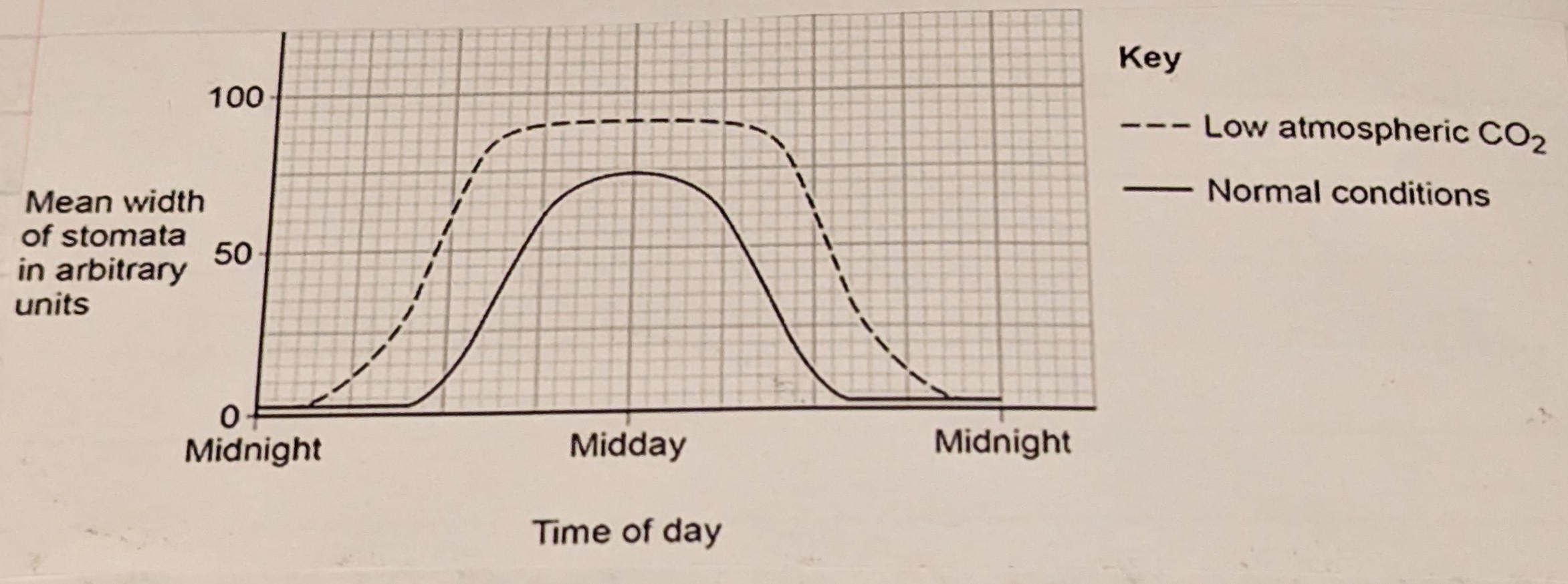
Low Atmospheric CO2 & Normal Conditions
In Low Atmospheric CO2 Stomata stay open for longer & are wider because they want lots of CO2 for Photosynthesis.
In Normal Conditions when it's Light Stomata are Open but when it's Dark Stomata Close because there is not enough CO2 & Light & they will lose water un-necessarily.
(They can't photosynthesis)
In Normal Conditions when it's Light Stomata are Open but when it's Dark Stomata Close because there is not enough CO2 & Light & they will lose water un-necessarily.
(They can't photosynthesis)
111
To Minimise Water Loss most plants do what?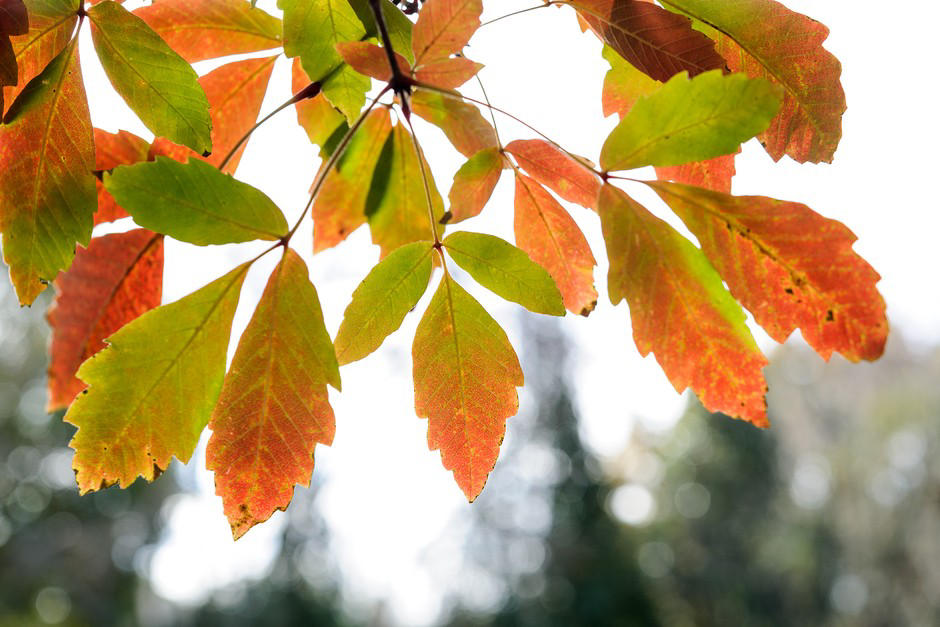
• Only Open Stomata when it's Light
(when photosynthesis can occur & CO2 is needed)
• Only have Stomata on Underside of Leaves, where it's Less Hot, Dry & Windy.
(when photosynthesis can occur & CO2 is needed)
• Only have Stomata on Underside of Leaves, where it's Less Hot, Dry & Windy.
112
Describe & Explain the Effect of the Rate of Transpiration of Putting Vaseline/Grease on Top of & Bottom of a Leaf?
If the Grease is On the Top of the leaf nothing happens.
If the Grease is On the Bottom it Slows Down Transpiration because Stomata are Blocked.
If the Grease is On the Bottom it Slows Down Transpiration because Stomata are Blocked.
113
Which cell in a plant controls the weight of water loss?
Guard Cells