Theories of Personalities
Study these flashcardsFree · spaced repetition · iPhone, Android, Mac & web
All cards
1
personality traits
openness to experiences, conscientiousness, extraversion, agreeableness, neuroticism
2
psychoanalytic perspective
Sigmund Freud, personality shaped by unconscious and childhood
libido- life instinct, drives behavior focused on pleasure, survival, and avoidance of pain
death instinct- drives dangerous behavior, desire to hurt others/oneself
id- generally unconscious, *pleasure principle* is to avoid pain and seek pleasure
ego- generally conscious, *reality principle* uses logic and reality, deals with the id and the superego, attempts to compromise
superego- morality, right and wrong
libido- life instinct, drives behavior focused on pleasure, survival, and avoidance of pain
death instinct- drives dangerous behavior, desire to hurt others/oneself
id- generally unconscious, *pleasure principle* is to avoid pain and seek pleasure
ego- generally conscious, *reality principle* uses logic and reality, deals with the id and the superego, attempts to compromise
superego- morality, right and wrong
3
consciousness
conscious- aware
preconscious- not aware but can be made aware
unconscious- inaccessible instinct and desire
Freud does not speak of subconsciousness
preconscious- not aware but can be made aware
unconscious- inaccessible instinct and desire
Freud does not speak of subconsciousness
4
ego defense mechanisms (8)
repression- completely forget a memory
denial- refuse to acknowledge a memory
reaction formation- express opposite emotion (I hate her, not sexually attracted to her)
projection- attribute feelings to someone else or thing (computer is dumb, not you)
displacement- redirect forbidden impulses onto less dangerous one (kick dog, not boss)
rationalization- justify impulsive behavior
regression-revert to earlier stage in development (adult wets bed after trauma)
sublimation- channel forbidden impulses into positive activities (paint picture, don't kill)
denial- refuse to acknowledge a memory
reaction formation- express opposite emotion (I hate her, not sexually attracted to her)
projection- attribute feelings to someone else or thing (computer is dumb, not you)
displacement- redirect forbidden impulses onto less dangerous one (kick dog, not boss)
rationalization- justify impulsive behavior
regression-revert to earlier stage in development (adult wets bed after trauma)
sublimation- channel forbidden impulses into positive activities (paint picture, don't kill)
5
Freud's stages of development (5)
oral- 0-1, mouth, weaning
anal- 1-3, anus, toilet training
phallic- 3-6, genitals, gender, oedipus/electra
latency- 6-12, sexual feelings dormant to focus on friendship
genital- 12+, other people's genitals, intimacy
if a child does not resolve the conflict, he becomes fixated and struggles with things later in life
anal- 1-3, anus, toilet training
phallic- 3-6, genitals, gender, oedipus/electra
latency- 6-12, sexual feelings dormant to focus on friendship
genital- 12+, other people's genitals, intimacy
if a child does not resolve the conflict, he becomes fixated and struggles with things later in life
6
Erikson's stages of development (6)
includes social and interpersonal factors
trust/mistrust- infancy
autonomy/shame- early childhood
initiative/ guilt- preschool
industry/inferiority- school
identity/ role confusion- adolescent
intimacy/isolation- young adult
generativity/stagnation- middle age
integrity/despair- later life
trust/mistrust- infancy
autonomy/shame- early childhood
initiative/ guilt- preschool
industry/inferiority- school
identity/ role confusion- adolescent
intimacy/isolation- young adult
generativity/stagnation- middle age
integrity/despair- later life
7
humanist perspective
Abraham Maslow says that self-actualization is an innate drive, we have free will
Carl Rogers says that humans are driven to realize their highest potential, personality conflicts arise when this is blocked
unconditional positive regard from parents is key to self-actualization
goal of development is to establish self-concept
incongruence- contradiction between ideal self and real self
Carl Rogers says that humans are driven to realize their highest potential, personality conflicts arise when this is blocked
unconditional positive regard from parents is key to self-actualization
goal of development is to establish self-concept
incongruence- contradiction between ideal self and real self
8
behaviorist perspective
B.F. Skinner says that humans learn behaviors based on environment, conditioning
determinism- people are blank slates, personality determined by reinforcement and punishment
babbling is reinforced by adults, babies learn
behavioral therapy- use conditioning to shape patient's behavior, desensitization and relaxation techniques
cognitive behavioral therapy- thoughts are behaviors, Beck's cognitive triad describe how depression comes from negative views of self, world, and future
determinism- people are blank slates, personality determined by reinforcement and punishment
babbling is reinforced by adults, babies learn
behavioral therapy- use conditioning to shape patient's behavior, desensitization and relaxation techniques
cognitive behavioral therapy- thoughts are behaviors, Beck's cognitive triad describe how depression comes from negative views of self, world, and future
9
classical conditioning
unconditioned response- original, natural response to stimuli
Ivan Pavlov did first experiment with bell and dog
phobias are conditioned through classical conditioning, can be made extinct through exposure therapy
Ivan Pavlov did first experiment with bell and dog
phobias are conditioned through classical conditioning, can be made extinct through exposure therapy
10
extinction
gradual weakening of a conditioned response that results in the behavior decreasing or disappearing
occurs with both classical and operant conditioning
occurs with both classical and operant conditioning
11
operant conditioning
*continuous reinforcement*- during initial part of acquisition phase, teach subject the correct behavior, type of fixed ratio reinforcement
*shaping*- reinforcing simple steps to condition a more complex behavior
*instinctual drift*- conditioned responses are replaced by instinctual behavior
*shaping*- reinforcing simple steps to condition a more complex behavior
*instinctual drift*- conditioned responses are replaced by instinctual behavior
12
primary/secondary reinforcement
primary reinforcers- biological like food, drink, and pleasure
secondary reinforcers- conditioned over a lifetime, like money, grades in schools, and tokens
secondary reinforcers- conditioned over a lifetime, like money, grades in schools, and tokens
13
positive/negative reinforcement
positive reinforcement- give good when desired behavior performed
negative reinforcement- remove bad when desired behavior performed
positive punishment- give bad when desired behavior not performed
negative punishment- remove good when desired behavior not performed
negative reinforcement- remove bad when desired behavior performed
positive punishment- give bad when desired behavior not performed
negative punishment- remove good when desired behavior not performed
14
partial reinforcement schedules (4)
partial reinforcement- learning is slower than continuous reinforcement, but more resistant to extinction
fixed ratio- reinforcement after set number of behavior, dip in response after each reinforcement
variable ratio- reinforcement after random number of behaviors, strongest schedule with no dips after reinforcements
fixed interval- reinforcement after set time, worse than ratio, dip in response after each reinforcement
variable interval- reinforcement after random times, worse than ratio but still no dips after reinforcements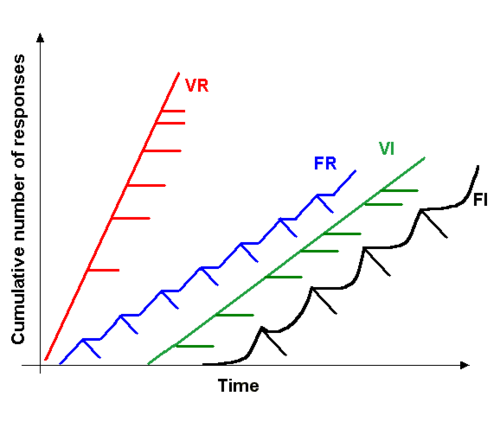
fixed ratio- reinforcement after set number of behavior, dip in response after each reinforcement
variable ratio- reinforcement after random number of behaviors, strongest schedule with no dips after reinforcements
fixed interval- reinforcement after set time, worse than ratio, dip in response after each reinforcement
variable interval- reinforcement after random times, worse than ratio but still no dips after reinforcements
15
social cognitive perspective (2)
Albert Bandura says that personality is not just behavioral, but also affected by cognitive and environmental factors
observational learning- Bobo doll study, behaviors are learned, *mirror neurons* for imitation
reciprocal determinism/causation- complex interactions of behavior, cognition, environment influencing each other
observational learning- Bobo doll study, behaviors are learned, *mirror neurons* for imitation
reciprocal determinism/causation- complex interactions of behavior, cognition, environment influencing each other
16
latent learning
latent learning- learning without reinforcement, learning with no explicit change in behavior while being taught, but it manifests later when the learned behavior is needed
insight learning- previously learned behaviors are combined in unique ways
related to social cognitive perspective and observational learning
insight learning- previously learned behaviors are combined in unique ways
related to social cognitive perspective and observational learning
17
trait perspective
personality is a result of traits, which are stable over time
cardinal traits- dominate person's life, rare and tend to develop later in life, Hitler is ruthless
central traits- terms you would use to describe someone, major characteristics
secondary traits- attitudes or preferences, situational aspects
INTP, OCEAN, dimensions of personality, etc.
cardinal traits- dominate person's life, rare and tend to develop later in life, Hitler is ruthless
central traits- terms you would use to describe someone, major characteristics
secondary traits- attitudes or preferences, situational aspects
INTP, OCEAN, dimensions of personality, etc.
18
biological perspective
Hans Eysenck says that personality is brain biology and genetics
personality traits are hierarchical, basic traits giving rise to larger array of traits
graph of extraversion and neuroticism explain array of personality
temperament, social potency, and other fixed traits
personality traits are hierarchical, basic traits giving rise to larger array of traits
graph of extraversion and neuroticism explain array of personality
temperament, social potency, and other fixed traits
19
behavioral genetics
individuals explained by nature and nurture, differences in behaviors, personality, disease incidence
shared environment- shared by siblings in the same family
nonshared environment- environment unique to individual
heritability- how much variation is caused by genetics, need large sample sizes
epigenetics differences- posttranslational changes in DNA, caused by environment, development, can be inherited
methodologies- family studies (not helpful, b/c environment and genetics play role), twin studies (study genetics), adoption studies (study environment)
phenylketonuria (PKA)- when treated, people are perfectly normal
autism- pesticides, plastics, drugs taken while pregnant, early diagnosis key
shared environment- shared by siblings in the same family
nonshared environment- environment unique to individual
heritability- how much variation is caused by genetics, need large sample sizes
epigenetics differences- posttranslational changes in DNA, caused by environment, development, can be inherited
methodologies- family studies (not helpful, b/c environment and genetics play role), twin studies (study genetics), adoption studies (study environment)
phenylketonuria (PKA)- when treated, people are perfectly normal
autism- pesticides, plastics, drugs taken while pregnant, early diagnosis key
20
attitude (3)
evaluation of people and things, formed from experiences
3 components:
1. cognition- thoughts and beliefs about it
2. affect- feelings about it
3. behavior- response to it
3 components:
1. cognition- thoughts and beliefs about it
2. affect- feelings about it
3. behavior- response to it
21
attitude influences behavior (4)
attitude predicts behavior when:
social influences are reduced
talking about general behaviors not specific instances, principle of aggregation- attitude affects person's average behavior
talking about specific attitudes, which are good at predicted specific behavior
self-reflection occurs, not impulse
social influences are reduced
talking about general behaviors not specific instances, principle of aggregation- attitude affects person's average behavior
talking about specific attitudes, which are good at predicted specific behavior
self-reflection occurs, not impulse
22
behavior influences attitude (3)
behavior has more powerful effect on attitude than the other way around
role-playing- we adjust attitude to align with expected behavior of role, Stanford prison experiment
public declarations- the more we express ourselves, the more we believe what we say
justification of effort- convince ourselves that the effort we put into something is worthwhile
role-playing- we adjust attitude to align with expected behavior of role, Stanford prison experiment
public declarations- the more we express ourselves, the more we believe what we say
justification of effort- convince ourselves that the effort we put into something is worthwhile
23
cognitive dissonance
don't like to hold two thoughts that are incompatible, so we do something to reduce the unpleasant tension
we prefer to change attitude rather than behavior
we prefer to change attitude rather than behavior
24
post-decisional conflict
after making a decision, we consider that it might be wrong
25
motivation
instinct- unlearned behaviors
needs- physiological needs and higher-level needs, creates a drive
drives- aroused internal state created by a need (*need is water, drive is thirst*)
arousal- need optimal level of stimulation
external motivator- external incentive triggers action
internal motivator- internal desire triggers action
3 components:
1. behavioral
2. cognitive
3 emotional/affective
needs- physiological needs and higher-level needs, creates a drive
drives- aroused internal state created by a need (*need is water, drive is thirst*)
arousal- need optimal level of stimulation
external motivator- external incentive triggers action
internal motivator- internal desire triggers action
3 components:
1. behavioral
2. cognitive
3 emotional/affective
26
drive-reduction theory
physiological needs creates arousal that drives organism to act to reduce arousal, seeking return to homeostasis
depression is a reduction in the motivating forces of arousal
depression is a reduction in the motivating forces of arousal
27
Maslow's hierarchy of needs
physiological needs, safety needs, love and belonging, esteem needs, self-actualization
while you cannot achieve higher needs until lower needs are met, you still have those higher needs
differs from Freud and Erikson, who say you don't have to resolve lower stage to move to higher ones
while you cannot achieve higher needs until lower needs are met, you still have those higher needs
differs from Freud and Erikson, who say you don't have to resolve lower stage to move to higher ones
28
emotion
universal emotions- happy, sad, anger, fear, surprise, disgust
facial expressions are recognized by almost all cultures
Yerkes-Dodson Law- emotion is adaptive, there is an optimal emotional arousal for performance
3 components:
1. physiological- arousal
2. behavioral- expressions
3. cognitive- subjective experience, appraisal, interpretation
facial expressions are recognized by almost all cultures
Yerkes-Dodson Law- emotion is adaptive, there is an optimal emotional arousal for performance
3 components:
1. physiological- arousal
2. behavioral- expressions
3. cognitive- subjective experience, appraisal, interpretation
29
theories of emotion (3)
James Lange- physiological arousal causes emotion
Cannon Bard- physiological arousal and emotion happen at same time
Schachter Singer- use situation to cognitively interpret physiological arousal to determine emotion
Cannon Bard- physiological arousal and emotion happen at same time
Schachter Singer- use situation to cognitively interpret physiological arousal to determine emotion
30
limbic system (4)
thalamus- center for incoming/outgoing stimuli
hypothalamus- homeostasis, base drives (sex, pain, hunger, etc.), send info to body via hormones and autonomic nervous system
hippocampus- consolidates STM into LTM
amygdala- emotions and fear, irrational thinking, electrical stimulation causes aggressive behavior, PTSD has overactive amygdala that prefrontal cortex cannot inhibit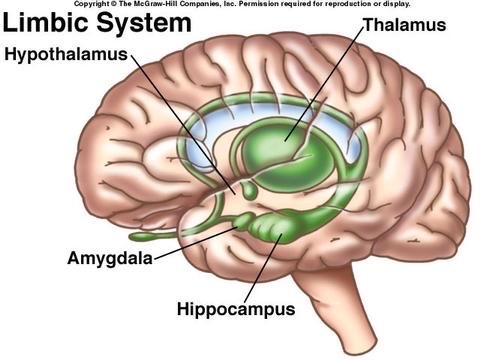
hypothalamus- homeostasis, base drives (sex, pain, hunger, etc.), send info to body via hormones and autonomic nervous system
hippocampus- consolidates STM into LTM
amygdala- emotions and fear, irrational thinking, electrical stimulation causes aggressive behavior, PTSD has overactive amygdala that prefrontal cortex cannot inhibit
31
stress
4 types of stressors:
1. catastrophes- large scale events, natural disasters and war, associated with PTSD, depression, anxiety
2. significant life changes- moving, losing job, death
3. daily hassles- everyday irritations, traffic, bills
4. ambient stressors- environmental, pollution
3 more types of stressors: distress, eustress, neustress
anger, anxiety, addiction
1. catastrophes- large scale events, natural disasters and war, associated with PTSD, depression, anxiety
2. significant life changes- moving, losing job, death
3. daily hassles- everyday irritations, traffic, bills
4. ambient stressors- environmental, pollution
3 more types of stressors: distress, eustress, neustress
anger, anxiety, addiction
32
managing stress
3 components of stress:
1. physiological- sympathetic NS releases epinephrine and norepinephrine (fast response to increase HR and RR), HPA releases cortisol (slow response to save glucose for brain), cortisol inhibits immune system, increases brain activity, increases glucose metabolism
2. emotional- negative mood causes worst medical things
3. behavioral- PTSD involves avoidance, hyperarousal, and re-experiencing
learned helplessness- believe you cannot control situation and averse stimuli, stress causes PTSD
adaptive ways to manage stress:
1. exercise
2. biofeedback- adjust physiological with yoga, meditation
3. social support
maladaptive ways to manage stress:
1. aggression
2. dependence
3. status-seeking
1. physiological- sympathetic NS releases epinephrine and norepinephrine (fast response to increase HR and RR), HPA releases cortisol (slow response to save glucose for brain), cortisol inhibits immune system, increases brain activity, increases glucose metabolism
2. emotional- negative mood causes worst medical things
3. behavioral- PTSD involves avoidance, hyperarousal, and re-experiencing
learned helplessness- believe you cannot control situation and averse stimuli, stress causes PTSD
adaptive ways to manage stress:
1. exercise
2. biofeedback- adjust physiological with yoga, meditation
3. social support
maladaptive ways to manage stress:
1. aggression
2. dependence
3. status-seeking
33
theories of stress
appraisal theory of stress- stress arises from interpretation
1. primary appraisal- consider how significant an event is, whether it is a good or bad event
2. secondary appraisal- consider ability to cope or take advantage of the event
Selye general adaptation syndrome- human stress response is not specific to the type of stressor
1. alarm- stress reaction kicks in
2. resistance- flee, all the cortisol
3. exhaustion- if no recovery, then tissue damage and decreased immune system (long term affects of stress)
1. primary appraisal- consider how significant an event is, whether it is a good or bad event
2. secondary appraisal- consider ability to cope or take advantage of the event
Selye general adaptation syndrome- human stress response is not specific to the type of stressor
1. alarm- stress reaction kicks in
2. resistance- flee, all the cortisol
3. exhaustion- if no recovery, then tissue damage and decreased immune system (long term affects of stress)
34
approach-avoidance conflict
approach-approach conflict- both options are positive
avoidant-avoidant conflict- both options are negative
approach-avoidant conflict- one option is positive and negative
double approach-avoidant conflict- both options are positive and negative
avoidant-avoidant conflict- both options are negative
approach-avoidant conflict- one option is positive and negative
double approach-avoidant conflict- both options are positive and negative
35
psychological disorders
diagnosable, treatable
psychological influences (paranoia, anxiety), sociocultural influences (isolation, stigma), biological influences (neurotransmitters)
anxiety disorders are most common (20%), then dissociative and mood disorders, then personality disorders
psychological influences (paranoia, anxiety), sociocultural influences (isolation, stigma), biological influences (neurotransmitters)
anxiety disorders are most common (20%), then dissociative and mood disorders, then personality disorders
36
neurodevelopmental disorders (2)
manifest early in development, intellectual disability, communication disorders
ADHD- impulsivity (can hinder performance on questions), motor restlessness, distractability
autism- males more more likely to have it, impaired social interaction, repetitive behavior
ADHD- impulsivity (can hinder performance on questions), motor restlessness, distractability
autism- males more more likely to have it, impaired social interaction, repetitive behavior
37
neurocognitive disorders
delirium- problems with attention/awareness
alzheimer's, parkinson's
alzheimer's, parkinson's
38
Parkinson's disease
caused by low dopamine levels, dopaminergic neurons in substantia nigra of basal ganglia die off
basal ganglia- voluntary motor movement, procedural learning, routine behavior
symptoms include tremors, hypokinesia
Lewy bodies- protein aggregates of alpha-synuclein inside neurons
basal ganglia- voluntary motor movement, procedural learning, routine behavior
symptoms include tremors, hypokinesia
Lewy bodies- protein aggregates of alpha-synuclein inside neurons
39
Alzheimer's disease
abnormalities in brain include amyloid plaques (amyloid beta, protein aggregates outside cells), neurofibrillary tangles (tau tangles, protein aggregates inside cells)
death of neurons cause memory failure and personality changes
cognitive dysfunction reduces performance on all tasks
death of neurons cause memory failure and personality changes
cognitive dysfunction reduces performance on all tasks
40
sleep disorders (2)
dyssomnias- abnormalities in amount or quality of sleep
1. insomnia- can't fall asleep or remain asleep
2. narcolepsy- periodic overwhelming sleepiness
3. sleep apnea- intermittent cessation of breathing during sleep, causes awakening
parasomnias- abnormal behavior during sleep
1. *somnambulism*- sleep-walking, occurring during stage 3, first 3rd of the night, children can grow out of it
2. *night terrors*- terrified, screaming during stage 3
unlike nightmares, which occur during REM sleep closer to the morning
1. insomnia- can't fall asleep or remain asleep
2. narcolepsy- periodic overwhelming sleepiness
3. sleep apnea- intermittent cessation of breathing during sleep, causes awakening
parasomnias- abnormal behavior during sleep
1. *somnambulism*- sleep-walking, occurring during stage 3, first 3rd of the night, children can grow out of it
2. *night terrors*- terrified, screaming during stage 3
unlike nightmares, which occur during REM sleep closer to the morning
41
stages of sleep (5)
sleep cycle lasts 90 minutes
awake- beta waves
sleepy- alpha waves
stage 1 sleep- theta waves
stage 2 sleep- theta waves, K-complexes, sleep spindles that suppress awakeness
stage 3 sleep- delta waves (slow waves, regular RR/HR)
stage 4 sleep- delta waves
REM sleep- dreaming, quick eye movements, paradoxical sleep (small muscle movements)
awake- beta waves
sleepy- alpha waves
stage 1 sleep- theta waves
stage 2 sleep- theta waves, K-complexes, sleep spindles that suppress awakeness
stage 3 sleep- delta waves (slow waves, regular RR/HR)
stage 4 sleep- delta waves
REM sleep- dreaming, quick eye movements, paradoxical sleep (small muscle movements)
42
theories of dreaming (4)
1. Freud says dreams have manifest content, symbolic of unconscious latent content
2. activation-synthesis theory- random brain activation
3. evolutionary purpose for threat simulation and problem solving
4. sleep helps encode to LTM
2. activation-synthesis theory- random brain activation
3. evolutionary purpose for threat simulation and problem solving
4. sleep helps encode to LTM
43
diathesis-stress theory
genes predispose people to certain disorders, stressors elicit onset of disease
44
opponent process theory
each emotion comes with a secondary opposite emotion that pushes in the other direction
give a baby a toy, baby is happy
take the toy away, baby is sad
eventually baby returns to neutral
addiction- with repeated exposures, withdrawal (sad) starts to outweigh the high (happy)
colors- opposite colors cannot both be activated
give a baby a toy, baby is happy
take the toy away, baby is sad
eventually baby returns to neutral
addiction- with repeated exposures, withdrawal (sad) starts to outweigh the high (happy)
colors- opposite colors cannot both be activated
45
anxiety disorders (4)
fear is immediate, anxiety is anticipatory, avoidance behavior
phobia- specific fear/anxiety, agoraphobia is fear of crowds
social anxiety disorder- fear/anxiety around social situations
panic disorders- panic attacks, anxiety about future attacks
generalized anxiety disorder- excessive anxiety without a cause
withdrawal and medical conditions can mimic anxiety symptoms
phobia- specific fear/anxiety, agoraphobia is fear of crowds
social anxiety disorder- fear/anxiety around social situations
panic disorders- panic attacks, anxiety about future attacks
generalized anxiety disorder- excessive anxiety without a cause
withdrawal and medical conditions can mimic anxiety symptoms
46
anxiety disorders (trauma)
PTSD- flashbacks, distress around similar experiences, derealization (everything feels unreal), depersonalization (out of body experience), hypervigilance
acute stress disorder- symptoms last longer, more persistent
adjustment disorders- severity of trauma not correlated to severity of symptoms (milder)
acute stress disorder- symptoms last longer, more persistent
adjustment disorders- severity of trauma not correlated to severity of symptoms (milder)
47
mood disorders (4)
major depressive disorder- fatigue, insomnia, loss of interest
monoamine hypothesis- basis of depression is decreased serotonin, norepinephrine, and/or dopamine
bipolar I disorder (manic-depressive)- mainly manic, needs manic episode, doesn't need depression to diagnose
bipolar II disorder- mainly depressive, needs depression, no manic episode, just hypomania
dysthymia- chronic depression, milder symptoms
hypomania- lots of energy, creativity
cyclothymic disorder- cycles of dysthymia and hypomania
monoamine hypothesis- basis of depression is decreased serotonin, norepinephrine, and/or dopamine
bipolar I disorder (manic-depressive)- mainly manic, needs manic episode, doesn't need depression to diagnose
bipolar II disorder- mainly depressive, needs depression, no manic episode, just hypomania
dysthymia- chronic depression, milder symptoms
hypomania- lots of energy, creativity
cyclothymic disorder- cycles of dysthymia and hypomania
48
schizophrenia
positive symptoms: hallucinations (sensation), delusions (beliefs), disorganized speech
dopamine may be hyperactive, creates euphoria, explains positive symptoms
negative symptoms: avolition (loss of motivation, flattened affect, reduced social interactions), alogia (decreased speech)
frontal lobe may be be hypoactive, explains negative
cognitive symptoms- poor WM, attention, executive functioning
genetic factors- only influence risk
environmental factors- stress/cortisol during pregnancy
types of schizophrenia:
1. paranoid- delusions and hallucinations, normal cognitive function
2. catatonic- extremes of behavior
3. disorganized- disorganized behavior and speech
4. undifferentiated- mixed symptoms
other types:
1. schizophreniform disorder- milder, not life-long
2. schizoaffective disorder- mood disorder
3. prodrome- deterioration before schizophrenia diagnosis
neuroleptics were first antipsychotics used, increased negative symptoms though
dopamine may be hyperactive, creates euphoria, explains positive symptoms
negative symptoms: avolition (loss of motivation, flattened affect, reduced social interactions), alogia (decreased speech)
frontal lobe may be be hypoactive, explains negative
cognitive symptoms- poor WM, attention, executive functioning
genetic factors- only influence risk
environmental factors- stress/cortisol during pregnancy
types of schizophrenia:
1. paranoid- delusions and hallucinations, normal cognitive function
2. catatonic- extremes of behavior
3. disorganized- disorganized behavior and speech
4. undifferentiated- mixed symptoms
other types:
1. schizophreniform disorder- milder, not life-long
2. schizoaffective disorder- mood disorder
3. prodrome- deterioration before schizophrenia diagnosis
neuroleptics were first antipsychotics used, increased negative symptoms though
49
substance-related disorders
psychological dependence- anxiety, depression
physical dependence- taking away the drug triggers *withdrawal* has physical symptoms, usually the opposite of the symptoms of the drug
*tolerance*- sensitivity to drug decreases
craving- strong desire to ingest a drug
reinforcing effects- operant condition, when you take the drug it feels good, when you don't take the drug it feels bad, so withdrawal due to an inhibitor of the drug would strengthen the reinforcing effects of the drug
nucleus accumbens- pleasure center that produces dopamine, responsible for addiction
Korsakoff's syndrome- long term memory loss from alcohol abuse, due to deficiency of thiamine
physical dependence- taking away the drug triggers *withdrawal* has physical symptoms, usually the opposite of the symptoms of the drug
*tolerance*- sensitivity to drug decreases
craving- strong desire to ingest a drug
reinforcing effects- operant condition, when you take the drug it feels good, when you don't take the drug it feels bad, so withdrawal due to an inhibitor of the drug would strengthen the reinforcing effects of the drug
nucleus accumbens- pleasure center that produces dopamine, responsible for addiction
Korsakoff's syndrome- long term memory loss from alcohol abuse, due to deficiency of thiamine
50
personality disorders (3)
inflexible pattern of socially deviant behaviors, begins in adolescence and not diagnosed in children
odd/eccentric (cluster A):
1. paranoid- mistrust everything
2. schizoid- detached loner
3. schizotypal- odd/magical beliefs and behaviors
dramatic/erratic (cluster B):
1. antisocial- disregard safety and rights of others, common in criminals
2. borderline- mood swings, self-harm
3. histrionic- dramatic, attract attention
4. narcissistic- grandiose and egotistical
anxious/fearful (cluster C):
1. avoidant- avoid people, fear of criticism/conflict
2. dependent- submissive and clingy to people, doesn't take responsibility
3. obsessive-compulsive- perfectionist, needs control
odd/eccentric (cluster A):
1. paranoid- mistrust everything
2. schizoid- detached loner
3. schizotypal- odd/magical beliefs and behaviors
dramatic/erratic (cluster B):
1. antisocial- disregard safety and rights of others, common in criminals
2. borderline- mood swings, self-harm
3. histrionic- dramatic, attract attention
4. narcissistic- grandiose and egotistical
anxious/fearful (cluster C):
1. avoidant- avoid people, fear of criticism/conflict
2. dependent- submissive and clingy to people, doesn't take responsibility
3. obsessive-compulsive- perfectionist, needs control
51
disruptive disorders (5)
oppositional defiant disorder- annoyed and angered easily, argue with authority
intermittent explosive disorder- bursts of anger greater than cause
conduct disorder- most severe, recurring destructive/aggressive behavior, feeling no remorse (may be diagnosed with antisocial), ex. bullying, fights, weapons, torturing
pyromania- impulsive fire-starting
kleptomania- impulsive stealing
intermittent explosive disorder- bursts of anger greater than cause
conduct disorder- most severe, recurring destructive/aggressive behavior, feeling no remorse (may be diagnosed with antisocial), ex. bullying, fights, weapons, torturing
pyromania- impulsive fire-starting
kleptomania- impulsive stealing
52
obsessive-compulsive disorders (4)
obsessions (urges) and compulsions (repetitive behaviors)
OCD- no distinct emotions, impossible to control
body dysmorphic disorder- obsessive preoccupation that some aspect of one's own appearance is severely flawed
hoarding disorder- distress at the thought of getting rid of personal items
trichotillomania- urges to pull out body hair
OCD- no distinct emotions, impossible to control
body dysmorphic disorder- obsessive preoccupation that some aspect of one's own appearance is severely flawed
hoarding disorder- distress at the thought of getting rid of personal items
trichotillomania- urges to pull out body hair
53
somatic symptom disorders (5)
medically unexplainable symptoms
somatic symptom disorder- general, vague symptoms
illness anxiety disorder- fear of illness even w/o symptoms
conversion disorder- specific disruption of nervous system, unexplainable paralysis or blindness, emotion is converted to neurological symptom
factitious disorder- falsification, to get attention, Munchhausen syndrome
somatic symptom disorder- general, vague symptoms
illness anxiety disorder- fear of illness even w/o symptoms
conversion disorder- specific disruption of nervous system, unexplainable paralysis or blindness, emotion is converted to neurological symptom
factitious disorder- falsification, to get attention, Munchhausen syndrome
54
eating disorders (4)
pica- eating non-food items
anorexia nervosa- starving
bulimia nervosa- binge eating and purging
binge eating disorder- no purging
anorexia nervosa- starving
bulimia nervosa- binge eating and purging
binge eating disorder- no purging
55
dissociative disorders (3)
DID- abnormal integration of consciousness
dissociative amnesia- lost part of autobiographical memory, wander aimlessly in dissociative fugue
can also selectively forget distracting elements of autobiographical memory
depersonalization/derealization disorder- associated with PTSD
common with abuse and trauma
dissociative amnesia- lost part of autobiographical memory, wander aimlessly in dissociative fugue
can also selectively forget distracting elements of autobiographical memory
depersonalization/derealization disorder- associated with PTSD
common with abuse and trauma
56
consciousness altering drugs (3)
depressants depress sympathetic NS, decrease brain activity, decrease glucose metabolism:
1. alcohol- stimulate GAPA and dopamine, suppress REM
2. *barbiturates*- sedatives, sleep aids, depress sympathetic NS
3. *opiates*- mimic endorphins to relieve pain, examples are morphine and heroin
4. *benzodiazepines*- stimulate GABA, anti-anxiety
stimulants activate sympathetic NS, increase brain activity, increase glucose metabolism:
1. release neurotransmitter or prevent reuptake
2. caffeine, nicotine- cause a rush
3. cocaine- release dopamine, serotonin, norepinephrine
4. ecstasy- release dopamine and serotonin
5. amphetamines- meth
hallucinogens make you see things, can be either stimulating or depressing, no dependence:
1. marijuana- THC stimulates cannabinoid receptors, amplifies sensory perception
2. LSD- emotional, out-of-body
1. alcohol- stimulate GAPA and dopamine, suppress REM
2. *barbiturates*- sedatives, sleep aids, depress sympathetic NS
3. *opiates*- mimic endorphins to relieve pain, examples are morphine and heroin
4. *benzodiazepines*- stimulate GABA, anti-anxiety
stimulants activate sympathetic NS, increase brain activity, increase glucose metabolism:
1. release neurotransmitter or prevent reuptake
2. caffeine, nicotine- cause a rush
3. cocaine- release dopamine, serotonin, norepinephrine
4. ecstasy- release dopamine and serotonin
5. amphetamines- meth
hallucinogens make you see things, can be either stimulating or depressing, no dependence:
1. marijuana- THC stimulates cannabinoid receptors, amplifies sensory perception
2. LSD- emotional, out-of-body
57
serial position effects
primacy effect and recency effect, hard to remember things in the middle
58
sensation/perception
psychophysics- study of how stimuli is translated to psychological experience
sensation- detecting and encoding physical stimuli
perception- selecting and interpreting sensations
sensation- detecting and encoding physical stimuli
perception- selecting and interpreting sensations
59
sensory thresholds
absolute threshold- lowest level of stimuli to detect 50% of time
difference threshold- minimum difference between two stimuli to detect 50% of time, known as *Just Noticeable Difference*
subliminal stimuli- stimuli below aboslute threshold
difference threshold- minimum difference between two stimuli to detect 50% of time, known as *Just Noticeable Difference*
subliminal stimuli- stimuli below aboslute threshold
60
Weber's Law
size of just noticeable difference is proportional to original stimuli value, its more like a noticeable percentage
61
signal detection theory
type I error- false positive
type II error- missed
signal depends on acquisition of information and application of criteria
external noise (instrument) and internal noise (physician) can cause errors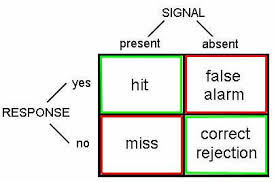
type II error- missed
signal depends on acquisition of information and application of criteria
external noise (instrument) and internal noise (physician) can cause errors
62
ROC curve
receiver operating characteristic curve compares false alarm rate on x axis to hit rate on y axis
steeper curve means more accurate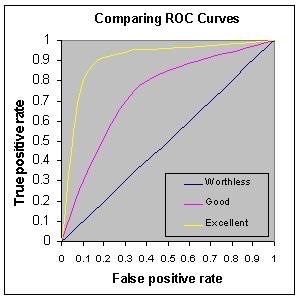
steeper curve means more accurate
63
habituation
sensory adaption, decreasing responsiveness with repeated stimulation
64
encoding of sensory stimuli
modality- type of stimuli, encoded by type of receptor firing
location- encoded by receptive field of stimulus
intensity- how strong, encoded by rate of firing of action potentials (frequency matters since action potentials are 1 or 0)
duration- how long stimulus is present
location- encoded by receptive field of stimulus
intensity- how strong, encoded by rate of firing of action potentials (frequency matters since action potentials are 1 or 0)
duration- how long stimulus is present
65
encoding specificity principle
conditions of encoding match conditions of testing
66
sensory receptors
tonic receptors- generate action potential as long as stimuli is present, may decrease over time due to habituation (sensory adaption), noiceptors (pain receptors)
phasic receptors- generate action potential only at changes in stimuli, depolarization/hyperpolarization can occur
phasic receptors- generate action potential only at changes in stimuli, depolarization/hyperpolarization can occur
67
feature detection theory
parts of brain are activated for specific features of visual stimuli, visual cortex passes sensory info to parts of the brain responsible for shape, angle, motion, etc.
ex. one feature detection neuron fires more action potentials at straight vertical lines
ex. one feature detection neuron fires more action potentials at straight vertical lines
68
parallel processing
many aspects of visual stimulus are processed simultaneously rather than serial processing
retinal processing- rods and cones activated
1. feature detection- feature neurons activated in visual cortex
2. abstraction- higher level visual cortex
3. recognition- match to memory
automatically process space, time, frequency, but need conscious effort to process novel information and interpret
retinal processing- rods and cones activated
1. feature detection- feature neurons activated in visual cortex
2. abstraction- higher level visual cortex
3. recognition- match to memory
automatically process space, time, frequency, but need conscious effort to process novel information and interpret
69
kinesthesis
proprioception, allows us to sense position of body in space
mechanoreceptors that detect mechanical movement- muscle spindle (muscle stretching), Golgi tendon organs (tension in tendons), joint capsule receptors (pressure/tension in joints)
mechanoreceptors that detect mechanical movement- muscle spindle (muscle stretching), Golgi tendon organs (tension in tendons), joint capsule receptors (pressure/tension in joints)
70
perception
stimulus- environmental, attended, receptors
electrochemical processes- transduction (activating receptor), transmission, processing
experience- perception, recognition, action
electrochemical processes- transduction (activating receptor), transmission, processing
experience- perception, recognition, action
71
types of stimuli
distal stimuli- objects and events out in the world
proximal stimuli- patterns from these objects and events that actually reach your senses
proximal stimuli- patterns from these objects and events that actually reach your senses
72
types of processing (2)
bottom-up processing- starts with sensory information to construct final representation in mind, learning Chinese, *inductive reasoning is always correct*
top-down processing- starts with a concept/idea that is imposed on sensory details, reading English, *deductive reasoning can be wrong*
top-down processing- starts with a concept/idea that is imposed on sensory details, reading English, *deductive reasoning can be wrong*
73
gestalt psychology
sum is greater than the parts
perceptual organization- to transform sensory information, we organize it
Gestalt principles:
1. emergence- patterns from randomness
2. pragnanz- seeing simplest form rather than complex one
3. figure/ ground- focus on an object, turns everything else to background
4. multistability- 3d illusions, switching between two logical interpretations
5. laws of grouping- group by proximity, continuity, closure, common fate, connectedness
perceptual organization- to transform sensory information, we organize it
Gestalt principles:
1. emergence- patterns from randomness
2. pragnanz- seeing simplest form rather than complex one
3. figure/ ground- focus on an object, turns everything else to background
4. multistability- 3d illusions, switching between two logical interpretations
5. laws of grouping- group by proximity, continuity, closure, common fate, connectedness
74
categorical perception
a continuous change in one dimension is perceived as distinct categories
75
binocular cues for depth
*retinal disparity*- greater difference in image between eyes, the shorter the distance
*convergence*- greater extent to which eyes converge to look at object, the shorter the distance
*convergence*- greater extent to which eyes converge to look at object, the shorter the distance
76
monocular cues for depth
relative size- smaller is closer
interposition- object blocking another is closer
relative clarity- sharper is closer
texture gradient- coarse is closer
relative height- higher in visual field is further
motion parallax- faster objects as we move are closer
linear perspective- greater convergence the further
light and shadow- brighter is closer
interposition- object blocking another is closer
relative clarity- sharper is closer
texture gradient- coarse is closer
relative height- higher in visual field is further
motion parallax- faster objects as we move are closer
linear perspective- greater convergence the further
light and shadow- brighter is closer
77
motion perception
assume that changing size of object suggests object is moving towards or away
larger objects should change size slowly
phi phenomenon- blinking lights next to each other give illusion of movement
larger objects should change size slowly
phi phenomenon- blinking lights next to each other give illusion of movement
78
perceptual constancy
shape constancy- despite changes in dimensions or orientation
size constancy- despite changes in depth
brightness constancy- despite changes in lighting
size constancy- despite changes in depth
brightness constancy- despite changes in lighting
79
attention
focus awareness on some stimuli and not others, selective attention and divided attention
resource model, spotlight model, filter model (Broadbent), attenuation model (Treisman)
resource model, spotlight model, filter model (Broadbent), attenuation model (Treisman)
80
Broadbent filter model of selective attention
input enters sensory store, selective filter removes unattended input and allowed to decay, then input goes to higher level processing and WM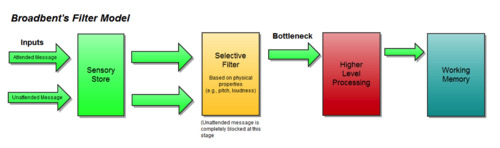
81
Treisman attenuation model of selective attention
some information not attended to can be detected, just turned down to lower volume, processed but not consciously
cocktail party effect- name is salient and shifts your attention
shadowing- repeating out loud what you hear in attending ear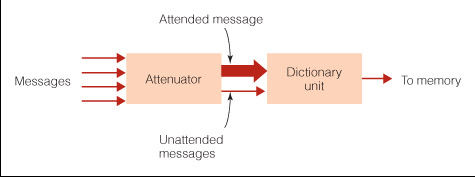
cocktail party effect- name is salient and shifts your attention
shadowing- repeating out loud what you hear in attending ear
82
sensory memory
activated before working memory
83
working memory
7+/-2 items
84
Baddeley's model of working memory (4)
central executive- coordinates slave systems, selective attention and inhibition, task shifting
phonological loop- short-term store, auditory rehearsal, links to semantic verbal memory
visuospatial sketchpad- temporary store of spatial and visual information, links to semantic visual memory
episodic buffer- integrate information across domains, links to episodic memory and links to LTM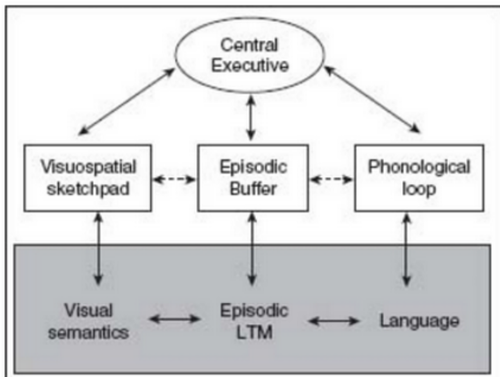
phonological loop- short-term store, auditory rehearsal, links to semantic verbal memory
visuospatial sketchpad- temporary store of spatial and visual information, links to semantic visual memory
episodic buffer- integrate information across domains, links to episodic memory and links to LTM
85
types of memory
procedural memory
sensory memory
working memory
short term memory
long term memory
STM and LTM are separate memory systems
implicit memory- responses influenced by experience, no awareness of remembering
explicit memory- intentional retrieval, semantic and episodic are the two types
semantic- facts and general knowledge
episodic- declarative memory, events
iconic memory- visual memory
echoic memory- auditory memory
*retrograde*- memory before event, going back in time
*anterograde*- memory after event, going forward in time
sensory memory
working memory
short term memory
long term memory
STM and LTM are separate memory systems
implicit memory- responses influenced by experience, no awareness of remembering
explicit memory- intentional retrieval, semantic and episodic are the two types
semantic- facts and general knowledge
episodic- declarative memory, events
iconic memory- visual memory
echoic memory- auditory memory
*retrograde*- memory before event, going back in time
*anterograde*- memory after event, going forward in time
86
rehearsal (3)
maintenance rehearsal- repetition, encodes to STM and working memory
elaboration rehearsal- connection to info already stored in memory, encodes to LTM
chunking- organize items into group to hold more in memory
elaboration rehearsal- connection to info already stored in memory, encodes to LTM
chunking- organize items into group to hold more in memory
87
schema (2)
mental framework to organize experiences and respond to new ones, created by implicit attitudes and memories
assimilation- new info interpreted using old info
accommodation- new info is incorporated into old info
assimilation- new info interpreted using old info
accommodation- new info is incorporated into old info
88
spreading activation theory
originates from hierarchical semantic network, where categories order the nodes
but this semantic network has no hierarchy, activating one node increases the likelihood of associated nodes becoming active
activation increases the ease of access to that material and makes retrieval of that node easier
confabulation- false memories can be triggered by activation of associated nodes
but this semantic network has no hierarchy, activating one node increases the likelihood of associated nodes becoming active
activation increases the ease of access to that material and makes retrieval of that node easier
confabulation- false memories can be triggered by activation of associated nodes
89
interference
retroactive interference- newly learned information interferes with recall of previously learned information
proactive interference- previously learned information interferes with recall of new learned information
interference cannot occur if you have retrograde amnesia, anterograde amnesia, or a memory disorder like Alzheimer's, Korsakoff syndrome, etc.
proactive interference- previously learned information interferes with recall of new learned information
interference cannot occur if you have retrograde amnesia, anterograde amnesia, or a memory disorder like Alzheimer's, Korsakoff syndrome, etc.
90
priming
A retrieval cue by which recall is aided by a word or phrase that is semantically related to the desired memory
increases likelihood of activation of nearby nodes
relies on implicit memory to work
increases likelihood of activation of nearby nodes
relies on implicit memory to work
91
autobiographical memory
childhood amnesia- no memory of first 5 years, although during childhood you can of course form LTM
reminiscence bump- heightened autobiographical memory for events that occurred between ages 10 and 30
reminiscence bump- heightened autobiographical memory for events that occurred between ages 10 and 30
92
source monitoring error
a specific type of recollection where a memory is incorrectly attributed to the wrong source
93
memory over time
semantic memory improves, episodic memory declines
implicit memory is stable, explicit memory declines
emotional reasoning improves, attention/processing declines
recognition memory is stable, recall memory declines
prospective memory decreases, where you remember to do something in the future
implicit memory is stable, explicit memory declines
emotional reasoning improves, attention/processing declines
recognition memory is stable, recall memory declines
prospective memory decreases, where you remember to do something in the future
94
Piaget's stages of cognitive development (4)
sensorimotor- 0-2, achieve: *object permanence*, stranger anxiety
preoperational- 2-7, achieve: pretend play, egocentrism
concrete operational- 7-11, achieve: *conservation*, logical reasoning
formal operational- 11-17, achieve: *hypothetical reasoning*, moral reasoning
preoperational- 2-7, achieve: pretend play, egocentrism
concrete operational- 7-11, achieve: *conservation*, logical reasoning
formal operational- 11-17, achieve: *hypothetical reasoning*, moral reasoning
95
Kohlberg's stages of moral development (3)
preconventional:
1. obedience (avoid punishment)
2. self-interest (personal gain)
conventional:
1. conformity (approval)
2. authority (social order), most adults are here
postconventional:
1. social contract (fairness)
2. universal principles (ethics)
1. obedience (avoid punishment)
2. self-interest (personal gain)
conventional:
1. conformity (approval)
2. authority (social order), most adults are here
postconventional:
1. social contract (fairness)
2. universal principles (ethics)
96
problem solving techniques (4)
trial-and-error- attempt potential solutions
algorithm- step-by-step procedure to exhaust all possible options, guarantees solution
heuristic- mental shortcut or guideline
insight- complete solution comes all at once, incubation gives time for this to occur
algorithm- step-by-step procedure to exhaust all possible options, guarantees solution
heuristic- mental shortcut or guideline
insight- complete solution comes all at once, incubation gives time for this to occur
97
problem solving obstacles (4)
fixation- structuring a problem in a certain way, unable to rethink it
mental set- tendency to approach problem in same way because it worked in the past
functional fixedness- think of objects only based on their typical use
framing- good things make us avoid risk
mental set- tendency to approach problem in same way because it worked in the past
functional fixedness- think of objects only based on their typical use
framing- good things make us avoid risk
98
availability heuristic
rely on examples that immediately come to mind
99
representative heuristic
comparing to existing prototype already existing in our mind
100
belief perseverance
belief bias- cling to old beliefs despite contrary evidence
hindsight bias- overestimate their ability to have predicted an outcome
confirmation bias- seek evidence to support ideas more than we seek evidence to refute, stronger for emotional topics, affects the way we search for and interpret evidence
leads to overconfidence
hindsight bias- overestimate their ability to have predicted an outcome
confirmation bias- seek evidence to support ideas more than we seek evidence to refute, stronger for emotional topics, affects the way we search for and interpret evidence
leads to overconfidence
101
intelligences (7)
general intelligence- g, *mental age*, IQ test normalized to 100
social intelligence- understand and manage people
emotional intelligence- monitor emotions in decision making
multiple intelligences- 8 different types of intelligence, different people excel in different intelligences
fluid intelligence- reasoning, abstract
crystallized intelligence- knowledge
fixed mindset- intelligence is static
growth mindset- intelligence can be developed
social intelligence- understand and manage people
emotional intelligence- monitor emotions in decision making
multiple intelligences- 8 different types of intelligence, different people excel in different intelligences
fluid intelligence- reasoning, abstract
crystallized intelligence- knowledge
fixed mindset- intelligence is static
growth mindset- intelligence can be developed
102
intelligence (nature vs. nurture)
in infancy, intelligence is 20% genetics since problems are easy and parenting is important
in adults, intelligence is 70% genetics since problems are hard
in adults, intelligence is 70% genetics since problems are hard
103
language acquisition (3)
learning/ behaviorist model- operant conditioning
nativist model- Chomsky says we have universal grammar, language acquisition device, an innate ability to learn language, *critical or sensitive period* during childhood, afterwards becomes much harder
interactionist model- driven by child's desire to communicate with others
first word by one year, explosion of language in second year
nativist model- Chomsky says we have universal grammar, language acquisition device, an innate ability to learn language, *critical or sensitive period* during childhood, afterwards becomes much harder
interactionist model- driven by child's desire to communicate with others
first word by one year, explosion of language in second year
104
plasticity (2)
brain can modify self and adapt to new environments
experience expectant- has a critical period, brain is primed to learn something (like language)
experience dependent- requires experience to learn it
experience expectant- has a critical period, brain is primed to learn something (like language)
experience dependent- requires experience to learn it
105
Sapir-Whorf hypothesis
linguistic relativity- language define and limit our cognitive ability
better at distinguishing colors for which we have a name
strong vs. weak theories
better at distinguishing colors for which we have a name
strong vs. weak theories
106
Broca's area
language production, frontal lobe of dominant (left) hemisphere, damage causes non-fluent aphasia
"Drive... car... get... groceries."
"Drive... car... get... groceries."
107
Wernicke's area
language comprehension, temporal lobe of dominant (left) hemisphere, damage causes fluent aphasia
"Have you ever had a dream that you you had your you could you'll do you wants you could do so you you'll do, you could you you want you want them to do you so much you could do anything?"
"Have you ever had a dream that you you had your you could you'll do you wants you could do so you you'll do, you could you you want you want them to do you so much you could do anything?"
108
language processing
auditory input goes to respective auditory cortexes, then go to language areas on left hemisphere
109
components of language
phenome- different sounds
morphemes- parts of a word
semantics- meaning of word
syntax- order of words in sentence
pragmatics- language depends on context
prosody- language depends on inflection of our voices
morphemes- parts of a word
semantics- meaning of word
syntax- order of words in sentence
pragmatics- language depends on context
prosody- language depends on inflection of our voices
110
brain imaging
MRI- magnetic field to look at brain structure
CAT/CT- X-ray to look at brain structure
fMRI- functional MRI, measures brain activity by detecting changes in blood flow, good spatial resolution
PET- radiolabelled glucose or other molecules, detect cancer cells and other cellular functions
EEG- record electrical activity, good temporal resolution
CAT/CT- X-ray to look at brain structure
fMRI- functional MRI, measures brain activity by detecting changes in blood flow, good spatial resolution
PET- radiolabelled glucose or other molecules, detect cancer cells and other cellular functions
EEG- record electrical activity, good temporal resolution
111
experimental methods
don't do causative experiments in psychology or sociology
probably unethical or inefficient
probably unethical or inefficient