Introduction to Neurotrans
Study these flashcardsFree · spaced repetition · iPhone, Android, Mac & web
All cards
1
Excitatory Neurtransmitters: , , , , , ,
Excitatory Neurtransmitters: Acetylcholine, aspartate, dopamine, histamine, norepinephrine, epinephrine, glutamate, 5‐ hydroxytryptamine (serotonin)
2
Inhibitory neurotransmitter: , ,
Inhibitory neurotransmitter: glycine, taurine, 4‐ aminobutyrate (GABA)
3
1. Presynaptic vessicles
2. Binding of Neurotransmitter (Depolarization Na+/K+)
3. Metabolic degradation of neurotrasnmitters in the pre-synaoptic neuron or in the nueral cleft.
2. Binding of Neurotransmitter (Depolarization Na+/K+)
3. Metabolic degradation of neurotrasnmitters in the pre-synaoptic neuron or in the nueral cleft.
1. Resting: Presynaptic vessicles
2. Excitation: Binding of Neurotransmitter (Depolarization Na+/K+)
3. Degradation: Metabolic degradation of neurotrasnmitters in the pre-synaoptic neuron or in the nueral cleft.
2. Excitation: Binding of Neurotransmitter (Depolarization Na+/K+)
3. Degradation: Metabolic degradation of neurotrasnmitters in the pre-synaoptic neuron or in the nueral cleft.
4
In the case of neurotransmitter serotonin, it is taken up into the (reuptake) before it is degraded.
In the case of neurotransmitter serotonin, it is taken up into the presynaptic neuron (reuptake) before it is degraded.
5
cells are the supporting nueronal cells that maintain normal physiology of system
Glial cells are the supporting nueronal cells that maintain normal physiology of system
6
are cells that provide fatty myelin sheaths that insulate axons. When the axonal connections die, you can end up with
Oligodendrocytes are cells that provide fatty myelin sheaths that insulate axons. When the axonal connections die, you can end up with Multiple Sclerosis
7
-Microglia protects the neuron from infection through phagocytosis. The microgla are activated by inflammatory signals
-The signals from the damaged cells include
-The signals from the damaged cells include
-Microglia protects the neuron from infection through phagocytosis. The microgla are activated by astrocyte inflammatory signals TNF-alpha, IL-6, and NO
-The signals from the damaged cells include ATP and CX3CL1
-The signals from the damaged cells include ATP and CX3CL1
8
Acetylcholine causes the opening of
channels in nerve after a nerve stimulus
channels in nerve after a nerve stimulus
Acetylcholine causes the opening of
Na+/K+ channels in post synaptic nerve after a nerve stimulus
Na+/K+ channels in post synaptic nerve after a nerve stimulus
9
is one of the fastest enzymes. Such a high turnover
is expected, since recovery from depolarization occurs within seconds.
is expected, since recovery from depolarization occurs within seconds.
Acetylcholinesterase is one of the fastest enzymes. Such a high turnover
is expected, since recovery from depolarization occurs within seconds.
is expected, since recovery from depolarization occurs within seconds.
10
Acetl CoA has a role in , , , , , and
Acetl CoA has a role in fatty acid synthesis, cholesterol synthesis, neurtransmitter synthesis, isoprenoids, trans acteylation, and TCA cycle
11
What is an example of something that is trans acetylated? What is the effect?
Histones. Acetylation if histones activates them.
12
Choline becomes acteylcholine using and
Choline becomes acteylcholine using choline acteyltrasnferase and Actyel CoA
13
Acetylcholine becomes acetate and choline using and
Acetylcholine becomes acetate and choline using cholinesterase and water
14
Physotigmine and neostigmine inhibit acteylcholinesterase by carbamoylating at active site.
Physotigmine and neostigmine inhibit acteylcholinesterase by carbamoylating serine at active site.
15
What does DIPF (organophosphate) target?
The active site serine
16
DIPF reactuves with the active site serine and enzyme irreveseribly
DIPF reactuves with the active site serine and covalently modifies enzyme irreveseribly
17
Tubocuraine, alpha bungarotoxin, and cobra toxin compete with
Tubocuraine, alpha bungarotoxin, and cobra toxin compete with acteylcholine receptor
18
Receptor targeted inhibitors (alpha bungartoxin, cobra toxin, etc) function as
Receptor targeted inhibitors (alpha bungartoxin, cobra toxin, etc) function as comptetive inhibitors
19
and have selenocystine
Glutathione peroxidase and deiodinase have selenocystine
20
What is the universal methyl group donor?
SAM
21
Methionine is a amino acid
Methionine is a conditional amino acid
22
Proline is synthesized from
Proline is synthesized from glutamate
23
Glutamate become (needs and ) which becomes which then becomes proline ( )
Glutamate become glutamate semialdehyde (needs ATP and NADH) which becomes gamma pyroline 5 carboxylate which then becomes proline (using NADPH) 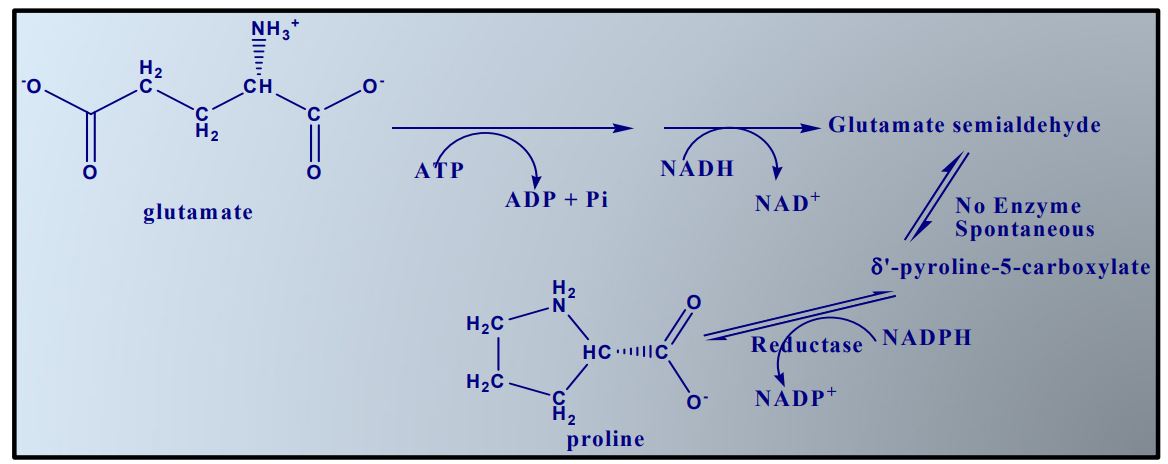
24
Hydroxylation of occurs as a
posttranslational modification (hydroxylases
require (ascorbate, lack of it
causes Scurvy).
posttranslational modification (hydroxylases
require (ascorbate, lack of it
causes Scurvy).
Hydroxylation of proline occurs as a
posttranslational modification (hydroxylases
require Vitamin C (ascorbate, lack of it
causes Scurvy).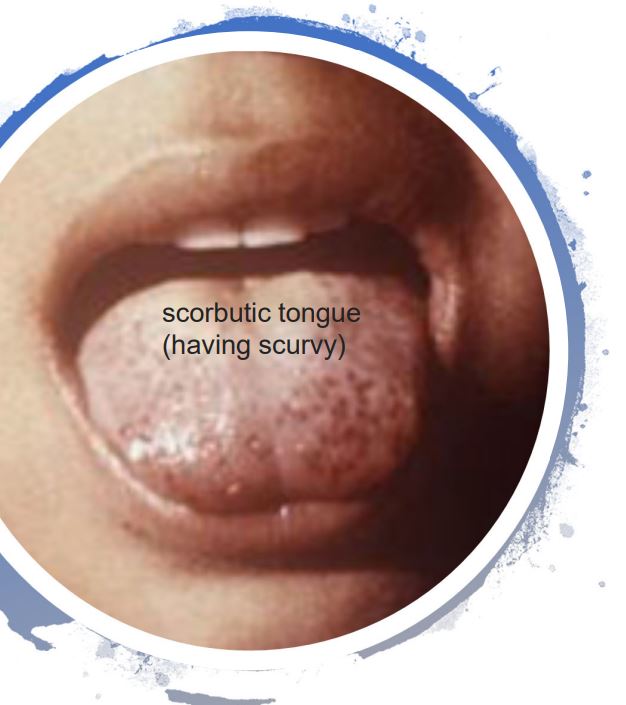
posttranslational modification (hydroxylases
require Vitamin C (ascorbate, lack of it
causes Scurvy).
25
3‐hydroxyproline and 4‐hydroxyproline are
found in
found in
3‐hydroxyproline and 4‐hydroxyproline are
found in collagen.
found in collagen.
26
Glutathione peroxidase contains
Glutathione peroxidase contains selenocysteine.
27
In the mRNA for selenoproteins, the codon , which generally serves as a termination codon, codes for selenocysteine
In the mRNA for selenoproteins, the codon UGA, which generally serves as a termination codon, codes for selenocysteine
28
Selenocysteinyl tRNA is formed by adding using ATP to
Selenocysteinyl tRNA is formed by adding slenide using ATP to seryl-tRNA 
29
Selenocysteinyl tRNA makes , , , and
Selenocysteinyl tRNA makes sleno proteins, gluthathione peroxidase, deiodinase, and thioredxin reductase
30
Pheylalanine is the precursor for
Pheylalanine is the precursor for tyrosine
31
Phenylalanine is converted into tyrosine using and cofactor
Phenylalanine is converted into tyrosine using phenylalanine hydroxylase and cofactor THB 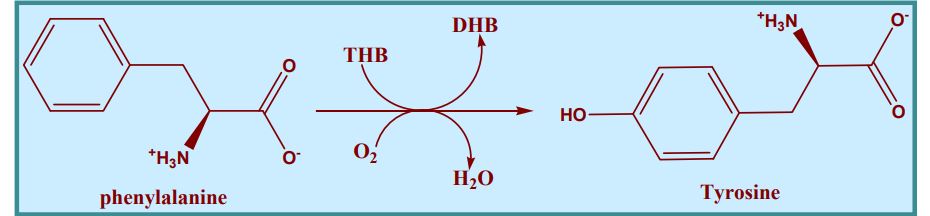
32
Phenylalanine to tyrosine occurs using enzyme with a gene symbol
Phenylalanine to tyrosine occurs using enzyme phenylalanine hydroxylase with a gene symbol PAH
33
THB is formed using and
THB is formed using GTP and beneficial bacteria
34
Classical Phenylketonuria
(PKU)= deficiency
(PKU)= deficiency
Classical Phenylketonuria
(PKU)= PAH deficiency
(PKU)= PAH deficiency
35
PKU is an autosomal recessive disorder that causes , light pigmentation, gait issues low IQ, epilepsy, etc...
PKU is an autosomal recessive disorder that causes high plamsa levels, light pigmentation, gait issues low IQ, epilepsy, etc...
36
3 proudtcs accumulates in PKU , ,
3 proudtcs accumulates in PKU Phenylalanine, Phenylpyruvate, Phenyllactate
37
In PKU (PHU deficinecy), you would want to have low and high in the diet.
In PKU (PHU deficinecy), you would want to have low Phe and high Tyr in the diet.
38
In non-classical, there is people who cannot make (THB)
In order to fix this, take
In order to fix this, take
In non-classical, there is people who cannot make biopterin supplement (THB)
In order to fix this, take Kuvan/sapropterin
In order to fix this, take Kuvan/sapropterin
39
Consumption of a Large numbers of neutral amino acids LNAA can also be used to address the
Consumption of a Large numbers of neutral amino acids LNAA can also be used to address the non-classical pathway
40
Accumulation of
, which upon
accumulation forms dark
brown polymer, gets
deposited into joints, causing
arthritis.
, which upon
accumulation forms dark
brown polymer, gets
deposited into joints, causing
arthritis.
Accumulation of
homogentisate, which upon
accumulation forms dark
brown polymer, gets
deposited into joints, causing
arthritis.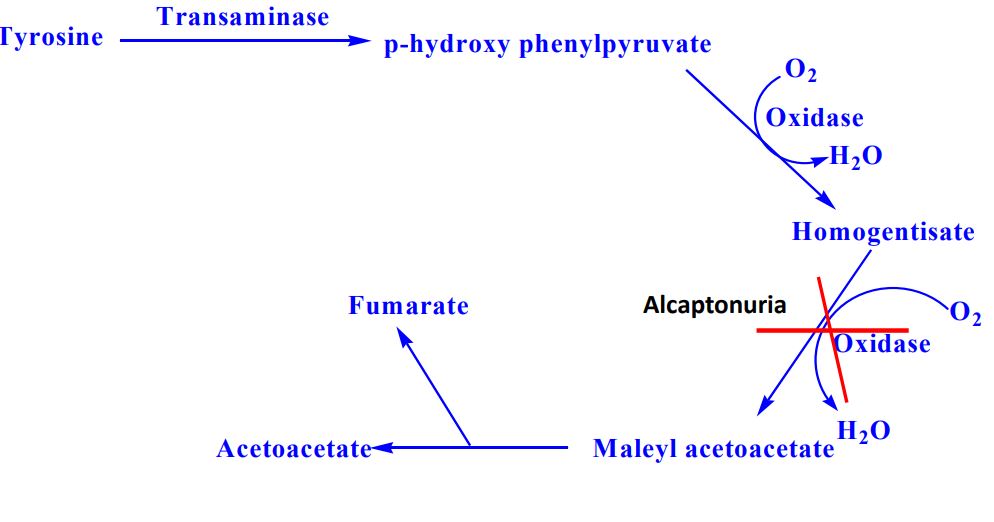
homogentisate, which upon
accumulation forms dark
brown polymer, gets
deposited into joints, causing
arthritis.
41
Methionine + adenosinetripphosphate forms s-adenosylmethionine (SAM) using enzyme
Methionine + adenosinetripphosphate forms s-adenosylmethionine (SAM) using enzyme methionine adenosyltransferase
42
SAM combines with an , transfers a , and becomes results in a and
SAM combines with an acceptor, transfers a methyl group, and becomes results in a methylated acceptor and S-adenosyl homocysteine 
43
Creatinine recieves phosphate from ATP when there is to store it in cardiac muscles, brain, etc.
Creatinine recieves phosphate from ATP when there is excess ATP to store it in cardiac muscles, brain, etc.
44
Guanidoacetic acid
Methylated Product: Metabolic Pathway:
Methylated Product: Metabolic Pathway:
Guanidoacetic acid
Methylated Product: Creatine phosphate Metabolic Pathway: Creatine synthesis
Methylated Product: Creatine phosphate Metabolic Pathway: Creatine synthesis
45
Phosphatidyl ethanolamine
Methylated Product: Metabolic Pathway:
Methylated Product: Metabolic Pathway:
Phosphatidyl ethanolamine
Methylated Product: Phosphatidyl choline Metabolic Pathway: Phospholipid
Methylated Product: Phosphatidyl choline Metabolic Pathway: Phospholipid
46
Norepinephrine
Methylated Product: Metabolic Pathway:
Methylated Product: Metabolic Pathway:
Norepinephrine
Methylated Product: Epinephrine Metabolic Pathway: Catecholamine
Methylated Product: Epinephrine Metabolic Pathway: Catecholamine
47
rRNA & tRNA
Methylated Product: Pathway:
Methylated Product: Pathway:
rRNA & tRNA
Methylated Product: Methylated RNA Pathway: RNA synthesis
Methylated Product: Methylated RNA Pathway: RNA synthesis
48
Protein bound lysine
Methylated Porduct: Pathway:
Methylated Porduct: Pathway:
Protein bound lysine
Methylated Porduct: Trimethyl lysine Pathway: Carnitine synthesis
Methylated Porduct: Trimethyl lysine Pathway: Carnitine synthesis
49
The precursors of carnitine are and
The precursors of carnitine are lysine and methionine
50
Histones (Chromatin)
Products:
Pathway:
Products:
Pathway:
Histones (Chromatin)
Products: Methyl Lys or Arg of histones
Pathway: Chromatin Modelling
Products: Methyl Lys or Arg of histones
Pathway: Chromatin Modelling
51
DNA CpG islands Gene Expression
Products:
Pathway:
Products:
Pathway:
DNA CpG islands Gene Expression
Products: GpG Islands
Pathway: Gene
Products: GpG Islands
Pathway: Gene
52
N‐Acetylation: (Many Proteins at the
Amino Terminal end residues such as
Met, Ser, etc…) Comes from
Amino Terminal end residues such as
Met, Ser, etc…) Comes from
N‐Acetylation: (Many Proteins at the
Amino Terminal end residues such as
Met, Ser, etc…) Comes from acteyl CoA
Amino Terminal end residues such as
Met, Ser, etc…) Comes from acteyl CoA
53
• N‐Methylation: (Histones on and
Residues)
Residues)
• N‐Methylation: (Histones on Lys and
Arg Residues)
Arg Residues)
54
N‐Ubiquitination: ( on
Residue)
Residue)
N‐Ubiquitination: (Histones on Lys
Residue)
Residue)
55
O‐Phosphorylation: (Histones on
Residues)
Residues)
O‐Phosphorylation: (Histones on
Serine Residues)
Serine Residues)
56
Keep on sickle cell hemoglobin type is a new theraputic method for sickle cell anemia
Keep acteyl group longer on sickle cell hemoglobin type is a new theraputic method for sickle cell anemia
57
Lysein is methylated to to to
Lysein is methylated to monomethyl lysine to trimethylysine to arginine
58
Arginine is methylated until the is formed
Arginine is methylated until the guanidinyl group is formed
59
Defect in , results in
the accumulation of homocysteine and
methionine in the blood and homocystine
in the urine.
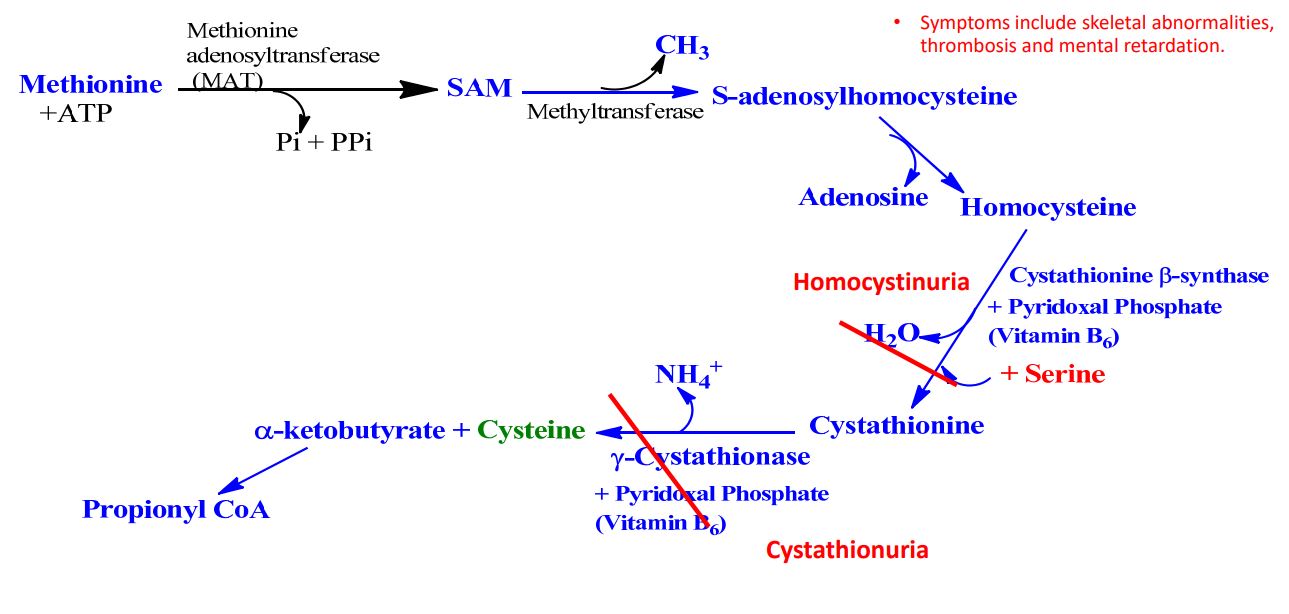
Symptoms include skeletal abnormalities,
thrombosis and mental retardation.
the accumulation of homocysteine and
methionine in the blood and homocystine
in the urine.
Symptoms include skeletal abnormalities,
thrombosis and mental retardation.
Defect in cystathionine synthase, results in
the accumulation of homocysteine and
methionine in the blood and homocystine
in the urine.
Symptoms include skeletal abnormalities,
thrombosis and mental retardation.
the accumulation of homocysteine and
methionine in the blood and homocystine
in the urine.
Symptoms include skeletal abnormalities,
thrombosis and mental retardation.
60
Methionine + ATP is converted to SAM using . SAM transfers a methyl and becomes . From that step, an adenosine is lost and forms. From there, + + forms cystathionine. Gamma cystathionase + B6 then forms +
Methionine + ATP is converted to SAM using MAT (methionine adenosyltransferase) . SAM transfers a methyl and becomes S-adenohomocysteine. From that step, an adenosine is lost and homocysetine forms. From there, cystathionine B-synthase + vitamin B6 + serine forms cystathionine. Gamma cystathionase + B6 then forms cysteine + alphaketobutyrate