Chapter 25
Study these flashcardsFree · spaced repetition · iPhone, Android, Mac & web
All cards
1
Biomarker is an objective and measurable of a physiological
condition or the severity/presence of some disease state.
condition or the severity/presence of some disease state.
Biomarker is an objective and measurable indicator of a physiological
condition or the severity/presence of some disease state.
condition or the severity/presence of some disease state.
2
A is any modality used to characterize and classify
health and disease as well as responses to treatments and/or
exacerbations
health and disease as well as responses to treatments and/or
exacerbations
A biomarker is any modality used to characterize and classify
health and disease as well as responses to treatments and/or
exacerbations
health and disease as well as responses to treatments and/or
exacerbations
3
What are 6 examples of biomarkers?
1. Specific cells
2. Genes
3. Enzymes
4. Hormones
5. Temp
6. Imaging
2. Genes
3. Enzymes
4. Hormones
5. Temp
6. Imaging
4
What is the biomarker for fever?
Body temp
5
What is the biomarker for determining risk of stroke?
Blood pressure
6
What is the biomarker for coronary and vascular disease?
Cholesterol
7
What is the biomarker for inflammation?
C-reactive protein
8
Protein/enzyme biomarkers ndicate a change in or state of a distinguishable/identifiable
protein/enzyme that or progression of a disease.
protein/enzyme that or progression of a disease.
Protein/enzyme biomarkers ndicate a change in expression or state of a distinguishable/identifiable
protein/enzyme that correlates with the risk or progression of a disease.
protein/enzyme that correlates with the risk or progression of a disease.
9
What are the 6 good features of a biomarker?
1. Easily obtained
2. Speed
3. Detection method must be accurate
4. The method must be easy to carry out
5. Must have effectiveness for diagnosis
6. Musthave sensitivity and specificity
2. Speed
3. Detection method must be accurate
4. The method must be easy to carry out
5. Must have effectiveness for diagnosis
6. Musthave sensitivity and specificity
10
What is a good example of an easily obtained biomarker?
Blood through venipuncture or catheter
11
and contain enzymes derived from tissues that might be useful
in disease diagnosis
in disease diagnosis
Plasma and serum contain enzymes derived from tissues that might be useful
in disease diagnosis
in disease diagnosis
12
The blood contains biomarkers that could reflect the ongoing
physiologic state of
physiologic state of
The blood contains biomarkers that could reflect the ongoing
physiologic state of all tissues
physiologic state of all tissues
13
Every cell in the body leaves a record of its physiological state in
the products it sheds into the blood, either as or as .
the products it sheds into the blood, either as or as .
Every cell in the body leaves a record of its physiological state in
the products it sheds into the blood, either as waste or as signals to
neighboring cells.
the products it sheds into the blood, either as waste or as signals to
neighboring cells.
14
The relative cellular abundance of thousands of different proteins,
along with their cleaved or modified forms, is a reflection of
and .
along with their cleaved or modified forms, is a reflection of
and .
The relative cellular abundance of thousands of different proteins,
along with their cleaved or modified forms, is a reflection of
ongoing physiological and pathological events.
along with their cleaved or modified forms, is a reflection of
ongoing physiological and pathological events.
15
useful to detect if a disease already exists, or
how such a disease may develop.
how such a disease may develop.
Diagnostic biomarker useful to detect if a disease already exists, or
how such a disease may develop.
how such a disease may develop.
16
Diagnostic biomarkers often indicate
Diagnostic biomarkers often indicate changes in metabolic processes
17
Normally most enzymes are found
Normally most enzymes are found inside the cell
18
When there is , the cell membrane breaks open and
some enzymes are released into the circulation.
some enzymes are released into the circulation.
When there is cell damage, the cell membrane breaks open and
some enzymes are released into the circulation.
some enzymes are released into the circulation.
19
, , and are examples of instances where enzymes are increased
Liver diseases, medical conditions, medications and infections are examples of instances where enzymes are increased
20
What are the three most common caused for elevated liver enzymes?
1. cholesterol-lowering drugs (statins)
2. acetaminophen
3. fatty liver disease, both alcoholic and nonalcoholic.
2. acetaminophen
3. fatty liver disease, both alcoholic and nonalcoholic.
21
What are the two most important factors to look at when working with biomarkers?
1. If the biomarker is specific (specific to a certain enzyme)
2. Must be quantifiable
2. Must be quantifiable
22
Plasma concentrations of enzymes
released from damaged cells may rise
or .
released from damaged cells may rise
or .
Plasma concentrations of enzymes
released from damaged cells may rise
early or late.
released from damaged cells may rise
early or late.
23
The of the protein may be fast or
slow.
slow.
The half life of the protein may be fast or
slow.
slow.
24
appear in plasma
faster than proteins that are
faster than proteins that are
Cytoplasmic proteins appear in plasma
faster than proteins that are enclosed in
organelles.
faster than proteins that are enclosed in
organelles.
25
What is important about the diagnostic window?
The enzyme should have a reasonable half
life and tissue specificity.
life and tissue specificity.
26
What is the major diagnostic use of alanine aminotransferase (ALT) in serum?
Viral hepatatis
27
What is the major diagnostic use of y-Glutamyl transferase in serum?
Various liver diseases
28
, &
act as biomarkers
act as biomarkers
Aspartate aminotransferase (AST), alanine aminotransferase (ALT) &
gamma-glutamyl transferase (GGT) act as biomarkers
gamma-glutamyl transferase (GGT) act as biomarkers
29
Biomarker is an objective and measurable of a physiological
condition or the severity/presence of some disease state.
condition or the severity/presence of some disease state.
Biomarker is an objective and measurable indicator of a physiological
condition or the severity/presence of some disease state.
condition or the severity/presence of some disease state.
30
If there’s liver damage, serum levels of & should be .
If there’s liver damage, serum levels of ALT & AST should be high.
31
ALT is mainly produced by the
ALT is mainly produced by the liver (specific).
32
AST is than ALT
AST is less specific than ALT
33
ALT and AST (sometimes referred to as ), they
don’t really indicate how . They tell us the
liver is , which can lead to reduced function.
don’t really indicate how . They tell us the
liver is , which can lead to reduced function.
ALT and AST (sometimes referred to as liver function tests), they
don’t really indicate how well the liver is functioning. They tell us the
liver is damaged, which can lead to reduced function.
don’t really indicate how well the liver is functioning. They tell us the
liver is damaged, which can lead to reduced function.
34
If patients take hepatotoxic drugs, and are often monitored.
If patients take hepatotoxic drugs, ALT and AST are often monitored.
35
If there’s gall bladder problem, it’s
predicted that will be .
predicted that will be .
If there’s gall bladder problem, it’s
predicted that GGT will be high.
predicted that GGT will be high.
36
High indicates cholestasis: a
in bile flow due to
secretion.
in bile flow due to
secretion.
High [GGT] indicates cholestasis: a
decrease in bile flow due to
impaired secretion.
decrease in bile flow due to
impaired secretion.
37
Alkaline phosphatase (ALP) is
also present in , but
it’s not specific ( ).
also present in , but
it’s not specific ( ).
Alkaline phosphatase (ALP) is
also present in biliary system, but
it’s not specific (also in bones and
placenta).
also present in biliary system, but
it’s not specific (also in bones and
placenta).
38
Alcohol metabolism by and results in the formation of the reactive intermediate,
Alcohol metabolism by alcohol dehydrogenase (ADH) and cytochrome P450 2E1 (CYP2E1) results in the formation of the reactive intermediate, acetaldehyde
39
CYP2E1-mediated metabolism also
produces and that lead to enhanced
and
produces and that lead to enhanced
and
CYP2E1-mediated metabolism also
produces reactive oxygen species (ROS) and hydroxyethyl radicals (HER) that lead to enhanced oxidative stress
and lipid peroxidation
produces reactive oxygen species (ROS) and hydroxyethyl radicals (HER) that lead to enhanced oxidative stress
and lipid peroxidation
40
The modified lipids are further metabolized to other intermediates
including and .
including and .
The modified lipids are further metabolized to other highly reactive intermediates
including malondialdehyde (MDA) and 4-hydroxy-2-nonenal (4-HNE).
including malondialdehyde (MDA) and 4-hydroxy-2-nonenal (4-HNE).
41
These reactive metabolites form
with proteins, lipids and DNA that impair
with proteins, lipids and DNA that impair
These reactive metabolites form adducts
with proteins, lipids and DNA that impair proper hepatic function
with proteins, lipids and DNA that impair proper hepatic function
42
Acetaldehyde production causes
formation of
formation of
Acetaldehyde production causes
formation of ROS damages proteins
and DNA
formation of ROS damages proteins
and DNA
43
Acetaldehyde cellular factors
that get processed and exhibited as
antigens on liver cell surfaces that attract
.
that get processed and exhibited as
antigens on liver cell surfaces that attract
.
Acetaldehyde inhibits cellular factors
that get processed and exhibited as
antigens on liver cell surfaces that attract
autoimmune response.
that get processed and exhibited as
antigens on liver cell surfaces that attract
autoimmune response.
44
will attack the liver! Inflammation leads destruction of
hepatocytes which causes !
hepatocytes which causes !
Neutrophils will attack the liver! Inflammation leads destruction of
hepatocytes which causes hepatitis!
hepatocytes which causes hepatitis!
45
In most liver diseases, >
In most liver diseases, ALT > AST
46
Except in , where <
can also raise levels of , while other
enzymes get slightly elevated
can also raise levels of , while other
enzymes get slightly elevated
Except in alcoholic liver disease, where ALT < AST
Alcohol can also raise levels of GGT, while other
enzymes get slightly elevated
Alcohol can also raise levels of GGT, while other
enzymes get slightly elevated
47
Excessive consumption leads to
Excessive consumption leads to alcoholic fatty
liver!
liver!
48
What type of conditions are impacted by non-alcholic fatty acid disease?
1. Metabolic syndromes
2. Diabetes
3. Hypertriglyceridemia
4. Hyperlipidemia
5. TOIF (thin on outside, fat on inside)
6. Obesity
2. Diabetes
3. Hypertriglyceridemia
4. Hyperlipidemia
5. TOIF (thin on outside, fat on inside)
6. Obesity
49
Non-alcohiolic fatty liver diease is driven by?
ALL HIGH BLOOD SUGAR THINGS
1. More sugars than can be handeled
2. Insulin resistance
3. Lower FA oxidation
4. Increased FA synthesis/storage
1. More sugars than can be handeled
2. Insulin resistance
3. Lower FA oxidation
4. Increased FA synthesis/storage
50
What are the three cuases of non-alcholic steatohepatitis?
1.Damage to lipid membranes
2. Mitochondrial dysfunction
3. Cell death/inflammation
2. Mitochondrial dysfunction
3. Cell death/inflammation
51
has become the currently preferred diagnostic marker
for myocardial infarction (MI)
for myocardial infarction (MI)
Plasma troponin has become the currently preferred diagnostic marker
for myocardial infarction (MI)
for myocardial infarction (MI)
52
is present in skeletal and cardiac
muscle but not in .
muscle but not in .
Troponin is present in skeletal and cardiac
muscle but not in smooth muscle.
muscle but not in smooth muscle.
53
Troponin levels rise for after MI
and remain elevated for (good
window for measurement)
and remain elevated for (good
window for measurement)
Troponin levels rise for 2 to 6 hours after MI
and remain elevated for 4 to 10 days (good
window for measurement)
and remain elevated for 4 to 10 days (good
window for measurement)
54
Immunological measurements of plasma levels
of provide sensitive
and specific indicators of damage to heart
muscle
of provide sensitive
and specific indicators of damage to heart
muscle
Immunological measurements of plasma levels
of cardiac troponins I and T provide sensitive
and specific indicators of damage to heart
muscle
of cardiac troponins I and T provide sensitive
and specific indicators of damage to heart
muscle
55
Since other sources of heart muscle damage
also elevate serum troponin levels, cardiac
troponins provide a general marker of
also elevate serum troponin levels, cardiac
troponins provide a general marker of
Since other sources of heart muscle damage
also elevate serum troponin levels, cardiac
troponins provide a general marker of cardiac
injury
also elevate serum troponin levels, cardiac
troponins provide a general marker of cardiac
injury
56
Explain what is happening in the graph 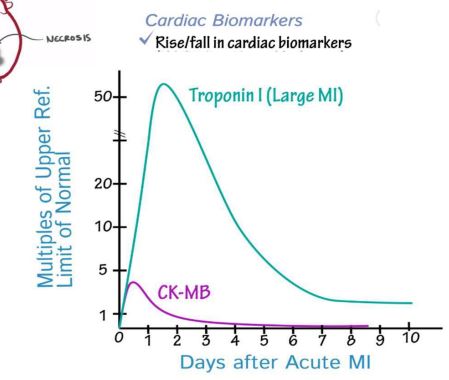
We are seeing the rise and fall of cardiac biomarkers
57
The first enzymes used to
diagnose myocardial Infarction
(MI) were: 1. ;
2.
diagnose myocardial Infarction
(MI) were: 1. ;
2.
The first enzymes used to
diagnose myocardial Infarction
(MI) were: 1. AST,
aspartate aminotransferase;
2. LDH, lactate dehydrogenase
diagnose myocardial Infarction
(MI) were: 1. AST,
aspartate aminotransferase;
2. LDH, lactate dehydrogenase
58
Alkaline phosphatase (usually abbreviated as AlkPhos or ALP).
AlkPhos/ALP removes
AlkPhos/ALP removes
Alkaline phosphatase (usually abbreviated as AlkPhos or ALP).
AlkPhos/ALP removes a phosphate group.
AlkPhos/ALP removes a phosphate group.
59
ALP is found in cells lining the . If those
cells are damaged (e.g. by obstruction), is released into
the blood at levels.
cells are damaged (e.g. by obstruction), is released into
the blood at levels.
ALP is found in cells lining the biliary tract (bile duct). If those
cells are damaged (e.g. by obstruction), AlkPhos is released into
the blood at abnormally high levels.
cells are damaged (e.g. by obstruction), AlkPhos is released into
the blood at abnormally high levels.
60
Alkaline phosphotase is present in all tissues, especially in , , , and
Alkaline phosphotase is present in all tissues, especially in bone, liver, kidney, and placenta
61
If a patient presents with right upper
quadrant pain, jaundice, high levels of ALT and high
levels of AST (ALT>AST), which is the most probable
cause?
quadrant pain, jaundice, high levels of ALT and high
levels of AST (ALT>AST), which is the most probable
cause?
Liver disease
62
In children: levels of are indicative of normal growth
In children: elevated levels of ALP are indicative of normal growth
63
The 3 isozymes of ALP are
1. Placenta
2. Intestine
3. Germ cell
2. Intestine
3. Germ cell
64
One isozyme that is non-specific or ubiquitous, expressed in bone
and liver, known as
and liver, known as
One isozyme that is non-specific or ubiquitous, expressed in bone
and liver, known as Tissue nonspecific ALP
and liver, known as Tissue nonspecific ALP
65
When related to the liver, high levels of ALP is indicative of
When related to the liver, high levels of ALP is indicative of hepatic obstruction
66
In bones, ALP is increased in diseases such as , ,
diseases.
diseases.
In bones, ALP is increased in diseases such as rickets, osteomalacia, neoplastic
diseases.
diseases.
67
In bones is also associated with normal process of healing fractures.
In bones increased ALP is also associated with normal process of healing fractures.
68
High levels of liver ALP are related to which 3 coniditons
1. Hepatitis
2. Bile duct obstruction
3. Cholangitis
2. Bile duct obstruction
3. Cholangitis
69
High levels of bone ALP are related to which four conditions
1. Osteoporosis
2. Vitamin D deficidency
3. Fracture
4. Hyperparathyroidism
2. Vitamin D deficidency
3. Fracture
4. Hyperparathyroidism
70
High levels of ALP in placenta are due to
High levels of ALP in placenta are due to pregancy
71
If high level of alkaline phosphatase is greater than 2 times the upper unit, it impacts the or the
If high level of alkaline phosphatase is greater than 2 times the upper unit, it impacts the liver or the bone turnover
72
If alkaline phosphatase is greater than 4, it indicates obstruction of the
If alkaline phosphatase is greater than 4, it indicates obstruction of the bile duct
73
If alkaline phosphatase is less than 4, , ,
If alkaline phosphatase is less than 4, liver cirrhosis, heart failure, hepatitis
74
ACP (acid phosphatases) are secretes by , , ,
ACP (acid phosphatases) are secretes by prostate cells, RBC, platelets, WBC
75
Acid Phosphatases (ACPs) are isozymes
with maximum activity at
with maximum activity at
Acid Phosphatases (ACPs) are isozymes
with maximum activity at pH 5-6
with maximum activity at pH 5-6
76
ACP values are increased in
and highly elevated in .
and highly elevated in .
ACP values are increased in prostrate cancer
and highly elevated in bone metastasis
of prostrate cancer.
and highly elevated in bone metastasis
of prostrate cancer.
77
ACP • It’s an important tumor biomarker for
monitoring
but not for diagnosis of ,
since ACP levels can also be high during
.
monitoring
but not for diagnosis of ,
since ACP levels can also be high during
.
ACP • It’s an important tumor biomarker for
monitoring prostrate cancer progression
but not for diagnosis of prostrate cancer,
since ACP levels can also be high during
prostrate hypertrophy.
monitoring prostrate cancer progression
but not for diagnosis of prostrate cancer,
since ACP levels can also be high during
prostrate hypertrophy.
78
Lactate dehydrogenase (LDH) Values are in
children and athletes and
this is
children and athletes and
this is
Lactate dehydrogenase (LDH) Values are increased in
children and athletes and
this is normal
children and athletes and
this is normal
79
lactate dehydrogenase (LDH) gets released : marker for several
diseases such as
diseases such as
lactate dehydrogenase (LDH) gets released during tissue damage: marker for several
diseases such as myocardial infarction
diseases such as myocardial infarction
80
High levels of a particular is associated with diseased
state
state
High levels of a particular isozyme is associated with diseased
state
state
81
LDH has 5 isoenzymes:
LDH has 5 isoenzymes: LDH1, LDH2, LDH3, LDH4 and LDH5
82
LDH1 and LDH2
Found in and :
Levels increase in and
Found in and :
Levels increase in and
LDH1 and LDH2
Found in myocardium and RBC:
Levels increase in MI and hemolytic
anemias, leukemias
Found in myocardium and RBC:
Levels increase in MI and hemolytic
anemias, leukemias
83
LDH3 and LDH4
and : levels
increase in and
dystrophies. However, high
levels can be normal in and
.
and : levels
increase in and
dystrophies. However, high
levels can be normal in and
.
LDH3 and LDH4
Kidney and skeletal muscle: levels
increase in kidney disease and
muscular dystrophies. However, high
levels can be normal in children and
athletes.
Kidney and skeletal muscle: levels
increase in kidney disease and
muscular dystrophies. However, high
levels can be normal in children and
athletes.
84
LDH5
May indicate problems with and/or
. However, high levels can
be normal in and
May indicate problems with and/or
. However, high levels can
be normal in and
LDH5
May indicate problems with liver and/or
skeletal muscle. However, high levels can
be normal in children and athletes.
May indicate problems with liver and/or
skeletal muscle. However, high levels can
be normal in children and athletes.
85
The first enzymes used to
diagnose myocardial Infarction
(MI) were: 1. ;
2.
diagnose myocardial Infarction
(MI) were: 1. ;
2.
The first enzymes used to
diagnose myocardial Infarction
(MI) were: 1. AST,
aspartate aminotransferase;
2. LDH, lactate dehydrogenase
diagnose myocardial Infarction
(MI) were: 1. AST,
aspartate aminotransferase;
2. LDH, lactate dehydrogenase
86
Diagnosis using LDH exploits the
tissue-specific variations in the
enzyme’s
tissue-specific variations in the
enzyme’s
Diagnosis using LDH exploits the
tissue-specific variations in the
enzyme’s quaternary structue
tissue-specific variations in the
enzyme’s quaternary structue
87
Be able to explain the Western Blot 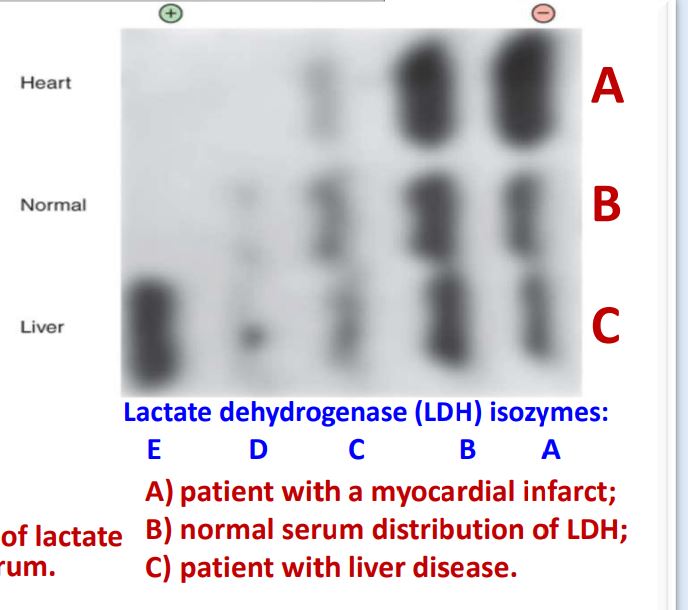
88
Creatine kinase (CK) has
isozymes and a good diagnostic window.
isozymes and a good diagnostic window.
Creatine kinase (CK) has three tissue-specific
isozymes and a good diagnostic window.
isozymes and a good diagnostic window.
89
CK-MM ( & ) leads to
is expressed in &
muscles: in rhabdomyolysis,
muscular dystrophy, MI, post-surgery,
muscle trauma, intense exercise
is expressed in &
muscles: in rhabdomyolysis,
muscular dystrophy, MI, post-surgery,
muscle trauma, intense exercise
CK-MM (heart & skeletal muscle) leads to
CK3 is expressed in myocardium &
skeletal muscles: Increase in rhabdomyolysis,
muscular dystrophy, MI, post-surgery,
muscle trauma, intense exercise
CK3 is expressed in myocardium &
skeletal muscles: Increase in rhabdomyolysis,
muscular dystrophy, MI, post-surgery,
muscle trauma, intense exercise
90
CK-BB ( ) leads to in the :
in diseases.
in diseases.
CK-BB (brain) leads to CK1 in the brain:
increases in CNS diseases.
increases in CNS diseases.
91
CK-MB ( ) leads to in :
increase in elevated in
increase in elevated in
CK-MB (heart) leads to CK2 in myocardium:
increase in elevated in acute MI
increase in elevated in acute MI
92
Activity in CPK is greatest in , , and
Activity in CPK is greatest in striated muscle, heart, and brain
93
Assay of plasma CK levels presently
continues in use to assess such as
continues in use to assess such as
Assay of plasma CK levels presently
continues in use to assess skeletal
muscle disorders such as Duchene
muscular dystrophy.
continues in use to assess skeletal
muscle disorders such as Duchene
muscular dystrophy.
94
The 2 biomarkers of pancreatic disorders are
1. Amylase
2. Lipase
2. Lipase
95
Primary role of amylase in the digestion of . More
(Amylase: 40 – 60% sensitivity) than lipase, but not because there’s
also .
(Amylase: 40 – 60% sensitivity) than lipase, but not because there’s
also .
Primary role of amylase in the digestion of carbohydrates. More sensitive
(Amylase: 40 – 60% sensitivity) than lipase, but not specific because there’s
also salivary amylase.
(Amylase: 40 – 60% sensitivity) than lipase, but not specific because there’s
also salivary amylase.
96
Lipase (more for the pancreas) Lipase:
80 – 90% specificity
This is more than serum amylase and can last in the serum
of patients after the resolution of symptoms.
80 – 90% specificity
This is more than serum amylase and can last in the serum
of patients after the resolution of symptoms.
Lipase (more specific for the pancreas) Lipase:
80 – 90% specificity
This is more specific than serum amylase and can last longer in the serum
of patients after the resolution of symptoms.
80 – 90% specificity
This is more specific than serum amylase and can last longer in the serum
of patients after the resolution of symptoms.
97
What are 2 other coniditons that lead to increased amylase and lipase?
1. Pancreatic cancer
2. Pancreatic duct obstruction
2. Pancreatic duct obstruction
98
In pancreatitis, there are increased levels of ....
1. Amylase
2. Lipase
2. Lipase
99
Epigastric pain that radiates to the back and fever are two key symptoms of
Epigastric pain that radiates to the back and fever are two key symptoms of pancreatitis
100
-Alcohol use
-Gall stones
-Hypercalcemia
- Hypertriglyceridemia
- Mumps
- Coxsackievirus
-Trauma to abdomen
Are all causes of
-Gall stones
-Hypercalcemia
- Hypertriglyceridemia
- Mumps
- Coxsackievirus
-Trauma to abdomen
Are all causes of
-Alcohol use
-Gall stones
-Hypercalcemia
- Hypertriglyceridemia
- Mumps
- Coxsackievirus
-Trauma to abdomen
Are all causes of pancreatitis
-Gall stones
-Hypercalcemia
- Hypertriglyceridemia
- Mumps
- Coxsackievirus
-Trauma to abdomen
Are all causes of pancreatitis