Lipid Metabolism
Study these flashcardsFree · spaced repetition · iPhone, Android, Mac & web
All cards
1
When blood glucose levels are high, beta cells of the pancreas are triggered to produce an anabolic hormone,
When blood glucose levels are high, beta cells of the pancreas are triggered to produce an anabolic hormone, insulin
2
Insulin stimulates mainly in the liver.
Insulin stimulates fatty acid synthesis mainly in the liver.
3
Under aerobic conditions, glucose is oxidized, a process that results in the production of inside the
Under aerobic conditions, glucose is oxidized, a process that results in the production of acetyl CoA inside the mitochondrial matrix.
4
a two-carbon compound is the precursor that is required for fatty acid synthesis.
Acetyl CoA a two-carbon compound is the precursor that is required for fatty acid synthesis.
5
Fatty acid synthesis occurs in the
Fatty acid synthesis occurs in the cytosol.
6
What are the two compounds required for fatty acid synthesis?
1.
2.
1.
2.
What are the two compounds required for fatty acid synthesis?
1. Acetyl CoA (substrate)
2. NADPH (reductant)
1. Acetyl CoA (substrate)
2. NADPH (reductant)
7
The precursor acetyl CoA be transported directly from the mitochondria into the cytosol, due to the .
The precursor acetyl CoA cannot be transported directly from the mitochondria into the cytosol, due to the absence of a transport system for acetyl CoA.
8
Transport of acetyl CoA into cytosol?
Citrate is carried into the cytosol by a citrate carrier. Then, (enzyme) converts citrate into and . + converts to . (which produces ) converts malatae into . Pyruvate can then enter the mitochondria using a pruvate transporter. Using and ), pyruvate becomes OAA. The OAA can then be combined with using to form citrate.
Citrate is carried into the cytosol by a citrate carrier. Then, (enzyme) converts citrate into and . + converts to . (which produces ) converts malatae into . Pyruvate can then enter the mitochondria using a pruvate transporter. Using and ), pyruvate becomes OAA. The OAA can then be combined with using to form citrate.
Transport of acetyl CoA into cytosol?
Citrate is carried into the cytosol by a citrate carrier. Then, citrate lyase (+COA) (enzyme) converts citrate into OAA and acetyl CoA. Malatae dephydrogenase +NADH converts OAA to malatae. Malic enzyme (which produces NADPH) converts malatae into pyruvate + CO2 . Pyruvate can then enter the mitochondria using a pruvate transporter. Using pyruvate carboxylase and ABC (ATP, Biotin, CO2), pyruvate becomes OAA. The OAA can then be combined with acteyl CoA using citrate synthase to form citrate.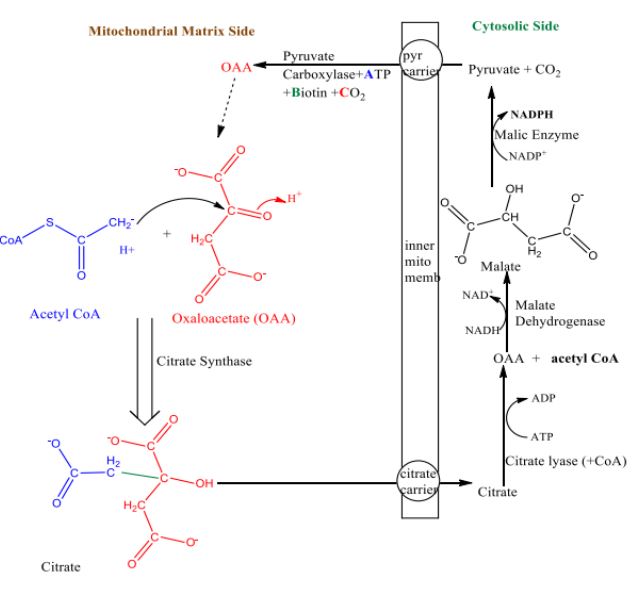
Citrate is carried into the cytosol by a citrate carrier. Then, citrate lyase (+COA) (enzyme) converts citrate into OAA and acetyl CoA. Malatae dephydrogenase +NADH converts OAA to malatae. Malic enzyme (which produces NADPH) converts malatae into pyruvate + CO2 . Pyruvate can then enter the mitochondria using a pruvate transporter. Using pyruvate carboxylase and ABC (ATP, Biotin, CO2), pyruvate becomes OAA. The OAA can then be combined with acteyl CoA using citrate synthase to form citrate.
9
In addition to acetyl CoA, fatty acid biosynthesis
also requires a
also requires a
In addition to acetyl CoA, fatty acid biosynthesis
also requires a reductant NADPH.
also requires a reductant NADPH.
10
What are the sources of NADPH for fatty acid synthesis?
1.
2.
1.
2.
What are the sources of NADPH for fatty acid synthesis?
1. Hexose monophosphate shunt (Major source)
2. Malic acid oxidation
1. Hexose monophosphate shunt (Major source)
2. Malic acid oxidation
11
What is the rate limiting step and commited step in fatty acid synthesis?
What is the rate limiting step and commited step in fatty acid synthesis?
Acetyl CoA carboxylase
Acetyl CoA carboxylase
12
Acetyl CoA carboxylase has
moiety which participates in the
carboxylation reaction in forming
moiety which participates in the
carboxylation reaction in forming
Acetyl CoA carboxylase has covalently bound biotin (one of the vitamin B derivative)
moiety which participates in the
carboxylation reaction in forming
malonyl CoA.
moiety which participates in the
carboxylation reaction in forming
malonyl CoA.
13
Steps in Synthesis of Malonyl COA
1. Carboxylation of
+ + ->
2. Carboxylation of
+ -> +
1. Carboxylation of
+ + ->
2. Carboxylation of
+ -> +
Steps in Synthesis of Malonyl COA
1. Carboxylation of biotin
HCO3- + ATP + Biotin -> Carboxy Biotin
2. Carboxylation of acetyl CoA
Carboxy biotin + Acetyl CoA -> Malonyl CoA + biotin
1. Carboxylation of biotin
HCO3- + ATP + Biotin -> Carboxy Biotin
2. Carboxylation of acetyl CoA
Carboxy biotin + Acetyl CoA -> Malonyl CoA + biotin
14
Consumption of raw egg is not
recommended since raw egg
contains a protein called
which can tie up the which would adversely impact
recommended since raw egg
contains a protein called
which can tie up the which would adversely impact
Consumption of raw egg is not
recommended since raw egg
contains a protein called avidin
which can tie up the biotin which would adversely impact acetyl CoA carboxylase
recommended since raw egg
contains a protein called avidin
which can tie up the biotin which would adversely impact acetyl CoA carboxylase
15
What three things does acteyl CoA carboxylase need?
1.
2.
3.
1.
2.
3.
What three things does acteyl CoA carboxylase need?
1. ATP
2. Bicarbonate
3. Acetyl CoA
1. ATP
2. Bicarbonate
3. Acetyl CoA
16
Acetyl CoA carboxylate synthesizes
Acetyl CoA carboxylate synthesizes malonyl CoA
17
is a committed metabolite that can enter only the fatty acid biosynthetic
pathway.
pathway.
Malonyl CoA is a committed metabolite that can enter only the fatty acid biosynthetic
pathway.
pathway.
18
Fatty acid synthase (FAS) is a multi-enzyme complex that is
composed of domains that are
composed of domains that are
Fatty acid synthase (FAS) is a multi-enzyme complex that is
composed of seven catalytic domains that are covalently
linked
composed of seven catalytic domains that are covalently
linked
19
What are the three steps of the catalytic events of the fatty acid synthase (FAS)?
1. After condensation, acteoacteyl group is reduced to in 3 steps while still attached to
2. The is transferred to and enters and gets attached to
3. occurs again and new 6 carbon gets while attached to
4. Cycle repeats until
1. After condensation, acteoacteyl group is reduced to in 3 steps while still attached to
2. The is transferred to and enters and gets attached to
3. occurs again and new 6 carbon gets while attached to
4. Cycle repeats until
What are the three steps of the catalytic events of the fatty acid synthase (FAS)?
1. After condensation, acteoacteyl group is reduced to butyrl group in 3 steps while still attached to ACP (acyl carrier protein)
2. The butyl group is transferred to condensing enzyme and new malonyl group enters and gets attached to acp
3. Condensation rxn occurs again and new 6 carbon gets reduced while attached to ACP
4. Cycle repeats until C-16
1. After condensation, acteoacteyl group is reduced to butyrl group in 3 steps while still attached to ACP (acyl carrier protein)
2. The butyl group is transferred to condensing enzyme and new malonyl group enters and gets attached to acp
3. Condensation rxn occurs again and new 6 carbon gets reduced while attached to ACP
4. Cycle repeats until C-16
20
Order of Enzyme Domians
Order of Enzyme Domians
AT
MT
CE
KR
DH
ER
TE
AT
MT
CE
KR
DH
ER
TE
21
What is AT?
acetyl transferase
22
What is MT?
malonyl transferase
23
What is CE?
Keto synthase (condensing enzyme)
24
When blood glucose levels are high, beta cells of the pancreas are triggered to produce an anabolic hormone,
When blood glucose levels are high, beta cells of the pancreas are triggered to produce an anabolic hormone, insulin
25
What is ER?
Enoyl reductase (USES NADPH)
26
What is KR?
b-ketoacyl reducatse (uses NADPH)
27
What is TE?
Thioesterase (releases palmitate from palmitoyl- ACP) ***ACP
28
is the prosthetic group that
anchors the growing fatty acid chain during synthesis
anchors the growing fatty acid chain during synthesis
phosphopantetheine (a derivative of the vitamin pantothenate) is the prosthetic group that
anchors the growing fatty acid chain during synthesis
anchors the growing fatty acid chain during synthesis
29
Phosphopantetheine is covalently attached to protein
5’-Phosphopantetheine is covalently attached to ACP protein
30
NADPH is utilized in the
NADPH is utilized in the reduction reactions.
31
domain cleaves off the final product, , from the fatty acid
synthase enzyme complex. Occasionally the fatty acyl chain goes through one more cycle, and
it gets cleaved off as
synthase enzyme complex. Occasionally the fatty acyl chain goes through one more cycle, and
it gets cleaved off as
Thioesterase I domain cleaves off the final product, palmitate (C16), from the fatty acid
synthase enzyme complex. Occasionally the fatty acyl chain goes through one more cycle, and
it gets cleaved off as stearic acid (C18)
synthase enzyme complex. Occasionally the fatty acyl chain goes through one more cycle, and
it gets cleaved off as stearic acid (C18)
32
In mammals during lactation, mammary glands express , an independent protein that interacts with the fatty acid synthase complex and causes the of fatty acids , , and
In mammals during lactation, mammary glands express Thioesterase II, an independent protein that interacts with the fatty acid synthase complex and causes the premature release of fatty acids (capric (C10), Lauric (C-12), and myristic (C14)
33
Unsaturated fatty acids that can be synthesized de novo are called
Unsaturated fatty acids that can be synthesized de novo are called non-essential fatty acids
34
Humans do not have
enzymes that can introduce beyond
enzymes that can introduce beyond
Humans do not have
enzymes that can introduce cis
double bonds beyond carbons 9 to
10
enzymes that can introduce cis
double bonds beyond carbons 9 to
10
35
Stoichometry of palmitate synthesis
36
Polyunsaturated fatty acids linoleic, 18:2
(9,12) and linolenic,18:3 (9,12,15) are
therefore that must be
supplied in the diet.
(9,12) and linolenic,18:3 (9,12,15) are
therefore that must be
supplied in the diet.
Polyunsaturated fatty acids linoleic, 18:2
(9,12) and linolenic,18:3 (9,12,15) are
therefore essential fatty acids that must be
supplied in the diet.
(9,12) and linolenic,18:3 (9,12,15) are
therefore essential fatty acids that must be
supplied in the diet.
37
Linoleic acid is the precursor for the
biosynthesis of which is
.
biosynthesis of which is
.
Linoleic acid is the precursor for the
biosynthesis of arachidonic acid which is
C-20:4 (5,8,11,14).
biosynthesis of arachidonic acid which is
C-20:4 (5,8,11,14).
38
the end product of fatty
acid synthase can be further elongated
and/or desaturated by separate enzymes
that are located in the and
.
acid synthase can be further elongated
and/or desaturated by separate enzymes
that are located in the and
.
Palmitate (16:0) the end product of fatty
acid synthase can be further elongated
and/or desaturated by separate enzymes
that are located in the mitochondria and
endoplasmic reticulum.
acid synthase can be further elongated
and/or desaturated by separate enzymes
that are located in the mitochondria and
endoplasmic reticulum.
39
The desaturase that is located in the
endoplasmic reticulum using , , and forms or respectively.
endoplasmic reticulum using , , and forms or respectively.
The desaturase that is located in the
endoplasmic reticulum using molecular
oxygen, NADPH, and palmitoyl CoA or stearoyl CoA forms palmitoleic acid, 16:1 (9) or oleic acid 18:1 (9) respectively.
endoplasmic reticulum using molecular
oxygen, NADPH, and palmitoyl CoA or stearoyl CoA forms palmitoleic acid, 16:1 (9) or oleic acid 18:1 (9) respectively.
40
The reaction that takes place with the desaturase in the ER uses a complex of which three membrane bound enzymes?
(NADH-cytochrome b5 reductase, cytochrome b5, and a desaturase)
41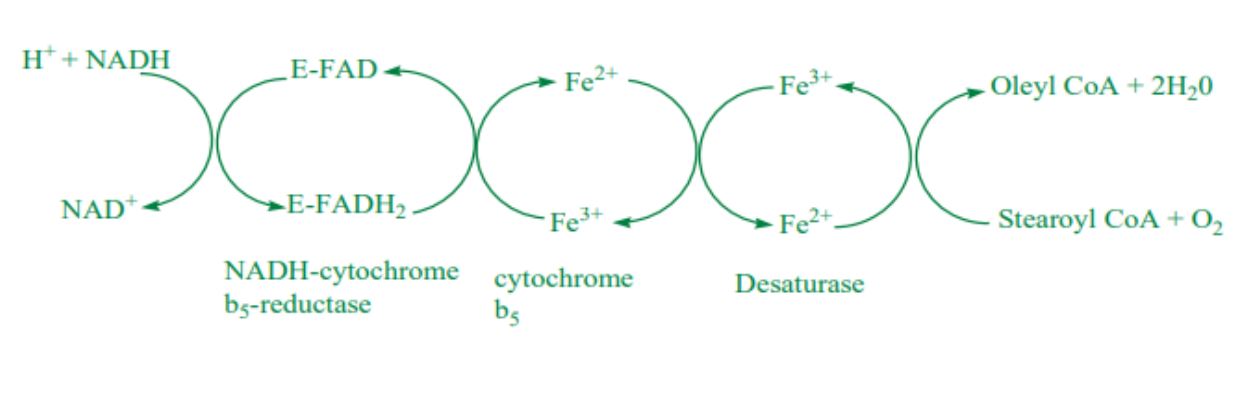
Draw desaturase reaction
42
Electron Transport Chain reaction in the desaturation of
Electron Transport Chain reaction in the desaturation of stearoyl CoA
43
Triglycerides are synthesized in the liver and are
stored in
stored in
Triglycerides are synthesized in the liver and are
stored in adipose tissues.
stored in adipose tissues.
44
Acetyl CoA can enter the TCA cycle to be
metabolized. However, cannot
enter the TCA cycle directly
metabolized. However, cannot
enter the TCA cycle directly
Acetyl CoA can enter the TCA cycle to be
metabolized. However, 3C propionyl CoA cannot
enter the TCA cycle directly
metabolized. However, 3C propionyl CoA cannot
enter the TCA cycle directly
45
Triglycerides that are formed in the liver are packaged with proteins to form , which are then transported into . Once inside the adipose tissue triglycerides are released from .
Triglycerides that are formed in the liver are packaged with proteins to form VLDL, which are then transported into adipose tissue. Once inside the adipose tissue triglycerides are released from VLDL and stored.
46
When the energy requirements are high, the adipose-stored triglycerides are into and
When the energy requirements are high, the adipose-stored triglycerides are hydrolyzed (by the hormone-sensitive lipase) into free fatty acids and glycerol
47
Free fatty acids are
oxidized e.g. thru
(b-oxidation) to produce
, , and
oxidized e.g. thru
(b-oxidation) to produce
, , and
Free fatty acids are
oxidized e.g. thru
(b-oxidation) to produce
NADH, FADH 2, and acetyl
CoA.
oxidized e.g. thru
(b-oxidation) to produce
NADH, FADH 2, and acetyl
CoA.
48
The released fatty acids bind to
and send to the
liver for .
and send to the
liver for .
The released fatty acids bind to
serum albumin and send to the
liver for fatty acid oxidation.
serum albumin and send to the
liver for fatty acid oxidation.
49
Pancreatic lipase (the enzyme that is involved in fat digestion) as part of food digestion is inhibited by the pharmacological compound
Pancreatic lipase (the enzyme that is involved in fat digestion) as part of food digestion is inhibited by the pharmacological compound orlistat.
50
Fatty acids must be transported from the into the where the
actual degradation occurs
actual degradation occurs
Fatty acids must be transported from the cytosol into the mitochondrial matrix where the
actual degradation occurs
actual degradation occurs
51
Fatty acids can be and for transport
Fatty acids can be activated and converted into fatty acyl carinitine for transport
52
How are free fatty acids activated?
-AMP is converted to 2 ADP using adenylate kinase
53
Activating fatty acid into fatty acid COA requires to be consumed.
Activating fatty acid into fatty acid COA requires 2 moles of ATP to be consumed.
54
The fatty acyl CoA from the cytosol is converted into a
transportable derivative called
catalyzed by the enzyme
transportable derivative called
catalyzed by the enzyme
The fatty acyl CoA from the cytosol is converted into a
transportable derivative called fatty acyl-carnitine
catalyzed by the enzyme carnitine acyltransferase I.
transportable derivative called fatty acyl-carnitine
catalyzed by the enzyme carnitine acyltransferase I.
55
Fatty acyl-carnitine enters the mitochondria through a specific carrier system into
the mitochondrial matrix, where it gets converted back to catalyzed by the enzyme .
the mitochondrial matrix, where it gets converted back to catalyzed by the enzyme .
Fatty acyl-carnitine enters the mitochondria through a specific carrier system into
the mitochondrial matrix, where it gets converted back to fatty
acyl CoA catalyzed by the enzyme carnitine acyltransferase II (CPT II).
the mitochondrial matrix, where it gets converted back to fatty
acyl CoA catalyzed by the enzyme carnitine acyltransferase II (CPT II).
56
People with carnitine or carnitine palmitoyltransferase (CPT) deficiency are unable to
like palmitic acid.
like palmitic acid.
People with carnitine or carnitine palmitoyltransferase (CPT) deficiency are unable to
metabolize long-chain fatty acids like palmitic acid.
metabolize long-chain fatty acids like palmitic acid.
57
In adults with a carinitive palitoyltransferase deficiency, what is the most common effect? Newborn?
Adults - muscle weakness, hypoketosis
Neonates - Irregular heart beat
Neonates - Irregular heart beat
58
Where do the NADH and FADH2 produced by b-oxidation go?
The electron transport
system directly to yield energy currency ATP.
system directly to yield energy currency ATP.
59
Where does the acteyl CoA produced by b-oxidation go?
Enters TCA cycle and further produces NADH and FADH
60
What are the 4 steps of B oxidation?
1.
2.
3. (using )
4. , using
1.
2.
3. (using )
4. , using
What are the 4 steps of B oxidation?
1. Dehydrogenation
2. Hydration
3. dehydrogenation (using NAD+)
4. Cleavage by a thiolase, using COA
1. Dehydrogenation
2. Hydration
3. dehydrogenation (using NAD+)
4. Cleavage by a thiolase, using COA
61
Each cycle of beta oxidation produces what?
1 molecule each of , , and
1 molecule each of , , and
Each cycle of beta oxidation produces what?
1 molecule each of FADH2, NADH, and acetyl CoA.
1 molecule each of FADH2, NADH, and acetyl CoA.
62
Each NADH through the electron transport system produces
molecules of ATP and FADH2 produces moles of ATP
molecules of ATP and FADH2 produces moles of ATP
Each NADH through the electron transport system produces 3
molecules of ATP and FADH2 produces 2 moles of ATP
molecules of ATP and FADH2 produces 2 moles of ATP
63
What is the total energy yeild of palmitate?
7 FADH2 (each provide 2 ATP) = 14 ATP
7 NADH (each provide 3 ATP) = 21 ATP
8 Acetyl CoA (each provide 12 ATP) = 96 ATP
TOTAL ATP= 131
NET Yield= 129
7 NADH (each provide 3 ATP) = 21 ATP
8 Acetyl CoA (each provide 12 ATP) = 96 ATP
TOTAL ATP= 131
NET Yield= 129
64
Free fatty acid must be converted to
before it undergoes B-oxidation.
before it undergoes B-oxidation.
Free fatty acid must be converted to fatty acyl CoA
before it undergoes B-oxidation.
before it undergoes B-oxidation.
65
Fatty acid activation to fatty acyl CoA , therefore deducting that, the net ATP yield is
( ).
( ).
Fatty acid activation to fatty acyl CoA consumes 2
ATP, therefore deducting that, the net ATP yield is
(131-2=129 ATP).
ATP, therefore deducting that, the net ATP yield is
(131-2=129 ATP).
66
Acetyl CoA can enter the TCA cycle to be
metabolized. However, cannot
enter the TCA cycle directly
metabolized. However, cannot
enter the TCA cycle directly
Acetyl CoA can enter the TCA cycle to be
metabolized. However, 3C propionyl CoA cannot
enter the TCA cycle directly
metabolized. However, 3C propionyl CoA cannot
enter the TCA cycle directly
67
What are the 3 steps of propinonyl coA metabolism?
1. through TCA cycle is converted to
2. Process produces , , and
3. One mole of succinyl coa is moles ATP ( because of step)
1. through TCA cycle is converted to
2. Process produces , , and
3. One mole of succinyl coa is moles ATP ( because of step)
What are the 3 steps of propinonyl coA metabolism?
1. Succinyl COA through TCA cycle is converted to oxaloacetate
2. Process produces 1 GTP, 1 FADH2, and 1 NADH
3. One mole of succinyl coa is 6 gross moles ATP (5 net because of propinoyl carboxylase step)
1. Succinyl COA through TCA cycle is converted to oxaloacetate
2. Process produces 1 GTP, 1 FADH2, and 1 NADH
3. One mole of succinyl coa is 6 gross moles ATP (5 net because of propinoyl carboxylase step)