All cards
1
The kidneys are
The kidneys are retroperitoneal.
2
The kidneys are pressed against the muscle
The kidneys are pressed against the psoas major muscle
3
The left kidney is and than the right kidney
The left kidney is longer and larger than the right kidney 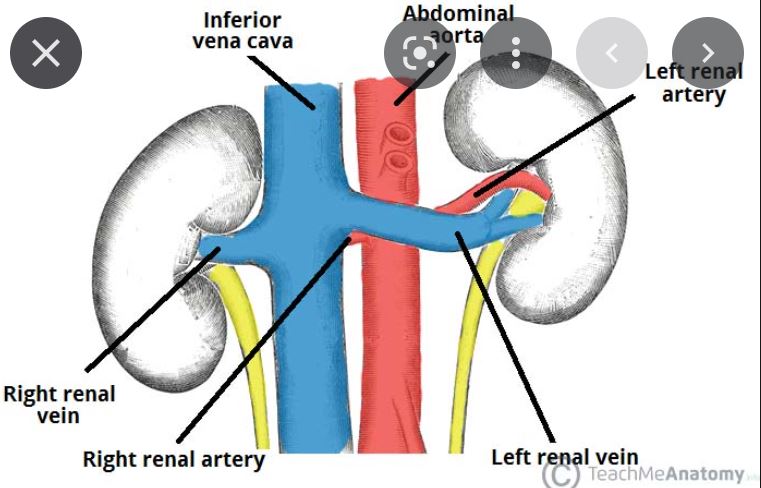
4
In erect position, the kidneys extend from . In supine, .
In erect position, the kidneys extend from L1-L4. In supine, T12-L3.
5
On the , the kidney needs to cross the abdominal aorta to get to the . The renal vein has to travel
On the left, the kidney needs to cross the abdominal aorta to get to the IVC. The left renal vein has to travel further. 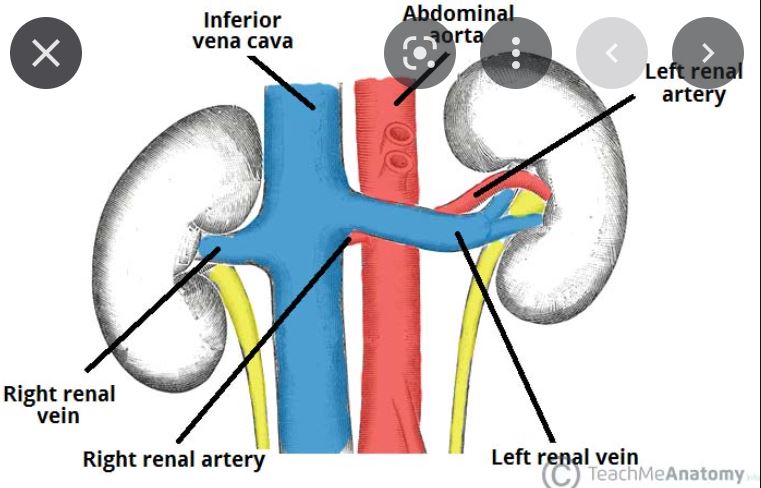
6
On the , the kidney does NOT need to cross over the abdominal aorta to get to . The renal vein has to travel .
On the right, the kidney does NOT need to cross over the abdominal aorta to get to IVC. The right renal vein has to travel less.
7
In Nutcracker's syndrome, the and compress the . Causes hematuria, adrenal hypertension on , and varicocele (in males).
In Nutcracker's syndrome, the SMA and abdominal aorta compress the left renal vein. Causes hematuria, adrenal hypertension on left, and left varicocele (in males).
8
In May-Thurner syndrome, is compressed by the and leads to .
In May-Thurner syndrome, left common iliac vein is compressed by the right common iliac artery and leads to DVT.
9
When the or are compromised = nephrotosis
When the pararenal fat or renal vessels are compromised = nephrotosis
10
1 thing found above the kidneys
Adrenal glands
11
5 things found BEHIND the kidneys
1. Diaphragm
2. Psoas major
3. Quadratus lumborum
4. 12th rib
5. Lateral edge of the erector spinae muscles
2. Psoas major
3. Quadratus lumborum
4. 12th rib
5. Lateral edge of the erector spinae muscles
12
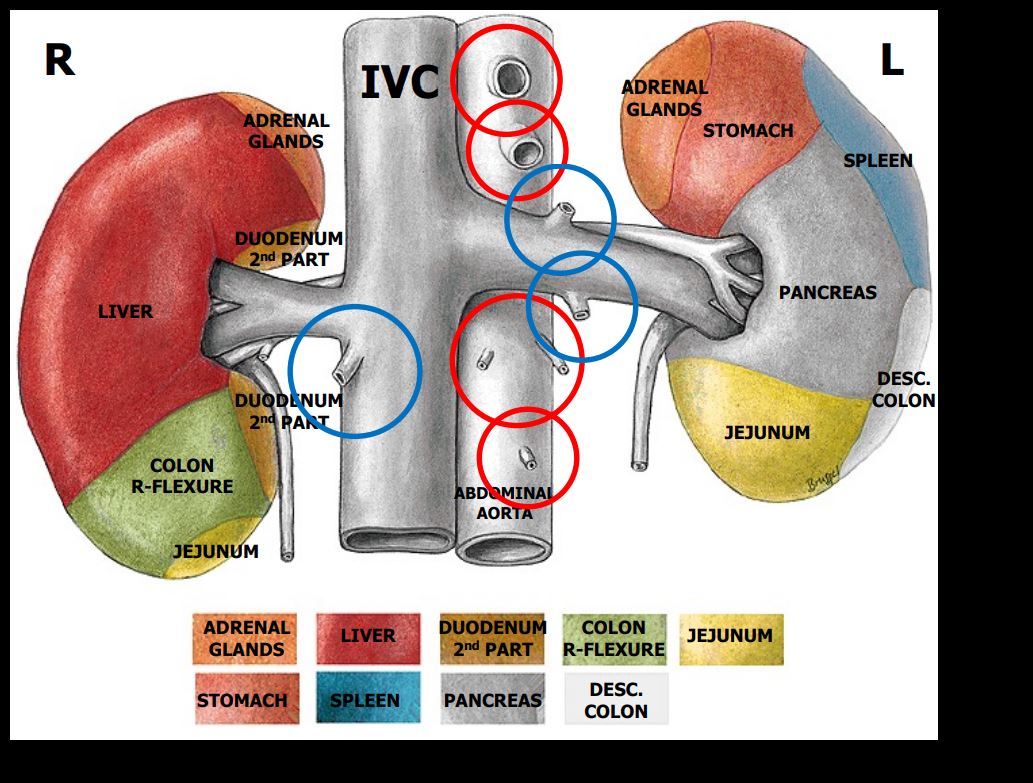
4 things anterior to the right kidney
1. Liver
2. 2nd part of duodenum
3. Ascending colon
4. Small intestine
2. 2nd part of duodenum
3. Ascending colon
4. Small intestine
13
5 things anterior to the left kidney
1. Stomach
2. Spleen
3. Pancreas
4. Left colic flexure
5. Small intestine
2. Spleen
3. Pancreas
4. Left colic flexure
5. Small intestine
14
TEST QUESTION
What are the 4 contents of the hilum of the kidney
Posterior:
Anterior:
Middle:
Nerve:
What are the 4 contents of the hilum of the kidney
Posterior:
Anterior:
Middle:
Nerve:
TEST QUESTION
What are the 4 contents of the hilum of the kidney
Posterior: Ureters and renal pelvis
Anterior: Renal veins
Middle: Renal arteries
Nerve: Sympathetic and Parasympathetic nerves
What are the 4 contents of the hilum of the kidney
Posterior: Ureters and renal pelvis
Anterior: Renal veins
Middle: Renal arteries
Nerve: Sympathetic and Parasympathetic nerves
15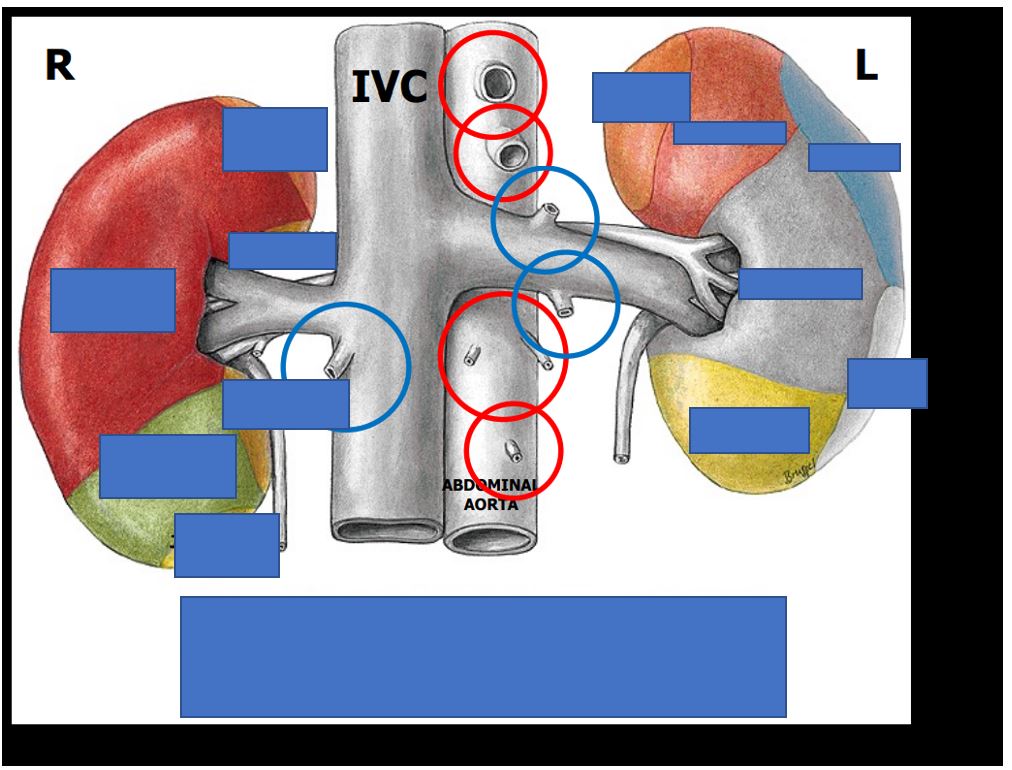
16
Boundaries of the hilum of the kidney
Anterior:
Middle:
Posterior:
(Also present)
Anterior:
Middle:
Posterior:
(Also present)
Boundaries of the hilum of the kidney
Anterior: Renal vein
Middle: Renal artery
Posterior: Ureter
(Also nerves present)
Anterior: Renal vein
Middle: Renal artery
Posterior: Ureter
(Also nerves present)
17
Pathway of urine to urinary bladder 6 steps
in to to to to to
in to to to to to
Pathway of urine to urinary bladder 6 steps
Papillary duct in renal pyramid to minor calyx to major calyx to renal pelvis to ureter to urinary bladder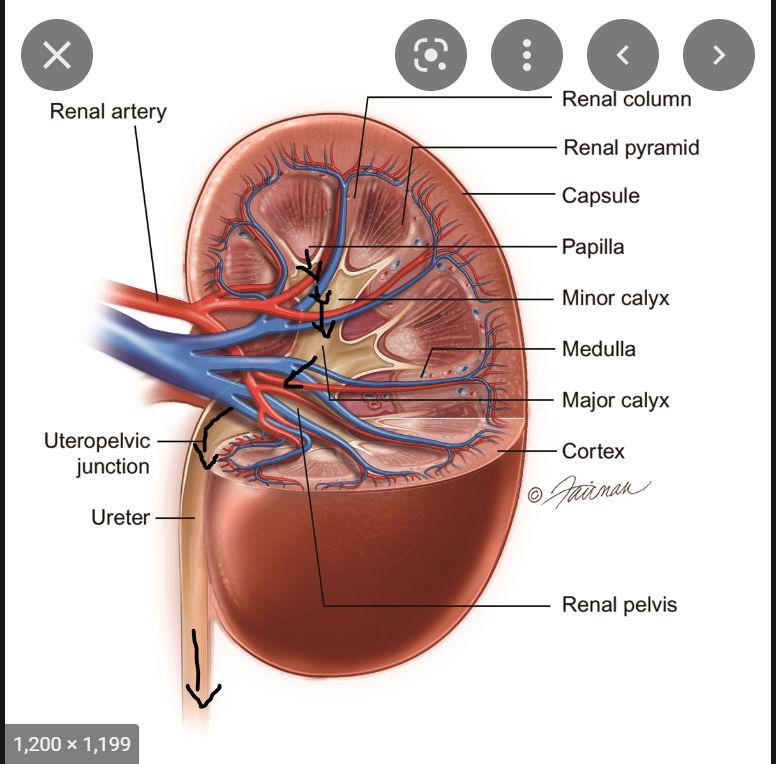
Papillary duct in renal pyramid to minor calyx to major calyx to renal pelvis to ureter to urinary bladder
18
The blood supply of the kidney is the (from the ) on branch below .
The blood supply of the kidney is the renal artery (from the abdominal aorta) on branch below SMA.
19
On the there
may be more than one
renal artery =
may be more than one
renal artery =
On the left side there
may be more than one
renal artery =
SUPERNUMERAY
ARTERIES
may be more than one
renal artery =
SUPERNUMERAY
ARTERIES
20
On the , the renal a. splits
(behind the IVC) into an
, , and
posterior
branches
(behind the IVC) into an
, , and
posterior
branches
On the right side, the renal a. splits
(behind the IVC) into an
upper, middle, and
lower posterior
branches
(behind the IVC) into an
upper, middle, and
lower posterior
branches
21
On the there
may be more than one
renal vein:
may be more than one
renal vein:
On the right side there
may be more than one
renal vein:
SUPRANUMERARY
VEINS or ACCESSORY
VEINS
may be more than one
renal vein:
SUPRANUMERARY
VEINS or ACCESSORY
VEINS
22
TEST QUESTION
On the left side, the left
renal vein receives
tributaries from:
•
•
•
•
On the left side, the left
renal vein receives
tributaries from:
•
•
•
•
TEST QUESTION
On the left side, the left
renal vein receives
tributaries from:
• Gonadal (L)
• Body wall
• Diaphragm
• Adrenal glands (L)
On the left side, the left
renal vein receives
tributaries from:
• Gonadal (L)
• Body wall
• Diaphragm
• Adrenal glands (L)
23
Pain fibers from the splanchnic nerves refer pain to the
, , and to the . If there is pain in these areas, watch out for the
, , and to the . If there is pain in these areas, watch out for the
Pain fibers from the splanchnic nerves refer pain to the
testis, labia majora, and to the lumbar region of the back (L1). If there is pain in these areas, watch out for the kidneys!
testis, labia majora, and to the lumbar region of the back (L1). If there is pain in these areas, watch out for the kidneys!
24
The right testicular (or ovarian) vein drains directly into the
The right testicular (or ovarian) vein drains directly into the IVC.
25
The left testicular (or ovarian) drains into the .
The left testicular (or ovarian) drains into the left renal vein .