All cards
1
What is red? Yellow? Green? 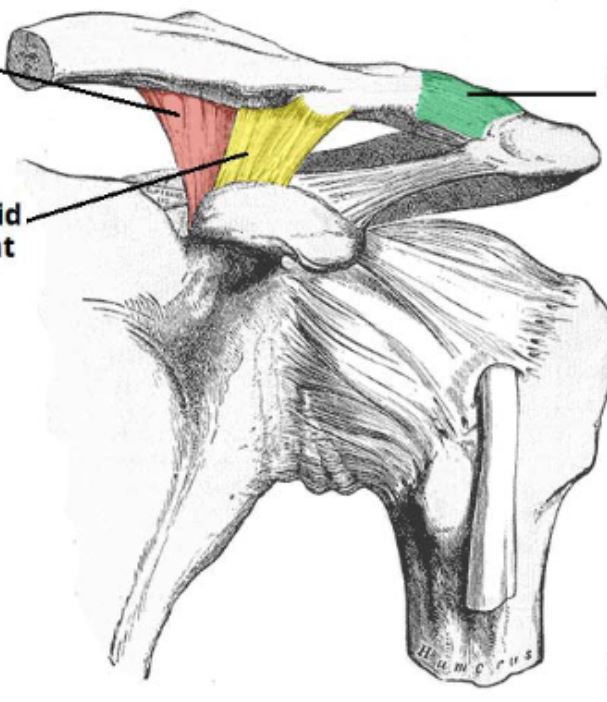
Red is conoid ligament, yellow is trapezoid ligament (combined make the coracoclavicular joint)
green is acromioclavicular ligament
green is acromioclavicular ligament
2
What is the condition described? What part of the brachial plexsus is injured?
"Caused by VIOLENT, EXCESSIVE force separating neck from shoulder),
common in contact sports and neonatal delivery"
"Caused by VIOLENT, EXCESSIVE force separating neck from shoulder),
common in contact sports and neonatal delivery"
Erb-Duchenne Palsy (waiter's tip), Upper trunk (C5-C6)
3
What is the result of upper brachial plexus injury?
ADDUCTED, INTERNALLY ROTATED, EXTENDED ELBOW, FLEXED WRIST "waiter's tip position"
4
Which 5 nerves are injured due to a C5-C6 injury?
1. Suprascapular
2. Musculoskeletal
3. Lateral pector
4. Axillary
5. Radial
2. Musculoskeletal
3. Lateral pector
4. Axillary
5. Radial
5
What muscles would be impacted by a suprascapular nerve injury?
Supraspinatus and Infraspinatus
6
What muscles would be impacted by a musculoskeletal nerve injury?
Biceps, Brachialis, Coracobrachialis
7
What muscles does the lateral pectoral nerve impact?
Pectoralis major
8
What muscles do the axillary nerves impact?
deltoid and teres minor
9
What muscles do the radial nerves impact?
Triceps and forearm extensors
10
What is the most common cause of middle brachial plexsus injury? What is the nerve root impacted?
interscalene anesthesia, C7
11
What are the possible nerves impacted by a middle brachial plexsus injury?
1. Axillary
2. Radial
3. Lower subscapular
2. Radial
3. Lower subscapular
12
What is the result of a middle brachial plexsus injury?
FLEXED ELBOW and WRIST with shoulder unable to ABDUCT nor ADDUCT!
13
What is the condition described? What part of the brachial plexsus is injured?
"Caused by VIOLENT, EXCESSIVE force displacing the arm upwards at the shoulder joint, away from the torso, common in shoulder dislocations during neonatal delivery
Can also occur due to cervical ribs, apical lung tumors, or scalene syndrome"
"Caused by VIOLENT, EXCESSIVE force displacing the arm upwards at the shoulder joint, away from the torso, common in shoulder dislocations during neonatal delivery
Can also occur due to cervical ribs, apical lung tumors, or scalene syndrome"
Dejerine-Klumpke Paralysis, lower
trunk C8-T1,
trunk C8-T1,
14
In lower brachial plexsus injury, which nerves are most likely to be effected?
1. Ulnar
2. Medial pectoral
2. Medial pectoral
15
Injury to the ulnar nerve would cause damage to what muscles?
All of the hand muscles, except for half-loaf
16
Injury to the medial pectoral nerve would cause damage to what muscles?
Pectoralis major
17
What is the result of lower brachial plexsus injury?
Claw hand with EXTENDED WRIST and HAND; also with an inability to ADDUCT shoulder
18
What are the two posterior cord injuries
Radial nerve injury and axillary nerve injury
19
What causes radial nerve injury on the posterior cord?
1. Often due to injury to axilla (Saturday night palsy),
2. mid-humeral shaft fracture and lateral epicondyle fracture
2. mid-humeral shaft fracture and lateral epicondyle fracture
20
What condition does posterior cord radial nerve injury cause? What type of sensory and motor issues does it cause?
Results in WRIST DROP
M: Wrist/elbow extension (forearm extensors and triceps)
S: Dorsum of hand sensory loss
M: Wrist/elbow extension (forearm extensors and triceps)
S: Dorsum of hand sensory loss
21
What causes posterior cord axillary nerve injury?
Often an injury of the surgical neck of the humerus
22
What type of sensory and motor impacts would be seen with posterior cord axillary nerve injury?
M: aBduction and lateral rotation of shoulder impaired
(deltoid and teres minor)
S: Lateral brachial sensory loss
(deltoid and teres minor)
S: Lateral brachial sensory loss
23
Know this pic 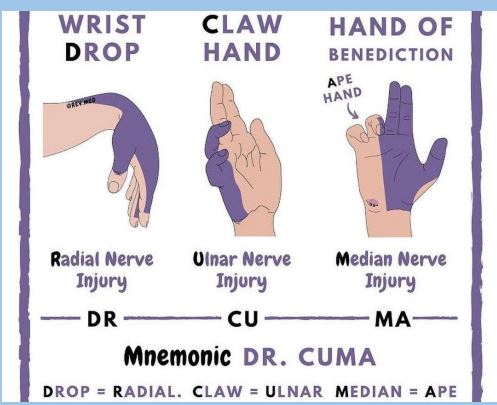
24
Lateral cord Musculoskeletal nerve injury would cause issues with what motor and what sensory function
M: Flexion of shoulder and elbow impaired
(Biceps, Brachialis, Coracobrachialis)
S: Lateral forearm sensory loss
(Biceps, Brachialis, Coracobrachialis)
S: Lateral forearm sensory loss
25
Lateral corrd median nerve injury causes what condition? At axilla? Above elbow? At wrist?
-Causes hand of benediction
At axilla:
M: Flexion of hand/fingers, pronation of forearm impaired
S: Lateral palm sensory loss
Above elbow:
M: Thumb muscles impaired EXCEPT aDduction
At wrist:
M: Only thenar muscles impaired
At axilla:
M: Flexion of hand/fingers, pronation of forearm impaired
S: Lateral palm sensory loss
Above elbow:
M: Thumb muscles impaired EXCEPT aDduction
At wrist:
M: Only thenar muscles impaired
26
What is ulnar nerve injury often caused by?
Medial epicondylar fractures
27
What is the motor an sensory effect of a medial cord ulnar nerve injury caused by a medial epicondylar fracture?
M: Flexion of hand and fingers, adduction of thumb impaired (FCU, ½ of FDP, Hypothenar and intrinsic hand muscles)
(claw hand)
S: Sensory loss to medial palm and dorsal hand over digits 4 and 5
(claw hand)
S: Sensory loss to medial palm and dorsal hand over digits 4 and 5
28
What is the impact of ulnar injury to the wrist? (medial cord injury)
(Guyon’s canal):M: Flexion of hand and fingers impaired (hypothenar and intrinsic hand muscles)
Pinky (digit 5) is immobile
Pinky (digit 5) is immobile
29
WHat is the impact of a humerous fracture to the surgical neck?
Common in elderly patient who fall on their elbow with an aBducted
arm. Risk for avascular necrosis and axillary nerve and post humeral circumflex a.
arm. Risk for avascular necrosis and axillary nerve and post humeral circumflex a.
30
What is the impact of a humerous fracture to the mid-shaft?
“radial groove injury” can injure the radial nerve and deep brachial a
31
What is the impact of a medial epicondle fracture?
can injure the ulnar nerve
32
What is another name for lateral epicondylitis? What is it?
pain and
tenderness over the lateral epicondyle and the origin
of the posterior muscles of the forearm via the
common tendon (common extensor tendon).
tenderness over the lateral epicondyle and the origin
of the posterior muscles of the forearm via the
common tendon (common extensor tendon).
33
What is another name for medial epicondylitis? What is it?
painful, from
repetitive use of the superficial muscles of the
anterior forearm. Pain is experienced on the medial
epicondyle. Repetitive motion strains the common
flexor tendon.
repetitive use of the superficial muscles of the
anterior forearm. Pain is experienced on the medial
epicondyle. Repetitive motion strains the common
flexor tendon.
34
What is pronator syndrome? What is the main symptom?
Entrapment of the median nerve, commonly between the 2 heads of the pronator teres m.
Pain and tenderness in proximal forearm, worse with activity
Pain and tenderness in proximal forearm, worse with activity
35
What is de Quervain’s disease?
Thickening of the common fibrous sheath for the tendons of the Abductor pollicis longus and
Extensor pollicis brevis
Extensor pollicis brevis
36
What is de Quervain’s disease caused by?
Rheumatoid arthritis, gout, high cholesterol, CREST, Reiter’s syndrome-reactive arthritis, disseminated gonococcal diseases, trauma?
37
What are the symptoms of de Quervain’s disease?
Pain w/tenderness over insertion of the tendons on palpation with limited ROM
38
What is the positive sign for de Quervain's disease?
+Finkelstein test (pt makes a fist, YOU passively ulnar deviate the pt’s fist, if pt
reports pain over base of thumb = POSITIVE test)
reports pain over base of thumb = POSITIVE test)
39
What is a midshaft radial fracture?
Fracture in midshaft of radius
40
What is a Galeazzi fracture?
A radial midshaft fracture with distal radio-ulnar
dislocation
dislocation
41
What is Colles fracture?
A radial fracture where Distal radius fragment dislocates posteriorly causing hand to ADDUCT at the wrist ->“dinner fork” deformity
42
What is Smith's fracture?
A radial fracture involving anterior dislocation of a distal fragment
43
What is Barton's fracture?
dislocation of the distal radiocarpal joint,
can also be a fracture
can also be a fracture
44
What is this?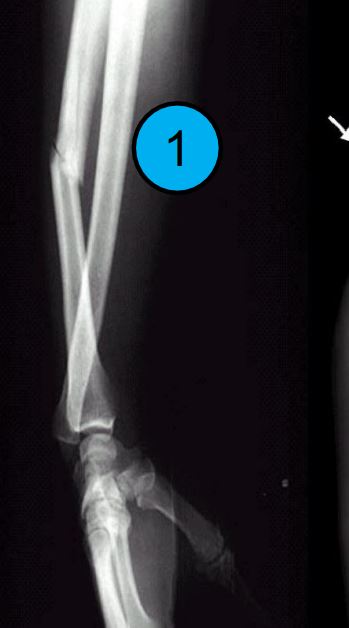
Midshaft radial fracture
45
What is this?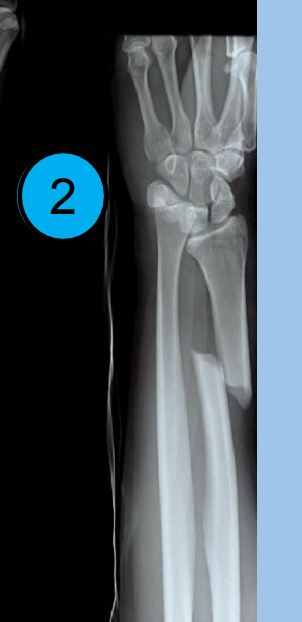
Galeazzi radial fracture
46
What is this?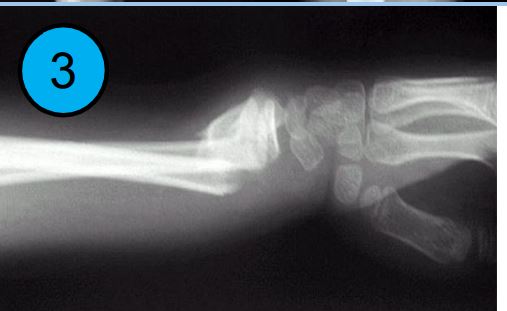
Colles radial fracture (dinner fork)
47
What is this?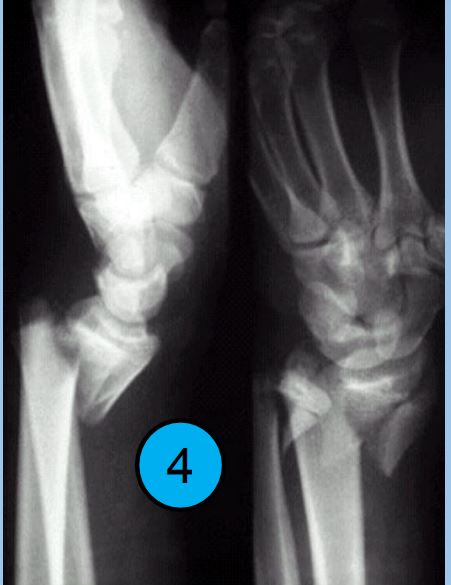
Smith's radial fracture
48
What is this?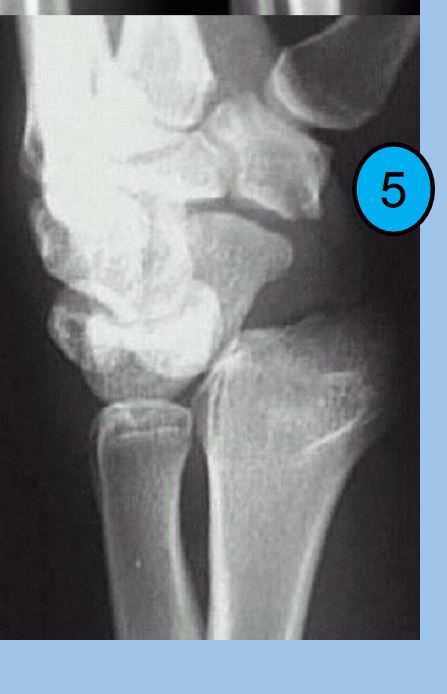
Bartons radial fracture
49
What is Carpal Tunnel syndrome caused by?
median nerve compression under the flexor retinaculum
50
What are the symptoms of carpal tunnel syndrome?
Paresthesia, pain and loss of mobility, impaired flexion at MPJ of index and middle fingers
51
What are the causes of carpal tunnel syndrome?
Repetitive motion, Trauma (lunate fractures), Tendonitis, Space-occupying lesions (ganglion
cysts) or occupational hazards (typists, carpenters, rowers)
cysts) or occupational hazards (typists, carpenters, rowers)
52
What is the diagnosis of carpal tunnel syndrome?
Diagnosis: +Tinel sign, +Phalen test, presence of an Ape hand, wasting of thenar muscles
53
What is the difference between the first and second picture? 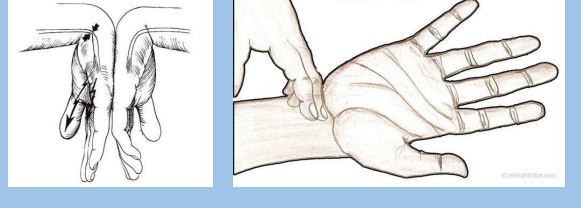
The first picture is Phalen's test and the second picture is Tinel's test
54
The scaphoid Most common carpal bone Results from falling on an arm with an hand.
Mildly displaces if at all.
Risk of developing AVN due to presence of with higher risk the more proximal the fracture.
Mildly displaces if at all.
Risk of developing AVN due to presence of with higher risk the more proximal the fracture.
The scaphoid Most common carpal bone FRACTURE Results from falling on an outstretched arm with an aBducted hand.
Mildly displaces if at all.
Risk of developing AVN due to presence of radial artery, with higher risk the more proximal the fracture.
Mildly displaces if at all.
Risk of developing AVN due to presence of radial artery, with higher risk the more proximal the fracture.
55
Lunate:
Most common carpal bone
Results from falling onto an hand.
Displaces .
Risk of developing AVN and Carpal Tunnel syndrome.
Most common carpal bone
Results from falling onto an hand.
Displaces .
Risk of developing AVN and Carpal Tunnel syndrome.
Lunate:
Most common carpal bone DISLOCATION.
Results from falling onto an aDducted hand.
Displaces anteriorly.
Risk of developing AVN and Carpal Tunnel syndrome.
Most common carpal bone DISLOCATION.
Results from falling onto an aDducted hand.
Displaces anteriorly.
Risk of developing AVN and Carpal Tunnel syndrome.
56
Break at neck of 5the metacarpal, typically caused by punching. (Remember, the wall always wins!)
Boxer’s: Break at neck of 5the metacarpal, typically caused by punching. (Remember, the wall always wins!)
57
Break at base Base of 1st metacarpal
Bennett’s: Break at base Base of 1st metacarpal
58
made up of the trapezoid
and Conoid ligament
and Conoid ligament
Coracoclavicular ligament: made up of the trapezoid
and Conoid ligament
and Conoid ligament
59
connects the acromium to the
clavicle (Commonly torn / Separated)
clavicle (Commonly torn / Separated)
Acromioclavicular lig. : connects the acromium to the
clavicle (Commonly torn / Separated)
clavicle (Commonly torn / Separated)
60
Connects the acromium to the
coracoid process
coracoid process
Coracacromial Lig. : Connects the acromium to the
coracoid process
coracoid process
61
- Extremely strong joint that is rarely injured
- The clavicle will break before separation
- Extremely strong joint that is rarely injured
- The clavicle will break before separation
Sternoclavicular Joint:
- Extremely strong joint that is rarely injured
- The clavicle will break before separation
- Extremely strong joint that is rarely injured
- The clavicle will break before separation
62
- Very common for separation in contact
sports
- Ligaments tear instead of bone breaking
- Very common for separation in contact
sports
- Ligaments tear instead of bone breaking
Acromioclavicular Joint:
- Very common for separation in contact
sports
- Ligaments tear instead of bone breaking
- Very common for separation in contact
sports
- Ligaments tear instead of bone breaking
63
- Dislocation is very common due to
excessive extension and lateral
rotation
- Anterior dislocation is the most
common
- Dislocation is very common due to
excessive extension and lateral
rotation
- Anterior dislocation is the most
common
Glenohumoral Joint
- Dislocation is very common due to
excessive extension and lateral
rotation
- Anterior dislocation is the most
common
- Dislocation is very common due to
excessive extension and lateral
rotation
- Anterior dislocation is the most
common
64
What is the most common glenhumoral joint dislocation? Least common?
Most common is subcoracoid, least common is the intrathoracic
65
: (i.e. )
inflammation of the bursa in the olecranon
inflammation of the bursa in the olecranon
Subcutaneous Olecranon Bursitis: (i.e.Student elbow)
inflammation of the bursa in the olecranon
inflammation of the bursa in the olecranon
66
bursa inflammation due to extension
of wrist and forearm pronated
of wrist and forearm pronated
Radioulnar Bursiti: bursa inflammation due to extension
of wrist and forearm pronated
of wrist and forearm pronated
67
(i.e. ) Incomplete dislocation
of the head of the radius
- Look for children getting swung
- Annular ligament tear
of the head of the radius
- Look for children getting swung
- Annular ligament tear
Pulled Elbow: (i.e. nursemaid elbow) Incomplete dislocation
of the head of the radius
- Look for children getting swung
- Annular ligament tear
of the head of the radius
- Look for children getting swung
- Annular ligament tear
68
-Most common is a posterior elbow joint dislocation?
Posterior elbow joint location
69
What happens in a positerior elbow joint location?
-A fall happens with elbow flexed
- Humorous moves forward and olecranon moves back
- Humorous moves forward and olecranon moves back
70
Dislocations are described with respect to what?
Position of the ulna. If ulna is behind humerous, posterior. If ulna in in front of humerous, anterior.