New 26 + 27 :(
Study these flashcardsFree · spaced repetition · iPhone, Android, Mac & web
All cards
1
Unlike carbohydrates and
triacylglycerols whose major
function is to provide
amino acids serve as building
blocks for
triacylglycerols whose major
function is to provide
amino acids serve as building
blocks for
Unlike carbohydrates and
triacylglycerols whose major
function is to provide energy
amino acids serve as building
blocks for tissue protein
synthesis.
triacylglycerols whose major
function is to provide energy
amino acids serve as building
blocks for tissue protein
synthesis.
2
Proteins from the diet are digested into
Proteins from the diet are digested into individual amino acids.
3
Individual amino acids are then used for intracellular tissues
Individual amino acids are then used for intracellular tissues protein
biosynthesis.
biosynthesis.
4
Amino acids that cannot be synthesized
de novoare
de novoare
Amino acids that cannot be synthesized
de novoare essential amino acids.
de novoare essential amino acids.
5
What are the essential amino acids?
Phenylalanine, valine, Threonine,
Tryptophan, Isoleucine, Methionine,
Histidine, Arginine, Leucine, Lysine
PVT TIM HALL
Tryptophan, Isoleucine, Methionine,
Histidine, Arginine, Leucine, Lysine
PVT TIM HALL
6
Which two amino acids are conditional?
Arginine and methionine
7
3 things that cause negative nitrogen balance?
1. Dietary deficiency of any one of
the essential amino acids
2. Extreme conditions of Diabetes
3. Pathogenic Infections
general starvation
the essential amino acids
2. Extreme conditions of Diabetes
3. Pathogenic Infections
general starvation
8
4 things that cause positive nitrogen balance?
1. Fetal Development (Pregnancy)
2. Human development (growth)
3. Post injury or surgery (recovery
phase)
4. Recovery from
fasting/starvation
2. Human development (growth)
3. Post injury or surgery (recovery
phase)
4. Recovery from
fasting/starvation
9
Deficiency of selective amino acids
(protein malnutrition alone) i.e.
negative nitrogen balance leads to
(protein malnutrition alone) i.e.
negative nitrogen balance leads to
Deficiency of selective amino acids
(protein malnutrition alone) i.e.
negative nitrogen balance leads to
Kwashiorkor
(protein malnutrition alone) i.e.
negative nitrogen balance leads to
Kwashiorkor
10
Nutritional deficiency (including Fats
and Carbs) leads to
(decay, extensive muscle wasting and
tissue damage etc.)
and Carbs) leads to
(decay, extensive muscle wasting and
tissue damage etc.)
Nutritional deficiency (including Fats
and Carbs) leads to Marasmus
(decay, extensive muscle wasting and
tissue damage etc.)
and Carbs) leads to Marasmus
(decay, extensive muscle wasting and
tissue damage etc.)
11
In Kwashiorkorsyndrome there is less synthesis which causes osmotic
imbalance in the blood and
of tissues.
imbalance in the blood and
of tissues.
In Kwashiorkorsyndrome there is less serum
albumin synthesis which causes osmotic
imbalance in the blood and generalized edema
of tissues.
albumin synthesis which causes osmotic
imbalance in the blood and generalized edema
of tissues.
12
The carbon skeletons from
amino acids can be fed into
or cycle to be
used for energy purposes.
amino acids can be fed into
or cycle to be
used for energy purposes.
The carbon skeletons from
amino acids can be fed into
glycolysis or TCA cycle to be
used for energy purposes.
amino acids can be fed into
glycolysis or TCA cycle to be
used for energy purposes.
13
However, the of
amino acids are removed
through the urea cycle and
the nitrogen is eliminated in
the form of
amino acids are removed
through the urea cycle and
the nitrogen is eliminated in
the form of
However, the amino group of
amino acids are removed
through the urea cycle and
the nitrogen is eliminated in
the form of Urea.
amino acids are removed
through the urea cycle and
the nitrogen is eliminated in
the form of Urea.
14
How are amino acids broken down?
1. broken down by
2. AA and enter
1. broken down by
2. AA and enter
How are amino acids broken down?
1. broken down by proteolysis
2. AA transaminated and enter urea cycle
1. broken down by proteolysis
2. AA transaminated and enter urea cycle
15
What is the Proteosome Pathway?
Intracellular protein degradation pathway
16
How does the proteosome pathway work?
1. Protein by
2. breaks down protein into peptide frag and released ubiquitin
3. Amino groups= , carbon skeleton = , ,
1. Protein by
2. breaks down protein into peptide frag and released ubiquitin
3. Amino groups= , carbon skeleton = , ,
How does the proteosome pathway work?
1. Protein ubiquinated by PEST
2. Proteasome breaks down protein into peptide frag and released ubiquitin
3. Amino groups= urea cycle, carbon skeleton = glucose synthesis, fatty acid synth, TCA cycle
1. Protein ubiquinated by PEST
2. Proteasome breaks down protein into peptide frag and released ubiquitin
3. Amino groups= urea cycle, carbon skeleton = glucose synthesis, fatty acid synth, TCA cycle
17
Ketogenic amino acidsupon
degradation produce only or .
degradation produce only or .
Ketogenic amino acidsupon
degradation produce only acetyl
CoA or acetoacetyl CoA.
degradation produce only acetyl
CoA or acetoacetyl CoA.
18
Glucogenic amino acidsupon
metabolism produce ,
or ,
, or
(TCA cycle
intermediates).
metabolism produce ,
or ,
, or
(TCA cycle
intermediates).
Glucogenic amino acidsupon
metabolism produce pyruvate,
3‐phosphoglycerate (glycolytic
intermediate) or oxalo acetate,
a‐ketoglutarate, succinyl CoA or
fumarate (TCA cycle
intermediates).
metabolism produce pyruvate,
3‐phosphoglycerate (glycolytic
intermediate) or oxalo acetate,
a‐ketoglutarate, succinyl CoA or
fumarate (TCA cycle
intermediates).
19
What are the ketogenic amino acids?
Leucine and lysine
20
What amino acids make acteyl CoA?
Isoleucine
Leucine
Tryptophan
Leucine
Tryptophan
21
What amino acids make acteoacetyl CoA?
L e ucin e
L ysin e
P he ny lala nine
T r yptop h an
T yr osin e
L ysin e
P he ny lala nine
T r yptop h an
T yr osin e
22
What amino acids make alpha keto gluterate?
A rg in in e
G lu tam ate
G lu tam in e
H istidine
P rolin e
G lu tam ate
G lu tam in e
H istidine
P rolin e
23
What amino acids make succinyl CoA?
Isoleucin e
M eth ion in e
T h re on in e
V alin e
M eth ion in e
T h re on in e
V alin e
24
What amino acids make fumarate?
A spa rtate
P hen ylala nine
T yrosin e
P hen ylala nine
T yrosin e
25
What amino acids make oxaloacetate?
A sp a ragine
A sp a rtate
A sp a rtate
26
What amino acids make pyruvate?
A lan in e
C ystein e
G lycin e
S erine
T h reo nine
T ry p top h a n
C ystein e
G lycin e
S erine
T h reo nine
T ry p top h a n
27
use an
amino acid to donate
an amine group to a
keto acid.
amino acid to donate
an amine group to a
keto acid.
Transaminases (amino
transferases) use an
amino acid to donate
an amine group to a
keto acid.
transferases) use an
amino acid to donate
an amine group to a
keto acid.
28
Keto acid becomes
and the
amino acid becomes
and the
amino acid becomes
Keto acid becomes
amino acid and the
amino acid becomes
keto acid.
amino acid and the
amino acid becomes
keto acid.
29
The mandatory amino acid/keto acid
pair is / .
pair is / .
The mandatory amino acid/keto acid
pair is glutamate/Alpha‐ketoglutarate.
pair is glutamate/Alpha‐ketoglutarate.
30
serves as a coenzyme in the
reaction. (transaminase rxn)
reaction. (transaminase rxn)
Pyridoxal phosphate (Vitamin B 6
derivative) serves as a coenzyme in the
reaction. (transaminase rxn)
derivative) serves as a coenzyme in the
reaction. (transaminase rxn)
31
What is the major vitamin used by amino transferase and its two enzyme derivatives?
Vitamin B6 pyridoxine, Coenzyme derivatives are pyridoxal phosphate and pyridoxamine
32
In liver diseases, that causes cell lysis (for
e.g., viral hepatitis, toxic injury) the two
enzymes
and are released into blood.
e.g., viral hepatitis, toxic injury) the two
enzymes
and are released into blood.
In liver diseases, that causes cell lysis (for
e.g., viral hepatitis, toxic injury) the two
enzymes
AST and ALT are released into blood.
e.g., viral hepatitis, toxic injury) the two
enzymes
AST and ALT are released into blood.
33
High concentrations of AST and ALT in plasma are diagnostic
markers of
markers of
High concentrations of AST and ALT in plasma are diagnostic
markers of liver cell damage
markers of liver cell damage
34
Many tissues lack complete sets of to dispose excess
nitrogen.
nitrogen.
Many tissues lack complete sets of urea
cycle enzymes to dispose excess
nitrogen.
cycle enzymes to dispose excess
nitrogen.
35
is the main organ that operates
urea cycle.
urea cycle.
Liver is the main organ that operates
urea cycle.
urea cycle.
36
Since is toxic to cells, Excess
nitrogen in the form of is sent
to liver, where it
can be metabolized.
nitrogen in the form of is sent
to liver, where it
can be metabolized.
Since NH 3 is toxic to cells, Excess
nitrogen in the form of glutamine is sent
to liver, where it
can be metabolized.
nitrogen in the form of glutamine is sent
to liver, where it
can be metabolized.
37
NH3 disrupts pH balance and causes
NH3 disrupts pH balance and causes alkalosis
38
How is glutamate turned into glutamine? Needed?
Enzyme:
Intermediate:
Needs:
Enzyme:
Intermediate:
Needs:
How is glutamate turned into glutamine? Needed?
Enzyme: Glutamine synthetase
Intermediate: glutamate gamma phosphate
Needs: NH4+, ATP
Enzyme: Glutamine synthetase
Intermediate: glutamate gamma phosphate
Needs: NH4+, ATP
39
What are the 4 things that glutamate becomes?
1. Urea
2. Polyamine
3. Glutathione ***
4. GABA ***
2. Polyamine
3. Glutathione ***
4. GABA ***
40
What are the 4 things that glutamine becomes?
1. Amino sugars
2. Glycoproteins
3. Nucleotides
4. Urea
2. Glycoproteins
3. Nucleotides
4. Urea
41
alpha-ketoglutarate -> ->
alpha-ketoglutarate -> Glutamate -> Glutamine
42
Alpha ketogluterate becomes using (enzyme) and requires . Glutamate becomes using (enzyme) and requires
Alpha ketogluterate becomes glutamate using glutamate dehydrogenase (enzyme) and requires NADPH. Glutamate becomes glutamine using glutamine synthetase (enzyme) and requires ATP.
43
When glutamine reaches liver,
converts glutamine
into and . Now, ammonia enters the .
converts glutamine
into and . Now, ammonia enters the .
When glutamine reaches liver,
glutaminase converts glutamine
into glutamate and ammonia. Now, ammonia enters the urea cycle.
glutaminase converts glutamine
into glutamate and ammonia. Now, ammonia enters the urea cycle.
44
Glutamate becomes alpha keto gluterate using (enzyme) and producing (needs
Glutamate becomes alpha keto gluterate using glutamate dehydrogenase (enzyme) and producing NADH (needs NAD+)
45
How is carbamoylphosphate synthesized?
NH4+ + HCO3- yeilds carbamoylphosphate using 2ATP and CPS-I
46
CPS‐I is located in the
CPS‐I is located in the
mitochondrial
matrix.
mitochondrial
matrix.
47
CPS‐I is activated by
an allosteric activator
an allosteric activator
CPS‐I is activated by
an allosteric activator
N‐acetyl glutamate.
an allosteric activator
N‐acetyl glutamate.
48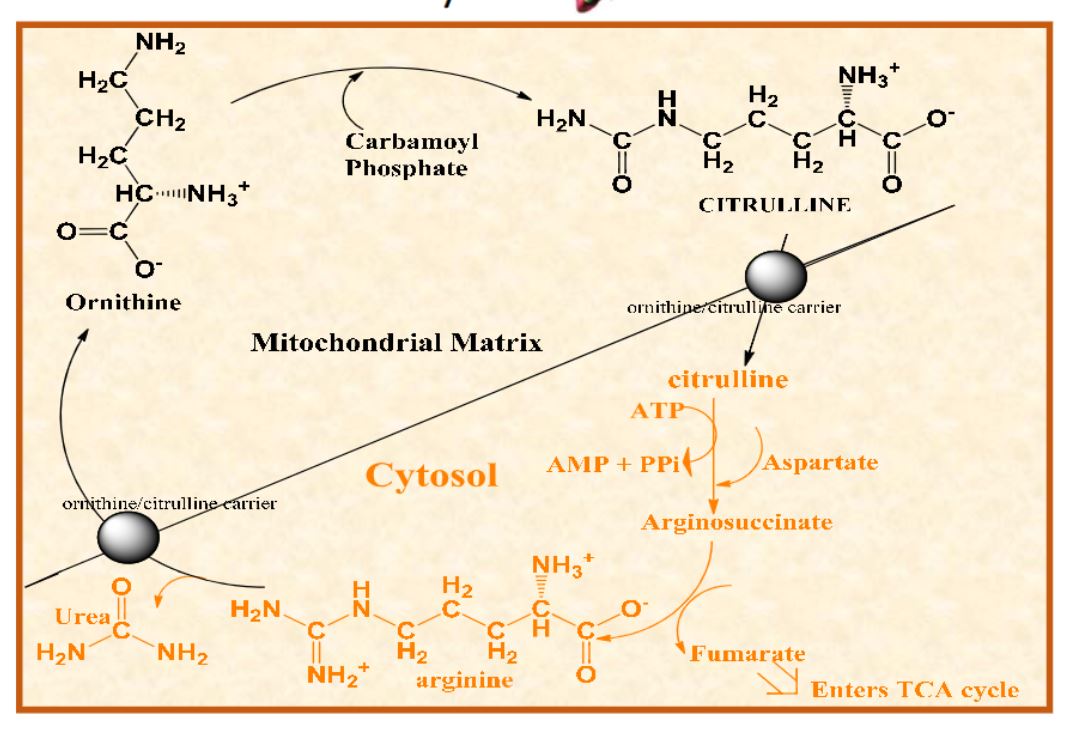
Draw the urea cycle
49
What in the urea cycle enters the TCA cycle?
1. Fumarate can be converted into malate
2. Aspartate can become oxaloactate
2. Aspartate can become oxaloactate
50
Excretion= – +
Excretion=Filtration – Reabsorption + Secretion
51
, , and
indicates a
defect in urea cycle.
indicates a
defect in urea cycle.
Hyperammonemia, elevated
blood glutamine, and
decreased BUN indicates a
defect in urea cycle.
blood glutamine, and
decreased BUN indicates a
defect in urea cycle.
52
N‐acetyl glutamate (an
allosteric activator of )
deficiency can be treated by
administering .
allosteric activator of )
deficiency can be treated by
administering .
N‐acetyl glutamate (an
allosteric activator of CPS‐I)
deficiency can be treated by
administering carbamoyl
glutamate (an analog).
allosteric activator of CPS‐I)
deficiency can be treated by
administering carbamoyl
glutamate (an analog).
53
Deficiency of all other urea
cycle enzymes can also occur
(therefore limit in
this case).
cycle enzymes can also occur
(therefore limit in
this case).
Deficiency of all other urea
cycle enzymes can also occur
(therefore limit protein intake in
this case).
cycle enzymes can also occur
(therefore limit protein intake in
this case).
54
Alternative Detox Rxn: Benzoate
Benzoate becomes with and . Glycine replaces and forms .
Benzoate becomes with and . Glycine replaces and forms .
Alternative Detox Rxn: Benzoate
Benzoate becomes benzyol CoA with ATP and CoA. Glycine replaces CoA and forms benzoyl glycine.
Benzoate becomes benzyol CoA with ATP and CoA. Glycine replaces CoA and forms benzoyl glycine.
55
Alternative Detox RXn: Phenyl acetate
Phenyl acetate + makes using and
Phenyl acetate + makes using and
Alternative Detox RXn: Phenyl acetate
Phenyl acetate + Glutamine makes phenylacetylglutamine using COA and ATP
Phenyl acetate + Glutamine makes phenylacetylglutamine using COA and ATP
56
Pyruvate to lactate occurs in the ____. Uses what isoform?
Occurs in the muscle. Uses LDH M isoform.
57
Lactate to pyruvate occurs in the _____. Uses what isoform?
Liver. Uses LDH L isoform.
58
This process
of shuttling of lactate into liver and further metabolism of lactate in the liver to form glucose
through gluconeogenesis is called
of shuttling of lactate into liver and further metabolism of lactate in the liver to form glucose
through gluconeogenesis is called
This process
of shuttling of lactate into liver and further metabolism of lactate in the liver to form glucose
through gluconeogenesis is called Cori’s cycle.
of shuttling of lactate into liver and further metabolism of lactate in the liver to form glucose
through gluconeogenesis is called Cori’s cycle.
59
In glucose/alanine cycle it is that
travels from muscle to liver by contrast in Cori’s cycle it is the that travels from muscle to
liver to be further metabolized
travels from muscle to liver by contrast in Cori’s cycle it is the that travels from muscle to
liver to be further metabolized
In glucose/alanine cycle it is alanine that
travels from muscle to liver by contrast in Cori’s cycle it is the lactate that travels from muscle to
liver to be further metabolized
travels from muscle to liver by contrast in Cori’s cycle it is the lactate that travels from muscle to
liver to be further metabolized
60
The glucose produced by this
process ( ) is transported back into muscle for muscle energy purposes.
process ( ) is transported back into muscle for muscle energy purposes.
The glucose produced by this
process (glucose-alanine/Cori cycle) is transported back into muscle for muscle energy purposes.
process (glucose-alanine/Cori cycle) is transported back into muscle for muscle energy purposes.
61
Cori cycle occurs when
Cori cycle occurs when oxygen delivery is low.
62
Tryosine in the hypothalamus and adreneal medulla makes
Tryosine in the hypothalamus and adreneal medulla makes dopamine
63
Tyrosine in the adrenal medulla makes
Tyrosine in the adrenal medulla makes epinephrine
64
Tyrosine in the tyroid gland makes
Tyrosine in the tyroid gland makes thyroxine
65
Tyrosine in the skin makes
Tyrosine in the skin makes melanin pigments
66
Tyrosine in th peripheral nerve makes
Tyrosine in th peripheral nerve makes norepinephrine
67
Release of catecholamines is stimulates by
Tyrosine goes to by ( )
to by (Needs )
to by ( )
to (needs
Tyrosine goes to by ( )
to by (Needs )
to by ( )
to (needs
Release of catecholamines is stimulates by Ach
Tyrosine goes to DOPA by tyrosine hydroxlase (rate limiting)
DOPA to dopamine by DOPA decarboxylase (Needs vitamin B6)
Dopamine to norepinephrine by hydroxylase (vitamin c)
Norephinephrine to epinephrine (needs SAM)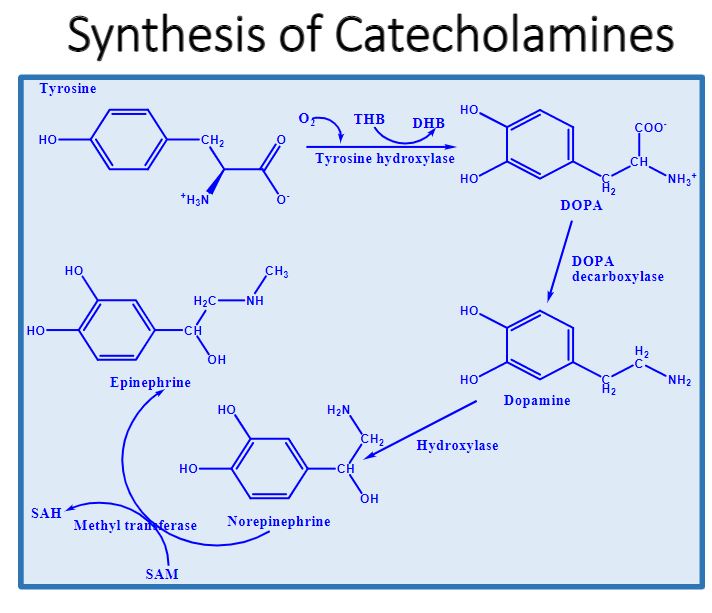
Tyrosine goes to DOPA by tyrosine hydroxlase (rate limiting)
DOPA to dopamine by DOPA decarboxylase (Needs vitamin B6)
Dopamine to norepinephrine by hydroxylase (vitamin c)
Norephinephrine to epinephrine (needs SAM)
68
The two enzymes involved in the catabolism of catecholamines are Catecholamine o‐
methyl transferase
and Monoamine oxidase
methyl transferase
and Monoamine oxidase
The two enzymes involved in the catabolism of catecholamines are Catecholamine o‐
methyl transferase
(COMT) and Monoamine oxidase
(MAO).
methyl transferase
(COMT) and Monoamine oxidase
(MAO).
69
What is the degradative product of dopamine?
Homovanillic Acid
70
What is the degradative product of epinepherine and norepionephrine?
Vanilylmandelic Acid (VMA)
71
What are the three functions of catecholamines?
1) for e.g. prepares
body for fight or flight response.
2) glycogen degradation.
3) triglyceride hydrolysis
etc
1) for e.g. prepares
body for fight or flight response.
2) glycogen degradation.
3) triglyceride hydrolysis
etc
What are the three functions of catecholamines?
1) Epinephrine for e.g. prepares
body for fight or flight response.
2) Increased glycogen degradation.
3) Increased triglyceride hydrolysis
etc
1) Epinephrine for e.g. prepares
body for fight or flight response.
2) Increased glycogen degradation.
3) Increased triglyceride hydrolysis
etc
72
How is melatonin made?
to to to to
to to to to
How is melatonin made?
Tryptophan to brain entero chromaffin cells to serotonin to pineal gland to melatonin
Tryptophan to brain entero chromaffin cells to serotonin to pineal gland to melatonin
73
How is serotonin made?
to (using enzyme and ) to (using enzyme and )
to (using enzyme and ) to (using enzyme and )
How is serotonin made?
Tryptophan to 5-hydroxy tryptophan (using tryptophan hydroxylase enzyme and O2+THB) to Serotonin (using decarboxylase enzyme and B6)
Tryptophan to 5-hydroxy tryptophan (using tryptophan hydroxylase enzyme and O2+THB) to Serotonin (using decarboxylase enzyme and B6)
74
Serotonin regulates and
Serotonin regulates temp and blood pressure
75
Serotonin is a and of smooth muscle
Serotonin is a powerful vasodilator and contractor of smooth muscle
76
How is melatonin produced?
to (using and ) to (using enzyme)
to (using and ) to (using enzyme)
How is melatonin produced?
Serotonin to N-acteyl serotonin (using NAT enzyme and acteyl CoA) to Melatonin (using SAM enzyme)
Serotonin to N-acteyl serotonin (using NAT enzyme and acteyl CoA) to Melatonin (using SAM enzyme)
77
is the key methyl transferase
SAM is the key methyl transferase
78
How is histamine synthesized from histidine?
Histidine to histamine using histidine decarboxylate enzyme and pyridoxal phosphate
79
Histamine is a strong
Histamine is a strong vasodilator
80
Histamine the brochioles
Histamine constricts the brochioles
81
Histamine stimulates secretion of in stomach
Histamine stimulates secretion of HCL in stomach
82
Mast cells attach molecules to themselves and release granules and chemical mediators
Mast cells attach IgE molecules to themselves and IgE primed mast cells release granules and chemical mediators
83
How is GABA formed?
Glutamate forms GABA using glutamate decarboxylase enzyme and pyridoxal phosphate
84
results in prolonged excitation of certain
neurons results in epileptic
seizures
neurons results in epileptic
seizures
GABA results in prolonged excitation of certain
neurons results in epileptic
seizures
neurons results in epileptic
seizures
85
Treatment for prolonged excitation for GABA
Is Keppra drug
86
What causes parkinson's? What is the treatment?
- Due to
degeneration of , is not
synthesized.
-Treatment:
- Due to
degeneration of , is not
synthesized.
-Treatment:
What causes parkinson's? What is the treatment?
- Due to
degeneration of substantia
nigra, dopamine is not
synthesized.
-Treatment: L‐DOPA
- Due to
degeneration of substantia
nigra, dopamine is not
synthesized.
-Treatment: L‐DOPA
87
What causes depression? Treatment?
-Serotonin metabolism problem
2-Treatment is serotonin reuptake inhibitor
2-Treatment is serotonin reuptake inhibitor
88
What causes pheochromocytomas?
Tumors of that cause
overproduction of ,
resulting in .
Tumors of that cause
overproduction of ,
resulting in .
What causes pheochromocytomas?
Tumors of chromaffin tissues that cause
overproduction of catecholamines,
resulting in hypertension.
Tumors of chromaffin tissues that cause
overproduction of catecholamines,
resulting in hypertension.
89
How is Melanin synthesized?
90
What causes albinism?
Tyrosinase deficiency
91
serves as an energy source in brain and muscle
Creatine phosphate serves as an energy source in brain and muscle
92
is a good clinical
marker enzyme, detected in the
blood, after the rupture of heart
cells due to severe heart attack.
marker enzyme, detected in the
blood, after the rupture of heart
cells due to severe heart attack.
Creatine kinase is a good clinical
marker enzyme, detected in the
blood, after the rupture of heart
cells due to severe heart attack.
marker enzyme, detected in the
blood, after the rupture of heart
cells due to severe heart attack.
93
Which two amino acids make creatine phospahte>
Arginine and glycine
94
In normal individuals the creatinine in the bloodis Creatinine is
excreted through urineand it is constant which is
excreted through urineand it is constant which is
In normal individuals the creatinine in the bloodis <1.5 mg/dl.Creatinine is
excreted through urineand it is constant which is ~1.0-1.6 g/day.
excreted through urineand it is constant which is ~1.0-1.6 g/day.
95
Under pathological conditions (muscle damage) creatinine levels
Under pathological conditions (muscle damage) creatinine levels increase
96
Glutathione maintains protein groups in their
Glutathione maintains protein thiol groups in their reduced state
97
In the liver, glutathione detoxifies
In the liver, glutathione detoxifies xenobiotics
98
What reactione does glutathione sythesis catalyze?
Glutamine + Cysteine yiellds gamma Glu-Cys-Gly
99
How is nitric oxide synthesized?
A r g in in e + O 2 + N A D P H with Nitric oxide synthase enzyme and THB produces NO and citrulline
100
Nitric oxide is a powerful and
Nitric oxide is a powerful vasodilator and neurotrasnmitter
101
Endothelium derived NO function ( ).
Endothelium derived NO function (relaxes smooth muscle).
102
Brain derived NO function ( ).
Brain derived NO function (activates protein).
103
Macrophage derived NO function ( ).
Macrophage derived NO function (kills bacteria).