Chapter 21
Study these flashcardsFree · spaced repetition · iPhone, Android, Mac & web
All cards
1
Carnitine is synthesized from . There are that allow for this formation to occur.
Carnitine is synthesized from lysine. There are beneficial bateria that allow for this formation to occur.
2
Lack of the synthesis of cartinine, addition of carntine, or removal of carnitie can lead to
Lack of the synthesis of cartinine, addition of carntine, or removal of carnitie can lead to hypoketosis
3
You get how many acteyl CoA per carbon?
You get 1 acteyl coA per carbon
4
cannot cross from cytosol into mitochondria.
Free fatty acids cannot cross from cytosol into mitochondria.
5
How are free fatty acids activated?
Palmitate goes to in using (enzyme) and and
Palmitate goes to in using (enzyme) and and
How are free fatty acids activated?
Palmitate goes to palmitoyl CoA in using fatty acyl coa synthetase (enzyme) and ATP and CoAsh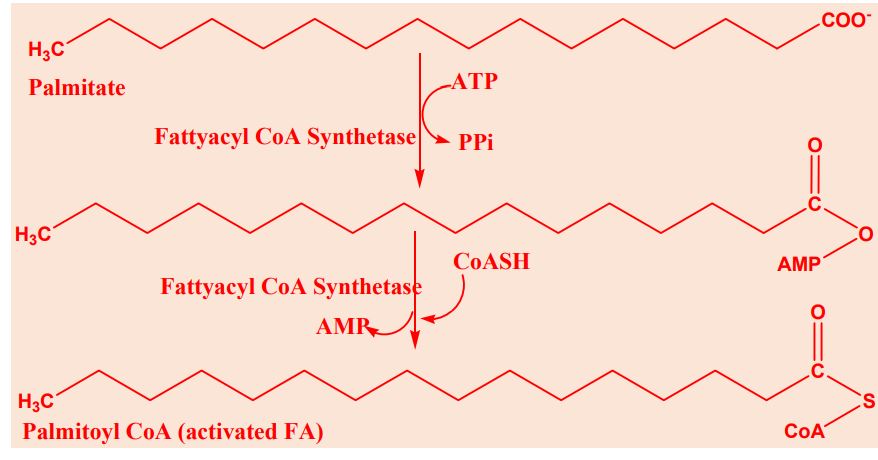
Palmitate goes to palmitoyl CoA in using fatty acyl coa synthetase (enzyme) and ATP and CoAsh
6
AMP + ATP using adenylate kinase will produce
AMP + ATP using adenylate kinase will produce 2 ADP
7
AMP has a linkage containg of energy
AMP has a Phospho‐ester linkage containg 3.4 kcal/mol of energy
8
ADP and ATP has a bond containing of energy
ADP and ATP has a Phospho‐anhydride bond containing 7.3 kcal/mol of energy
9
For activating fatty acid into fatty acyl CoA, are consumed.
For activating fatty acid into fatty acyl CoA, two moles of ATP are consumed.
10
How does fatty acyl COA enter the mitochondrial matrix from the cytosol?
The from the ---> catalyzed (by enzyme )
The from the ---> catalyzed (by enzyme )
How does fatty acyl COA enter the mitochondrial matrix from the cytosol?
The fatty acyl CoA from the cytosol ---> fatty acyl-carnitine catalyzed (by enzyme carnitine acyltransferase I (CPT I))
The fatty acyl CoA from the cytosol ---> fatty acyl-carnitine catalyzed (by enzyme carnitine acyltransferase I (CPT I))
11
In the mitochondrial matrix, what happens to the fatty acyl-carnitine?
enters into the mitochondrial matrix, wherem it gets converted back to catalyzed by the enzyme
enters into the mitochondrial matrix, wherem it gets converted back to catalyzed by the enzyme
In the mitochondrial matrix, what happens to the fatty acyl-carnitine?
Fatty acyl-carnitine enters CPT II (carnitine acyltransferase II) into the mitochondrial matrix, wherem it gets converted back to fatty acyl CoA catalyzed by the enzyme
Fatty acyl-carnitine enters CPT II (carnitine acyltransferase II) into the mitochondrial matrix, wherem it gets converted back to fatty acyl CoA catalyzed by the enzyme
12
Hypoketosis due to : Disorder
Hypoketosis due to Carnitineacyl carnitine translocase: Autosomal Recessive Disorder
13
With Carnitineacyl‐carnitine translocase: Autosomal Recessive Disorder, use
With Carnitineacyl‐carnitine translocase: Autosomal Recessive Disorder, use punnet square to solve any problems if given on test
14
Hypoketosis affects tissues such as
, . Muscle weakness is due to Fatty acid is a good source of energy for . Lack of it could cause .
, . Muscle weakness is due to Fatty acid is a good source of energy for . Lack of it could cause .
Hypoketosis affects tissues such as liver,
cardiac muscle, skeletal muscle . Muscle weakness is due to poor
fatty acid breakdown.Fatty acid is a good source of energy for heart muscle. Lack of it could cause Arrhythmia.
cardiac muscle, skeletal muscle . Muscle weakness is due to poor
fatty acid breakdown.Fatty acid is a good source of energy for heart muscle. Lack of it could cause Arrhythmia.
15
Fatty acyl CoA is ready for inside the
once there is a
once there is a
Fatty acyl CoA is ready for B‐oxidation inside the
mitochondrial matrix once there is a fatty acyl CoA
mitochondrial matrix once there is a fatty acyl CoA
16
NADH and FADH2 that are produced during B‐oxidation enter to .
NADH and FADH2 that are produced during B‐oxidation enter electron transport
system to produce ATP.
system to produce ATP.
17
Acetyl CoA from B oxidation enters to further produce and .
Acetyl CoA from B oxidation enters TCA cycle to further produce NADH and FADH2.
18
What are the 4 steps of B oxidation?
1. Dehydration
2. Hydration
3. Dehydrogenation
4. Clevage by thiolase
2. Hydration
3. Dehydrogenation
4. Clevage by thiolase
19
Beta Oxidation
Fatty acyl CoA goes to using . Then, it becomes by . Then it becomes using . The fatty acid then becomes shorter after cleavage by thiolase.
Fatty acyl CoA goes to using . Then, it becomes by . Then it becomes using . The fatty acid then becomes shorter after cleavage by thiolase.
Beta Oxidation
Fatty acyl CoA goes to enoyl CoA using acyl CoA dehydrogenase. Then, it becomes beta hydroxy acteyl CoA by enoyl CoA hydratase. Then it becomes betaketoacyl CoA using dehydrogenase. The fatty acid then becomes 2 C shorter after cleavage by thiolase.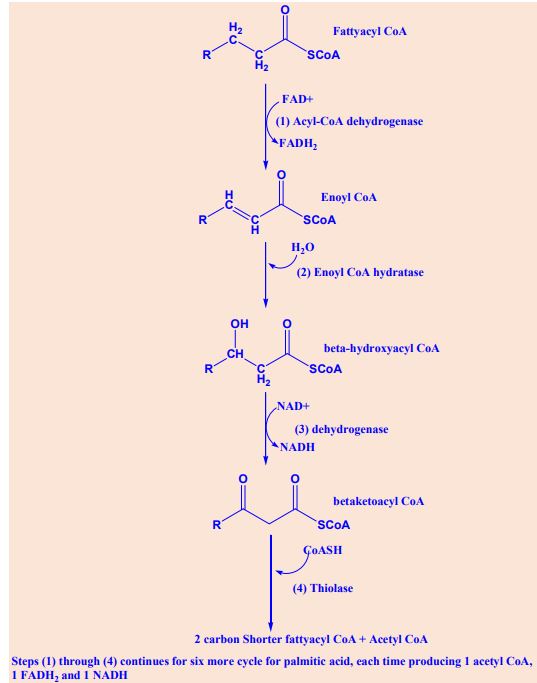
Fatty acyl CoA goes to enoyl CoA using acyl CoA dehydrogenase. Then, it becomes beta hydroxy acteyl CoA by enoyl CoA hydratase. Then it becomes betaketoacyl CoA using dehydrogenase. The fatty acid then becomes 2 C shorter after cleavage by thiolase.
20
The ester bond of AMP has per mol while the anhydride bonds have per mol.
The ester bond of AMP has 3.4 kcal per mol while the anhydride bonds have 7.3 kcal per mol.
21
WHat is teh gross yield of the complete oxidation of palmitate?
Gross yield is 131 ATP, Net yield is 129 ATP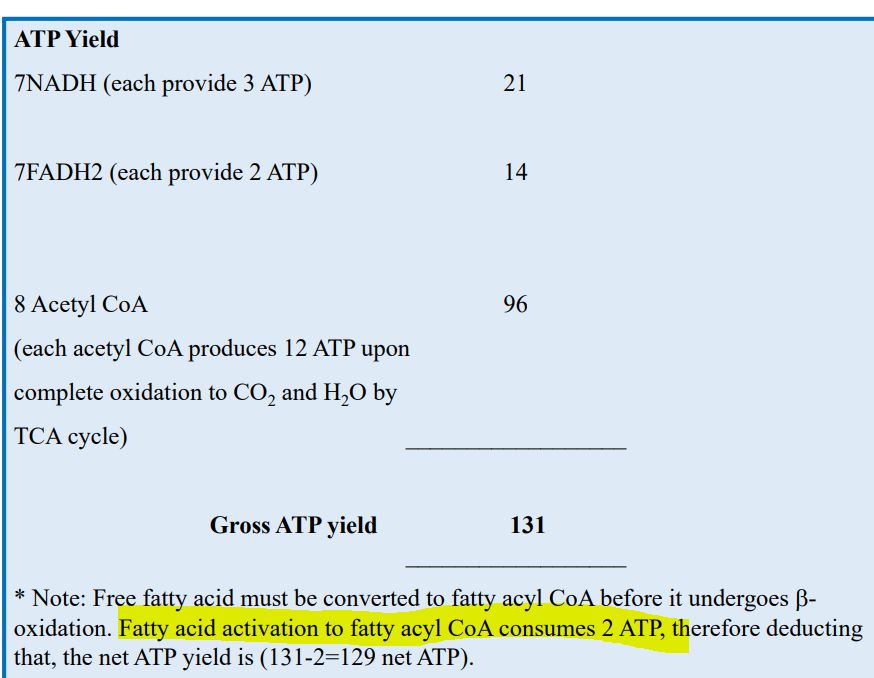
22
Oxidation of odd chain fatty acids is the same as , except when it reaches last step a fatty acid produces a compound called
Oxidation of odd chain fatty acids is the same as b‐oxidation, except when it reaches last step a C‐17 fatty acid produces a 3 carbon compound called propionyl CoA.
23
Propinoyl COA coA is able to enter the cycle
Propinoyl COA coA is able to enter the TCA cycle
24
GUARANTEED ONE QUESTION FROM HERE - Draw out the schematic for propionyl CoA to the TCA cycle
(1) Propinoyl COA becomes using (enzyme) (Requires )
(2) A racemate converts into
(3) gets converted into using with has group
(1) Propinoyl COA becomes using (enzyme) (Requires )
(2) A racemate converts into
(3) gets converted into using with has group
GUARANTEED ONE QUESTION FROM HERE - Draw out the schematic for propionyl CoA to the TCA cycle
(1) Propinoyl COA becomes D-methyl malonyl CoA using propinoylCoA carboxylase (enzyme) (Requires ABC)
(2) A racemate converts D-methyl malonyl CoA into L-methyl malonyl CoA
(3) L-methyl malonyl CoA gets converted into succinyl coa using methyl malonyl CoA mutase with has B12 group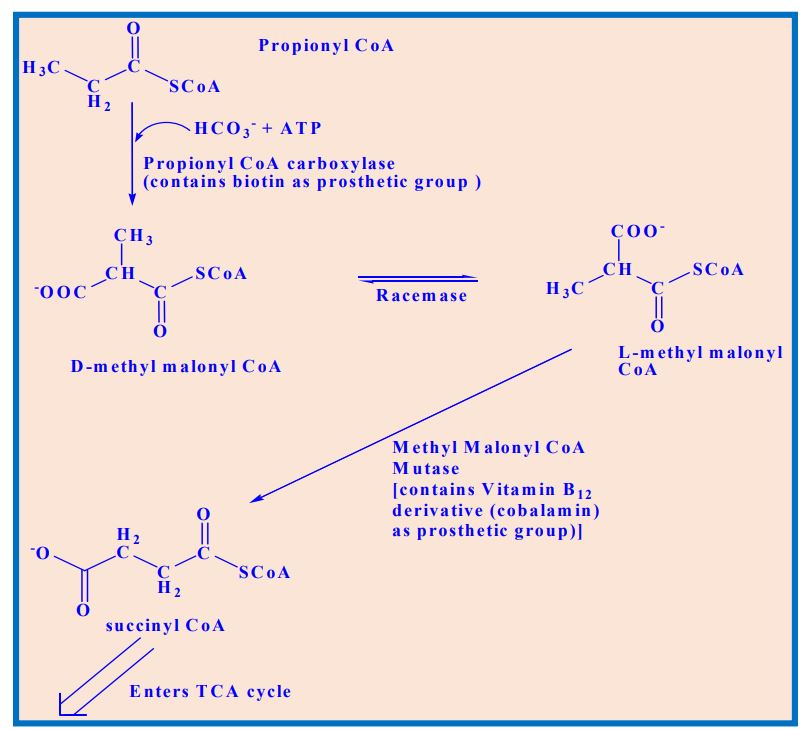
(1) Propinoyl COA becomes D-methyl malonyl CoA using propinoylCoA carboxylase (enzyme) (Requires ABC)
(2) A racemate converts D-methyl malonyl CoA into L-methyl malonyl CoA
(3) L-methyl malonyl CoA gets converted into succinyl coa using methyl malonyl CoA mutase with has B12 group
25
Propionyl CoA carboxylase contains as a prosthetic group.
Propionyl CoA carboxylase contains biotin as a prosthetic group.
26
Methyl malonyl CoA mutase requires as a coenzyme
Methyl malonyl CoA mutase requires vitamin B12 derivative (Cobalamin) as a coenzyme
27
Dairy products and digested chlorophyll contains
fatty acid called . Initial oxidation of this fatty acid occurs by occurs by
fatty acid called . Initial oxidation of this fatty acid occurs by occurs by
Dairy products and digested chlorophyll contains methylated
fatty acid called phytanic acid. Initial oxidation of this fatty acid occurs by occurs by a‐oxidation.
fatty acid called phytanic acid. Initial oxidation of this fatty acid occurs by occurs by a‐oxidation.
28
Since phytanic acid is , it is not a
substrate for , the first enzyme in b‐oxidation.
substrate for , the first enzyme in b‐oxidation.
Since phytanic acid is methyl substituted, it is not a
substrate for acyl CoA dehydrogenase, the first enzyme in b‐oxidation.
substrate for acyl CoA dehydrogenase, the first enzyme in b‐oxidation.
29
What are the steps of phytanic acid breakdown?
Phytanic acid becomes which becomes (using an ) and (using ). It then has to go through rounds of regular beta oxidation.
Phytanic acid becomes which becomes (using an ) and (using ). It then has to go through rounds of regular beta oxidation.
What are the steps of phytanic acid breakdown?
Phytanic acid becomes alpha hydroxylated phytanic acid which becomes Pristanic acid (using an alpha oxidase) and Pristanyl CoA (using acteyl CoA Synthetase). It then has to go through 6 rounds of regular beta oxidation.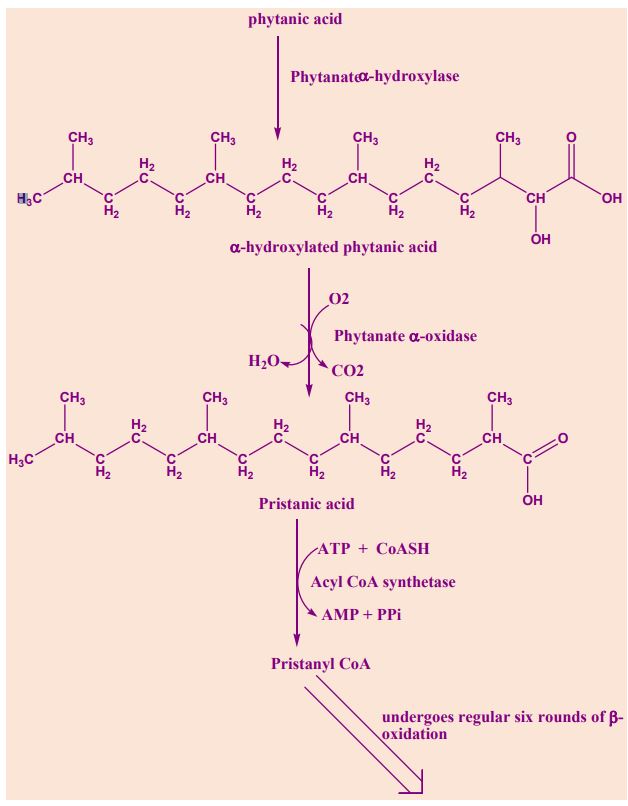
Phytanic acid becomes alpha hydroxylated phytanic acid which becomes Pristanic acid (using an alpha oxidase) and Pristanyl CoA (using acteyl CoA Synthetase). It then has to go through 6 rounds of regular beta oxidation.
30
a‐hydroxylase, hydroxylates
a‐hydroxylase, hydroxylates a‐carbon of phytanic acid
31
is unsubstituted at carbon 3 and can be
oxidized by acyl CoA dehydrogenase.
oxidized by acyl CoA dehydrogenase.
Pristanyl CoA is unsubstituted at carbon 3 and can be
oxidized by acyl CoA dehydrogenase.
oxidized by acyl CoA dehydrogenase.
32
Omega-oxidation is significant for fatty acids like,
and . It involves oxidation of
omega‐methyl or the
and . It involves oxidation of
omega‐methyl or the
Omega-oxidation is significant for short chain fatty acids like,
C‐6 (caproic acid) and C‐10 capric acids. It involves oxidation of
omega‐methyl or the adjacent methylene carbon.
C‐6 (caproic acid) and C‐10 capric acids. It involves oxidation of
omega‐methyl or the adjacent methylene carbon.
33
Omega Oxidation: Capric acid becomes using (Needs , , ) which can then form a with CoA and the product can be broken down in
Omega Oxidation: Capric acid becomes dihydroxy capric acid using oxidase (Needs O2, NADPH, Cyt P450) which can then form a thioester with CoA and the product can be broken down in beta oxidation 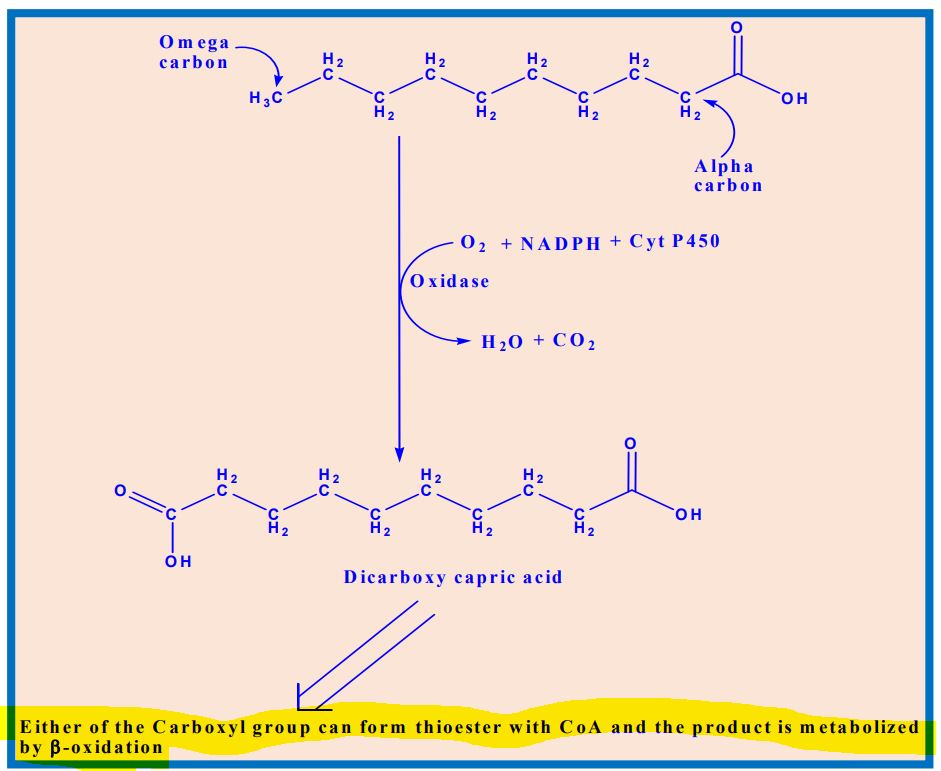
34
What are the two forms of allosteric regulation?
a. (energy sensory activates acetyl COA carboxylase)
b. (inhibits carnitine acyltransferase)
a. (energy sensory activates acetyl COA carboxylase)
b. (inhibits carnitine acyltransferase)
What are the two forms of allosteric regulation?
a. citrate (energy sensory activates acetyl COA carboxylase)
b. malonyl CoA (inhibits carnitine acyltransferase)
a. citrate (energy sensory activates acetyl COA carboxylase)
b. malonyl CoA (inhibits carnitine acyltransferase)
35
When the blood glucose
levels are high, it stimulates
the secretion of Insulin by
levels are high, it stimulates
the secretion of Insulin by
When the blood glucose
levels are high, it stimulates
the secretion of Insulin by
beta cells of pancreas.
levels are high, it stimulates
the secretion of Insulin by
beta cells of pancreas.
36
in turn stimulates
fatty acid synthesis in Liver.
fatty acid synthesis in Liver.
Insulin in turn stimulates
fatty acid synthesis in Liver.
fatty acid synthesis in Liver.
37
When the blood glucose
levels are low, it stimulates
the secretion of by
levels are low, it stimulates
the secretion of by
When the blood glucose
levels are low, it stimulates
the secretion of glucagon by
alpha cells of pancreas
levels are low, it stimulates
the secretion of glucagon by
alpha cells of pancreas
38
Glucagon triggers
of Fat.
of Fat.
Glucagon triggers
Catabolism of Fat.
Catabolism of Fat.
39
The ACC (Acetyl-CoA carboxylase) can be activated by
The ACC (Acetyl-CoA carboxylase) can be activated by dephosyphorylation.
40
cAMP activates (becomes active) and then with and , can turn a triacyl glyercol into and
cAMP activates protien kinase A (becomes active) and then with ATP and Lipase, can turn a triacyl glyercol into diacyglycerol and fatty acid
41
Ethanol metabolism: Ethanol becomes (using with ) which then becomes (using and ) which then becomes (using and + ). Aldehyde dehydrogenase is inhibited by .
Ethanol metabolism: Ethanol becomes acetaldehyde (using alcohol dehydrogenase with NAD+) which then becomes acetate (using aldehyde dehydrogenase and NAD+) which then becomes acetyl coa (using acetothiokinase and ATP +COA). Aldehyde dehydrogenase is inhibited by disulfirum. 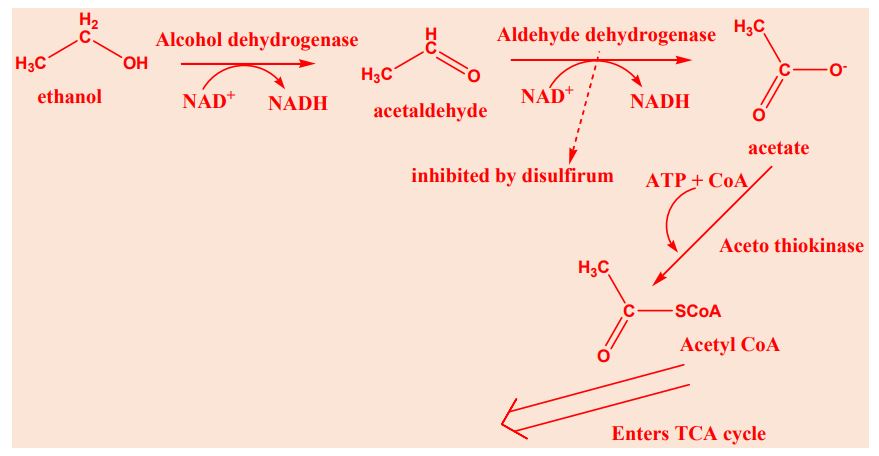
42
Refsum disease is a in the enzyme. Accumulation of in plasma and nerve tissues. due to accumulation.
Refsum disease is a deficiency in the alpha‐hydroxylase enzyme. Accumulation of phytanic acid in plasma and nerve tissues. Neurological damage due to accumulation.
43
deficiency
causes 10% of the
cases of SIDS. The condition is of inheritance.
causes 10% of the
cases of SIDS. The condition is of inheritance.
Medium chain fatty acyl CoA
dehydrogenase deficiency
causes 10% of the
cases of SIDS. The condition is autosomal recessive mode of inheritance.
dehydrogenase deficiency
causes 10% of the
cases of SIDS. The condition is autosomal recessive mode of inheritance.
44
In Methylmalonic acidemia (aciduria), is missing. In some cases conversion of into coenzyme form is missing.
In Methylmalonic acidemia (aciduria), Methylmalonyl CoA mutase is missing. In some cases conversion of Vitamin B12 into coenzyme form is missing.
45
Obesity thought to occur in synthesis
Obesity thought to occur in NPY defective synthesis
46
Ketone Body
Synthesis occurs in the
Synthesis occurs in the
Ketone Body
Synthesis occurs in the
(Liver
Mitochondria)
Synthesis occurs in the
(Liver
Mitochondria)
47
The three ketone bodies are , , and
The three ketone bodies are acetone, acetoacetate, and betahydroxybutyrate
48
Ketogenesis occurs in and
Ketogenesis occurs in Liver and extrahepatic tissues (brain, skeletal, and cardiac muscle)
49
Diabetic Ketoacidosis is caused by high levels of and (pkA of 3.5) causing
Diabetic Ketoacidosis is caused by high levels of acetoacetic acid and b-hydroxybutyric acid (pkA of 3.5) causing metabolic acidosis
50
In biochemical terms the events of diabetic ketoacidosis are very similar to
In biochemical terms the events of diabetic ketoacidosis are very similar to starvation mediated ketosis.
51
In diabetic ketoacidosis, increased ratio causes elevation of liver , which leads to decreased , which causes de‐inhibition of , which consequently results in the . From FA degradation more is produced. Increased acetyl CoA causes production.
In diabetic ketoacidosis, increased glucagon/insulin ratio causes elevation of liver cAMP, which leads to decreased malonyl CoA, which causes de‐inhibition of CPT I, which consequently results in the activation of fatty acid oxidation . From FA degradation more acetyl CoA is produced. Increased acetyl CoA causes increased ketone body production.