Resting Membrane Potential 3+4
Study these flashcardsFree · spaced repetition · iPhone, Android, Mac & web
All cards
1
Which 4 ions are found in greater amounts in the extracellular env? What is the net charge of the extracellular env?
Na+, Cl-, HCO3-, Ca2+ (Net charge is positive)
2
Which 4 ions are found in greater amounts in teh intracellular env? What is the net charge of the extracellular env?
K+, HPO4-, Mg2+, Protein (Net charge is negative)
3
What are the two primary contributers of the electrochemical gradient?
( ) and ( ) (intra or extracellular?)
( ) and ( ) (intra or extracellular?)
What are the two primary contributers of the electrochemical gradient?
K+ (intracllular) and Na+ (extracellular) (intra or extracellular?)
K+ (intracllular) and Na+ (extracellular) (intra or extracellular?)
4
Resting potentioal is between and and is always
Resting potentioal is between -60 and -80 mV and is always negative
5
The extracellular potential is and the intracellular potential is
The extracellular potential is positive and the intracellular potential is negative
6
Resting membrane potential is also called
Em or Vm
7
What is the formula for membrane potential?
E Net = E in – E out
8
Movement depends on cencentration or gradient (they can be in equal or opposite directions)
Movement depends on cencentration gradient or chemical gradient (they can be in equal or opposite directions)
9
Electrical equilibrium is called
Electrical equilibrium is called Ena
10
When there is NO more movement of an ion even if there is a favoring gradient
because it has reached with its forces. Equilibrium with its and potential. The equation explains this relationship.
because it has reached with its forces. Equilibrium with its and potential. The equation explains this relationship.
When there is NO more movement of an ion even if there is a favoring gradient
because it has reached equilibrium with its forces. Equilibrium with its electrical
potential and concentration potential. The Nerest equation explains this relationship.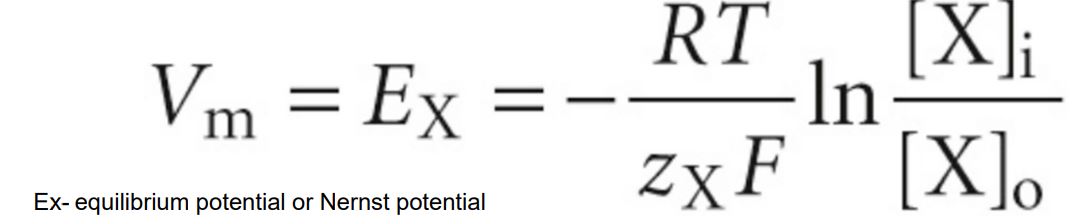
because it has reached equilibrium with its forces. Equilibrium with its electrical
potential and concentration potential. The Nerest equation explains this relationship.
11
If Ena for sodium is 61+ mV, what does that mean?
Sodium movement at +61 mV will stop
12
For sodium, and gradident botth drive sodium into the the cell.
For sodium, electrical and chemical gradident botth drive sodium into the the cell. 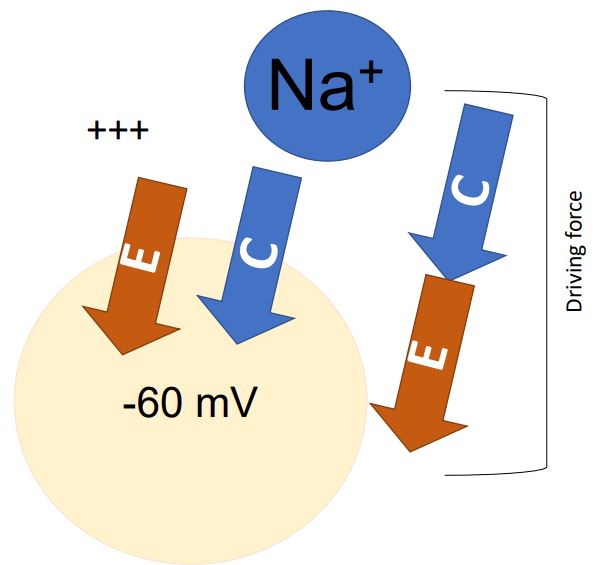
13
For potassium, drives potassium but a much larger drives potassium . Vector addtion, so leaves.
For potassium, electrical gradient drives potassium in but a much larger chemical gradient drives potassium out. Vector addtion, so K+ leaves.
14
Equilibrium potential is
Equilibrium potential is Ex
15
Em is due to high resting conductance to K+ at rest when Na + channels are closed because the sodium channel is “ ”, if it is too negative it .
Em is due to high resting conductance to K+ at rest when Na + channels are closed because the sodium channel is “electrosensitive”, if it is too negative it closes.
16
Em is maintained by the
Em is maintained by the Na+-K+ ATPase pump
17
The cell takes advantage of this and switches the cell on “depolarizes” the cell by
letting in and switches it off “repolarize” by removing positive charges in the
form of
letting in and switches it off “repolarize” by removing positive charges in the
form of
The cell takes advantage of this and switches the cell on “depolarizes” the cell by
letting sodium in and switches it off “repolarize” by removing positive charges in the
form of potassium
letting sodium in and switches it off “repolarize” by removing positive charges in the
form of potassium
18
Driving force is the minus the
Driving force is the electrical force minus the chemical force
19
Cells in different tissues have different
Cells in different tissues have different Em
20
Membrane potential: potential that exists across the cell membrane.
Membrane potential: electric potential that exists across the cell membrane.
21
• Resting membrane potential or resting potential (EM):
across the membrane of a cell at rest.
across the membrane of a cell at rest.
• Resting membrane potential or resting potential (EM): potential difference
across the membrane of a cell at rest.
across the membrane of a cell at rest.
22
Equilibrium potential (EX): membrane potential at which there is ion
movement in or out of the cell ; it is the value of the potential difference across the
membrane when an ion is in electrochemical equilibrium
movement in or out of the cell ; it is the value of the potential difference across the
membrane when an ion is in electrochemical equilibrium
Equilibrium potential (EX): membrane potential at which there is no NET ion
movement in or out of the cell ; it is the value of the potential difference across the
membrane when an ion is in electrochemical equilibrium
movement in or out of the cell ; it is the value of the potential difference across the
membrane when an ion is in electrochemical equilibrium
23
Electrochemical Equilibrium (EX): when the electrical & chemical forces inside
and outside the cell have each other out resulting in no net movement
of an ion
and outside the cell have each other out resulting in no net movement
of an ion
Electrochemical Equilibrium (EX): when the electrical & chemical forces inside
and outside the cell have balanced each other out resulting in no net movement
of an ion
and outside the cell have balanced each other out resulting in no net movement
of an ion
24
• Excitability: a function of the plasma membrane mediated by in
state of transmembrane proteins termed ion channels or pores
state of transmembrane proteins termed ion channels or pores
• Excitability: a function of the plasma membrane mediated by transient changes in
state of transmembrane proteins termed ion channels or pores
state of transmembrane proteins termed ion channels or pores
25
Selective permeability is highest for
>>> >
>>> >
Selective permeability is highest for K
PK>>>PCl>PNa
PK>>>PCl>PNa
26
In all cells, Vm is close to Ek but more
than Ek
than Ek
In all cells, Vm is close to Ek but more
positive than Ek
positive than Ek
27
Why isn't the volage membrane potential equal to potassium's equilibrium potential?
Potassium allows to leak
Potassium allows to leak
Why isn't the volage membrane potential equal to potassium's equilibrium potential?
Potassium allows Na+ to leak in
Potassium allows Na+ to leak in
28
Sodium is the , K+ is the
Sodium is the depolarizer, K+ is the repolarizer 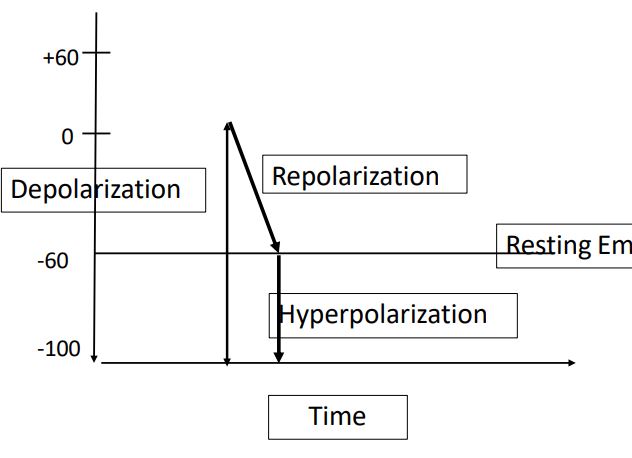
29
Recall that cells are “polarized” with
a negative resting membrane
potential in a typical cell
a negative resting membrane
potential in a typical cell
Recall that cells are “polarized” with
a negative resting membrane
potential – 60 mV in a typical cell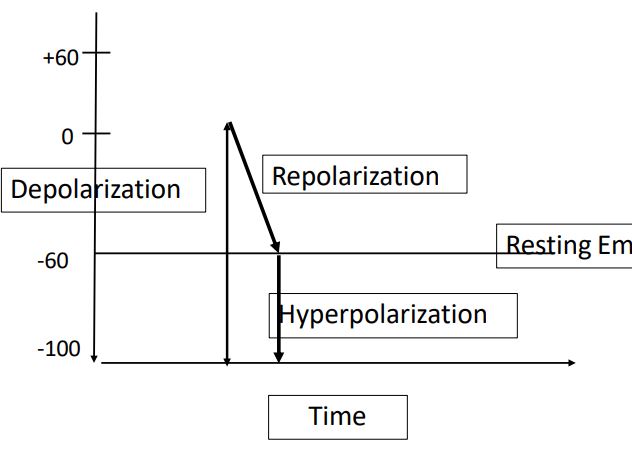
a negative resting membrane
potential – 60 mV in a typical cell
30
is the process where
the membrane potential is now
becoming positive (no longer at
rest), away from the “polarized”
state hence “de” In a typical cell this happens with a
sodium influx
the membrane potential is now
becoming positive (no longer at
rest), away from the “polarized”
state hence “de” In a typical cell this happens with a
sodium influx
Depolarization is the process where
the membrane potential is now
becoming positive (no longer at
rest), away from the “polarized”
state hence “de” In a typical cell this happens with a
sodium influx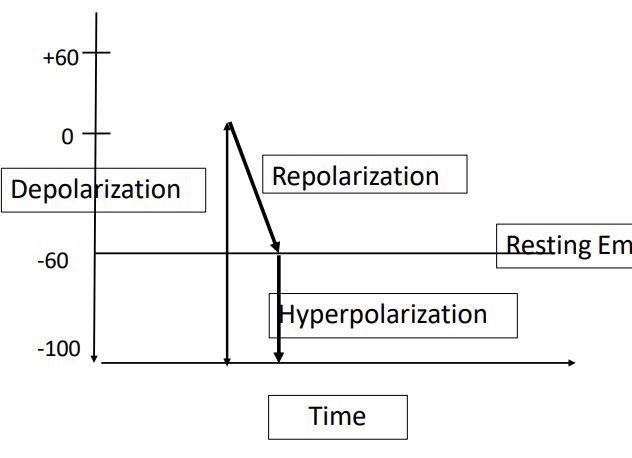
the membrane potential is now
becoming positive (no longer at
rest), away from the “polarized”
state hence “de” In a typical cell this happens with a
sodium influx
31
During depolarization, potential difference between inside and outside
During depolarization, potential difference between inside and outside DECREASES 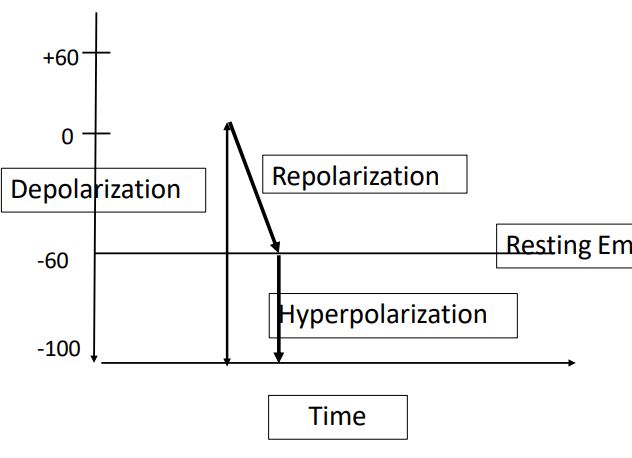
32
This is a process where the
“polarized” cell returns to its
polar state
“polarized” cell returns to its
polar state
This is a process where the
“polarized” cell returns to its
polar state “re"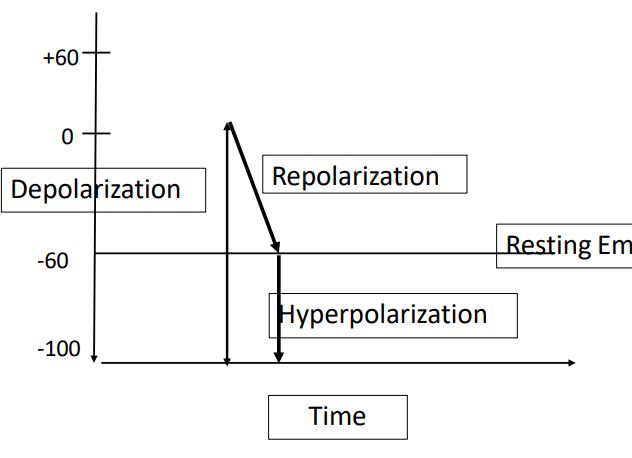
“polarized” cell returns to its
polar state “re"
33
Resting membrane potential is
restored and the potential
difference across
its
restored and the potential
difference across
its
Resting membrane potential is
restored and the potential
difference across RE-gains
its negative value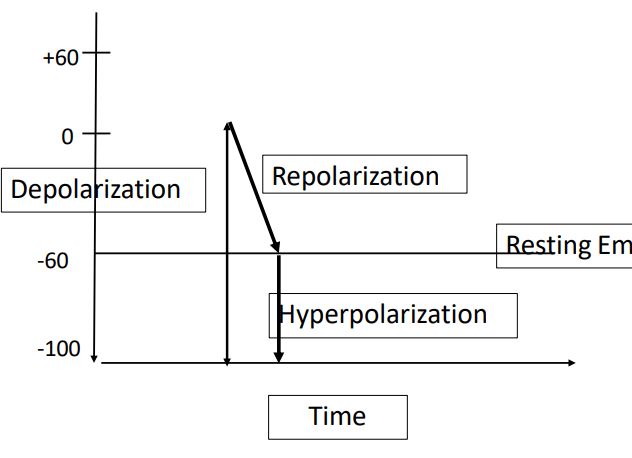
restored and the potential
difference across RE-gains
its negative value
34
This is a process where the
“polarized” cell becomes too
negative
“polarized” cell becomes too
negative
This is a process where the
“polarized” cell becomes too
negative “hyper"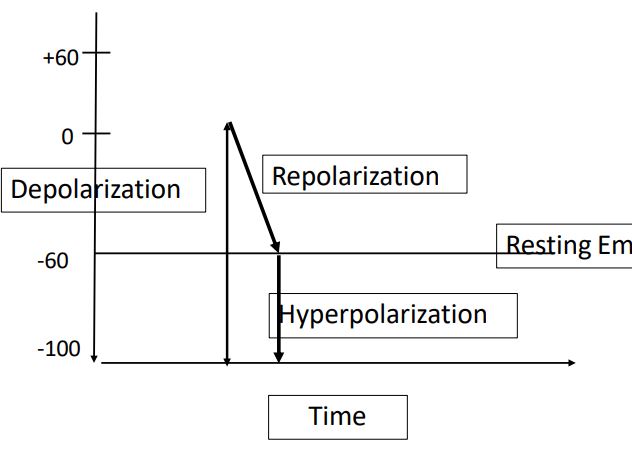
“polarized” cell becomes too
negative “hyper"
35
Majority of cell types in the
body needs to go through
so ion
channels recover, a break
before the next wave
body needs to go through
so ion
channels recover, a break
before the next wave
Majority of cell types in the
body needs to go through
hyperpolarization so ion
channels recover, a break
before the next wave
body needs to go through
hyperpolarization so ion
channels recover, a break
before the next wave
36
GHK equation predicts a reversal potential that is
equal to the potential
equal to the potential
GHK equation predicts a reversal potential that is
equal to the Nernst potential
equal to the Nernst potential
37
Ionic currents measured with
Ionic currents measured with patch clamp 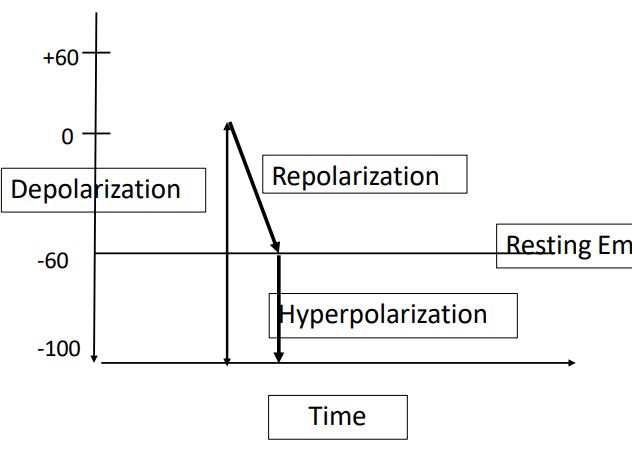
38
Hyperkalemia is a common clinical problem that is most often due to impaired
due to acute or chronic kidney disease and/or
disorders or drugs that inhibit the axis.
due to acute or chronic kidney disease and/or
disorders or drugs that inhibit the axis.
Hyperkalemia is a common clinical problem that is most often due to impaired
urinary potassium excretion due to acute or chronic kidney disease and/or
disorders or drugs that inhibit the renin-angiotensin-aldosterone axis.
urinary potassium excretion due to acute or chronic kidney disease and/or
disorders or drugs that inhibit the renin-angiotensin-aldosterone axis.
39
Hypokalemia is the result from unreplenished or due, for
example, to , , or therapy,
example, to , , or therapy,
Hypokalemia is the result from unreplenished gastrointestinal or urinary losses due, for
example, to vomiting, diarrhea, or diuretic therapy, primary aldosteronism
example, to vomiting, diarrhea, or diuretic therapy, primary aldosteronism
40
In hypokalemia, , a reduction in the serum (extracellular) potassium will
the cell membrane (that is, make the membrane potential more
electronegative); this impairs the ability of the muscle to and
, leading to weakness.
the cell membrane (that is, make the membrane potential more
electronegative); this impairs the ability of the muscle to and
, leading to weakness.
In hypokalemia, , a reduction in the serum (extracellular) potassium will
hyperpolarize the cell membrane (that is, make the membrane potential more
electronegative); this impairs the ability of the muscle to depolarize and
contract, leading to weakness.
hyperpolarize the cell membrane (that is, make the membrane potential more
electronegative); this impairs the ability of the muscle to depolarize and
contract, leading to weakness.
41
Symptoms of hypokalemia do not manifest unit below
Symptoms of hypokalemia do not manifest unit below 3.0 meq/L
42
: membrane potential that triggers an action potential; it
could be caused by passive propagations.
could be caused by passive propagations.
Threshold potential (TP): membrane potential that triggers an action potential; it
could be caused by passive propagations.
could be caused by passive propagations.
43
a rapid all or none change in membrane potential, followed
by a return to the resting membrane potential; require voltage gate ion channels.
by a return to the resting membrane potential; require voltage gate ion channels.
Action potential (AP): a rapid all or none change in membrane potential, followed
by a return to the resting membrane potential; require voltage gate ion channels.
by a return to the resting membrane potential; require voltage gate ion channels.
44
causes the membrane potential to become more positive
(decreases EM)
(decreases EM)
Depolarizing stimulus: causes the membrane potential to become more positive
(decreases EM)
(decreases EM)
45
causes the membrane potential to become more
negative (increases EM).
negative (increases EM).
Hyperpolarizing stimulus: causes the membrane potential to become more
negative (increases EM).
negative (increases EM).
46
is caused by neurotransmitters/stimulus on postsynaptic
membrane
membrane
Synaptic potential is caused by neurotransmitters/stimulus on postsynaptic
membrane
membrane
47
What are the stages of theaction potential of a neuron?
1. Resting membrane potential is .
2. Depolzarization occurs ( )
3. Repolarization ( )
4. Afterhyperpolarization ( )
1. Resting membrane potential is .
2. Depolzarization occurs ( )
3. Repolarization ( )
4. Afterhyperpolarization ( )
What are the stages of theaction potential of a neuron?
1. Resting membrane potential is -70.
2. Depolzarization occurs (Na+ enters)
3. Repolarization (abosulte refractory period)
4. Afterhyperpolarization (relative refractory period)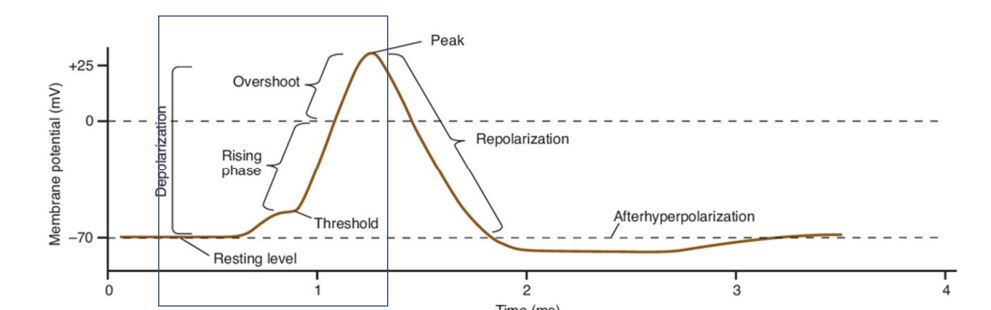
1. Resting membrane potential is -70.
2. Depolzarization occurs (Na+ enters)
3. Repolarization (abosulte refractory period)
4. Afterhyperpolarization (relative refractory period)
48
In order to be stimulated, a neurotransmiter release causes opening of Na+ channels and Em is more positive ( mV)
In order to be stimulated, a neurotransmiter release causes opening of Na+ channels and Em is more positive (-55mV)
49
Opening of sodium channels can be “timed” appropriately called “ ” or if sodium channels are close to each other “ ”
Opening of sodium channels can be “timed” appropriately called “temporal
summation” or if sodium channels are close to each other “spital summation”
summation” or if sodium channels are close to each other “spital summation”
50
Having a threshold means the cells will not depolarize without a stimulus – this
is termed an phenomenon
is termed an phenomenon
Having a threshold means the cells will not depolarize without a stimulus – this
is termed an “all or none” phenomenon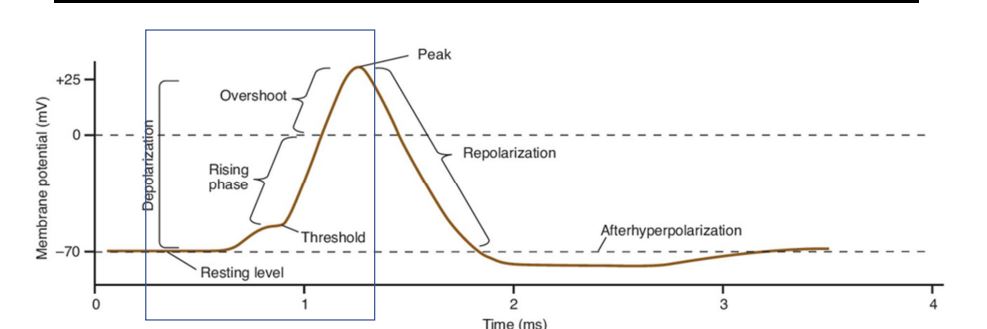
is termed an “all or none” phenomenon
51
Depolarization, in a nerve cell it is split into two and -
enters in both phases. Rising phase occurs until potential is . Overshoot is above
enters in both phases. Rising phase occurs until potential is . Overshoot is above
Depolarization, in a nerve cell it is split into two “rising” and “overshoot”- sodium
enters in both phases. Rising phase occurs until potential is 0 mv . Overshoot is above 0 mV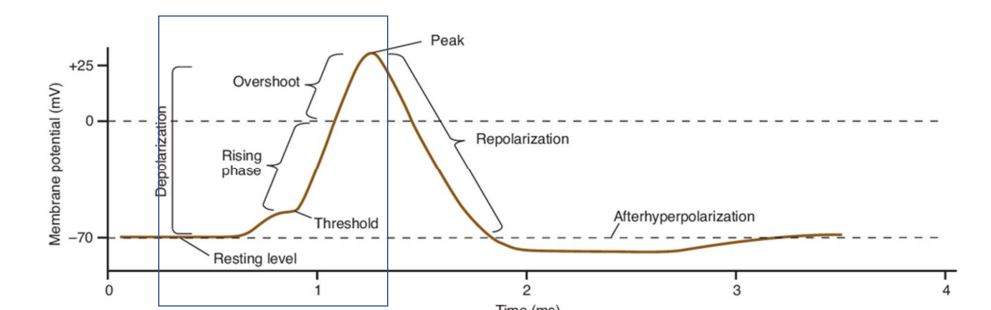
enters in both phases. Rising phase occurs until potential is 0 mv . Overshoot is above 0 mV
52
Sodium channels have two gates activation
gate ( ) and the inactivation gate ( )
gate ( ) and the inactivation gate ( )
Sodium channels have two gates activation
gate (outside) and the inactivation gate (inside)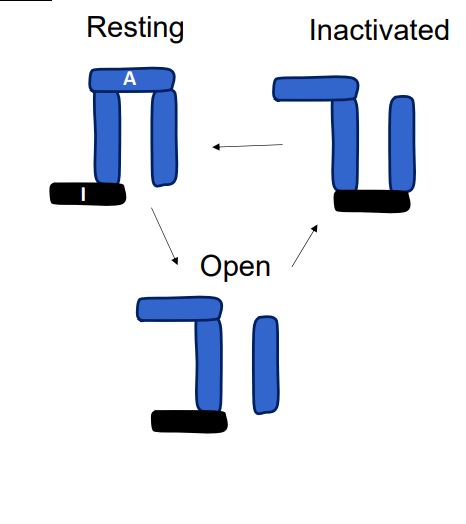
gate (outside) and the inactivation gate (inside)
53
The inactivation period of the sodium channel
is what is termed the “
is what is termed the “
The inactivation period of the sodium channel
is what is termed the “absolute refractory
period”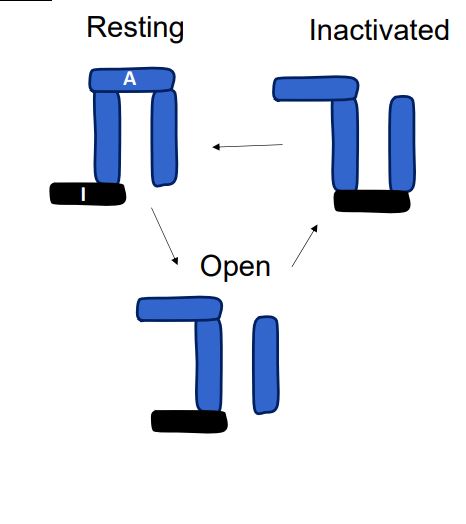
is what is termed the “absolute refractory
period”
54
When some sodium channels recover from the
inactivation state, this is termed “ ”
inactivation state, this is termed “ ”
When some sodium channels recover from the
inactivation state, this is termed “relative
refractory period”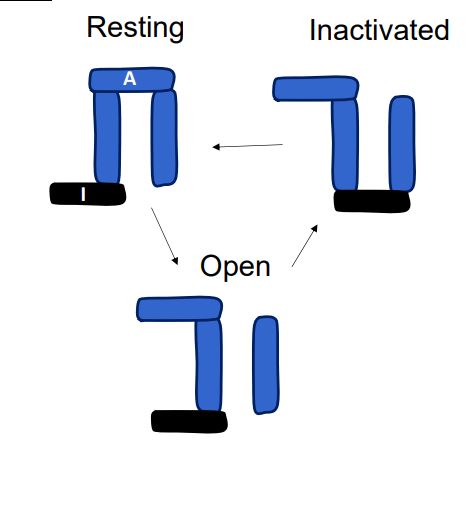
inactivation state, this is termed “relative
refractory period”
55
At the peak of the action potential, channels open (and channels closed) (they are voltage gated)
Because channels are inactivated, rapid repolarization takes place
Because channels are inactivated, rapid repolarization takes place
At the peak of the action potential, potassium channels open (and sodium channels closed) (they are voltage gated)
Because sodium channels are inactivated, rapid repolarization takes place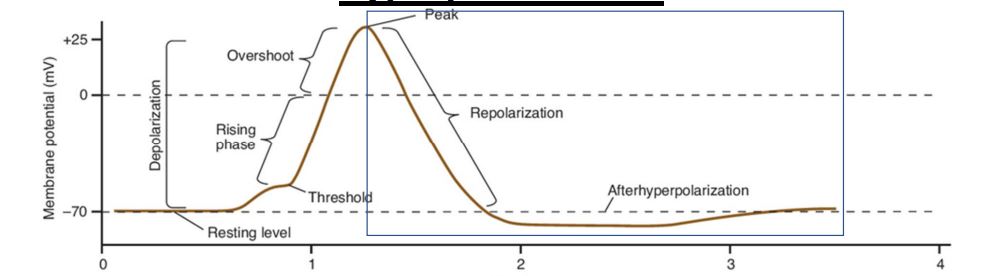
Because sodium channels are inactivated, rapid repolarization takes place
56
d Na/K ATPase pump restores
d Na/K ATPase pump restores RMP 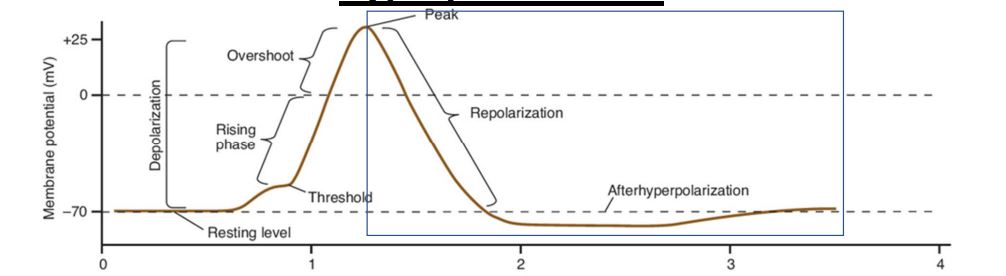
57
is a
property of a
channel, how many
ions are allowed
through which
depends on how
much the channel
pore opens
property of a
channel, how many
ions are allowed
through which
depends on how
much the channel
pore opens
Conductance: is a
property of a
channel, how many
ions are allowed
through which
depends on how
much the channel
pore opens
property of a
channel, how many
ions are allowed
through which
depends on how
much the channel
pore opens
58
propogation - graded signal that dimimishes with distances and will not transport sinal from one end of axon to the other
Passive propogation - graded signal that dimimishes with distances and will not transport sinal from one end of axon to the other
59
propagation - the action potential has constant velocity and not change in a,plutide and vaires over time. Strong enough to reactivate itself.
Active propagation - the action potential has constant velocity and not change in a,plutide and vaires over time. Strong enough to reactivate itself.
60
The probability of a channel being in
an open state, or a closed state
depends on
an open state, or a closed state
depends on
The probability of a channel being in
an open state, or a closed state
depends on membrane potential
an open state, or a closed state
depends on membrane potential
61
are triggered by the inactivation of sodium channel.
Refractory periods are triggered by the inactivation of sodium channel.
62
Refractory periods determine and are responsible for and propagation for origin of inital segment
Refractory periods determine action potential duration and are responsible for singular and unidirectional propagation for origin of inital segment
63
Absolute:
• Another AP occur
regardless of the
• All Na+ channels are
• Another AP occur
regardless of the
• All Na+ channels are
Absolute:
• Another AP cannot occur
regardless of the size of
stimulus
• All Na+ channels are inactivated
• Another AP cannot occur
regardless of the size of
stimulus
• All Na+ channels are inactivated
64
Relative:
• Another AP occur if the
stimulus is than normal
• Some Na+ channels are
beginning to recover from
inactivation
• Another AP occur if the
stimulus is than normal
• Some Na+ channels are
beginning to recover from
inactivation
Relative:
• Another AP can occur if the
stimulus is larger than normal
• Some Na+ channels are
beginning to recover from
inactivation
• Another AP can occur if the
stimulus is larger than normal
• Some Na+ channels are
beginning to recover from
inactivation
65
Opening of voltage gated Na+ channels (Nav) has a , as
ion channels open and Na+ enters the cell, it becomes more (+) & more ion channels open. At threshold they all
ion channels open and Na+ enters the cell, it becomes more (+) & more ion channels open. At threshold they all
Opening of voltage gated Na+ channels (Nav) has a positive feedback loop, as
ion channels open and Na+ enters the cell, it becomes more (+) & more ion channels open. At threshold they all open rapidly
ion channels open and Na+ enters the cell, it becomes more (+) & more ion channels open. At threshold they all open rapidly
66
Depolarization opens voltage gated ( rectifier K
+) much slower kinetics. Works like a that opposes the effect of depolarization Nav
+) much slower kinetics. Works like a that opposes the effect of depolarization Nav
Depolarization opens voltage gated K+ channels (delayed rectifier K
+) much slower kinetics. Works like a negative feedback that opposes the effect of depolarization Nav
+) much slower kinetics. Works like a negative feedback that opposes the effect of depolarization Nav