Chapter 6 Gram Positive
Study these flashcardsFree · spaced repetition · iPhone, Android, Mac & web
All cards
1
Staphylococcus
Anaerobes
(motile/nonmotile)
Grows best (anerobically or aerobically)
Anaerobes
(motile/nonmotile)
Grows best (anerobically or aerobically)
Staphylococcus
Facultative Anaerobes
Nonmotile (motile/nonmotile)
Grows best aerobically (anerobically or aerobically)
Facultative Anaerobes
Nonmotile (motile/nonmotile)
Grows best aerobically (anerobically or aerobically)
2
What is this organism? 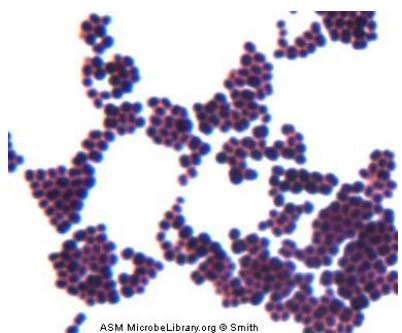
Staphylococcus
3
Staphylococcus are Catalase- (Streptococcus are catalase-
Staphylococcus are Catalase-positive (Streptococcus are catalase-negative)
4
3 most important species of staph
1.
2.
3.
1.
2.
3.
3 most important species of staph
1. S. aureus
2. S. epidermidis
3. S. Saprohyticus
1. S. aureus
2. S. epidermidis
3. S. Saprohyticus
5
S. aureus most (coagulase- ) **** Only S. aureus is
S. aureus most virulent (coagulase-positive) **** Only S. aureus is
6
S. epidermidis (agent of opportunistic infections associated with
equipment ( , , …)
equipment ( , , …)
S. epidermidis (agent of opportunistic infections associated with
indwelling equipment (catheters, prosthetics, …)
indwelling equipment (catheters, prosthetics, …)
7
S. saprophyticus (agent of , )
S. saprophyticus (agent of urinary tract infection, UTI)
8
Coagulase-Positive: (carrier); (person
with lesion), (person with lesion) or (Survive
long periods of drying);
with lesion), (person with lesion) or (Survive
long periods of drying);
Coagulase-Positive: Autoinfection (carrier); Direct contact (person
with lesion), Contaminated food (person with lesion) or Fomite (Survive
long periods of drying);
with lesion), Contaminated food (person with lesion) or Fomite (Survive
long periods of drying);
9
Coagulase-Negative
(infections associated with
implanted catheters and prosthetic devices; UTI)
(infections associated with
implanted catheters and prosthetic devices; UTI)
Coagulase-Negative
Autoinfection (infections associated with
implanted catheters and prosthetic devices; UTI)
Autoinfection (infections associated with
implanted catheters and prosthetic devices; UTI)
10
About 30% of individuals carry in the anterior nares
About 30% of individuals carry S. aureus in the anterior nares
11
Coagulase-negative species are flora of skin, nares and ear canals
Coagulase-negative species are normal flora of skin, nares and ear canals
12
Staphylococcus aureus causes furuncles ( ) and carbuncles ( )
Staphylococcus aureus causes furuncles (boils) and carbuncles (connected boils)
13
Most Relevant Virulence Factor for Staphylococcus is
toxin that damages membranes of
the skin cells (and erythrocytes); causes marked
of the skin and
toxin that damages membranes of
the skin cells (and erythrocytes); causes marked
of the skin and
Most Relevant Virulence Factor for Staphylococcus is Alpha toxin
Pore-forming toxin that damages membranes of
the skin cells (and erythrocytes); causes marked
necrosis of the skin and hemolysis
Pore-forming toxin that damages membranes of
the skin cells (and erythrocytes); causes marked
necrosis of the skin and hemolysis
14
Staphylococcus aureus causes . cause large blister in superficial skin. Causes bullae rupture-oozing yellow crusts. causes pruritic lesions that form honey crusts.
Staphylococcus aureus causes impetigo. Bullous impetigo cause large blister in superficial skin. Causes bullae rupture-oozing yellow crusts. Non-bullous impetigo causes pruritic lesions that form honey crusts.
15
Bullous impetigo has which targets and it degrades
Bullous impetigo has exfloliatin which targets desmoglein-1 and it degrades desomosomes
16
Staphylococcus aureus causes scalded skin syndrome. It causes , , and of remote sites. It has which targets .
Staphylococcus aureus causes scalded skin syndrome. It causes fever, erythma (redness), and desquamation of remote sites. It has exfloliatin which targets desmoglein-1.
17
Scalded skin syndrome is AKA
Scalded skin syndrome is AKA Ritter's disease
18
Staphylococcus aureus causes infectious
Staphylococcus aureus causes infectious endocardititis
19
Symptoms of staphylococcus aures invlude symptoms of (heart murmur, shortness of breath, swoleen feet), , on hands and soles, and noduces, r hemorrage, lesions, and conjuctival .
Symptoms of staphylococcus aures invlude symptoms of heart problems (heart murmur, shortness of breath, swoleen feet), fever, red spots on hands and soles, and Osler's noduces, splinter hemorrage, Janeway lesions, and conjuctival petechiae.
20
Infectious endocardidits can only occur with existing .
Infectious endocardidits can only occur with existing heart damage.
21
Infectious endocardidits can to a distant site.
Infectious endocardidits can spread to a distant site.
22
(dark-red, linear lesions in nail
beds)
(dark-red, linear lesions in nail
beds)
Splinter Hemorrhage
(dark-red, linear lesions in nail
beds)
(dark-red, linear lesions in nail
beds)
23
(microbleed from broken
capillaries due to emboli)
(microbleed from broken
capillaries due to emboli)
Conjunctival petechiae
(microbleed from broken
capillaries due to emboli)
(microbleed from broken
capillaries due to emboli)
24
(tender subcutaneous nodules
usu. found on distal pads of
digits)
(tender subcutaneous nodules
usu. found on distal pads of
digits)
Osler’s nodes
(tender subcutaneous nodules
usu. found on distal pads of
digits)
(tender subcutaneous nodules
usu. found on distal pads of
digits)
25
(painless macula on the palms
& soles)
(painless macula on the palms
& soles)
Janeway lesion
(painless macula on the palms
& soles)
(painless macula on the palms
& soles)
26
Staphylococcus aureus causes pneumonia and the primary virulence factor is
Staphylococcus aureus causes pneumonia and the primary virulence factor is alpha toxin
27
With pneumonia, activates and activates the secretion of and . Respiratory epithelial cells express and undergo apoptossis.
With pneumonia, Alpha toxin activates NLRP3 and activates the secretion of IL-1 and IL-18. Respiratory epithelial cells express NLRP3 and undergo apoptossis.
28
Osteomyelitis, post-surgical wounds, and conjunctivitis are caused by
Osteomyelitis, post-surgical wounds, and conjunctivitis are caused by S. aureus
29
is causes by superantigen activity in blood stream. Causes a diffuse, macular that progresses to desqumation
Toxic shock syndrome is causes by superantigen activity in blood stream. Causes a diffuse, macular sunburn-like rash that progresses to desqumation
30
Food posioning with an incubating of is caused by staphylococcus aureus and . It is caused by a acting in the GI that stimulates a lot of .
Food posioning with an incubating of 1-6 hr is caused by staphylococcus aureus enterotoxins A and B. It is caused by a superantigen acting in the GI that stimulates a lot of cytokines.
31
While nausea, vomiting, watery nonbloody diarrhea are all associated with food posioning, there is in food poisining.
While nausea, vomiting, watery nonbloody diarrhea are all associated with food posioning, there is NO FEVER in food poisining.
32
MRSA
• <10% of susceptible to Penicillin but many still susceptible
to
• <10% of susceptible to Penicillin but many still susceptible
to
MRSA
• <10% of S. aureus strains susceptible to Penicillin but many still susceptible
to penicillin-derivatives
• <10% of S. aureus strains susceptible to Penicillin but many still susceptible
to penicillin-derivatives
33
In both cases, MRSA expressed a new resistance gene on a plasmid,
– encodes for an alternate penicillin binding protein (PBP) or
that resists penicillin binding and inactivation
– encodes for an alternate penicillin binding protein (PBP) or
that resists penicillin binding and inactivation
In both cases, MRSA expressed a new resistance gene on a plasmid,
mecA – encodes for an alternate penicillin binding protein (PBP) or PBP-2A
that resists penicillin binding and inactivation
mecA – encodes for an alternate penicillin binding protein (PBP) or PBP-2A
that resists penicillin binding and inactivation
34
CA-MRSA genetic distinction resided in the production of new types of
o toxin that damages cell membranes (esp white blood cells)
o Severe necrotizing attributed to CA-MRSA PVL production
o toxin that damages cell membranes (esp white blood cells)
o Severe necrotizing attributed to CA-MRSA PVL production
CA-MRSA genetic distinction resided in the production of new types of
Panton-Valentine leukocidins (PVL)
o Pore-forming toxin that damages cell membranes (esp white blood cells)
o Severe necrotizing pneumonia attributed to CA-MRSA PVL production
Panton-Valentine leukocidins (PVL)
o Pore-forming toxin that damages cell membranes (esp white blood cells)
o Severe necrotizing pneumonia attributed to CA-MRSA PVL production
35
Staph can be differeniated by strep because staph is positive
Staph can be differeniated by strep because staph is catalase positive
36
S. aureus is differentiated because it is the only one that is positive.
S. aureus is differentiated because it is the only one that is coagulase positive.
37
S. epidermidis and S. saprophyticus can be differentiated because only is sensitive to it.
S. epidermidis and S. saprophyticus can be differentiated because only S. epidermidis is sensitive to it.
38
Staphylococcus
Gram stain of pus, surgave swab, blood, and sputum = gram- clusters
Gram stain of pus, surgave swab, blood, and sputum = gram- clusters
Staphylococcus
Gram stain of pus, surgave swab, blood, and sputum = gram-positive clusters
Gram stain of pus, surgave swab, blood, and sputum = gram-positive clusters
39
For staphylococcus, you are looking for the presence of variable hemolysis on a agar plate.
For staphylococcus, you are looking for the presence of variable hemolysis on a blood agar plate.
40
hemolysis = incomplete (has a brown/olive green color)
hemolysis = complete lysis of RBC
hemolysis = no lysis of RBC
hemolysis = complete lysis of RBC
hemolysis = no lysis of RBC
Alpha hemolysis = incomplete (has a brown/olive green color)
Beta hemolysis = complete lysis of RBC
Gamma hemolysis = no lysis of RBC
Beta hemolysis = complete lysis of RBC
Gamma hemolysis = no lysis of RBC
41
Mannitol salt agar has to inhibit normal flora growth.
Mannitol salt agar has salt to inhibit normal flora growth.
42
Staphylococcus auerus ferments mannitol ( ) and other media remains
Staphylococcus auerus ferments mannitol (yellow) and other media remains pink
43
Streptococccus are , , form
Streptococccus are faculatative anerobes, nonmotile, form linear chains
44
Blood agar is preferred because satisfies growth requirements and can
differentiate groups based upon patterns
differentiate groups based upon patterns
Blood agar is preferred because satisfies growth requirements and can
differentiate groups based upon hemolysis patterns
differentiate groups based upon hemolysis patterns
45
What organism is this? 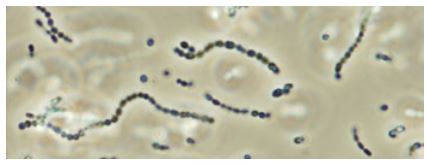
Streptococcus
46
Streptococcus is transmitted by or ;
In utero or during birth ; Direct contact with or
Contaminated ( or )
In utero or during birth ; Direct contact with or
Contaminated ( or )
Streptococcus is transmitted by fomites or Contaminated respiratory droplets (GAS);
In utero or during birth (GBS); Direct contact with nasal secretions or
Contaminated respiratory droplets (S. pneumoniae or Pneumococcus)
In utero or during birth (GBS); Direct contact with nasal secretions or
Contaminated respiratory droplets (S. pneumoniae or Pneumococcus)
47
Streptococcus pyogenes (GAS)
- week duration
-Causes
- , ,
- week duration
-Causes
- , ,
Streptococcus pyogenes (GAS)
-1 week duration
-Causes strep throat
-Sore throat, fever, headache
-1 week duration
-Causes strep throat
-Sore throat, fever, headache
48
Streptococcus pyogenes has an (antiphagocytic protein), (antiphagocytic hyaluronic acid), but the main agent is (superantigen activty produced by certain stains lysogenized by a phage carrying the gene)
Streptococcus pyogenes has an M protein (antiphagocytic protein), capsule (antiphagocytic hyaluronic acid), but the main agent is erythrogenic toxin (superantigen activty produced by certain stains lysogenized by a phage carrying the gene)
49
Streptococcus pyogenes (GAS)
Can cause scarlet fever in
Occurs when the steptococci produces (superantigen) and the host lacks antibody against toxin
Biggest symptoms are and
Can cause scarlet fever in
Occurs when the steptococci produces (superantigen) and the host lacks antibody against toxin
Biggest symptoms are and
Streptococcus pyogenes (GAS)
Can cause scarlet fever in untreated patients
Occurs when the steptococci produces erythrogenic toxin (superantigen) and the host lacks antibody against toxin
Biggest symptoms are "stawberry tounge" and "sandpaper rash"
Can cause scarlet fever in untreated patients
Occurs when the steptococci produces erythrogenic toxin (superantigen) and the host lacks antibody against toxin
Biggest symptoms are "stawberry tounge" and "sandpaper rash"
50
Streptococcus pyogenes (GAS)
Caused by untreated strep throat or scarlet fever
- , (jerky motion), and painful
Caused by untreated strep throat or scarlet fever
- , (jerky motion), and painful
Streptococcus pyogenes (GAS)
Rhemuatic fever
Caused by untreated strep throat or scarlet fever
-Congestive heart failure, chorea (jerky motion), and painful joints
Rhemuatic fever
Caused by untreated strep throat or scarlet fever
-Congestive heart failure, chorea (jerky motion), and painful joints
51
RHEUMATIC FEVER
Occurs as a cross-reactive Ig against recognizes heart and joint antigens, activates complement and phagocytes
Occurs as a cross-reactive Ig against recognizes heart and joint antigens, activates complement and phagocytes
RHEUMATIC FEVER
Occurs as a cross-reactive Ig against M protein recognizes heart and joint antigens, activates complement and phagocytes
Occurs as a cross-reactive Ig against M protein recognizes heart and joint antigens, activates complement and phagocytes
52
Streptococcus pyogenes (GAS)
ACUTE POST-STREPTOCOCCAL
GLOMERULONEPHRITIS (PSGN)
-10 days after or 3 weeks after
-Dark / (high protein)
-
-Decreased
ACUTE POST-STREPTOCOCCAL
GLOMERULONEPHRITIS (PSGN)
-10 days after or 3 weeks after
-Dark / (high protein)
-
-Decreased
Streptococcus pyogenes (GAS)
ACUTE POST-STREPTOCOCCAL
GLOMERULONEPHRITIS (PSGN)
-10 days after strep or 3 weeks after scarlet fever
-Dark red/ brown (high protein)
-Edema
-Decreased urgency
ACUTE POST-STREPTOCOCCAL
GLOMERULONEPHRITIS (PSGN)
-10 days after strep or 3 weeks after scarlet fever
-Dark red/ brown (high protein)
-Edema
-Decreased urgency
53
ACUTE POST-STREPTOCOCCAL
GLOMERULONEPHRITIS (PSGN)
Cross-reactive Ig against streptococcal antigens bind and form which deposit in the kidney
– triggers complement and phagocytes
GLOMERULONEPHRITIS (PSGN)
Cross-reactive Ig against streptococcal antigens bind and form which deposit in the kidney
– triggers complement and phagocytes
ACUTE POST-STREPTOCOCCAL
GLOMERULONEPHRITIS (PSGN)
Cross-reactive Ig against streptococcal antigens bind and form immune complexes which deposit in the kidney
glomeruli – triggers complement and phagocytes
GLOMERULONEPHRITIS (PSGN)
Cross-reactive Ig against streptococcal antigens bind and form immune complexes which deposit in the kidney
glomeruli – triggers complement and phagocytes
54
Impetigo (both bollous and non-bullous forms) can also be formed by
Impetigo (both bollous and non-bullous forms) can also be formed by streptococcus pyogenes
55
Streptococcus can cause infections deep in the tissue. It has a "shiny" texture
Streptococcus can cause cellulitis infections deep in the tissue. It has a "shiny" texture
56
Erysipelas
-Rash on face that has
- is also present
-Rash on face that has
- is also present
Erysipelas
-Rash on face that has raised borders
-Lymphadenopathy is also present
-Rash on face that has raised borders
-Lymphadenopathy is also present
57
can also be called by streoptococcus pyogenes, but it is caused by pyrigenic exotoxin A, which releases large amounts of cytokines friom T cells and macrophages
Toxic shock syndrome can also be called by streoptococcus pyogenes, but it is caused by pyrigenic exotoxin A, which releases large amounts of cytokines friom T cells and macrophages
58
Streptococcus pyogenes can cause necrotizing fascitis due to , which is a protease that rapidly destroys tissue
Streptococcus pyogenes can cause necrotizing fascitis due to extotoxin B, which is a protease that rapidly destroys tissue
59
Both staph and strep do hemolysis
Both staph and strep do beta hemolysis
60
S. pyogenes is high suspectible to
S. pyogenes is high suspectible to bacitracin
61
Streptococcus agalactiae (GBS)
-Causes disease in
- , , and
-Causes disease in
- , , and
Streptococcus agalactiae (GBS)
-Causes disease in newborn
-Pnemonia, menigitis, and sepsis
-Causes disease in newborn
-Pnemonia, menigitis, and sepsis
62
Streptococcus agalactiae (GBS)
Main virulence factors is the capsule, which is
Also binds to in serum to aid in degrading to prevent
Main virulence factors is the capsule, which is
Also binds to in serum to aid in degrading to prevent
Streptococcus agalactiae (GBS)
Main virulence factors is the capsule, which is anti-phagocytic
Also binds to factor H in serum to aid in degrading C3b to prevent complement activity
Main virulence factors is the capsule, which is anti-phagocytic
Also binds to factor H in serum to aid in degrading C3b to prevent complement activity
63
To test for Streptococcus agalactiae (GBS), use the test. It detects sodium . Positive for .
To test for Streptococcus agalactiae (GBS), use the hippurtate test. It detects sodium hippurate hydrolysis. Positive for GBS.
64
The CAMP tets is also used for Streptococcus agalactiae (GBS). It is the the only -hemolytic streptoccoi which has a positive camp test! It grows in an arrow towards
The CAMP tets is also used for Streptococcus agalactiae (GBS). It is the the only beta-hemolytic streptoccoi which has a positive camp test! It grows in an arrow towards S. auerus
65
Viridans Group Streptococci (VGS)
-Agenets of
-Alpha hemolytic and lack a , resistent to
-Agenets of
-Alpha hemolytic and lack a , resistent to
Viridans Group Streptococci (VGS)
-Agenets of infective endocarditis
-Alpha hemolytic and lack a capsule , resistent to optochin
-Agenets of infective endocarditis
-Alpha hemolytic and lack a capsule , resistent to optochin
66
S. mutans
Are isolated from cavity
Associated with
Are isolated from cavity
Associated with
S. mutans
Are isolated from human oral cavity
Associated with dental cavities
Are isolated from human oral cavity
Associated with dental cavities
67
VGS can lead to
1. Infectious
2. Brain
3. Abcesses of , and
1. Infectious
2. Brain
3. Abcesses of , and
VGS can lead to
1. Infectious endocarditis
2. Brain abscesses
3. Abcesses of lungs, abdomen, and liver
1. Infectious endocarditis
2. Brain abscesses
3. Abcesses of lungs, abdomen, and liver
68
VGS diseases are diagnosed using hemolysis on blood agar plate and resistence to on
VGS diseases are diagnosed using Alpha hemolysis on blood agar plate and resistence to optochin on BAP
69
Group D Are
and
and
Group D Are
Streptococci and Enterococcus
Streptococci and Enterococcus
70
Growth in 6.5% NaCl = only ; all others are
Growth in 6.5% NaCl = only Enterococcus; all others are
non-enterococci (S. bovis)
non-enterococci (S. bovis)
71
Bile esculin test
• Bile inhibits Gram-
• Esculin is hydrolyzed to
+ d
• Esculetin reacts with ferric
chloride to form
• Bile inhibits Gram-
• Esculin is hydrolyzed to
+ d
• Esculetin reacts with ferric
chloride to form
Bile esculin test
• Bile inhibits Gram-positive
• Esculin is hydrolyzed to
esculetin + dextrose
• Esculetin reacts with ferric
chloride to form black
precipitate
• Bile inhibits Gram-positive
• Esculin is hydrolyzed to
esculetin + dextrose
• Esculetin reacts with ferric
chloride to form black
precipitate
72
ENTEROCOCCUS
E. Facealis
-Part of gut flora and causes
- or hemolytic; positive for bile test
E. Facealis
-Part of gut flora and causes
- or hemolytic; positive for bile test
ENTEROCOCCUS
E. Facealis
-Part of gut flora and causes UTI
-Alpha or gamma hemolytic; positive for bile esculin test
E. Facealis
-Part of gut flora and causes UTI
-Alpha or gamma hemolytic; positive for bile esculin test
73
complex
- on blood agar; negative for test
-Associated with , and many
(IBD, bleeding, etc)
- on blood agar; negative for test
-Associated with , and many
(IBD, bleeding, etc)
S. bovis-S. equinus complex
-Non-hemolytic on blood agar; negative for bile esculin test
-Associated with bacteremias, ENDOCARDITIS and many GI disorders
(IBD, bleeding, etc)
-Non-hemolytic on blood agar; negative for bile esculin test
-Associated with bacteremias, ENDOCARDITIS and many GI disorders
(IBD, bleeding, etc)
74
Streptococcus pneumoniae causes both and . Leading cause of world-wide. Causes 1 in 3 cases of .
Streptococcus pneumoniae causes both pneumonia and mennigitis . Leading cause of pneumonia world-wide. Causes 1 in 3 cases of bacterial meningitis.
75
The main virulence factor for streptococcus pneumoniae is . Directly cytotoxic to and impairs action of . It suppresses .
The main virulence factor for streptococcus pneumoniae is pneumonlysin. Directly cytotoxic to endothelia and impairs action of cilia. It suppresses phagocytic activity.
76
The three leading causes of bacterial meingitis are , ,
The three leading causes of bacterial meingitis are N. meningitids, H. influenzae, S. pneumoniae
77
Pneymoncoccal disease is the most frequent cause of infection.
Pneymoncoccal disease is the most frequent cause of ear infection.
78
For s. pneumonaie, the organism is specific because it is gram
For s. pneumonaie, the organism is specific because it is gram positive DIPLOCOCCI
79
S. pneumoniae has a bile test that is for
S. pneumoniae has a bile test that is positive for lysis
80
S. pneumoniae expresses that disrupts the cell wall and kills bacteria as a means to release which causes tissue damage. Bile salt activates .
S. pneumoniae expresses autolysin that disrupts the cell wall and kills bacteria as a means to release pneumonlysin which causes tissue damage. Bile salt activates autolysin.
81
Microccus luteus
Strict ; or irregular
Strict ; or irregular
Microccus luteus
Strict aerobes; tetrads or irregular clusters
Strict aerobes; tetrads or irregular clusters
82
Micrococcus luteus is a pigmented bacteria that produces colonies on nutrient agar
Micrococcus luteus is a pigmented bacteria that produces yellow colonies on nutrient agar
83
Micrococcus luteus is sensitive to and can withstand massive doses of radiation
Micrococcus luteus is sensitive to bacitracin and can withstand massive doses of UV radiation
84
Micrococcus luteus can cause odors in humans and leads to common infection in
Micrococcus luteus can cause odors in humans and leads to common infection in immunocomproised patients (HIV)
85
Transmission of micrococcus luteus is often by direct or indirect contact with contaminated person or objects (often transmitted due to poor practices)
Transmission of micrococcus luteus is often by direct or indirect contact with contaminated person or objects (often transmitted due to poor hand washing practices)
86
Micrococcus luteus are considered to be opportunistic because they do not impact
Micrococcus luteus are considered to be opportunistic because they do not impact healthy patients.
87
Micrococcus luteus causes
1.
2.
3.
4.
1.
2.
3.
4.
Micrococcus luteus causes
1. Endocarditis
2. Septic arthritis
3. Meningitis
4. Pneumonia
1. Endocarditis
2. Septic arthritis
3. Meningitis
4. Pneumonia
88
M. luteus has gram (shape), on nutrient agar, positive for . Similar to staph, it is catalase
M. luteus has gram positive tetrads(shape), yellow color on nutrient agar, positive for urease . Similar to staph, it is catalase positive