Erythrocytes
Study these flashcardsFree · spaced repetition · iPhone, Android, Mac & web
All cards
1
In the mesoblastic stage of fetal development, blood cells are made in
In the mesoblastic stage of fetal development, blood cells are made in yolk sac
2
A little later in development, blood comes from , , and
A little later in development, blood comes from liver, spleen, and lymph nodes
3
Very late in fetal development, blood is from and
Very late in fetal development, blood is from bone marrow and lymph node
4
Erythropoietin is made in the
Erythropoietin is made in the kidneys
5
is the last stage with the nucleus. Our mature red blood cells lack and
Orthochromatic normoblast is the last stage with the nucleus. Our mature red blood cells lack organelles and nuclei
6
Unlike typical red blood cells, reticulocytes are able to make
Unlike typical red blood cells, reticulocytes are able to make hemoglobin
7
Orthochromatic erythroblasts become and they become
Orthochromatic erythroblasts become reticulocytes and they become eyrthrocyte
8
What are 3 things that cause erythropotein release?
1. Anemia
2. High elevation
3. Increased metabolic demand
2. High elevation
3. Increased metabolic demand
9
stimulates enhanced erythropoisesis in bone marrow
Erythropotein stimulates enhanced erythropoisesis in bone marrow
10
Red blood cells have a that allows for maximal /
Red blood cells have a biconcave disk that allows for maximal surface/volume
11
Normal red blood cell death occurs after 120 days due to loss of membrane , , and
Normal red blood cell death occurs after 120 days due to loss of membrane flexibility, oxidation, and damage during circulation
12
Abnormal RBC lifespan = , ,
Abnormal RBC lifespan = defective membrane (atypical hemoglobin), enzyme deficiency, infection
13
Red blood cells are predominatly made of , then , then
Red blood cells are predominatly made of protein, then lipids, then carbohydrates
14
Blood groups are attached to
Blood groups are attached to glycophorin
15
Majority of protein in RBC is
Majority of protein in RBC is hemoglobin
16
The enzymes in hemoglobin include those for , , ,
The enzymes in hemoglobin include those for glycolysis, PPP, Co2 hydration/dehydration, reduction with glutathione
17
Glutathione (*γ glutamylcysteinylglycine) has a cysteinyl group that increases levels of in the process of . You don't want (in your hemoglobin) because it cannot bind oxygen and glutathione allows for its reduction.
Glutathione (*γ glutamylcysteinylglycine) has a cysteinyl -SH group that increases levels of reduced glutathione (GSSGR) in the process of aerobic glycolysis. You don't want FE3+ (in your hemoglobin) because it cannot bind oxygen and glutathione allows for its reduction.
18
If hemoglobin goes from F2+ to F3+, it can
If hemoglobin goes from F2+ to F3+, it can no longer bind O2
19
Enzymes in the cytoplasm of RBC are for
Enzymes in the cytoplasm of RBC are for antioxidant activity
20
The 5 enzymes for antioxidant activity
1.
2.
3.
4.
5.
1.
2.
3.
4.
5.
The 5 enzymes for antioxidant activity
1. superoxide dismutase
(O2-)
2. glutathione (GSH) peroxidase
(lipid- and hydrogen- peroxides)
3. glutathione reductase
(restores GSH)
4. catalase
(H2O2)
5. glucose
6-phosphate dh
(NADPH)
1. superoxide dismutase
(O2-)
2. glutathione (GSH) peroxidase
(lipid- and hydrogen- peroxides)
3. glutathione reductase
(restores GSH)
4. catalase
(H2O2)
5. glucose
6-phosphate dh
(NADPH)
21
Gluathione peroxidases detox and by .
Gluathione peroxidases detox H2O2 and lipid peroxides by reduced glutathione.
22
Glutathione reductase restores
Glutathione reductase restores glutathione Peroxidase
23
Glutathione Peroxidase
+
(or lipid peroxide)
→ +
(or lipid hydroxide)
+
(or lipid peroxide)
→ +
(or lipid hydroxide)
Glutathione Peroxidase
2 GSH + H2O2
(or lipid peroxide)
→ GS-SG+ 2H2O
(or lipid hydroxide)
2 GSH + H2O2
(or lipid peroxide)
→ GS-SG+ 2H2O
(or lipid hydroxide)
24
Glutathione Reductase
+ + →
+
+ + →
+
Glutathione Reductase
GS-SG + NADPH + H+ →
2GSH + NADP+
GS-SG + NADPH + H+ →
2GSH + NADP+
25
+ to
+
methemoglobin reductase
+
methemoglobin reductase
Hb(Fe3+)+ NADH to
Hb(Fe2+) + NAD+
methemoglobin reductase
Hb(Fe2+) + NAD+
methemoglobin reductase
26
The n-terminal region of the cytoplasmic domain of band 3 binds , , , and .
The c-terminal of the band 3 binds .
The c-terminal of the band 3 binds .
The n-terminal region of the cytoplasmic domain of band 3 binds deoxy hemogloobin, hemichromes, G3P, and aldolase.
The c-terminal of the band 3 binds carbonic anhydrase II.
The c-terminal of the band 3 binds carbonic anhydrase II.
27
Deoxyhemoglobin is more prevelant in the
Deoxyhemoglobin is more prevelant in the peripheral tissues
28
High oxygen causes enzymes to bind to band 3, which halts , , and and favors
High oxygen causes enzymes to bind to band 3, which halts glycotic pathway, ATP, and NADH and favors PPP (production of NADPH)
29
Low oxygen causes enzymes to unbind from , which activates the glycolytic pathway that produces and and downregulates
Low oxygen causes enzymes to unbind from band 3, which activates the glycolytic pathway that produces ATP and NADH and downregulates PPP (NADPH production)
30
Red Cell Metabolism is Balanced
(by binding to )
to Optimize the Availability of
when [Oxygen] is High
…and
production when [
is lower.
(by binding to )
to Optimize the Availability of
when [Oxygen] is High
…and
production when [
is lower.
Red Cell Metabolism is Balanced
(by deoxy Hb binding to Band 3)
to Optimize the Availability of
NADPH when [Oxygen] is High
…and maximize ATP
production when [O2]
is lower.
(by deoxy Hb binding to Band 3)
to Optimize the Availability of
NADPH when [Oxygen] is High
…and maximize ATP
production when [O2]
is lower.
31
The conformational change to
also triggers the
from the
erythrocyte.
ATP is a
also triggers the
from the
erythrocyte.
ATP is a
The conformational change to
deoxy Hb also triggers the
release of ATP from the
erythrocyte.
ATP is a vasodilator.
deoxy Hb also triggers the
release of ATP from the
erythrocyte.
ATP is a vasodilator.
32
The erythrocyte “makes a path”
for itself by as
it encounters low
for itself by as
it encounters low
The erythrocyte “makes a path”
for itself by dilating vessels as
it encounters low [O2]
for itself by dilating vessels as
it encounters low [O2]
33
These results suggest that the addition of
to the treatment regimen for
could have beneficial effects on
tissue oxygenation,
which would help to ameliorate the
concomitant
peripheral vascular disease.
to the treatment regimen for
could have beneficial effects on
tissue oxygenation,
which would help to ameliorate the
concomitant
peripheral vascular disease.
These results suggest that the addition of C-peptide
to the treatment regimen for
type 2 diabetes
could have beneficial effects on
tissue oxygenation,
which would help to ameliorate the
concomitant
peripheral vascular disease.
to the treatment regimen for
type 2 diabetes
could have beneficial effects on
tissue oxygenation,
which would help to ameliorate the
concomitant
peripheral vascular disease.
34
binds in low oxygen concentration (using to form)
2,3 BPG binds in low oxygen concentration (using mutase to form)
35
2,3 BPG is made from (from glycolysis)
2,3 BPG is made from 1,3 BPG (from glycolysis)
36
No matter of blood type, you have an .
No matter of blood type, you have an H antigen.
37
A antigen has fucose, and N-acetylgalactosamine, and galactose
A antigen has 1 fucose, and 2 N-acetylgalactosamine, and 1 galactose
38
B antigen has galatcose, fucose, and n-acetylgalactosamine
B antigen has 2 galatcose, 1 fucose, and 1 n-acetylgalactosamine
39
In o blood type, there is n-acetylgalactosamine, galactose, and fucose
In o blood type, there is 1 n-acetylgalactosamine, 1 galactose, and 1 fucose
40
In bombay's phenotype, there is no . There is just galactose and n-acetylgalactosamine
In bombay's phenotype, there is no H antigen . There is just one galactose and one n-acetylgalactosamine
41
Megaloblastic (Macrocytic)
Megaloblastic (Macrocytic)
95-150 fl
95-150 fl
42
Microcytic
Microcytic
<83 fl
<83 fl
43
Normocytic
Normocytic
approx 90 fl
approx 90 fl
44
In nonhemolytic anemia, reticulocyte is or
In nonhemolytic anemia, reticulocyte is normal or low. 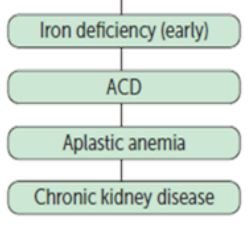
45
In hemolytic anemia, there are both and causes. Recticulocyte count is
In hemolytic anemia, there are both intrinstic and extrincic causes. Recticulocyte count is elevated. 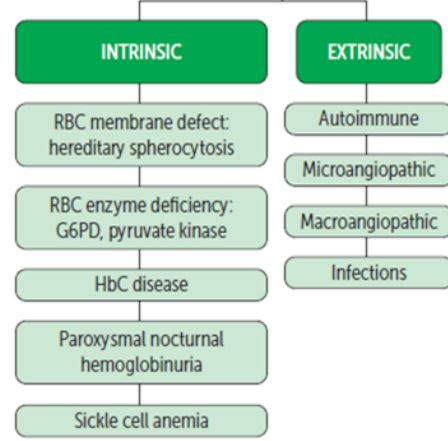
46
Causes of marcocytic anemia can be and
Causes of marcocytic anemia can be megaloblastic and non-megaloblastic 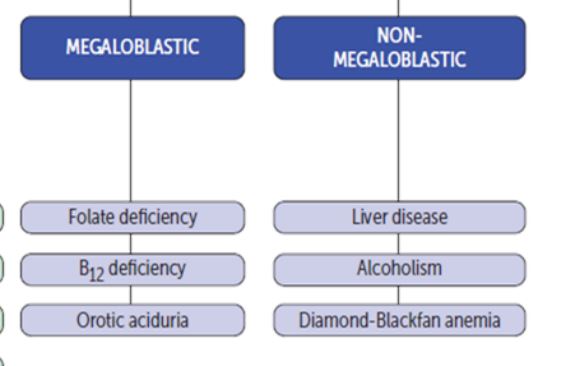
47
Causes of microcytic anemia can be rembered by the acronym
Causes of microcytic anemia can be rembered by the acronym SALTI 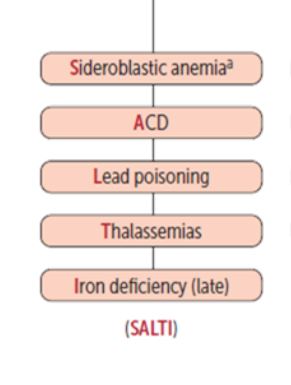
48
Polycythemia vera = making of blood cells, but is
Polycythemia vera = making alot of blood cells, but erythropoietin is not elevated
49
Physiological polycythemia = making of blood cells, but is
Physiological polycythemia = making a lot of blood cells, but erythropotein is elevated
50
Dehydration causes
Dehydration causes polycythemia
51
In hemolytic anemia, these two enzymes are deficient
1.
2.
1.
2.
In hemolytic anemia, these two enzymes are deficient
1. Glucose 6-Phosphate dehydrogenase
2. Pyruvate kinase
1. Glucose 6-Phosphate dehydrogenase
2. Pyruvate kinase
52
In space, erythropoises was but was
In space, erythropoises was reduced but was reversible.
53
High partial pressure of oxygen leads to high
High partial pressure of oxygen leads to high hemoglobin saturation
54
Emden Meyerhof pathway EMP =
Emden Meyerhof pathway EMP = glycolosis
55
In sickle hemoglobin, problem with pathway. Sickle cell of hemoglobin "pretends" to be deoxy and shunts path towards instead of .
In sickle hemoglobin, problem with pathway. Sickle cell of hemoglobin "pretends" to be deoxy and shunts path towards PPP instead of glyolysis.
56
For megaloblastic, is mostly problems with . The DNA growing slowly, but keeps growing = cell.
For megaloblastic, is mostly problems with DNA production. The DNA growing slowly, but cytoplasms keeps growing =larger cell.
57
Example of physiological polycythemia=
Example of physiological polycythemia= difference in elevation