Start of Exam 2 Ch. 16 and 17
Study these flashcardsFree · spaced repetition · iPhone, Android, Mac & web
All cards
1
Glycogen is a branched carbohydrate polymer composed of
Glycogen is a branched carbohydrate polymer composed of glucose monomers
2
Glycogen main chains are glycosidic linkages, whereas at branch points
the linkage is .
the linkage is .
Glycogen main chains are alpha-1-4 glycosidic linkages, whereas at branch points
the linkage is alpha-1-6.
the linkage is alpha-1-6.
3
Glycogen serves as a source of stored glucose mainly in and
Glycogen serves as a source of stored glucose mainly in liver and skeletal
muscle
muscle
4
Glycogenolysis (breakdown of ) in results in the production of glucose,
which is released into blood, and eventually utilized by various other tissues
which is released into blood, and eventually utilized by various other tissues
Glycogenolysis (breakdown of glycogen) in liver results in the production of glucose,
which is released into blood, and eventually utilized by various other tissues
which is released into blood, and eventually utilized by various other tissues
5
The major site of glucose consumption (75%) is , through .
The major site of glucose consumption (75%) is brain, through aerobic metabolism.
6
In the liver, a glucokinase reaction occurs that makes Glucose + ATP into . The Km for glucose is high with unlike .
In the liver, a glucokinase reaction occurs that makes Glucose + ATP into Glucose 6 phosphate. The Km for glucose is high with glucokinase unlike hexokinase.
7
The product of glycogenolysis ( ) in muscle is not available to other tissues, since muscle lacks the crucial enzyme .
The product of glycogenolysis (glucose-1-phosphate) in muscle is not available to other tissues, since muscle lacks the crucial enzyme glucose-6-phosphatase.
8
Animals use (alpha or beta) for glycogen synthesis
Animals use a anomer (alpha or beta) for glycogen synthesis 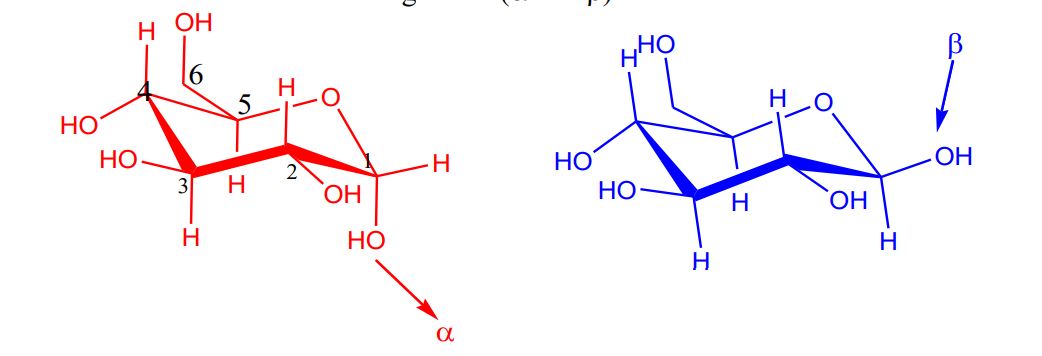
9
Plants use (alpha or beta) of glucose for cellulose biosynthesis and for starch synthesis.
Plants use b anomer (alpha or beta) of glucose for cellulose biosynthesis and a anomer for starch synthesis. 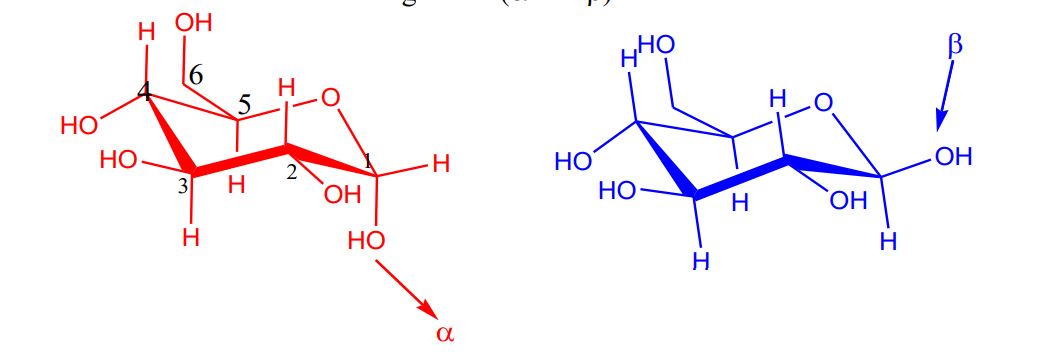
10
The Synthesis of glycogen from glucose is carried out by the enzyme
The Synthesis of glycogen from glucose is carried out by the enzyme glycogen synthase.
11
Glycogen synthase utilizes an activated glucose monomer , to extend the polymer
by .
by .
Glycogen synthase utilizes an activated glucose monomer UDP-glucose, to extend the polymer
by one unit.
by one unit.
12
What type of reaction forms large glycogen polymers?
Catalytic condensation reactions
13
Glycogen = straight chain polymer of glucose with
Glycogen = straight chain polymer of glucose with alpha-1-4-glycosidic linkages
14
How is UDP-glucose made? What enzyme catalyzes this rxn?
Glucose 1- phosphate is combined with UTP forms UDP glucose and pyrophosphate
Glucose 1 phosphate UTP uridylyl transferase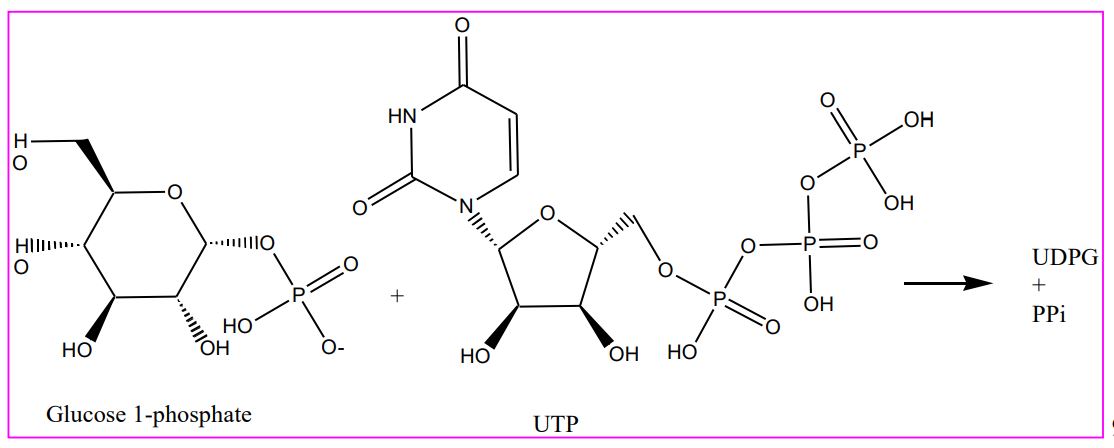
Glucose 1 phosphate UTP uridylyl transferase
15
What happens to the pyrophosphate that is formed?
Pyrophospotase rapidly makes 2 inorganic phosphates
16
What is significant about the pyrophosphate becoming 2 inorganic phosphates?
It makes the forwards reaction more thermodynamically favorable (by converting one of the products)
17
The energy of the phospho-glycosyl bond of UDP-glucose is utilized by glycogen synthase to
catalyze the incorporation of into
catalyze the incorporation of into
The energy of the phospho-glycosyl bond of UDP-glucose is utilized by glycogen synthase to
catalyze the incorporation of glucose into glycogen
catalyze the incorporation of glucose into glycogen
18
What is the primer in glycogen synthesis?
Glycogenin
19
Glycogenin autocatalytically attaches of a UDP-glucose (UDPG) to its . From the first glucosyl residue more glucosyl units are sequentially added using to form an attached to glycogenin.
Glycogenin autocatalytically attaches C-1 of a UDP-glucose (UDPG) to its tyrosine residue. From the first glucosyl residue 7 more glucosyl units are sequentially added using 7 UDPG to form an octomer attached to glycogenin.
20
The glucose formed at the bgeinning of glycogen synthesis has shown to be needed as a primer in glycogen synthesis
The glucose octomer formed at the bgeinning of glycogen synthesis has shown to be needed as a primer in glycogen synthesis
21
UDP is used in the formation of the polymer unit. It is a
UDP is NOT used in the formation of the polymer unit. It is a byproduct.
22
The alpha-1,6 branches in glycogen are synthesized by a (alpha -1-4)- (alpha-1-6)-glucan transferase commonly known as
The alpha-1,6 branches in glycogen are synthesized by a (alpha -1-4)- (alpha-1-6)-glucan transferase commonly known as branching enzyme
23
What does branching enzyme do?
It transfers a terminal fragment of 6-7 glucose to internal glucose resuide at C-6 hydroxyl position
24
The terminal fragment that branching enzymes uses must be a polymer at least glucose long
The terminal fragment that branching enzymes uses must be a polymer at least 11 glucose long
25
Glycogen terminal with free hydroxyl on C4 is called the
Glycogen terminal with free hydroxyl on C4 is called the non-reducing end
26
The glycogen terminal with free hydroxyl at the C-1 carbon is called the
The glycogen terminal with free hydroxyl at the C-1 carbon is called the reducing end
27
The degradation of glycogen (glycogenolysis) is catalyzed by
The degradation of glycogen (glycogenolysis) is catalyzed by glycogen phosphorylase
28
Glycogen phosphorylase contains a moiety covalently attached to the residue of the enzyme which participates in the catalysis
Glycogen phosphorylase contains a vitamin B6 (pyridoxal phosphate, [PLP]) moiety covalently attached to the lysine residue of the enzyme which participates in the catalysis
29
What is the function of the PLP (vitamin B6) phosphate?
Activates the inorganic phosphate by deprotonation at the active site
30
Where does the degredation of glycogen start?
At the non-reducing end
31
How is the terminal residue at the reducing end cleaved?
Using inorganic phosphate
32
How does glycogen phosphorylase break down glycogen units?
Using phosphorolysis (cutting using inorganic phosphate)
33
By phosphorolysis a single glucose residue is removed at a time to form
By phosphorolysis a single glucose residue is removed at a time to form glucose1-phosphate
34
How does alpha-amylase break down glucose (specific instance in the stomach and pancreas)?
Using hydroylysis to form glucose
35
What is the benefit of phosphorolytic cleavage?
Glucose-1-phosphate is formed WITHOUT neededing ATP and concentration of inorganic phosphate is high enough to drive rxn forward
36
At before a branching point, phosphorylase stops cleaving the glycogen
At four residues before a branching point, phosphorylase stops cleaving the glycogen
37
Once the branch is down to four residues, , (alpha -1-4)- (alpha-1-4)-glucantransferase activity) takes over.
Once the branch is down to four residues, debranching enzyme, (alpha -1-4)- (alpha-1-4)-glucantransferase activity) takes over.
38
First (alpha-1-4)- (alpha-1-4)-glucantransferase, domain activity transfers the on to another branch. Then the activity removes the last glucose residue from the branch by
First (alpha-1-4)- (alpha-1-4)-glucantransferase, domain activity transfers the terminal trisaccharide on to another branch. Then the alpha -1,6- glucosidase activity removes the last glucose residue from the branch by hydrolysis 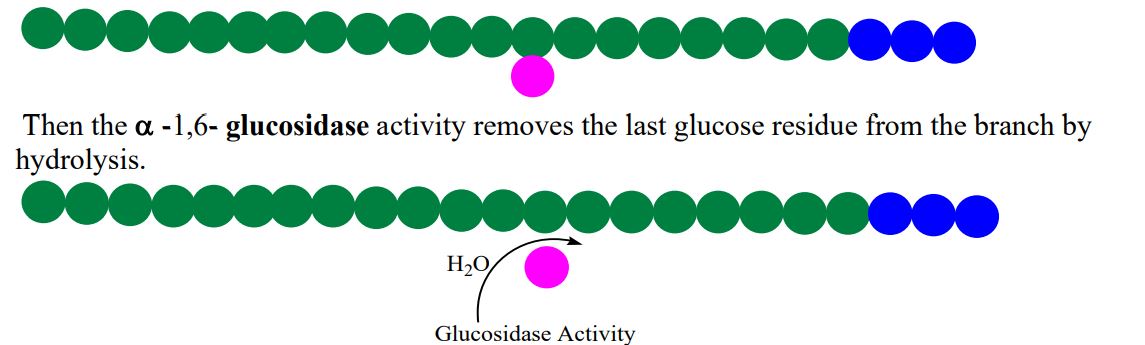
39
In muscle, what happens to the free glucose that is released?
The activity of hexokinase is so high that the free glucoses immediately phosphorylated into glucose 6-phosphate (enters glycolysis)
40
Glucose 1-phosphate produced by the action of phosphorylase is converted into
by the enzyme phosphoglucomutase.
by the enzyme phosphoglucomutase.
Glucose 1-phosphate produced by the action of phosphorylase is converted into
glucose 6-phosphate by the enzyme phosphoglucomutase.
glucose 6-phosphate by the enzyme phosphoglucomutase.
41
Glucose 1-phosphate is
a direct precursor for glycolysis
a direct precursor for glycolysis
Glucose 1-phosphate is
not a direct precursor for glycolysis
not a direct precursor for glycolysis
42
Phosphoglucomutase contains a in the active site. The enzyme linked covalent phosphate is transferred to C-6 of glucose 1-phosphate, generating as a transient intermediate. The phosphate on the C-1 is then transferred to the enzyme regenerating the phospho enzyme and releases as a product.
Phosphoglucomutase contains a phosphorylated amino acid (Ser) in the active site. The enzyme linked covalent phosphate is transferred to C-6 of glucose 1-phosphate, generating glucose1,6-bisphosphate as a transient intermediate. The phosphate on the C-1 is then transferred to the enzyme regenerating the phospho enzyme and releases glucose-6-phosphate as a product.
43
In muscle the sole purpose of glycogenolysis is to breakdown glycogen, to form
, which is converted into
, which is converted into
In muscle the sole purpose of glycogenolysis is to breakdown glycogen, to form
glucose 1-phosphate, which is converted into glucose 6-phosphate
glucose 1-phosphate, which is converted into glucose 6-phosphate
44
It is interesting to note that is absent in muscle, therefore the only fate for the glucose 6-phosphate is to enter the glycolytic pathway for ATP production
It is interesting to note that glucose 6-phosphatase is absent in muscle, therefore the only fate for the glucose 6-phosphate is to enter the glycolytic pathway for ATP production
45
In liver, the enzyme glucose 6-phosphatase releases , which enter the
bloodstream for maintaining .
bloodstream for maintaining .
In liver, the enzyme glucose 6-phosphatase releases free glucose, which enter the
bloodstream for maintaining blood glucose level.
bloodstream for maintaining blood glucose level.
46
Regulation of an enzyme activity by an effector or a metabolite that binds to allosteric site is
called
called
Regulation of an enzyme activity by an effector or a metabolite that binds to allosteric site is
called allosteric regulation
called allosteric regulation
47
is a compound other than the substrate that modulates
enzyme activity in allosteric regulation
enzyme activity in allosteric regulation
Effector is a compound other than the substrate that modulates
enzyme activity in allosteric regulation
enzyme activity in allosteric regulation
48
During basal cellular needs, , controlled by metabolites, governs the glycogen breakdown, which is sufficient to provide the needed energy for various cell types. It does this by and regulation.
During basal cellular needs, phosphorylaseb, controlled by metabolites, governs the glycogen breakdown, which is sufficient to provide the needed energy for various cell types. It does this by allosteric and covalent modification regulation.
49
Glycogen phosphorylase (phosphorylase-b) is a homodimeric enzyme that has a and state. R state is stabalized by and inhibited by and
Glycogen phosphorylase (phosphorylase-b) is a homodimeric enzyme that has a T and R state. R state is stabalized by AMP and inhibited by ATP and glucose 6 phosphate
50
During the resting state, the unmodified form (Phosphorylase-b), is
sufficient to generate for entry into glycolysis, for the production of ATP,
both in liver and muscle, however during high energy demand, is needed.
sufficient to generate for entry into glycolysis, for the production of ATP,
both in liver and muscle, however during high energy demand, is needed.
During the resting state, the unmodified form (Phosphorylase-b), is
sufficient to generate glucose1-phosphate for entry into glycolysis, for the production of ATP,
both in liver and muscle, however during high energy demand, phosphorylase-a is needed.
sufficient to generate glucose1-phosphate for entry into glycolysis, for the production of ATP,
both in liver and muscle, however during high energy demand, phosphorylase-a is needed.
51
When blood sugar is low, alpha cells of pancrease secrete glucagon which causes activation of which forms , which binds to and causes the formation of the because of the removal of an R unit.
When blood sugar is low, alpha cells of pancrease secrete glucagon which causes activation of adenylate cyclase which forms cAMP, which binds to PKA and causes the formation of the active enzyme because of the removal of an R unit.
52
The active catalytic subunit (dimer) (C2) of PKA then activates
by phosphorylating critical residues. Now activated, it in turn
phosphorylates converting into active .
by phosphorylating critical residues. Now activated, it in turn
phosphorylates converting into active .
The active catalytic subunit (dimer) (C2) of PKA then activates phosphorylase kinase
by phosphorylating critical serine residues. Now activated, it in turn
phosphorylates phosphorylase-b converting into active phosphorylase-a.
by phosphorylating critical serine residues. Now activated, it in turn
phosphorylates phosphorylase-b converting into active phosphorylase-a.
53
Epinephrine binds to its
receptor in muscle cell and activates the
receptor in muscle cell and activates the
Epinephrine binds to its
receptor in muscle cell and activates the glycogenolysis cascade
receptor in muscle cell and activates the glycogenolysis cascade
54
When epinephrine is released during flight or fight, glycogenolysis and glucose-1-phosphate is produced and isomerized to . It enters glycolysis after step 1 and so it
When epinephrine is released during flight or fight, glycogenolysis increases and glucose-1-phosphate is produced and isomerized to glucose 6 phosphate. It enters glycolysis after step 1 and so it yields more ATP (3 instead of 2).
55
Each stored glucosyl unit of glycogen would yield as opposed to the free glucose which would yield a ATP.
Each stored glucosyl unit of glycogen would yield 33 ATP as opposed to the free glucose which would yield a net 32 ATP.
56
In hormonal regulation/insulin secretion, phosphorylase kinase activity is also affected by
In hormonal regulation/insulin secretion, phosphorylase kinase activity is also affected by calcium ions
57
The binding of Ca2+to calmodulin like subunit, induces a conformational change, which in turn
The binding of Ca2+to calmodulin like subunit, induces a conformational change, which in turn activates phosphorylase kinase.
58
During glycogenolysis, increase.
During glycogenolysis, intracellular calcium levels increase.
59
Glucagon (Signals , in Liver)
Glucagon (Signals Degradation, Catabolism in Liver)
60
Epinephrine Stimulates Glycogen in
and
and
Epinephrine Stimulates Glycogen degradation in
Muscle and Liver
Muscle and Liver
61
The signaling mechanism in glycogenolysis is mediated by secondary messengers and .
The signaling mechanism in glycogenolysis is mediated by secondary messengers Inositol trisphosphate (IP3) and diacylglycerol (DAG).
62
The action of epinephrine at alpha -adrenergic receptors is coupled through that
activates .
activates .
The action of epinephrine at alpha -adrenergic receptors is coupled through G-proteins that
activates phospholipase C (PLC).
activates phospholipase C (PLC).
63
Activation of PLC leads to the hydrolysis of into and
Activation of PLC leads to the hydrolysis of phosphotidyl
inositol 1-4,5-bisphosphate (PIP2) into inositol trisphosphate (IP3) and diacylglycerol (DAG).
inositol 1-4,5-bisphosphate (PIP2) into inositol trisphosphate (IP3) and diacylglycerol (DAG).
64
binds to and activates protein kinase C (PKC) an enzyme that phosphorylates numerous
substrates, one of which is
substrates, one of which is
DAG binds to and activates protein kinase C (PKC) an enzyme that phosphorylates numerous
substrates, one of which is glycogen synthase
substrates, one of which is glycogen synthase
65
IP3 binds to receptors on the surface of the
endoplasmic reticulum leading to the
endoplasmic reticulum leading to the
IP3 binds to receptors on the surface of the
endoplasmic reticulum leading to the release of calcium ions.
endoplasmic reticulum leading to the release of calcium ions.
66
The Ca2+ binds to the calmodulin like subunit of , resulting in its activation. Ca2
+ also directly activates similar to DAG.
+ also directly activates similar to DAG.
The Ca2+ binds to the calmodulin like subunit of phosphorylase kinase, resulting in its activation. Ca2
+ also directly activates PKC similar to DAG.
+ also directly activates PKC similar to DAG.
67
Glycogenolysis is “turned off” by
Glycogenolysis is “turned off” by phosphoprotein phosphatase-1 (PP-1).
68
The activity of PP-1 must be closely regulated so that it does not
The activity of PP-1 must be closely regulated so that it does not immediately remove a phosphate
69
Phosphorylase leads to activation of , whereas phosphorylation in the case of inactivates it, avoiding the futile cycle
Phosphorylase leads to activation of glycogen breakdown, whereas phosphorylation in the case of glycogen synthase inactivates it, avoiding the futile cycle
70
Glycogen synthase is a consisting of identical subunits
Glycogen synthase is a tetrameric enzyme consisting of 4 identical subunits
71
The activity of glycogen synthase is regulated by residues in the subunit proteins.
The activity of glycogen synthase is regulated by phosphorylation of serine residues in the subunit proteins.
72
Phosphorylation of glycogen synthase reduces its affinity toward its substrate
Phosphorylation of glycogen synthase reduces its affinity toward its substrate UDP-glucose
73
In the non-phosphorylated state, glycogen synthase does not require as an allosteric activator ( of glycogen synthase)
In the non-phosphorylated state, glycogen synthase does not require glucose 6-phosphate as an allosteric activator (I-form of glycogen synthase)
74
In the phosphorylated state, glycogen
synthase requires the allosteric activator, ( of glycogen synthase).
synthase requires the allosteric activator, ( of glycogen synthase).
In the phosphorylated state, glycogen
synthase requires the allosteric activator, glucose 6-phosphate (D-form of glycogen synthase).
synthase requires the allosteric activator, glucose 6-phosphate (D-form of glycogen synthase).
75
The D form corresponds to the phosphorylated and (less active) form also termed as and the I form corresponds to the non-phosphorylated, glucose 6-phosphate independent form termed as
The D form corresponds to the phosphorylated and (less active) form also termed as glycogen
synthase-b and the I form corresponds to the non-phosphorylated, glucose 6-phosphate independent form termed as glycogen synthase-a.
synthase-b and the I form corresponds to the non-phosphorylated, glucose 6-phosphate independent form termed as glycogen synthase-a.
76
Phosphorylation of synthase occurs primarily in response to hormonal activation of
Phosphorylation of synthase occurs primarily in response to hormonal activation of cAMP
dependent protein kinase A.
dependent protein kinase A.
77
One of the major kinases that phosphorylates glycogen synthase is
; the same enzyme that phosphorylates g
; the same enzyme that phosphorylates g
One of the major kinases that phosphorylates glycogen synthase is
synthase-phosphorylase kinase; the same enzyme that phosphorylates glycogen phosphorylase
synthase-phosphorylase kinase; the same enzyme that phosphorylates glycogen phosphorylase
78
What is an example of a enzyme that can phosphorylate glycogen its own?
PKA
79
What are the effects of ephinephrine binding to alpha-adrenergic receptors for the glycogen synthase?
1. Decrease affinity of glycogen for UDP-glucose (substrate)
2. Increase dependency of glycogen synthase for G6P
2. Increase dependency of glycogen synthase for G6P
80
Insulin in general is an hormone, whereas glucagon is a
hormone that induces events
hormone that induces events
Insulin in general is an anabolic (synthesis inducing) hormone, whereas glucagon is a
hormone that induces catabolic (degradative) events
hormone that induces catabolic (degradative) events
81
What is Von Gierke's disease?
-Lack of glucose 6 phosphatase
-Mutations of phosphatase or translocase make transfer of liver glocose to blood difficult
-Mutations of phosphatase or translocase make transfer of liver glocose to blood difficult
82
What would not be impacted by Von Gierke's disease? Why?
Muscle tissue because it lacks glucose-6-phosphatase
83
Pompe’s Disease
Lysosomal alpha-glucosidase deficiency
84
McArdles Disease
Skeletal muscle phosphorylase deficiency
85
Cori’s Disease
Defect in debranching enzyme
86
Andersen’s Disease
Defect in branching enzyme
87
Hers Disease
Liver phosphorylase deficiency
88
In Type 1 Diabetes, the is very low, the liver is breaking down and
depleting the storage glycogen to make further increasing amounts of glucose.
depleting the storage glycogen to make further increasing amounts of glucose.
In Type 1 Diabetes, the insulin/ glucagon ratio is very low, the liver is breaking down and
depleting the storage glycogen to make further increasing amounts of glucose.
depleting the storage glycogen to make further increasing amounts of glucose.
89
Cataracts form in diabeteics why?
Because excess glucose is converted to sorbitol and sorbitol is viscous
90
Glycoconjugates are formed in Type 1 Diabetes by the of glucose
that forms linkages with many proteins either with the amino terminal residue or with reactive
lysines. This non-enzymatic glycation artificially damages many protein/enzyme activities
that forms linkages with many proteins either with the amino terminal residue or with reactive
lysines. This non-enzymatic glycation artificially damages many protein/enzyme activities
Glycoconjugates are formed in Type 1 Diabetes by the reactive aldehyde of glucose
that forms linkages with many proteins either with the amino terminal residue or with reactive
lysines. This non-enzymatic glycation artificially damages many protein/enzyme activities
that forms linkages with many proteins either with the amino terminal residue or with reactive
lysines. This non-enzymatic glycation artificially damages many protein/enzyme activities
91
Type I diabetics due to low levels of insulin exhibit in the blood (i.e., High
Levels of in the blood). Normally, lipoprotein lipase responds to insulin and converts TG of liver VLDL into and . In diabetes, continues to circulate in blood.
Levels of in the blood). Normally, lipoprotein lipase responds to insulin and converts TG of liver VLDL into and . In diabetes, continues to circulate in blood.
Type I diabetics due to low levels of insulin exhibit hyperlipidemia in the blood (i.e., High
Levels of TG in the blood). Normally, lipoprotein lipase responds to insulin and converts TG of liver VLDL into FA and gycerol. In diabetes, TG continues to circulate in blood.
Levels of TG in the blood). Normally, lipoprotein lipase responds to insulin and converts TG of liver VLDL into FA and gycerol. In diabetes, TG continues to circulate in blood.
92
In type 2 diabetes, the body is resistant to
administration.
administration.
In type 2 diabetes, the body is resistant to exogenous insulin
administration.
administration.
93
If there is a pancreatic tumor of the beta-cell region of pancreas, then the
hormone insulin is . This means the insulin/ glucagon ratio is . This leads to over uptake of glucose into cells resulting in
hormone insulin is . This means the insulin/ glucagon ratio is . This leads to over uptake of glucose into cells resulting in
If there is a pancreatic tumor of the beta-cell region of pancreas, then the
hormone insulin is over produced. This means the insulin/ glucagon ratio is very high. This leads to over uptake of glucose into cells resulting in low blood glucose levels.
hormone insulin is over produced. This means the insulin/ glucagon ratio is very high. This leads to over uptake of glucose into cells resulting in low blood glucose levels.
94
3 difference between diabetes and hyperlipidemia
1. Insulin/ glucagon low
2. PLC not activated in liver
3. triglyercides in serum
2. PLC not activated in liver
3. triglyercides in serum
95
= Increased Urination
= Increased Thirst
= Increased Hunger
= Increased Thirst
= Increased Hunger
Polyuria= Increased Urination
Polydipsia= Increased Thirst
Polyphagia= Increased Hunger
Polydipsia= Increased Thirst
Polyphagia= Increased Hunger
96
What is the significance of metformin?
Comes from french lilac and is a biguanide
97
How is AbA1C formed?
Protein reacts with glucose's reactive aldehyde
98
What is glucose comverted to?
Glucose gets convcerted to sorbitol by non-specific dehydrogenase required NADPH and impacts pressure of eue