CH. 31 Integration of Metabolism
Study these flashcardsFree · spaced repetition · iPhone, Android, Mac & web
All cards
1
Macronutrients a) b) c) d) that come from food are processed into simple molecules before it is metabolized for energy purposes mainly by liver
Macronutrients a) carbohydrates (starch, glycogen) b) proteins c) fats d) nucleic acids that come from food are processed into simple molecules before it is metabolized for energy purposes mainly by liver
2
Zona glomeruloa (salt) = releases
Zona glomeruloa (salt) = releases aldosterone -> mineralocorticoids
3
Zona fasciulata (sugar) = releases
Zona fasciulata (sugar) = releases glucocorticoids -> cortisol
4
Zona reticularis (sex) = releases
Zona reticularis (sex) = releases androgens
5
Though there is lingual lipases and alpha-amylases that breaks down molecules in a
limited way, majority of the action happens in the , , and minimally in
limited way, majority of the action happens in the , , and minimally in
Though there is lingual lipases and alpha-amylases that breaks down molecules in a
limited way, majority of the action happens in the stomach, duodenum, and minimally in small intestine
limited way, majority of the action happens in the stomach, duodenum, and minimally in small intestine
6
Stomach aids can denature proteins which then can be digested by into
Stomach aids can denature proteins which then can be digested by pepsin into
oligopeptides
oligopeptides
7
Oligopeptides are cleaved even further into dipeptides in duodenum by proteases
( , , ) that are secreted by
( , , ) that are secreted by
Oligopeptides are cleaved even further into dipeptides in duodenum by proteases
(trypsin, chymotrypsin, elastase) that are secreted by pancreas
(trypsin, chymotrypsin, elastase) that are secreted by pancreas
8
The breakdown of oligopeptides into dipeptides is controlled by the peptide hormone
The breakdown of oligopeptides into dipeptides is controlled by the peptide hormone secretin
9
Dipeptides are further cleaved into
individual amino acids by intestinal epithelium bound
individual amino acids by intestinal epithelium bound
Dipeptides are further cleaved into
individual amino acids by intestinal epithelium bound dipeptidases.
individual amino acids by intestinal epithelium bound dipeptidases.
10
Partially digested starch and glycogen are broken down in duodenum mainly to monosaccharide (glucose)
by
by
Partially digested starch and glycogen are broken down in duodenum mainly to monosaccharide (glucose)
by pancreatic alpha-amylase
by pancreatic alpha-amylase
11
Intestinal epithelium absorbed monosaccharides and individual amino
acids are then transported by hepatic portal system to liver where it can be signaled by to be packaged to form and respectively.
acids are then transported by hepatic portal system to liver where it can be signaled by to be packaged to form and respectively.
Intestinal epithelium absorbed monosaccharides and individual amino
acids are then transported by hepatic portal system to liver where it can be signaled by insulin to be packaged to form glycogen and proteins respectively.
acids are then transported by hepatic portal system to liver where it can be signaled by insulin to be packaged to form glycogen and proteins respectively.
12
The dietary source of fats is acted on by
aided by in small intestine.
aided by in small intestine.
The dietary source of fats is acted on by
pancreatic lipase aided by bile salts in small intestine.
pancreatic lipase aided by bile salts in small intestine.
13
Bile acids are synthesized and conjugated
to form bile salts in liver and stored in
to form bile salts in liver and stored in
Bile acids are synthesized and conjugated
to form bile salts in liver and stored in gall bladder.
to form bile salts in liver and stored in gall bladder.
14
Cholecystokinin (CCK) stimulates the
and secretion of from gall bladder.
and secretion of from gall bladder.
Cholecystokinin (CCK) stimulates the
contraction and secretion of bile salts from gall bladder.
contraction and secretion of bile salts from gall bladder.
15
Fatty acids in the intestinal epithelium
are reformed into and packaged with proteins to form .
are reformed into and packaged with proteins to form .
Fatty acids in the intestinal epithelium
are reformed into triacylglycerol (triglyceride) and packaged with proteins to form chylomicrons.
are reformed into triacylglycerol (triglyceride) and packaged with proteins to form chylomicrons.
16
Chylomicrons from intestinal epithelium are transported into liver through
Chylomicrons from intestinal epithelium are transported into liver through lymphatic system.
17
In liver chylomicrons are converted into which then is delivered to adipose tissue where
lipids can be stored as
lipids can be stored as
In liver chylomicrons are converted into VLDL which then is delivered to adipose tissue where
lipids can be stored as triglycerides (triacylglycerol).
lipids can be stored as triglycerides (triacylglycerol).
18
When the blood glucose levels are high it
stimulates the synthesis and secretion of from pancreas which then signals the
course of events
stimulates the synthesis and secretion of from pancreas which then signals the
course of events
When the blood glucose levels are high it
stimulates the synthesis and secretion of insulin from pancreas which then signals the anabolic
course of events
stimulates the synthesis and secretion of insulin from pancreas which then signals the anabolic
course of events
19
Liver responds to peptide hormones and
Liver responds to peptide hormones insulin and glucagon
20
Insulin in general
promotes . Glucagon stimulates .
promotes . Glucagon stimulates .
Insulin in general
promotes synthesis. Glucagon stimulates catabolism.
promotes synthesis. Glucagon stimulates catabolism.
21
Glucose that is produced in the liver is pumped into to be picked by glucose
utilizing tissues like brain, RBC, and various glucose metabolizing tissues.
utilizing tissues like brain, RBC, and various glucose metabolizing tissues.
Glucose that is produced in the liver is pumped into blood stream to be picked by glucose
utilizing tissues like brain, RBC, and various glucose metabolizing tissues.
utilizing tissues like brain, RBC, and various glucose metabolizing tissues.
22
Since brain does not
use as an energy source produced by liver is essential under normal metabolic
condition.
use as an energy source produced by liver is essential under normal metabolic
condition.
Since brain does not
use fatty acid as an energy source glucose produced by liver is essential under normal metabolic
condition.
use fatty acid as an energy source glucose produced by liver is essential under normal metabolic
condition.
23
Skeletal muscle and Cardiac muscle can normally metabolize or as an
energy source.
energy source.
Skeletal muscle and Cardiac muscle can normally metabolize glucose or fat as an
energy source.
energy source.
24
The source of glucose for muscle tissues are
The source of glucose for muscle tissues are its own glycogen stores
25
The muscle
stored glycogen is mobilized by hormones such as , , and .
stored glycogen is mobilized by hormones such as , , and .
The muscle
stored glycogen is mobilized by hormones such as epinephrine, norepinephrine, and cortisol.
stored glycogen is mobilized by hormones such as epinephrine, norepinephrine, and cortisol.
26
In general epinephrine goes through system to activate
the production of
the production of
In general epinephrine goes through beta-adrenergic G-protein coupled receptor system to activate
the production of cAMP
the production of cAMP
27
With epinephrine, cAMP dependent protein kinases activate and then as needed, fatty acid degradation is also activated to provide energy for active muscle, during exercise.
With epinephrine, cAMP dependent protein kinases activate glycogenolysis and then as needed, fatty acid degradation is also activated to provide energy for active muscle, during exercise.
28
Norepinephrine goes through
system to produce and . activates the release of from
sarcoplasmic reticulum. Both and activates muscle glycogenolysis and its
contraction.
system to produce and . activates the release of from
sarcoplasmic reticulum. Both and activates muscle glycogenolysis and its
contraction.
Norepinephrine goes through
alpha-adrenergic system to produce IP3 and DAG. IP3 activates the release of calcium from
sarcoplasmic reticulum. Both DAG and calcium activates muscle glycogenolysis and its
contraction.
alpha-adrenergic system to produce IP3 and DAG. IP3 activates the release of calcium from
sarcoplasmic reticulum. Both DAG and calcium activates muscle glycogenolysis and its
contraction.
29
In flight or fight, Adrenal glands produce which activates skeletal muscle
to provide quick energy for muscle
to provide quick energy for muscle
In flight or fight, Adrenal glands produce adrenalin (epinephrine) which activates skeletal muscle
glycogenolysis to provide quick energy for muscle
glycogenolysis to provide quick energy for muscle
30
Cortisol is synthesized and secreted by
adrenal gland during physical or another in general.
adrenal gland during physical or another in general.
Cortisol is synthesized and secreted by
adrenal gland during physical or another stressful situation in general.
adrenal gland during physical or another stressful situation in general.
31
How does cortisol get released?
Hypothalamus releases
releasing from brain which stimulates production by pituitary. secreted from pituitary glands then stimulate to produce cortisol.
Hypothalamus releases
releasing from brain which stimulates production by pituitary. secreted from pituitary glands then stimulate to produce cortisol.
How does cortisol get released?
Hypothalamus releases
corticotropin releasing hormone (CRH) from brain which stimulates ACTH production by pituitary. ACTH secreted from pituitary glands then stimulate adrenal cortex to produce cortisol.
Hypothalamus releases
corticotropin releasing hormone (CRH) from brain which stimulates ACTH production by pituitary. ACTH secreted from pituitary glands then stimulate adrenal cortex to produce cortisol.
32
Cortisol activates in liver, in adipose tissue, and in
skeletal muscle
skeletal muscle
Cortisol activates gluconeogenesis in liver, lipolysis in adipose tissue, and protein degradation in
skeletal muscle
skeletal muscle
33
The protein that is stored in skeletal muscle is there for reasons. But
under extreme conditions and during prolonged muscle protein can undergo
stimulated by .
under extreme conditions and during prolonged muscle protein can undergo
stimulated by .
The protein that is stored in skeletal muscle is there for structural reasons. But
under extreme conditions and during prolonged starvation muscle protein can undergo
proteolysis stimulated by cortisol.
under extreme conditions and during prolonged starvation muscle protein can undergo
proteolysis stimulated by cortisol.
34
Individual amino acids released from are and the ketoacids directly or in processed form are transported via blood into the liver where happens through .
Individual amino acids released from proteolysis are transaminated and the ketoacids directly or in processed form are transported via blood into the liver where glucose synthesis happens through gluconeogenesis.
35
The glucose produced by the breakdown of amino acids is transported back into for energy (via the ). The from the amino acid is a toxic product that is converted into urea through urea cycle, for excretion.
The glucose produced by the breakdown of amino acids is transported back into muscle for energy (via the glucose-alanine/Cori cycle). The ammonia nitrogen from the amino acid is a toxic product that is converted into urea through urea cycle, for excretion.
36
Urea cycle happens only in
Urea cycle happens only in liver.
37
Though has some sets of urea
cycle enzyme it doesn’t have the complete urea cycle enzymes.
cycle enzyme it doesn’t have the complete urea cycle enzymes.
Though kidney has some sets of urea
cycle enzyme it doesn’t have the complete urea cycle enzymes.
cycle enzyme it doesn’t have the complete urea cycle enzymes.
38
Thus, liver is a
both in terms of primary (carbohydrate, lipid, protein, and nucleic acids) and secondary (for e.g.,
activation of vitamins to coenzymes, drug, alcohol metabolism etc..).
both in terms of primary (carbohydrate, lipid, protein, and nucleic acids) and secondary (for e.g.,
activation of vitamins to coenzymes, drug, alcohol metabolism etc..).
Thus, liver is a metabolic factory
both in terms of primary (carbohydrate, lipid, protein, and nucleic acids) and secondary (for e.g.,
activation of vitamins to coenzymes, drug, alcohol metabolism etc..).
both in terms of primary (carbohydrate, lipid, protein, and nucleic acids) and secondary (for e.g.,
activation of vitamins to coenzymes, drug, alcohol metabolism etc..).
39
Skeletal muscle and cardiac muscle can
also use ketone bodies ( and ) for its energy purposes.
also use ketone bodies ( and ) for its energy purposes.
Skeletal muscle and cardiac muscle can
also use ketone bodies (acetoacetate and beta-hydroxybutyrate) for its energy purposes.
also use ketone bodies (acetoacetate and beta-hydroxybutyrate) for its energy purposes.
40
Ketone bodies are synthesized (ketogenesis) in and through ketogenolysis, is produced in ketone body producing tissues where it can be sent into for complete
oxidation of acetyl for eventual production.
oxidation of acetyl for eventual production.
Ketone bodies are synthesized (ketogenesis) in liver and through ketogenolysis, acetyl CoA is produced in ketone body producing tissues where it can be sent into TCA cycle for complete
oxidation of acetyl for eventual ATP production.
oxidation of acetyl for eventual ATP production.
41
Brain as a tissue relies solely on as an energy source under normal conditions. are not metabolized in brain for energy purposes. However, during starvation brain can use
as an energy source.
as an energy source.
Brain as a tissue relies solely on glucose as an energy source under normal conditions. Fatty
acids are not metabolized in brain for energy purposes. However, during starvation brain can use
ketone bodies as an energy source.
acids are not metabolized in brain for energy purposes. However, during starvation brain can use
ketone bodies as an energy source.
42
In ketone body synthesis
1. of acetyl CoA are condensed to by in the
mitochondrial matrix.
2. Another molecule of acetyl is condensed with to form by (enzyme).
3. then cleaves HMG CoA into which then directly enters blood
where it can be picked by ketone body utilizing tissue
4. Acetoacetate is also converted into by a and then beta-hydroxybutyrate leaves liver into blood
stream which then is taken up by tissues like renal cortex (kidney), brain, and muscles.
1. of acetyl CoA are condensed to by in the
mitochondrial matrix.
2. Another molecule of acetyl is condensed with to form by (enzyme).
3. then cleaves HMG CoA into which then directly enters blood
where it can be picked by ketone body utilizing tissue
4. Acetoacetate is also converted into by a and then beta-hydroxybutyrate leaves liver into blood
stream which then is taken up by tissues like renal cortex (kidney), brain, and muscles.
In ketone body synthesis
1. two moles of acetyl CoA are condensed to acetoacetyl CoA by thiolase in the
mitochondrial matrix.
2. Another molecule of acetyl is condensed with acetoacetate to form HMGCoA by HMG-CoA synthase (enzyme).
3. HMG CoA lyase then cleaves HMG CoA into acetoacetate which then directly enters blood
where it can be picked by ketone body utilizing tissue
4. Acetoacetate is also converted into betahydroxybutyrate by a dehydrogenase and then beta-hydroxybutyrate leaves liver into blood
stream which then is taken up by tissues like renal cortex (kidney), brain, and muscles.
1. two moles of acetyl CoA are condensed to acetoacetyl CoA by thiolase in the
mitochondrial matrix.
2. Another molecule of acetyl is condensed with acetoacetate to form HMGCoA by HMG-CoA synthase (enzyme).
3. HMG CoA lyase then cleaves HMG CoA into acetoacetate which then directly enters blood
where it can be picked by ketone body utilizing tissue
4. Acetoacetate is also converted into betahydroxybutyrate by a dehydrogenase and then beta-hydroxybutyrate leaves liver into blood
stream which then is taken up by tissues like renal cortex (kidney), brain, and muscles.
43
The
ketone body utilizing tissue express special enzyme that can convert acetoacetate
into of .
ketone body utilizing tissue express special enzyme that can convert acetoacetate
into of .
The
ketone body utilizing tissue express special enzyme thiophorase that can convert acetoacetate
into 2 moles of acetyl CoA.
ketone body utilizing tissue express special enzyme thiophorase that can convert acetoacetate
into 2 moles of acetyl CoA.
44
Thiophorase is in liver the ketogenic tissue.
Thiophorase is Absent in liver the ketogenic tissue.
45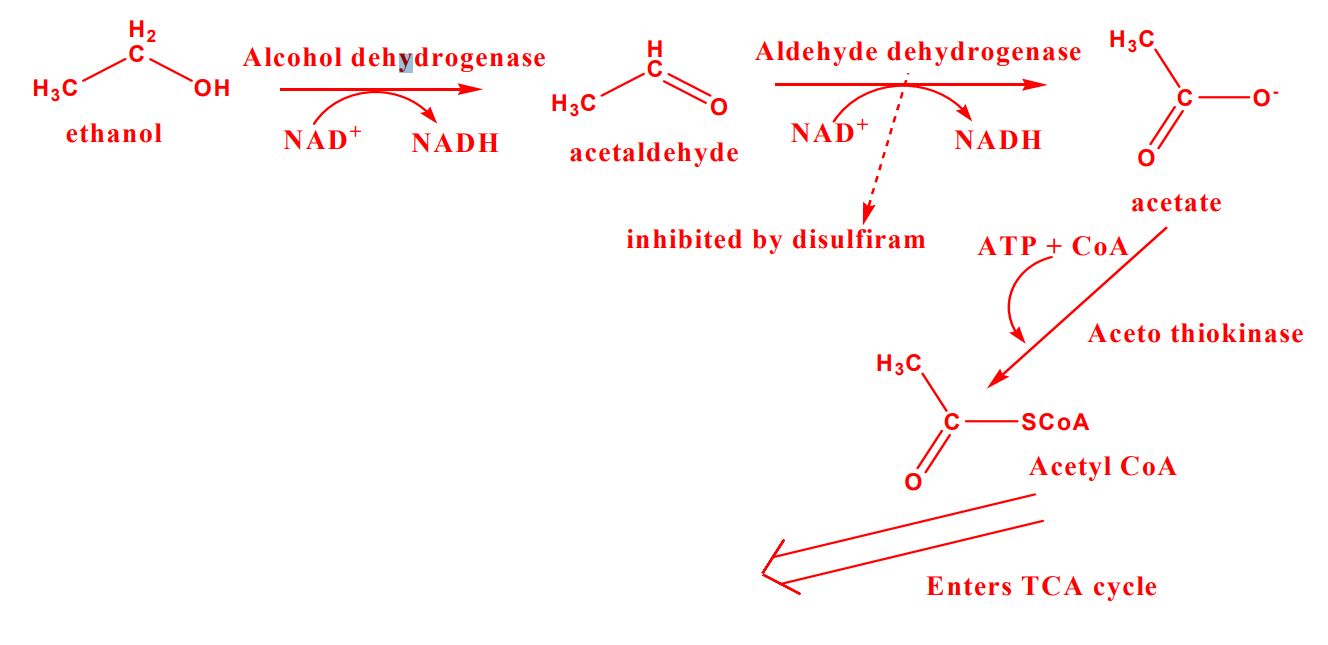
Schematic for Alcohol
Metabolism in
Liver
Metabolism in
Liver
46
activates insulin gene expression and secretion
Calcium activates insulin gene expression and secretion